

 Download PDF
Market Overview
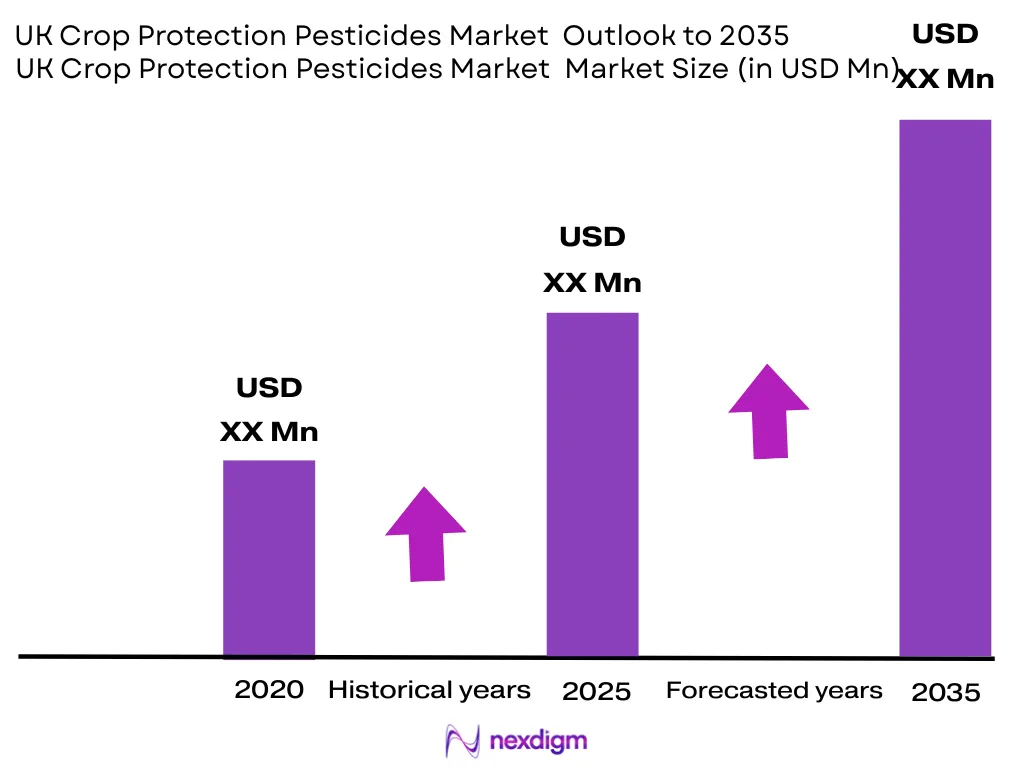
The UK Crop Protection Pesticides Market is valued at £ ~ million, based on official plant protection product expenditure, compared with £ ~ billion in the previous reporting cycle. The decline of £ ~ million was mainly linked to lower application volume on cereal farms after reduced winter wheat, winter barley and oilseed rape areas. The market is driven by cereal disease control, black-grass management, potato blight protection, sugar beet virus yellows risk and high-value horticulture residue compliance. The UK-specific crop protection chemicals forecast benchmark is 2.50% CAGR, while longer-horizon UK agrochemicals growth is benchmarked at 5.28% CAGR. England, East Anglia, Lincolnshire, Yorkshire, the East Midlands, Scotland’s arable belt and the Fens dominate the UK Crop Protection Pesticides Market because these regions concentrate wheat, barley, oilseed rape, potatoes, sugar beet and field vegetables. UK cereal production reached 19.4 million tonnes, while wheat output reached 11.1 million tonnes, barley output reached 7.1 million tonnes, oilseed rape output reached 824 thousand tonnes, sugar beet harvested production reached 7.8 million tonnes, and vegetable output reached 2.4 million tonnes. These crop bases require fungicides, herbicides, seed treatments, molluscicides and insecticides.
Market Segmentation
By Product Type
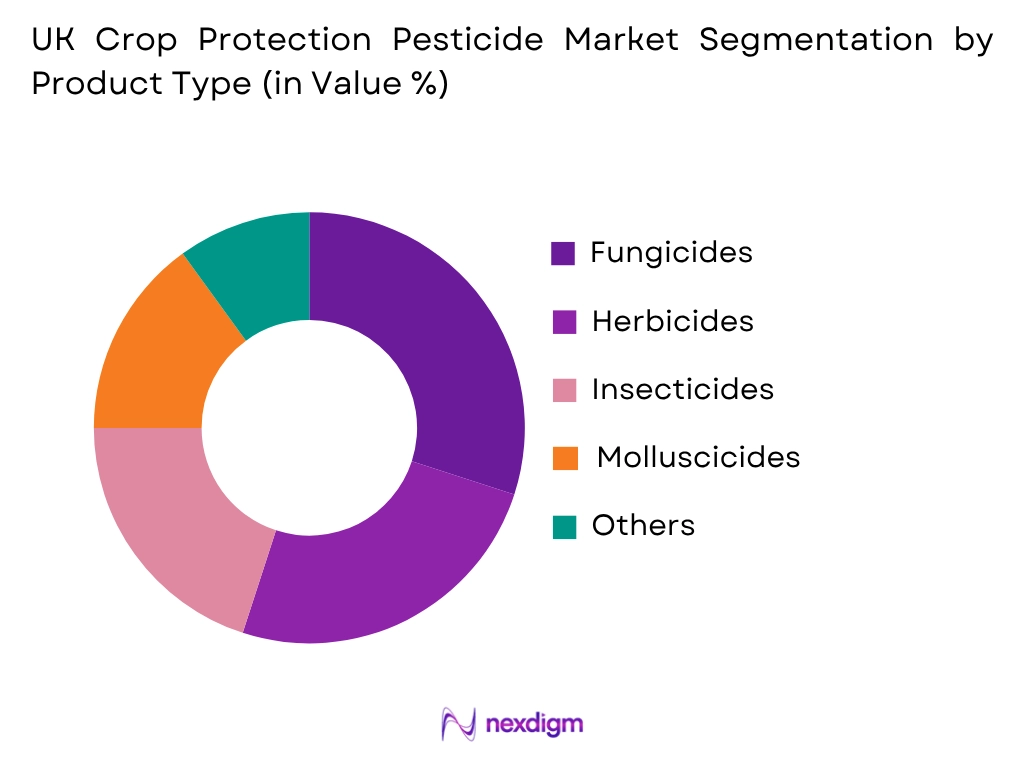
The UK Crop Protection Pesticides Market is segmented by product type into fungicides, herbicides, insecticides, molluscicides, nematicides and other crop protection products. Recently, fungicides have a dominant market share in the UK under the segmentation product type, due to the country’s high dependence on wheat, barley, potatoes and horticulture crops where disease pressure directly affects yield and crop quality. Septoria tritici, yellow rust, ramularia, fusarium, potato late blight and botrytis keep fungicide programmes central to arable and high-value crop protection. Official crop data shows wheat production at 11.1 million tonnes, barley production at 7.1 million tonnes, oilseed rape production at 824 thousand tonnes, and vegetable production at 2.4 million tonnes, making disease prevention commercially critical. Fungicides also dominate because wetter planting and growing conditions increase disease risk and force growers to protect crop establishment, grain fill and marketable quality.
By Crop Type
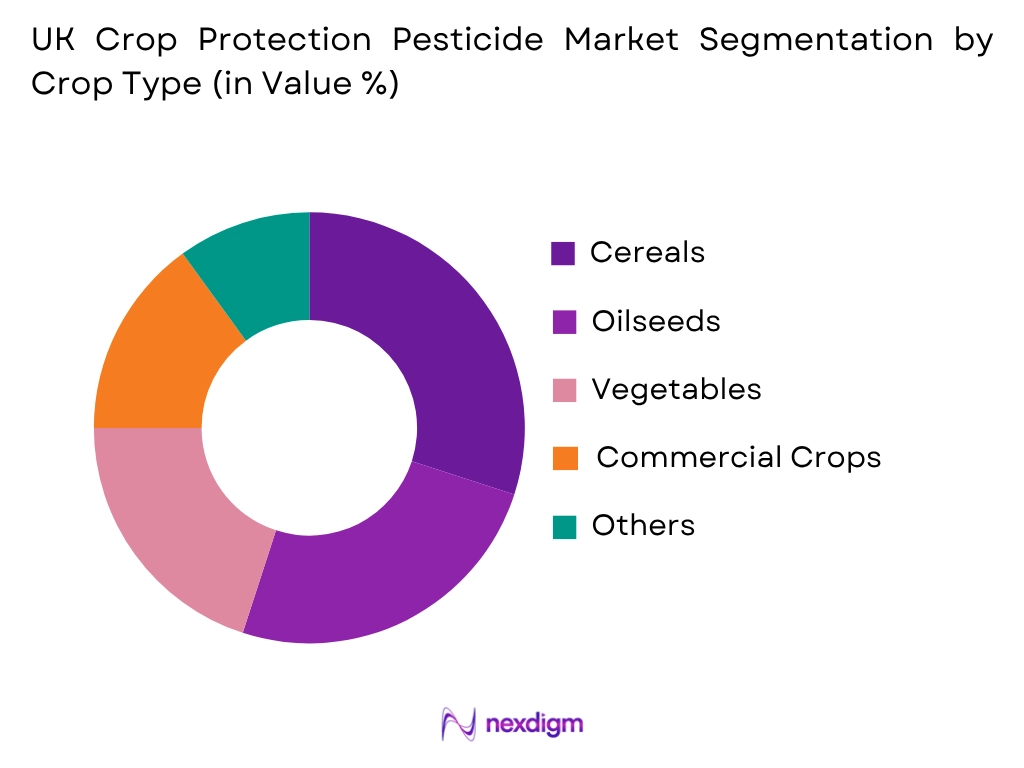
The UK Crop Protection Pesticides Market is segmented by crop type into grains and cereals, pulses and oilseeds, fruits and vegetables, commercial crops, and turf, ornamental and other crops. Recently, grains and cereals have a dominant market share in the UK under the segmentation crop type, due to their extensive planted area, recurring spray programmes and exposure to fungal diseases and resistant weeds. Wheat and barley are the core demand centres for fungicides, herbicides, seed treatments and plant growth regulators. Defra reported total cereal production of 19.4 million tonnes, with wheat at 11.1 million tonnes and barley at 7.1 million tonnes. Even when crop output declined after wet weather and lower planted area, cereals remained the backbone of pesticide expenditure because large arable farms still require residual herbicides, foliar fungicides, black-grass control, yellow rust management and lodging protection.
Competitive Landscape
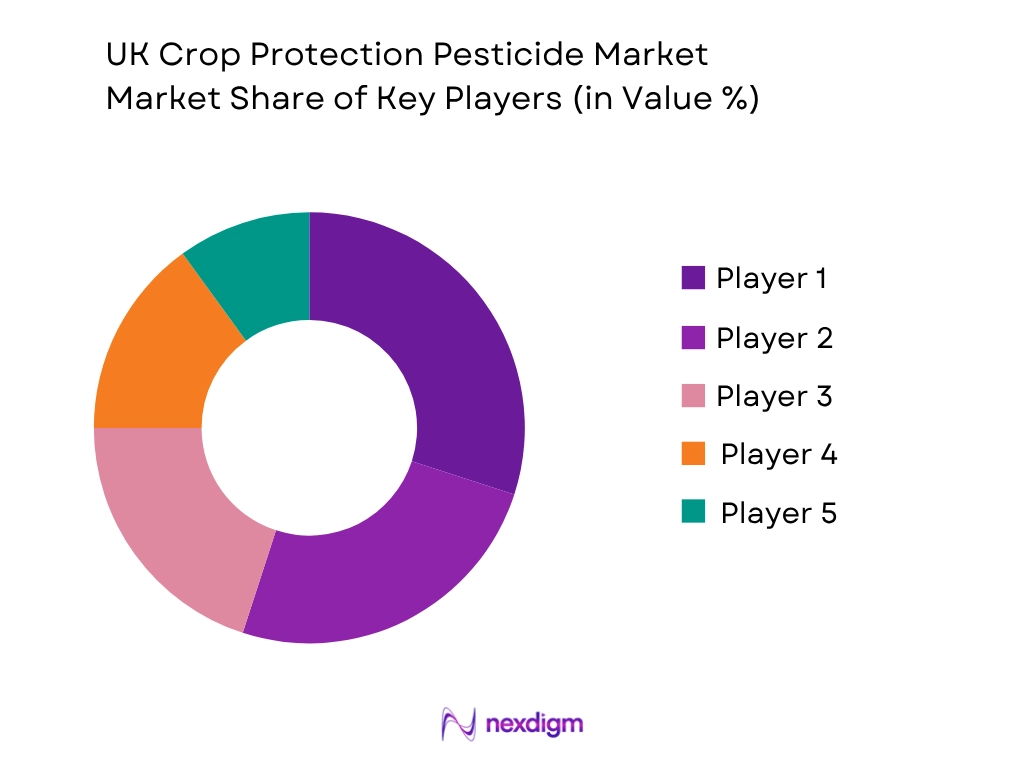
The UK Crop Protection Pesticides Market is moderately consolidated, led by multinational agrochemical manufacturers and supported by specialist distributors, biological crop protection suppliers and agronomy-led channels. Bayer CropScience, Syngenta, BASF, Corteva and FMC are among the most influential companies due to broad fungicide, herbicide, insecticide and seed treatment portfolios. Competition is shaped by product authorisations, active substance resilience, agronomist recommendations, distributor access, crop-specific efficacy, resistance-management positioning and stewardship support.
| Company | Establishment Year | Headquarters | Core Crop Protection Focus | UK Crop Strength | Key Product Categories | Route to Market | Regulatory/Stewardship Strength | Market-Specific Differentiator |
| Bayer CropScience UK | 1863 | Leverkusen, Germany | ~ | ~ | ~ | ~ | ~ | ~ |
| Syngenta UK | 2000 | Basel, Switzerland | ~ | ~ | ~ | ~ | ~ | ~ |
| BASF Agricultural Solutions UK | 1865 | Ludwigshafen, Germany | ~ | ~ | ~ | ~ | ~ | ~ |
| Corteva Agriscience UK | 2019 | Indianapolis, USA | ~ | ~ | ~ | ~ | ~ | ~ |
| FMC Agro UK | 1883 | Philadelphia, USA | ~ | ~ | ~ | ~ | ~ | ~ |
UK Crop Protection Pesticides Market Analysis
Growth Drivers
Large cereal and sugar beet crop base sustains core pesticide demand
The UK Crop Protection Pesticides Market is supported by a large arable base requiring fungicides, herbicides, seed treatments, molluscicides and plant growth regulators. Defra recorded wheat production of 11.1 million tonnes, barley production of 7.1 million tonnes, oilseed rape production of 824 thousand tonnes, and sugar beet production of 7.8 million tonnes in the latest crop year. This crop base is backed by a high-income macro environment, with World Bank reporting UK GDP at USD 3.69 trillion, GDP per capita at USD 53,246.4, and population at 69,226,000. These indicators support sustained domestic food production, large commercial farm input procurement and continued crop protection use across wheat, barley, oilseed rape and sugar beet.
Horticulture and potato output create recurring need for disease and residue-managed products
The UK Crop Protection Pesticides Market is driven by high-value crop categories where disease, pest and weed control directly affect marketable output. Defra recorded fresh vegetable production of 2.362 million tonnes, vegetable area of 97 thousand hectares, potato harvested production of 5.137 million tonnes, potato harvested area of 111 thousand hectares, and potato yield of 46 tonnes per hectare. These crops require potato blight fungicides, aphid control, herbicides, nematicides, desiccation alternatives and residue-managed horticulture programmes. Macro demand is reinforced by the UK’s 69,226,000 population and USD 3.69 trillion GDP base, supporting large retail food systems that require consistent domestic vegetables and potatoes.
Market Challenges
Weather volatility disrupts crop establishment and spray timing
The UK Crop Protection Pesticides Market faces operational pressure from weather volatility because wet fields reduce drilling windows, shorten spray opportunities and increase uneven crop establishment. Defra reported record-breaking rainfall between September and May, causing waterlogged fields, delayed sowing and poor establishment in oilseed rape. Wheat output stood at 11.1 million tonnes, while wheat area fell to 1,531 thousand hectares and yield reached 7.3 tonnes per hectare, indicating a weaker cropping base for standard pesticide programmes. The World Bank macro context remains large at USD 3.69 trillion GDP and USD 53,246.4 GDP per capita, but weather-related crop losses make pesticide demand less predictable for manufacturers, distributors and agronomists.
Regulation and pesticide-risk reduction increase product approval burden
The UK Crop Protection Pesticides Market is challenged by stricter regulatory and stewardship expectations. The UK Pesticides National Action Plan applies to all 4 UK governments and is structured around 3 objectives: integrated pest management uptake, pesticide-use reduction timetables and stronger compliance. HSE’s official arable pesticide report covers pesticide application to crops grown and harvested in the 2024 season, reflecting continuing government monitoring of professional pesticide use. The World Bank reports UK population at 69,226,000, GDP at USD 3.69 trillion, and GDP per capita at USD 53,246.4, creating a sophisticated food economy where residue limits, environmental protection and operator safety increasingly shape crop protection purchasing.
Market Opportunities
Biological and IPM-compatible pesticides can expand within organic and residue-sensitive systems
The UK Crop Protection Pesticides Market has an opportunity in biological pesticides, lower-risk products and IPM-compatible crop protection because organic and residue-sensitive production systems need approved pest, disease and weed-control options. Defra recorded 503 thousand hectares of organic land and 5,133 organic operators in the UK, with 50 thousand hectares of organic land used to grow cereals. The UK Pesticides National Action Plan also prioritises integrated pest management across 4 governments, supporting demand for microbial products, pheromones, biocontrols and low-residue formulations. A large macro base of 69,226,000 people and USD 3.69 trillion GDP supports premium food supply chains requiring safer and more traceable crop protection approaches.
Precision spraying and stewardship tools can address high treated-area intensity in arable crops
The UK Crop Protection Pesticides Market has an opportunity in precision spraying, digital agronomy and variable-rate application because arable crop protection remains highly application-intensive. The Scottish Government’s official arable pesticide statistics recorded 502,400 hectares of arable crops and an estimated 5,003,000 hectares of pesticide-treated formulation area, with combined pesticide weight of about 1,300 tonnes. It also recorded 5 active substances appearing for the first time in the arable survey, showing ongoing product and formulation change. With World Bank reporting UK GDP at USD 3.69 trillion and GDP per capita at USD 53,246.4, growers and distributors have a stronger base for adopting weed mapping, disease forecasting, drift reduction, spray records and decision-support tools.
Future Outlook
Over the forecast period, the UK Crop Protection Pesticides Market is expected to grow steadily, but not uniformly, as regulatory pressure, integrated pest management, active substance withdrawals and retailer residue protocols limit broad chemical expansion. Growth will be led by fungicide-resistance solutions, black-grass herbicide programmes, potato blight protection, sugar beet disease management, molluscicides, biological crop protection and precision spraying. The official market base remains tied to £969 million in plant protection product expenditure, while the UK-specific crop protection chemicals forecast benchmark is 2.50% CAGR through the available forecast window. Longer-horizon UK agrochemicals references indicate 5.28% CAGR to 2035, but crop protection demand will depend on active approvals, crop acreage, disease pressure and farmer profitability.
The most attractive opportunities will come from low-residue formulations, biological pesticides, seed treatment alternatives, digital pest monitoring, variable-rate application, and products that reduce resistance risk. The UK’s 503 thousand hectares of organic land and the government’s National Action Plan also increase the need for lower-risk crop protection, IPM-compatible products and precision-use technologies. At the same time, cereals and potatoes will continue to anchor chemical pesticide demand because disease and weed pressure remain structurally high.
Major Players
- Bayer CropScience UK
- Syngenta UK
- BASF Agricultural Solutions UK
- Corteva Agriscience UK
- FMC Agro UK
- ADAMA Agricultural Solutions UK
- UPL UK
- Nufarm UK
- Certis Belchim UK
- Sipcam UK
- Albaugh UK
- Gowan Crop Protection
- Sumitomo Chemical UK
- Nichino Europe
- De Sangosse UK
Key Target Audience
- Agrochemical manufacturers and formulation companies
- Crop protection distributors and agri-input retailers
- BASIS-qualified agronomy service providers
- Large arable farm enterprises and contract farming operators
- Potato, sugar beet and horticulture grower groups
- Seed treatment plants and crop input procurement teams
- Investments and venture capitalist firms
- Government and regulatory bodies — Department for Environment, Food & Rural Affairs, Health and Safety Executive, Chemicals Regulation Division, Food Standards Agency, Environment Agency, Scottish Government Agriculture and Rural Economy Directorate, Welsh Government Rural Affairs, DAERA Northern Ireland
Research Methodology
Step 1: Identification of Key Variables
The initial phase involves constructing an ecosystem map for the UK Crop Protection Pesticides Market, covering pesticide manufacturers, distributors, agronomists, farmers, buying groups, seed treatment plants, horticulture growers and regulatory bodies. Core variables include plant protection product expenditure, active substance usage, crop area, treated area, spray hectares, product type, crop type, application mode and regulatory status.
Step 2: Market Analysis and Construction
In this phase, historical and current data are compiled from Defra agricultural accounts, HSE pesticide usage surveys, crop output statistics, authorised plant protection product databases, company portfolios and distributor-level interviews. Market construction combines top-down official expenditure with bottom-up spray programme analysis by wheat, barley, oilseed rape, potatoes, sugar beet, vegetables and horticulture crops.
Step 3: Hypothesis Validation and Expert Consultation
Market hypotheses are validated through structured interviews with manufacturers, agronomists, distributors, large arable farmers, potato specialists, horticulture growers, seed treatment providers and regulatory professionals. These consultations refine assumptions on fungicide dominance, black-grass herbicide demand, foliar application intensity, biological adoption, active ingredient substitution and crop-specific purchasing behaviour.
Step 4: Research Synthesis and Final Output
The final phase triangulates official statistics, regulatory records, product authorisation data, company benchmarking and expert validation. The output provides a structured view of the UK Crop Protection Pesticides Market, including market size, segmentation, competitive landscape, future outlook, key target audience and strategic implications for manufacturers, distributors, investors and agricultural buyers.

- Executive Summary
- Research Methodology (Market definitions and assumptions, abbreviations, pesticide product classification, plant protection product inclusion criteria, active ingredient mapping, treated area analysis, spray hectare methodology, application-rate benchmarking, channel-level triangulation, distributor margin validation, farmer purchase behaviour, agronomist recommendation mapping, primary research framework, limitations and future conclusions)

- Definition and Scope
- Market Genesis and Evolution
- Timeline of Regulatory and Active Substance Changes
- Crop Protection Business Cycle
- Supply Chain and Value Chain Analysis

- Growth Drivers (Cereal disease pressure, black-grass resistance, potato blight risk, food security focus, high-value crop protection, precision agriculture, agronomy advisory networks, resilient farm output demand)
- Market Challenges (Active ingredient withdrawals, tighter environmental regulation, pollinator restrictions, watercourse protection, resistance evolution, farmer margin pressure, weather windows, biological efficacy variability, public perception of pesticides)
- Opportunities (Biopesticides, IPM-compatible chemistry, precision spraying, drift-reduction technology, resistance-management products, seed treatment innovation, horticulture minor-use solutions, digital agronomy, low-residue formulations)
- Market Trends (IPM adoption, glyphosate stewardship, biological integration, low-drift application, crop monitoring tools, digital prescriptions, MRL-led crop protection, pollinator-sensitive formulations, residue minimisation)
- SWOT Analysis
- PESTLE Analysis
- Porter’s Five Forces

- By Value (2020-2025)
- By Volume (2020-2025)
- By Active Ingredient Volume (2020-2025)
- By Treated Area (2020-2025)

- By Product Type (In Value %)
Fungicides
Herbicides
Insecticides
Molluscicides
Seed Treatments - By Crop Type (In Value %)
Wheat
Barley
Oilseed Rape
Potatoes
Sugar Beet - By Distribution Channel (In Value %)
Agrochemical Distributors
Agronomy-Led Channels
Farmer Buying Groups
Co-operatives and Independent Retailers
Digital Agri-Input Platforms - By Region (In Value %)
England
Scotland
Wales
Northern Ireland
East Anglia and Eastern Counties

- Market Share of Major Players on the Basis of Value and Volume (Product sales value, active ingredient volume, treated area coverage, product registrations, crop coverage, distributor penetration, agronomist recommendation share)
- Cross Comparison Parameters (Product registration breadth, active substance portfolio, crop coverage, resistance-management strength, UK distributor network, biological/IPM portfolio, formulation and tank-mix capability, stewardship and regulatory support)
- SWOT Analysis of Major Players
- Pricing Analysis by Crop Protection SKU
- Detailed Profiles of Major Companies
Bayer CropScience UK
Syngenta UK
BASF Agricultural Solutions UK
Corteva Agriscience UK
FMC Agro UK
ADAMA Agricultural Solutions UK
UPL UK
Nufarm UK
Certis Belchim UK
Sipcam UK
Albaugh UK
Gowan Crop Protection
Sumitomo Chemical UK
Nichino Europe
De Sangosse UK

- Arable Farmer Demand and Utilization
- Potato Grower Demand and Utilization
- Horticulture and Protected Crop Grower Demand
- Sugar Beet and Specialist Crop Demand
- Distributor and Agronomist Decision-Making

- By Value (2026-2035)
- By Volume (2026-2035)
- By Active Ingredient Volume (2026-2035)


 Request a Sample
 Ask for Customization
 Get a Quote
 Enquire Now