
 Download PDF
Market Overview
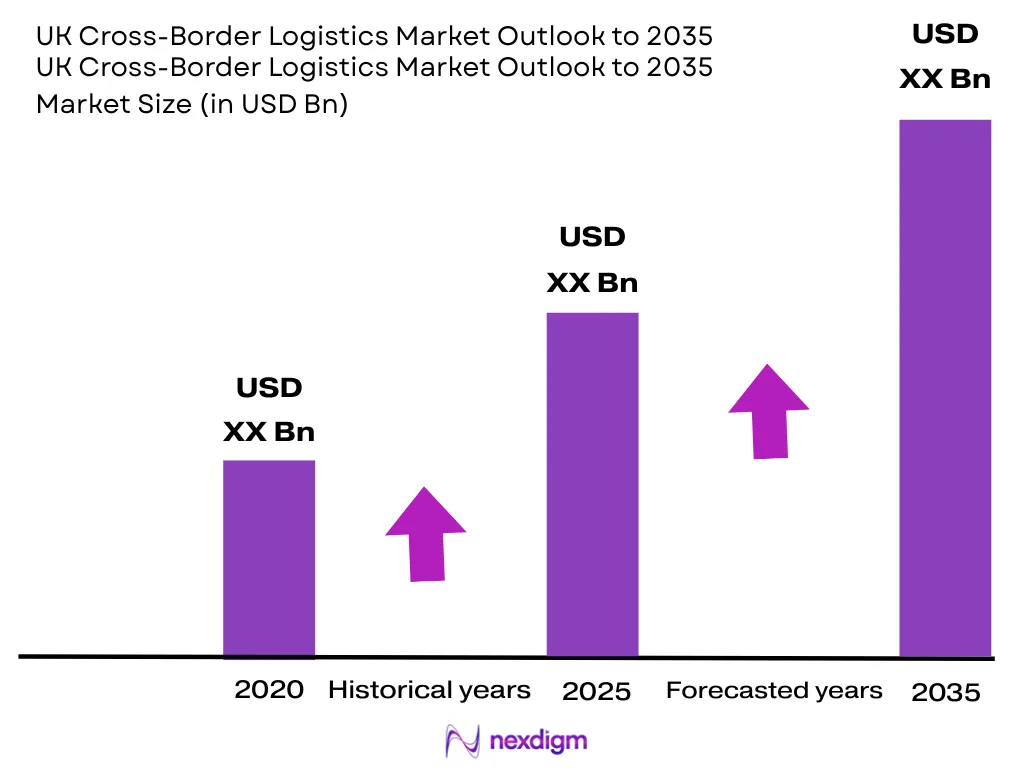
The UK Cross-Border Logistics Market was valued at USD ~ Billion in 2024 and is anticipated to expand at a CAGR of ~% during 2026–2035. The market is primarily driven by rapid growth in cross-border e-commerce, ongoing digital transformation of customs processes, and the UK’s continued repositioning of trade relationships following Brexit. The broader UK Logistics Market is projected to reach USD 927.9 billion by 2034, advancing at a CAGR of 5.3%, according to IMARC Group, while the UK E-Commerce Logistics Market alone is estimated at USD 21.98 billion in 2026, growing to USD 29.22 billion by 2031 at a CAGR of 5.87%, with cross-border outbound logistics recording an 8.1% CAGR as UK sellers increasingly target the EU’s online non-food market. The New Computerised Transit System Phase 5 went live in January 2025, allowing Movement Reference Numbers to replace paper documentation, while ports including Felixstowe and Southampton report 25-30% shorter dwell times for digitally processed consignments. Despite this digital progress, UK exports to the EU fell 23% between 2017 and 2024, from 106.4 million tonnes to 82.4 million tonnes, according to Logistics UK, while imports declined by just 5% over the same period, reflecting the lasting structural impact of post-Brexit customs checks and regulatory divergence across bakery, dairy, retail, automotive, and pharmaceutical cross-border applications.
Market Segmentation
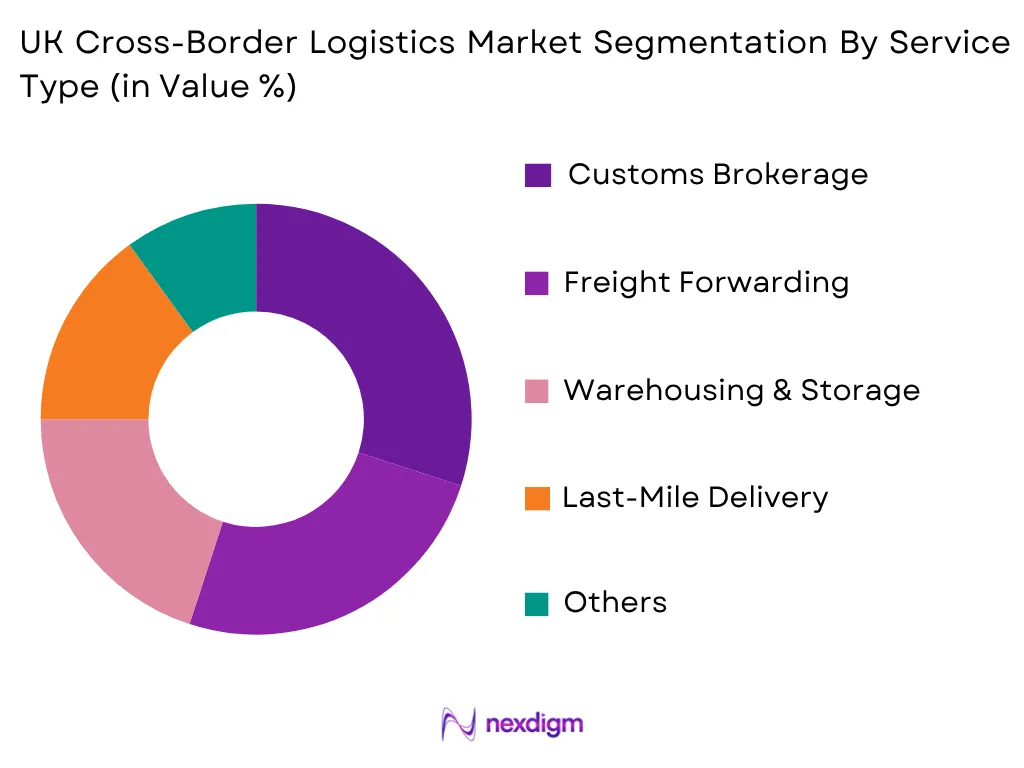
By Service Type
Among these, Customs Brokerage and Freight Forwarding hold a significant and growing share of the UK Cross-Border Logistics Market, as complex post-Brexit documentation and the staggered Border Target Operating Model have spurred venture funding for artificial-intelligence brokerage software. HappyRobot’s USD 15.6 million Series A funding round illustrates investor confidence in automated data capture, tariff classification, and predictive clearance technology, with ports such as Felixstowe and Southampton reporting 25-30% shorter dwell times for digitally processed consignments, giving technology-enabled forwarders a competitive edge. This faster border passage increases asset turns and reinforces the multimodal agility that distinguishes the UK cross-border logistics market from continental peers. Warehousing & Storage continues to see robust demand, with non-temperature controlled facilities capturing 92.10% of revenue share in 2025, serving discretionary goods and replenishment stock destined for cross-border distribution.
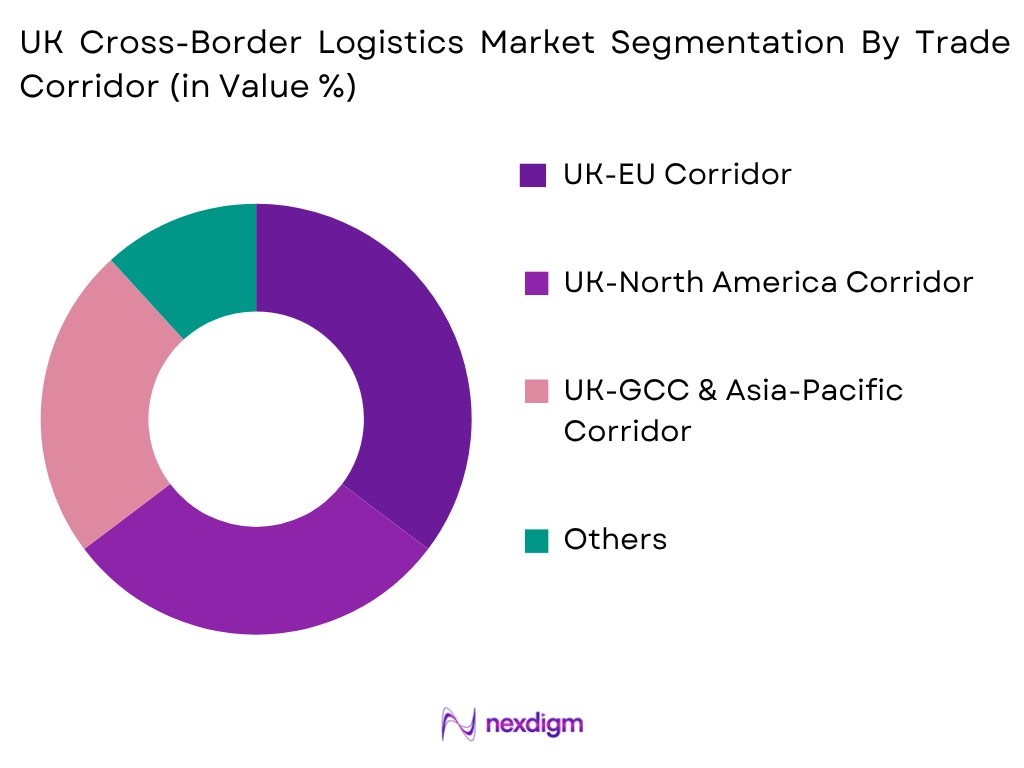
By Trade Corridor
The UK-EU Corridor remains the largest trade corridor by volume within the UK Cross-Border Logistics Market, despite structural headwinds, as Dutch hauliers continue to lose more than four hours at customs on average, triggering the development of new EU-to-UK fulfilment hubs specifically designed to cut transit friction. UK exports to the EU fell 23% between 2017 and 2024, reflecting the reintroduction of customs checks and additional paperwork that transformed what was once frictionless single-market trade into a process marked by documentation, inspections, and regulatory divergence. The UK-GCC and Asia-Pacific Corridor represents the fastest-growing trade corridor, as export logistics to GCC and Southeast Asian markets grows rapidly following post-Brexit trade agreements, creating investment opportunities in UK-based export freight forwarding and specialist customs brokerage capabilities serving these emerging long-haul trade relationships.
Competitive Landscape
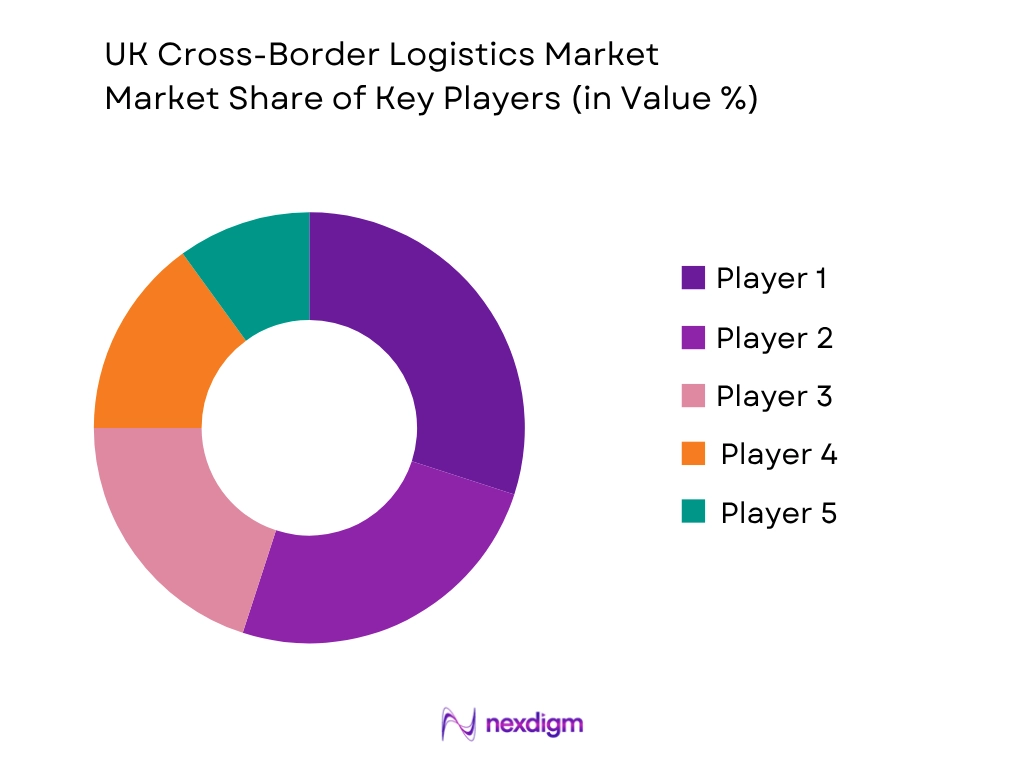
The UK Cross-Border Logistics Market is moderately consolidated, with major global logistics conglomerates competing alongside British logistics providers serving grocery, retail, manufacturing, e-commerce, and healthcare customers. Competition is primarily based on customs brokerage expertise, network capacity, digital tariff classification capability, and the ability to navigate the UK’s evolving post-Brexit trade documentation requirements. DHL Group, GXO Logistics (including Wincanton plc), DSV A/S (including DB Schenker), Kuehne+Nagel, and La Poste Group (including DPD Group and CitySprint UK Ltd.) are recognized as the major companies operating in the UK freight and logistics market. GXO Logistics completed its acquisition of Wincanton, a British logistics provider based in Chippenham specializing in warehousing and transportation solutions across the UK and Ireland, for approximately GBP 762 million (USD 958 million) in April 2024, a transaction referred for an in-depth Phase 2 investigation by the UK Competition and Markets Authority in November 2024. The recently announced DHL-Evri merger in May 2025 adds unprecedented parcel scale to the UK market, while continued consolidation activity, including GXO’s earlier acquisition of Clipper Logistics, reflects the sector’s ongoing restructuring around scale, digital capability, and cross-border expertise.
| Company | Established | Headquarters | Primary Service | Cross-Border Network | Customs Brokerage | Digital Visibility Platform | Sustainability capability | Certifications & Complainces |
| Wincanton (GXO Logistics) | 1925 | ~ | ~ | ~ | ~ | ~ | ~ | ~ |
| DHL Group | 1969 | ~ | ~ | ~ | ~ | ~ | ~ | ~ |
| Kuehne+Nagel | 1890 | ~ | ~ | ~ | ~ | ~ | ~ | ~ |
| DSV A/S | 1976 | ~ | ~ | ~ | ~ | ~ | ~ | ~ |
| DPD Group (GeoPost) | 1999 | ~ | ~ | ~ | ~ | ~ | ~ | ~ |
UK Cross-Border Logistics Market Analysis
Growth Drivers
E-Commerce Cross-Border Outbound Growth to EU and Global Markets
The UK Cross-Border Logistics Market is experiencing sustained growth due to rapid expansion in cross-border e-commerce, with cross-border outbound logistics recording an 8.1% CAGR as UK sellers increasingly target the EU’s online non-food market. International deliveries are on track for a 3.27% CAGR during 2026-2031 as small and medium-sized enterprises leverage digital customs portals to reach European and transatlantic buyers, with cross-border e-commerce platforms increasingly integrating duty-paid options at checkout to lift conversion rates and parcel volumes through gateways including Heathrow and East Midlands. This growing cross-border e-commerce activity continues to drive demand for specialist freight forwarding, customs brokerage, and last-mile delivery capabilities capable of navigating the UK’s post-Brexit trade documentation requirements while maintaining competitive transit times for online retailers.
Digital Customs Automation Reducing Border Friction
Continued investment in digital customs automation remains a significant driver of the UK Cross-Border Logistics Market. The New Computerised Transit System Phase 5 went live in January 2025, allowing Movement Reference Numbers to replace paper-based transit documentation, while ports including Felixstowe and Southampton report 25-30% shorter dwell times for digitally processed consignments. Complex post-Brexit documentation and the staggered Border Target Operating Model have spurred venture funding for artificial-intelligence brokerage software, exemplified by HappyRobot’s USD 15.6 million Series A funding round for automated data capture, tariff classification, and predictive clearance technology. The UK government’s 2024 commitment of GBP 600 million to accelerate the development of logistics and industrial sites, alongside the establishment of a national Supply Chain Centre spanning autonomous delivery vehicles and sustainability tracking platforms, further reinforces sustained investment in digital customs and logistics infrastructure.
Market Challenges
HGV Driver Shortage and Wage Inflation
The UK Cross-Border Logistics Market faces significant challenges from a persistent HGV driver shortage, with the UK road haulage industry facing a shortage of approximately 60,000 HGV drivers in 2024, creating operational constraints, higher freight rates, and delivery delays that disproportionately affect time-sensitive cross-border sectors. Carrier payrolls now compete directly with construction and utilities for scarce vocational drivers, with advertised pay rising 21% since 2024, eroding the cost competitiveness of long-haul lanes. Cross-border specialists feel this pinch most acutely because customs paperwork requires experienced operators, and while driver academies funded by large third-party logistics providers signal a long-term solution, near-term capacity still relies heavily on overtime and agency labor, depressing on-time performance metrics across the UK cross-border logistics sector.
Post-Brexit Customs Complexity and Trade Volume Decline
Post-Brexit customs checks and regulatory divergence continue to add complexity and cost to UK-EU freight flows, increasing border dwell times and compliance costs for manufacturers dependent on just-in-time supply chains. According to Logistics UK, UK exports to the EU fell 23% between 2017 and 2024, from 106.4 million tonnes to 82.4 million tonnes, while imports declined by just 5% over the same period, reflecting the lasting structural impact of reintroduced customs checks and additional paperwork. Dutch hauliers continue to lose more than four hours at customs on average, and Phil Roe, President of Logistics UK, has stressed the urgent need for smoother border operations, calling for swift implementation of revisions to border checks agreed as part of the UK-EU reset summit to prevent continuing frictions that make UK goods less competitive in European markets.
Market Opportunities
AI-Powered Customs Brokerage and Predictive Clearance
Growing investment in AI-powered customs brokerage software presents substantial opportunities within the UK Cross-Border Logistics Market. HappyRobot’s USD 15.6 million Series A funding round illustrates investor confidence in automated data capture, tariff classification, and predictive clearance technology, with ports such as Felixstowe and Southampton already reporting 25-30% shorter dwell times for digitally processed consignments. As the Border Target Operating Model continues to be staggered into full implementation, technology-enabled forwarders capable of offering AI-driven customs automation are well positioned to capture market share from traditional, paper-intensive competitors, particularly as faster border passage increases asset turns and reinforces the multimodal agility increasingly demanded by cross-border e-commerce and manufacturing customers.
GCC and Southeast Asia Export Trade Growth
Export logistics to GCC and Southeast Asian markets is growing rapidly following post-Brexit trade agreements, creating substantial investment opportunities in UK-based export freight forwarding and specialist customs brokerage capabilities. As the UK continues to diversify its trade relationships beyond the EU, logistics providers capable of developing specialized expertise in these emerging long-haul corridors are well positioned to capture growing demand from UK exporters seeking to reach new international markets. This diversification trend, combined with continued UK government investment in logistics and industrial infrastructure, including a 2024 commitment of GBP 600 million and a new national Supply Chain Centre, creates long-term opportunities for cross-border logistics providers to expand service capabilities beyond traditional UK-EU trade lanes.
Future Outlook
The UK Cross-Border Logistics Market is expected to witness sustained expansion over the forecast period, supported by continued cross-border e-commerce growth, ongoing digital customs automation investment, and growing trade diversification toward GCC and Southeast Asian markets. Continued resolution of HGV driver shortage challenges through driver academies and workforce development, alongside growing adoption of AI-powered customs brokerage technology, is expected to strengthen the market’s operational efficiency. The market is also likely to benefit from continued consolidation activity among major logistics providers and growing government infrastructure investment, supporting long-term growth across retail, e-commerce, manufacturing, automotive, and pharmaceutical cross-border logistics applications.
Major Players
- Wincanton (GXO Logistics)
- DHL Group
- Kuehne+Nagel
- DSV A/S
- DPD Group (GeoPost)
- DB Schenker (DSV A/S)
- Evri (DHL Group)
- CitySprint (UK) Ltd. (GeoPost)
- Clipper Logistics (GXO Logistics)
- Europa Worldwide Group
- Uniserve Group
- XPO Logistics Inc.
- FedEx Corporation
- United Parcel Service (UPS)
- Maersk Group
Key Target Audience
- Cross-Border Logistics and Freight Forwarding Companies
- Retail and E-Commerce Companies
- Manufacturing and Automotive Companies
- Healthcare and Pharmaceutical Companies
- Customs Brokerage and Compliance Technology Providers
- Port Authorities and Terminal Operators
- Investment and Venture Capitalist Firms
- Government and Regulatory Bodies (HM Revenue & Customs (HMRC), Department for Transport, Competition and Markets Authority (CMA))
- Technology Providers and System Integrators
Research Methodology
Step 1: Identification of Key Variables
The research process begins with identifying the complete ecosystem of the UK Cross-Border Logistics Market, including freight forwarders, customs brokers, warehousing providers, retail and manufacturing companies, and regulatory authorities. Extensive secondary research is conducted using company annual reports, government publications, trade associations, customs statistics, industry journals, and proprietary databases to determine the variables influencing market demand, pricing, shipment volumes, and technological developments.
Step 2: Market Analysis and Construction
Historical market information is collected and analyzed to estimate market size, shipment volumes, import-export activity, application-wise demand, and pricing trends. A combination of top-down and bottom-up approaches is used to estimate market revenues and validate segment-level performance. Consumption patterns across retail, manufacturing, automotive, and healthcare are evaluated to establish an accurate representation of the industry.
Step 3: Hypothesis Validation and Expert Consultation
The preliminary findings are validated through Computer-Assisted Telephone Interviews (CATIs) and structured discussions with logistics providers, procurement managers, customs brokers, regulatory experts, and senior executives operating within the UK logistics industry. These interviews help verify market assumptions, competitive developments, technology adoption trends, pricing dynamics, and future investment opportunities while refining the overall market estimates.
Step 4: Research Synthesis and Final Output
The final stage integrates insights obtained from primary interviews with quantitative information collected through secondary sources. Data triangulation techniques are applied to reconcile differences between supply-side and demand-side estimates, ensuring robust market forecasting. The report is then reviewed through multiple quality assurance checkpoints to deliver a comprehensive analysis covering market size, segmentation, competitive landscape, future outlook, and strategic recommendations for industry stakeholders.

- Executive Summary
- Research Methodology (Market Definitions and Assumptions, Abbreviations, Market Sizing Approach, Top-Down Analysis, Bottom-Up Analysis, Demand-Side Assessment, Supply-Side Assessment, Primary Industry Interviews, Trade Flow Assessment, Freight Intelligence Analysis, Data Triangulation, Forecasting Framework, Limitations and Future Conclusions)

- Definition and Scope
- Market Evolution and Industry Genesis
- Timeline of Major Industry Developments
- Cross-Border Trade Value Chain Analysis
- Cross-Border Logistics Supply Chain Analysis (Shippers, Freight Forwarders, Customs Brokers, Carriers, Warehousing, Border Inspection Agencies, Last-Mile Operators, Technology Providers)
- Trade Corridor Ecosystem Analysis

- Growth Drivers (E-Commerce Cross-Border Outbound Growth to EU and Global Markets, Digital Customs Automation Reducing Border Friction, GCC and Southeast Asia Export Trade Growth, Government Infrastructure Investment, Growth in Specialist Customs Brokerage, Nearshoring and Supply Chain Diversification)
- Market Challenges (HGV Driver Shortage and Wage Inflation, Post-Brexit Customs Complexity and Trade Volume Decline, Fuel Cost Volatility, Congested Urban Road Networks, Regulatory Compliance Complexity)
- Market Opportunities (AI-Powered Customs Brokerage and Predictive Clearance, Fleet Electrification and Green Logistics Transition, EU-to-UK Fulfilment Hub Development, Autonomous and Semi-Autonomous Transport Solutions, Driver Academy and Workforce Development Investment)
- Market Trends (Growth of AI-Enabled Tariff Classification, Digital Customs Portal Adoption, Hub-and-Spoke Network Densification, Electric and Hydrogen Freight Vehicle Adoption, Consolidation Through Mergers and Acquisitions)
- Government Regulations (HMRC Post-Brexit Customs Declarations, Border Target Operating Model, New Computerised Transit System (NCTS) Phase 5, Traffic Commissioner HGV Operator Licensing, Road to Zero Strategy and Clean Air Zone Frameworks)
- Import and Export Analysis (Trade Volume, Major Import Sources, Export Destinations, HS Code Analysis, Trade Balance)
- Infrastructure Availability Analysis (Ports (Felixstowe & Southampton), Warehousing Capacity, Rail Freight Terminals, Customs Clearance Facilities, Fleet and Vehicle Availability)
- Technology Landscape (AI-Powered Customs Brokerage Software, Digital Customs Portals, Automated Storage and Retrieval Systems, Route Optimization Software, Electric and Hydrogen Freight Vehicles)
- Sustainability Assessment (Fleet Electrification, Road to Zero Strategy Compliance, Clean Air Zone Adaptation, Carbon Footprint Reduction, Alternative Energy Adoption)
- PESTLE Analysis
- SWOT Analysis
- Porter’s Five Forces Analysis
- Stakeholder Ecosystem
- Competition Ecosystem

- By Market Value (2020-2025)
- By Freight Volume (2020-2025)
- By Average Logistics Cost per Shipment (2020-2025)

- By Mode of Transport (In Value %)
Road Freight
Sea Freight
Air Freight
Rail Freight - By Service Type (In Value %)
Customs Brokerage
Freight Forwarding
Warehousing & Storage
Last-Mile Delivery - By End User (In Value %)
Retail & E-Commerce
Manufacturing
Automotive
Healthcare & Pharmaceuticals
Food & Beverage - By Trade Corridor (In Value %)
UK-EU Corridor
UK-North America Corridor
UK-GCC & Asia-Pacific Corridor

- Market Share of Major Players (By Value, Volume, Mode of Transport, Service Type, Trade Corridor)
- Cross Comparison Parameters (Service Portfolio Breadth, Customs Brokerage Capability, Application Technical Support Capability, Network Capacity, Regulatory Compliance & Certifications, E-Commerce Customer Base, Innovation & New Service Launch Frequency)
- SWOT Analysis of Major Players
- Pricing Analysis by Service Category and Trade Lane
- Network Capacity Analysis
- Warehousing and Distribution Footprint Analysis
- Distribution Network Analysis
- Innovation Benchmarking
- Detailed Profiles of Major Companies
Wincanton (GXO Logistics)
DHL Group
Kuehne+Nagel
DSV A/S
DPD Group (GeoPost)
DB Schenker (DSV A/S)
Evri (DHL Group)
CitySprint (UK) Ltd. (GeoPost)
Clipper Logistics (GXO Logistics)
Europa Worldwide Group
Uniserve Group
XPO Logistics Inc.
FedEx Corporation
United Parcel Service (UPS)
Maersk Group

- Consumption Pattern Analysis (Shipment Volume, Order Size, Product Category Penetration, Seasonal Demand, Reformulation Activity)
- Purchasing Criteria (Transit Time Reliability, Regulatory Compliance, Cost Efficiency, Customs Expertise, Real-Time Tracking, Supply Reliability)
- Procurement and Supplier Selection Analysis
- Sustainable Logistics Adoption Assessment
- Premium vs Conventional Service Demand
- Product Attribute Preference Analysis (Transit Speed, Documentation Accuracy, Real-Time Visibility, Customs Compliance, Cost Efficiency, Damage-Free Delivery)
- Consumer and Business Trade Transparency Influence on Service Development
- Pain Point Analysis
- Decision-Making Process

- By Market Value (2026-2035)
- By Freight Volume (2026-2035)
- By Average Logistics Cost per Shipment (2026-2035)


 Request a Sample
 Ask for Customization
 Get a Quote
 Enquire Now