

 Download PDF
Market Overview
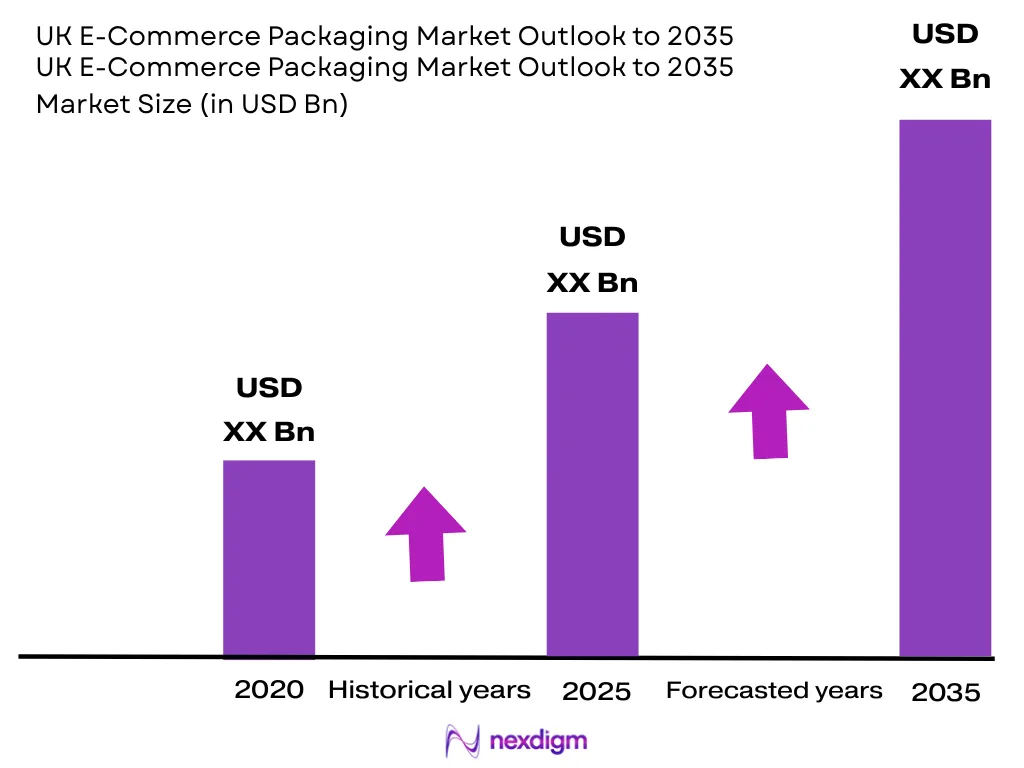
The UK E-Commerce Packaging Market was valued at USD ~ Billion in 2024 and is anticipated to expand at a CAGR of ~% during 2026–2035. The market is primarily driven by the UK’s position as one of the highest e-commerce adoption rates in Europe, with online retail accounting for approximately 27.8% of total UK retail sales, alongside an accelerating regulatory and retailer-driven shift toward recyclable, plastic-free parcel packaging. UK corrugated packaging consumption grew 12.6% between 2010 and 2024, with e-commerce identified as one of the fastest-growing end-use segments at a 4.73% CAGR, while corrugated boxes captured the largest share of the broader e-commerce packaging market at 37.22% of revenue in 2025 given their strength, durability, and protective performance across diverse product categories. Amazon’s elimination of more than 1 billion single-use plastic mailers since 2018, culminating in the conversion of its European operations to 100% recyclable paper pouches and board envelopes in January 2025, illustrates the scale of transformation underway across the UK’s e-commerce packaging supply chain as major retailers respond to both regulatory pressure and shifting consumer expectations.
Market Segmentation
By Material
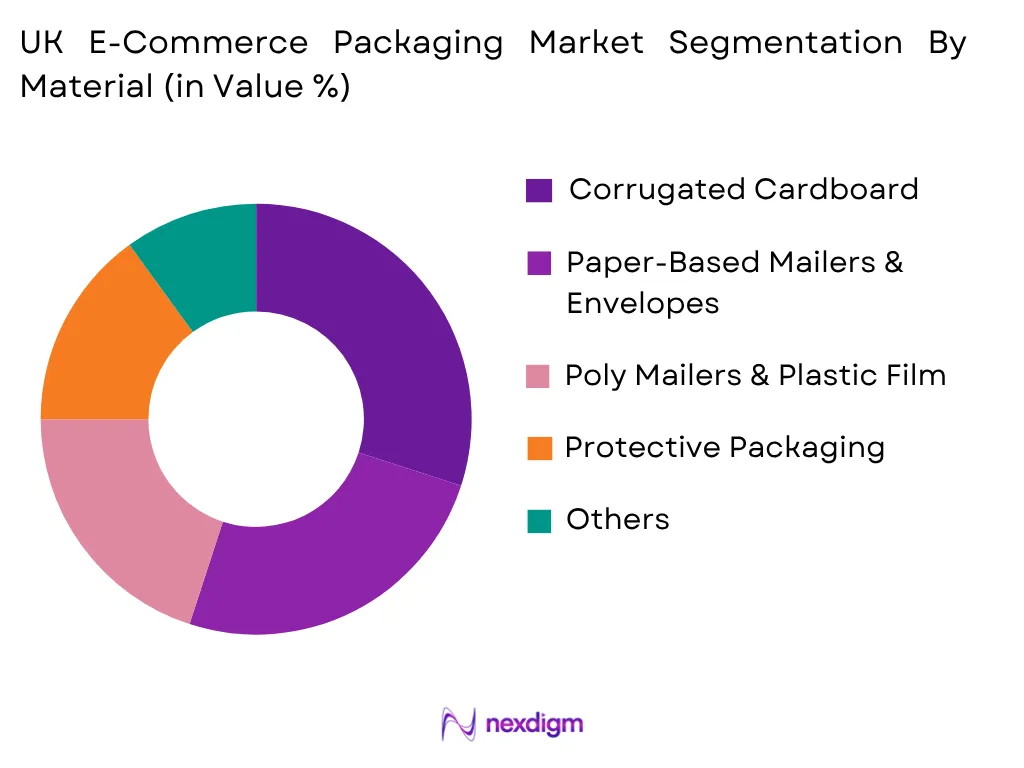
Corrugated Cardboard represents the largest material category in the UK E-Commerce Packaging Market, valued for its strength, durability, and ability to protect items during transit through layers of fluted paper that cushion against shocks and vibrations, while remaining highly customizable across shapes and sizes suited to products ranging from electronics to clothing. Paper-Based Mailers & Envelopes represent the fastest-evolving category, propelled directly by major retailer commitments such as Amazon’s shift to 100% recyclable paper pouches and board envelopes across its European operations, alongside similar paper-based mailer launches from packaging majors including Mondi Group. Poly Mailers & Plastic Film retain a meaningful share for lightweight, non-fragile items such as apparel and accessories, where their light weight and flexibility help retailers manage dimensional weight shipping costs, even as sustained regulatory and consumer pressure continues to push volume toward recyclable paper-based alternatives. Protective Packaging, including bubble wrap and air pillows, remains essential for electronics and fragile goods, an application area in which global player Sealed Air Corporation maintains a particularly strong UK market presence.
By End-Use Industry
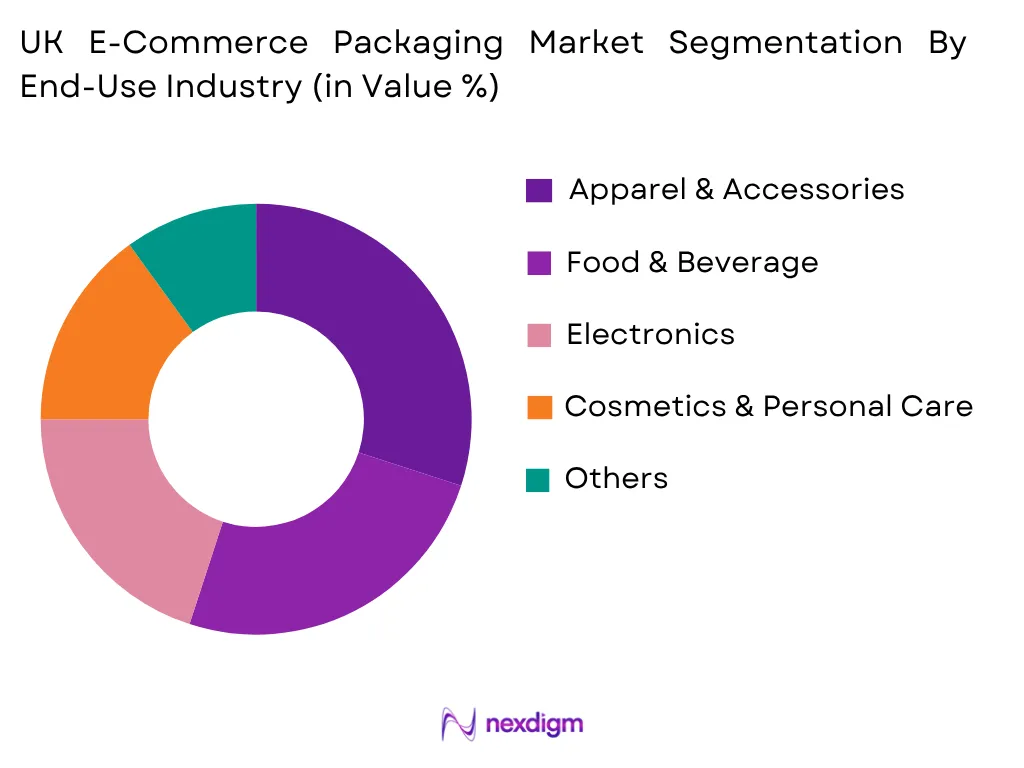
Apparel & Accessories represents the fastest-growing end-use segment within the UK E-Commerce Packaging Market, with the broader global e-commerce packaging industry projecting this category to expand at the highest CAGR of any end-use segment at approximately 7.90%, reflecting the UK’s mature and rapidly expanding online fashion retail sector. Food & Beverage remains a substantial end-use category, having accounted for 35.63% of the broader UK corrugated packaging market in 2025, supported by continued growth in online grocery and specialty food delivery. Electronics and Cosmetics & Personal Care round out the market’s major end-use categories, each requiring differentiated packaging solutions balancing protective performance, brand presentation, and increasingly stringent sustainability requirements as UK retailers across all categories respond to consumer demand for recyclable and plastic-free delivery packaging.
Competitive Landscape
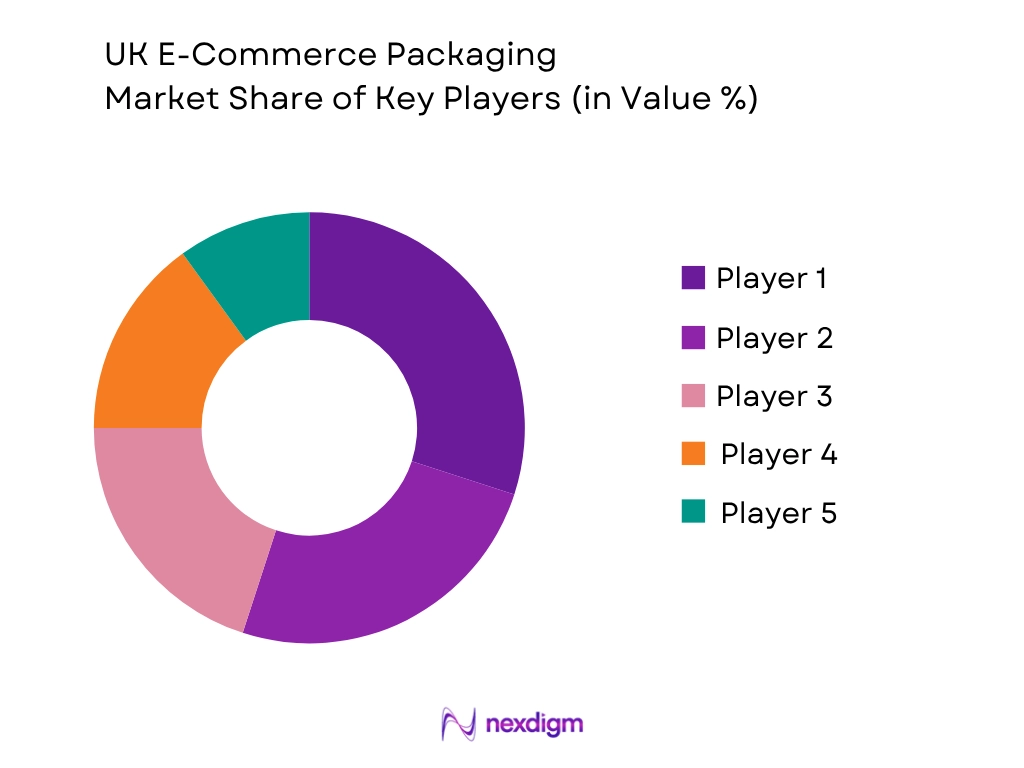
The UK E-Commerce Packaging Market is shaped by large, publicly listed corrugated and fiber-based packaging majors with substantial UK manufacturing footprints, alongside a base of specialized e-commerce packaging converters and global protective packaging suppliers. DS Smith plc, one of the UK’s largest corrugated packaging companies, and Mondi Group, a dual-listed London and Johannesburg packaging major, have both introduced dedicated sustainable e-commerce packaging solutions, including subscription box designs and paper-based mailers tailored for fashion and retail online sellers. Smurfit Kappa, now part of Smurfit WestRock following its 2024 merger, maintains substantial UK corrugated manufacturing capacity and has launched sustainable corrugated e-commerce packaging solutions specifically for UK retailers. UK-based specialist converters such as Reedbut Group, which launched a new range of cardboard mailers, mail-wraps, and cardboard inserts in March 2024, illustrate the continued innovation occurring among smaller domestic packaging manufacturers responding directly to UK e-commerce sellers’ needs. Global protective packaging leader Sealed Air Corporation, meanwhile, has expanded its protective packaging portfolio specifically for electronics shipped through UK e-commerce channels, competing alongside these fiber-based packaging majors on protective performance, sustainability credentials, and the ability to serve high-volume UK fulfillment operations.
| Company | Established | Headquarters | Primary Product Portfolio | Natural Color Portfolio | Manufacturing Presence | Major End-Use Industries | Key Strategic Focus | Certifications & Compliance |
| DS Smith plc | 1940 | ~ | ~ | ~ | ~ | ~ | ~ | ~ |
| Mondi Group | 1967 | ~ | ~ | ~ | ~ | ~ | ~ | ~ |
| Smurfit Kappa (Smurfit WestRock) | 1934 | ~ | ~ | ~ | ~ | ~ | ~ | ~ |
| Reedbut Group | 2015 | ~ | ~ | ~ | ~ | ~ | ~ | ~ |
| Sealed Air Corporation | 1960 | ~ | ~ | ~ | ~ | ~ | ~ | ~ |
UK E-Commerce Packaging Market Analysis
Growth Drivers
Rapid Growth of UK Online Retail Penetration
The UK E-Commerce Packaging Market continues to benefit from one of the highest e-commerce adoption rates in Europe, with online retail penetration reaching approximately 27.8% of total UK retail sales. UK corrugated packaging consumption grew 12.6% between 2010 and 2024, and e-commerce has emerged as one of the fastest-growing end-use segments within the broader corrugated packaging market, expanding at a 4.73% CAGR as omnichannel grocers and specialty retailers continue to upgrade their distribution networks. Apparel & Accessories represents the fastest-growing end-use category within e-commerce packaging specifically, reflecting the scale of the UK’s online fashion retail sector, while continued growth in cross-border e-commerce is driving demand for standardized, lightweight, and regulatory-compliant packaging formats that reduce both shipping costs and damage rates across increasingly complex international fulfillment networks.
Regulatory and Retailer-Driven Shift to Recyclable, Plastic-Free Packaging
The UK’s tightening packaging regulatory framework, including the Plastic Packaging Tax and the Extended Producer Responsibility (pEPR) scheme that entered into force on January 1, 2025, continues to push e-commerce retailers and their packaging suppliers toward recyclable and plastic-free formats. Amazon’s conversion of its European operations to 100% recyclable paper pouches and board envelopes in January 2025, eliminating more than 1 billion single-use plastic mailers since 2018, illustrates the scale of transformation being driven by major online retailers, while consumer sentiment reinforces this shift; roughly one in five UK consumers have indicated they would boycott sellers using unsustainable packaging. Household paper collection and recycling infrastructure, alongside major packaging suppliers’ continued investment in paper-based mailer alternatives from companies such as Mondi Group, are together enabling this transition toward more sustainable e-commerce packaging formats across the UK market.
Market Challenges
Royal Mail Dimensional and Weight Constraints Driving Redesign Costs
UK e-commerce retailers and their packaging suppliers must navigate Royal Mail’s strict dimensional and weight guidelines, which specify that Large Letter format parcels must not exceed external dimensions of 353 by 250 by 25 millimeters, with retailers increasingly targeting letterbox-friendly designs of 22 millimeters or less in thickness to maximize delivery reliability and minimize failed delivery attempts. Balancing these dimensional constraints against adequate product protection requires continuous packaging redesign investment, particularly as retailers pursue right-sizing and lightweighting strategies to avoid dimensional weight penalties imposed by couriers, adding engineering and testing costs that smaller e-commerce sellers in particular may struggle to absorb without dedicated packaging design expertise.
Declining Domestic Recovered Paper Feedstock Availability
Despite the UK’s shift toward paper-based e-commerce packaging, domestic recovered paper feedstock availability has come under pressure, with household paper collection falling 3.3% year on year to 1.894 million tonnes in 2023 even as the household paper recycling rate reached 74.3%. Packaging Recovery Note (PRN) prices have simultaneously dropped below GBP 5 per tonne, compressing the economics of recycled fiber sourcing for UK converters at precisely the moment when demand for recycled-content corrugated and paper mailer packaging is accelerating due to e-commerce growth and regulatory pressure. This tension between rising demand for recycled paper-based packaging and constrained domestic feedstock supply creates ongoing cost and availability pressure for UK packaging manufacturers.
Market Opportunities
Plastic-to-Paper Mailer Conversion at Scale
Amazon’s large-scale conversion to 100% recyclable paper pouches and board envelopes across its European operations provides a proven template that smaller UK e-commerce retailers and marketplace sellers are likely to follow, creating substantial opportunity for packaging suppliers capable of delivering cost-competitive, protective paper-based mailer alternatives to plastic poly bags. Mondi Group’s introduction of paper-based mailers specifically designed for fashion and retail e-commerce illustrates the kind of product innovation likely to accelerate as more UK retailers seek to replicate Amazon’s plastic elimination at their own scale, positioning packaging converters with strong paper-based mailer capability to capture significant conversion volume over the coming decade.
Right-Sized, Automated and Smart Packaging Innovation
Growing adoption of automated box-sizing and fulfillment technology, designed to minimize void fill and optimize parcel dimensions against Royal Mail and courier dimensional weight rules, represents a significant opportunity for packaging technology providers serving UK e-commerce fulfillment centers. QR-linked smart packaging, which allows consumers to track and authenticate purchases while providing brands with sustainability transparency and marketing engagement, is emerging as a distinct innovation trend, while DS Smith’s subscription box packaging designs illustrate the growing opportunity in customized, branded unboxing experiences. As UK online retailers continue to seek differentiation through packaging in an increasingly competitive e-commerce landscape, suppliers that can combine dimensional efficiency, recyclability, and brand customization stand to capture premium positioning across the market.
Future Outlook
The UK E-Commerce Packaging Market is expected to witness sustained expansion over the forecast period, supported by continued growth in UK online retail penetration, ongoing regulatory tightening under the Plastic Packaging Tax and Extended Producer Responsibility framework, and accelerating retailer-led conversion from plastic to paper-based mailer formats. Growing investment in automated, right-sized packaging systems and smart, QR-linked packaging technology will further accelerate demand for next-generation e-commerce packaging solutions. The market is also likely to benefit from continued growth in cross-border e-commerce and fashion and apparel online retail, as UK packaging manufacturers and global suppliers operating in the UK continue to innovate around recyclability, dimensional efficiency, and branded customer experience to meet the evolving needs of the country’s fast-growing online retail sector.
Major Players
- DS Smith plc
- Mondi Group
- Smurfit Kappa (Smurfit WestRock)
- Reedbut Group
- Sealed Air Corporation
- International Paper
- Amcor plc
- Stora Enso
- WestRock Company
- Macfarlane Group
- RAJA UK
- Priory Direct
- BoxPac
- Duo UK
- Antalis
Key Target Audience
- E-Commerce Packaging Manufacturers and Converters
- E-Commerce Retailers and Online Marketplaces
- Direct-to-Consumer Brands
- Third-Party Logistics and Fulfillment Providers
- Subscription Box Companies
- Investment and Venture Capitalist Firms
- Government and Regulatory Bodies (Environment Agency, Department for Environment, Food & Rural Affairs – Defra, WRAP)
- Courier and Postal Operators
Research Methodology
Step 1: Identification of Key Variables
The research process begins with identifying the complete ecosystem of the UK E-Commerce Packaging Market, including raw material suppliers, packaging converters, e-commerce retailers, third-party logistics providers, courier and postal operators, and regulatory authorities. Extensive secondary research is conducted using company reports, government publications, trade associations, customs statistics, industry journals, and proprietary databases to determine the variables influencing market demand, pricing, production, consumption, and technological developments.
Step 2: Market Analysis and Construction
Historical market information is collected and analyzed to estimate market size, import volumes, application-wise demand, and pricing trends. A combination of top-down and bottom-up approaches is used to estimate market revenues and validate segment-level performance. Consumption patterns across apparel, electronics, food & beverage, cosmetics, and books & media applications are evaluated to establish an accurate representation of the industry.
Step 3: Hypothesis Validation and Expert Consultation
The preliminary findings are validated through Computer-Assisted Telephone Interviews (CATIs) and structured discussions with packaging converters, procurement managers, fulfillment operations specialists, sustainability officers, and senior executives operating within the UK e-commerce and packaging industry. These interviews help verify market assumptions, competitive developments, technology adoption trends, pricing dynamics, and future investment opportunities while refining the overall market estimates.
Step 4: Research Synthesis and Final Output
The final stage integrates insights obtained from primary interviews with quantitative information collected through secondary sources. Data triangulation techniques are applied to reconcile differences between supply-side and demand-side estimates, ensuring robust market forecasting. The report is then reviewed through multiple quality assurance checkpoints to deliver a comprehensive analysis covering market size, segmentation, competitive landscape, future outlook, and strategic recommendations for industry stakeholders.

- Executive Summary
- Research Methodology (Market Definitions and Assumptions, Abbreviations, Market Sizing Approach, Top-Down Analysis, Bottom-Up Analysis, Demand-Side Assessment, Supply-Side Assessment, Primary Industry Interviews, Secondary Research Validation, Data Triangulation, Forecasting Framework, Limitations and Future Conclusions)

- Definition and Scope
- Market Evolution and Industry Genesis
- Timeline of Major Industry Developments
- E-Commerce Packaging Industry Value Chain Analysis
- Supply Chain Analysis

- Growth Drivers (Rapid Growth of UK Online Retail Penetration, Regulatory and Retailer-Driven Shift to Recyclable Packaging, Growth of Apparel and Fashion E-Commerce, Expansion of Direct-to-Consumer Brands, Rising Demand for Branded Unboxing Experiences, Growth of Cross-Border E-Commerce)
- Market Challenges (Royal Mail Dimensional and Weight Constraints, Declining Domestic Recovered Paper Feedstock Availability, High Regulatory and Compliance Burden, Rising Raw Material and Energy Costs, Balancing Protection with Lightweighting, Uneven Recycling Infrastructure Across Regions)
- Market Opportunities (Plastic-to-Paper Mailer Conversion at Scale, Right-Sized and Automated Packaging Systems, Smart and QR-Linked Packaging Innovation, Returns Packaging Redesign, Reusable and Circular Packaging Models, Subscription Box Customization Growth)
- Market Trends (Shift Toward Paper-Based and Plastic-Free Mailers, Right-Sizing and Lightweighting to Reduce Dimensional Weight Fees, Automation in Packaging and Fulfillment, Smart Packaging with QR-Linked Transparency, Growth of Branded and Personalized Unboxing, Rise of Reusable and Returnable Packaging Models)
- Government Regulations (UK Plastic Packaging Tax, Extended Producer Responsibility (pEPR) for Packaging, Royal Mail Dimensional and Weight Guidelines, WRAP UK Plastics Pact Commitments, Packaging Waste (Essential Requirements) Regulations, Mandatory Recyclability Labelling)
- Import and Export Analysis (Trade Volume, Major Import Sources, Export Destinations, HS Code Analysis, Trade Balance)
- Raw Material Availability Analysis (Domestic and Imported Recovered Paper Feedstocks, Virgin Kraft Paper Supply, Plastic Film and Resin Feedstocks, Molded Pulp Fiber Availability, Packaging Recovery Note (PRN) Market Dynamics)
- Technology Landscape (Automated Box-Sizing and Fulfillment Technology, Paper-Based Void-Fill and Cushioning Systems, Digital Printing for Personalization, Smart Packaging and QR Code Integration, Recyclable Adhesive and Tape Technology)
- Sustainability Assessment (Recyclable and Plastic-Free Packaging Adoption, Carbon Footprint Reduction in Last-Mile Delivery, Recovered Fiber Content Integration, Reusable Packaging System Development, Circular Economy Alignment)
- PESTLE Analysis
- SWOT Analysis
- Porter’s Five Forces Analysis
- Stakeholder Ecosystem
- Competition Ecosystem

- By Market Value (2020-2025)
- By Volume Consumption (2020-2025)
- By Average Selling Price (2020-2025)

- By Material (In Value %)
Corrugated Cardboard
Poly Mailers & Plastic Film
Paper-Based Mailers & Envelopes
Protective Packaging (Bubble Wrap, Air Pillows)
Molded Pulp & Fiber - By Packaging Type (In Value %)
Boxes
Mailers & Envelopes
Protective/Void-Fill Packaging
Tapes & Labels
Padded Mailers - By End-Use Industry (In Value %)
Apparel & Accessories
Electronics
Food & Beverage
Cosmetics & Personal Care
Books & Media - By End User (In Value %)
E-Commerce Retailers & Marketplaces
Direct-to-Consumer Brands
Third-Party Logistics & Fulfillment Providers
Subscription Box Companies
Courier & Postal Operators - By Region (In Value %)
England
Scotland
Wales
Northern Ireland

- Market Share of Major Players (By Value, Volume, Material Type, End-Use Industry, Format)
- Cross Comparison Parameters (Recyclable/Sustainable Portfolio Breadth, Corrugated and Mailer Portfolio, Automation and Right-Sizing Capability, Application Technical Support, Manufacturing Capacity, Regulatory Compliance & Certifications, Customer Base, Innovation & New Product Launch Frequency)
- SWOT Analysis of Major Players
- Pricing Analysis by Product Category and Format
- Production Capacity Analysis
- Manufacturing Footprint Analysis
- Distribution Network Analysis
- Innovation Benchmarking
- Detailed Profiles of Major Companies
DS Smith plc
Mondi Group
Smurfit Kappa (Smurfit WestRock)
Reedbut Group
Sealed Air Corporation
International Paper
Amcor plc
Stora Enso
WestRock Company
Macfarlane Group
RAJA UK
Priory Direct
BoxPac
Duo UK
Antalis

- Consumption Pattern Analysis (Order Volume Intensity, Parcel Size Distribution, End-Use Industry Penetration, Seasonal and Peak-Period Demand, Returns Volume Impact)
- Purchasing Criteria (Cost per Parcel, Regulatory Compliance, Protective Performance, Recyclability, Letterbox and Dimensional Fit, Brand Customization Capability)
- Procurement and Supplier Selection Analysis
- Sustainable and Recyclable Packaging Adoption Assessment
- Premium Branded vs Standard Parcel Packaging Demand
- Product Attribute Preference Analysis (Protective Performance, Recyclability, Dimensional Efficiency, Print and Brand Customization, Ease of Assembly, Tamper Evidence)
- Sustainability & ESG Influence on Procurement Decisions
- Pain Point Analysis
- Decision-Making Process

- By Market Value (2026-2035)
- By Volume Consumption (2026-2035)
- By Average Selling Price (2026-2035)


 Request a Sample
 Ask for Customization
 Get a Quote
 Enquire Now