

 Download PDF
 Download PDF
Market Overview
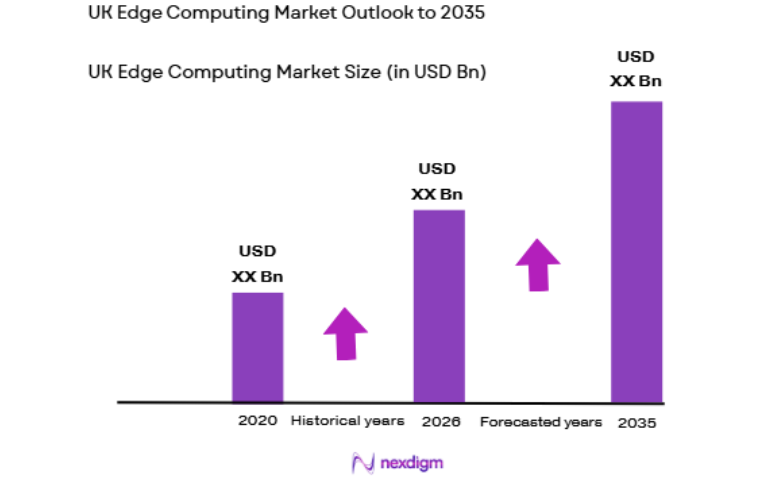
The UK Edge Computing Market is valued at approximately USD ~ billion based on recent historical assessments derived from telecom edge deployment investments, colocation micro data center expansion, and enterprise edge infrastructure spending across sectors such as manufacturing, transport, retail, and smart city systems. Growth is driven by rising demand for low-latency data processing, real-time analytics, and distributed computing architectures supporting IoT, 5G applications, and autonomous systems. Telecom operators and cloud providers are expanding national edge node networks.
Dominant regions include London, Manchester, Birmingham, Bristol, and Glasgow due to dense 5G rollout, industrial clusters, urban smart infrastructure programs, and proximity to enterprise and telecom network hubs. London leads in multi-access edge deployments supporting media, finance, and public services. Northern and Midlands cities attract industrial edge infrastructure for manufacturing automation and logistics. Regional digital transformation initiatives and transport modernization programs further stimulate distributed computing deployment across metropolitan and industrial corridors.
Market Segmentation
By Component Type
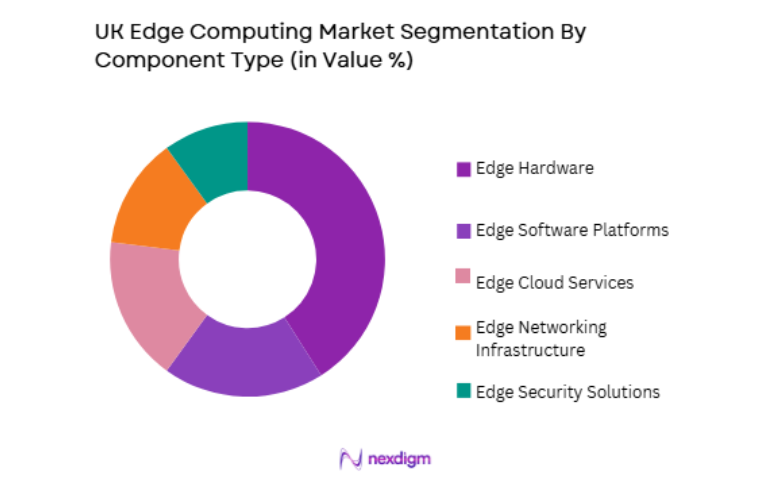
UK Edge Computing Market is segmented by component type into edge hardware, edge software platforms, edge cloud services, edge networking infrastructure, and edge security solutions. Recently, edge hardware has a dominant market share due to factors such as deployment of micro data centers, ruggedized edge servers, on-premise gateways, and localized compute nodes across telecom sites, factories, transport hubs, and urban infrastructure environments. Organizations require physical computing devices positioned near data sources to enable real-time processing and reduce latency compared to centralized cloud models. Telecom operators are investing heavily in distributed hardware nodes integrated with 5G base stations to support multi-access edge computing services.
By Application Environment
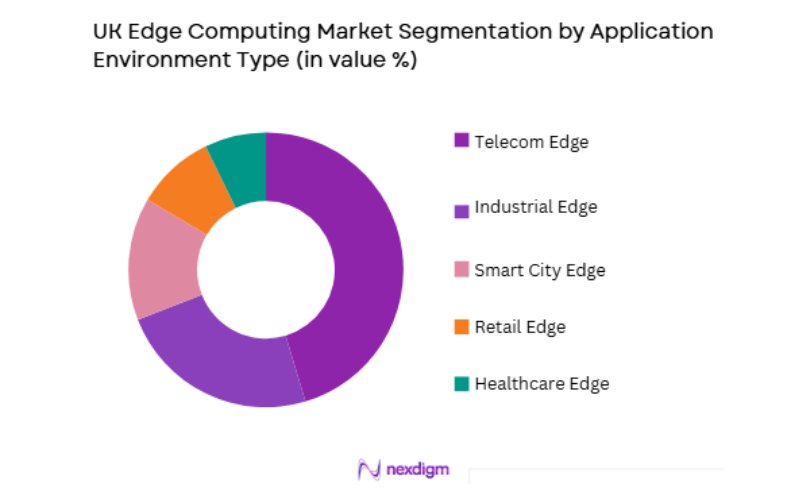
UK Edge Computing Market is segmented by application environment into telecom edge, industrial edge, smart city edge, retail edge, and healthcare edge. Recently, telecom edge has a dominant market share due to factors such as nationwide 5G infrastructure rollout, mobile data traffic growth, and integration of edge nodes within telecom access networks to support latency-sensitive digital services. Telecom operators deploy multi-access edge computing platforms at base stations and aggregation points to deliver localized processing for video streaming, augmented reality, and connected devices. Cloud providers partner with telecom networks to extend public cloud services to edge locations, increasing infrastructure deployment scale.
Competitive Landscape
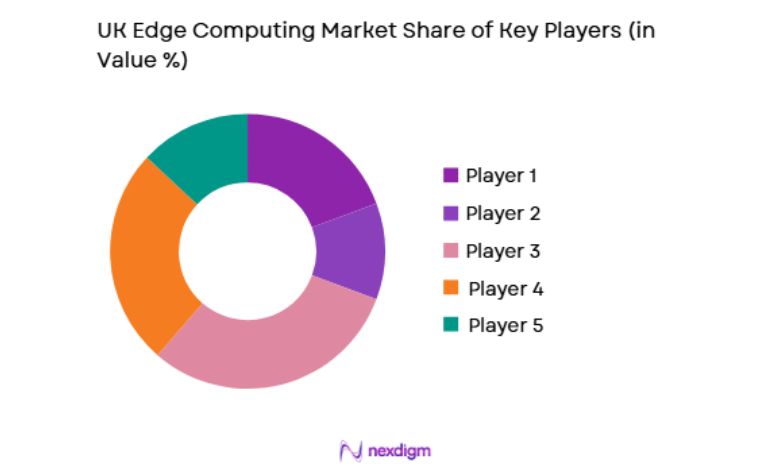
The UK Edge Computing Market is moderately competitive, led by telecom operators, cloud providers, and infrastructure technology firms deploying distributed compute nodes and edge platforms across national networks. Competitive differentiation centers on 5G integration capability, edge orchestration software, hardware ruggedization, and vertical-specific solutions for industrial and urban environments. Partnerships between telecom companies and hyperscale cloud providers are shaping market structure and accelerating multi-access edge computing deployment nationwide.
| Company Name | Establishment Year | Headquarters | Technology Focus | Market Reach | Key Products | Revenue | UK Edge Node Deployment |
| BT Group | 1846 | London, UK | ~ | ~ | ~ | ~ | ~ |
| Vodafone | 1984 | Newbury, UK | ~ | ~ | ~ | ~ | ~ |
| AWS | 2006 | Seattle, USA | ~ | ~ | ~ | ~ | ~ |
| Microsoft | 1975 | Redmond, USA | ~ | ~ | ~ | ~ | ~ |
| Nokia | 1865 | Espoo, Finland | ~ | ~ | ~ | ~ | ~ |
UK Edge Computing Market Analysis
Growth Drivers
Nationwide 5G Deployment Enabling Distributed Edge Infrastructure
Rapid nationwide deployment of fifth-generation mobile networks across the United Kingdom is fundamentally transforming digital infrastructure architecture by enabling distributed edge computing nodes integrated directly within telecom access networks and aggregation layers. 5G technology provides ultra-low latency, high bandwidth, and network slicing capabilities essential for real-time digital services such as augmented reality, connected vehicles, industrial automation, and immersive media platforms. Telecom operators are embedding multi-access edge computing platforms at base stations and regional exchanges to process data closer to end users and devices. Cloud providers are partnering with telecom networks to extend hyperscale cloud services to edge locations, accelerating infrastructure deployment. Enterprises adopt edge-enabled 5G connectivity for smart factories, logistics automation, and remote operations requiring instantaneous data processing. Public sector digital programs including smart transport and urban monitoring depend on distributed edge infrastructure supported by 5G networks. Device proliferation across IoT ecosystems multiplies data generation at network edges, requiring localized processing capacity.
Industrial Automation and Real-Time Analytics Adoption Across Enterprises
Increasing adoption of industrial automation, robotics, and real-time analytics platforms by UK manufacturing, energy, logistics, and infrastructure enterprises is generating strong demand for localized computing resources capable of processing operational data with minimal latency and high reliability. Industrial processes require immediate response to sensor data and machine signals that cannot tolerate delays associated with centralized cloud processing. Edge computing platforms enable predictive maintenance, quality inspection, and autonomous control systems by executing analytics near equipment and production lines. Enterprises deploy ruggedized edge servers and gateways within factories and facilities to support machine vision, robotics coordination, and process optimization applications. Integration of operational technology with digital analytics platforms further expands edge infrastructure requirements. Supply chain digitization and warehouse automation also depend on localized computing for tracking, routing, and control systems. Industrial edge deployments improve resilience by maintaining operational continuity during network disruptions.
Market Challenges
Fragmented Standards and Interoperability Across Edge Platforms
The UK Edge Computing Market faces significant challenges due to fragmentation of hardware architectures, software frameworks, and orchestration standards across telecom, cloud, and enterprise edge ecosystems, limiting seamless integration and scalability of distributed computing deployments. Multiple vendors provide proprietary edge platforms with differing management interfaces, virtualization models, and networking protocols, complicating cross-platform interoperability. Enterprises deploying edge solutions across diverse environments must integrate heterogeneous hardware and software stacks, increasing complexity and cost. Lack of standardized APIs and orchestration frameworks restricts portability of applications across edge locations and providers. Telecom edge, industrial edge, and cloud edge systems often operate in parallel without unified management. Developers face challenges adapting applications to varied edge environments.
High Deployment and Maintenance Costs for Distributed Edge Nodes
Deployment of distributed edge computing infrastructure across multiple locations involves significant capital expenditure and operational complexity compared to centralized cloud data centers, creating economic barriers for widespread enterprise adoption in the United Kingdom. Edge nodes require ruggedized hardware, secure enclosures, local power systems, and environmental controls suitable for diverse environments including factories, transport sites, and urban infrastructure. Installation and maintenance across geographically dispersed sites increase logistics and service costs. Edge infrastructure must also incorporate security and remote management capabilities, adding technical complexity. Enterprises must manage lifecycle upgrades and monitoring across numerous nodes. Smaller organizations may lack resources to deploy and operate distributed infrastructure at scale. Telecom and infrastructure providers bear substantial investment requirements to establish nationwide edge networks. These economic and operational challenges constrain rapid expansion of edge computing deployments beyond large enterprises and telecom ecosystems.
Opportunities
Smart City Infrastructure and Urban Digitalization Programs
Expansion of smart city initiatives and urban digital infrastructure modernization across the United Kingdom is creating substantial opportunities for edge computing platforms supporting real-time monitoring, traffic management, energy optimization, public safety, and environmental sensing applications within metropolitan environments. Cities are deploying sensor networks, intelligent transport systems, and connected public services that generate continuous data streams requiring localized processing for immediate decision-making. Edge nodes positioned within urban infrastructure enable responsive control of traffic signals, surveillance analytics, and public utilities. Government funding for digital city programs accelerates deployment of distributed computing platforms. Integration of edge computing with 5G and IoT networks supports scalable urban services. Municipalities increasingly adopt data-driven operations requiring localized analytics capacity. Public-private partnerships enable deployment of edge infrastructure across city assets.
Edge-Enabled Content Delivery and Immersive Media Services
Rising demand for high-quality video streaming, cloud gaming, augmented reality, and immersive digital media experiences across the United Kingdom is creating strong opportunities for edge computing infrastructure that reduces latency and bandwidth consumption while improving user experience in content delivery networks and interactive services. Media platforms deploy edge nodes to cache and process content closer to users, minimizing network congestion and delay. Cloud gaming and extended reality applications require ultra-low latency rendering supported by edge processing. Telecom operators integrate media edge platforms within 5G networks to support immersive services. Entertainment, sports broadcasting, and virtual event platforms expand localized processing capabilities. Consumer demand for interactive digital experiences continues to grow. Edge computing enables scalable delivery of high-bandwidth content across regions.
Future Outlook
The UK Edge Computing Market is expected to grow steadily as 5G expansion, industrial automation, and smart city deployment accelerate distributed computing adoption. Telecom and cloud partnerships will expand nationwide edge node networks. Enterprises will integrate edge with AI and IoT systems for real-time operations. Urban digital infrastructure programs will stimulate municipal deployments. Continued demand for low-latency digital services will sustain long-term market expansion.
Major Players
- BT Group
- Vodafone
- Amazon Web Services
- Microsoft
- Nokia
- Ericsson
- Cisco Systems
- Hewlett Packard Enterprise
- Dell Technologies
- Intel
- NVIDIA
- Equinix
- Digital Realty
- Juniper Networks
- Atos
Key Target Audience
- Telecom operators
- Cloud service providers
- Data center operators
- Industrial automation firms
- Smart city infrastructure providers
- Enterprise IT infrastructure buyers
- Investments and venture capitalist firms
- Government and regulatory bodies
Research Methodology
Step 1: Identification of Key Variables
Key variables including edge node deployments, telecom MEC investments, enterprise edge adoption, industrial automation infrastructure, and distributed computing spending were identified. Supply-side indicators such as provider revenue and hardware shipments were mapped. Demand indicators across telecom, industrial, and urban sectors were incorporated.
Step 2: Market Analysis and Construction
Market size and segmentation were constructed using telecom infrastructure investment data, edge hardware deployment statistics, enterprise IT spending benchmarks, and cloud edge platform adoption datasets. Segment shares were estimated based on deployment patterns across industries and regions. Application environments were integrated into allocation modeling.
Step 3: Hypothesis Validation and Expert Consultation
Findings were validated through consultations with telecom network architects, industrial automation engineers, cloud edge specialists, and infrastructure strategists. Deployment drivers, cost structures, and technology maturity were cross-checked against implementation experience. Expert insights refined segmentation and growth assumptions.
Step 4: Research Synthesis and Final Output
Validated quantitative and qualitative insights were synthesized into structured market intelligence covering size, segmentation, competition, and outlook. Consistency checks ensured alignment between demand drivers, telecom infrastructure expansion, and enterprise adoption. The final report integrates analytical modeling with strategic interpretation for actionable understanding.

- Executive Summary
- Research Methodology (Definitions, Scope, Industry Assumptions, Market Sizing Approach, Primary & Secondary Research Framework, Data Collection & Verification Protocol, Analytic Models & Forecast Methodology, Limitations & Research Validity Checks)

- Market Definition and Scope
- Value Chain & Stakeholder Ecosystem
- Regulatory / Certification Landscape
- Sector Dynamics Affecting Demand

- Growth Drivers
5G rollout enabling low latency edge services
IoT and real time analytics deployment growth
Enterprise demand for localized data processing - Market Challenges
Fragmented edge standards and interoperability gaps
High deployment and site management costs
Limited skilled workforce for distributed infrastructure - Market Opportunities
Industry specific edge solutions for manufacturing and retail
Integration of edge with AI and real time analytics
Expansion of regional micro data center networks - Trends
Convergence of telecom and cloud edge architectures
Growth of containerized and modular edge systems
Edge AI acceleration at network endpoints - Government regulations
UK telecom and digital infrastructure regulations
Data protection and local processing requirements
Smart city and digital infrastructure funding policies - SWOT analysis
- Porters Five forces

- By Market Value, 2020-2025
- By Installed Units, 2020-2025
- By Average System Price, 2020-2025
- By System Complexity Tier, 2020-2025

- By System Type (In Value%)
Edge Servers and Micro Data Centers
Edge Networking and Connectivity Infrastructure
Edge Storage and Data Processing Infrastructure
Edge AI and Acceleration Hardware
Edge Management and Orchestration Platforms - By Platform Type (In Value%)
Telecom Edge and 5G MEC Platforms
Enterprise On Premise Edge Platforms
Cloud Provider Distributed Edge Platforms
Industrial and IoT Edge Platforms
Public Sector and Smart City Edge Platforms - By Fitment Type (In Value%)
Greenfield Edge Site Deployments
Retrofit of Existing Network Sites
On Premise Edge Installations
Modular and Containerized Edge Units
Hybrid Edge Cloud Integration - By End User Segment (In Value%)
Telecom Operators and Network Providers
Manufacturing and Industrial Enterprises
Retail and Logistics Companies

- Market Share Analysis
- Cross Comparison Parameters (Edge Deployment Footprint and Site Density, Telecom and 5G MEC Integration Depth, Edge AI and Acceleration Capability, Distributed Orchestration and Lifecycle Management, Network Latency and Performance Optimization, Industry Vertical Solution Readiness)
- SWOT Analysis of Key Competitors
- Pricing & Procurement Analysis
- Key Players
Nokia
Ericsson
Huawei
Dell Technologies
Hewlett Packard Enterprise
Cisco Systems
Juniper Networks
IBM
Microsoft
Amazon Web Services
Google
Schneider Electric
Vertiv
Equinix
Digital Realty

- Telecom operators deploying MEC for 5G services
- Manufacturers adopting edge for automation analytics
- Retail and logistics using edge for real time operations
- Public sector investing in smart infrastructure edge

- Forecast Market Value, 2026-2035
- Forecast Installed Units, 2026-2035
- Price Forecast by System Tier, 2026-2035
- Future Demand by Platform, 2026-2035


 Request a Sample
 Ask for Customization
 Get a Quote
 Enquire Now