
 Download PDF
Market Overview
The UK Electric Off-Highway Vehicle Market is supported by the scale of construction, agricultural machinery and industrial activity, alongside increasing requirements for low-emission equipment. Great Britain recorded £140.684 billion of construction new work in 2024, while infrastructure new work amounted to £33.9 billion, creating a substantial equipment-utilisation base. The Agricultural Engineers Association recorded 10,241 agricultural tractors above 50 hp registered in the UK during 2024, providing an important replacement pool for electric and alternative-powertrain equipment.
England represents the largest demand centre because of its concentration of construction activity, infrastructure projects, logistics facilities, rental fleets and urban development. London and the South East are particularly relevant for compact electric construction equipment because of space constraints, noise-sensitive worksites and emissions requirements. East Anglia remains an important agricultural machinery market, while the Midlands and North West provide substantial manufacturing, warehousing and construction applications. The AEA identified East Anglia as the leading UK region for tractor registrations during 2024, while London provides a strong regulatory environment for low-emission construction machinery.
Market Segmentation
By Vehicle Type
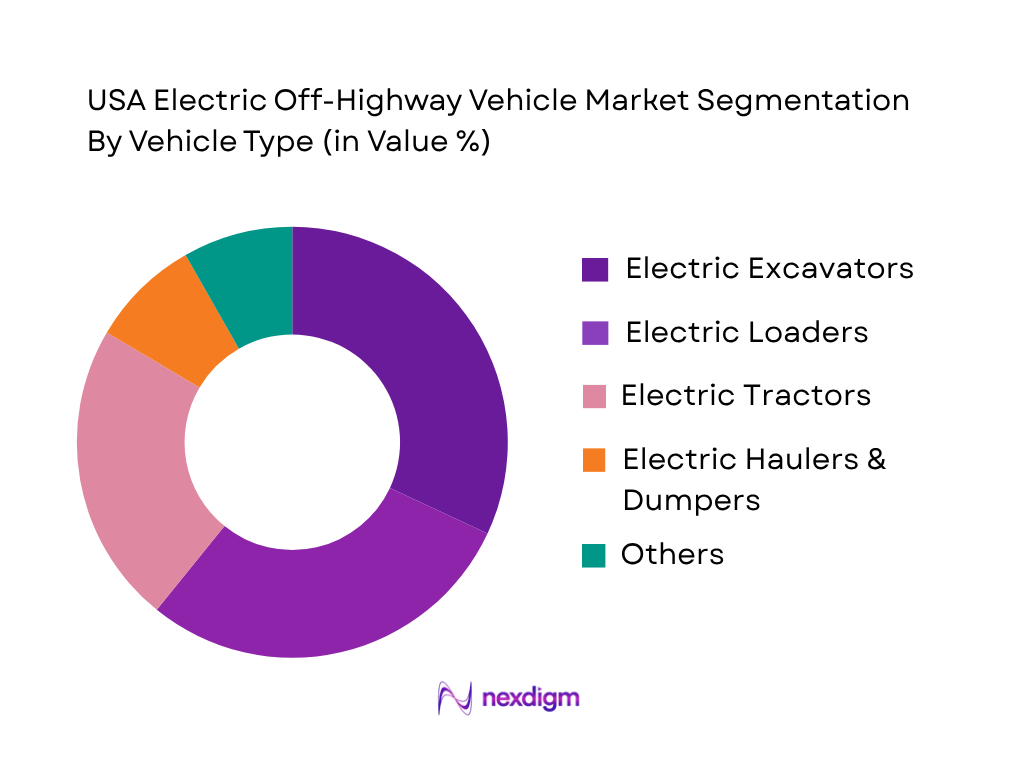
The UK Electric Off-Highway Vehicle Market is segmented by vehicle type into electric excavators, electric loaders, electric tractors, electric forklifts, electric telehandlers, electric compact construction equipment, electric utility vehicles, electric aerial work platforms and other electric off-highway vehicles. Electric Excavators are expected to represent the dominant vehicle category because construction provides one of the clearest near-term use cases for electrification. Compact and mini excavators can operate within predictable daily duty cycles and return to a depot or charging point, reducing the range limitations associated with larger mobile equipment. Their suitability for urban construction, indoor work, utilities, landscaping and noise-sensitive projects further strengthens adoption. JCB’s 19C-1E provides an established UK example of a fully electric compact excavator, while Volvo CE demonstrated its 23-tonne EC230 Electric on a UK airport project, illustrating the progression from compact machines toward heavier electric equipment.
By End-Use Industry
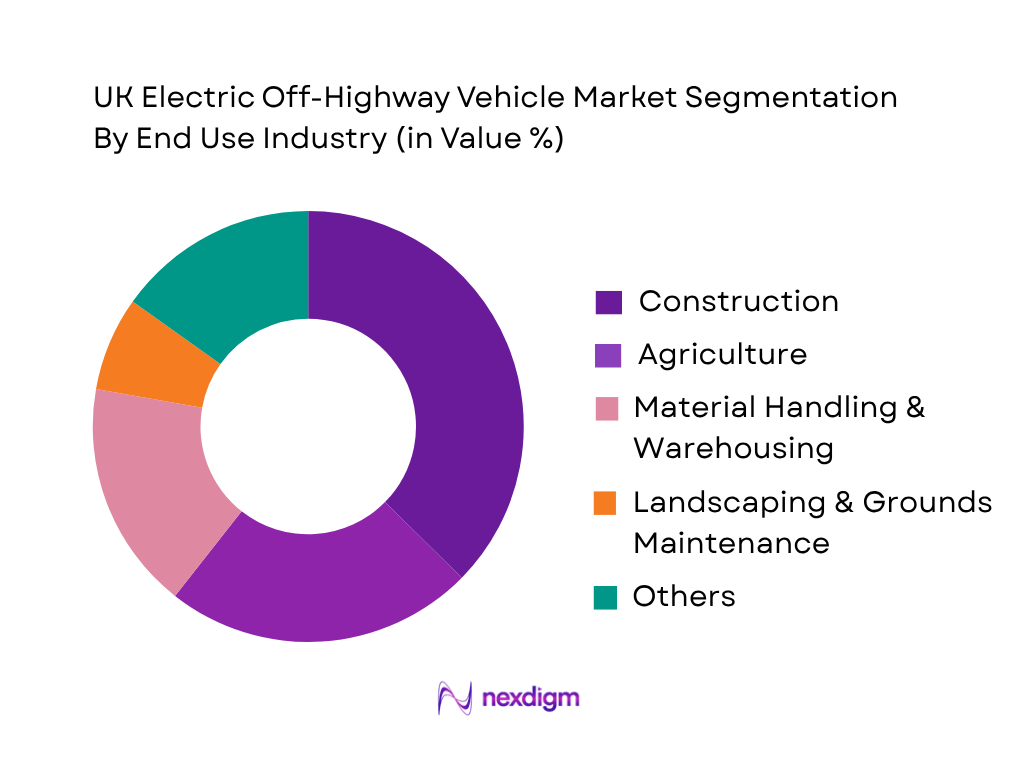
The market is segmented by end-use industry into construction, agriculture, material handling and warehousing, landscaping and grounds maintenance, utilities, mining and quarrying, municipal operations, industrial manufacturing, ports and logistics, and rental equipment. Construction is expected to maintain the leading position because electric off-highway vehicles can address several operational requirements simultaneously, including zero tailpipe emissions, reduced noise and suitability for enclosed or urban environments. UK construction generated £140.684 billion in new work during 2024, while public-sector new work increased to support infrastructure and housing activity. Government policy also identifies NRMM emissions as an area requiring cleaner technologies, while local authorities can encourage electric equipment within clean-air initiatives. These factors create a direct pathway for electric excavators, loaders, compact equipment, telehandlers and site utility vehicles.
Competitive Landscape
The UK Electric Off-Highway Vehicle Market features a combination of established construction-equipment OEMs, agricultural machinery manufacturers, material-handling specialists and global heavy-equipment companies. JCB, Volvo Construction Equipment, Caterpillar, Komatsu, CNH Industrial, John Deere, AGCO and Kubota have particularly strong relevance because of their existing installed bases and ability to integrate electrification into established equipment platforms. Competition is increasingly shifting from conventional machine specifications toward battery capacity, charging architecture, machine uptime, connected services and fleet-level energy management.
| Company | Established | Headquarters | Electric Product Focus | Core Off-Highway Segment | UK Presence | Key Technology | Distribution/Service Strength |
| JCB | 1945 | Staffordshire, UK | ~ | ~ | ~ | ~ | ~ |
| Volvo CE | 1832 | Gothenburg, Sweden | ~ | ~ | ~ | ~ | ~ |
| Caterpillar | 1925 | Texas, USA | ~ | ~ | ~ | ~ | ~ |
| Komatsu | 1921 | Tokyo, Japan | ~ | ~ | ~ | ~ | ~ |
| CNH Industrial | 1842 | Basildon, UK / Amsterdam | ~ | ~ | ~ | ~ | ~ |
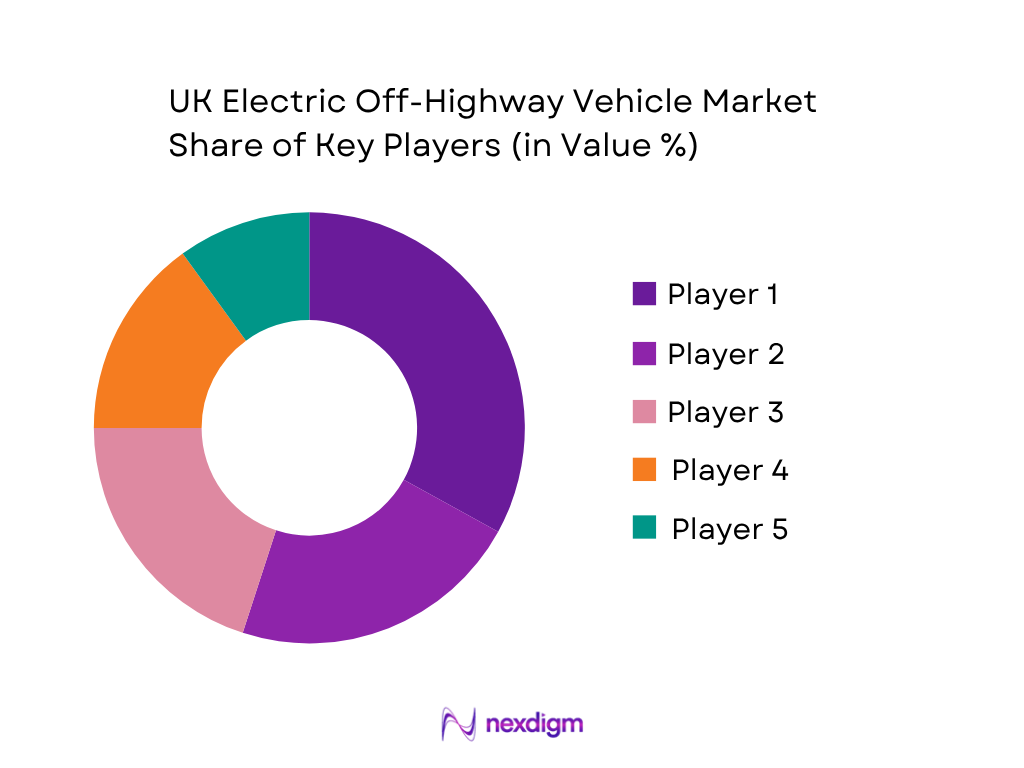
UK Electric Off-Highway Vehicle Market Analysis
Growth Drivers
Construction Decarbonisation, Clean Air Requirements, Zero-Emission Jobsites, Equipment Rental Electrification, Urban Noise Reduction
The UK Electric Off-Highway Vehicle Market is benefiting from the scale of construction activity and the increasing pressure to reduce emissions from non-road mobile machinery. Great Britain recorded £140.684 billion of construction new work in 2024, while infrastructure construction accounted for £33.9 billion, providing a substantial operating base for excavators, loaders, telehandlers and compact equipment. Government analysis identifies industrial NRMM emissions at around 6 MtCO₂e annually, covering construction, mining and manufacturing, while total NRMM emissions are around 12 MtCO₂e annually. Clean-air policies also allow local authorities to encourage electrically powered NRMM where practical, particularly on construction sites where older machinery can emit significant pollutants. The UK Government’s current decarbonisation policy framework includes fuel switching to electricity, biofuels and hydrogen for industrial off-road machinery, creating a regulatory pathway for electric equipment. The construction opportunity is particularly relevant to compact excavators and loaders because these machines can operate in urban developments, enclosed sites and noise-sensitive locations with comparatively predictable duty cycles. Equipment rental provides another adoption route because contractors can access electric machinery without immediately replacing owned fleets. As construction contractors increasingly incorporate emissions performance into site-level equipment decisions, battery-electric machines can address both local air-quality and noise requirements while supporting broader site decarbonisation.
Agricultural Electrification, Warehouse Automation, OEM Product Expansion
Agricultural and material-handling equipment provide additional adoption pathways for the UK Electric Off-Highway Vehicle Market, particularly where machinery operates on defined routes or within controlled facilities. The Agricultural Engineers Association recorded 10,241 agricultural tractors above 50 hp registered in the UK during 2024, with the average machine reaching 179.7 hp and total registered tractor power reaching 1.84 million hp. The wider equipment base included 3,630 telehandlers, 6,300 utility ATVs and 5,920 utility side-by-side vehicles, demonstrating the breadth of potential electrification applications. The UK also registered 11,761 agricultural tractors when compact tractors are included, illustrating the size of the annual equipment replacement channel. In material handling, electric powertrains are particularly suitable for warehouses, distribution centres and manufacturing facilities because equipment operates within bounded environments and can often return to designated charging locations. The UK’s transition toward automated warehousing further strengthens the relevance of electrically powered forklifts and utility vehicles. OEM product expansion is lowering the availability barrier: manufacturers including JCB, Volvo Construction Equipment, John Deere, Kubota and others are introducing electric equipment across construction and agricultural applications. The combination of an established replacement market, controlled operating environments and expanding OEM portfolios creates a practical pathway for electrification beyond construction.
Market Challenges
High Acquisition Requirements, Battery Energy Density, Charging Infrastructure Gaps, Charging Downtime, Heavy-Duty Duty Cycles
The UK Electric Off-Highway Vehicle Market faces technical and operational constraints that are more pronounced for high-load machinery than for compact equipment. UK Government analysis recognises that electrification has already begun penetrating some NRMM applications, particularly small and light-duty equipment, while indicating that further technology development is required for broader decarbonisation. The challenge is especially relevant because the UK industrial NRMM fleet generates around 6 MtCO₂e annually, covering construction, mining and manufacturing machinery with substantially different energy requirements. Battery-electric excavators and loaders must provide sufficient energy for hydraulic systems, traction and auxiliary functions without excessive battery mass affecting payload or machine stability. Charging infrastructure is another constraint because construction sites can move frequently and may not have reliable high-power electrical connections. A machine requiring several hours of charging can also create utilisation losses when compared with conventional refuelling. Agricultural equipment presents a similar issue because tractors can experience seasonal periods of intensive operation, making downtime particularly consequential. The UK Government’s feasibility work identifies multiple decarbonisation pathways because battery-electric solutions are not equally practical across all NRMM applications. Consequently, electrification is currently better suited to machines with predictable duty cycles, accessible charging and lower continuous power requirements, while heavy-duty equipment requires improvements in battery energy density, charging capacity and operating endurance.
Heavy-Duty Duty Cycles, Battery Thermal Management, Limited Residual-Value History, Specialist Technician Requirements
Heavy-duty operating requirements remain a significant challenge because electric off-highway vehicles must deliver sustained torque and hydraulic power under variable loads while maintaining reliable operation. The UK agricultural equipment base illustrates this requirement: tractors above 50 hp recorded 10,241 registrations in 2024, with the average newly registered machine reaching 179.7 hp. This means electrification must address substantially higher energy requirements than those associated with compact utility machinery. Battery thermal management becomes particularly important when equipment operates continuously under high loads or during intensive agricultural and construction cycles. The absence of a long historical dataset for used electric off-highway machinery can also make residual-value assessment more difficult for rental companies and fleet owners, potentially affecting replacement decisions. Technician capability is another consideration because battery-electric machinery introduces high-voltage systems, battery diagnostics, power electronics and specialised thermal-management components alongside conventional hydraulic and mechanical systems. The UK Government’s NRMM framework confirms that machinery such as construction equipment, industrial trucks, forklifts and mobile cranes falls within the broader regulatory ecosystem, increasing the importance of compliant equipment maintenance and servicing. For fleets, the transition therefore requires more than purchasing electric machines; operators must consider charging planning, technician training, spare-parts availability, battery health monitoring and emergency procedures. These requirements can slow adoption in applications where utilisation is intensive and downtime has a direct operational consequence.
Market Opportunities
Electric Compact Equipment, Mid-Size Excavators, Battery-Electric Construction Equipment, Mobile Charging
Electric compact equipment and progressively larger excavators represent a practical opportunity for the UK Electric Off-Highway Vehicle Market because construction provides both a substantial equipment-use base and a clear decarbonisation requirement. Great Britain’s construction sector generated £140.684 billion in new work in 2024, while infrastructure construction reached £33.9 billion, creating sustained applications for excavators, loaders, access equipment and site-support machinery. Government emissions data identifies construction activity as responsible for 18 units per 100 units of total UK PM10 emissions in 2024 and 4 units per 100 units of PM2.5 emissions, reinforcing the relevance of cleaner construction machinery. Local authorities can also encourage higher-emission standards or electrically powered NRMM where practical within clean-air initiatives. Compact electric excavators are particularly suited to urban construction, utilities, landscaping and indoor work because their operating cycles can be relatively predictable and charging can be concentrated at depots or worksites. Mobile charging can further expand deployment by addressing sites without permanent grid connections, allowing rental fleets and contractors to operate electric machines across temporary projects. The progression from compact equipment toward mid-size excavators provides an additional technology pathway as battery capacity and charging systems improve. OEM expansion is already supporting this transition, giving contractors more opportunities to select electric machines according to operating weight, duty cycle and site requirements rather than treating electrification as a niche equipment category.
Electric Agricultural Tractors, Electric Forklifts, Mining Electrification, Autonomous Electric Machinery
Agriculture, warehousing, mining and autonomous machinery provide longer-term opportunities because electrification can be matched with applications where operating routes, charging locations or machine utilisation can be controlled. The UK registered 10,241 agricultural tractors above 50 hp in 2024, with total registered tractor power of 1.84 million hp, establishing a substantial replacement ecosystem for electric agricultural machinery. Telehandler registrations reached 3,630 units, while utility ATVs and side-by-side vehicles recorded 6,300 and 5,920 units, respectively, providing additional equipment categories where battery-electric power can be considered. Forklifts offer another strong application because warehouse vehicles generally operate indoors or within defined facilities, enabling scheduled charging and reducing exposure to public-road range constraints. Mining and quarrying equipment represents a technically more demanding opportunity, but electrification can provide benefits where vehicles follow predictable haul routes and charging infrastructure can be concentrated around fixed operating areas. Autonomous electric machinery could further increase the value proposition by combining battery propulsion with machine-control systems, remote operation and automated charging. The UK Government has also confirmed policy work covering alternative zero-emission NRMM technologies, including hydrogen, indicating that future off-highway decarbonisation will involve multiple powertrain architectures. This creates opportunities for equipment manufacturers and infrastructure providers to develop application-specific solutions combining batteries, charging, telematics, autonomy and energy management rather than relying on a single electrification model across all off-highway equipment.
Future Outlook
The UK Electric Off-Highway Vehicle Market is expected to experience increasing adoption as construction contractors, agricultural operators, rental companies, utilities and industrial users seek lower-emission machinery. Electrification is likely to progress fastest in applications with predictable duty cycles, depot-based operation and high sensitivity to noise or local emissions.
Compact excavators, loaders, forklifts and landscaping equipment are positioned for relatively early adoption, while larger excavators, agricultural tractors and high-power machinery will require improvements in battery energy density, charging infrastructure and operating endurance. Government policy will remain an important catalyst as NRMM emissions become increasingly integrated into clean-air and decarbonisation strategies. The UK Government has also moved toward enabling road use of hydrogen-powered NRMM and agricultural machinery, indicating that the future powertrain landscape may extend beyond battery-electric systems.
Major Players
- JCB
- Volvo Construction Equipment
- Caterpillar
- Komatsu
- CNH Industrial
- John Deere
- AGCO Corporation
- Kubota Corporation
- Hitachi Construction Machinery
- HD Hyundai Construction Equipment
- Doosan Bobcat
- Liebherr
- Wacker Neuson
- Manitou Group
- SANY
Key Target Audience
- Construction contractors and infrastructure developers
- Agricultural machinery owners and commercial farming enterprises
- Equipment rental and leasing companies
- Material-handling and warehouse operators
- Industrial manufacturing and factory operators
- Investments and venture capitalist firms (infrastructure funds, industrial technology investors, clean-technology investors)
- Government and regulatory bodies (Department for Transport, Department for Energy Security and Net Zero, Environment Agency, Construction Plant-hire Association)
- Equipment distributors, dealers and aftermarket service providers
Research Methodology
Step 1: Identification of Key Variables
The research begins with an ecosystem assessment covering electric-equipment OEMs, construction contractors, agricultural machinery users, rental companies, dealers, charging providers and component suppliers. Variables include machine type, battery capacity, operating duty cycle, charging requirements, application suitability, fleet size, replacement cycles and electrification readiness.
Step 2: Market Analysis and Construction
Historical and current information is consolidated across equipment registrations, construction activity, agricultural machinery registrations, industrial applications, regulatory developments and OEM product introductions. A bottom-up framework assesses equipment deployment by vehicle category and end-use application, while a top-down framework validates the market against sectoral equipment demand.
Step 3: Hypothesis Validation and Expert Consultation
Market hypotheses are validated through discussions with equipment manufacturers, distributors, rental operators, fleet managers, contractors, agricultural machinery dealers and technology suppliers. Expert inputs are used to assess electric-machine adoption barriers, charging requirements, operating performance, procurement criteria and application-specific electrification potential.
Step 4: Research Synthesis and Final Output
The final analysis triangulates primary insights with official UK statistics, regulatory publications, manufacturer disclosures and industry datasets. Vehicle-level and application-level findings are reconciled to establish market segmentation, competitive positioning, adoption patterns and the long-term outlook for electric off-highway vehicles in the UK.

- Executive Summary
- Research Methodology (Market Definition and Scope, Electric Off-Highway Vehicle Classification, Historical Market Reconstruction, Market Sizing Framework, Unit-Sales Assessment, Revenue Estimation, Top-Down Analysis, Bottom-Up Analysis, OEM and Dealer Validation, Fleet-Level Assessment, Primary Interviews, Secondary Research, Data Triangulation, Forecasting Framework, Scenario Modelling, Assumptions and Limitations)

- Definition and Scope
- Evolution of Electric Off-Highway Machinery in the UK
- UK Non-Road Mobile Machinery Ecosystem
- Electric Off-Highway Vehicle Value Chain
- UK Manufacturing and Supply-Chain Landscape
- Electric Powertrain and Battery Ecosystem

- Growth Drivers (Construction Decarbonisation, Clean Air Requirements, Zero-Emission Jobsites, Agricultural Electrification, Equipment Rental Electrification, Warehouse Automation, Urban Noise Reduction, OEM Product Expansion)
- Market Challenges (High Acquisition Requirements, Battery Energy Density, Charging Infrastructure Gaps, Charging Downtime, Heavy-Duty Duty Cycles, Battery Thermal Management, Limited Residual-Value History, Specialist Technician Requirements)
- Market Opportunities (Electric Compact Equipment, Mid-Size Excavators, Electric Agricultural Tractors, Electric Forklifts, Battery-Electric Construction Equipment, Mining Electrification, Mobile Charging, Autonomous Electric Machinery)
- Emerging Technology Trends (High-Voltage Architectures, LFP Batteries, Fast Charging, Electric Hydraulics, Integrated E-Axles, Thermal Management, Regenerative Systems, Software-Defined Machinery)
- Government Support and Regulatory Analysis
- Porter’s Five Forces Analysis
- PESTLE Analysis
- SWOT Analysis

- By Market Value (2020-2025)
- By Unit Sales (2020-2025)
- By Average Selling Value (2020-2025)
- By Electric Vehicle Type (2020-2025)
- By Battery Capacity (2020-2025)
- By Power Output (2020-2025)
- By Geography (2020-2025)

- By Vehicle Type (in value %)
Electric Mini and Compact Excavators
Electric Excavators
Electric Wheel Loaders
Electric Skid-Steer Loaders
Electric Compact Track Loaders
Electric Telehandlers
Electric Forklifts
Electric Site Dumpers
Electric Agricultural Tractors
Electric Utility and Specialty Vehicles - By Propulsion Technology (in value %)
Battery Electric
Hybrid Electric
Plug-in Hybrid Electric
Fuel-Cell Electric
Hydrogen Combustion - By Application (in value %)
Construction
Agriculture
Material Handling and Warehousing
Mining and Quarrying
Landscaping and Grounds Maintenance
Waste Management
Utilities
Municipal Operations
Forestry
Industrial Applications - By Equipment Weight (in value %)
Below 5 Tons
5–10 Tons
10–20 Tons
20–40 Tons
Above 40 Tons - By Battery Capacity (in value %)
Below 50 kWh
50–150 kWh
151–300 kWh
301–500 kWh
Above 500 kWh - By Power Output (in value %)
Below 50 kW
50–100 kW
101–200 kW
201–400 kW
Above 400 kW

- Market Share of Major Players (By Revenue, Unit Sales, Vehicle Type, Application, Propulsion Technology, Battery Capacity, Equipment Weight and Geography)
- Cross Comparison Parameters (Electric Equipment Portfolio Breadth, Battery Capacity Range, Electric Machine Model Count, Maximum Power Output, Operating Runtime, Charging Technology Capability, UK Dealer and Service Network Coverage, Telematics and Autonomous Technology Capability)
- Detailed Profiles of Major Companies
JCB
Caterpillar Inc.
Komatsu Ltd.
Volvo Construction Equipment
Hitachi Construction Machinery
Kubota Corporation
CNH Industrial
Deere & Company
AGCO Corporation
Manitou Group
Wacker Neuson SE
Doosan Bobcat
Liebherr Group
SANY UK
Terex Corporation

- Fleet Electrification Adoption Assessment
- Equipment Purchase Decision Analysis
- End-User Application Analysis
- Construction Contractor Buying Behaviour
- Agricultural Equipment User Behaviour

- By Market Value (2026-2035)
- By Unit Sales (2026-2035)
- By Average Selling Value (2026-2035)
- By Electric Vehicle Type (2026-2035)
- By Battery Capacity (2026-2035)
- By Power Output (2026-2035)
- By Geography (2026-2035)


 Request a Sample
 Ask for Customization
 Get a Quote
 Enquire Now