
 Download PDF
Market Overview
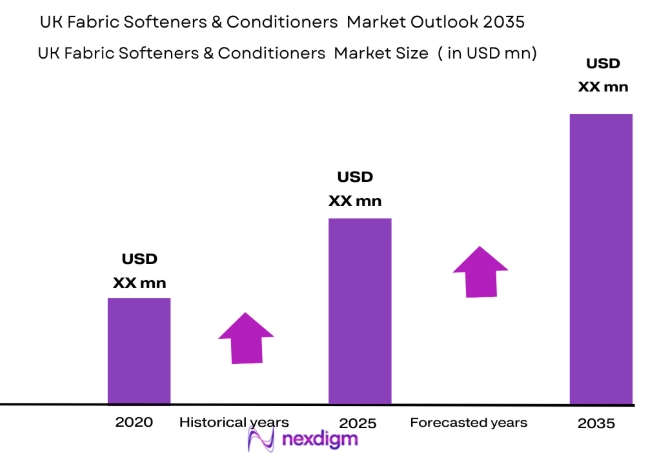
The UK Fabric Softeners & Conditioners Market was valued at USD ~ million based on a recent historical assessment derived from the latest disclosed UK category benchmark and growth trajectory. Grand View Research reports that the UK market generated USD 824.7 million and is projected to reach USD 1,159.0 million, with liquid products identified as the leading segment. Demand is driven by fragrance-led laundry routines, concentrated formats, sensitive-skin formulations, and retail availability across grocery and online channels.
London, South East England, North West England, and the West Midlands dominate consumption because they combine dense populations, high grocery retail penetration, and large urban household bases. The UK population reached 69.3 million, while England recorded faster population growth than Scotland, Wales, and Northern Ireland, reinforcing the concentration of household-care demand in large English regions. Urban flats, frequent indoor drying, and premium grocery assortments strengthen demand for long-lasting fragrance and concentrated conditioners.
Market Segmentation
By Product Type
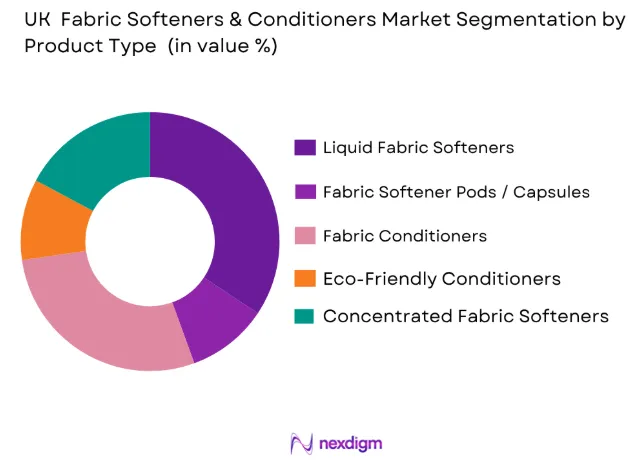
UK Fabric Softeners & Conditioners Market is segmented by product type into liquid fabric softeners, fabric conditioners, dryer sheets, fabric softener pods/capsules, concentrated fabric softeners, and eco-friendly/plant-based fabric softeners. Recently, liquid fabric softeners have a dominant market share due to factors such as broad household familiarity, extensive supermarket shelf presence, compatibility with UK washing-machine routines, and a wide price ladder from value private label to premium fragrance-led brands. Liquid formats also benefit from repeated brand investment by Comfort, Lenor, Fairy, Ecover, and supermarket own-label ranges, while concentrated liquids support smaller bottles, reduced transport weight, and stronger claims around value per wash. Dryer sheets remain relatively limited because tumble-dryer penetration and laundry behaviour differ from the US, while pods and capsules are still more associated with detergent than conditioning. Eco-friendly and plant-based options are gaining visibility but remain constrained by price premiums and consumer scepticism around softness performance.
By Distribution Channel
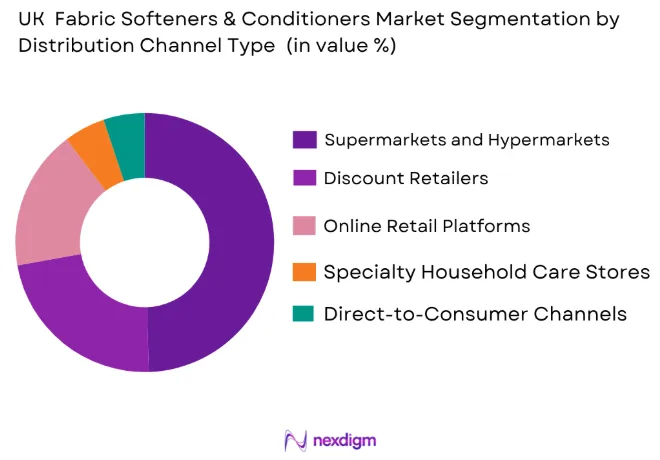
UK Fabric Softeners & Conditioners Market is segmented by distribution channel into supermarkets and hypermarkets, discount retailers, online retail platforms, convenience stores, specialty household-care stores, and direct-to-consumer channels. Recently, supermarkets and hypermarkets have a dominant market share due to factors such as high household grocery frequency, established category shelf space, price promotions, own-label competition, and the ability to bundle fabric conditioners with detergents, scent boosters, stain removers, and other home-care purchases. Tesco, Sainsbury’s, Asda, Morrisons, Waitrose, and regional grocers remain central because consumers often replenish laundry products during weekly or monthly household shopping trips. Discount retailers such as Aldi and Lidl exert strong price pressure through concentrated and private-label alternatives, while online platforms support bulk packs, repeat purchasing, and subscription behaviour. Direct-to-consumer remains niche because heavy liquid formats raise fulfilment costs and consumers still prefer price comparison across grocery retailers.
Competitive Landscape
The UK Fabric Softeners & Conditioners Market is moderately consolidated at the brand level but fragmented at the retail shelf level because multinational branded players compete directly with supermarket and discounter private labels. Unilever’s Comfort and P&G’s Lenor/Fairy occupy strong branded positions, while SC Johnson’s Ecover and Method support the eco-oriented segment. Tesco, Sainsbury’s, Aldi, Lidl, and other retailers influence pricing, pack architecture, and promotion cycles through own-label ranges. P&G reported USD 84.0 billion in fiscal sales, with Fabric & Home Care net sales of USD 29.5 billion, while Unilever’s Home Care division reported EUR 12.4 billion turnover in its recent divisional history.
| Company Name | Establishment Year | Headquarters | Technology Focus | Market Reach | Key Products | Revenue | Market-Specific Parameter |
| Unilever / Comfort | 1929 | London, UK | ~ | ~ | ~ | ~ | ~ |
| Procter & Gamble / Lenor & Fairy | 1837 | Cincinnati, US | ~ | ~ | ~ | ~ | ~ |
| SC Johnson / Ecover & Method | 1886 | Racine, US | ~ | ~ | ~ | ~ | ~ |
| Tesco Own Label | 1919 | Welwyn Garden City, UK | ~ | ~ | ~ | ~ | ~ |
| Aldi Almat | 1913 | Essen/Mülheim, Germany | ~ | ~ | ~ | ~ | ~ |
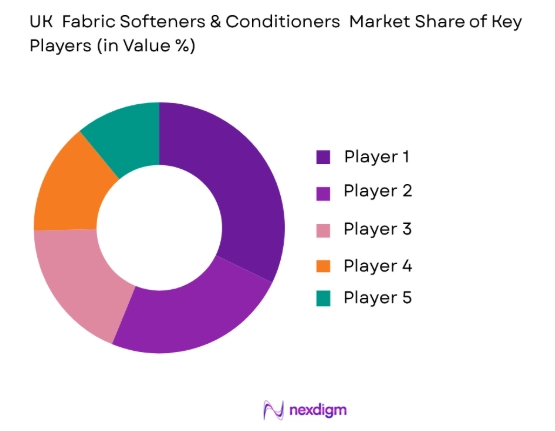
UK Fabric Softeners & Conditioners Market Analysis
Growth Drivers
Rising Demand for Premium Laundry Care Products
Rising demand for premium laundry care products is supported by the UK’s large household base and resilient consumer spending capacity, which directly strengthens the addressable market for fabric softeners and conditioners used in routine laundry care. The Office for National Statistics reported 28.6 million UK households and an average household size of 2.35 residents, creating a broad recurring-use base for fabric conditioners across family, single-person, and shared households. The same source recorded 19.7 million families, indicating a sizeable laundry-intensive consumer group where bedding, schoolwear, workwear, towels, and everyday apparel increase the relevance of softness, fragrance, and fabric-care benefits. Household spending conditions also support trade-up within laundry care: ONS reported average weekly household expenditure of GBP 623.30, while the richest fifth of households spent GBP 948.70 per week, creating scope for premium conditioners, sensitive-skin variants, and long-lasting fragrance formats.
Expansion of E-Commerce and Subscription-Based Purchases
Expansion of e-commerce and subscription-based purchases is a growth driver for the UK Fabric Softeners & Conditioners Market because laundry conditioners are replenishment products that fit online grocery baskets, repeat delivery, and bulk household purchasing. ONS reported that online spending values increased during December, while the proportion of sales made online reached 27.0 in that month, showing that digital retail remains structurally important for household goods discovery and replenishment. The same ONS release noted that non-store retailing includes online retailers, which matters for fabric conditioners because heavy liquid bottles, concentrated formats, and multi-pack purchases are increasingly compatible with home delivery. The UK’s broader retail infrastructure also supports online category growth: the ONS-linked retail release identifies internet sales datasets as a core part of the Retail Sales Index, while household expenditure data show average weekly spending of GBP 623.30, indicating a recurring grocery and household-care budget into which conditioners are usually bundled.
Challenges
Price Sensitivity Across Mass-Market Consumers
Price sensitivity across mass-market consumers is a major challenge for the UK Fabric Softeners & Conditioners Market because conditioners are often treated as an optional laundry enhancer rather than a non-negotiable essential. ONS household income data show that median household disposable income was GBP 36,700, while the poorest fifth had GBP 16,800 and the richest fifth had GBP 71,100, creating a wide affordability gap across laundry-care consumers. ONS family spending data also show that the poorest fifth of households spent GBP 378.60 per week, compared with GBP 948.70 for the richest fifth, which is critical for fabric conditioners because the category competes with food, energy, rent, transport, detergents, and other household necessities. The same ONS release reported average weekly household expenditure of GBP 623.30, but housing, fuel, and power absorbed GBP 113.30 per week, while transport absorbed GBP 88.20, reducing flexibility for discretionary fragrance-led laundry add-ons. In market terms, this creates a two-speed category: premium conditioners can grow among higher-spending households, but mass-market consumers are more likely to buy on promotion, switch to supermarket own label, reduce dosage, or skip conditioner.
Environmental Concerns Around Chemical Ingredients
Environmental concerns around chemical ingredients are a challenge for the UK Fabric Softeners & Conditioners Market because the category relies on surfactants, fragrance systems, preservatives, dyes, plastic bottles, and water-heavy liquid formulations. Defra reported 12,727 thousand tonnes of UK packaging waste under methodology one, including 2,265 thousand tonnes of plastic packaging waste and 1,154 thousand tonnes of recycled plastic packaging, making packaging scrutiny directly relevant to conditioner bottles, caps, labels, and refill packs. Under methodology two, Defra reported 10,844 thousand tonnes of packaging waste and 2,149 thousand tonnes of plastic packaging waste, reinforcing the scale of regulatory and consumer pressure around plastic-heavy household-care products. The Health and Safety Executive states that detergents in Great Britain are governed by retained Detergents Regulation 648/2004, with additional UK exit statutory instruments including 2019/672, 2019/671, and 2020/1617, creating compliance obligations for detergent and fabric-care formulations.
Opportunities
Growth in Refill and Low-Plastic Packaging Solutions
Growth in refill and low-plastic packaging solutions is a major opportunity for the UK Fabric Softeners & Conditioners Market because conditioners are high-frequency liquid products traditionally sold in plastic bottles, creating direct exposure to packaging regulation and consumer scrutiny. Defra’s UK packaging waste data show 2,265 thousand tonnes of plastic packaging waste under methodology one and 2,149 thousand tonnes under methodology two, giving a clear numerical basis for why low-plastic fabric conditioner formats are commercially relevant. Defra also reported 12,727 thousand tonnes of total packaging waste under methodology one and 10,844 thousand tonnes under methodology two, showing that packaging reduction is a national-scale issue rather than a niche sustainability concern. This supports opportunities for concentrated conditioners, refill pouches, reusable bottles, lightweight caps, recycled-content bottles, and online multi-refill systems. Fabric softeners are especially suitable for this shift because the product is dosed repeatedly, allowing concentrated formats to reduce bottle size while maintaining wash-count messaging.
Expansion of Plant-Based and Biodegradable Fabric Softeners
Expansion of plant-based and biodegradable fabric softeners is an opportunity for the UK Fabric Softeners & Conditioners Market because environmental regulation and household demand are moving toward safer, lower-impact formulations. HSE confirms that the Detergents Regulation applies in Great Britain and identifies retained Regulation 648/2004 as the central legal framework for detergents, making biodegradability, labelling, and product safety directly relevant to fabric conditioner formulations. HSE also states that UK REACH generally applies to individual chemical substances, including substances in mixtures and articles, with some obligations applying at one tonne per year or more, which matters for large-scale use of surfactants, fragrance ingredients, preservatives, and conditioning agents. From the demand side, ONS reported 8.4 million people living alone and 19.7 million families, creating multiple consumer missions for plant-based conditioners, including low-irritation laundry, baby and bedding care, small-household convenience, and premium eco-positioning. The World Bank’s UK GDP per capita figure of USD 53,246.4 supports the presence of a consumer base able to absorb higher-value sustainable products when performance is credible.
Future Outlook
The UK Fabric Softeners & Conditioners Market is expected to remain stable but increasingly segmented over the next five years, with growth led by concentrated products, premium scent platforms, and sensitive-skin formulations.Technological development will focus on fragrance encapsulation, low-dose liquids, recyclable packaging, and refill systems that reduce plastic intensity.Regulatory pressure around chemical safety, packaging waste, and green claims will push companies toward clearer labelling and more defensible sustainability positioning.Demand-side growth will depend on urban household routines, indoor drying, online bulk purchases, and consumers seeking laundry products that combine freshness, softness, and fabric protection.
Major Players
- Comfort
- Lenor
- Fairy
- Ecover
- Method
- Surcare
- Tesco Own Label
- Sainsbury’s Own Label
- Aldi Almat
- Lidl Formil
- Waitrose Essential
- Morrisons Own Label
- Asda Own Label
- Lenor Outdoorable
- Comfort Pure
Key Target Audience
- Fabric softener and conditioner manufacturers
- Laundry care product brands –
- Supermarkets and hypermarkets
- Discount retailers
- Online grocery and household-care platforms
- Packaging manufacturers
- Investments and venture capitalist firms –
- Government and regulatory bodies
Research Methodology
Step 1: Identification of Key Variables
The research began by identifying demand, supply, pricing, and channel variables specific to the UK Fabric Softeners & Conditioners Market. Key variables included product type, formulation, distribution channel, packaging format, regional consumption concentration, and competitive brand presence.
Step 2: Market Analysis and Construction
Market construction used publicly available industry benchmarks, company disclosures, retail observations, and category-level laundry-care references. The analysis aligned UK-specific category values with product segmentation, brand positioning, channel mix, and household consumption patterns.
Step 3: Hypothesis Validation and Expert Consultation
The working hypotheses were checked against brand portfolios, retailer assortment structures, regulatory context, and observed shifts toward concentrated, eco-oriented, and sensitive-skin products. Validation focused on whether category dynamics were consistent with UK household behaviour and retail pricing realities.
Step 4: Research Synthesis and Final Output
The final output synthesised market sizing, segmentation, competitive positioning, growth drivers, challenges, opportunities, and future outlook into a structured executive report. Findings were prioritised for commercial relevance, investment usefulness, and consistency with the stated UK Fabric Softeners & Conditioners Market scope.

- Executive Summary
- Research Methodology (Market Definitions and Assumptions, Abbreviations and Terminology, Data Sources and Validation Approach, UK Fabric Softeners & Conditioners Market Sizing Methodology, Primary and Secondary Research Benchmarks, Market Reliability and Confidence Intervals)

- Industry Definition and Scope
- Market Genesis and Evolution in the UK
- Consumer Adoption Patterns
- Market Value Chain and Distribution Architecture
- Import and Export Dynamics

- Growth Drivers
Rising Demand for Premium Laundry Care Products
Increasing Consumer Focus on Fabric Fragrance and Freshness
Growth of Eco-Friendly and Sustainable Household Products
Expansion of E-Commerce and Subscription-Based Purchases
Innovation in Concentrated and Long-Lasting Formulations
Rising Awareness of Fabric Protection and Garment Longevity - Challenges
Price Sensitivity Across Mass-Market Consumers
Environmental Concerns Around Chemical Ingredients
Declining Use Among Some Eco-Conscious Consumers
Competition from Multi-Functional Laundry Detergents
Regulatory Pressure on Packaging and Chemical Formulations
Private Label Competition from Supermarkets and Discount Retailers
- Opportunities
Expansion of Plant-Based and Biodegradable Fabric Softeners
Growth in Refill and Low-Plastic Packaging Solutions
Premium Fragrance-Led Product Innovation
Personalisation and Scent Customisation
Growth of Online-First and Direct-to-Consumer Laundry Brands
Development of Sensitive Skin and Dermatologically Tested Products - Trends
Eco-Friendly and Sustainable Laundry Care
Concentrated Fabric Conditioner Formats
Refill Stations and Reusable Packaging
Luxury Fragrance-Inspired Fabric Softeners
Hypoallergenic and Skin-Safe Formulations
Subscription-Based Household Essentials
Private Label Growth in Laundry Care
Multi-Functional Fabric Care Products - Government Regulations
Chemical Safety and Ingredient Regulations
Packaging Waste and Recycling Regulations
Labelling and Consumer Safety Requirements
Environmental Standards for Household Cleaning Products
Regulations on Claims for Biodegradable and Eco-Friendly Products - SWOT Analysis
- Porter’s Five Forces

- By Market Value, 2020-2025
- By Volume Sold, 2020-2025
- By Average Selling Price, 2020-2025
- By Product Category Revenue Contribution, 2020-2025

- By Product Type (In Value %)
Liquid Fabric Softeners
Fabric Conditioners
Dryer Sheets
Fabric Softener Pods / Capsules
Concentrated Fabric Softeners
Eco-Friendly / Plant-Based Fabric Softeners - By Formulation Type (In Value %)
Standard Formulations
Sensitive Skin / Hypoallergenic Formulations
Fragrance-Free Formulations
Long-Lasting Fragrance Formulations
Anti-Bacterial / Hygiene-Focused Formulations
Eco-Friendly and Biodegradable Formulations - By Packaging Type (In Value %)
Bottles
Refill Pouches
Capsules / Pods Packaging
Bulk Packs
Sustainable / Recyclable Packaging - By Distribution Channel (In Value %)
Supermarkets and Hypermarkets
Convenience Stores
Discount Retailers
Online Retail Platforms
Specialty Household Care Stores
Direct-to-Consumer Channels - By Consumer Demographic (In Value %)
Urban Households
Young Professionals
Families with Children
Middle-Income Households
Premium Household Care Consumers
Eco-Conscious Consumers
Sensitive Skin / Allergy-Prone Consumers - By Price Tier (In Value %)
Budget / Economy
Mid-Tier
Premium
Eco-Premium / Sustainable
- By Region (In Value %)
London
South East England
North West England
West Midlands
Scotland
Wales
Northern Ireland
Other Regions

- Market Share by Product Category
- Volume Sales by Major Brands
- Cross Comparison Parameters(Company Overview, Product Portfolio Strength, Retail Footprint, Pricing Strategy, Sustainability Positioning, Brand Equity, Consumer Preference Score, Annual Revenue, and Growth Trajectory)
- Company Profiles
Comfort
Lenor
Fairy
Ecover
Method
Surcare
Tesco Own Label
Sainsbury’s Own Label
Aldi Almat
Lidl Formil
Waitrose Essential
Wilko Laundry Care

- Buying Decision Drivers
- Brand Loyalty and Purchase Frequency
- Preferred Fragrance Profiles
- Payment Preferences and Purchase Channels
- Post-Purchase Usage Patterns
- Pain Points in Product Usage and Repurchase

- By Market Value, 2026-2035
- By Volume Sold, 2026-2035
- By Average Selling Price, 2026-2035
- By Product Category Revenue Contribution, 2026-2035


 Request a Sample
 Ask for Customization
 Get a Quote
 Enquire Now