

 Download PDF
Market Overview
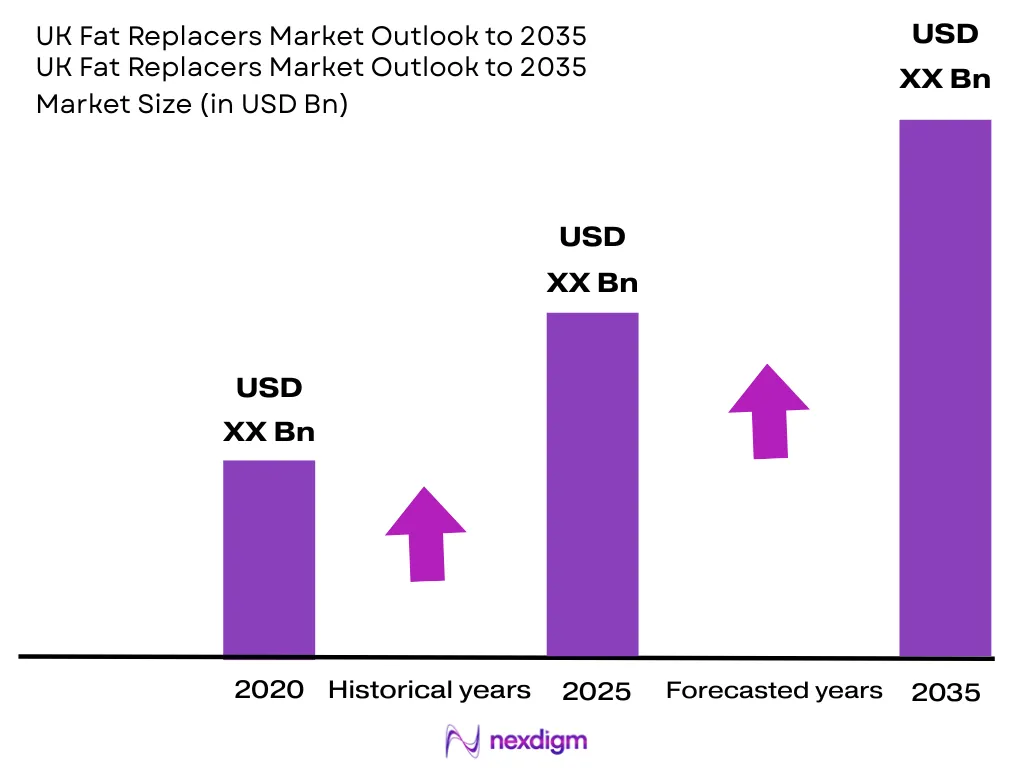
The UK Fat Replacers Market was valued at approximately USD ~ billion in 2024 and is projected to grow at a CAGR of ~% during the 2026–2035 forecast period. The market is driven by increasing demand for reduced-fat and low-calorie food products, rising health consciousness among British consumers, and growing reformulation activities by food manufacturers across bakery, dairy, processed meats, snacks, and functional food categories. The United Kingdom possesses one of Europe’s most sophisticated and highly regulated food processing industries, with the food and drink sector generating revenues exceeding GBP 110 billion annually while serving a domestic population exceeding 68 million consumers. According to NHS England and Public Health England, more than 28% of adults in England are classified as obese, driving sustained demand for reduced-fat, lower-calorie, and nutritionally improved food products. The UK government’s obesity strategy, including restrictions on the promotion and placement of High Fat, Salt and Sugar (HFSS) products in retail environments, has created strong regulatory incentives for food manufacturers to invest in product reformulation using fat replacer ingredients. The expansion of plant-based foods, high-protein dairy products, functional snacks, and clean-label packaged food has significantly increased the utilisation of carbohydrate-, protein-, and fibre-based fat replacers. Continuous innovation in clean-label ingredients, dietary fibres, plant proteins, and hydrocolloids is further accelerating adoption across multiple food applications.
Market Segmentation
By Source
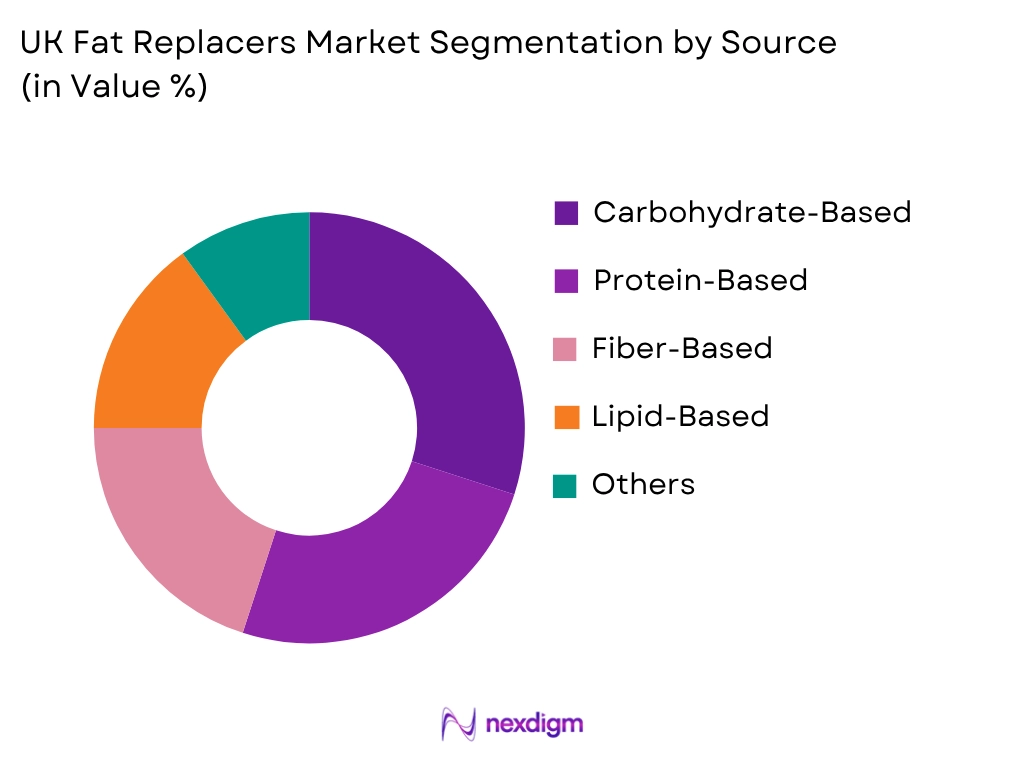
Carbohydrate-based fat replacers dominate the UK market because they provide excellent functionality while maintaining product texture, viscosity, moisture retention, and mouthfeel at comparatively lower formulation costs. Ingredients such as modified starches, maltodextrins, cellulose derivatives, polydextrose, and hydrocolloids are extensively incorporated into bakery products, dairy products, sauces, confectionery, processed meats, and ready-to-eat foods across the United Kingdom’s large and sophisticated packaged food sector. The UK’s domestic production of wheat and sugar beet provides manufacturers with reliable domestic sources for starch- and fibre-based ingredients, while oat fibre sourced from the UK and Ireland offers an increasingly popular clean-label carbohydrate-based fat replacement option. Food manufacturers increasingly prefer carbohydrate-based solutions because they allow significant fat reduction without adversely affecting sensory characteristics or consumer acceptance, while also satisfying the United Kingdom’s increasingly stringent clean-label and front-of-pack traffic light labelling requirements. These ingredients possess broad regulatory acceptance under retained UK food law, compatibility with existing manufacturing processes, and versatility across multiple food categories. Continuous innovation in resistant starches and soluble fibres further strengthens the segment by enabling clean-label product reformulation while improving nutritional profiles, supporting calorie reduction initiatives, and helping manufacturers meet reformulation targets under the UK government’s obesity strategy.
By Application
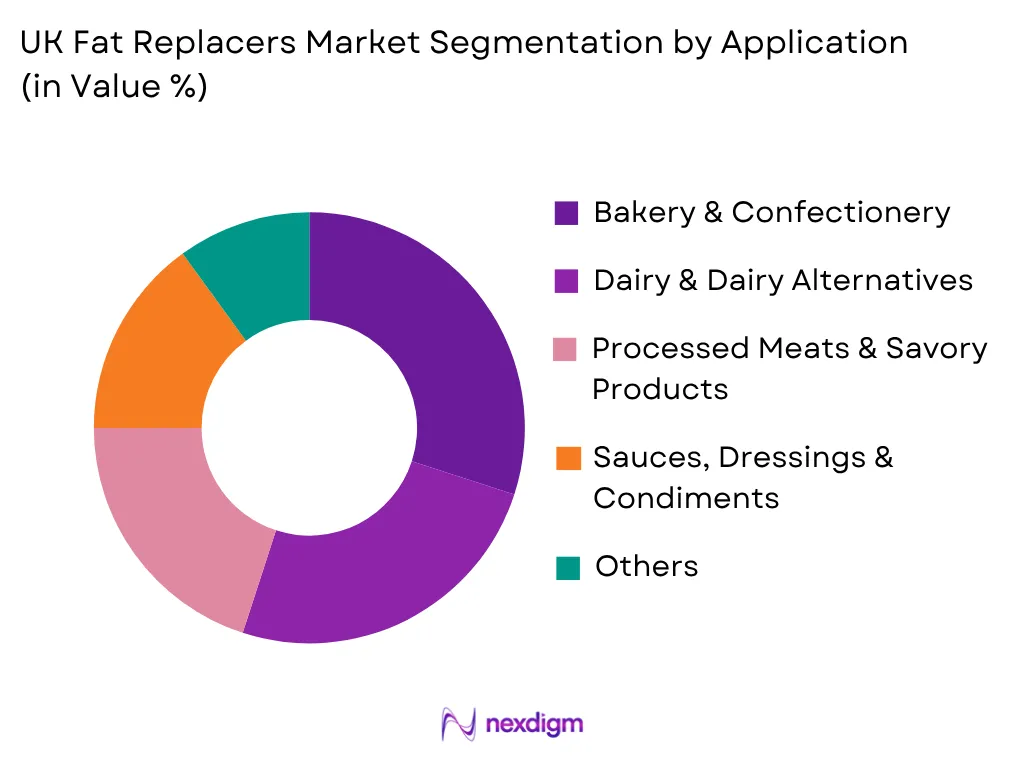
Bakery and confectionery represent the largest application segment because fat replacers play a crucial role in reducing calories while maintaining softness, moisture retention, texture, volume, and shelf stability. British consumers continue demanding healthier baked products without compromising taste, encouraging manufacturers to reformulate bread, cakes, biscuits, pastries, cookies, and sweet baked goods using carbohydrate-based fat mimetics, fibres, and protein ingredients. Major bakery manufacturers including Allied Bakeries, Hovis, and Warburtons are increasingly introducing reduced-fat premium products to satisfy growing health-conscious consumer preferences while complying with evolving Food Standards Agency labelling requirements and the UK government’s sugar and calorie reduction programmes. Fat replacers also improve processing efficiency and product consistency during industrial-scale manufacturing, making them particularly attractive for high-volume production facilities. The UK government’s Public Health England calorie reduction programme, which set targets for food manufacturers to reduce the calorie content of everyday food products by 20% by 2024, has further accelerated ingredient adoption across the bakery sector. The widespread presence of large-scale industrial bakeries, own-label supermarket bakery production, and national packaged bakery brands throughout the United Kingdom continues to reinforce the leadership of this application segment across the domestic fat replacers market.
Competitive Landscape
The UK Fat Replacers Market is moderately consolidated, with a small number of large multinational ingredient companies — including Tate & Lyle, Cargill UK, Ingredion UK, Kerry Group, and Roquette — accounting for the majority of total market revenue through extensive fat replacement ingredient portfolios, advanced technical service capabilities, and strong existing relationships with the United Kingdom’s large-scale food and beverage processing industry. Tate & Lyle holds a particularly prominent position as a UK-headquartered global ingredient leader with deep roots in the domestic food industry and extensive reformulation support capabilities. These leading companies compete through continuous investment in ingredient innovation, application-specific technical support, proprietary processing technologies, and distribution networks spanning all major UK food manufacturing regions. Post-Brexit regulatory adjustments have introduced additional compliance considerations for EU-based ingredient suppliers accessing the UK market, creating both challenges and opportunities for companies with established UK manufacturing and distribution infrastructure.
| Company | Establishment Year | Headquarters | Primary Fat Replacer Portfolio | Key Application Industries
|
Manufacturing Presence | R&D Capability | Distribution Network | Clean Label Solutions |
| Tate & Lyle PLC | 1921 | ~ | ~ | ~ | ~ | ~ | ~ | ~ |
| Cargill UK | 1965 | ~ | ~ | ~ | ~ | ~ | ~ | ~ |
| Ingredion UK | 1906 | ~ | ~ | ~ | ~ | ~ | ~ | ~ |
| Kerry Group (UK) | 1972 | ~ | ~ | ~ | ~ | ~ | ~ | ~ |
| Roquette UK | 1933 | ~ | ~ | ~ | ~ | ~ | ~ | ~ |

UK Fat Replacers Market Analysis
Growth Drivers
Government HFSS Regulations and Obesity Strategy Accelerating Food Reformulation
The United Kingdom’s proactive and comprehensive government-led approach to tackling obesity and diet-related ill health through food regulation continues to be one of the most powerful structural drivers of fat replacer demand across the country’s food processing industry. According to NHS England and Public Health England, more than 28% of adults in England are classified as obese, with obesity-related conditions costing the NHS an estimated GBP 6.1 billion annually, creating strong public policy incentives for government-mandated food reformulation programs. The UK government’s obesity strategy has introduced a range of regulatory measures that directly incentivise manufacturers to reduce fat content in processed foods, including the implementation of restrictions on the promotion of High Fat, Salt and Sugar (HFSS) products in prominent retail locations such as supermarket entrances, checkouts, and aisle ends — restrictions that significantly reduce the commercial viability of unreformulated high-fat products in major retail channels. Public Health England’s sugar and calorie reduction programmes set explicit targets for manufacturers across multiple food categories, encouraging sustained investment in fat replacement technologies. The Food Standards Agency continues to update nutritional composition standards and front-of-pack traffic light labelling guidelines, increasing consumer visibility of fat content and further driving manufacturer reformulation activity. According to the Office for National Statistics (ONS), the United Kingdom’s population exceeded 68 million in 2024, providing a substantial domestic market for reformulated healthier food products, while the World Bank estimated the UK’s nominal GDP at more than USD 3.1 trillion, supporting continued industry investment in ingredient development and manufacturing modernisation.
Expansion of Plant-Based Foods and Clean-Label Ingredient Innovation
The rapid growth of the United Kingdom’s plant-based food sector and the accelerating adoption of clean-label functional food ingredients have significantly expanded the addressable market for fat replacer technologies across multiple food categories. According to the Vegan Society and retail data from Kantar, the United Kingdom is one of Europe’s leading plant-based food markets, with plant-based meat, dairy alternatives, egg substitutes, and seafood analogs generating substantial and growing annual retail sales across the country’s major supermarket chains. The UK food industry’s strong commitment to reformulation is further demonstrated by the food and drink sector’s voluntary participation in government-led reduction programmes, which has created sustained commercial demand for technically superior fat replacement ingredient systems that can replicate the sensory properties of conventional fats in reformulated products. Plant-based food formulations inherently require sophisticated fat replacement ingredient systems because they must replicate the texture, juiciness, mouthfeel, and cooking characteristics of conventional animal-based products without access to the natural fats and proteins that provide these sensory properties. Ingredients including methylcellulose, pea protein, oat fibre, konjac flour, and carrageenan have emerged as critical components in UK plant-based meat formulations, while hydrocolloids, oat fibre, and modified starches are widely used in the country’s rapidly growing plant-based dairy alternative sector. The UK’s strong domestic oat and wheat production provides a competitive and regionally proximate source of clean-label carbohydrate- and fibre-based fat replacement ingredients, supporting the country’s food manufacturers in sourcing ingredients that meet both technical performance and consumer clean-label expectations simultaneously.
Market Challenges
Functional Performance Limitations During Food Reformulation
Despite significant technological advances, achieving the same sensory characteristics as conventional fats remains one of the most significant technical challenges for the UK fat replacers market. Fats contribute not only to caloric content but also to creaminess, lubrication, flavour release, aeration, moisture retention, emulsification, and shelf-life stability — functional properties that collectively define the eating quality of many of the United Kingdom’s most popular packaged food products, including premium biscuits, full-fat dairy products, and processed meats. Replacing these functional properties requires sophisticated ingredient combinations that increase formulation complexity and development cost. The United Kingdom’s food processing industry comprises thousands of manufacturing facilities producing highly diverse product portfolios, each requiring customised ingredient solutions depending on the specific product category, target consumer segment, and applicable nutritional labelling requirements. Manufacturers reformulating bakery products, dairy foods, chocolates, processed meats, sauces, and snack foods often face technical challenges associated with texture degradation, flavour profile changes, reduced consumer acceptance scores in sensory evaluation panels, and shorter shelf life. Although the United Kingdom benefits from domestic agricultural resources including wheat, oats, and sugar beet, certain high-performance specialty ingredients — including advanced modified hydrocolloids, precision fermentation-derived proteins, and some functional fibre isolates — rely on complex processing technologies or international supply chains that can face availability and cost pressures. Additional research, pilot-scale testing, sensory validation, and production trials increase product development timelines before commercial launch, representing a meaningful barrier to the pace of reformulation across UK food manufacturing.
Post-Brexit Supply Chain Complexity and Regulatory Transition
UK fat replacer manufacturers and food companies continue facing significant challenges associated with post-Brexit supply chain disruption, regulatory divergence from the European Union, and the operational complexity of managing ingredient supply chains across new trade and customs boundaries. According to the Food and Drink Federation (FDF), the introduction of border controls, customs declarations, and sanitary and phytosanitary checks for food ingredients imported from the EU has increased administrative costs, extended delivery lead times, and introduced additional regulatory documentation requirements for ingredient suppliers and food manufacturers sourcing materials from European origins. The UK’s departure from EU regulatory frameworks has also created uncertainty around the continued recognition of certain EU novel food authorisations and food additive approvals under UK retained food law, requiring ingredient suppliers to pursue separate UK authorisations for novel ingredients entering the market for the first time. The UK REACH chemical regulation, which diverged from EU REACH following Brexit, has added further compliance complexity for ingredient manufacturers and distributors operating across both UK and EU markets. These post-Brexit regulatory and supply chain challenges are particularly significant for the fat replacers market given that many leading ingredient suppliers, including Roquette, BENEO, and Corbion, manufacture primarily in continental European facilities and distribute to UK food manufacturers through cross-channel supply chains that have become more costly and administratively complex since the UK’s departure from the EU single market.
Market Opportunities
Expansion of Clean-Label, Plant-Based and Functional Foods
The United Kingdom’s rapidly evolving health and wellness food sector presents significant opportunities for fat replacer manufacturers serving a large, sophisticated, and highly regulation-responsive food ingredient market. Rising consumer awareness regarding balanced nutrition has accelerated demand for foods formulated with recognisable ingredients, dietary fibres, plant proteins, and naturally derived fat replacement systems. The United Kingdom’s population exceeds 68 million, while the highly urban and nutritionally engaged consumer base — with the ONS reporting more than 83% urban population concentration — provides a substantial addressable market for premium and health-oriented packaged food innovation. The UK’s strong domestic production of wheat, oats, sugar beet, and dairy ingredients provides competitive and locally available raw materials for developing clean-label carbohydrate-, fibre-, and protein-based fat replacers that meet both technical performance and consumer transparency requirements. Manufacturers are increasingly reformulating bakery products, dairy alternatives, plant-based meats, nutritional snacks, and functional beverages using starches, soluble fibres, inulin, oat fibres, and pea and soy proteins. Growing demand for vegan, flexitarian, and plant-forward diets has further encouraged food processors to invest in multifunctional ingredients capable of replacing fat while enhancing nutritional value and maintaining clean-label positioning. Ingredient suppliers capable of delivering clean-label, allergen-friendly, and minimally processed fat replacement technologies with strong application technical support and UK regulatory compliance expertise are therefore well positioned to capture significant growth within the United Kingdom’s continuously evolving and government-regulation-driven food processing industry.
Innovation in High-Protein Foods and Government-Supported Reformulation
Growing investments in functional nutrition and the UK government’s sustained food reformulation agenda are creating highly attractive opportunities for the UK fat replacers market, particularly through the convergence of high-protein food trends, plant-based innovation, and government-incentivised reduction programmes. The United Kingdom’s food industry has a long and well-established track record of voluntary reformulation in response to government-led reduction programmes, with the Food Standards Agency and Public Health England having successfully driven significant reductions in salt content across the UK food supply over the previous decade, demonstrating the commercial viability and industry appetite for government-supported ingredient reformulation. The extension of this reformulation culture to fat and calorie reduction under the current obesity strategy creates a structurally supportive environment for fat replacer ingredient demand that is arguably more systematic and policy-driven than in most other global markets. According to the British Nutrition Foundation and the Institute of Food Science and Technology, the UK food industry continues to invest in nutritional improvement as a core component of corporate responsibility and retailer relationship management, with major supermarkets including Tesco, Sainsbury’s, and Marks & Spencer maintaining active reformulation partnership programmes with their supplier base. Simultaneously, the UK’s growing high-protein food market — encompassing sports nutrition, high-protein dairy products, protein-enriched snacks, and functional meal solutions — creates additional commercial applications for protein-based fat mimetics, particularly whey protein microparticulates and pea protein systems that simultaneously provide fat replacement, protein enrichment, and clean-label positioning.
Future Outlook
The UK Fat Replacers Market is expected to experience sustained expansion throughout the forecast period, supported by the UK government’s ongoing obesity strategy, sustained consumer demand for healthier and reduced-fat food products, and the continued growth of plant-based and functional food categories. Food manufacturers are expected to accelerate product reformulation activities as HFSS placement restrictions, calorie reduction programme targets, and front-of-pack labelling requirements create increasing commercial incentives for fat content reduction across multiple food categories. Rapid innovation in dietary fibres, plant proteins, hydrocolloids, resistant starches, and precision fermentation ingredients is likely to improve ingredient functionality while maintaining desirable sensory characteristics. Growing investments in food technology, sustainable ingredient sourcing, and UK-based manufacturing capacity will further strengthen the domestic ingredient ecosystem. Expansion of plant-based foods, high-protein dairy products, and functional snacks will create additional commercial opportunities. Simultaneously, progressive resolution of post-Brexit regulatory frameworks and supply chain adjustments are expected to improve operational predictability for ingredient suppliers serving the UK food processing industry.
Major Players
- Tate & Lyle PLC
- Cargill UK
- Ingredion UK
- Kerry Group (UK)
- Roquette UK
- IFF (Danisco UK)
- DSM-Firmenich UK
- CP Kelco UK
- BENEO UK
- Corbion UK
- Fiberstar, Inc.
- Glanbia Nutritionals UK
- Ashland UK
- Jungbunzlauer UK
- Brenntag UK (Specialty Ingredients Distribution)
Key Target Audience
- Food & Beverage Manufacturers
- Bakery & Confectionery Manufacturers
- Dairy Product Manufacturers
- Meat & Processed Food Manufacturers
- Functional Food & Nutraceutical Companies
- Ingredient Distributors & Specialty Food Ingredient Suppliers
- Investments and Venture Capitalist Firms
- Government and Regulatory Bodies (Food Standards Agency (FSA), Department for Environment, Food and Rural Affairs (DEFRA), Food and Drink Federation (FDF))
Research Methodology
Step 1: Identification of Key Variables
The research process begins with identifying all major stakeholders across the UK Fat Replacers Market ecosystem, including raw material suppliers, specialty ingredient manufacturers, food processors, distributors, retailers, regulatory authorities, and end-use industries. Extensive desk research is conducted using government publications, FSA and DEFRA databases, trade statistics, company annual reports, food ingredient databases, industry journals, and proprietary databases to determine the key variables influencing market demand, supply dynamics, technological developments, and regulatory compliance.
Step 2: Market Analysis and Construction
Historical market information is compiled and analysed to evaluate consumption patterns, ingredient utilisation rates, production capacities, import-export movements, application trends, and industrial demand across different food categories. A combination of top-down and bottom-up market sizing approaches is adopted to estimate market revenues, supported by demand-side consumption analysis and supply-side production assessment. Data triangulation techniques are employed to ensure consistency across all market segments and sub-segments.
Step 3: Hypothesis Validation and Expert Consultation
The preliminary market estimates and analytical assumptions are validated through Computer Assisted Telephone Interviews (CATIs) and structured discussions with food ingredient manufacturers, formulation experts, procurement managers, product development specialists, regulatory professionals, and executives from food processing companies. Their operational and commercial insights are utilised to verify ingredient adoption trends, technological developments, purchasing behaviour, and future market opportunities while improving the accuracy of market forecasts.
Step 4: Research Synthesis and Final Output
The final phase integrates findings from secondary research and primary interviews to prepare a comprehensive assessment of the UK Fat Replacers Market. Detailed analyses covering market size, segmentation, competitive landscape, innovation trends, application analysis, consumer preferences, and future growth prospects are developed through multiple rounds of validation. Cross-verification using both supply-side and demand-side information ensures that the final report delivers reliable, actionable, and business-oriented market intelligence.

- Executive Summary
- Research Methodology (Market Definitions and Assumptions, Abbreviations, Market Taxonomy, Market Sizing Approach, Top-Down Analysis, Bottom-Up Analysis, Demand-Side Assessment, Supply-Side Assessment, Primary Industry Interviews, Secondary Research Validation, Data Triangulation, Forecasting Framework, Limitations and Future Conclusions)

- Definition and Scope
- Market Evolution and Industry Genesis
- Timeline of Major Industry Developments
- Fat Replacer Industry Value Chain Analysis
- Supply Chain Analysis

- Growth Drivers (Growing Low-Fat and Reduced-Calorie Food Demand, Rising Obesity and Cardiovascular Disease Awareness, Government HFSS Regulations Accelerating Reformulation, Expansion of Plant-Based Food Processing, Increasing Clean Label Demand, Rising Dairy and Bakery Reformulation Activities)
- Market Challenges (High Ingredient Development and Formulation Costs, Functional Performance Limitations, Consumer Acceptance of Reformulated Foods, Post-Brexit Supply Chain Complexity, Raw Material Price Volatility, Regulatory Transition Under UK REACH and FSA Standards)
- Market Opportunities (Expansion of Plant-Based and Alternative Protein Foods, Rising High-Protein and Sports Nutrition Products, Sugar & Fat Reduction Initiatives Under UK Obesity Strategy, Premium Healthy Snack Innovation, Functional Dairy Reformulation, Clean Label and Natural Ingredient Development)
- Market Trends (Hydrocolloid Innovation, Plant Protein Fat Mimetics, Fibre-Enriched Fat Replacers, Natural Ingredient Reformulation, Multi-Functional Ingredient Systems, Precision Fermentation Ingredients)
- Government Regulations (Food Standards Agency (FSA) Food Safety Regulations, UK Food Additives Legislation, Nutrition and Health Claims Regulation (retained EU law), HFSS (High Fat Salt Sugar) Product Restrictions, UK Nutrient Profiling Model, Front-of-Pack Traffic Light Labelling, UK REACH Chemical Regulations, Novel Food Authorisation Process)
- Ingredient Innovation Landscape (Novel Hydrocolloids, Resistant Starches, Soluble Fibres, Functional Proteins, Oleogel Technology, Enzyme-Based Fat Modification, Precision Fermentation Ingredients)
- Raw Material Supply Analysis (Wheat Starch, Oat Fibre, Pea Protein, Whey Protein, Chicory Root Fibre, Cellulose Sources, Sugar Beet Fibre)
- Import Dependency Assessment (Specialty Hydrocolloids, Guar Gum, Locust Bean Gum, Novel Food Ingredients, Advanced Protein Isolates, Post-Brexit EU Import Complexity)
- Product Reformulation Landscape (Fat Reduction Targets Under UK Obesity Strategy, Texture Optimisation, Flavour Retention, Shelf-Life Stability, Calorie Reduction)
- Consumer Health & Nutrition Analysis (Low-Fat Consumption Trends, Clean Label Preference, Functional Food Adoption, Weight Management Demand, High-Protein Consumption)
- Sustainability Assessment (Renewable Raw Materials, Sustainable Ingredient Sourcing, Food Waste Reduction, Carbon Footprint Optimisation)
- SWOT Analysis
- Porter’s Five Forces Analysis
- PESTLE Analysis
- Stakeholder Ecosystem
- Competition Ecosystem

- By Market Value (2020-2025)
- By Volume Consumption (2020-2025)
- By Average Selling Price (2020-2025)

- By Source (In Value %)
Carbohydrate-Based Fat Replacers
Protein-Based Fat Replacers
Lipid-Based Fat Replacers
Fibre-Based Fat Replacers
Botanical & Plant-Derived Fat Replacers
Microbial Fermentation-Based Fat Replacers - By Ingredient Type (In Value %)
Starch-Based Fat Replacers
Cellulose-Based Fat Replacers
Protein-Based Fat Replacers
Functional & Fortified Fat Replacers
Organic & Natural Fat Replacers
Plant-Based & Vegan Fat Replacers - By Product Type (In Value %)
Starch Derivatives
Cellulose Derivatives
Inulin
Maltodextrin
Whey Protein Concentrates
Microparticulated Proteins
Polydextrose
Hydrocolloids - By Functionality (In Value %)
Fat Mimetic
Fat Substitute
Fat Extender
Texture Enhancer
Mouthfeel Enhancer - By Application (In Value %)
Bakery & Confectionery
Dairy & Dairy Alternatives
Processed Meats & Savoury Products
Sauces, Dressings & Condiments
Snacks & Extruded Products
Functional & Sports Nutrition
Frozen & Ready Meals - By Region (In Value %)
England
Scotland
Wales
Northern Ireland

- Market Share Analysis (By Value, Volume, Source Type, Application, End User)
- Cross Comparison Parameters (Fat Replacement Technology Portfolio, Clean Label Ingredient Portfolio, Functional Ingredient Innovation, Food Application Coverage, Manufacturing Capacity, UK Distribution Network, Regulatory Compliance Expertise, R&D Investment & Product Development Capability)
- SWOT Analysis of Major Players
- Pricing Analysis (By Ingredient Type, Functional Performance, Application Category, Inclusion Rate, Purity Level)
- Detailed Profiles of Major Companies
Tate & Lyle PLC
Cargill UK
Ingredion UK
Kerry Group (UK)
Roquette UK
IFF (Danisco UK)
DSM-Firmenich UK
CP Kelco UK
BENEO UK
Corbion UK
Fiberstar, Inc.
Glanbia Nutritionals UK
Ashland UK
Jungbunzlauer UK
Brenntag UK (Specialty Ingredients Distribution)

- Ingredient Utilisation Analysis (Application Intensity, Inclusion Rate, Formulation Complexity, Processing Compatibility)
- Purchasing Criteria Assessment (Functionality, Cost Efficiency, Regulatory Compliance, Label Friendliness, Ingredient Availability)
- Product Reformulation Analysis (Fat Reduction Targets, Sensory Performance, Texture Retention, Shelf-Life Extension)
- Consumer Preference Analysis (Taste Acceptance, Mouthfeel, Nutrition Claims, Clean Label Preference, Protein Enrichment)
- Decision-Making Framework (R&D Teams, Procurement, Regulatory Affairs, Product Development, Commercialisation)

- By Market Value (2026-2035)
- By Volume Consumption (2026-2035)
- By Average Selling Price (2026-2035)


 Request a Sample
 Ask for Customization
 Get a Quote
 Enquire Now