
 Download PDF
Market Overview
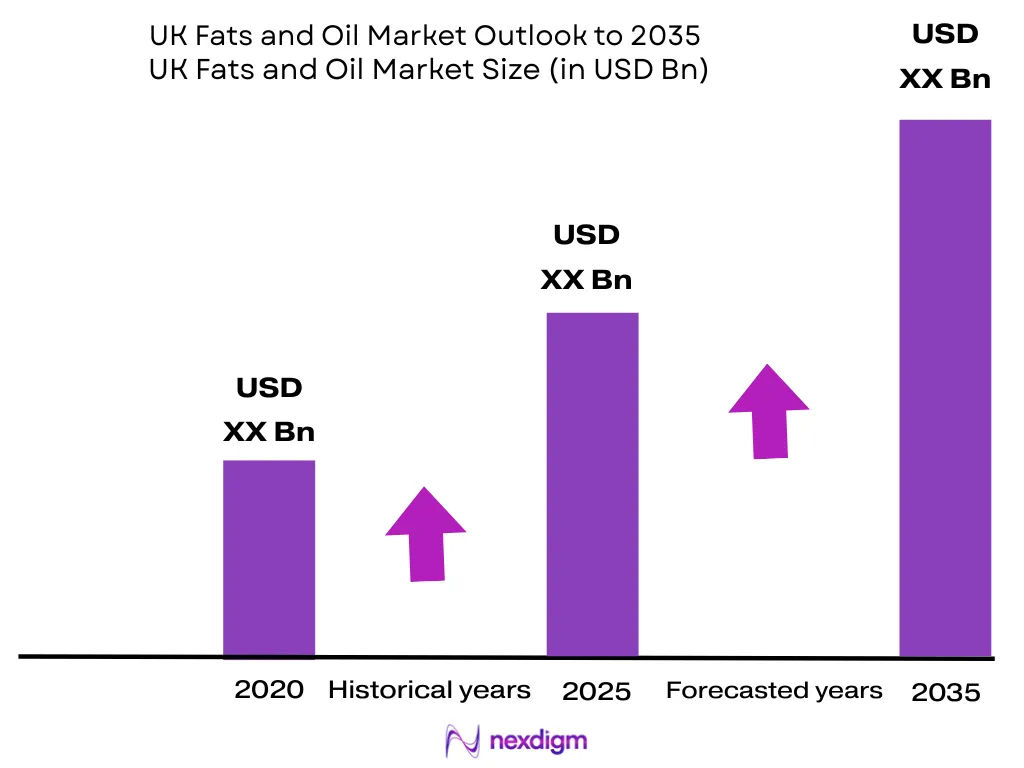
The UK Fats and Oil Market is valued at USD ~ billion, based on a five-year historical analysis, and is forecasted to grow at a CAGR of ~% during the forecast period. Demand is driven by household cooking oils, foodservice frying oils, bakery fats, spreads, animal fats, and renewable fuel feedstocks. UK oilseed rape output reached around 824 thousand tonnes after the prior crop had been higher, while UK GDP reached USD 3.69 trillion, supporting food and retail demand. England, Scotland, East Anglia, Yorkshire and Humber, the Midlands, London and the South East dominate the UK Fats and Oil Market because of rapeseed cultivation, food manufacturing density, population concentration, supermarket distribution, fish-and-chip foodservice demand, and import-linked refinery access. Scotland’s oilseed rape production reached 0.13 million tonnes, while UK renewable fuel supply reached 3,809 million litres equivalent, strengthening demand for used cooking oil and waste-fat collection networks.
Market Segmentation
By Product Type
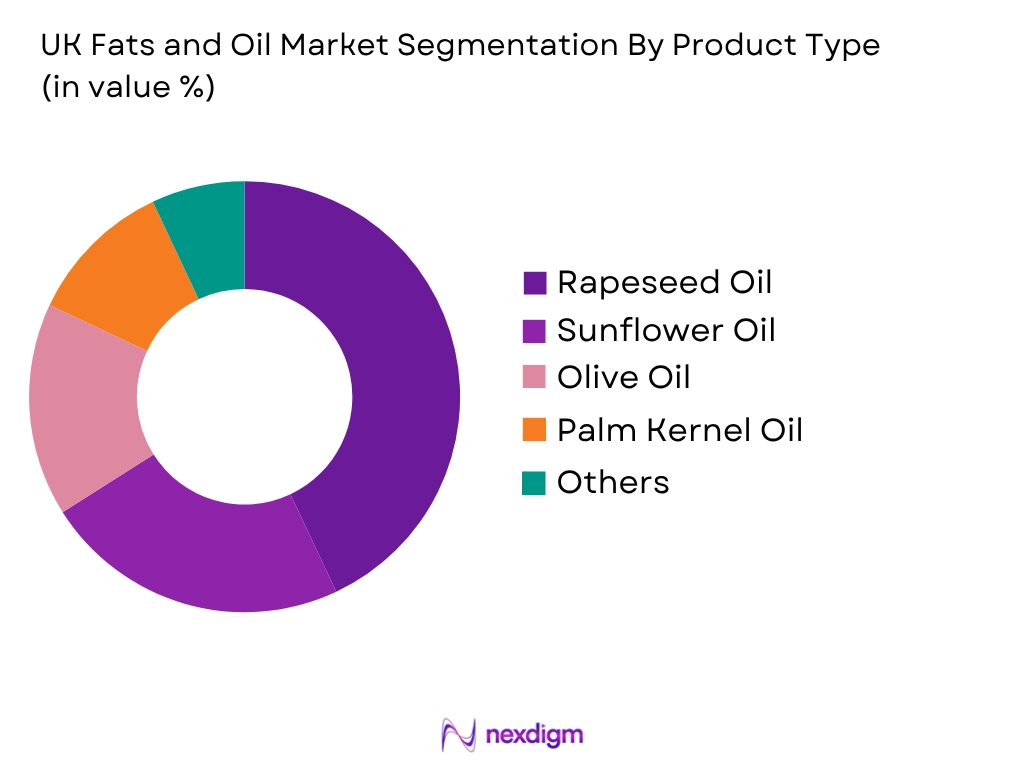
UK Fats and Oil Market is segmented by product type into rapeseed oil, sunflower oil, olive oil, palm oil, palm kernel oil, soybean oil, coconut oil, corn oil, groundnut oil, avocado oil, butter, dairy fats, lard, beef tallow, poultry fat, shortening, margarine, spreads, and specialty fats. Recently, rapeseed oil has had the dominant market share under the product type segmentation due to its domestic crop linkage, strong use in retail cooking oil, foodservice frying, private label vegetable oil blends, and industrial food formulations. Rapeseed oil also benefits from its low-saturated-fat positioning, neutral flavor, suitability for roasting and frying, and “British origin” claims used by premium cold-pressed brands. Olive oil is strong in premium retail, while palm oil is important in bakery, confectionery, spreads, and industrial fats. However, rapeseed oil remains the structural anchor because it connects local agriculture, refining, retail shelves, food manufacturing, and foodservice procurement.
By Application
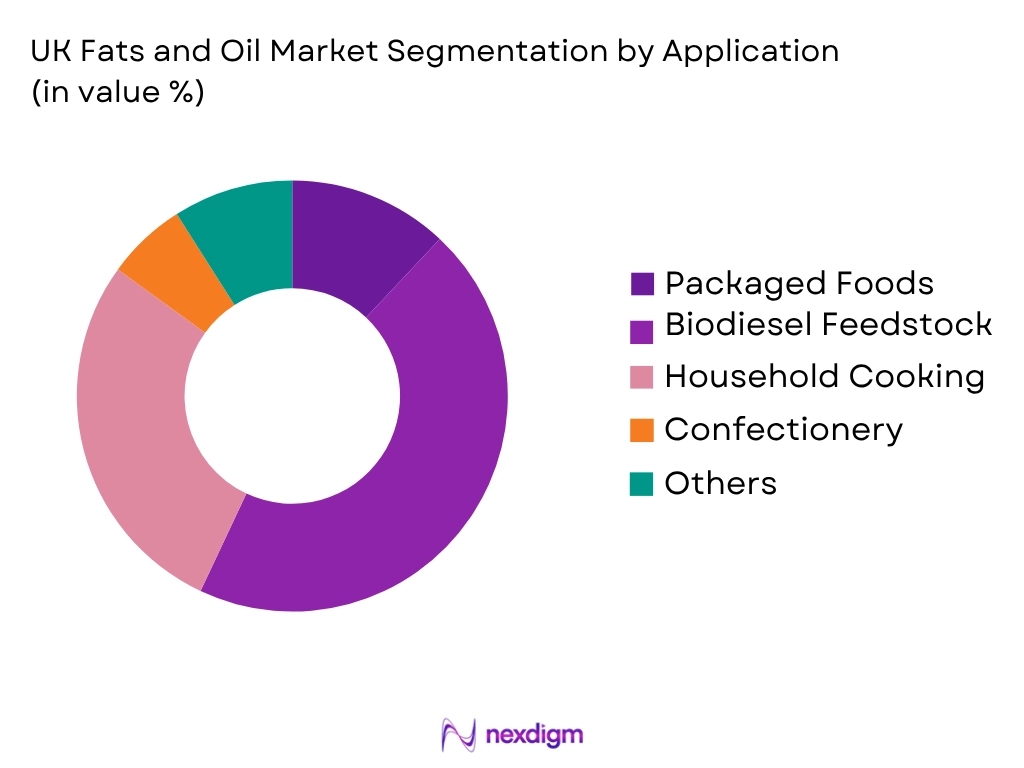
UK Fats and Oil Market is segmented by application into household cooking, foodservice frying, bakery and confectionery, ready meals and packaged foods, snack food processing, margarine and spread manufacturing, meat processing, biodiesel and renewable fuel feedstock, animal feed, oleochemicals, cosmetics, and personal care ingredients. Recently, household cooking and retail consumption have had the dominant market share under the application segmentation because oils, butter, spreads, and fats remain staple pantry and cooking ingredients across UK households. Supermarkets, discounters, convenience stores, and online grocery platforms support high product availability across rapeseed oil, sunflower oil, olive oil, vegetable oil, butter, and spreads. Foodservice frying is also important because restaurants, QSR chains, pubs, hotels, fish-and-chip shops, and institutional kitchens require high-stability oils. Industrial applications are more fragmented, but bakery, confectionery, and ready-meal manufacturers drive consistent demand for palm-based fats, shortenings, emulsified fats, and application-specific lipid systems.
Competitive Landscape
The UK Fats and Oil Market is led by a mix of global agribusiness processors, domestic refiners, foodservice oil suppliers, supermarket private-label suppliers, premium cold-pressed rapeseed brands, and renewable fuel feedstock companies. ADM UK, Cargill UK, AAK UK, KTC Edibles, and Princes Group hold strong relevance due to oilseed processing, refining, imported oil access, industrial ingredient supply, foodservice packs, retail cooking oils, and private-label relationships. Competition is shaped by rapeseed availability, import dependency, sustainable palm certification, used cooking oil sourcing, foodservice fryer performance, and supermarket price positioning.
| Company | Establishment Year | Headquarters | Core Portfolio | Processing Strength | Key End Users | Channel Strength | Sustainability Focus | Market-Specific Advantage |
| ADM UK | 1902 parent origin | London, UK / Chicago, USA | ~ | ~ | ~ | ~ | ~ | ~ |
| Cargill UK | 1865 parent origin | Weybridge, UK / Minnesota, USA | ~ | ~ | ~ | ~ | ~ | ~ |
| AAK UK | 1871 parent origin | Hull, UK / Malmö, Sweden | ~ | ~ | ~ | ~ | ~ | ~ |
| KTC Edibles | 1972 | Wednesbury, UK | ~ | ~ | ~ | ~ | ~ | ~ |
| Princes Group | 1880 parent history | Liverpool, UK | ~ | ~ | ~ | ~ | ~ | ~ |
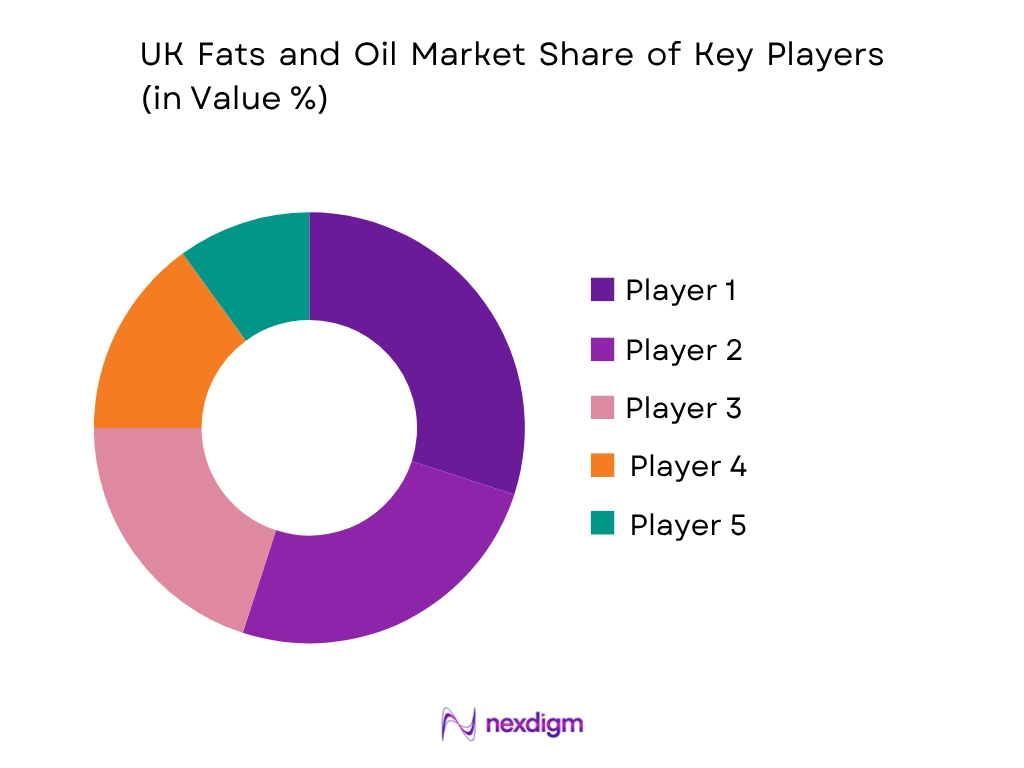
UK Fats and Oil Market Analysis
Growth Drivers
Domestic Rapeseed Oil and Food Manufacturing Demand
Domestic rapeseed oil availability is a growth driver for the UK Fats and Oil Market because rapeseed is the country’s principal oilseed crop and supports retail cooking oils, foodservice frying blends, bakery fats, spreads, and packaged food formulations. DEFRA reported UK oilseed rape production at 824 thousand tonnes and later reported production at 893 thousand tonnes, giving crushers and refiners a domestic feedstock base for British rapeseed oil and blended vegetable oil products. The wider food chain strengthens this demand base, with DEFRA’s Food Statistics Pocketbook reporting agri-food chain GVA at £153.2 billion and food chain GVA excluding agriculture and fishing at £139.5 billion. World Bank data records UK GDP at USD 3.69 trillion and GDP per capita at USD 53,246.4, indicating a high-value consumer and food-manufacturing economy. These figures are market specific because fats and oils are technical ingredients in bakery, confectionery, ready meals, snacks, sauces, spreads, frying applications, and household cooking, not just commodity cooking products.
Renewable Fuel and Used Cooking Oil Demand
Renewable fuel policy is a growth driver for the UK Fats and Oil Market because used cooking oil, tallow, waste fats, and other lipid streams are pulled into biodiesel and renewable fuel supply chains. GOV.UK’s RTFO final report recorded 3,809 million litres equivalent of renewable fuel supplied for road and non-road mobile machinery, while biodiesel accounted for 22 verified renewable-fuel units out of every 100, with 81 out of every 100 biodiesel units produced from used cooking oil. The prior final report recorded 2,669 million litres equivalent of renewable fuel from waste feedstocks, showing the scale of waste-derived fuel integration. World Bank data places UK GDP at USD 3.69 trillion and total population at roughly 69.1 million, while IMF’s 2026 profile lists UK current-price GDP at USD 4.26 trillion. These macro indicators support a large transport, foodservice, restaurant, catering, and waste-oil collection base. The market impact is direct: fryers, collectors, renderers, refiners, and renewable fuel suppliers increasingly compete for traceable waste oils and fats.
Market Challenges
Rapeseed Crop Volatility and Import Dependence
Rapeseed crop volatility is a central challenge for the UK Fats and Oil Market because domestic rapeseed oil positioning depends on farm output, planted area, yield, weather, crushing availability, and refinery scheduling. DEFRA reported UK oilseed rape production at 824 thousand tonnes after a difficult crop season, while the next estimate showed 893 thousand tonnes, with the change driven largely by yield recovery. Scotland separately reported oilseed rape yield at 3.6 tonnes per hectare, lower than the previous crop and below the 5-year average of 3.9 tonnes per hectare. This volatility affects British rapeseed oil supply, foodservice frying blends, private-label vegetable oils, animal feed co-products, and processor utilization. World Bank data records UK GDP at USD 3.69 trillion, GDP per capita at USD 53,246.4, and a population of roughly 69.1 million, confirming a large downstream demand base that must be served even when local crop output weakens. The result is greater reliance on imported sunflower, olive, palm, soybean, and tropical oils for substitution and blending.
Processing, Traceability and Regulatory Complexity
Processing and traceability complexity restrain the UK Fats and Oil Market because edible oils and fats require food-grade handling, refining, blending, allergen-safe operations, palm certification, import documentation, nutrition labeling, renewable-fuel traceability, and waste-oil chain-of-custody controls. The challenge is intensified by the scale of the UK food system: DEFRA reported agri-food chain GVA of £153.2 billion and food chain GVA excluding agriculture and fishing of £139.5 billion, while food and drink manufacturing is identified by the UK government as the country’s largest manufacturing sector by turnover at £104.4 billion. GOV.UK’s RTFO framework also creates traceability requirements for low-carbon feedstocks, with 3,809 million litres equivalent of renewable fuel supplied and used cooking oil forming the dominant biodiesel feedstock. World Bank data records UK GDP at USD 3.69 trillion and GDP per capita at USD 53,246.4. For market participants, this means oils must meet multiple specifications across retail cooking, bakery fats, confectionery, foodservice frying, plant-based spreads, biodiesel, and oleochemical applications, increasing operational and compliance burden.
Market Opportunities
Premium, British-Origin and Health-Positioned Oils
Premium, British-origin, and health-positioned oils create an opportunity for the UK Fats and Oil Market because rapeseed oil, cold-pressed seed oils, olive oil, avocado oil, and low-saturated-fat blends can serve consumers seeking provenance, cooking performance, and nutritional differentiation. DEFRA reported UK oilseed rape production at 893 thousand tonnes after 824 thousand tonnes, showing a domestic feedstock base that can support British rapeseed oil brands even with crop variability. NHS guidance states that men should not eat more than 30g of saturated fat a day and women should not eat more than 20g, reinforcing demand for vegetable oils and spreads positioned around lower saturated fat compared with butter or lard. World Bank data records GDP per capita at USD 53,246.4 and population at roughly 69.1 million, supporting a large retail base for premium oils, private label oils, and health-oriented cooking fats. This opportunity is market specific because oils compete not only on price, but also on origin claims, cold-pressed processing, smoke point, omega profile, recipe use, and retail trust.
Circular Used Cooking Oil and Foodservice Oil Management
Circular used cooking oil systems create an opportunity for the UK Fats and Oil Market because restaurants, QSR chains, pubs, caterers, hotels, fish-and-chip shops, and institutional kitchens generate recoverable lipid streams that can be collected, filtered, traded, refined, and used in renewable fuel supply chains. GOV.UK reported 3,809 million litres equivalent of renewable fuel supplied, with biodiesel representing 22 verified renewable-fuel units out of every 100 and 81 out of every 100 biodiesel units produced from used cooking oil. The earlier renewable fuel report also recorded 2,669 million litres equivalent of renewable fuel from waste feedstocks, confirming the operational base for waste-oil aggregation. The UK’s macro base strengthens the opportunity, with World Bank data recording GDP of USD 3.69 trillion and GDP per capita of USD 53,246.4, while IMF’s 2026 profile records current-price GDP of USD 4.26 trillion. This creates room for integrated oil supply, fryer servicing, filtration, collection, sustainability documentation, RTFO compliance support, and feedstock trading models across the foodservice and renewable fuel interface.
Future Outlook
The UK Fats and Oil Market is expected to expand steadily during the forecast period, supported by household cooking oil demand, foodservice recovery, premium retail oils, private-label expansion, and industrial demand from bakery, confectionery, ready meals, snacks, and spreads. Rapeseed oil will remain structurally important due to its domestic association and low-saturated-fat positioning, although local crop volatility will keep import dependence relevant. Foodservice demand will remain a central growth pillar. Fish-and-chip shops, pubs, QSR chains, restaurants, hotels, catering firms, and institutional kitchens require oils with frying stability, neutral taste, consistent supply, and waste oil collection support. Suppliers that combine oil sales with filtration advice, collection contracts, compliance support, and consistent delivery will hold stronger buyer relationships.
Retail demand will continue to split between value-led private label and premium specialty oils. Discounters and supermarket own-label ranges will remain important for rapeseed, sunflower, and vegetable oils, while olive oil, avocado oil, organic oils, and cold-pressed British rapeseed oil will support premium baskets. Consumer concerns around saturated fat, seed oils, palm oil, and ultra-processed foods will influence product communication. Renewable fuel and circular feedstock demand will increase competition for used cooking oil, animal fats, and waste-derived lipid streams. RTFO-linked demand already makes UCO an important renewable fuel input, creating opportunities for collectors, renderers, refiners, and traceability providers. Sustainability, waste-fat documentation, palm certification, and supply-chain transparency will become more important for both food and fuel buyers.
Major Players
- ADM UK
- Cargill UK
- AAK UK
- Olenex
- KTC Edibles
- Princes Group
- Edible Oils Limited
- Aldi UK
- Tesco Own Brand
- Sainsbury’s Own Brand
- Waitrose Duchy Organic
- Biona Organic
- Farrington Oils
- Hillfarm Oils
- Greenergy
Key Target Audience
- Edible Oil Manufacturers
- Oilseed Crushers and Refiners
- Food Processing Companies
- Foodservice and QSR Operators
- Supermarket and Private Label Buyers
- Biodiesel and Renewable Fuel Producers
- Investments and Venture Capitalist Firms
- Government and Regulatory Bodies (Food Standards Agency, Department for Environment Food and Rural Affairs, Department for Transport, HM Revenue and Customs, Office for Health Improvement and Disparities)
Research Methodology
Step 1: Identification of Key Variables
The initial phase involves constructing an ecosystem map encompassing all major stakeholders within the UK Fats and Oil Market. This includes oilseed growers, crushers, refiners, importers, renderers, foodservice distributors, retailers, private-label suppliers, food manufacturers, renewable fuel producers, and regulators. The objective is to define variables such as product type, source, application, channel, pack size, import exposure, and sustainability requirement.
Step 2: Market Analysis and Construction
In this phase, historical data is compiled and analyzed for the UK Fats and Oil Market. The assessment covers rapeseed production, imported vegetable oils, retail cooking oils, foodservice frying oils, bakery fats, animal fats, used cooking oil, renewable fuel feedstocks, and regional demand clusters. Top-down validation uses government and trade datasets, while bottom-up validation uses SKU mapping and channel-level checks.
Step 3: Hypothesis Validation and Expert Consultation
Market hypotheses are validated through interviews with refiners, food ingredient suppliers, foodservice distributors, supermarket category buyers, importers, renderers, UCO collectors, and industrial food manufacturers. These consultations provide operational insights into product substitution, private-label demand, frying oil performance, import dependence, sustainability documentation, and renewable fuel-linked feedstock pressure. This step strengthens segmentation and competitive validation.
Step 4: Research Synthesis and Final Output
The final phase integrates desk research, expert interviews, retail checks, trade mapping, segmentation analysis, and competitive benchmarking into a consolidated market model. Supplier and buyer inputs are compared with observed shelf presence, industrial demand indicators, foodservice procurement practices, and feedstock movement. The final output provides a validated view of market size, segmentation, competition, future outlook, and strategic implications.

- Executive Summary
- Research Methodology (Market Definitions and Assumptions, Abbreviations, Edible Fats and Oils Classification, Vegetable Oil and Animal Fat Inclusion Criteria, Rapeseed Oil Supply-Use Mapping, Palm Oil and Specialty Fat Inclusion Criteria, Retail vs Foodservice vs Industrial Demand Mapping, Market Sizing Approach, Top-Down Analysis, Bottom-Up Analysis, Demand-Side Assessment, Supply-Side Assessment, DEFRA Agriculture and Food Data Validation, AHDB Oilseed Rape Market Assessment, HMRC Import and Export Trade Checks, Retail SKU Audits, Distributor and Foodservice Channel Interviews, Industrial Ingredient Buyer Interviews, Primary Industry Interviews, Data Triangulation, Forecasting Framework, Limitations and Future Conclusions)

- Definition and Scope
- Market Evolution and Industry Genesis
- Timeline of Major Industry Developments
- Business Cycle and Seasonal Demand Pattern
- Oilseed Rape Crushing and Refining Value Chain Analysis
- Animal Fat Rendering Value Chain Analysis
- Palm Oil and Specialty Fat Value Chain Analysis
- Supply Chain Analysis
- Domestic Production vs Import Dependency
- Food, Foodservice, Retail and Biofuel Demand Ecosystem

- Growth Drivers (Domestic Rapeseed Oil Positioning, Food Processing Demand, Foodservice Frying Oil Consumption, Retail Private Label Expansion, Premium Olive Oil Demand, Bakery and Confectionery Fat Use, Plant-Based Spread Adoption, Used Cooking Oil Collection, Renewable Fuel Feedstock Demand)
- Market Challenges (Oilseed Rape Yield Volatility, Import Dependence for Sunflower and Olive Oil, Palm Oil Sustainability Scrutiny, Seed Oil Health Debate, Food Inflation Pressure, Foodservice Volume Pressure, Biofuel Feedstock Competition, Post-Brexit Trade Friction, Refining and Logistics Constraints)
- Market Opportunities (Cold-Pressed British Rapeseed Oil, High-Oleic Frying Oils, Sustainable Palm Oil Sourcing, Used Cooking Oil Circular Economy, Clean Label Bakery Fats, Plant-Based Butter and Spreads, Premium Mediterranean Oils, Private Label Cooking Oils, Foodservice Oil Management Services)
- Market Trends (Shift Toward British Rapeseed Oil, Premiumization in Olive and Avocado Oil, Plant-Based Fat Systems, Traceable Palm and Soy Sourcing, Reformulation Away from High Saturated Fat, Foodservice Fry-Life Optimization, Discounters and Private Label Growth, Online Specialty Oil Discovery)
- SWOT Analysis
- Porter’s Five Forces Analysis
- PESTLE Analysis

- By Market Value (2020-2025)
- By Volume Consumption (2020-2025)
- By Average Selling Price (2020-2025)

- By Product Type (In Value %)
Rapeseed Oil
Sunflower Oil
Olive Oil
Palm Oil
Shortening - By Source Type (In Value %)
Vegetable Oils
Animal-Based Fats
Dairy-Based Fats
Blended Oils and Fats
Tropical Oils - By Distribution Channel (In Value %)
Supermarkets and Hypermarkets
Discounters
Convenience Stores
Cash-and-Carry and Wholesale Clubs
Online Grocery Retail
- By Region (In Value %)
England
Scotland
Wales
Northern Ireland

- Market Share of Major Players (By Value, Volume, Product Type, Application, Channel, Source Type)
- Competitive Positioning Matrix (Rapeseed Origination Access, Refining Capability, Retail Brand Strength, Private Label Capability, Foodservice Penetration, Industrial Ingredient Portfolio, Sustainable Palm Credentials, Used Cooking Oil Collection Exposure)
- Cross Comparison Parameters (Rapeseed Oil Portfolio Strength, Refining and RBD Capability, Foodservice Frying Oil Range, Private Label Manufacturing Capability, Sustainable Palm and RSPO Coverage, Used Cooking Oil Collection Network, Plant-Based Spreads and Specialty Fat Innovation, UK Retail and Foodservice Distribution Reach)
- SWOT Analysis of Major Players
- Detailed Profiles of Major Companies
ADM UK
Cargill UK
AAK UK
Olenex
KTC Edibles
Princes Group
Edible Oils Limited
Aldi UK
Tesco Own Brand
Sainsbury’s Own Brand
Waitrose Duchy Organic
Biona Organic
Farrington Oils
Hillfarm Oils
Greenergy

- Household Consumption Behavior Assessment
- Foodservice Demand Assessment
- Industrial Food Manufacturer Demand Assessment
- Health and Wellness Influence on Purchase Decisions
- Purchasing Power and Trade-Down Analysis

- By Market Value (2026-2035)
- By Volume Consumption (2026-2035)
- By Average Selling Price (2026-2035)


 Request a Sample
 Ask for Customization
 Get a Quote
 Enquire Now