

 Download PDF
Market Overview
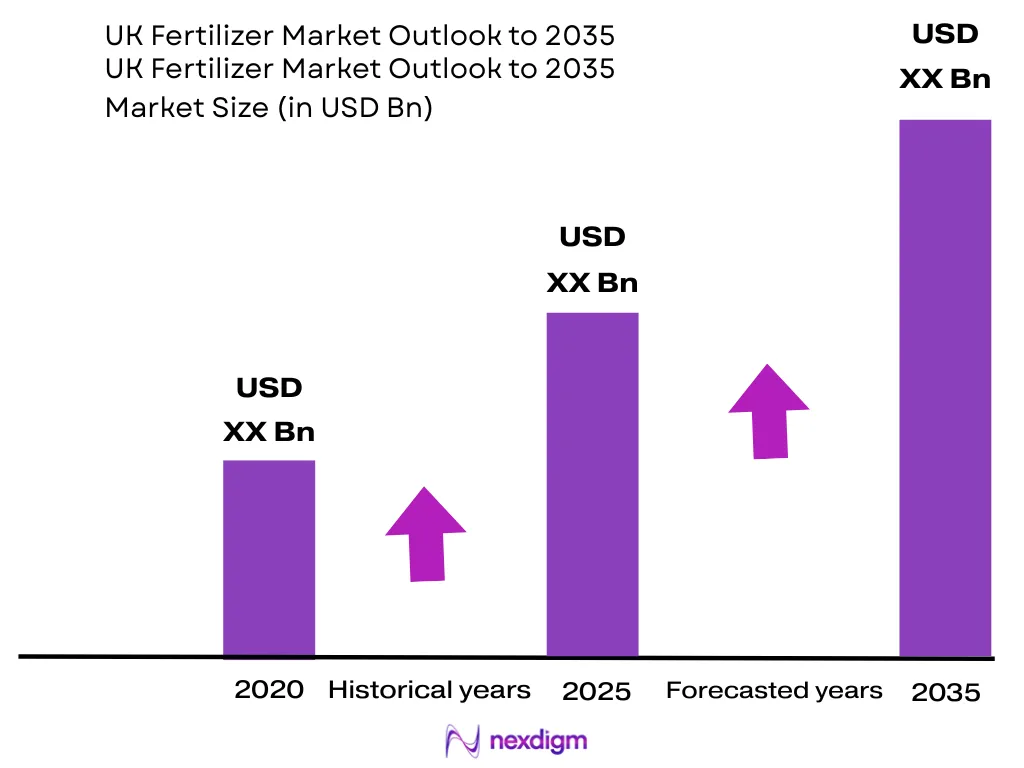
The UK fertilizer market is a well-established agricultural input market, supported by the country’s position as a significant producer of winter wheat, oilseed rape, barley, sugar beet, and potatoes. The United Kingdom cultivated approximately 6 million hectares of arable land and produced around 24 million metric tons of cereals and oilseeds, creating substantial demand for nutrient replenishment and soil fertility management. Fertilizer consumption reached approximately 1.6 million metric tons of nutrients, driven by the need to sustain crop yields on intensively farmed land, rising crop productivity requirements, increasing adoption of precision farming technologies, and government initiatives aimed at balancing agricultural productivity with environmental sustainability.
Market Segmentation
By Nutrient Type
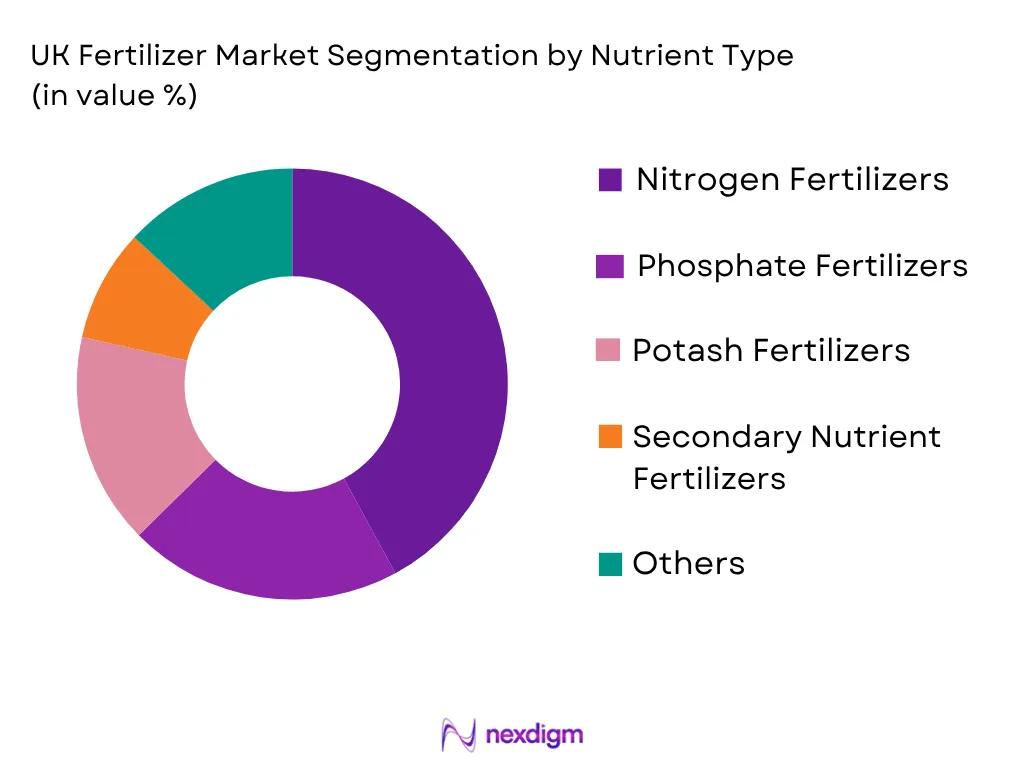
Nitrogen fertilizers dominate the UK fertilizer market due to the country’s extensive cultivation of nitrogen-intensive crops such as winter wheat, oilseed rape, and barley. UK agricultural soils require consistent nitrogen replenishment to achieve commercially viable yields across multiple growing seasons on intensively farmed arable land. Ammonium nitrate (AN) is the most widely used nitrogen product in the UK market, supported by strong agronomic guidance from the Agriculture and Horticulture Development Board (AHDB). The adoption of planned nitrogen management, supported by government regulations and nutrient management planning, underpins steady demand. Growing emphasis on nitrogen use efficiency and compliance with nitrate vulnerable zone regulations further shapes product preferences within the nitrogen fertilizer segment.
By Crop Type
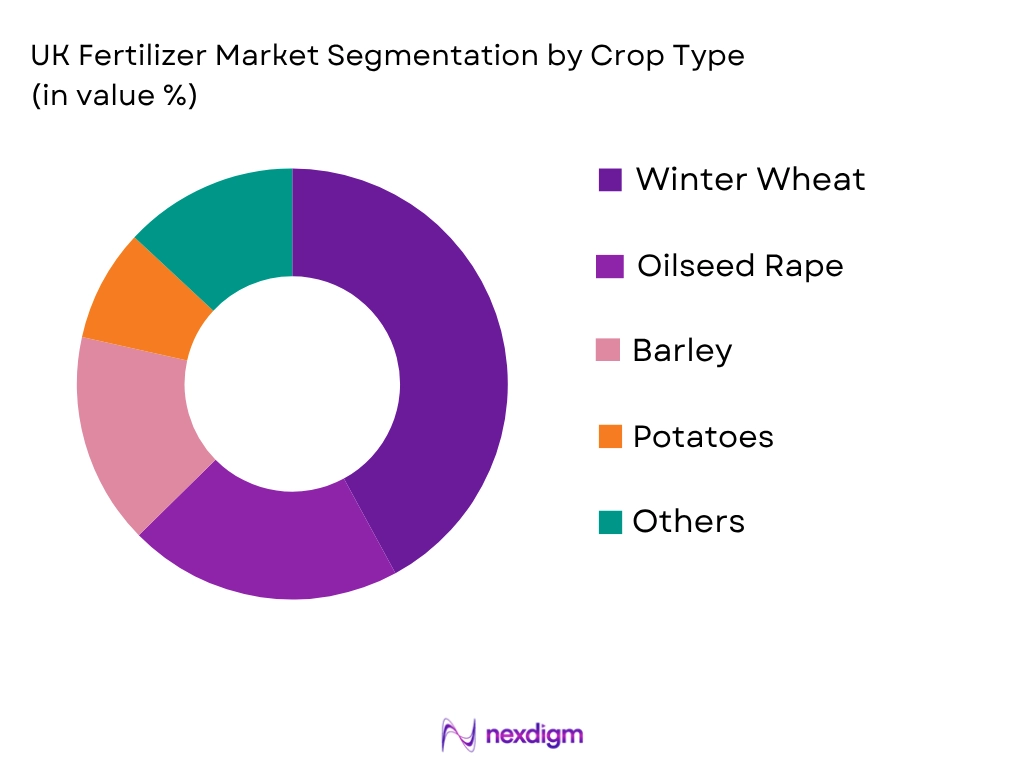
Winter wheat represents the dominant crop segment within the UK fertilizer market because it is the most widely grown arable crop in the country, occupying the largest share of cultivated agricultural land. The crop requires significant nutrient application, particularly nitrogen, to sustain productivity and achieve premium milling and feed quality specifications. Large-scale commercial farms across the East of England, Yorkshire, and the East Midlands heavily depend on balanced fertilization programs involving nitrogen, phosphorus, sulphur, and micronutrients. Rising demand for domestic grain supplies, driven by food security priorities, has encouraged producers to optimize yields through advanced nutrient management practices. Consequently, winter wheat farming remains the largest contributor to fertilizer consumption throughout the United Kingdom.
Competitive Landscape
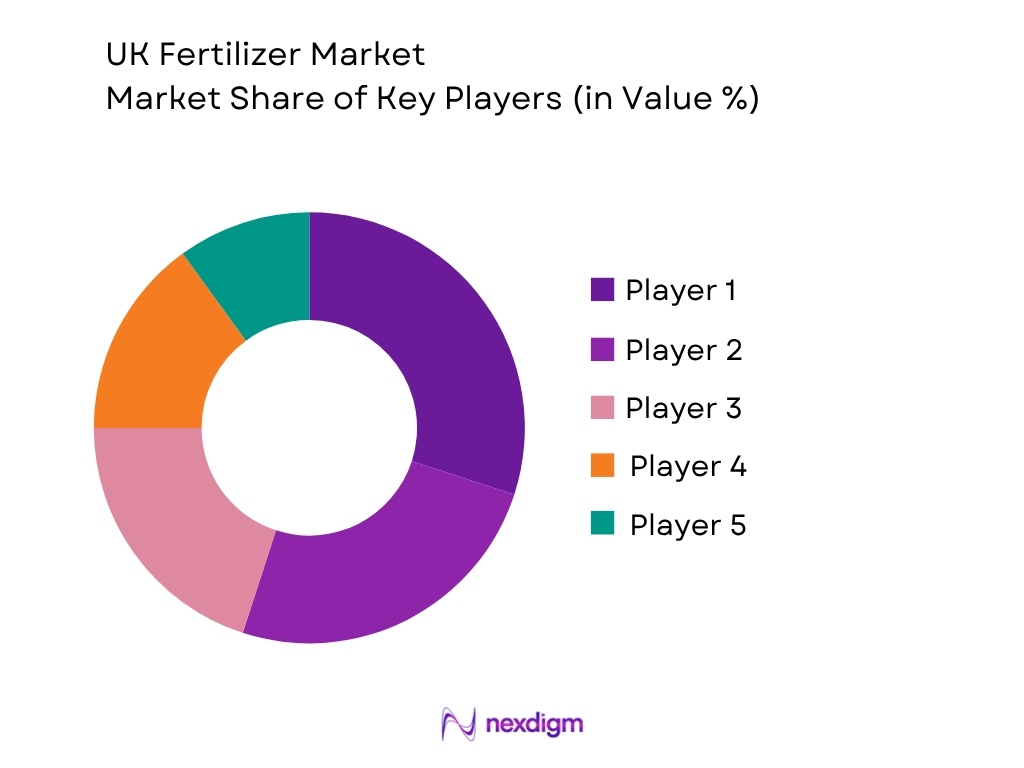
The UK fertilizer market is moderately concentrated, with major multinational fertilizer producers and domestic manufacturers controlling a substantial portion of production, imports, distribution, and agricultural service activities. Companies compete through extensive distribution networks, agronomic consulting services, blending capabilities, import infrastructure, and crop-specific nutrient solutions. Strategic investments in sustainable fertilizer products, specialty nutrition, and precision agriculture solutions continue to shape competitive dynamics across the market.
| Company | Establishment Year | Headquarters | Product Portfolio | Production & Blending Facilities
|
Import Infrastructure | Distribution Reach | Specialty Fertilizer Portfolio | Agronomic Support Network |
| Yara UK | 1905 | ~ | ~ | ~ | ~ | ~ | ~ | ~ |
| CF Fertilisers UK | 1946 | ~ | ~ | ~ | ~ | ~ | ~ | ~ |
| ICL UK | 1968 | ~ | ~ | ~ | ~ | ~ | ~ | ~ |
| Nutrien Ag Solutions UK | 2018 | ~ | ~ | ~ | ~ | ~ | ~ | ~ |
| Origin Enterprises | 2006 | ~ | ~ | ~ | ~ | ~ | ~ | ~ |
UK Fertilizer Market Analysis
Growth Drivers
Expansion of Winter Wheat and Oilseed Rape Cultivation
The UK fertilizer market continues to be driven by the consistent cultivation of winter wheat and oilseed rape across arable regions. According to the USDA Foreign Agricultural Service and the UK Department for Environment, Food and Rural Affairs (DEFRA), the UK’s total cereal output reached approximately 24 million metric tons in 2024, with winter wheat accounting for the majority of production across around 1.8 million hectares. Oilseed rape cultivation covered approximately 400,000 hectares, requiring significant applications of sulphur, nitrogen, and phosphate fertilizers. These crops represent the backbone of UK arable farming and rely on consistent nutrient management programs to sustain commercially viable yields. The Agriculture and Horticulture Development Board (AHDB) reported average fertilizer application rates for winter wheat of approximately 185 kg of nitrogen per hectare, reflecting the nutrient intensity of UK arable systems. Eastern England, Yorkshire, the East Midlands, and the South East remain the largest fertilizer-consuming regions due to their high concentration of arable land. The UK’s commitment to maintaining domestic food production capacity following Brexit has further reinforced the importance of optimized crop nutrition programmes across the country’s farming sector.
Rising Food Security Priorities and Domestic Agricultural Output Requirements
The UK’s heightened emphasis on food security following Brexit and global supply chain disruptions has significantly supported fertilizer demand. According to DEFRA’s Agriculture in the United Kingdom report, the total value of UK agricultural output exceeded GBP 30 billion in 2024, with arable crops, horticulture, and livestock products contributing substantially to farm revenues. The UK produces approximately 60% of its domestic food supply, creating ongoing pressure to maximize yields from available farmland. Rising input costs and global commodity price volatility have encouraged farmers to adopt more precise nutrient management strategies to maintain profitability while sustaining yield performance. The UK’s population exceeded 68 million people, supporting steady domestic food demand. Post-Brexit agricultural policy under the Agriculture Act 2020 and the Environmental Land Management (ELM) scheme has introduced new dynamics, balancing productivity support with environmental stewardship requirements. Fertilizer consumption remains closely linked to the need to sustain cereal and oilseed production across intensively managed farmland. These dynamics reinforce the structural importance of nitrogen, phosphate, potash, and sulphur fertilizers within the UK agricultural input market.
Market Challenges
Dependence on Imported Fertilizer Raw Materials
A major challenge facing the UK fertilizer market is its significant reliance on imported fertilizer products and raw materials. According to the British Survey of Fertiliser Practice (BSFP) and DEFRA, the UK imports the majority of its potash and phosphate fertilizer requirements, with domestic production capacity concentrated in nitrogen-based products at CF Fertilisers’ Ince and Billingham plants. This dependence exposes the market to global supply chain disruptions, geopolitical tensions, energy price fluctuations, and international commodity price volatility. The temporary closure of CF Fertilisers’ production facilities in 2021 due to high natural gas prices highlighted the sector’s vulnerability to energy cost pressures. Since nitrogen fertilizer production is heavily dependent on natural gas as a feedstock, UK manufacturers face ongoing exposure to European and global gas price movements. Any significant disruption in fertilizer imports or domestic production directly impacts planting decisions, nutrient application rates, and crop productivity. Ensuring stable access to both imported and domestically produced fertilizer materials remains a persistent challenge for manufacturers, distributors, and farmers operating across UK agricultural regions.
Post-Brexit Trade Adjustments and Regulatory Divergence
The UK fertilizer market faces ongoing structural adjustments resulting from the country’s departure from the European Union. According to the UK Trade Policy Observatory and the Agriculture and Horticulture Development Board (AHDB), Brexit has introduced new customs procedures, border checks, and import documentation requirements that have added complexity and cost to fertilizer supply chains. Previously seamless trade flows with EU-based suppliers have been subject to additional regulatory steps, creating logistical friction particularly for smaller distributors and merchants. The UK’s independent regulation of fertilizer product standards, including the Fertilisers Regulation (GB), has begun to diverge from EU frameworks, requiring manufacturers and importers to navigate dual compliance requirements. Additionally, trade tariff adjustments have influenced the cost competitiveness of imported products from certain supplier countries. DEFRA’s ongoing development of new agricultural support schemes and nutrient management frameworks under domestic policy adds regulatory uncertainty for market participants. As the UK continues to establish its independent trade relationships and agricultural policy framework, managing the costs and complexities of post-Brexit market conditions remains a significant ongoing challenge for the fertilizer industry.
Market Opportunities
Expansion of Domestic Fertilizer Production Capacity
The growing emphasis on supply security presents a significant opportunity for the UK fertilizer market. CF Fertilisers operates nitrogen production facilities at Ince in Cheshire and Billingham in County Durham, representing the primary domestic manufacturing base for ammonium nitrate and carbon dioxide. Recent discussions around green ammonia production, low-carbon hydrogen-based fertilizer manufacturing, and investment in sustainable nitrogen production highlight the potential for domestic capacity expansion. The UK Government’s food security agenda and net zero commitments provide a strategic backdrop for investment in cleaner domestic fertilizer production. Additionally, the UK’s significant agricultural residue resources and growing interest in organomineral and biostimulant products offer pathways to diversify the domestic nutrient supply base. The country’s stable agricultural demand, well-developed distribution infrastructure, and increasing regulatory focus on nutrient use efficiency provide favorable conditions for investment in local production. Expanding domestic manufacturing capacity would reduce exposure to international supply disruptions and strengthen the resilience of the UK’s agricultural input supply chain, positioning capacity expansion as a key long-term opportunity within the fertilizer industry.
Growth of Specialty, Biological, and Sustainable Fertilizers
The transition toward sustainable agriculture and improved nutrient-use efficiency is creating strong opportunities for specialty fertilizer products in the UK. Regulatory requirements under the Farming Rules for Water, nitrate vulnerable zone (NVZ) restrictions, and the emerging Environmental Land Management scheme are encouraging farmers to adopt more precise and efficient nutrient management practices. Biological fertilizers, micronutrients, controlled-release nitrogen products, sulphur-enhanced formulations, and organomineral fertilizers are gaining traction as growers seek solutions that improve nutrient delivery efficiency while reducing environmental losses. The UK is home to a sophisticated precision agriculture sector, with growing adoption of variable rate application technology, drone-based field mapping, and digital nutrient planning tools enabling more targeted fertilizer use. Additionally, the UK Government’s net zero agricultural ambitions and the introduction of carbon auditing on farms are creating new incentives for low-emission fertilizer alternatives. Supported by a well-educated farming community, strong agronomic advisory infrastructure, and increasing environmental awareness, specialty and sustainable fertilizer categories are well positioned for substantial long-term growth within the UK’s broader fertilizer market ecosystem.
Future Outlook
The UK fertilizer market is expected to witness measured growth over the forecast period, driven by the continued need to sustain domestic crop production, increasing adoption of precision farming technologies, and rising demand for environmentally efficient nutrient solutions. Government initiatives under the Environmental Land Management scheme and the UK’s net zero agricultural strategy are expected to shape fertilizer use patterns and encourage the adoption of sustainable products. Growing demand for specialty fertilizers, biological solutions, and controlled-release nitrogen products will support market development. Additionally, investment in low-carbon fertilizer production and digital nutrient management tools is likely to strengthen long-term market prospects as the UK agricultural sector navigates evolving sustainability requirements.
Major Players
- Yara UK
- CF Fertilisers UK
- ICL UK
- Nutrien Ag Solutions UK
- Origin Enterprises
- Frontier Agriculture
- Timac Agro UK
- Compo Expert UK
- Haifa Group UK
- BASF Agricultural Solutions UK
- Omex Agriculture
- EuroChem UK
- Agrii
- Gleadell Agriculture
- Velcourt
Key Target Audience
- Fertilizer Manufacturers
- Agricultural Input Distributors and Merchants
- Commercial Farming Enterprises
- Agribusiness Cooperatives
- Investments and Venture Capitalist Firms
- Government and Regulatory Bodies (DEFRA, Environment Agency, Agriculture and Horticulture Development Board, UK Health and Safety Executive)
- Fertilizer Importers and Exporters
- Precision Agriculture Technology Providers
Research Methodology
Step 1: Identification of Key Variables
The initial phase involves constructing an ecosystem map encompassing all major stakeholders within the UK Fertilizer Market. Extensive secondary research is conducted through industry publications, government databases, company annual reports, trade associations, and agricultural statistics. The objective is to identify critical variables influencing fertilizer demand, supply, pricing, imports, and crop production.
Step 2: Market Analysis and Construction
This phase focuses on gathering and analyzing historical information regarding fertilizer production, imports, nutrient consumption, crop acreage, and agricultural output. Market revenues are estimated through analysis of fertilizer volumes, average selling prices, and nutrient demand trends. Both supply-side and demand-side assessments are incorporated to develop comprehensive market estimates.
Step 3: Hypothesis Validation and Expert Consultation
Preliminary findings and market assumptions are validated through structured interviews with fertilizer manufacturers, distributors, agricultural cooperatives, agronomists, and industry specialists. These consultations provide valuable insights into purchasing patterns, nutrient application trends, production economics, and future market developments.
Step 4: Research Synthesis and Final Output
The final stage integrates findings obtained from primary and secondary research. Data triangulation techniques are applied to ensure consistency and reliability across all market estimates. The resulting report provides a comprehensive assessment of market structure, competitive dynamics, growth opportunities, and long-term industry outlook for the UK Fertilizer Market.

- Executive Summary
- Research Methodology (Market Definitions and Assumptions, Abbreviations, Market Sizing Approach, Top-Down Analysis, Bottom-Up Analysis, Fertilizer Demand Assessment by Crop Area, Nutrient Consumption Analysis, Import-Export Assessment, Primary Industry Interviews, Data Triangulation, Forecasting Framework, Limitations and Future Conclusions)

- Definition and Scope
- Market Evolution and Industry Genesis
- Timeline of Major Industry Developments
- UK Agricultural Production Ecosystem
- Fertilizer Industry Value Chain Analysis

- Growth Drivers (Expansion of Winter Wheat and Oilseed Rape Cultivation, Rising Yield Optimization Requirements, Increasing Adoption of Precision Agriculture, Government Support for Sustainable Farming, Growth in Food Security Initiatives, Investment in Domestic Fertilizer Manufacturing)
- Market Challenges (Dependence on Imported Fertilizer Raw Materials, Volatility in Global Fertilizer Prices, Natural Gas Price Fluctuations, Environmental Compliance Costs, Post-Brexit Trade Adjustments)
- Market Opportunities (Domestic Nitrogen Production Expansion, Specialty Fertilizer Growth, Biofertilizer Adoption, Organomineral Fertilizer Development, Precision Nutrient Management Solutions)
- Market Trends (Increased Use of Enhanced Efficiency Fertilizers, Digital Agriculture Integration, Customized Nutrient Blends, Carbon-Efficient Crop Nutrition, Expansion of Biological Inputs)
- Government Regulations (UK Farming Rules for Water, Nitrate Vulnerable Zone Regulations, Environment Act 2021 Requirements, Nutrient Quality Standards, Import and Trade Policies)
- Import Dependency Assessment (Potash Import Ratio, Phosphate Import Ratio, Nitrogen Import Ratio, Supplier Country Concentration)
- Raw Material Analysis (Natural Gas Availability, Phosphate Rock Supply, Potash Reserves, Sulfur Availability)
- Fertilizer Consumption Intensity Analysis (Kg per Hectare, Nutrient Use Efficiency, Crop-Wise Consumption, Regional Application Rates)
- Price Trend Analysis (Urea Prices, AN Prices, DAP Prices, Potash Prices, NPK Prices)
- Supply-Demand Gap Analysis (Domestic Production Capacity, Installed Capacity Utilization, Import Requirements, Inventory Levels)
- SWOT Analysis
- Porter’s Five Forces Analysis
- PESTLE Analysis
- Stakeholder Ecosystem
- Competition Ecosystem

- By Market Value (2020-2025)
- By Production Volume (2020-2025)
- By Average Selling Price (2020-2025)

- By Nutrient Type (In Value %)
Nitrogen Fertilizers
Phosphate Fertilizers
Potash Fertilizers
Secondary Nutrient Fertilizers
Micronutrient Fertilizers
Specialty and Customized Fertilizers - By Application Method (In Value %)
Soil Application
Fertigation
Foliar Application
Seed Treatment
Precision Agriculture Application - By Crop Type (In Value %)
Winter Wheat
Oilseed Rape
Barley
Sugar Beet
Potatoes
Maize
Fruits and Vegetables
Pasture and Forage Crops
Others - By Region (In Value %)
England
Scotland
Wales
Northern Ireland - By Distribution Channel (In Value %)
Agricultural Cooperatives
Agricultural Merchants and Retailers
Direct Sales by Manufacturers
Distributors and Wholesalers
Digital Agricultural Platforms

- Market Share Analysis of Major Players (By Value, By Volume, Nutrient Segment, Crop Segment, By Region)
- Market Concentration Analysis
- Cross Comparison Parameters (Product Portfolio Diversity, Annual Fertilizer Production Capacity, Blending Capacity, Import Terminal Infrastructure, Distribution Network Reach, Agronomic Technical Service Coverage, Specialty Fertilizer Portfolio Strength, Crop-Specific Nutrient Solution Capability)
- SWOT Analysis of Major Players
- Pricing Analysis by Product Type and Nutrient Grade
- Detailed Profiles of Major Companies
Yara UK
CF Fertilisers UK
ICL UK
Nutrien Ag Solutions UK
Origin Enterprises
Frontier Agriculture
Timac Agro UK
Compo Expert UK
Haifa Group UK
BASF Agricultural Solutions UK
Omex Agriculture
EuroChem UK
Agrii
Gleadell Agriculture
Velcourt

- Crop Nutrient Consumption Assessment (Crop Area, Yield Targets, Nutrient Removal Rates, Fertilizer Intensity)
- Farm Size Analysis (Small Farms, Medium Farms, Large Commercial Farms)
- Purchasing Power Analysis (Farm Income Levels, Credit Availability, Fertilizer Budget Allocation)
- Seasonal Demand Assessment (Planting Cycles, Crop Calendar, Procurement Patterns)
- Farmer Purchasing Behavior (Brand Preference, Nutrient Preference, Price Sensitivity)
- Precision Agriculture Adoption Analysis (GPS-Based Application, Variable Rate Technology, Digital Farm Management)
- Sustainability Adoption Analysis (Carbon Reduction Practices, Soil Health Management, Regenerative Agriculture)
- Pain Point Analysis (Input Costs, Nutrient Availability, Logistics Challenges, Agronomic Support)
- Purchase Decision-Making Process

- By Market Value (2026-2035)
- By Production Volume (2026-2035)
- By Average Selling Price (2026-2035)


 Request a Sample
 Ask for Customization
 Get a Quote
 Enquire Now