
 Download PDF
Market Overview
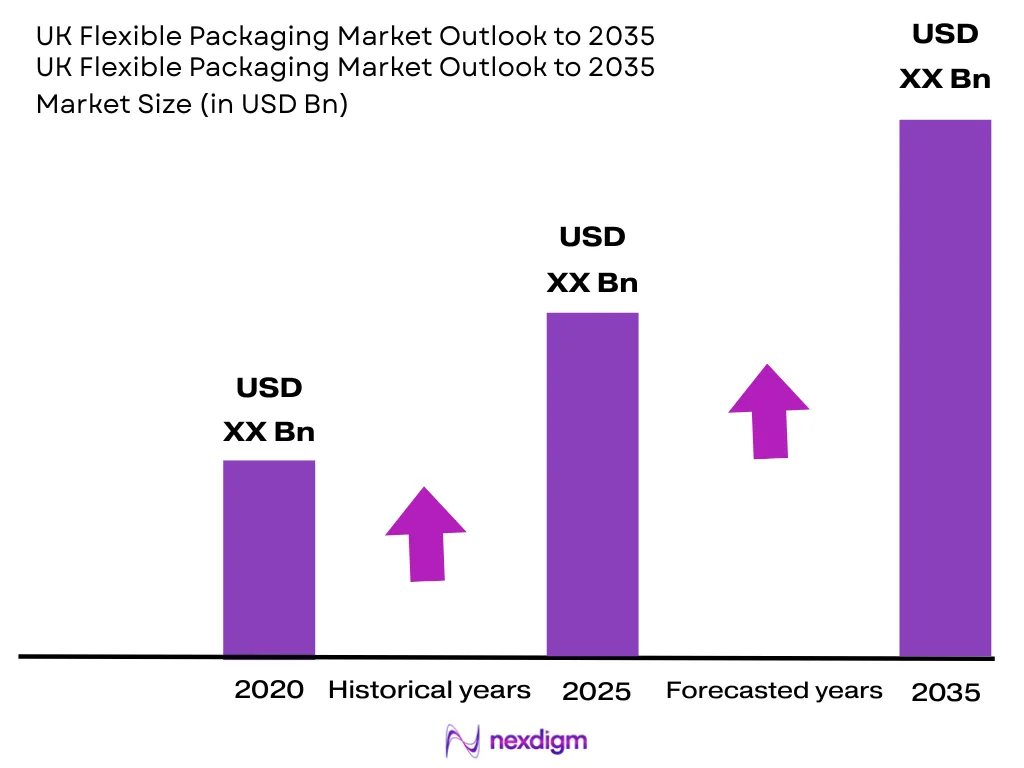
The UK Flexible Packaging Market was valued at USD ~ Billion in 2024 and is anticipated to expand at a CAGR of ~% during 2026–2035. The market is primarily driven by sustained demand from the UK’s large food and beverage manufacturing base, the country’s position as one of the top 10 medical device manufacturers globally, and continued sustainability-linked investment from multinational packaging producers. According to Grand View Research’s Horizon Databook, the UK flexible packaging market generated revenue of USD ~ Billion in 2023 and is expected to reach USD ~ Billion by 2030, growing at a CAGR of 4% from 2024, with the UK accounting for approximately 3.6% of the global flexible packaging market in 2023. Separately, Mordor Intelligence estimates the UK Flexible Plastic Packaging Market at 1.46 million tonnes in 2025, growing to 1.70 million tonnes by 2030 at a 3.05% CAGR. The UK’s broader packaging manufacturing industry generates GBP 11 billion (USD 13.59 billion) in annual sales, according to the Packaging Federation, and employs more than 85,000 people, representing 3% of the UK’s manufacturing workforce.
Market Segmentation
By Material
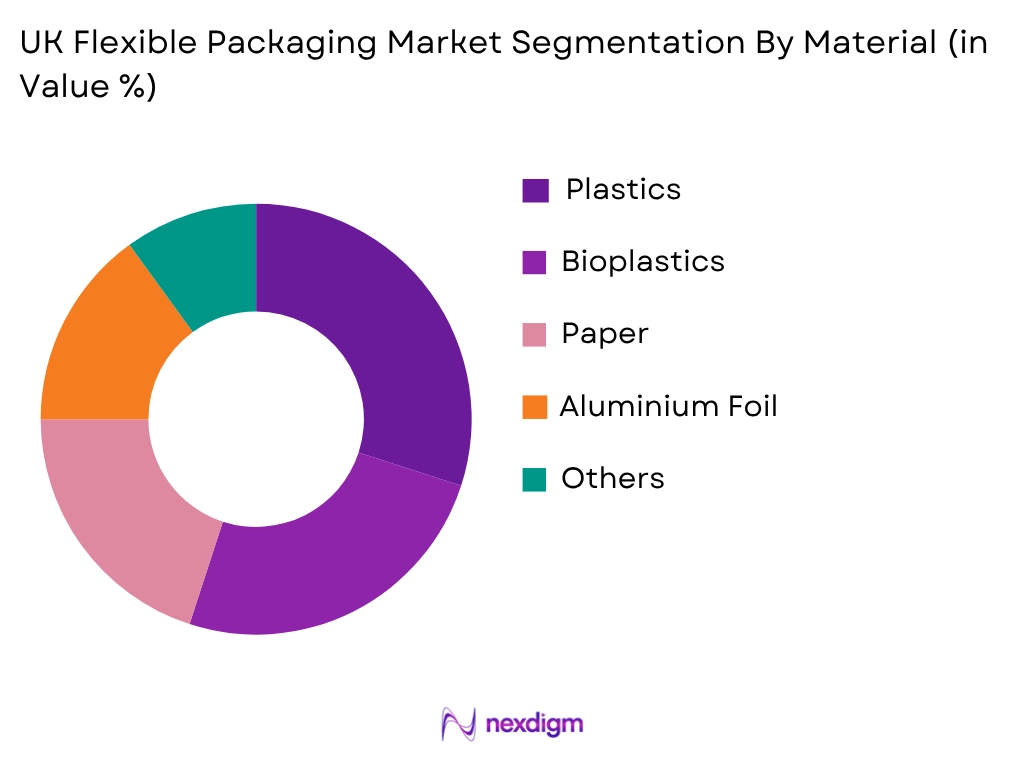
Among these, Plastics dominate the UK Flexible Packaging Market, holding a 68.84% revenue share in 2024, according to Grand View Research, valued for its lightweight, affordable, and versatile nature that shields products from contamination, extends shelf life, and ensures safe transportation. The UK Parliament estimates that five million tonnes of plastic are used in the country annually, with packaging accounting for approximately half of that total. Bioplastics represent the most lucrative and fastest-growing raw material segment, registering the strongest growth through the forecast period as sustainability regulation and consumer expectations continue to reshape material selection. This shift is exemplified by companies such as Sirane, which has pioneered plastic-free, paper-based barrier films and recyclable flow-wrap films, positioning itself at the forefront of the plastic-free flexibles movement within the UK market, aligned with the broader UK Plastics Pact vision for improved recycling and reprocessing across the packaging sector.
By Application
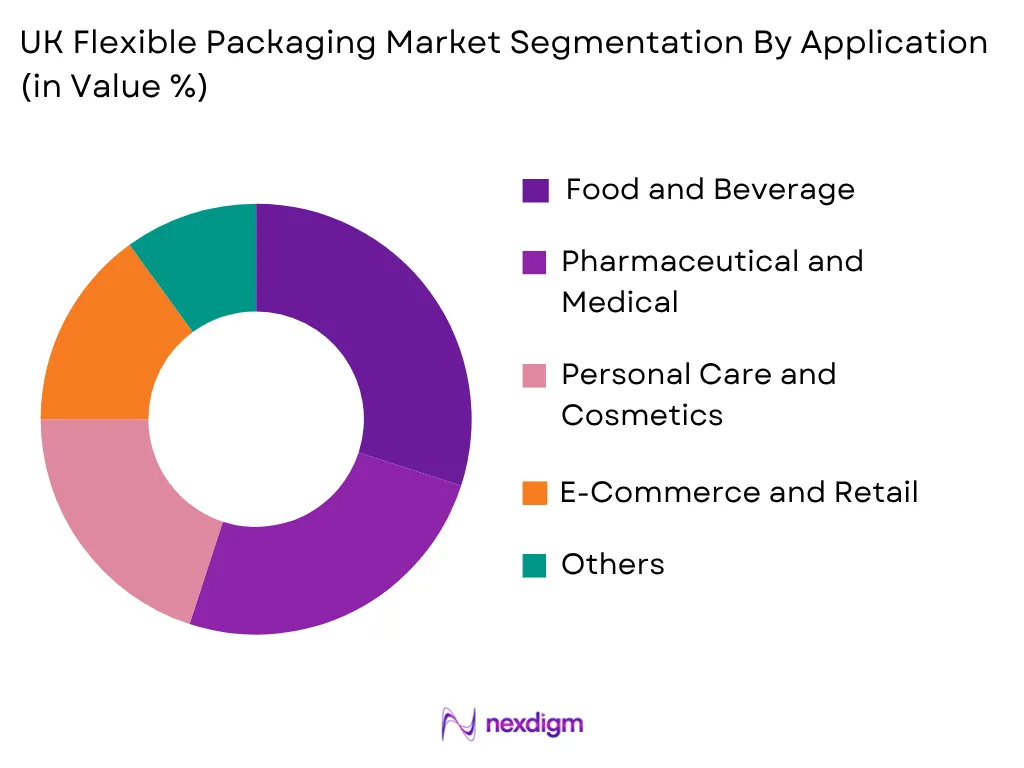
The Food and Beverage segment commands the largest share of the UK Flexible Packaging Market, reflecting the scale of the UK’s food processing industry and the crucial role packaging plays in driving demand across the sector. According to the Federation of Bakers, the UK bakery market alone is worth GBP 5 billion (USD 6.21 billion), with a total volume of over 4.5 billion units, equivalent to more than 11 million loaves and packs sold daily, illustrating the sheer scale of flexible packaging consumption within just one food sub-sector. The Pharmaceutical and Medical Devices segment represents a significant and growing application area, supported by the UK’s position as one of the top 10 medical device manufacturers globally; growing exports of UK medical devices are expected to result in increased consumption of flexible packaging products, with pharmaceutical manufacturing remaining a major end-use segment given the concentration of pharmaceutical companies operating in the country. Constantia FFP’s Estercook printed roast-in-the-bag films and Esterseal recyclable PET lidding film, which forms a circular solution for PET trays, illustrate the type of technically sophisticated, sustainability-linked packaging increasingly demanded by the UK’s leading food brands.
Competitive Landscape
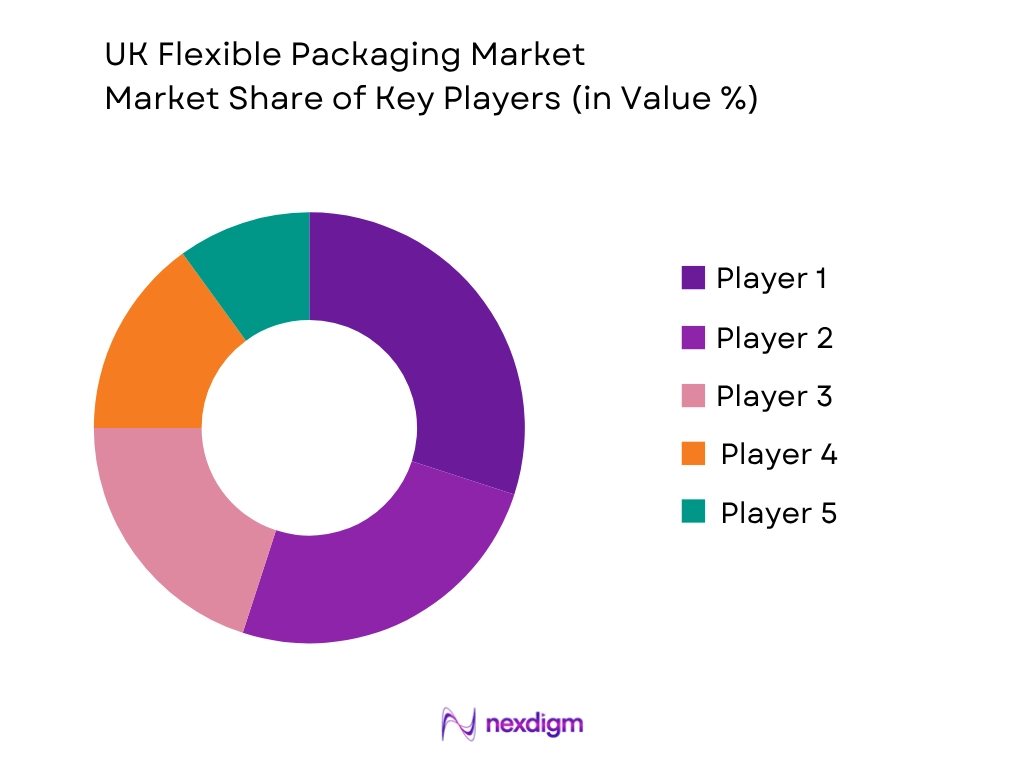
The UK Flexible Packaging Market is moderately concentrated, with a small number of large multinational players, including Amcor, Constantia Flexibles, and Mondi, commanding a combined share estimated at 35-40%, according to Archive Market Research, alongside a significant number of smaller, specialised UK companies focused on niche applications and sustainable packaging solutions. Constantia FFP, trading under the FFP Packaging Solutions name since 1962, has built a UK heritage position as a critical supplier of recyclable lidding film, pouches, and resealable packaging within the global Constantia Flexibles group. Telford-based Sirane Limited, founded in 2003 and the UK’s largest stand-up pouch manufacturer, illustrates the financial pressures facing mid-sized UK converters: the company entered administration in July 2024 after surging energy prices, inflating operational costs, and supply chain constraints created sustained cash flow pressures, before food packaging group Coppice Alupack, part of the EP Group, acquired its assets, sales book, and intellectual property later that month and rehired the substantial majority of its workforce under the Sirane brand. In December 2025, Amcor plc announced expanded recyclable flexible packaging innovations in the UK market, supported by an estimated USD 500-700 million in sustainability investment strengthening mono-material films, food-grade packaging, and circular economy adoption.
| Company | Establishment Year | Headquarters | Primary Product Portfolio | Flexible Packaging Portfolio
|
Manufacturing Presence | Major End-Use Industries | Key Strategic Focus | Certifications & Compliance |
| Constantia FFP (FFP Packaging Solutions) | 1962 | ~ | ~ | ~ | ~ | ~ | ~ | ~ |
| Sirane Limited | 2003 | ~ | ~ | ~ | ~ | ~ | ~ | ~ |
| Mondi plc | 1967 | ~ | ~ | ~ | ~ | ~ | ~ | ~ |
| Amcor PLC | 1896 | ~ | ~ | ~ | ~ | ~ | ~ | ~ |
| Sealed Air Corporation | 1960 | ~ | ~ | ~ | ~ | ~ | ~ | ~ |
UK Flexible Packaging Market Analysis
Growth Drivers
Strength of the UK Food, Beverage, and Medical Device Manufacturing Base
The UK flexible packaging market is experiencing sustained growth due to the scale and diversity of the country’s food and beverage manufacturing industry, which drives roughly 42% of UK flexible packaging demand, according to Decisions Advisors and Consulting. The UK bakery market alone is worth GBP 5 billion, with more than 11 million loaves and packs sold daily, according to the Federation of Bakers, illustrating the depth of demand within a single food sub-sector. The UK’s position as one of the top 10 medical device manufacturers globally provides a further structural growth driver, as growing exports of UK medical devices are expected to result in increased consumption of flexible packaging products, with pharmaceutical manufacturing remaining a major end-use segment given the concentration of pharmaceutical companies operating in the country, according to Grand View Research. The UK’s retail and consumer goods sector, which exceeds GBP 520 billion annually according to the Office for National Statistics, provides an additional broad-based demand driver across the flexible packaging value chain.
Sustainability Investment and UK Plastics Pact Alignment
Regulatory and consumer pressure around plastic waste continues to drive substantial sustainability investment across the UK flexible packaging market, with the UK plastic packaging sector witnessing growth in recycling and reprocessing driven by initiatives such as the UK Plastics Pact vision, according to Mordor Intelligence. In December 2025, Amcor plc announced expanded recyclable flexible packaging innovations in the UK, supported by an estimated USD 500-700 million in sustainability investment strengthening mono-material films and food-grade packaging capabilities. The UK’s dairy industry has faced particular scrutiny, with the UK’s Food and Farming Minister calling for the sector to become more sustainable, targeting a 50% reduction in the volume of plastics used in milk packaging. Companies such as Sirane have responded by pioneering plastic-free, paper-based barrier films and recyclable flow-wrap films, while Constantia FFP’s recyclable PET lidding film technology, which forms a fully circular solution with PET trays, illustrates how UK converters are engineering mono-material solutions that maintain functional performance while meeting tightening recyclability expectations.
Market Challenges
Rising Energy and Input Costs Pressuring Mid-Sized Converters
The UK Flexible Packaging Market faces significant financial pressure on mid-sized converters from rising energy prices, inflating operational costs, and ongoing supply chain constraints. Telford-based Sirane Limited, the UK’s largest stand-up pouch manufacturer, generated revenue of GBP 29.7 million but incurred an EBITDA loss of GBP 3.9 million in the year ended December 2022, and entered administration in July 2024 with 172 jobs lost, before Coppice Alupack, part of the EP Group, stepped in to acquire the company’s assets and rehire the majority of its workforce. This case illustrates the structural cost pressures facing UK converters that lack the scale and diversified customer base of the market’s largest multinational players, particularly given that energy-intensive processes such as extrusion, lamination, and multi-layer film production leave converters exposed to volatile input costs that are difficult to pass through to price-sensitive food and beverage customers.
Multi-Layer Film Recycling Complexity and Regulatory Pressure
Growing environmental concerns surrounding plastic waste and increasing regulatory pressure regarding plastic usage act as significant restraints on the UK Flexible Packaging Market, according to Archive Market Research. Multi-layer flexible packaging structures, which combine plastic film, aluminium foil, and paper to achieve required barrier properties, remain difficult and costly to recycle using conventional infrastructure, creating tension between functional packaging requirements and the UK Plastics Pact’s recycling and reprocessing goals. Converters must increasingly redesign products around mono-material structures to maintain recyclability credentials demanded by major UK retailers and brand owners, a transition that requires substantial capital investment in new equipment and material science capability, disproportionately affecting smaller UK converters relative to well-capitalised multinational competitors such as Amcor, Constantia Flexibles, and Mondi.
Market Opportunities
Plastic-Free and Paper-Based Barrier Film Innovation
Rising consumer and regulatory pressure around plastic waste presents a substantial opportunity for UK converters investing in plastic-free and paper-based barrier film technology. Telford-based Sirane has positioned itself at the forefront of the plastic-free flexibles movement, with a product range that includes paper-based barrier films, recyclable coated boards as a plastic replacement, and plastic-free, biodegradable tree shelters, alongside its core stand-up pouch and flow-wrap film manufacturing. As UK retailers and food brands continue setting ambitious plastic reduction targets, such as the dairy industry’s targeted 50% reduction in milk packaging plastics, converters with proven plastic-free and mono-material product development capabilities are well positioned to capture premium demand from sustainability-conscious brand owners across food, medical, and horticultural applications.
Consolidation of Distressed and Mid-Sized Converters
The UK Flexible Packaging Market’s moderate M&A activity, with larger players strategically acquiring smaller companies to expand product portfolios and market reach, according to Archive Market Research, presents ongoing opportunities for well-capitalised acquirers. Coppice Alupack’s July 2024 acquisition of Sirane’s assets, sales book, and intellectual property following the company’s administration, and its stated intention to put the Sirane brand “back on the map” while rehiring the substantial majority of its workforce, illustrates how financially resilient groups can acquire distressed but technically capable UK converters at attractive valuations. As rising energy costs and input price volatility continue to pressure smaller, less diversified UK converters, well-capitalised strategic and financial acquirers are likely to find continued opportunities to consolidate valuable manufacturing capacity, customer relationships, and intellectual property across the UK’s fragmented converter landscape.
Future Outlook
The UK Flexible Packaging Market is expected to witness steady expansion over the forecast period, supported by continued strength in the country’s food, beverage, and medical device manufacturing base, sustained sustainability investment from multinational producers such as Amcor, and ongoing alignment with the UK Plastics Pact’s recycling and reprocessing goals. Growing demand for plastic-free and mono-material recyclable packaging, exemplified by innovators such as Sirane and Constantia FFP, will further shape product development priorities across the industry. The market is also likely to benefit from continued consolidation among the UK’s fragmented base of mid-sized converters, even as the industry continues to navigate rising energy and input cost pressures, the practical complexity of recycling multi-layer flexible structures, and tightening regulatory expectations around plastic packaging.
Major Players
- Amcor plc
- Mondi plc
- Constantia Flexibles Group GmbH
- Sealed Air Corporation
- Huhtamaki Oyj
- Coveris Holdings S.A.
- ALPLA Group
- Smurfit Westrock plc
- Surepak Innovative Packaging Solutions
- Tyler Packaging
- Constantia FFP (FFP Packaging Solutions)
- Sirane Limited
- Polypouch
- PB Polybags Co. UK
- Moore and Buckle
Key Target Audience
- Flexible Packaging Manufacturers and Converters
- Food & Beverage Processing Companies
- Pharmaceutical and Medical Device Manufacturers
- Personal Care and Cosmetics Manufacturers
- Retailers and E-Commerce Fulfilment Operators
- Investment and Private Equity Firms
- Government and Regulatory Bodies (Food Standards Agency (FSA), Environment Agency, Department for Environment, Food and Rural Affairs (Defra))
- Packaging Machinery and Raw Material Suppliers
Research Methodology
Step 1: Identification of Key Variables
The research process begins with identifying the complete ecosystem of the UK Flexible Packaging Market, including raw material and resin suppliers, flexible packaging converters, printing and lamination technology providers, food and beverage manufacturers, retailers, and regulatory authorities. Extensive secondary research is conducted using company annual reports, government publications, trade associations, customs statistics, industry journals, and proprietary databases to determine the variables influencing market demand, pricing, production, consumption, and technological developments.
Step 2: Market Analysis and Construction
Historical market information is collected and analysed to estimate market size, production volumes, import-export activity, application-wise demand, and pricing trends. A combination of top-down and bottom-up approaches is used to estimate market revenues and validate segment-level performance. Consumption patterns across food and beverage, pharmaceutical, personal care, and industrial applications are evaluated to establish an accurate representation of the industry.
Step 3: Hypothesis Validation and Expert Consultation
The preliminary findings are validated through Computer-Assisted Telephone Interviews (CATIs) and structured discussions with flexible packaging manufacturers, procurement managers, distributors, brand owners, regulatory experts, and senior executives operating within the UK food, beverage, and consumer goods industries. These interviews help verify market assumptions, competitive developments, technology adoption trends, pricing dynamics, and future investment opportunities while refining the overall market estimates.
Step 4: Research Synthesis and Final Output
The final stage integrates insights obtained from primary interviews with quantitative information collected through secondary sources. Data triangulation techniques are applied to reconcile differences between supply-side and demand-side estimates, ensuring robust market forecasting. The report is then reviewed through multiple quality assurance checkpoints to deliver a comprehensive analysis covering market size, segmentation, competitive landscape, future outlook, and strategic recommendations for industry stakeholders.

- Executive Summary
- Research Methodology (Market Definitions and Assumptions, Abbreviations, Market Sizing Approach, Top-Down Analysis, Bottom-Up Analysis, Demand-Side Assessment, Supply-Side Assessment, Primary Industry Interviews, Secondary Research Validation, Data Triangulation, Forecasting Framework, Limitations and Future Conclusions)

- Definition and Scope
- Market Evolution and Industry Genesis
- Timeline of Major Industry Developments
- Flexible Packaging Industry Value Chain Analysis
- Supply Chain Analysis

- Growth Drivers (Growth of Food and Beverage Packaging Demand, UK Medical Device Manufacturing Strength, Rising E-Commerce Fulfilment Packaging, UK Plastics Pact Recycling Initiatives, Multinational Sustainability Investment, Convenience-Oriented Consumer Lifestyles)
- Market Challenges (Rising Energy and Input Cost Pressures on Converters, Multi-Layer Film Recycling Complexity, Consolidation Risk Among Mid-Sized Converters, Raw Material Price Volatility, Post-Brexit Trade and Customs Friction, Environmental and Regulatory Pressure on Plastics)
- Market Opportunities (Mono-Material Recyclable Film Development, Plastic-Free and Paper-Based Barrier Films, Dairy Sector Plastics Reduction Programmes, Medical and Healthcare Packaging Expansion, Digital Printing for Short-Run Customisation, Circular Economy Partnership Models)
- Market Trends (Shift Toward Mono-Material Recyclable Films, Growth of Plastic-Free Flow-Wrap Films, Consolidation Through Acquisition of Distressed Converters, Lightweighting of Flexible Formats, Recyclable PET Lidding Film Adoption, Extended Producer Responsibility Preparation)
- Government Regulations (UK Plastics Pact Commitments, Extended Producer Responsibility for Packaging, Plastic Packaging Tax, Food Contact Packaging Safety Regulations, Placing on the Market Regulations, Import and Export Compliance)
- Import and Export Analysis (Plastic Resin Import Volume, Major Import Sources, Export Destinations, HS Code Analysis, Trade Balance)
- Raw Material Availability Analysis (Domestic Polymer Resin Supply, Paper and Board Supply, Recycled Polymer Availability, Aluminium Foil Supply, Bioplastic Feedstock Supply)
- Technology Landscape (Cast and Blown Film Extrusion, Multi-Layer Lamination, Flexographic and Digital Printing, Recyclable PET Lidding Technology, Paper-Based Barrier Film Technology)
- Sustainability Assessment (Mono-Material Film Development, Plastic-Free Packaging Innovation, UK Plastics Pact Alignment, Recyclable PET Lidding Adoption, Dairy Sector Plastics Reduction Commitments)
- PESTLE Analysis
- SWOT Analysis
- Porter’s Five Forces Analysis
- Stakeholder Ecosystem
- Competition Ecosystem

- By Market Value (2020-2025)
- By Volume Consumption (2020-2025)
- By Average Selling Price (2020-2025)

- By Material (In Value %)
Plastics (Polyethylene, Polypropylene, PET)
Paper
Aluminium Foil and Metal
Bioplastics - By Product Type (In Value %)
Pouches
Bags
Films and Wraps
Lidding Film
Labels - By Application (In Value %)
Food and Beverage
Pharmaceutical and Medical Devices
Personal Care and Cosmetics
Household and Industrial
Horticultural and Specialist Packaging - By End User (In Value %)
Food and Beverage Manufacturers
Pharmaceutical and Medical Device Manufacturers
Personal Care and Cosmetics Manufacturers
Retailers and E-Commerce Fulfilment
Industrial and Horticultural Users - By Region (In Value %)
London & South East England
Midlands
North West England
Scotland
Wales & Northern Ireland

- Market Share of Major Players (By Value, Volume, Material Type, Application Industry, Product Category)
- Cross Comparison Parameters (Product Portfolio Breadth, Recyclable Material Capability, Printing Technology Range, Application Technical Support Capability, Manufacturing Capacity, Regulatory Compliance & Certifications, Customer Base Across Industries, Innovation & New Product Launch Frequency)
- SWOT Analysis of Major Players
- Pricing Analysis by Product Category and Material
- Production Capacity Analysis
- Manufacturing Footprint Analysis
- Distribution Network Analysis
- Innovation Benchmarking
- Detailed Profiles of Major Companies
Amcor plc
Mondi plc
Constantia Flexibles Group GmbH
Sealed Air Corporation
Huhtamaki Oyj
Coveris Holdings S.A.
ALPLA Group
Smurfit Westrock plc
Surepak Innovative Packaging Solutions
Tyler Packaging
Constantia FFP (FFP Packaging Solutions)
Sirane Limited
Polypouch
PB Polybags Co. UK
Moore and Buckle

- Consumption Pattern Analysis (Industrial Usage, Batch Size, Product Category Penetration, Seasonal Demand, Reformulation Activity)
- Purchasing Criteria (Barrier Performance, Recyclability, Cost Efficiency, Print Quality, Supply Consistency, Shelf Life Extension)
- Procurement and Supplier Selection Analysis
- Sustainable Packaging Adoption Assessment
- Premium vs Conventional Packaging Demand
- Product Attribute Preference Analysis (Barrier Properties, Seal Integrity, Recyclability, Print Definition, Lightweighting, Ease of Opening)
- Consumer Sustainability Influence on Packaging Choice
- Pain Point Analysis
- Decision-Making Process

- By Market Value (2026-2035)
- By Volume Consumption (2026-2035)
- By Average Selling Price (2026-2035)


 Request a Sample
 Ask for Customization
 Get a Quote
 Enquire Now