
 Download PDF
Market Overview
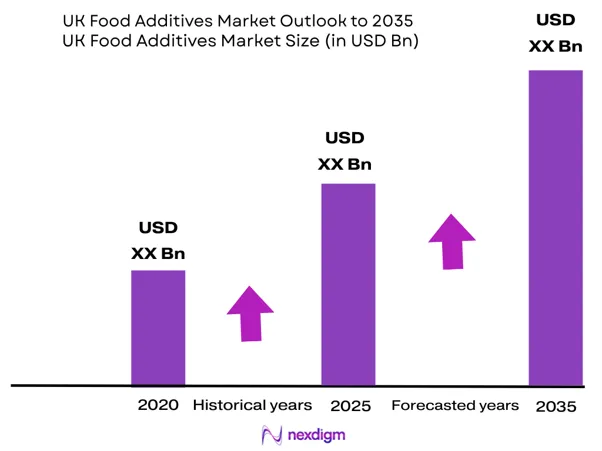
The UK Food Additives Market is valued at USD ~ billion, based on a five-year historical analysis, and is forecasted to grow at a CAGR of ~% during the forecast period. Demand is driven by flavors, sweeteners, preservatives, colors, emulsifiers, stabilizers, thickeners, enzymes, acidulants and processing aids. The UK agri-food sector generated £153.2 billion in GVA, while total consumer expenditure on food and alcoholic drinks reached £300.4 billion, supporting additive demand across processed foods and beverages. England, Scotland, Wales and Northern Ireland dominate the UK Food Additives Market through packaged food manufacturing, bakery, dairy, beverages, confectionery, meat processing, seafood processing, chilled ready meals, private label and foodservice ingredients. London and South East lead innovation and head-office procurement, while the Midlands, Yorkshire, North West, Scotland and Northern Ireland anchor manufacturing. UK GDP reached about USD 3.7 trillion and GDP per capita exceeded USD 53,000, supporting premium and convenience food consumption.
Market Segmentation
By Additive Function
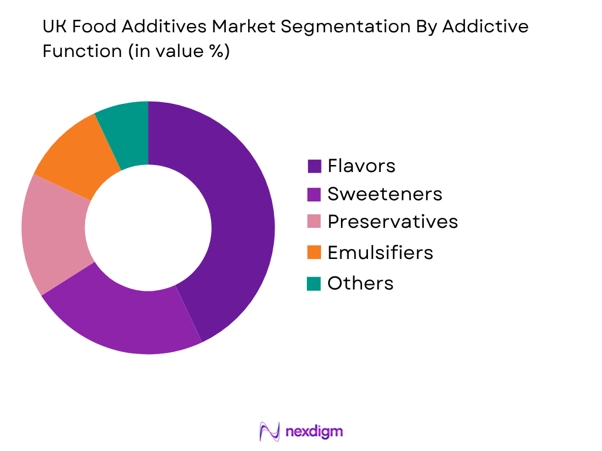
UK Food Additives Market is segmented by additive function into flavors and flavor enhancers, sweeteners, preservatives, colors, emulsifiers, stabilizers, thickeners, acidity regulators, antioxidants, enzymes, texturizers, humectants, anti-caking agents, leavening agents, nutrient additives and processing aids. Recently, flavors and flavor enhancers have had a dominant market share under the additive function segmentation due to their central role in beverages, bakery, dairy, confectionery, snacks, sauces, ready meals, meat products and foodservice formulations. UK food manufacturers use flavor systems to protect product identity, mask reduced-sugar and reduced-salt reformulations, improve plant-based foods, support retailer private label ranges and maintain consistency across chilled and ambient categories. Sweeteners, preservatives and texture systems remain important, but flavors dominate because UK consumers are highly responsive to taste, branded identity, seasonal product launches, premiumization and ethnic cuisine formats. Flavor systems also support reformulation where salt, sugar, fat or artificial additive reduction must not compromise sensory quality.
By Application
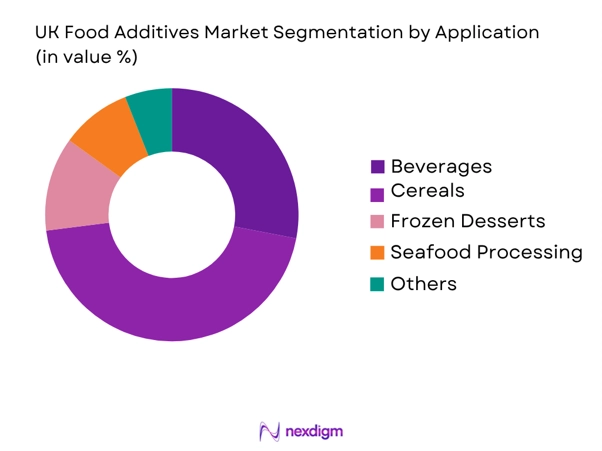
UK Food Additives Market is segmented by application into beverages, bakery and cereals, dairy and frozen desserts, confectionery, meat, poultry and seafood processing, snacks and savory foods, sauces, dressings and condiments, ready meals, frozen foods, plant-based foods, free-from foods, functional foods, fortified foods and foodservice ingredients. Recently, bakery and cereals have had a dominant market share under the application segmentation because the UK has a large packaged bread, morning goods, cakes, biscuits, breakfast cereal, in-store bakery and private-label bakery ecosystem. This segment uses emulsifiers, enzymes, mold inhibitors, leavening agents, humectants, flavors, colors, fibers and texture systems to improve softness, shelf life, dough tolerance, volume, crumb structure and eating quality. Beverages remain additive-intensive due to sweetener and flavor systems, while chilled ready meals and dairy require stabilizers and preservatives. Bakery and cereals dominate because shelf-life extension, cost-in-use efficiency and private-label consistency are critical in high-frequency grocery categories.
Competitive Landscape
The UK Food Additives Market is led by global ingredient companies, UK specialty ingredient firms, flavor houses, starch and sweetener suppliers, bakery ingredient companies, natural color suppliers and clean-label formulation platforms. Tate & Lyle, Kerry Ingredients UK, IFF UK, Givaudan UK and DSM-Firmenich UK are major players due to additive portfolio breadth, application labs, retailer relationships, foodservice access, clean-label expertise, sugar-reduction platforms and regulatory documentation. Food additives in Great Britain must be authorised before being placed on the market, and the FSA notes that additives include colours, preservatives, antioxidants, sweeteners, emulsifiers, stabilisers, thickeners and other ingredient classes, making compliance support a major competitive differentiator.
| Company | Establishment Year | Headquarters | Core Portfolio | Technical Capability | Key End Users | Channel Strength | Regulatory / Clean Label Focus | Market-Specific Advantage |
| Tate & Lyle | 1921 | London, UK | ~ | ~ | ~ | ~ | ~ | ~ |
| Kerry Ingredients UK | 1972 | Tralee, Ireland / UK operations | ~ | ~ | ~ | ~ | ~ | ~ |
| International Flavors & Fragrances UK | 1889 | New York, USA / UK operations | ~ | ~ | ~ | ~ | ~ | ~ |
| Givaudan UK | 1895 | Vernier, Switzerland / UK operations | ~ | ~ | ~ | ~ | ~ | ~ |
| DSM-Firmenich UK | 2023 merged entity | Kaiseraugst / Maastricht / UK operations | ~ | ~ | ~ | ~ | ~ | ~ |
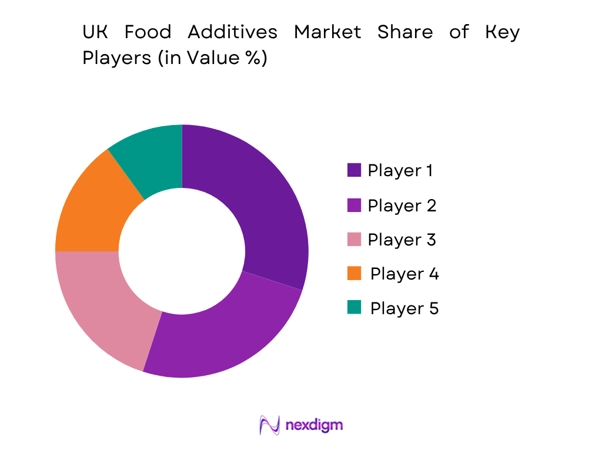
UK Food Additives Market Analysis
Growth Drivers
Processed food manufacturing scale and ingredient-function demand
The UK Food Additives Market is driven by the scale of domestic food manufacturing, where preservatives, emulsifiers, stabilisers, thickeners, sweeteners, colours, acidity regulators and antioxidants are used to maintain shelf life, texture, flavour stability and product consistency. ONS reported total UK manufacturers’ product sales at £452.2 billion in 2024, with manufacture of food remaining the largest manufacturing division and representing 21 units out of every 100 units of total manufacturers’ sales. DEFRA reported food and drink manufacturing GVA at £37.1 billion, alongside food and drink retail GVA of £40.2 billion and non-residential catering GVA of £45.2 billion. This creates a broad additive demand base across bakery, beverages, dairy alternatives, sauces, ready meals, confectionery, meat products and chilled foods, because manufacturers require consistent formulation performance across high-volume retail and foodservice channels.
Urban consumption, packaged food expenditure and convenience-led retail demand
Urbanised consumption patterns support the UK Food Additives Market because dense consumer markets rely on packaged, chilled, frozen, ready-to-eat and foodservice products that need preservation, texture control, colour stability and flavour consistency. ONS estimated the UK population at 69,281,400 in mid-2024, while World Bank data places UK GDP at USD 3.64 trillion and GDP per capita at USD 53,246.37 for 2024. DEFRA reported consumer expenditure on food and alcoholic drinks at £300.4 billion in 2024, including household food expenditure of £138.4 billion and expenditure on food and drink eaten out of £135.6 billion. These consumption values support additive use in retail packaged food, quick-service restaurants, bakery goods, beverages, desserts, savoury snacks and meal solutions. The driver is market-specific because additives extend shelf life, standardise sensory quality and enable nationwide distribution through supermarkets, convenience stores and foodservice chains.
Market Challenges
Regulatory complexity and additive-specific compliance burden
The UK Food Additives Market faces a high compliance burden because additive use is governed by permitted substance lists, food-category restrictions, quantitative limits and labelling requirements. The Food Standards Agency’s 2026 approved additives guidance states that most additives are permitted only in certain foods and are subject to specific quantitative limits, with additive categories covering colours, preservatives, antioxidants, sweeteners, emulsifiers, stabilisers, thickeners, gelling agents and other additives. The guidance applies to England, Northern Ireland and Wales and must be used alongside assimilated Regulation 1333/2008 for England and Wales, while Northern Ireland follows Regulation 1333/2008 and Commission Regulation 2022/63. The compliance challenge is market-specific because one additive cannot be freely transferred across all applications; sodium benzoate, sorbates, phosphates, nitrites, emulsifiers and sweeteners each require product-by-product checks. This increases formulation review, technical documentation, label control and regulatory monitoring requirements for food manufacturers and additive suppliers.
Fragmented manufacturer base and reformulation capability constraints
The UK Food Additives Market is constrained by the fragmented structure of the food and drink manufacturing base, where many businesses need additive expertise but do not have the technical resources of large manufacturers. DEFRA reported 24,880 small and medium enterprises in food and drink manufacturing in 2025, including 13,035 unregistered businesses with no employees, 3,765 registered businesses with no employees, 7,320 small businesses and 760 medium-sized businesses, compared with only 290 large businesses. The same source reported 444,000 employees in food and drink manufacturing. This creates a technical challenge because smaller manufacturers often require external support for reformulation, shelf-life testing, additive replacement, clean-label conversion, allergen interaction checks and compliance with E-number declarations. The challenge is specific to additives because removing or replacing one stabiliser, preservative, emulsifier or sweetener can alter viscosity, microbial stability, water activity, mouthfeel and shelf life, requiring repeated product trials and documented validation before commercial launch.
Market Opportunities
Regulatory modernisation and faster authorisation pathway for innovation
Regulatory modernisation creates an opportunity for UK Food Additives Market participants developing new or improved ingredient systems, including fermentation-derived sweeteners, clean-label stabilisers, modified starches, natural colours, enzyme-enabled processing aids and next-generation preservatives. The Food Standards Agency stated that from 1 April 2025, a Great Britain-wide statutory instrument implemented 2 reforms to the market authorisation process: removing periodic renewal requirements for selected regimes and enabling authorisations to come into effect after ministerial decision, followed by publication in an official register or list. The reform covers 8 regulated product regimes, including food additives, food enzymes, food flavourings, food contact materials and novel foods. This opportunity is market-specific because additive suppliers require predictable regulatory pathways before customers will adopt new E-numbered or functionally equivalent solutions. The ability to update registers after ministerial decisions can support faster commercialisation, especially where reformulation is needed for sugar reduction, salt reduction, shelf-life extension and clean-label product development.
Clean-label, natural additive and functionality-led reformulation demand
The UK Food Additives Market has an opportunity in clean-label and functionally targeted additive systems because manufacturers must balance consumer-facing ingredient simplification with industrial requirements for safety, stability and distribution. The Food Standards Agency’s approved additive list includes functional groups such as colours, preservatives, antioxidants, sweeteners, emulsifiers, stabilisers, thickeners and gelling agents, showing the breadth of formulation roles that cannot simply be removed without product impact. DEFRA reported total food sector employment of 3.669 million in 2025, with 1.938 million employees in non-residential catering, 1.057 million in food and drink retail and 444,000 in food and drink manufacturing. This large food ecosystem creates practical demand for additives that improve consistency across fresh, chilled, frozen, bakery, beverage and foodservice applications. The opportunity sits in natural colours, citrus fibre, pectin, lecithin, starch-based texturisers, rosemary extract antioxidants and low-calorie sweetening systems that preserve technical performance while improving ingredient-list acceptability.
Future Outlook
UK Food Additives Market is expected to grow steadily during the forecast period, supported by private-label reformulation, clean-label demand, sugar reduction, salt reduction, bakery and chilled ready-meal demand, functional beverages, plant-based foods, foodservice chain standardization and shelf-life extension.
Regulatory compliance will remain a central operating factor. Food additives must be authorised before they can be placed on the Great Britain market, and approved additive lists must be used together with relevant legislation because many additives are only permitted in specific foods and are subject to quantitative limits.
Retailer-led formulation pressure will intensify. UK supermarkets and foodservice operators will continue pushing suppliers toward cleaner ingredient declarations, shorter label statements, reduced sugar, reduced salt, allergen control, private-label consistency and cost-in-use optimization.
Bakery, chilled ready meals and beverages will remain high-value additive-use categories. These applications require enzymes, emulsifiers, stabilizers, preservatives, flavors, colors, sweeteners, acidulants and texture systems that protect shelf life, sensory quality and processing stability.
Plant-based and free-from foods will create technical opportunities for hydrocolloids, starches, fibers, protein stabilizers, emulsifiers, flavor maskers and natural colors. Texture and taste performance will remain key commercial barriers, increasing the importance of application labs and co-development support.
Major Players
- Tate & Lyle
- Kerry Ingredients UK
- International Flavors & Fragrances UK
- Givaudan UK
- DSM-Firmenich UK
- Ingredion UK
- Cargill UK
- ADM UK
- Corbion UK
- Sensient Technologies UK
- Kalsec UK
- CP Kelco UK
- Synergy Flavours
- British Bakels
- Ulrick & Short
Key Target Audience
- Food Additive Manufacturers
- Flavor and Fragrance Companies
- Packaged Food Manufacturers
- Beverage Manufacturers
- Bakery, Dairy, Meat and Snack Processors
- Retail Private Label and Foodservice Ingredient Buyers
- Investments and Venture Capitalist Firms
- Government and Regulatory Bodies (Food Standards Agency, Food Standards Scotland, Department for Environment Food and Rural Affairs, Office for Health Improvement and Disparities, Competition and Markets Authority)
Research Methodology
Step 1: Identification of Key Variables
The initial phase involves constructing an ecosystem map encompassing all major stakeholders within the UK Food Additives Market. This includes additive manufacturers, flavor houses, ingredient distributors, food manufacturers, beverage companies, private label suppliers, co-packers, foodservice chains, application labs, testing providers and regulatory agencies. The objective is to define variables such as additive function, origin, application, regulatory status, form, end user and clean-label positioning.
Step 2: Market Analysis and Construction
In this phase, historical data is compiled and analyzed for the UK Food Additives Market. The assessment covers flavors, sweeteners, preservatives, colors, emulsifiers, stabilizers, thickeners, enzymes, acidulants, antioxidants, nutrient additives and processing aids. Top-down validation uses food expenditure, food manufacturing and regulatory datasets, while bottom-up validation uses product-label audits, application mapping and manufacturer interviews.
Step 3: Hypothesis Validation and Expert Consultation
Market hypotheses are developed and validated through computer-assisted telephone interviews with additive suppliers, flavor houses, bakery ingredient buyers, beverage formulators, dairy processors, meat processors, snack manufacturers, retail private-label suppliers, co-packers and regulatory professionals. These consultations provide operational insights into reformulation triggers, additive selection, clean-label substitution, FSA documentation, retailer specifications and cost-in-use dynamics.
Step 4: Research Synthesis and Final Output
The final phase integrates desk research, primary interviews, label audits, application benchmarking, regulatory mapping and competitive assessment into a consolidated market model. Supplier inputs are compared with observed product launches, manufacturing demand, retailer reformulation activity and compliance requirements. The final output provides a validated view of market size, segmentation, competition, future outlook and strategic implications.

- Executive Summary
- Research Methodology (Market Definitions and Assumptions, Abbreviations, Food Additive and Processing Aid Classification, Direct vs Indirect Additive Inclusion Criteria, Synthetic vs Natural Additive Inclusion Criteria, Retained EU Food Additive Regulation Mapping, FSA and Food Standards Scotland Compliance Assessment, Clean Label vs Conventional Formulation Scope, Retail Packaged Food Label Audit, Food Manufacturer Demand Mapping, Foodservice and Private Label Reformulation Assessment, Market Sizing Approach, Top-Down Analysis, Bottom-Up Analysis, Demand-Side Assessment, Supply-Side Assessment, Additive Authorization Validation, Ingredient Distributor Interviews, Food Processor Interviews, Primary Industry Interviews, Data Triangulation, Forecasting Framework, Limitations and Future Conclusions)

- Definition and Scope
- Market Evolution and Industry Genesis
- Timeline of Major Industry Developments
- Business Cycle and Reformulation Cycle
- Food Additive Authorization and Compliance Pathway

- Growth Drivers (Large Food and Drink Manufacturing Base, Private Label Reformulation, Retailer Clean Label Standards, Sugar Reduction and HFSS Reformulation, Salt Reduction Programs, Beverage Innovation, Bakery and Prepared Meal Demand, Plant-Based Food Texture Optimization, Foodservice Chain Standardization, Shelf-Life Extension for Chilled and Convenience Foods)
- Market Challenges (FSA and FSS Regulatory Compliance, UK-EU Additive Divergence Risk, Northern Ireland Regulatory Complexity, E-Number Consumer Skepticism, Ultra-Processed Food Scrutiny, Natural Ingredient Stability Issues, Specialty Ingredient Import Dependence, Clean Label Cost and Functionality Trade-Offs, Reformulation Validation Burden)
- Market Opportunities (Natural Color Replacement, Clean Label Preservatives, Fermentation-Derived Additives, Sugar and Salt Reduction Systems, Plant-Based Texture Solutions, Enzyme-Based Bakery Improvers, Upcycled Citrus and Fibre Ingredients, Functional Beverage Additive Platforms, Retail Private Label Reformulation, Sustainable Ingredient Systems)
- Market Trends (Clean Label Ingredient Simplification, Reduced-Sugar Reformulation, Reduced-Salt Formulation, Natural Flavour Expansion, Natural Colour Adoption, Plant-Based Stabilizer Demand, Functional Drinks Additive Demand, Chilled Ready Meal Shelf-Life Systems, Free-From Texture Optimization, Retailer-Led Additive Restrictions)
- SWOT Analysis
- Porter’s Five Forces Analysis
- PESTLE Analysis

- By Market Value (2020-2025)
- By Volume Consumption (2020-2025)
- By Average Selling Price (2020-2025)

- By Additive Function (In Value %)
Flavors and Flavor Enhancers
Sweeteners
Preservatives
Colors
Emulsifiers
Stabilizers and Thickeners
Acidity Regulators
Antioxidants
Enzymes
Texturizers
- By Ingredient Origin (In Value %)
Synthetic Additives
Nature-Identical Additives
Natural Additives
Plant-Derived Additives
Fermentation-Derived Additives
- By Distribution and Sales Channel (In Value %)
Direct Sales to Food Manufacturers
Ingredient Distributors
Specialty Chemical Distributors
Flavor Houses
Foodservice Ingredient Suppliers
- By Region (In Value %)
England
Scotland
Wales
Northern Ireland

- Market Share of Major Players (By Value, Volume, Additive Function, Application, Ingredient Origin, Sales Channel)
- Cross Comparison Parameters (Food Additive Portfolio Breadth, FSA and FSS Regulatory Support Capability, UK-EU Additive Compliance Expertise, Application Lab and Technical Service Network, Clean Label Reformulation Strength, Natural Colors and Flavors Portfolio, Sweetener and Salt-Reduction System Capability, UK Manufacturing and Distribution Footprint)
- SWOT Analysis of Major Players
- Detailed Profiles of Major Companies
Tate & Lyle
Kerry Ingredients UK
International Flavors & Fragrances UK
Givaudan UK
DSM-Firmenich UK
Ingredion UK
Cargill UK
ADM UK
Corbion UK
Sensient Technologies UK
Kalsec UK
CP Kelco UK
Synergy Flavours
British Bakels
Ulrick & Short

- Food Manufacturer Demand Assessment
- Retail Private Label Reformulation Assessment
- Packaged Food Buyer Behavior Assessment
- Beverage Formulation Demand Assessment
- Bakery and Cereal Additive Demand Assessment
- Dairy and Frozen Dessert Additive Demand Assessment

- By Market Value (2026-2035)
- By Volume Consumption (2026-2035)
- By Average Selling Price (2026-2035)


 Request a Sample
 Ask for Customization
 Get a Quote
 Enquire Now