
 Download PDF
Market Overview
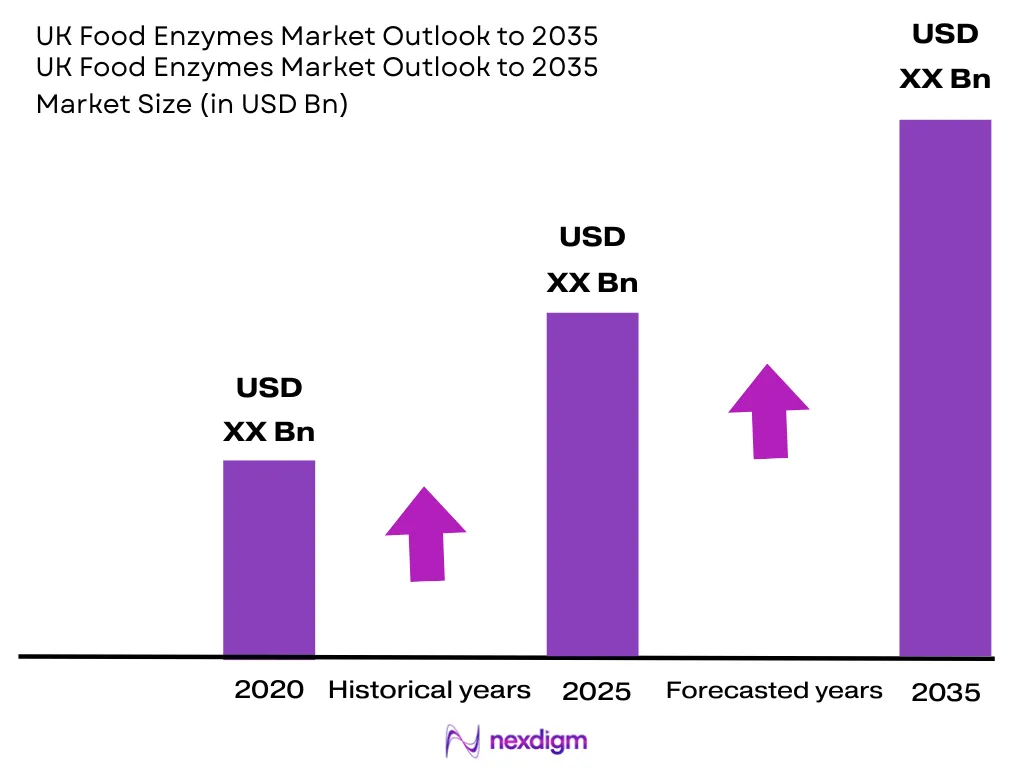
The UK Food Enzymes Market was valued at USD ~ Billion in 2024 and is anticipated to expand at a CAGR of ~% during 2026–2035. The market is primarily driven by the country’s well-established bakery, brewing, and dairy manufacturing base, increasing demand for clean-label processing aids, and continued reformulation of processed foods to reduce chemical additives. According to the Food and Drink Federation (FDF), the UK food and drink manufacturing sector contributed more than GBP 37 billion to the economy and supported almost 486,500 jobs across 12,195 businesses in 2024, making it one of the country’s largest manufacturing industries. The UK bakery sector alone produces close to 11 million loaves and packs of bread every day, according to the Federation of Bakers, creating substantial and sustained demand for baking enzymes that improve dough handling, extend shelf life, and enhance loaf volume and softness.
Market Segmentation
By Type
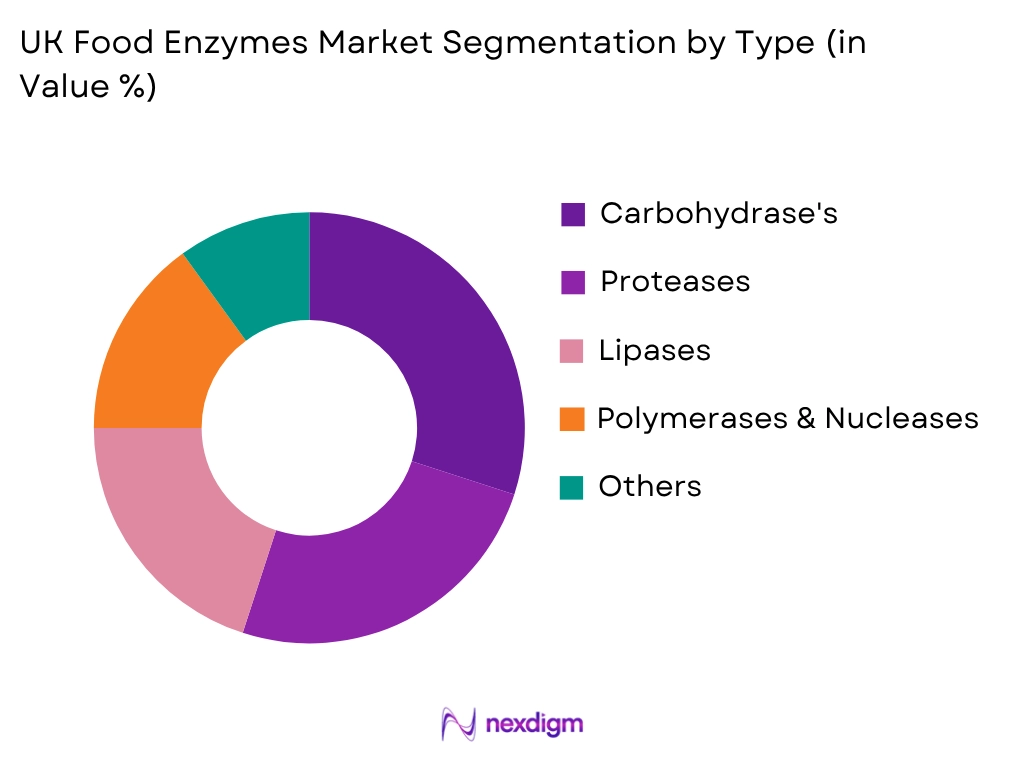
Among these, Carbohydrases, including amylases, cellulases, and xylanases, dominate the UK Food Enzymes Market owing to their extensive use across the country’s large bakery and brewing industries. Amylases and xylanases are widely used by UK bakers to improve dough stability, delay staling, and enhance loaf softness and shelf life, addressing the practical needs of a bakery sector producing nearly 4 billion units annually. Lactases represent one of the fastest-growing enzyme types, driven by rising demand for lactose-free and reduced-sugar dairy products, a trend reinforced by Kerry Group’s 2023 acquisition of the global lactase enzyme business from Chr. Hansen and Novozymes. Proteases and pectinases also maintain a meaningful share, supporting applications across brewing, fruit juice clarification, and bakery dough conditioning, while phytases remain more prominent in the adjacent animal feed enzyme market.
By Application
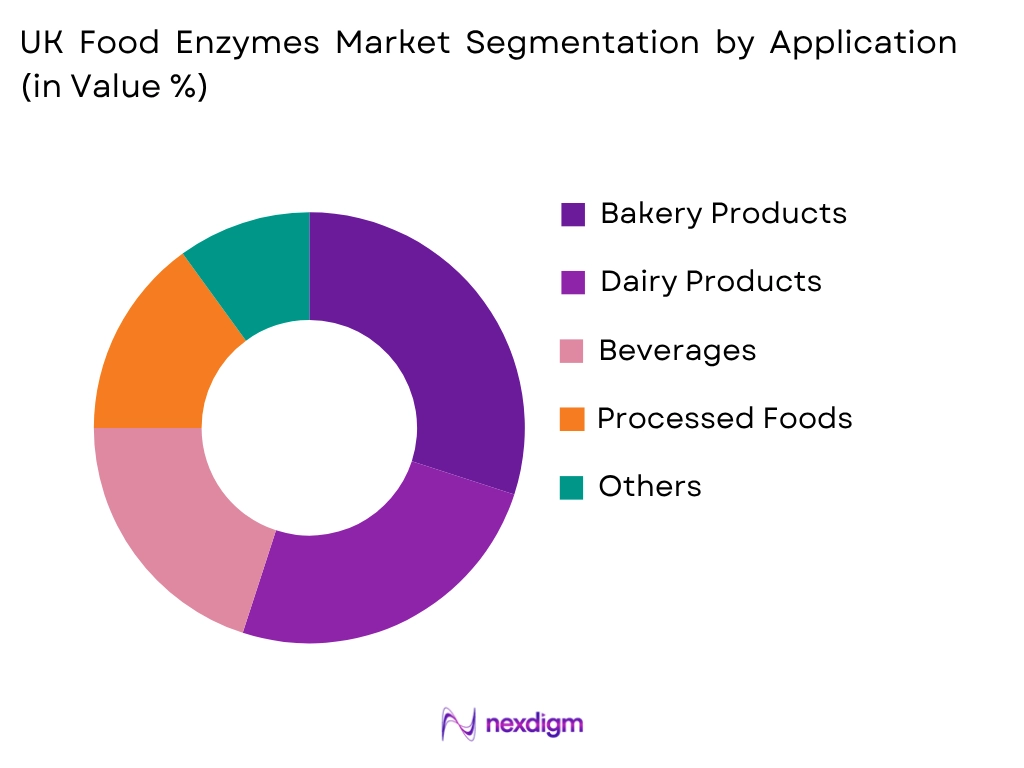
The Bakery segment holds the largest share owing to the extensive use of food enzymes for dough conditioning, crumb softness, loaf volume enhancement, and shelf-life extension across the UK’s large-scale bread and baked goods industry. According to the Federation of Bakers, UK bakery production totals almost 11 million loaves and packs sold every single day, creating structural demand for enzymes such as amylases, xylanases, and lipases that allow manufacturers to meet consumer expectations around freshness while reducing reliance on chemical emulsifiers. Products such as AB Enzymes’ VERON GMS+, launched in late 2023 as a next-generation baking enzyme designed to replace traditional monoglyceride emulsifiers, illustrate the ongoing shift toward enzyme-based clean-label reformulation. The Beverages segment, encompassing brewing, wine, and juice processing, also holds a significant share, reflecting the UK’s substantial beer and cider manufacturing base and its established use of enzymes for mashing, clarification, and fermentation efficiency.
Competitive Landscape
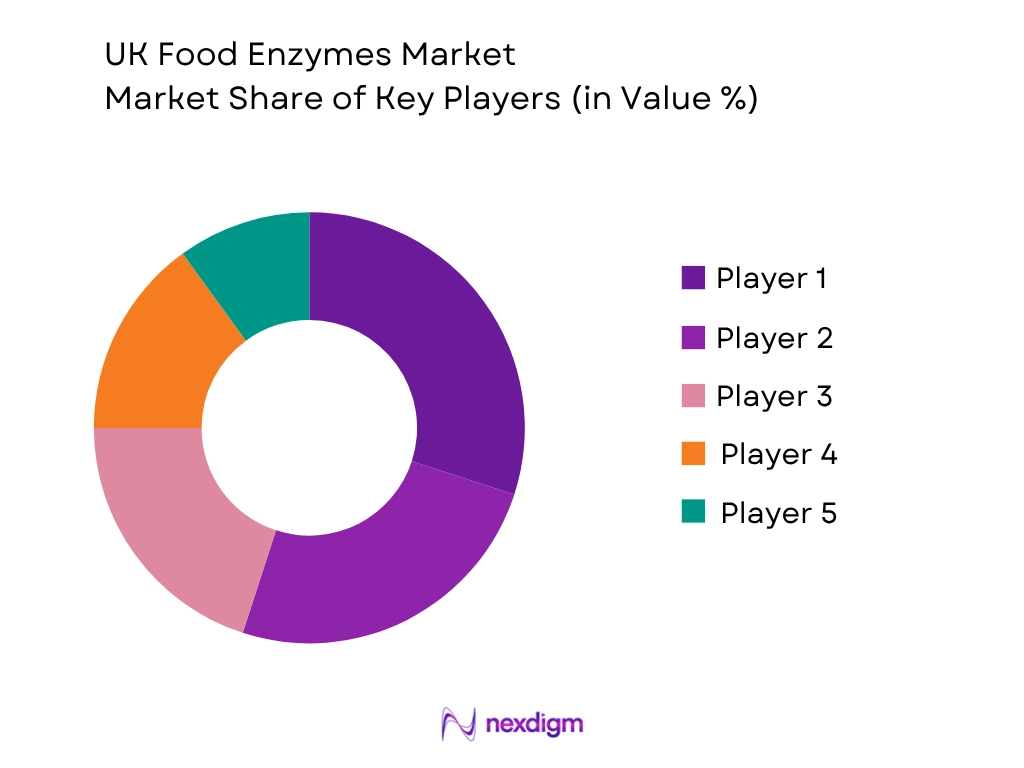
The UK Food Enzymes Market is moderately consolidated, with the presence of large multinational ingredient manufacturers alongside specialised domestic enzyme developers. Competition is primarily based on enzyme portfolio breadth, custom development capability, regulatory compliance, technical application support, pricing, and the ability to provide clean-label processing solutions. Companies are increasingly investing in fermentation capacity, metagenomics-based enzyme discovery, and protein engineering to improve enzyme specificity, thermal stability, and dosage efficiency. Strategic collaborations with UK food and beverage manufacturers, bespoke enzyme development services, and continued consolidation among global enzyme producers, including the 2024 merger of Novozymes and Chr. Hansen into Novonesis, have become key competitive dynamics shaping the market.
| Company | Establishment Year | Headquarters | Primary Product Portfolio | Enzyme Portfolio
|
Manufacturing Presence | Major End-Use Industries | Key Strategic Focus | Certifications & Compliance |
| Associated British Foods plc (AB Enzymes) | 1935 | ~ | ~ | ~ | ~ | ~ | ~ | ~ |
| Biocatalysts Ltd | 1983 | ~ | ~ | ~ | ~ | ~ | ~ | ~ |
| Koninklijke DSM N.V. | 1902 | ~ | ~ | ~ | ~ | ~ | ~ | ~ |
| Chr. Hansen Holding A/S | 1874 | ~ | ~ | ~ | ~ | ~ | ~ | ~ |
| Kerry Group plc | 1972 | ~ | ~ | ~ | ~ | ~ | ~ | ~ |
UK Food Enzymes Market Analysis
Growth Drivers
Growing Demand for Clean-Label Processing Aids
The UK’s food enzymes market is experiencing sustained growth due to the increasing preference for clean-label processing aids that can replace synthetic chemical additives across the country’s food and beverage industry. The Food and Drink Federation (FDF) reports that the sector contributed more than GBP 37 billion to the UK economy in 2024, making it one of the country’s largest manufacturing industries and supporting almost 486,500 jobs across more than 12,195 businesses. The number of food and drink manufacturing businesses in the UK rose 14% between 2019 and 2024, reflecting sustained investment in production capacity that directly increases consumption of functional processing aids such as enzymes. UK bakery manufacturers, seeking to meet consumer demand for “free-from” and clean-label products, have increasingly adopted enzyme-based solutions such as AB Enzymes’ VERON GMS+, launched in late 2023 to replace traditional monoglyceride emulsifiers while maintaining dough stability and texture, illustrating the broader industry shift toward enzymatic reformulation across bakery, dairy, and beverage categories.
Expansion of Lactose-Free and Functional Dairy Products
The growing UK consumer demand for lactose-free, reduced-sugar, and functional dairy products is a significant driver for the food enzymes market, particularly for lactase and other specialty dairy enzymes. In December 2023, Kerry Group, which operates significant manufacturing and innovation capacity in the UK and Ireland, announced the acquisition of the global lactase enzyme business from Chr. Hansen and Novozymes for USD 170 million, a deal that closed in the first half of 2024 and included the NOLA range of lactase products, strengthening the availability of lactose-free dairy processing solutions for UK manufacturers. The broader 2024 merger of Novozymes and Chr. Hansen into Novonesis further consolidated enzyme and bioscience capabilities relevant to UK dairy processors. According to Office for National Statistics data, the UK’s food and drink manufacturing sector remains one of the country’s largest industrial employers, with rising disposable income in urban centres such as London, Manchester, and Edinburgh supporting demand for premium, functional dairy products that rely on enzymatic processing for taste, texture, and digestibility improvements.
Market Challenges
High Dependence on Imported Specialty Enzymes
The UK imports a significant proportion of the specialty enzymes used across its food and beverage industry, particularly niche enzymes requiring advanced fermentation and protein engineering capabilities concentrated in a small number of global producers. Since Brexit, changes in customs procedures and border checks have added complexity and cost to importing enzyme preparations from the European Union, and post-Brexit UK trade data shows reduced export volumes to the EU alongside broadly stable import volumes, reflecting the added friction facing cross-border ingredient supply chains. Because food enzymes require precise activity levels, thermal stability, and purity specifications, disruptions in international supply chains or shipping delays can directly affect production planning for UK bakery, brewing, and dairy manufacturers that depend on consistent, temperature-controlled enzyme supply. Currency fluctuations further compound cost pressures for manufacturers sourcing specialty enzymes from producers based in the European Union, United States, and Asia.
Stringent Regulatory Compliance for Novel Enzyme Approval
The UK’s regulatory framework for food enzymes presents a significant challenge for manufacturers seeking to introduce novel or genetically modified enzyme preparations. The Food Standards Agency (FSA) in England, Wales, and Northern Ireland, together with Food Standards Scotland (FSS), maintains rigorous requirements governing the safety assessment, purity specifications, and permitted use of food enzymes, largely built on retained EU Regulation (EC) No. 1332/2008 on food enzymes. Manufacturers introducing new enzyme preparations, particularly those derived from genetically modified microorganisms, must provide extensive toxicological, allergenicity, and safety documentation before commercialisation. Following Brexit, UK manufacturers exporting enzyme-treated food products to the EU must additionally align with EU regulatory frameworks in parallel with domestic FSA and FSS requirements, increasing regulatory complexity and extending product development and approval timelines for specialty enzyme producers serving both markets.
Market Opportunities
Rising Investment in Custom Enzyme Development
The UK’s established base of specialist enzyme developers provides significant opportunities for innovation in custom, application-specific enzyme solutions. Domestic producers such as Biocatalysts Ltd, based in Cardiff, Wales, and established in 1983, demonstrate the country’s capacity for high-value custom enzyme discovery and manufacturing, taking bespoke enzymes from concept to commercial-scale production for major global food companies. Advances in metagenomics-based enzyme discovery, protein engineering, and fermentation technology continue to improve enzyme specificity, thermal tolerance, and dosage efficiency, expanding commercial applications across bakery, brewing, dairy, and plant-based food categories. As UK and multinational food companies continue seeking enzyme-based alternatives to chemical processing aids and emulsifiers, domestic enzyme developers are well positioned to capitalise on both domestic demand and export opportunities through value-added, application-specific enzyme manufacturing.
Growth in Plant-Based and Functional Food Categories
The UK’s expanding plant-based and functional food categories create substantial long-term opportunities for food enzyme manufacturers. Enzymes play a critical role in improving the taste, texture, and nutritional profile of plant-based dairy and meat alternatives, an increasingly important category as UK retailers and manufacturers continue to expand plant-based product ranges. Continued investment in food processing facilities and industrial automation further strengthens production capacity for value-added foods requiring advanced enzymatic processing, including gluten-free bakery products, low-sugar confectionery, and acrylamide-reduced snack foods. These structural developments create favourable conditions for enzyme manufacturers to introduce innovative, sustainable, and application-specific solutions capable of serving both the UK’s domestic food industry and its export customer base across the European Union and beyond.
Future Outlook
The UK Food Enzymes Market is expected to witness steady expansion over the forecast period, supported by increasing consumer preference for clean-label food ingredients, continuous product reformulation by food manufacturers seeking to reduce chemical additives, and advancements in enzyme discovery and protein engineering technologies. Growing investment in lactose-free dairy products, plant-based foods, and premium bakery products will further accelerate demand for innovative enzymatic solutions. The market is also likely to benefit from the UK’s established specialty enzyme development base and its close, if increasingly complex, trading relationship with the European Union, which continues to shape ingredient sourcing and regulatory alignment across the industry.
Major Players
- Associated British Foods plc (AB Enzymes)
- Koninklijke DSM N.V.
- Chr. Hansen Holding A/S
- Kerry Group plc
- IFF (International Flavors & Fragrances)
- Novonesis (Novozymes A/S)
- BASF SE
- Amano Enzyme Inc.
- Advanced Enzyme Technologies Ltd
- Dyadic International Inc.
- Lallemand Inc.
- AB Mauri
- Enzyme Development Corporation
- MetGen Oy
- Biocatalysts Ltd
Key Target Audience
- Food Enzyme Manufacturers
- Food & Beverage Processing Companies
- Bakery Manufacturers
- Dairy Product Manufacturers
- Brewers and Beverage Manufacturers
- Investment and Venture Capitalist Firms
- Government and Regulatory Bodies (Food Standards Agency (FSA), Food Standards Scotland (FSS), Department for Environment, Food and Rural Affairs (Defra))
- Food Ingredient Distributors and Industrial Raw Material Suppliers
Research Methodology
Step 1: Identification of Key Variables
The research process begins with identifying the complete ecosystem of the UK Food Enzymes Market, including raw material and fermentation feedstock suppliers, enzyme manufacturers, ingredient distributors, food processors, retailers, and regulatory authorities. Extensive secondary research is conducted using company annual reports, government publications, trade associations, customs statistics, industry journals, and proprietary databases to determine the variables influencing market demand, pricing, production, consumption, and technological developments.
Step 2: Market Analysis and Construction
Historical market information is collected and analysed to estimate market size, production volumes, import-export activity, application-wise demand, and pricing trends. A combination of top-down and bottom-up approaches is used to estimate market revenues and validate segment-level performance. Consumption patterns across bakery, dairy, beverages, confectionery, processed foods, and nutraceuticals are evaluated to establish an accurate representation of the industry.
Step 3: Hypothesis Validation and Expert Consultation
The preliminary findings are validated through Computer-Assisted Telephone Interviews (CATIs) and structured discussions with enzyme manufacturers, procurement managers, distributors, food technologists, regulatory experts, and senior executives operating within the UK food industry. These interviews help verify market assumptions, competitive developments, technology adoption trends, pricing dynamics, and future investment opportunities while refining the overall market estimates.
Step 4: Research Synthesis and Final Output
The final stage integrates insights obtained from primary interviews with quantitative information collected through secondary sources. Data triangulation techniques are applied to reconcile differences between supply-side and demand-side estimates, ensuring robust market forecasting. The report is then reviewed through multiple quality assurance checkpoints to deliver a comprehensive analysis covering market size, segmentation, competitive landscape, future outlook, and strategic recommendations for industry stakeholders.

- Executive Summary
- Research Methodology (Market Definitions and Assumptions, Abbreviations, Market Sizing Approach, Top-Down Analysis, Bottom-Up Analysis, Demand-Side Assessment, Supply-Side Assessment, Primary Industry Interviews, Secondary Research Validation, Data Triangulation, Forecasting Framework, Limitations and Future Conclusions)

- Definition and Scope
- Market Evolution and Industry Genesis
- Timeline of Major Industry Developments
- Food Enzymes Industry Value Chain Analysis
- Supply Chain Analysis

- Growth Drivers (Growing Clean Label Food Demand, Rising Consumption of Processed Foods, Expansion of Brewing and Beverage Manufacturing, Increasing Demand for Lactose-Free Dairy Products, Premiumisation of Bakery Products, Growth in Plant-Based Foods)
- Market Challenges (High Cost of Specialty Enzymes, Enzyme Stability and Shelf-Life Issues, Raw Material Price Volatility, Regulatory Compliance Complexity, Cold-Chain Storage Requirements, Import Dependency for Specialty Enzymes)
- Market Opportunities (Precision Fermentation Technologies, Novel Enzyme Discovery Platforms, Acrylamide Reduction Solutions, Functional Food Innovation, Export-Oriented Enzyme Manufacturing, Clean Label Reformulation Projects)
- Market Trends (Replacement of Chemical Processing Aids, Enzyme-Assisted Gluten-Free Formulation, Custom Enzyme Development, Sustainable Fermentation-Based Production, Enzymes for Sugar and Additive Reduction, Multi-Functional Enzyme Blends)
- Government Regulations (FSA Food Enzyme Regulations, Food Labelling Requirements, Maximum Permitted Usage Levels, Novel Enzyme Approval Standards, Import Compliance, Food Safety Standards)
- Import and Export Analysis (Trade Volume, Major Import Sources, Export Destinations, HS Code Analysis, Trade Balance)
- Raw Material Availability Analysis (Fermentation Feedstocks, Cereal and Grain Substrates, Milk-Derived Substrates, Fruit and Vegetable Substrates, Microbial Strains)
- Technology Landscape (Submerged Fermentation, Solid-State Fermentation, Enzyme Immobilisation, Protein Engineering, Metagenomics-Based Enzyme Discovery)
- Sustainability Assessment (Renewable Fermentation Feedstocks, Carbon Footprint Reduction, Waste Valorisation, Energy-Efficient Manufacturing, Biodegradable Processing Aids)
- PESTLE Analysis
- SWOT Analysis
- Porter’s Five Forces Analysis
- Stakeholder Ecosystem
- Competition Ecosystem

- By Market Value (2020-2025)
- By Volume Consumption (2020-2025)
- By Average Selling Price (2020-2025)

- By Type (In Value %)
Carbohydrases
Proteases
Lipases
Phytases
Lactases
Pectinases - By Application (In Value %)
Bakery
Dairy
Beverages (Brewing, Wine and Juice Processing)
Confectionery
Meat, Poultry and Seafood Products
Processed Foods
Nutraceuticals and Functional Foods - By Distribution Channel (In Value %)
Direct Sales to Food Manufacturers
Ingredient Distributors
Industrial Ingredient Suppliers
Online B2B Ingredient Platforms
Specialty Ingredient Suppliers - By End User (In Value %)
Bakery Manufacturers
Dairy Processors
Brewers and Beverage Manufacturers
Confectionery Manufacturers
Meat and Seafood Processors
Nutraceutical Manufacturers
Foodservice Manufacturers - By Region (In Value %)
London & South East England
North West England
Midlands
Scotland
Wales & Northern Ireland

- Market Share of Major Players (By Value, Volume, Enzyme Type, Application Industry, Product Category)
- Cross Comparison Parameters (Enzyme Portfolio Breadth, Custom Enzyme Development Capability, Thermal and pH Stability Performance, Application Technical Support Capability, Manufacturing Capacity, Regulatory Compliance & Certifications, Food & Beverage Customer Base, Innovation & New Product Launch Frequency)
- SWOT Analysis of Major Players
- Pricing Analysis by Product Category and SKU
- Production Capacity Analysis
- Manufacturing Footprint Analysis
- Distribution Network Analysis
- Innovation Benchmarking
- Detailed Profiles of Major Companies
Associated British Foods plc (AB Enzymes)
Koninklijke DSM N.V.
Chr. Hansen Holding A/S
Kerry Group plc
IFF (International Flavors & Fragrances)
Novonesis (Novozymes A/S)
BASF SE
Amano Enzyme Inc.
Advanced Enzyme Technologies Ltd
Dyadic International Inc.
Lallemand Inc.
AB Mauri
Enzyme Development Corporation
MetGen Oy
Biocatalysts Ltd

- Consumption Pattern Analysis (Industrial Usage, Batch Size, Product Category Penetration, Seasonal Demand, Reformulation Activity)
- Purchasing Criteria (Enzyme Activity Consistency, Regulatory Compliance, Cost Efficiency, Thermal Stability, pH Stability, Shelf Life)
- Procurement and Supplier Selection Analysis
- Clean Label Adoption Assessment
- Premium vs Conventional Product Demand
- Product Attribute Preference Analysis (Activity Consistency, Dosage Efficiency, Thermal Tolerance, Substrate Specificity, Natural Origin, Label Friendliness)
- Consumer Health & Wellness Influence on Product Development
- Pain Point Analysis
- Decision-Making Process

- By Market Value (2026-2035)
- By Volume Consumption (2026-2035)
- By Average Selling Price (2026-2035)


 Request a Sample
 Ask for Customization
 Get a Quote
 Enquire Now