
 Download PDF
Market Overview
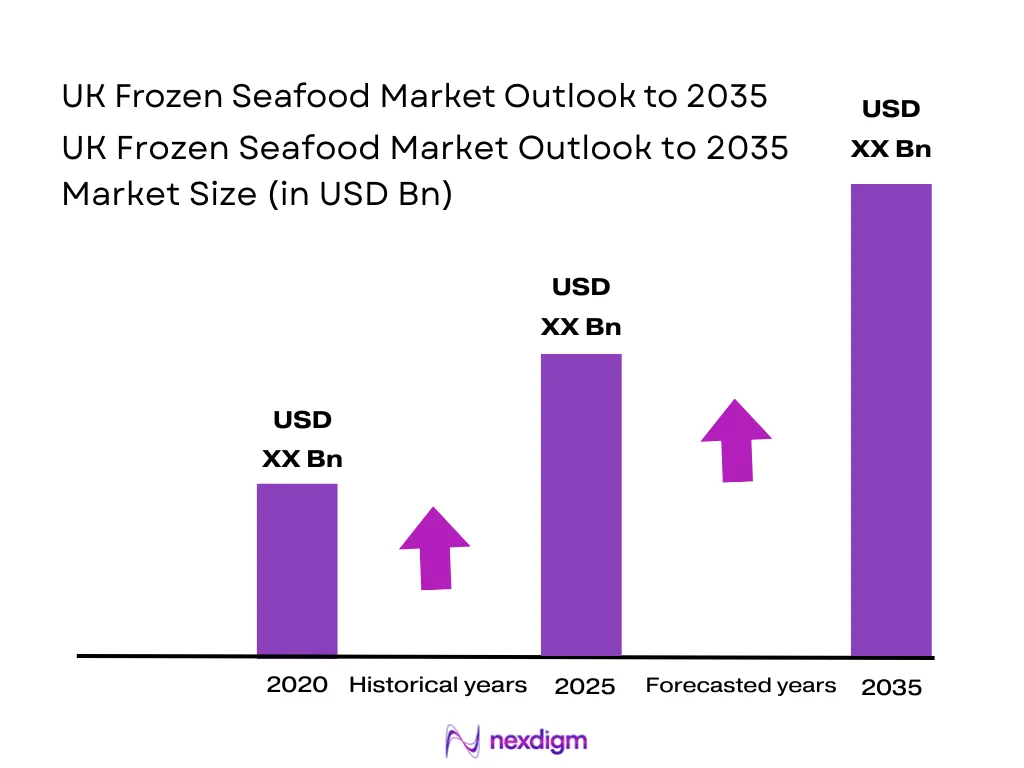
The UK frozen seafood market is valued at USD ~ billion, based on the latest annual market reading, compared with a prior annual peak of USD ~ billion and prior-year consumption above 401 thousand tons. Demand is driven by frozen fish fillets, which account for around 80% of consumption volume, supported by retail freezer availability, foodservice portion control, longer shelf life, and household demand for affordable protein. The forecast value CAGR is 1.9% through 2035.
The market is dominated by the UK’s major seafood processing, import and retail corridors: Grimsby, Hull, Whitby, London, Scotland, and major supermarket distribution hubs across England. Grimsby and Hull dominate because of seafood processing heritage and imported whitefish handling; Whitby is important for scampi; London concentrates wholesale and premium foodservice demand; Scotland anchors salmon, pelagic seafood and export flows. UK retail seafood reached ~ billion and 381,371 tons, with salmon, tuna, cod, pollock and warmwater prawns leading supermarket volumes.
Market Segmentation
By Product Type
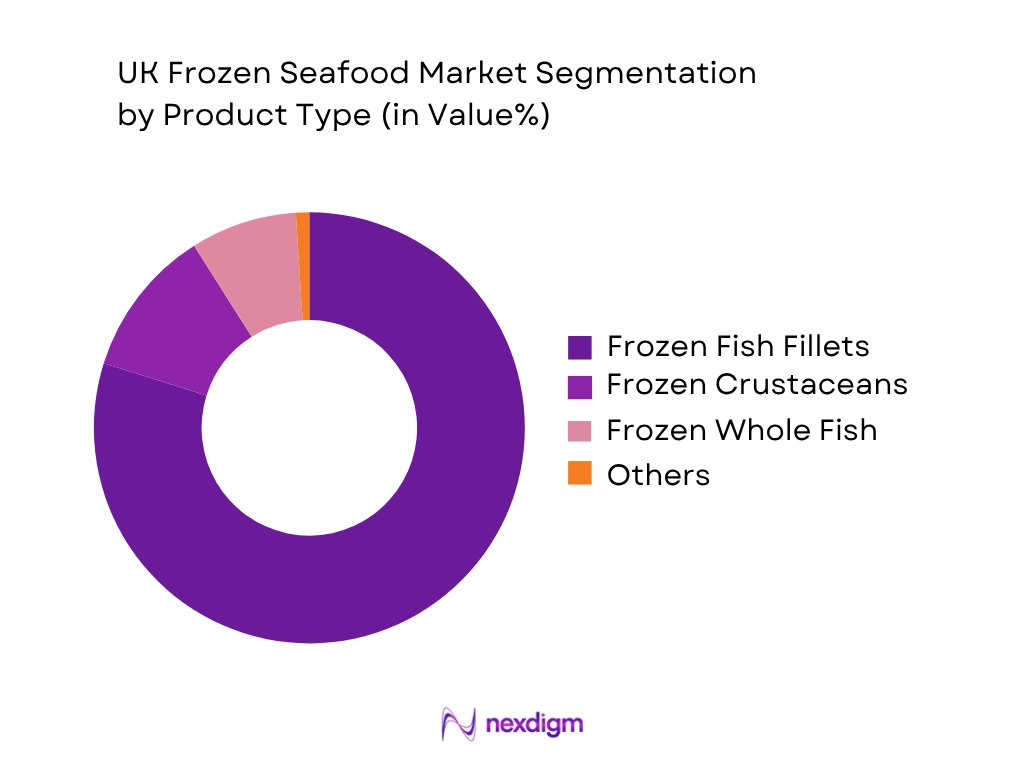
The UK frozen seafood market is segmented by product type into frozen fish fillets, frozen crustaceans, frozen whole fish, and frozen molluscs and other seafood. Frozen fish fillets dominate because they are the most commercially scalable frozen seafood format across retail and foodservice. They fit supermarket private-label packs, branded fish-finger and coated-fish ranges, fish-and-chip shop procurement, and contract-catering portion control. Cod, haddock, pollock and salmon fillets also offer easier boneless preparation, lower kitchen labour, predictable yield and compatibility with IQF, block-frozen and value-added coating lines. IndexBox identifies frozen fish fillets as the leading UK consumption type, with crustaceans and whole fish materially smaller in volume terms.
By Import Source Country
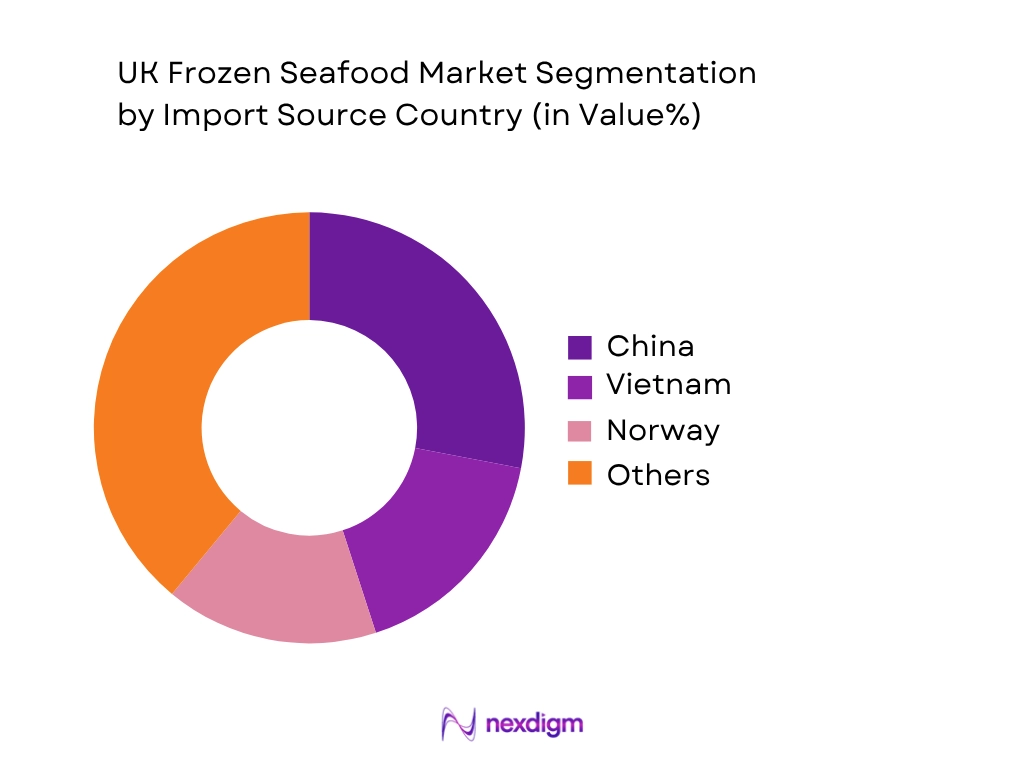
The UK frozen seafood market is segmented by import source country into China, Vietnam, Norway, Iceland, India, Turkey, Ecuador and other countries. China dominates import volume because it acts as a large-scale processing hub for whitefish, especially filleting, coating, freezing and re-exporting cod, haddock and Alaska pollock products. Vietnam has gained relevance through seafood processing and warmwater seafood supply; Norway is important due to salmon, cod and coldwater seafood proximity; Iceland remains critical for higher-value whitefish. The UK’s net-importer position makes origin diversification central to pricing, traceability, sanctions exposure and retailer supply continuity.
Competitive Landscape
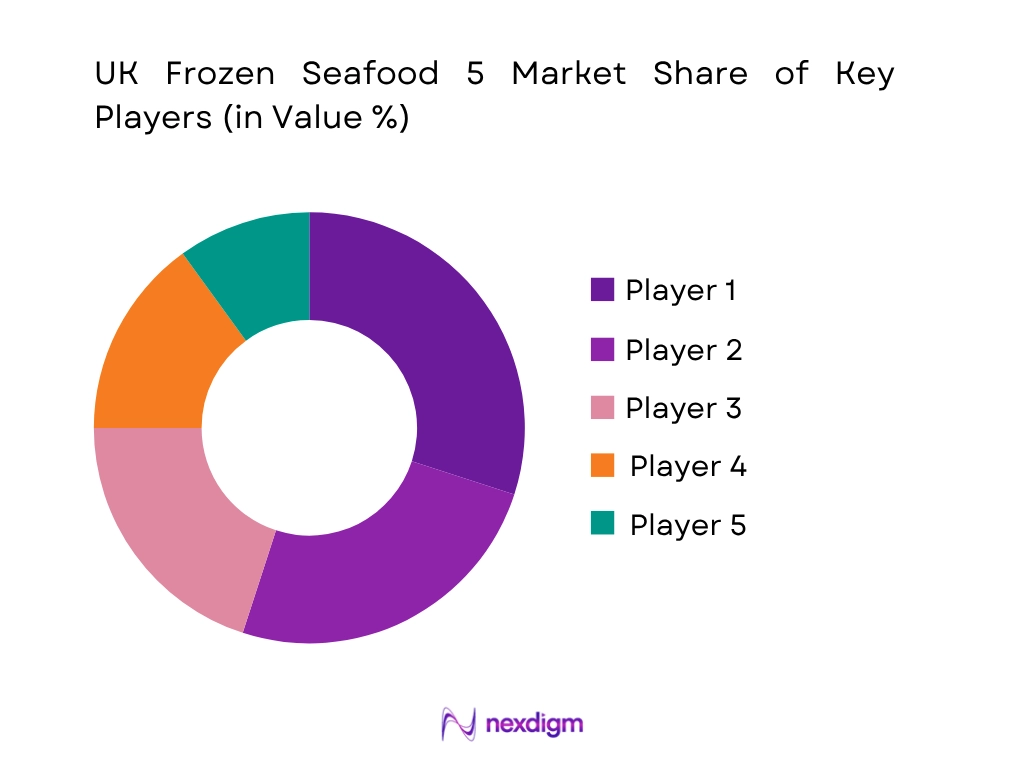
The UK frozen seafood market is concentrated around a mix of branded frozen-food leaders, heritage seafood processors, private-label manufacturers, scampi specialists and foodservice distributors. Nomad Foods/Birds Eye controls major branded freezer-space visibility; Young’s Seafood has scale across branded and own-label seafood; Whitby Seafoods leads scampi-led coated seafood; Iceland Seafood International UK and New England Seafood International are important in imported, processed and retailer-facing seafood supply. Competition is shaped by retail listings, species sourcing security, MSC/ASC certification, processing capacity, cold-chain reliability, and ability to supply both value and premium frozen seafood formats.
| Company | Establishment Year | Headquarters | Product Focus | Channel Strength | Sourcing / Certification Focus | Processing & Cold-Chain Capability | Private Label Exposure | Key Market Role |
| Nomad Foods / Birds Eye | 2014 | Feltham, UK | ~ | ~ | ~ | ~ | ~ | ~ |
| Young’s Seafood | 1805 heritage / 1999 current company | Grimsby, UK | ~ | ~ | ~ | ~ | ~ | ~ |
| Whitby Seafoods | 1985 | Whitby, UK | ~ | ~ | ~ | ~ | ~ | ~ |
| Iceland Seafood International UK | 1932 group origin | Grimsby / UK operations | ~ | ~ | ~ | ~ | ~ | ~ |
| New England Seafood International | 1991 | Chessington, UK | ~ | ~ | ~ | ~ | ~ | ~ |
UK Frozen Seafood Market Outlook to 2035
Growth Drivers
Large Consumer Base and Stable Seafood Basket Supporting Frozen Seafood Demand
The UK frozen seafood market is supported by a broad consumer base and a concentrated seafood basket that fits frozen formats such as fillets, prawns, fish fingers, coated portions and freezer-stable meal components. The UK population reached 69,281,400 people in mid-2024, while the World Bank reported UK GDP at USD 3.69 trillion and GDP per capita at USD 53,246.4, indicating a large, high-income food retail base for frozen protein categories. Seafood retail purchases through large multiple retailers reached 381,371 tonnes in 2023, with the top species by volume being salmon at 63,100 tonnes, tuna at 60,800 tonnes, cod at 45,200 tonnes, pollock at 35,200 tonnes, and warmwater prawns at 23,800 tonnes. These species align strongly with frozen seafood use cases because cod and pollock support coated fish and fish fingers, salmon supports frozen portions, tuna supports processed formats, and prawns support both retail freezer packs and foodservice recipes.
Import-Backed Supply System Enabling Consistent Retail and Foodservice Availability
The UK frozen seafood market is driven by a mature import-backed supply chain that provides consistent access to species not available in sufficient domestic volumes. In 2024, the UK imported 633 thousand tonnes of fish and fish preparations and exported 380 thousand tonnes, confirming the structural role of imports in supermarket freezers, foodservice distributors and seafood processors. The UK imported 107.0 thousand tonnes of tuna, 95.0 thousand tonnes of salmon, 78.2 thousand tonnes of shrimps and prawns, 77.7 thousand tonnes of cod, 54.0 thousand tonnes of haddock and 30.7 thousand tonnes of pollack in 2024. These species are directly relevant to frozen seafood because they are used in IQF fillets, coated whitefish, prawn bags, seafood mixes, salmon portions and frozen meal solutions. The macroeconomic base remains supportive, with the IMF listing the UK country population at 69.85 million for 2026, sustaining foodservice and household freezer consumption at national scale.
Market Challenges
Heavy Dependence on Imported Whitefish and Shellfish Exposes Frozen Seafood Supply
The UK frozen seafood market faces a major challenge from import dependence, especially in whitefish and shellfish categories that feed retail frozen fillets, coated seafood and fish-and-chip supply. The UK was a net importer of fish in 2024, with the trade balance at 253 thousand tonnes. Cod imports reached 77.7 thousand tonnes, and the top five cod suppliers delivered 69.2 thousand tonnes. Haddock imports reached 54.0 thousand tonnes, with the top five markets supplying 50.2 thousand tonnes. Shrimps and prawns imports reached 78.2 thousand tonnes, with Vietnam alone supplying 19.4 thousand tonnes, India 12.1 thousand tonnes, and Ecuador 10.4 thousand tonnes. This concentration creates operational exposure for frozen seafood buyers because delays, origin restrictions, catch documentation issues or processing disruptions can affect freezer-ready cod, haddock, prawns and pollock. The exposure is significant in a large economy World Bank records UK GDP at USD 3.69 trillion, meaning frozen seafood distributors must manage import resilience at national retail and foodservice scale.
Domestic Fleet Structure Limits Substitution Away from Imported Frozen Seafood
The UK frozen seafood market also faces a domestic supply limitation because the UK fleet does not fully match domestic frozen seafood demand for cod, haddock, tuna, prawns and processed whitefish. In 2024, there were 5,232 UK-registered fishing vessels, of which 4,140 were under 10 metres in length, indicating a fleet structure with many small vessels and limited capacity to replace large-scale frozen seafood imports. UK vessels landed 745 thousand tonnes of sea fish, but 269 thousand tonnes were landed abroad, reducing the direct domestic landing base available for UK processors. Foreign vessels landed only 22 thousand tonnes into the UK. Species composition also matters: mackerel alone accounted for more than 233 thousand tonnes landed by the UK fleet, while frozen retail demand relies heavily on imported cod, haddock, pollock, tuna, salmon and prawns. With the ONS estimating the UK population at 69,281,400, domestic seafood supply constraints create a clear challenge for supermarket freezer continuity and foodservice procurement.
Market Opportunities
Certified and Traceable Frozen Expand Through Retail Freezer Aisles Seafood Can
A key opportunity in the UK frozen seafood market lies in certified and traceable frozen seafood, particularly wild-caught whitefish, tuna and value-added freezer products. MSC reported that UK and Ireland shoppers bought 189,000 tonnes of MSC-certified fish and seafood products in the latest reporting period, and the UK retail system included 948 MSC-labelled own-brand products. MSC-certified tuna reached just over 23,500 tonnes in the previous reporting period, showing that certified seafood can scale in mainstream grocery rather than remaining a niche premium claim. This is important for frozen seafood suppliers because frozen fillets, fish fingers, breaded portions, preserved seafood and ready-meal seafood all rely on origin assurance, chain-of-custody checks and species verification. The opportunity is supported by the UK’s high-income macro base, with World Bank GDP per capita at USD 53,246.4, giving retailers room to differentiate freezer products through certified sourcing, traceable packaging and private-label sustainability tiers without relying only on commodity frozen seafood positioning.
Prawns, Salmon and Value-Added Seafood Create Scope for Premium Frozen Formats
The UK frozen seafood market has a strong opportunity in prawns, salmon and value-added frozen seafood because current trade flows already show large volumes in species suited to premium freezer formats. In 2024, the UK imported 78.2 thousand tonnes of shrimps and prawns, including 19.4 thousand tonnes from Vietnam, 12.1 thousand tonnes from India and 10.4 thousand tonnes from Ecuador. Salmon trade reached 211.2 thousand tonnes, with imports of 95.0 thousand tonnes and exports of 116.2 thousand tonnes, indicating strong handling, processing and distribution expertise around a high-recognition seafood species. These volumes support frozen product extensions such as raw king prawns, cooked prawn bags, garlic prawns, salmon portions, fish-pie mixes, seafood pasta kits and premium ready-to-cook freezer meals. The opportunity is reinforced by a large domestic demand base: the IMF lists UK population at 69.85 million for 2026, while ONS places the mid-2024 population at 69,281,400, supporting national-scale retail and foodservice product development.
Future Outlook
The UK frozen seafood market is expected to expand steadily rather than aggressively, with demand supported by household value-seeking, foodservice portion control and wider acceptance of frozen seafood as a convenient protein format. Growth will be strongest in fillets, coated seafood, prawns, premium frozen seafood and certified sustainable ranges. The market is forecast to reach USD 3.1 billion and 475 thousand tons by 2035, with a value CAGR of 1.9% and volume CAGR of 1.5%.
Future performance will depend on four structural shifts. First, retailers will continue repositioning freezer aisles from purely value-led products toward quality, provenance and sustainability. Second, foodservice operators will use frozen seafood to manage labour shortages, portion losses and volatile fish prices. Third, importers will diversify beyond exposed whitefish supply chains, especially where China processing and Russian-origin fish create traceability concerns. Fourth, value-added formats such as coated prawns, tempura seafood, fishcakes, seafood mixes, fish-pie components and world-cuisine meal solutions will improve margins versus commodity frozen blocks.
Major Players
- Nomad Foods / Birds Eye
- Young’s Seafood
- Whitby Seafoods
- Iceland Seafood International UK
- New England Seafood International
- Lyons Seafoods
- Ocean Fish
- Direct Seafoods
- M&J Seafood
- Fastnet Fish
- Thistle Seafoods
- Northcoast Seafoods
- Smales
- Hilton Seafood / Hilton Food Group
- Bidfood UK
Key Target Audience
- Frozen seafood manufacturers and processors
- Seafood importers and exporters
- Supermarket chains and grocery retailers
- Foodservice distributors and wholesalers
- Fish and chip shop supplier networks
- Cold-chain logistics and frozen warehousing companies
- Investments and venture capitalist firms
- Government and regulatory bodies
Research Methodology
Step 1: Identification of Key Variables
The initial phase involves constructing an ecosystem map of the UK frozen seafood market, covering fishing fleets, aquaculture suppliers, importers, processors, retailers, foodservice distributors, certification bodies and regulators. The key variables include species type, import origin, product format, retail channel, foodservice demand, cold-chain cost, certification status and price per ton.
Step 2: Market Analysis and Construction
The second phase involves compiling historical market data on consumption, import volume, import value, domestic production, exports, average import prices and product-type composition. Market construction uses a top-to-bottom approach from national frozen seafood consumption value and a bottom-to-top approach based on fillet, crustacean, whole fish and mollusc volumes.
Step 3: Hypothesis Validation and Expert Consultation
Market hypotheses are validated through interviews with frozen seafood processors, seafood importers, foodservice procurement heads, supermarket category managers and cold-chain logistics operators. These consultations help verify operating margins, SKU movement, private-label supply intensity, frozen storage economics, import exposure and species-level substitution patterns.
Step 4: Research Synthesis and Final Output
The final phase integrates secondary data, trade statistics, retail performance indicators and expert inputs into a validated market model. The output includes market size, forecast CAGR, segmentation, competitive benchmarking, target audience mapping, and strategic implications for investors, retailers, processors, distributors and seafood supply-chain participants.

- Executive Summary
- Research Methodology(Market Definitions and Scope, Frozen Seafood Classification, Species Inclusion and Exclusion, Retail Scanner Data Review, Foodservice Procurement Mapping, Import-Export Data Triangulation, Top-to-Bottom Market Sizing, Bottom-to-Top SKU and Channel Build-Up, Primary Interviews with Importers/Processors/Distributors/Retailers/Foodservice Buyers, Price and Margin Validation, Cold Chain Capacity Assessment, Certification Mapping, Forecasting Assumptions, Limitations and Risk Controls)

- Definition and Scope
- Market Genesis
- Evolution of Frozen Seafood Consumption
- Industry Life Cycle
- Supply Chain and Value Chain Analysis

- Growth Drivers(Protein-Rich Diets, Convenience Cooking, Longer Shelf Life, Food Waste Reduction, Frozen Quality Perception, Retail Own Label Expansion, Foodservice Portion Control)
- Rising Demand for Convenient Protein
- Expansion of Online Grocery and Frozen Delivery
- Market Challenges(Import Volatility, Whitefish Price Inflation, Energy Costs, Labour Costs, Cold Storage Capacity, Certification Costs, Origin Transparency, Retail Price Wars)
- Opportunities(Premium Frozen Seafood, Sustainable Whitefish, Value-Added Prawns, Foodservice Bulk Packs, Digital Fishmongers, Ethnic Meal Solutions, Health-Led Positioning)
- Market Trends (Freezer Aisle Repositioning, Private Label Premiumisation, IQF Quality Messaging, Oven-Ready Seafood, Alternative Species, Sustainable Packaging, Digital Traceability)
- Government Regulation and Compliance (Food Safety, Import Controls, Labelling, Catch Certificates, IUU Compliance, Border Checks, Allergen Declaration, Temperature Control, Traceability Records)
- SWOT Analysis
- Porter’s Five Forces
- Stakeholder Ecosystem

- By Value (2020-2025)
- By Volume (2020-2025)
- By Average Selling Price (2020-2025)

- By Species Type (In Value %)
Cod
Haddock
Salmon
Prawns and Shrimps
Pollock - By Product Format (In Value %)
Frozen Fillets and Portions
Breaded and Battered Seafood
Frozen Shellfish
Value-Added Frozen Seafood
Frozen Seafood Meals and Components - By End User (In Value %)
Retail Consumers
Foodservice Operators
Fish and Chip Shops
Hospitality and Casual Dining
Public Sector and Contract Catering - By Distribution Channel (In Value %)
Supermarkets and Hypermarkets
Discounters
Online Grocery
Frozen Food Specialists
Foodservice Distributors

- Market Share of Major Players (Retail Value Share, Foodservice Value Share, Frozen Whitefish Share, Frozen Shellfish Share, Coated Seafood Share, Private Label Supply Share)
- Cross Comparison Parameters (Frozen Seafood SKU Breadth, Species Portfolio, Retail Listing Strength, Foodservice Distribution Reach, MSC/ASC Certification Coverage, Import-Origin Diversification, Cold Chain and Processing Capacity, Private Label Manufacturing Capability)
- Competitive Benchmarking Matrix (Brand Equity, Price Tier, Product Innovation, Sustainability Claims, Packaging Innovation, Online Availability, Foodservice Penetration, Traceability Strength)
- SWOT Analysis of Major Players
- Pricing Analysis by SKU
- Detailed Profiles of Major Companies
Nomad Foods / Birds Eye
Young’s Seafood
Whitby Seafoods
Iceland Seafood International UK
New England Seafood International
Lyons Seafoods
Ocean Fish
Direct Seafoods
M&J Seafood
Fastnet Fish
Thistle Seafoods
Northcoast Seafoods
Smales
Hilton Seafood / Hilton Food Group
Bidfood UK

- Retail Consumer Demand and Utilisation
- Foodservice Demand and Utilisation
- Purchasing Power and Budget Allocation
- Needs, Desires and Pain Point Analysis
- Decision-Making Process
- SKU-Level Purchase Triggers

- By Value (2026-2035)
- By Volume (2026-2035)
- By Average Selling Price (2026-2035)


 Request a Sample
 Ask for Customization
 Get a Quote
 Enquire Now