
 Download PDF
Market Overview
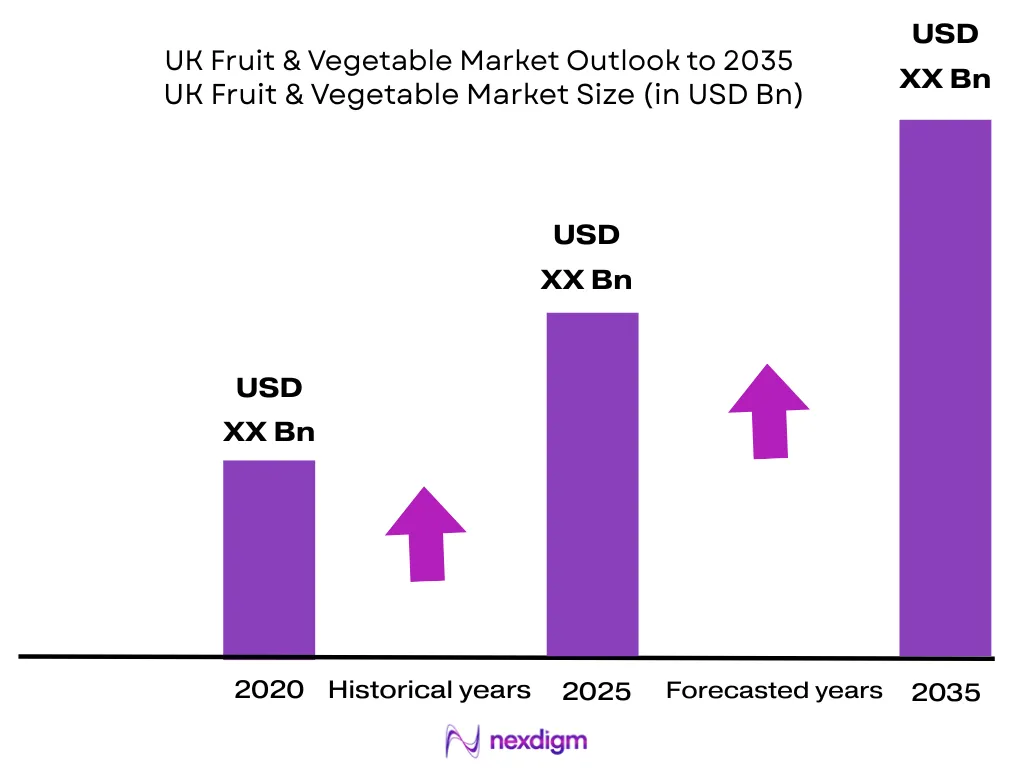
The UK Fruit & Vegetable Market is valued at USD ~ billion, based on a five-year historical analysis, and is forecast to grow at 4.7% CAGR across the outlook period. Home-produced vegetables reached £2.028 billion compared with £1.986 billion previously, while home-produced fruit reached £1.084 billion compared with £1.037 billion previously. Growth is supported by supermarkets, discounters, prepared salads, soft fruit demand and import-backed year-round availability. England dominates the UK Fruit & Vegetable Market because it has the largest consumer base, major supermarket distribution centres, protected crop clusters and key production belts across Kent, Lincolnshire, East Anglia, Herefordshire and Yorkshire. DEFRA recorded UK vegetable supply at 4.466 million tonnes compared with 4.296 million tonnes previously, while fruit production reached 579 thousand tonnes compared with a slightly higher prior level. Spain, Netherlands, France, Morocco and South Africa remain critical import partners due to seasonality and product diversity.
Market Segmentation
By Product Type
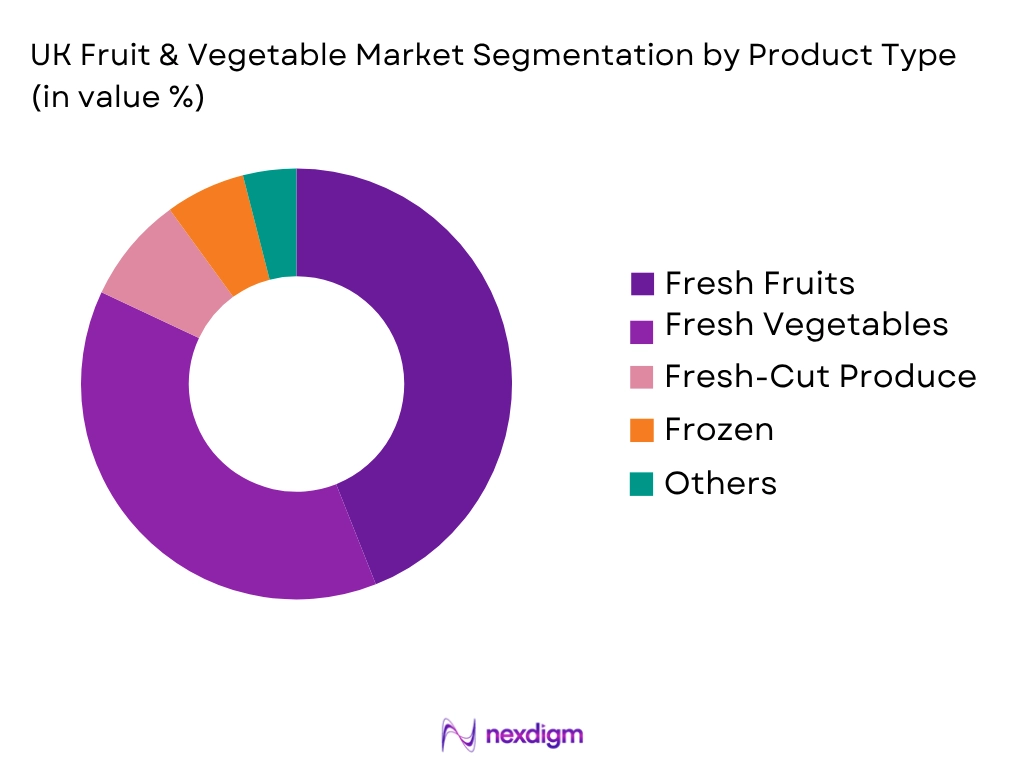
The UK Fruit & Vegetable Market is segmented by product type into fresh vegetables, fresh fruits, prepared and fresh-cut produce, frozen fruits and vegetables, and canned, dried and ambient produce. Fresh vegetables hold the dominant market share because vegetables are more strongly supported by domestic production than fruit and are embedded in household cooking, foodservice procurement and public-sector catering. DEFRA reports home-produced vegetables at 2.4 million tonnes, with total vegetable supply at 4.466 million tonnes, while domestic production represented 53% of total fresh vegetable supply. Carrots, brassicas, lettuce, onions, potatoes, mushrooms and protected crops such as tomatoes and cucumbers create high-volume rotation across supermarkets and wholesale channels. The segment also benefits from British seasonal sourcing, retailer private label ranges and prepared vegetable formats used in ready meals and meal solutions.
By Distribution Channel
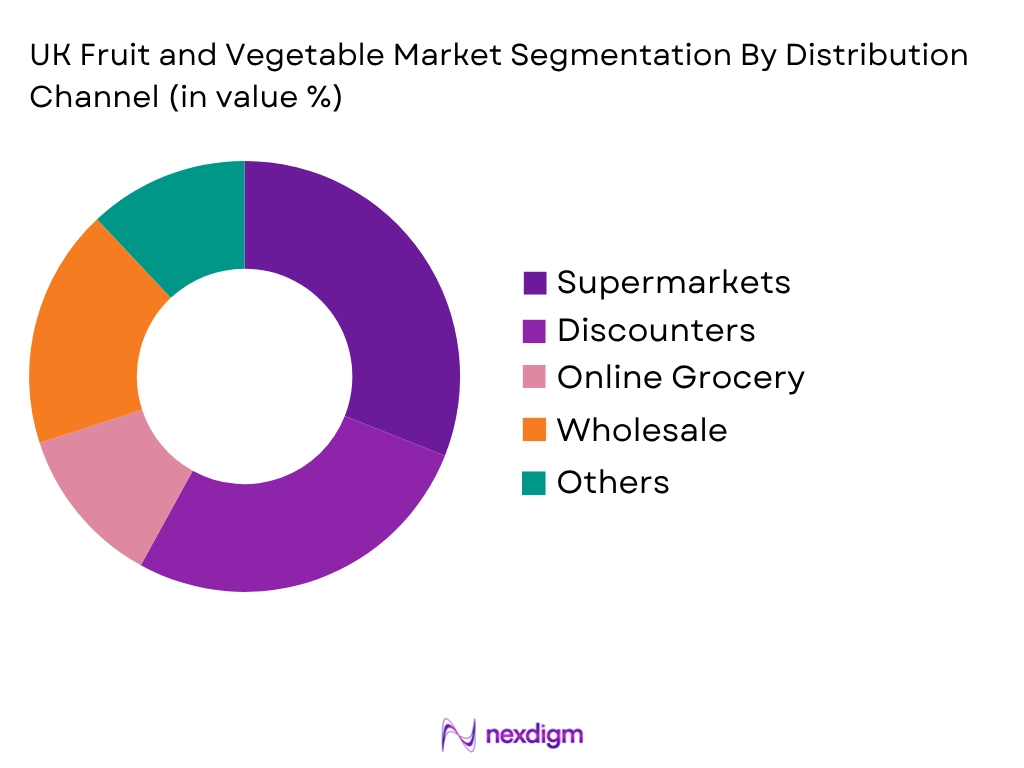
The UK Fruit & Vegetable Market is segmented by distribution channel into supermarkets and hypermarkets, discounters, online grocery, wholesale and foodservice distribution, and convenience stores, farm shops and box schemes. Supermarkets and hypermarkets dominate the market because major retailers control large fresh produce departments, private label ranges, chilled distribution, supplier scorecards and weekly household grocery missions. Retailers also manage ripening programmes for bananas and avocados, British seasonal campaigns for berries and apples, and prepared produce lines such as bagged salads, stir-fry mixes and ready-to-roast vegetables. Their dominance is reinforced by strong fresh category merchandising, clubcard-style promotions, large refrigerated supply chains and long-term sourcing contracts with growers, importers and fresh-cut processors. Discounters are expanding, but supermarket networks remain central for range depth, quality standards and national availability.
Competitive Landscape
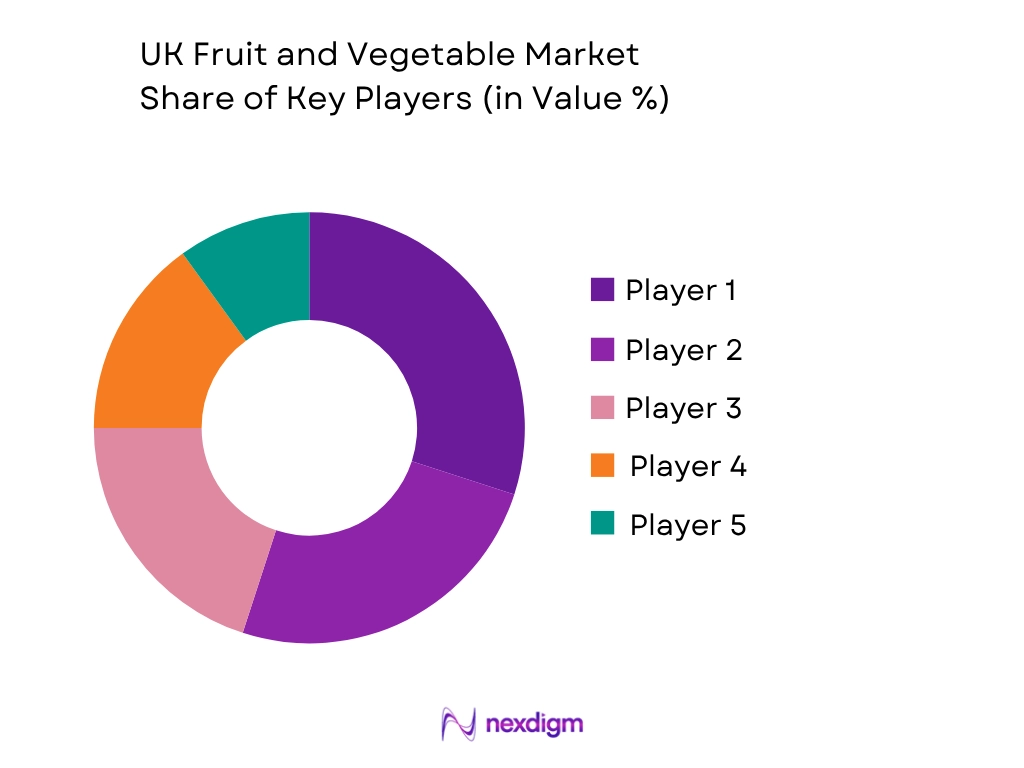
The UK Fruit & Vegetable Market is dominated by a mix of fresh produce importers, grower-marketers, prepared produce suppliers, soft fruit specialists and potato packers. Large players such as Dole UK, Fresca Group, G’s Fresh, Berry Gardens and A.G. Thames have strong influence because they combine domestic growing relationships, import sourcing, retailer category management, packhouse capacity and compliance systems. Competition is shaped by product quality, British seasonal supply, sourcing resilience, labour access, chilled logistics and supermarket account penetration.
| Company | Establishment Year | Headquarters | Key Categories | Business Model | Key Channel | UK / Import Footprint | Market-Specific Capability | Competitive Advantage |
| Dole UK / Total Produce UK | 2006 | Liverpool, UK | ~ | ~ | ~ | ~ | ~ | ~ |
| Fresca Group | 2005 | Kent, UK | ~ | ~ | ~ | ~ | ~ | ~ |
| G’s Fresh | 1952 | Cambridgeshire, UK | ~ | ~ | ~ | ~ | ~ | ~ |
| Berry Gardens | 1972 | Kent, UK | ~ | ~ | ~ | ~ | ~ | ~ |
| A.G. Thames | 1948 | Kent, UK | ~ | ~ | ~ | ~ | ~ | ~ |
UK Fruit & Vegetable Market Analysis
Growth Drivers
Strong Domestic Vegetable Production Supports Retail and Foodservice Availability
The UK Fruit & Vegetable Market is supported by a large consumer economy and a resilient domestic vegetable base. The World Bank reports UK GDP at USD 3.69 trillion and GDP per capita at USD 53,246.4 in 2024, creating a high-income grocery and foodservice environment for fresh produce consumption. DEFRA recorded home-produced vegetables at 2.4 million tonnes in 2024, compared with a total UK vegetable supply of 4.466 million tonnes, indicating strong domestic participation in carrots, brassicas, onions, lettuce, mushrooms and other staple crops. Field vegetables produced 2.108 million tonnes, while protected vegetables produced 254 thousand tonnes, supporting both open-field and glasshouse supply chains. This production structure benefits supermarkets, discounters, wholesalers, prepared vegetable processors and public-sector caterers because domestic vegetables provide shorter lead times, stronger British-origin positioning and more reliable replenishment for daily-use food categories.
Protected Cropping and Prepared Produce Demand Strengthen Year-Round Supply
The UK Fruit & Vegetable Market is driven by protected cropping, fresh-cut produce and high-frequency retail purchasing. World Bank data shows the UK economy at USD 3.69 trillion in 2024, while GDP per capita reached USD 53,246.4, supporting demand for convenience-led fresh foods such as bagged salads, stir-fry vegetables, snack fruit, herbs and prepared vegetable packs. DEFRA reported protected vegetable production of 254 thousand tonnes from 804 hectares in 2024, covering crops such as tomatoes, cucumbers, lettuce and other glasshouse or polytunnel vegetables. Total UK vegetable supply increased from 4.296 million tonnes to 4.466 million tonnes, giving retailers more volume to support chilled produce fixtures, fresh meal solutions and prepared produce ranges. This driver is market-specific because UK supermarkets rely on consistent shelf-life, controlled specification, rapid replenishment and private-label execution. Protected cropping also reduces some weather exposure for salad vegetables, helping retailers maintain category availability even when open-field production is disrupted.
Market Challenges
High Import Dependence Creates Supply Risk for Fruits and Selected Vegetables
The UK Fruit & Vegetable Market faces structural import dependence, especially for fruit, citrus, bananas, grapes, avocados, tomatoes, peppers and out-of-season salad vegetables. The World Bank places the UK’s 2024 GDP at USD 3.69 trillion, which supports strong consumer demand, but domestic production is not sufficient to meet total fruit and vegetable requirements. DEFRA reported home-produced fruit at 579 thousand tonnes in 2024, while domestic production contributed only 15 parts out of every 100 parts of total UK fruit supply. The UK Food Security Report states that the country remains highly dependent on imports for fruit and vegetables, and many supplying countries are exposed to climate and sustainability risks. Vegetable imports reached 2.2 million tonnes, while vegetable exports were only 75 thousand tonnes, showing the scale of reliance on inbound produce movement. This creates risk from border checks, crop failures abroad, port disruption, currency volatility and longer chilled logistics chains.
Seasonal Labour Availability Remains a Constraint for Growers and Packhouses
The UK Fruit & Vegetable Market is constrained by labour dependency in soft fruit, orchard fruit, field vegetables, protected crops and packhouse operations. The World Bank reports the UK population at 69,226,000 in 2024, indicating a large food-consumption base that must be supplied consistently through labour-intensive growing and harvesting systems. The UK government made 45,000 Seasonal Worker visas available for horticulture in 2024, and official Home Office data shows 35,561 Seasonal Worker visas were granted during the year. DEFRA also reported that 590 Seasonal Worker visas were for poultry, meaning most seasonal visa capacity was relevant to horticulture-linked roles. The same government source notes 6 licensed horticulture scheme operators, showing that grower labour access is channelled through a limited recruitment structure. This challenge is market-specific because strawberries, raspberries, apples, salads, herbs, brassicas and fresh-cut packing depend on timely picking, grading, trimming and dispatch.
Market Opportunities
Domestic Horticulture Expansion Can Reduce Import Exposure
The UK Fruit & Vegetable Market has an opportunity to expand domestic production where climate, infrastructure and grower capability support supply resilience. World Bank data shows the UK’s GDP per capita at USD 53,246.4 in 2024, creating a consumer base capable of supporting British seasonal fruit and vegetable programmes across supermarkets, discounters and premium grocery formats. DEFRA recorded 97 thousand hectares used for field vegetables and 31 thousand hectares used for fruit production in 2024. Home-produced vegetables reached 2.4 million tonnes, while home-produced fruit stood at 579 thousand tonnes, giving growers, producer organisations and retailers a measurable domestic base for expansion. The opportunity is strongest in carrots, brassicas, onions, potatoes, apples, berries, protected salads and herbs, where British-origin messaging, shorter supply chains and retailer sourcing commitments can improve category resilience. Current import dependence creates a clear commercial case for glasshouse investment, orchard renewal, storage capacity, packhouse automation and contract-growing models.
Protected Crops, Soft Fruit and Fresh-Cut Formats Offer Higher-Value Channel Growth
The UK Fruit & Vegetable Market has a growth opportunity in protected vegetables, soft fruit, prepared salads and fresh-cut formats because these categories align with retailer demand for consistent quality, convenience and reduced preparation time. The World Bank reports UK GDP at USD 3.69 trillion in 2024, supporting modern retail formats and chilled supply-chain investment. DEFRA recorded protected vegetable output of 254 thousand tonnes across 804 hectares, showing an established platform for tomatoes, cucumbers, lettuce and other controlled-environment crops. Orchard fruit production reached 441 thousand tonnes, while fruit area stood at 31 thousand hectares, supporting British apple and pear programmes alongside imported counter-seasonal supply. The UK also granted 35,561 Seasonal Worker visas in 2024, demonstrating the scale of labour infrastructure already linked to horticulture. These current figures support future expansion in glasshouses, polytunnels, tabletop berry systems, fresh-cut packhouses, automated grading, chilled distribution and retailer-led British seasonal merchandising.
Future Outlook
Over the forecast period, the UK Fruit & Vegetable Market is expected to expand steadily, supported by health-focused diets, fresh produce merchandising, discounter expansion, online grocery adoption and prepared produce innovation. The forecasted CAGR for 2026-2035 is 4.7%, aligned with the available UK fresh fruits and vegetables growth benchmark. Domestic vegetable production will remain strategically important because the UK has stronger self-supply in vegetables than in fruit. DEFRA reports domestic vegetables at 53% of total fresh vegetable supply, while the UK Food Security Report states fresh fruit domestic production reached only 16% of total supply. This gap will keep importers, ripeners and overseas grower programmes central to category resilience.
Prepared and convenience-led produce will gain relevance as consumers seek cooking shortcuts and retailers use fresh categories to protect store traffic. Bagged salads, prepared vegetables, fruit pots, stir-fry mixes, ready-to-roast vegetables and premium berry packs are expected to outperform loose commodity produce in value terms. The strongest innovation pipeline is likely to come from salad suppliers, fresh-cut processors, protected crop growers and supermarket own-label ranges. The market will remain exposed to climate disruption, labour constraints, energy costs and import compliance. DEFRA notes that the UK remains highly dependent on imports for fruits and vegetables, while many supplying countries face their own climate and sustainability risks. This creates opportunities for British seasonal sourcing, greenhouse modernization, renewable-energy glasshouses, robotic harvesting, crop forecasting tools and shorter supply chains.
Major Players
- Dole UK / Total Produce UK
- Fresca Group
- G’s Fresh
- Berry Gardens
- Angus Soft Fruits
- A.G. Thames
- Greenyard Fresh UK
- Worldwide Fruit
- AM Fresh UK
- Fyffes UK
- Branston Ltd
- Albert Bartlett
- Produce World Group
- Thanet Earth
- Barfoots
Key Target Audience
- Fresh fruit importers and ripening companies
- Vegetable growers and producer organisations
- Supermarket chains and discount retailers
- Fresh-cut produce and prepared salad manufacturers
- Foodservice distributors and public-sector catering suppliers
- Cold-chain logistics, packhouse and chilled distribution operators
- Investments and venture capitalist firms
- Government and regulatory bodies (DEFRA, Food Standards Agency, Animal and Plant Health Agency, Health and Safety Executive, UK Health Security Agency, Border Force, HMRC)
Research Methodology
Step 1: Identification of Key Variables
The initial phase involves constructing an ecosystem map of the UK Fruit & Vegetable Market. This includes growers, producer organisations, importers, ripeners, packhouses, wholesalers, supermarkets, discounters, online grocery platforms, foodservice distributors and prepared produce manufacturers. Key variables include domestic production, import dependence, protected cropping, retail channel mix, fresh-cut penetration, labour exposure and supply-chain resilience.
Step 2: Market Analysis and Construction
Historical data is compiled across market revenue, crop output, retail demand, imports, domestic supply and distribution channels. The analysis combines top-down market valuation with bottom-up crop-level assessment across fresh fruits, fresh vegetables, prepared produce, frozen produce and ambient produce. DEFRA horticulture data, UK food security indicators and company-level operating footprints are used to validate the structure.
Step 3: Hypothesis Validation and Expert Consultation
Market hypotheses are validated through structured interviews with growers, supermarket buyers, fresh produce importers, ripening operators, packhouse managers, wholesalers and foodservice distributors. These consultations help test assumptions around channel dominance, prepared produce growth, import risk, seasonal labour constraints, protected crop economics and retailer supplier requirements.
Step 4: Research Synthesis and Final Output
The final phase integrates secondary research, primary consultation and proprietary market modelling into a structured report. The output includes market size, segmentation, competitive landscape, growth outlook, target audience mapping and strategic recommendations. This ensures the UK Fruit & Vegetable Market assessment captures both national-level demand and operational realities across growers, importers and retailers.

- Executive Summary
- Research Methodology (Market Definitions and Assumptions, Fresh/Processed/Frozen/Canned/Dried Produce Classification, Farm-Gate and Retail Valuation, Import-Export Mapping, DEFRA and ONS Data Triangulation, Retail Scanner Data Review, Wholesale and Foodservice Flow Assessment, Bottom-Up Crop Output Model, Top-Down Household Consumption Model, Primary Interviews with Growers, Importers, Supermarket Buyers, Packhouses, Wholesalers and Foodservice Distributors, Limitations and Forecast Assumptions)

- Definition and Scope
- Market Genesis and Evolution
- Domestic Horticulture Production Landscape
- Role of Imports in Fresh Produce Availability
- UK Food Security and Self-Sufficiency Position

- Growth Drivers (Health-Based Consumption, Five-a-Day Awareness, Supermarket Fresh Differentiation, Discounters’ Produce Expansion, Prepared Produce Convenience, Online Grocery, Foodservice Recovery, British Seasonal Sourcing, Protected Crop Investment)
- Market Challenges (Import Dependence, Weather Volatility, Labour Shortages, Energy Costs, Border Controls, Retail Price Pressure, Food Waste, Crop Disease, Water Stress)
- Opportunities (Domestic Production Expansion, Import Substitution, Greenhouse Modernization, Prepared Produce Innovation, Sustainable Packaging, Traceability, Foodservice Recovery, Public Procurement)
- Trends (Local Sourcing, Own-Label Premiumization, Food Inflation Sensitivity, Loose Produce Revival, Online Grocery, Retail Shrink Control, Carbon Labelling, Residue Standards)
- SWOT Analysis
- Porter’s Five Forces

- By Value (2020-2025)
- By Volume (2020-2025)
- By Average Realization (2020-2025)

- By Product Category (In Value %)
Fresh Fruits
Fresh Vegetables
Frozen Fruits and Vegetables
Canned and Ambient Produce
Prepared and Value-Added Produce - By Fruit Type (In Value %)
Top Fruit
Soft Fruit
Citrus Fruits
Bananas and Tropical Fruits
Grapes, Melons and Stone Fruits - By Distribution Channel (In Value %)
Supermarkets
Discounters
Convenience Stores
Online Grocery
Wholesale Markets - By Geography (In Value %)
England
Scotland
Wales
Northern Ireland
Kent Soft Fruit Belt

- Market Share of Major Players (Value Share, Volume Share, Product Category Share, Retail Channel Share, Foodservice Channel Share)
- Cross Comparison Parameters (Domestic Growing and Grower Network, Import Sourcing Footprint, Category Specialization, Packhouse and Fresh-Cut Capacity, Retail and Foodservice Account Penetration, Cold-Chain and Ripening Infrastructure, British Seasonal Supply Capability, Compliance and Sustainability Credentials)
- SWOT Analysis of Major Players
- Pricing and SKU Benchmarking of Major Players
- Detailed Profiles of Major Companies
Total Produce UK / Dole UK
Fresca Group
G’s Fresh
Berry Gardens
Angus Soft Fruits
6 A.G. Thames
Greenyard Fresh UK
Worldwide Fruit
MM Flowers / AM Fresh UK
Fyffes UK
Branston Ltd
Albert Bartlett
Produce World Group
Thanet Earth
Barfoots

- Household Consumers
- Supermarkets and Discounters
- Convenience Retailers
- Online Grocery Platforms
- Foodservice Operators

- By Value (2026-2035)
- By Volume (2026-2035)
- By Average Realization (2026-2035)


 Request a Sample
 Ask for Customization
 Get a Quote
 Enquire Now