

 Download PDF
Market Overview
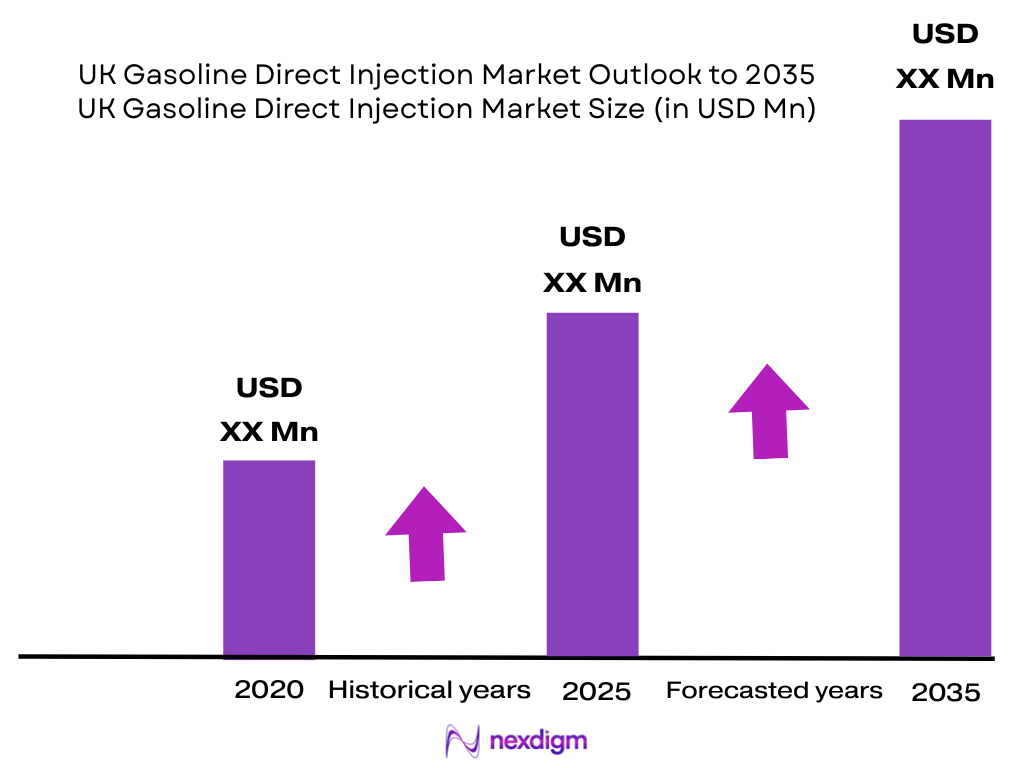
The UK Gasoline Direct Injection Market is valued at approximately USD ~ million, supported by a large petrol-powered vehicle base, turbocharged downsized engines and growing hybridisation. The country recorded approximately 750,000 new petrol-car registrations in the latest annual benchmark, while total first-time vehicle registrations reached 2.605 million. With 41.7 million licensed vehicles operating nationally, demand extends beyond OEM fitment into injector, high-pressure pump, sensor and fuel-system replacement requirements. The West Midlands, North East England, North West England and South East England dominate the UK Gasoline Direct Injection Market because they concentrate vehicle manufacturing, petrol and hybrid powertrain engineering, Tier-1 suppliers, motorsport development and aftermarket distribution. British plants produced 905,233 vehicles, including 779,584 cars, in the latest full manufacturing benchmark, while 162,904 cars were already produced during the opening two months of the preceding production cycle. These clusters therefore remain pivotal for GDI engineering, procurement and servicing. The UK GDI ecosystem is undergoing a structural transition rather than an abrupt disappearance. Petrol remains the largest single fuel type within the existing British car parc: current SMMT motorparc data identify more than 21.15 million petrol cars in use, compared with approximately 11.04 million diesel cars, 1.73 million hybrids, 941,753 plug-in hybrids and 1.80 million battery-electric cars. This installed base gives GDI suppliers a substantial aftermarket even as new pure-ICE registrations decline.
Market Segmentation
By Component Type
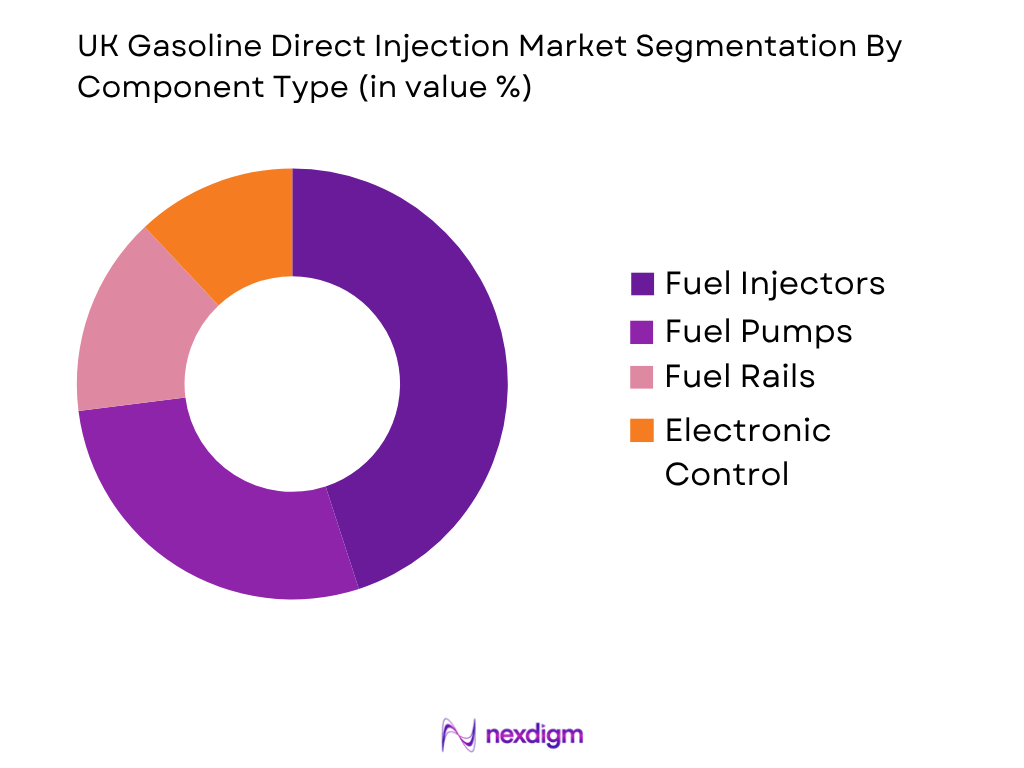
The UK Gasoline Direct Injection Market is segmented into high-pressure fuel injectors, high-pressure fuel pumps, fuel rails and pressure-management components, and electronic and ancillary fuel-system components. High-pressure injectors account for the dominant analytical share because each cylinder requires an individual precision injector, meaning a four-cylinder GDI vehicle uses four direct injectors while six- and eight-cylinder premium applications require proportionally greater injector content. Injectors are also exposed directly to combustion temperatures and deposit formation, increasing aftermarket replacement relevance. Their technical value continues rising as injection pressure migrates upward and OEMs seek finer atomisation, faster multiple-injection events and better particulate control. High-pressure pumps form the second-largest category because every GDI engine requires mechanically generated fuel pressure significantly above conventional port-injection levels. Fuel rails, pressure sensors and control components contribute additional system value as engines migrate toward combined direct-port injection and hybrid operating strategies.
By Powertrain Type
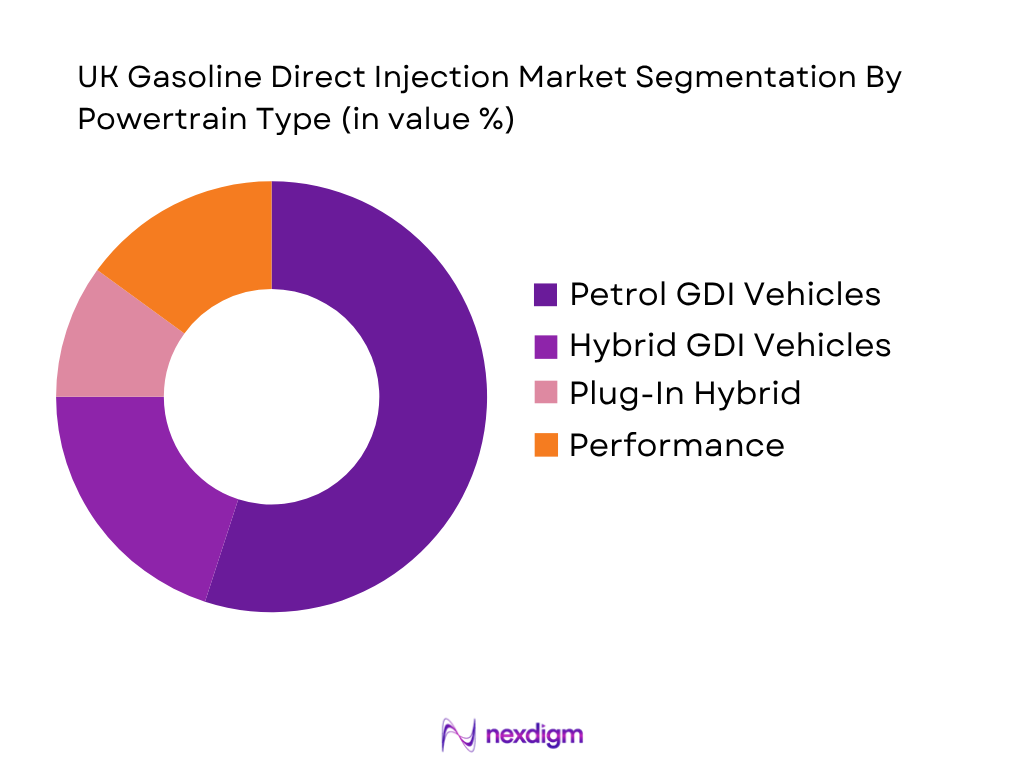
The UK Gasoline Direct Injection Market is segmented into pure petrol GDI vehicles, mild-hybrid GDI vehicles, full-hybrid GDI vehicles, plug-in hybrid GDI vehicles and specialist/performance GDI applications. Pure petrol vehicles remain the dominant analytical segment because Britain maintains an installed fleet exceeding 21 million petrol cars, creating considerable ongoing consumption of pumps, injectors and associated fuel-system components. However, the highest strategic momentum is shifting toward hybrid GDI. UK policy permits hybrid vehicles through 2035, while new pure internal-combustion cars face a 2030 phase-out under the current pathway. Hybrid engines still require accurate direct injection but operate under repeated engine-start, shutdown and transient conditions, increasing requirements for rapid rail-pressure generation and precise cold-start fueling. Plug-in hybrids provide similar component opportunities while reducing engine operating hours. Performance vehicles remain smaller but support high-value injectors, pumps and calibration technologies.
Competitive Landscape
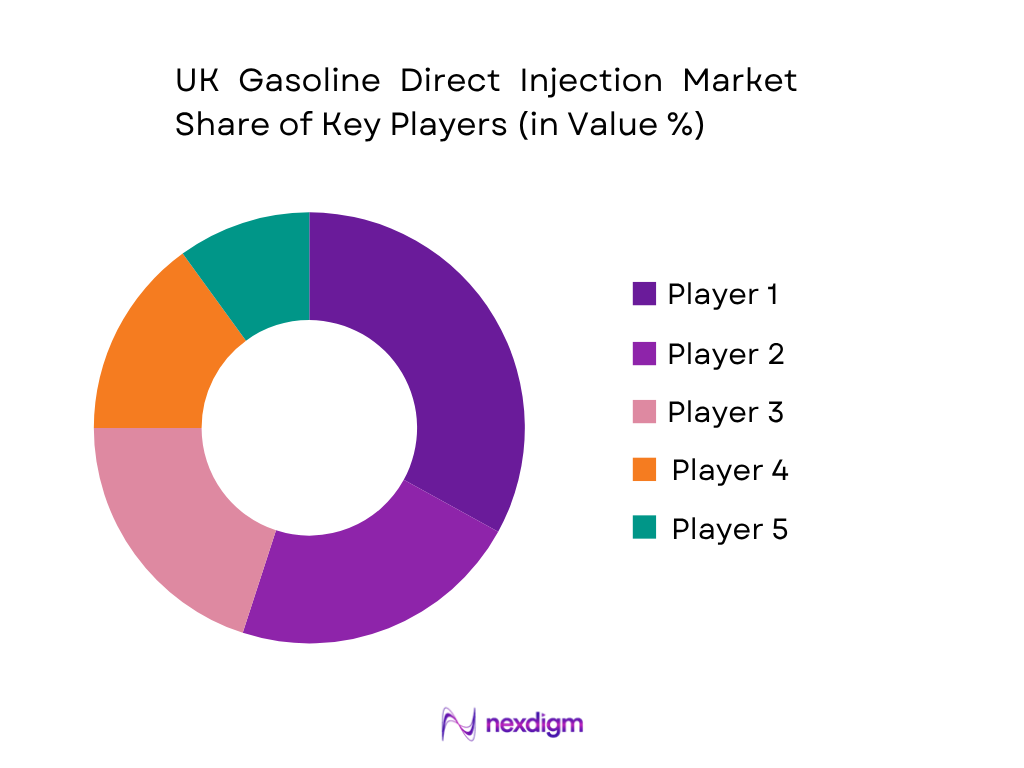
The UK Gasoline Direct Injection Market is led by technologically intensive global Tier-1 suppliers rather than a fragmented commodity supplier base. Bosch, PHINIA/Delphi, DENSO, Astemo and Marelli compete on injector precision, pump-pressure capability, rail architecture, OEM relationships and hybrid-powertrain compatibility. Bosch provides integrated injectors, high-pressure pumps and rails; PHINIA markets systems extending beyond 500 bar; and the competitive frontier is moving toward higher-pressure injection, reduced particulate formation, alternative-fuel compatibility and software-controlled fuel delivery. UK demand is also influenced by the country’s premium and performance vehicle sector, which requires higher-flow and tightly calibrated GDI components.
| Major Player | Establishment | Headquarters | Core GDI Portfolio | High-Pressure Capability | Hybrid-GDI Capability | UK/European OEM Coverage | Alternative-Fuel Readiness | Aftermarket Position |
| Robert Bosch GmbH | 1886 | Gerlingen, Germany | ~ | ~ | ~ | ~ | ~ | ~ |
| PHINIA / Delphi Technologies | 2023 independent entity | Auburn Hills, USA | ~ | ~ | ~ | ~ | ~ | ~ |
| DENSO Corporation | 1949 | Kariya, Japan | ~ | ~ | ~ | ~ | ~ | ~ |
| Astemo Ltd. | 2021 current structure | Tokyo, Japan | ~ | ~ | ~ | ~ | ~ | ~ |
| Marelli | 2019 current entity | Saitama, Japan | ~ | ~ | ~ | ~ | ~ | ~ |
UK Gasoline Direct Injection Market Analysis
Growth Drivers
Large Installed Petrol-Vehicle Base Supporting GDI Component Demand
The UK Gasoline Direct Injection market continues to benefit from the large installed base of petrol-powered vehicles and the continued registration of gasoline engines using increasingly sophisticated high-pressure fuel systems. Department for Transport data show that 899,000 new petrol cars were registered in 2023 and 749,000 in 2024, demonstrating that even while electrification accelerates, hundreds of thousands of new petrol vehicles continue to enter the national fleet each year. The UK finished 2024 with approximately 41.7 million licensed vehicles, providing a very large base for replacement injectors, high-pressure pumps, fuel rails, rail-pressure sensors, seals and diagnostic services. This installed fleet is particularly important for GDI because the technology has been widely adopted across turbocharged three- and four-cylinder petrol engines, premium six-cylinder engines, SUVs and performance vehicles. Direct injectors operate within the combustion chamber and are exposed to high temperature, pressure cycling and deposit formation, while mechanically driven high-pressure pumps undergo continuous plunger and cam loading. An ageing vehicle population therefore generates recurring aftermarket requirements independently of new-car production. The broader macroeconomic environment provides the financial and industrial scale supporting this demand. World Bank data place UK GDP at approximately USD 4.17 trillion in 2024, increasing further to around USD 4 trillion-plus in 2025, with GDP per capita reaching approximately USD 57,602 in 2025. The IMF reports a UK population of approximately 69.85 million in 2026, creating a large consumer base for personal transportation, while projected real GDP growth remains positive at 1.0 units for every 100 units of output in 2026. For GDI suppliers, the commercial implication is that demand is increasingly split between two streams: continuing original-equipment installation in petrol and hybrid platforms, and a growing service opportunity from existing GDI-equipped vehicles. The latter becomes particularly significant as pure-petrol registrations decline because cars already operating on British roads continue to require maintenance for many years. Injector remanufacturing, high-pressure pump replacement, fuel-pressure diagnosis and deposit-related servicing can therefore extend the revenue life of GDI technology well beyond the period of strong new petrol vehicle sales.
Hybridisation Preserving High-Pressure Gasoline Injection Demand
Hybridisation is becoming one of the most important growth drivers for the UK Gasoline Direct Injection market because gasoline engines remain integral to mild-hybrid, full-hybrid and plug-in hybrid vehicles even as conventional petrol-only models lose registration volume. Department for Transport data show that new petrol registrations declined from 899,000 vehicles in 2023 to 749,000 in 2024 and approximately 610,000 in 2025, while registrations of both hybrid and plug-in hybrid cars increased during the same transition. This change does not eliminate high-pressure fuel injection; instead, it shifts demand toward GDI systems engineered for repeated engine restarts, high compression ratios, cold-start emissions control and rapidly changing load conditions. A hybrid engine may remain switched off during low-speed driving and then restart within seconds when additional torque is required, meaning its high-pressure pump must establish rail pressure rapidly and its injectors must deliver accurately metered fuel almost immediately. The UK government’s current transition framework further supports this bridge role. In 2025, the government confirmed the 2030 phase-out of new conventional petrol and diesel cars while allowing qualifying hybrids to continue until 2035, creating a defined period during which gasoline injection remains relevant to increasingly electrified powertrains. The market also benefits from continuing scale in the overall vehicle sector: 2.605 million vehicles were registered for the first time during 2024, while the licensed vehicle parc reached 41.7 million units. Macroeconomic conditions provide additional context for continuing vehicle investment. World Bank data put UK GDP at approximately USD 4.17 trillion in 2024, while the IMF estimates the economy will still expand by 1.0 units per 100 units of output in 2026 despite near-term pressure from energy and financing conditions. For GDI manufacturers, hybridisation increases the importance of injector response speed, pump efficiency, low NVH, advanced pressure sensing and software integration. Combined port-and-direct injection offers further content opportunity because some hybrid gasoline engines can use port injection during selected operating conditions and GDI during higher-load operation, increasing the number of fuel-system components per engine. Suppliers able to optimise GDI systems around hybrid duty cycles can therefore preserve OEM participation even as conventional gasoline platforms contract.
Market Challenges
Rapid Reduction in Pure-Petrol Registrations and Zero-Emission Substitution
The principal structural challenge for the UK Gasoline Direct Injection market is the rapid contraction of new conventional petrol vehicle demand as zero-emission technologies gain registrations and government policy progressively restricts pure internal-combustion platforms. Department for Transport figures show new petrol-car registrations falling from 899,000 vehicles in 2023 to 749,000 in 2024 and approximately 610,000 in 2025. At the same time, the number of zero-emission vehicles operating on UK roads increased to 1.394 million by the end of 2024, while 410,000 zero-emission vehicles were registered for the first time during that year. The transition continued into 2025, when first registrations of road-going zero-emission vehicles reached 473,000, providing direct substitution pressure because a battery-electric vehicle requires no high-pressure gasoline injector, mechanical GDI pump or petrol fuel rail. Government policy compounds this substitution effect. The UK confirmed in 2025 that conventional new petrol and diesel car sales will end from 2030, while all new cars and vans must become fully zero-emission from 2035. This creates a finite OEM runway for pure-GDI platforms and requires suppliers to reconsider capacity utilisation, tooling investments and future engineering programmes. The challenge is especially significant for manufacturers whose facilities are dedicated to injection nozzles, cam-driven pumps or petrol rails without meaningful exposure to hybrid applications, aftermarket service or other propulsion technologies. Macroeconomic scale cannot offset this technology substitution. World Bank data show an economy of approximately USD 4.17 trillion in 2024, while IMF figures put the national population at 69.85 million in 2026 and projected GDP growth at 1.0 units per 100 units of output. The UK remains a high-value automotive economy, but an increasing portion of that spending is being redirected toward electric drivetrains, charging, battery manufacturing and power electronics. GDI companies must consequently manage a difficult transition: they need to maintain enough capacity to supply existing petrol and hybrid programmes while avoiding overinvestment in equipment that could become underutilised as BEV penetration rises. Hybrid-GDI, replacement parts and remanufacturing can moderate this decline, but they do not fully replicate the hardware opportunity lost whenever a combustion platform is replaced by a battery-electric model.
Higher Emissions Compliance and Diagnostic Complexity
UK GDI suppliers face increasing technical pressure because gasoline direct injection must simultaneously deliver combustion efficiency, high torque density and increasingly strict emissions control. The direct placement of fuel inside the cylinder makes mixture preparation highly dependent on injector spray targeting, droplet size, injection timing and pressure stability. Imperfect atomisation can increase wall wetting and particle formation, particularly during cold starts, making injector design directly relevant to regulatory compliance. The UK Vehicle Market Surveillance Unit reported in its 2024 emissions programme, published in 2026, that petrol, diesel and hybrid cars and light vans were subjected to laboratory Worldwide Harmonised Light Vehicle Test Cycle testing, on-road Real Driving Emissions testing with cold starts and additional low-temperature RDE testing at 0°C. Such operating conditions are particularly demanding for GDI because cold fuel vaporises less readily, placing greater emphasis on high-quality atomisation and accurate multi-pulse injection. The UK’s regulatory environment is also moving toward more stringent requirements. In 2026, the government began consultation on updating minimum emissions standards for new vehicles in response to Euro 7 developments, with particulate number, durability and real-world performance forming key considerations. The European Euro 7 timetable applies requirements to new light-duty vehicle types from 29 November 2026, making this an immediate engineering issue for UK-oriented suppliers operating within integrated European OEM programmes. Macroeconomic conditions add cost discipline to the challenge. IMF data project UK growth at 1.0 units per 100 units of output in 2026 and consumer-price inflation at 3.2 units per 100 consumer-price units, while World Bank data show GDP per capita around USD 57,602 in 2025. Vehicle owners therefore operate in a market where advanced fuel-system repairs must compete with broader household expenditure pressures. GDI faults can require pressure-capable diagnostic equipment, rail-pressure analysis, injector balance testing, fuel-trim diagnosis and specialist understanding of dual-injection or hybrid systems. Independent workshops without appropriate equipment may replace components unnecessarily or misdiagnose carbon-deposit issues as injector failures. For suppliers, this creates warranty and reputation risk if technically complex components are installed incorrectly. The challenge therefore extends beyond manufacturing; it includes providing accurate application data, installer training, diagnostic guidance and durable components capable of meeting increasingly demanding cold-start and particulate-control requirements.
Market Opportunities
High-Pressure GDI and Advanced Hybrid Fuel-System Localisation
The most significant technology opportunity for the UK Gasoline Direct Injection market lies in moving from conventional GDI toward higher-pressure, more precisely controlled systems for hybridised petrol engines. Current UK registration data demonstrate why suppliers should pursue this transition rather than rely exclusively on pure-petrol engines. New petrol car registrations decreased from 899,000 in 2023 to 749,000 in 2024 and approximately 610,000 in 2025, while hybrid and plug-in hybrid registrations continued to increase. The government’s 2025 policy response confirmed that qualifying hybrid vehicles can remain on sale until 2035, creating a defined development window for next-generation petrol-electric fuel systems. Higher injection pressures can improve fuel atomisation and mixture formation, enabling manufacturers to extract more efficiency from the combustion engine whenever it operates. This is particularly relevant in hybrids because the engine may start under rapidly changing temperature and load conditions, placing greater demands on rail-pressure build-up and injection accuracy. High-pressure systems also support turbocharged downsized engines, which remain widely used in UK passenger cars, crossovers and premium vehicles. The opportunity extends beyond injectors to mechanical pumps, rails, pressure sensors, control valves and software calibration. Combined port-and-direct injection represents another high-content architecture because it permits different injection strategies according to engine temperature and load, potentially reducing direct-injection particulate formation while maintaining performance. Existing economic conditions support continued engineering investment. The World Bank places UK GDP at approximately USD 4.17 trillion in 2024, while GDP per capita reached around USD 57,602 in 2025. The IMF reports a population of 69.85 million in 2026, providing a substantial consumer and skills base, despite slower projected output expansion of 1.0 units per 100 units. The UK’s premium automotive and motorsport engineering capabilities create an additional advantage because the transition toward higher-pressure GDI requires precision machining, advanced calibration and thermal-management skills already present within British automotive clusters. Companies able to combine high-pressure hardware with hybrid control strategies can secure future business from vehicles retaining gasoline engines during the transition toward full electrification. The opportunity is therefore not higher volumes of conventional GDI, but greater technological content and value per remaining combustion-equipped vehicle.
Expansion of the GDI Replacement, Remanufacturing and Specialist Diagnostic Ecosystem
The UK’s large and ageing vehicle parc provides a second major growth opportunity because GDI components installed during previous years will continue requiring service long after new conventional petrol registrations decline. The country ended 2024 with approximately 41.7 million licensed vehicles, compared with 41.4 million licensed vehicles already recorded at the end of March 2024, demonstrating the scale of the operating fleet. Petrol cars remain a substantial part of this installed base, and Department for Transport data show that another 749,000 new petrol cars entered the fleet during 2024, followed by roughly 610,000 during 2025. Each GDI-equipped vehicle contains multiple precision injectors and at least one high-pressure pump that must operate reliably across extensive thermal and pressure cycles. As mileage rises, injector nozzle deposits, pump wear, seal degradation, pressure sensor faults and electrical failures create service opportunities. The commercial opportunity is therefore broader than straightforward component replacement. Injector-remanufacturing businesses can develop flow matching, spray-pattern testing, leakage testing and deposit cleaning services; distributors can expand OE-equivalent GDI ranges; and garages can invest in dedicated rail-pressure and injector diagnostics. Specialist servicing is especially valuable for premium and performance vehicles, where individual injectors and pump architectures can be tightly calibrated to specific engine variants. Macro indicators support a substantial service economy. World Bank data show UK GDP around USD 4.17 trillion in 2024 and GDP per capita approximately USD 57,602 in 2025, while the IMF reports a population of approximately 69.85 million in 2026. Inflation is projected at 3.2 units per 100 consumer-price units in 2026, which can strengthen the relative attractiveness of repairing an existing vehicle rather than immediately replacing it with a new one. The increasing number of zero-emission vehicles does not eliminate this opportunity because replacement markets respond to the installed fleet rather than only current registrations. Indeed, the gradual nature of fleet turnover means petrol GDI vehicles will coexist with electric vehicles for many years. Businesses that establish specialist injector testing, remanufacturing, application databases and technician training can therefore capture a long service tail. This gives the UK GDI sector an aftermarket growth route even as OEM demand becomes increasingly hybridised and eventually contracts under zero-emission policy.
Future Outlook
The UK Gasoline Direct Injection Market is expected to expand at approximately ~ CAGR during 2026–2035, but the composition of demand will change substantially. New pure-petrol GDI applications will gradually contract as the UK implements its zero-emission transition, while hybrid-GDI, plug-in-hybrid GDI and the replacement aftermarket will account for a larger portion of industry activity. The transition is already visible in national vehicle data. Britain recorded 2.605 million first-time vehicle registrations in the latest full annual dataset and had 41.7 million licensed vehicles on the road, creating a long replacement tail even where new gasoline registrations decline. Hybridisation should become particularly important. The government has confirmed that from 2030 new cars must be hybridised in some form or zero-emission, while hybrid sales can continue until 2035. This gives GDI technology a defined bridge role in increasingly efficient petrol-electric powertrains. Higher-pressure injection will create additional value per vehicle. Future systems are moving beyond conventional 200–350 bar operating ranges toward 500 bar and higher. Improved atomisation helps manufacturers manage combustion efficiency, cold-start behaviour and particle formation, making injector precision and high-pressure pump durability key differentiators.The aftermarket should remain resilient even after new pure-petrol vehicle sales fall. Britain currently has more than 21.15 million petrol cars in use, giving distributors, workshops, injector remanufacturers and diagnostic-equipment suppliers a very large addressable service base.
Major Players
- Robert Bosch GmbH / Bosch Mobility
- PHINIA Inc. / Delphi Technologies
- DENSO Corporation
- Astemo Ltd.
- Marelli
- Continental Automotive
- Schaeffler / Vitesco Technologies
- BorgWarner
- Stanadyne
- Standard Motor Products
- TI Fluid Systems
- Sensata Technologies
- GB Remanufacturing
- Nostrum High Performance
- Injector Dynamics
Key Target Audience
- Gasoline Direct Injection System Manufacturers
- High-Pressure Fuel Injector and Fuel Pump Manufacturers
- Petrol, Hybrid and Plug-In Hybrid Vehicle OEMs
- Automotive Tier-1 and Tier-2 Powertrain Component Suppliers
- Automotive Parts Distributors, Motor Factors and Workshop Networks
- Injector Remanufacturing, Engine Calibration and Performance Companies
- Investments and Venture Capitalist Firms
- Government and Regulatory Bodies (Department for Transport, Driver and Vehicle Licensing Agency, Vehicle Certification Agency, Department for Business and Trade and Office for Zero Emission Vehicles)
Research Methodology
Step 1: Identification of Key Variables
The initial phase involves constructing a complete ecosystem map covering UK petrol and hybrid vehicle manufacturers, GDI Tier-1 suppliers, injector and pump manufacturers, engine plants, distributors, workshops and remanufacturers. Key variables include petrol registrations, vehicle parc, GDI penetration, cylinder count, engine displacement, turbocharging, hybridisation and injection-pressure architecture. Secondary research incorporates Department for Transport licensing statistics, SMMT production and motorparc information, UK regulatory documents and technical information from established GDI suppliers. This determines the core vehicle and technology variables required for the market-sizing model.
Step 2: Market Analysis and Construction
The top-down calculation begins with UK petrol, hybrid and plug-in-hybrid vehicle registrations and the corresponding installed vehicle parc. GDI penetration is then applied according to engine architecture, vehicle segment and model generation to determine the addressable GDI-equipped population. The bottom-up calculation assesses injectors per engine, high-pressure pumps per vehicle, rail and pressure-sensor content, replacement frequency and average system content. Separate models are built for pure petrol, mild-hybrid, full-hybrid and plug-in-hybrid applications to prevent differences in operating duty cycles from being obscured.
Step 3: Hypothesis Validation and Expert Consultation
Market hypotheses are validated through computer-assisted telephone interviews with fuel-system suppliers, vehicle OEMs, automotive component distributors, injector specialists and independent garages. The objective is to verify pressure classes, supplier nomination structures, replacement cycles, common failure modes and GDI diagnostic practices. Particular attention is given to differences between conventional GDI and dual port-direct injection, hybrid engine requirements, injector remanufacturing and the effect of increasing petrol-vehicle age on independent aftermarket demand.
Step 4: Research Synthesis and Final Output
Primary and secondary findings are triangulated to produce independent estimates for injectors, high-pressure pumps, rails, sensors, OEM fitment and replacement demand. Production and registration trends are reconciled with UK vehicle-parc data to avoid double counting domestic production and imported vehicles. Forecasting incorporates the 2030 pure-ICE phase-out pathway, hybrids remaining permissible until 2035, BEV adoption, high-pressure injection migration and the ageing petrol fleet. Base, accelerated-electrification and extended-hybrid scenarios are used to assess future market sensitivity.

- Executive Summary
- Research Methodology (Market Definitions and Assumptions, Abbreviations, UK GDI Market Boundary, Top-Down Market Sizing, Bottom-Up Vehicle-Parc Modelling, Petrol Vehicle Registration Assessment, Engine Production Assessment, GDI Penetration Analysis, Injector Content per Engine, High-Pressure Pump Content per Vehicle, Fuel Rail Content per Vehicle, Turbo-GDI Assessment, Hybrid-GDI Assessment, GDI-Port Dual-Injection Assessment, OEM Sourcing Analysis, Replacement-Cycle Analysis, Primary Industry Interviews, Supplier Interviews, Distributor and Workshop Interviews, Demand-Side Assessment, Supply-Side Assessment, Data Triangulation, Forecasting Framework, ZEV Transition Scenario Analysis, Limitations and Future Conclusions)

- Definition and Scope
- Evolution of Petrol Fuel-Injection Technology in the UK
- Transition from Port Fuel Injection to Gasoline Direct Injection
- Evolution from Pure GDI to Combined GDI-Port Injection
- UK Petrol Powertrain Ecosystem

- Growth Drivers (Turbo-Petrol Adoption, Hybrid-GDI Expansion, Existing Petrol Vehicle Parc, Engine Downsizing, Fuel-Efficiency Pressure, Aftermarket Replacement, Dual Injection, High-Pressure Technology)
- Market Challenges (ZEV Mandate, BEV Substitution, Euro 7 Compliance, Particulate Emissions, Deposit Formation, High-Pressure Complexity, OEM Consolidation, Skilled Diagnostics)
- Market Opportunities (500+ Bar Injection, Hybrid GDI, GDI-Port Dual Injection, GPF Integration, Renewable Fuel Compatibility, Aftermarket Replacement, Remanufacturing, Motorsport)
- Market Trends (Higher Pressure, Dual Injection, Hybrid Integration, Software Calibration, GPF, Renewable Fuels, Injector Miniaturisation, Aftermarket Professionalisation)
- SWOT Analysis
- Porter’s Five Forces Analysis
- PESTLE Analysis

By Market Value (2020-2025)
By GDI System Units (2020-2025)
By High-Pressure Injector Units (2020-2025)

- By Component Type (In Value %)
High-Pressure GDI Fuel Injectors
High-Pressure Mechanical Fuel Pumps
High-Pressure Fuel Rails
Fuel Rail Pressure Sensors
Fuel Pressure Regulators - By Fuel-Injection Architecture (In Value %)
Pure Gasoline Direct Injection
Combined Gasoline Direct and Port Fuel Injection
Sequential Direct Injection
Multi-Pulse Direct Injection - By Powertrain Type (In Value %)
Pure Petrol GDI Vehicles
Mild-Hybrid GDI Vehicles
Full-Hybrid GDI Vehicles
Plug-In Hybrid GDI Vehicles - By Region (In Value %)
England
Scotland
Wales
Northern Ireland

- Market Share of Major Players by Market Value
- Cross Comparison Parameters (Maximum GDI Injection Pressure Capability, High-Pressure Injector–Pump–Rail Portfolio Breadth, UK Petrol and Hybrid OEM Platform Coverage, Turbo-GDI and Hybrid-GDI Application Capability, GDI-Port Dual-Injection System Capability, Euro 7 and Particulate-Control Readiness, UK OE–Aftermarket Distribution and Diagnostic Support, Renewable Petrol–Ethanol Compatibility and Alternative-Fuel Readiness)
- SWOT Analysis of Major Players
- Detailed Profiles of Major Companies
Robert Bosch GmbH / Bosch Mobility
PHINIA Inc. / Delphi Technologies
DENSO Corporation
Astemo Ltd.
Marelli
Continental Automotive
Schaeffler / Vitesco Technologies
BorgWarner
Stanadyne
Standard Motor Products
TI Fluid Systems
Sensata Technologies
GB Remanufacturing
Nostrum High Performance
Injector Dynamics

- Passenger Vehicle OEM Demand
- Turbo-Petrol Engine Manufacturer Demand
- Hybrid Powertrain Manufacturer Demand
- Premium Vehicle OEM Demand
- Tier-1 Fuel-System Integrator Demand

- By Market Value (2026-2035)
- By GDI System Units (2026-2035)
- By High-Pressure Injector Units (2026-2035)


 Request a Sample
 Ask for Customization
 Get a Quote
 Enquire Now