

 Download PDF
Market Overview
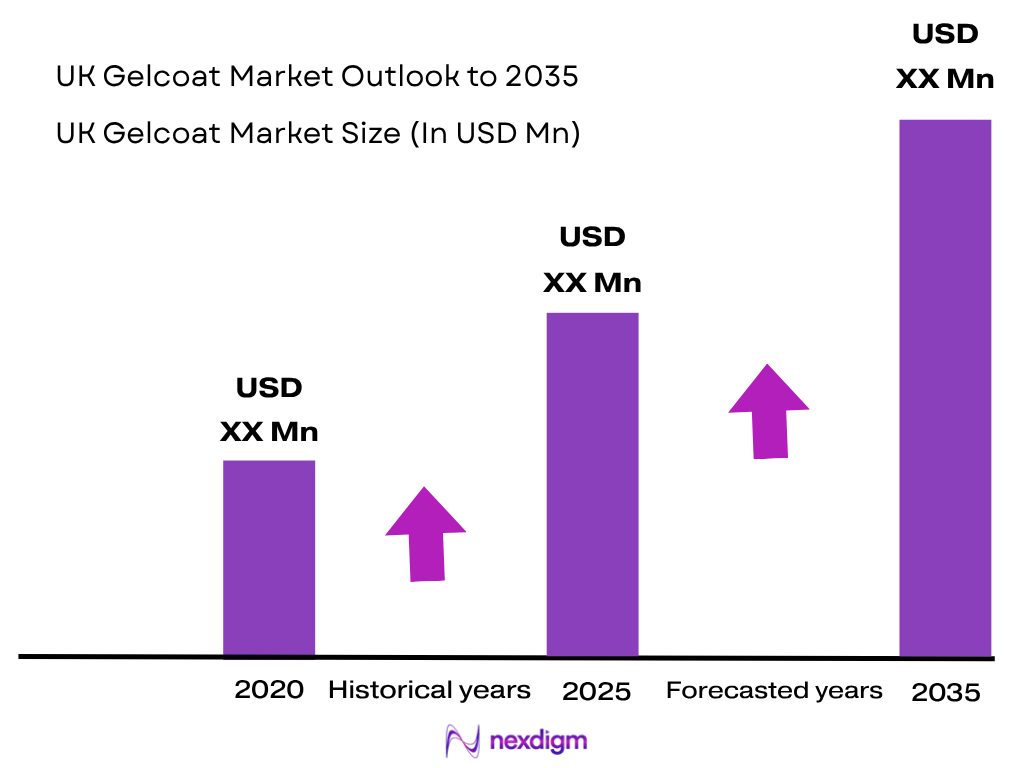
The UK Gelcoat Market is valued at approximately USD ~XX million, based on historical demand from marine, wind-energy, transportation, construction and industrial composites. Demand is supported by UK manufacturers’ product sales moving from £466.7 billion in the preceding annual period to £452.2 billion in the latest period. The marine base remains important, with production of larger motor yachts rising from roughly 40 units to more than 60 units across the recent production cycle.
South West England, the South Coast, East Midlands and major offshore-wind manufacturing corridors dominate UK gelcoat consumption because they concentrate boatbuilding, GRP fabrication, composite-material formulation and renewable-energy activity. The UK operated 30,299 MW of wind capacity in the latest period, including 14.7 GW offshore, while 6.3 GW of offshore projects were undergoing major installation activity. Marine clusters around Plymouth, Poole and Southampton further support gelcoat demand through yacht, leisure-craft and composite-component manufacturing.
Market Segmentation
By Resin Chemistry
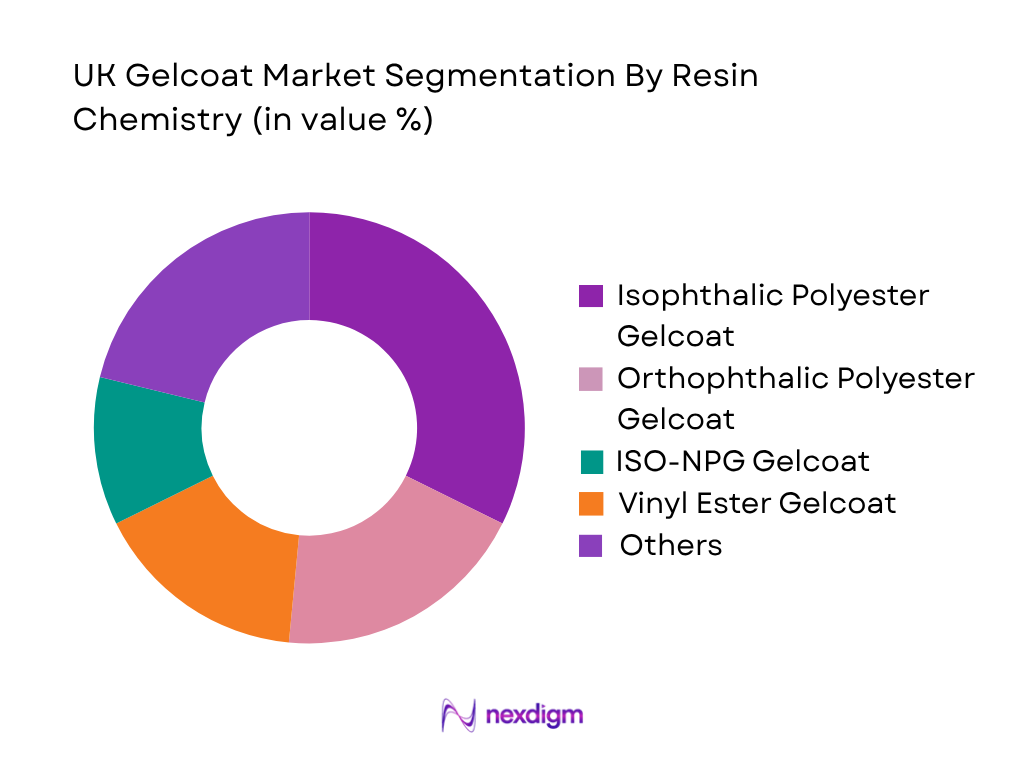
The UK Gelcoat Market is segmented into orthophthalic polyester, isophthalic polyester, ISO-NPG, vinyl ester, epoxy, low-styrene, styrene-free and specialty gelcoats. Isophthalic polyester gelcoat holds the dominant report-model share because it provides the balance of weathering resistance, water resistance, surface quality, processing flexibility and economics required across the UK’s marine, transportation, building-component and general GRP industries. Its established compatibility with unsaturated polyester composite laminates also supports widespread processing through spray and hand lay-up systems. ISO-NPG products occupy a significant higher-performance position where hydrolysis resistance, gloss retention and prolonged outdoor exposure are critical, particularly in marine and swimming-pool applications. Vinyl ester gelcoats are more specialised toward chemical and severe-service environments, while epoxy systems serve selected high-performance composites. The technology transition is increasingly important: commercially available UK formulations now include gelcoats containing 23% styrene, ultra-low-styrene systems containing 16% styrene, and zero-styrene products for industrial composite applications.
By End-Use Industry
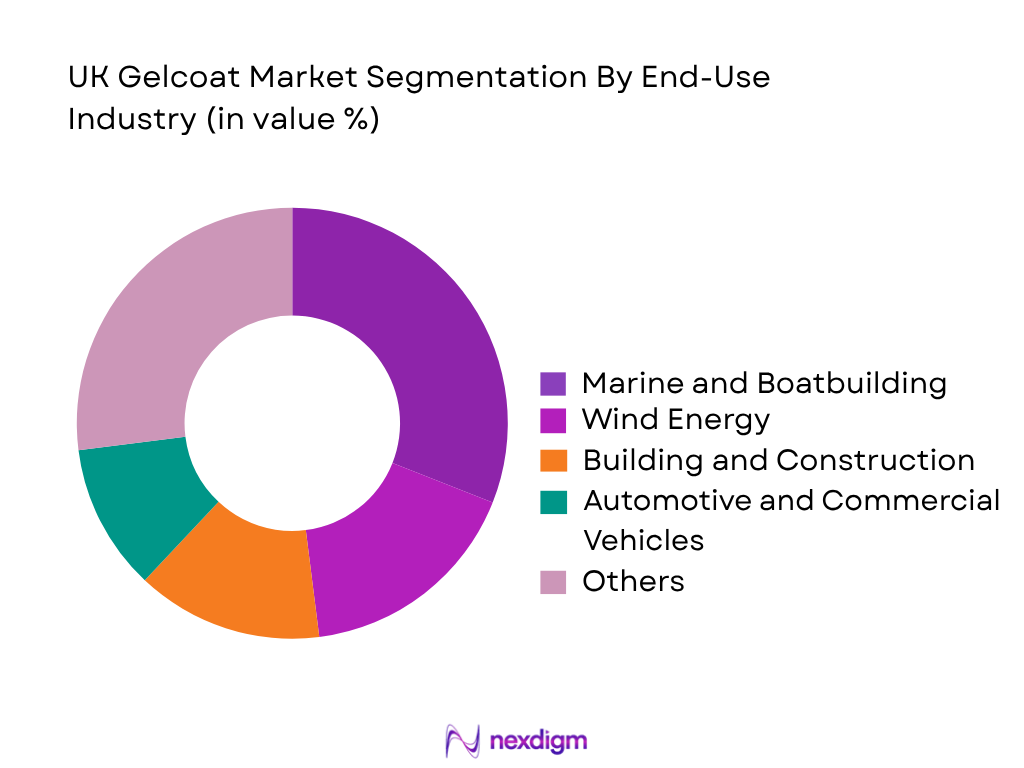
The UK Gelcoat Market is segmented into marine and boatbuilding, wind energy, automotive and commercial vehicles, rail transportation, building and construction, sanitaryware, swimming pools, industrial equipment and other composite applications. Marine and boatbuilding hold the dominant report-model share, reflecting the UK’s established yacht, leisure-craft, RIB and specialist vessel manufacturing ecosystem. Gelcoats are fundamental to exposed GRP boat surfaces because they provide water resistance, gloss, colour retention, UV protection and a repairable exterior finish. British Marine reports that the country’s 12.50–23.99 metre motor-yacht category produces around 300 units annually, while production of motor yachts above 24 metres exceeded 60 units in the latest reported period. Wind energy represents another strategically important demand source because nacelles, covers and other GRP structures require weather-resistant composite surfaces. UK operational offshore wind capacity reached 14.7 GW, while the country’s total wind fleet surpassed 30 GW, supporting a substantial installed composite-asset ecosystem.
Competitive Landscape
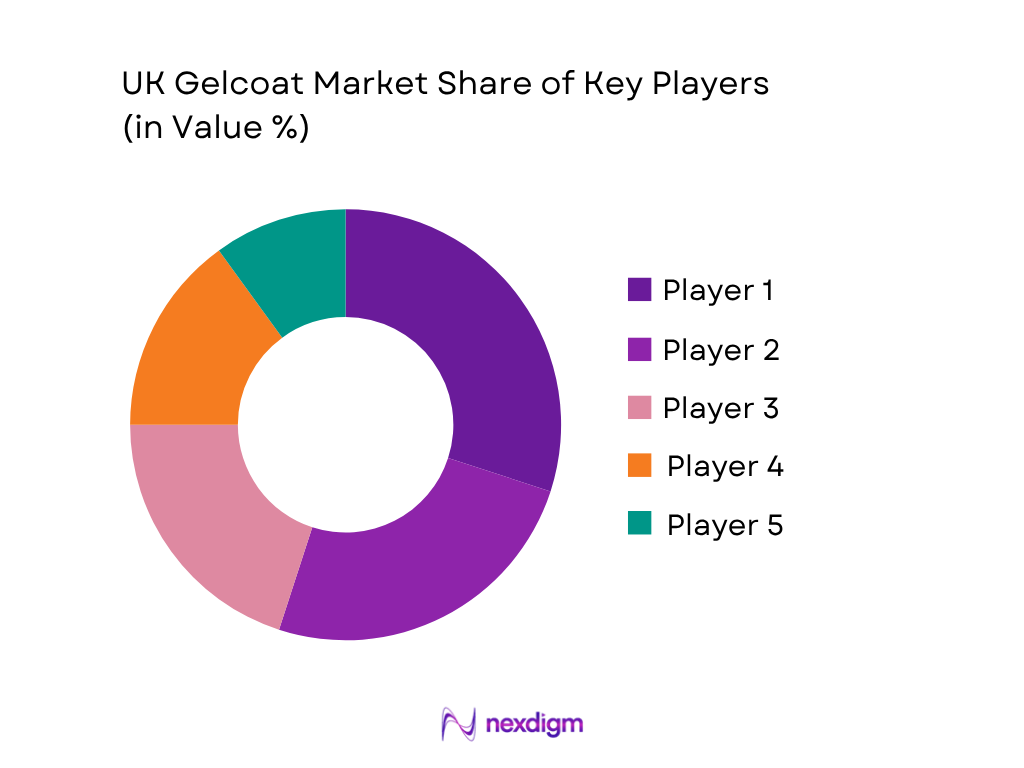
The UK Gelcoat Market combines domestic formulation expertise with European and international composite-material suppliers. Competition centres on marine-grade performance, ISO-NPG chemistry, low-styrene technology, fire performance, colour matching, application consistency and technical support. Scott Bader has particular relevance because its UK-developed Crystic portfolio spans marine, wind, transportation, construction and industrial applications, while suppliers such as Polynt, BÜFA, allnex and AOC compete through broad polyester, vinyl-ester and specialty surface-system portfolios.
| Major Player | Established | Headquarters | Marine Gelcoats | Low-Styrene Capability | Specialty/FR Systems | Colour & Finish Capability | Wind/Transport Exposure | Technical Support |
| Scott Bader | 1921 | Wollaston, UK | ~ | ~ | ~ | ~ | ~ | ~ |
| Polynt | 1955* | Scanzorosciate, Italy | ~ | ~ | ~ | ~ | ~ | ~ |
| BÜFA | 1883 | Oldenburg, Germany | ~ | ~ | ~ | ~ | ~ | ~ |
| allnex | 2013 | Frankfurt, Germany | ~ | ~ | ~ | ~ | ~ | ~ |
| AOC | 2018* | Tennessee, USA | ~ | ~ | ~ | ~ | ~ | ~ |
UK Gelcoat Market Analysis
Growth Drivers
Strong Marine and Boatbuilding Composite Manufacturing Base
The UK marine and boatbuilding base is a direct demand engine for gelcoats used on GRP hulls, decks, superstructures, moulded panels and repair surfaces. Office for National Statistics data show output in the building of ships and boats category expanded in 2024, while domestic sales from the sector reached £6,721.9 million, compared with £5,961.5 million in 2023. The sector then recorded £8,142.7 million in domestic sales in 2025, indicating a larger production base for polyester, ISO-NPG and vinyl-ester surface systems. The UK Ship Register covered 1,054 merchant and pleasure vessels of 100 gross tonnes and above at the end of 2024, representing 9.9 million gross tonnes, which reinforces the scale of marine assets requiring ongoing maintenance and composite refurbishment. Gelcoat demand benefits because marine applications require hydrolysis resistance, UV stability, colour retention, gloss and repairability under repeated saltwater exposure. The wider macroeconomic environment supports this manufacturing activity: World Bank data place UK GDP at USD 3.69 trillion in 2024, GDP per capita at USD 53,246.4 and population at 69,226,000, providing a substantial industrial and consumer base for leisure marine, commercial marine and composite fabrication activity across regional coastal manufacturing clusters.
Offshore Wind and Renewable-Energy Composite Infrastructure Expansion
The expansion of offshore wind and renewable-energy infrastructure is strengthening demand for gelcoats used on nacelles, spinner covers, housings, access components and other GRP surfaces exposed to ultraviolet radiation, salt spray, rain and cyclic weathering. The UK government’s sixth Contracts for Difference allocation round in 2024 awarded contracts to 128 renewable-electricity projects delivering approximately 9.6 GW of new low-carbon capacity, while the auction budget was increased to more than £1.5 billion. Government data also reported 30.7 GW of offshore wind either installed or committed, with another 7.2 GW consented, demonstrating the scale of the composite asset pipeline that requires protective surface systems and maintenance materials. Gelcoat suppliers benefit because offshore components require controlled film build, weather resistance, adhesion, colour stability and compatibility with polyester or vinyl-ester laminates. The same demand supports low-styrene and automated application systems that reduce emissions and improve consistency in large moulded components. Macroeconomic capacity is substantial: World Bank figures show UK GDP of USD 3.69 trillion in 2024, GDP per capita of USD 53,246.4 and a population of 69,226,000, supporting investment-intensive clean-energy manufacturing and associated composite-material supply chains across domestic manufacturing clusters and specialist composite processors.
Market Challenges
Styrene Exposure Control and Open-Mould Processing Compliance
Styrene exposure management is a material operating challenge for UK gelcoat formulators and GRP processors because conventional unsaturated-polyester gelcoats can release styrene during spraying, hand lay-up, curing and mould preparation. The Health and Safety Executive specifies a workplace exposure limit for styrene of 100 parts per million averaged across an 8-hour working day and a short-term exposure limit of 250 parts per million averaged across 15 minutes. These thresholds require processors to invest in extraction, ventilation, enclosed application, personal protection, monitoring and work practices, particularly where gelcoat is sprayed over large mould surfaces. The compliance burden is commercially relevant because many UK marine, sanitaryware, construction and industrial composite manufacturers still rely on open-mould processes where operator proximity to uncured resin is high. Moving toward low-styrene or styrene-free gelcoat can mitigate exposure but may require reformulation, application trials, catalyst adjustment and verification of gloss, cure and weathering performance. The wider economy provides a large manufacturing platform but also a high compliance environment: World Bank data show UK GDP of USD 3.69 trillion in 2024, GDP per capita of USD 53,246.4 and population of 69,226,000, increasing the importance of regulation-compatible production practices.
Manufacturing Cycle Weakness and Downstream Composite Demand Sensitivity
Weakness in parts of UK manufacturing creates a demand-side challenge for gelcoat suppliers because gelcoat consumption is tied directly to moulded composite output in transport, construction, industrial equipment, leisure products and other fabricated goods. Office for National Statistics data show total UK manufacturers’ product sales at £460.3 billion in 2024, followed by £452.0 billion in 2025, a reduction of £8.3 billion in one year. The 2025 dataset covers 21,500 businesses, 240 subsectors and 3,900 products, illustrating how broadly the slowdown can affect downstream material demand. For gelcoat producers, weaker manufacturing activity can reduce mould utilisation, delay replenishment of polyester and vinyl-ester systems, increase competition for distributor volumes and intensify pressure on technical differentiation. This is particularly relevant for general-purpose gelcoats serving GRP fabricators that lack order visibility from marine or wind-energy OEM programmes. Suppliers must therefore balance inventory, colour ranges and batch production while maintaining delivery times for specialist users. World Bank macroeconomic data nevertheless show an underlying economy, with UK GDP at USD 3.69 trillion in 2024, GDP per capita of USD 53,246.4 and population of 69,226,000, meaning the challenge is manufacturing-cycle sensitivity rather than absence of industrial demand.
Market Opportunities
Low-Styrene and Styrene-Free Gelcoat Technology Development
Low-styrene and styrene-free gelcoat technologies create a clear future growth opportunity in the UK because regulatory pressure and processor health requirements favour surface systems that reduce volatile styrene exposure without sacrificing mould release, gloss, weatherability or cure performance. The Health and Safety Executive currently sets the styrene workplace exposure limit at 100 parts per million over an 8-hour day and the short-term limit at 250 parts per million over 15 minutes, giving composite manufacturers a measurable incentive to reduce airborne emissions at source. This opportunity is reinforced by the UK’s broader advanced-manufacturing policy environment: the 2025 Advanced Manufacturing Sector Plan identifies 6 priority industries, including advanced materials, automotive and aerospace, where high-performance composites and lower-emission processing technologies can be deployed. Suppliers able to provide sprayable low-styrene, zero-styrene, fire-retardant and marine-grade gelcoats can target boatbuilders, wind-component manufacturers, transport moulders and architectural GRP processors while supporting safer open-mould operations. The macroeconomic platform is substantial, with World Bank data recording UK GDP of USD 3.69 trillion in 2024, GDP per capita of USD 53,246.4 and population of 69,226,000. These conditions support investment in reformulation, application equipment, testing and qualification of next-generation gelcoat systems.
Marine Refurbishment and Offshore-Wind Composite Maintenance
Marine refurbishment and offshore-wind composite maintenance provide a future opportunity for UK gelcoat suppliers because the installed asset base generates recurring demand beyond original component manufacturing. The UK Ship Register contained 1,054 merchant and pleasure vessels of 100 gross tonnes and above at the end of 2024, representing 9.9 million gross tonnes, while Office for National Statistics data show domestic sales from building ships and boats reached £6,721.9 million in 2024 and £8,142.7 million in 2025. In renewable energy, the government reported 30.7 GW of offshore wind installed or committed and another 7.2 GW consented, creating a large population of composite nacelles, covers and ancillary GRP parts exposed to marine weathering. This installed base supports demand for repair gelcoats, colour-matched systems, barrier coats, UV-resistant finishes and field-compatible materials that restore surfaces without replacing complete composite structures. Suppliers can therefore expand through technical service, rapid colour matching, smaller repair pack formats and application support for maintenance contractors and asset owners. World Bank data show UK GDP of USD 3.69 trillion in 2024, GDP per capita of USD 53,246.4 and population of 69,226,000, supporting a sizeable industrial maintenance and aftermarket environment nationwide.
Future Outlook
The UK Gelcoat Market is forecast to expand at approximately ~XX% CAGR during 2026–2035, supported by marine manufacturing, offshore-wind infrastructure, lightweight composite transportation components and continued replacement of conventional surface systems with lower-emission gelcoat technologies. Product development will increasingly focus on styrene reduction, weathering performance, fire safety and compatibility with more sustainable composite resin system.
Wind-energy infrastructure provides an important long-term application platform. The UK had 14.7 GW of operational offshore wind capacity at the end of 2024, with 6.3 GW undergoing major offshore installation. In 2026, 11.5 GW of offshore wind was under construction, expanding the potential asset base for nacelles, composite housings, repair materials and weather-resistant surface systems. Marine applications should remain central because UK manufacturers retain strong positions in performance yachts, RIBs, tenders and specialist craft. Product innovation will increasingly target ISO-NPG chemistry, hydrolysis resistance, UV stability, low porosity and long-term colour retention, particularly for exposed exterior composite surfaces.
Major Players
- Scott Bader
- Polynt Composites UK
- BÜFA Composites UK
- allnex
- AOC Formulations
- Mäder
- Resoltech
- Sicomin
- Axalta Coating Systems
- Gurit
- GRP Solutions
- East Coast Fibreglass Supplies
- ECF Composites
- Fibreglass Supplies
- Polyfibre UK
Key Target Audience
- Gelcoat, Unsaturated Polyester Resin and Composite Material Manufacturers
- Marine, Yacht, Leisure Craft and Boatbuilding Companies
- Wind Turbine and Renewable-Energy Composite Component Manufacturers
- Automotive, Commercial Vehicle and Rail Composite Manufacturers
- GRP Construction, Sanitaryware and Industrial Composite Manufacturers
- Composite Material Distributors and GRP Processing Companies
- Investments and Venture Capitalist Firms
- Government and Regulatory Bodies (Health and Safety Executive, Department for Business and Trade, Department for Energy Security and Net Zero, Environment Agency, Office for Product Safety and Standards)
Research Methodology
Step 1: Identification of Key Variables
The initial phase involves developing a complete ecosystem map for the UK Gelcoat Market, covering resin manufacturers, gelcoat formulators, composite distributors, GRP moulders, marine manufacturers, wind-component producers and transportation OEMs. Key variables include resin chemistry, gelcoat consumption, application technique, end-use surface area, styrene content, domestic production, imports, curing technology, colour requirements and application-specific performance.
Step 2: Market Analysis and Construction
Historical market data are analysed using complementary top-down and bottom-up approaches. The top-down framework assesses marine production, wind-energy infrastructure, transportation composites, construction GRP and sanitaryware manufacturing, while bottom-up analysis calculates gelcoat demand from composite component production, coated surface area, gelcoat film requirements, application losses, replacement activity and manufacturer-level consumption patterns.
Step 3: Hypothesis Validation and Expert Consultation
Market hypotheses are validated through computer-assisted telephone interviews with gelcoat formulators, resin suppliers, distributors, composite moulders, boatbuilders, wind-component manufacturers and GRP processors. Consultations focus on resin chemistry preferences, styrene reduction, spray-versus-brush application, customer qualification, film performance, colour matching, cure characteristics, product substitution and procurement behaviour, allowing preliminary demand assumptions and segmentation structures to be refined.
Step 4: Research Synthesis and Final Output
The final phase triangulates manufacturer information, distributor data, industry production indicators, end-user application requirements and bottom-up consumption calculations. Results for polyester, ISO-NPG, vinyl ester, epoxy, low-styrene and styrene-free gelcoats are reconciled with marine, wind, transportation, construction and industrial demand. This approach produces a validated assessment of market structure, segmentation, competitive positioning and future opportunities in the UK Gelcoat Market.

- Executive Summary
- Research Methodology (Market Definition and Scope, UK Gelcoat Market Classification, Gelcoat Consumption Assessment, Unsaturated Polyester and Vinyl Ester Resin Mapping, Composite Moulding Industry Assessment, Marine Gelcoat Demand Analysis, Wind Energy Composite Application Mapping, Transportation and Construction Gelcoat Assessment, Styrene Emission and Regulatory Evaluation, Manufacturer and Distributor Mapping, End-Use Industry Demand Assessment)

- Definition and Scope
- UK Gelcoat Industry Evolution and Development of Marine, Composite Manufacturing, Wind Energy and GRP Processing Ecosystem
- Gelcoat Formulation, Composite Material Distribution and GRP Processing Industry Structure
- UK Gelcoat Value Chain Analysis
- UK Gelcoat Supply Chain Analysis
- Resin Producer, Gelcoat Formulator, Pigment Supplier, Composite Distributor, GRP Moulder, OEM and Repair Specialist Ecosystem Analysis
- Gelcoat Manufacturing and Application Integration Assessment Across Marine, Wind Energy, Transportation, Construction, Sanitaryware and Industrial Composite Applications

- Growth Drivers (Established UK Marine and Boatbuilding Industry, Expansion of Offshore Wind Composite Applications, Growth of High-Performance Composite Manufacturing, Commercial Vehicle Lightweighting, GRP Construction Component Demand, Sanitaryware Composite Applications, Surface Durability and Weathering Requirements, Composite Repair and Refurbishment Demand)
- Market Challenges (Styrene Workplace Exposure Control, Volatile Organic Compound Management, Dependence on Petrochemical Feedstocks, Energy-Intensive Resin Manufacturing, Competition from Paint and In-Mould Coating Systems, Surface Defect and Osmotic Blistering Risk, Skilled Gelcoat Application Requirements, Raw Material Supply Volatility)
- Market Opportunities (Styrene-Free Gelcoat Adoption, Low-Styrene Emission Formulations, Bio-Based Resin Systems, Offshore Wind Composite Surface Solutions, High-Durability Marine Gelcoats, Fire-Retardant Rail Gelcoats, Sustainable Construction Composites, Automated Gelcoat Application, Repair and Refurbishment Gelcoats)
- Market Trends (Low-Styrene Formulation, Styrene-Free Chemistry, ISO-NPG Gelcoat Adoption, High-Gloss Colour Retention, UV-Resistant Surfaces, Fire-Retardant Composite Finishes, Automated Spray Application, Sustainable Resin Content, Custom Colour-Matching, Barrier-Coat Integration)
- Regulatory and Standards Landscape (UK REACH, Control of Substances Hazardous to Health Regulations, HSE Styrene Workplace Exposure Requirements, Workplace Exposure Limits, Environmental Permitting Requirements, Volatile Organic Compound Emission Controls, UK CLP Requirements, Marine Approval Requirements)
- SWOT Analysis
- Porter’s Five Forces Analysis
- PESTLE Analysis
- Stakeholder Ecosystem
- Competition Ecosystem

- By Market Value (2020-2025)
- By Gelcoat Consumption Volume (2020-2025)
- By Domestic Gelcoat Production Volume (2020-2025)
- By Polyester Gelcoat Consumption Volume (2020-2025)
- By Vinyl Ester Gelcoat Consumption Volume (2020-2025)
- By Low-Styrene and Styrene-Free Gelcoat Consumption Volume (2020-2025)
- By Gelcoat Import Volume (2020-2025)

- By Resin Chemistry (In Value %)
Orthophthalic Polyester Gelcoat
Isophthalic Polyester Gelcoat
Isophthalic-Neopentyl Glycol Gelcoat
Vinyl Ester Gelcoat
Epoxy Gelcoat
Low-Styrene Polyester Gelcoat
Styrene-Free Gelcoat
Bio-Based and Lower-Carbon Gelcoat
Other Specialty Gelcoats - By Product Type (In Value %)
Standard General-Purpose Gelcoat
Marine-Grade Gelcoat
Weathering and UV-Resistant Gelcoat
Chemical-Resistant Gelcoat
Fire-Retardant Gelcoat
Tooling Gelcoat
Barrier Gelcoat
Conductive Gelcoat
Clear and Transparent Gelcoat
High-Gloss Decorative Gelcoat - By Application Type (In Value %)
Boat Hulls and Decks
Yacht and Leisure Craft Components
Wind Turbine Nacelles and Composite Covers
Commercial Vehicle Exterior Components
Rail Interior and Exterior Composite Panels
Architectural and Construction Panels
Baths, Shower Trays and Sinks
Swimming Pools and Water Features
GRP Tanks and Process Equipment
Composite Moulds and Tooling - By Processing Technology (In Value %)
Hand Lay-Up
Spray-Up
Resin Transfer Moulding
Light Resin Transfer Moulding
Vacuum Infusion
Compression Moulding
Closed-Mould Composite Processing
Automated Gelcoat Application
Brush and Roller Application
Tooling and Mould Manufacturing - By End-Use Industry (In Value %)
Marine and Boatbuilding
Wind Energy
Automotive and Commercial Vehicles
Rail and Mass Transportation
Building and Construction
Sanitaryware and Bathroom Products
Swimming Pools and Leisure Products
Industrial Equipment
Tanks and Pipes
Aerospace and High-Performance Composites - By Application Method (In Value %)
Spray Gelcoat
Airless Spray Gelcoat
Non-Atomising Spray Gelcoat
Brush Gelcoat
Roller-Applied Gelcoat
Automated Gelcoat Application
Manual Repair and Touch-Up Gelcoat

- Market Share of Major Players (By Revenue, Gelcoat Volume, Resin Chemistry, Product Portfolio, End-Use Industry, Application Method, UK Manufacturing Footprint, Distribution Channel)
- Cross Comparison Parameters (UK Gelcoat Revenue, Marine-Grade and ISO-NPG Gelcoat Portfolio Breadth, Low-Styrene and Styrene-Free Gelcoat Capability, Fire-Retardant and Specialty Gelcoat Capability, Colour-Matching and Surface-Finish Technology, UK Manufacturing and Tinting Footprint, Marine Wind and Transportation Customer Exposure, Application Engineering and Technical Support Capability)
- SWOT Analysis of Major Players
- Competitive Positioning Matrix
- Gelcoat Chemistry and Product Portfolio Benchmarking
- Surface Performance and Gelcoat Category Benchmarking
- Manufacturing and Application Technology Assessment
- Customer Industry and UK Distribution Assessment
- Detailed Profiles of Major Companies
Scott Bader
Polynt Composites UK
BÜFA Composites UK
allnex
AOC Formulations
Mäder
Resoltech
Sicomin
Axalta Coating Systems
Gurit
GRP Solutions
East Coast Fibreglass Supplies
ECF Composites
Fibreglass Supplies
Polyfibre UK

- Marine Boatbuilder Gelcoat Procurement Assessment
- Yacht and Leisure Craft Gelcoat Requirement Analysis
- Wind Energy Composite Manufacturer Surface-Coating Assessment
- Commercial Vehicle GRP Manufacturer Gelcoat Requirement Analysis
- Rail Composite Manufacturer Fire-Performance Gelcoat Assessment
- Construction Composite Manufacturer Surface-Finish Analysis
- Sanitaryware Manufacturer Chemical and Thermal Resistance Assessment
- Swimming Pool Manufacturer Hydrolysis-Resistant Gelcoat Analysis
- Industrial GRP Manufacturer Gelcoat Procurement Assessment

- By Market Value (2026-2035)
- By Gelcoat Consumption Volume (2026-2035)
- By Domestic Gelcoat Production Volume (2026-2035)
- By Polyester Gelcoat Consumption Volume (2026-2035)
- By Vinyl Ester Gelcoat Consumption Volume (2026-2035)
- By Low-Styrene and Styrene-Free Gelcoat Consumption Volume (2026-2035)
- By Gelcoat Import Volume (2026-2035)


 Request a Sample
 Ask for Customization
 Get a Quote
 Enquire Now