
 Download PDF
Market Overview
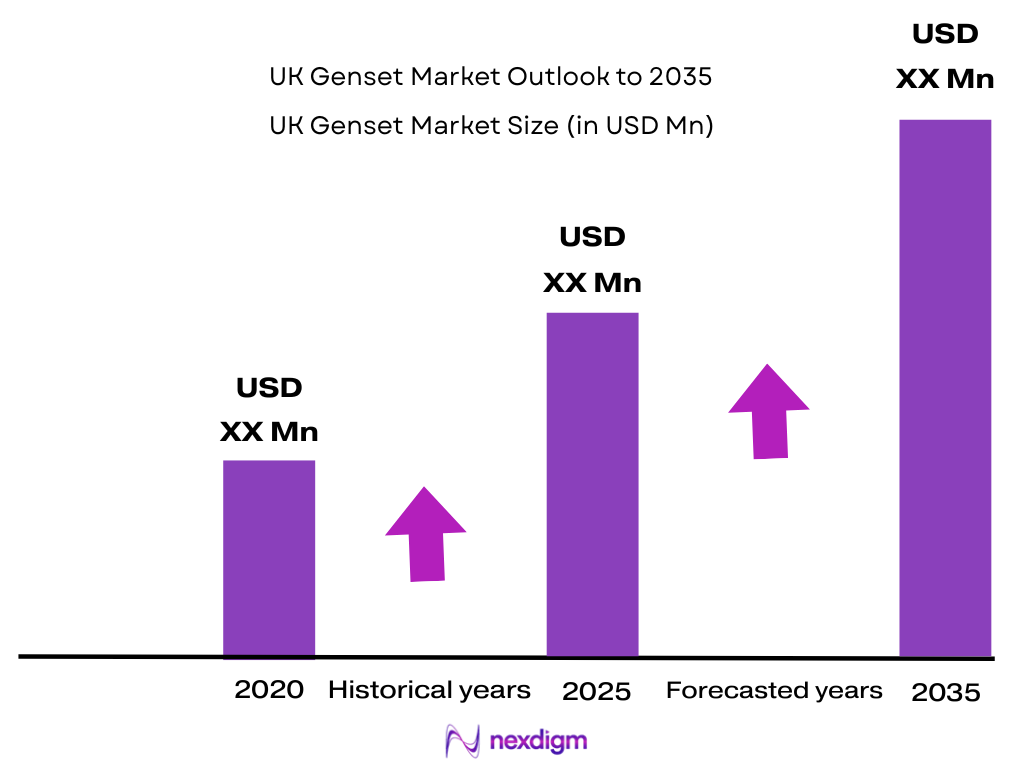
The UK Genset Market is valued at approximately ~ million, supported by construction new-work value increasing from £139.03 billion to £140.68 billion across two consecutive annual periods. Temporary power requirements at construction sites, workshops, mobile maintenance operations, outdoor events and emergency-response locations sustain demand for portable petrol and inverter generators. Weather-related grid interruptions further reinforce backup-power requirements among households, small businesses and mobile field operations.London, Birmingham, Manchester and other major urban-industrial centres represent important demand locations because they combine construction activity, tradespeople, equipment-rental networks, commercial premises and dense service infrastructure. National construction new orders increased from £67.89 billion to £71.71 billion, strengthening temporary-power applications across major development centres. London also applies specific non-road mobile machinery emission requirements to engines rated between 37 kW and 560 kW, increasing emphasis on compliant, efficient generator technologies.
Market Segmentation
By Generator Type
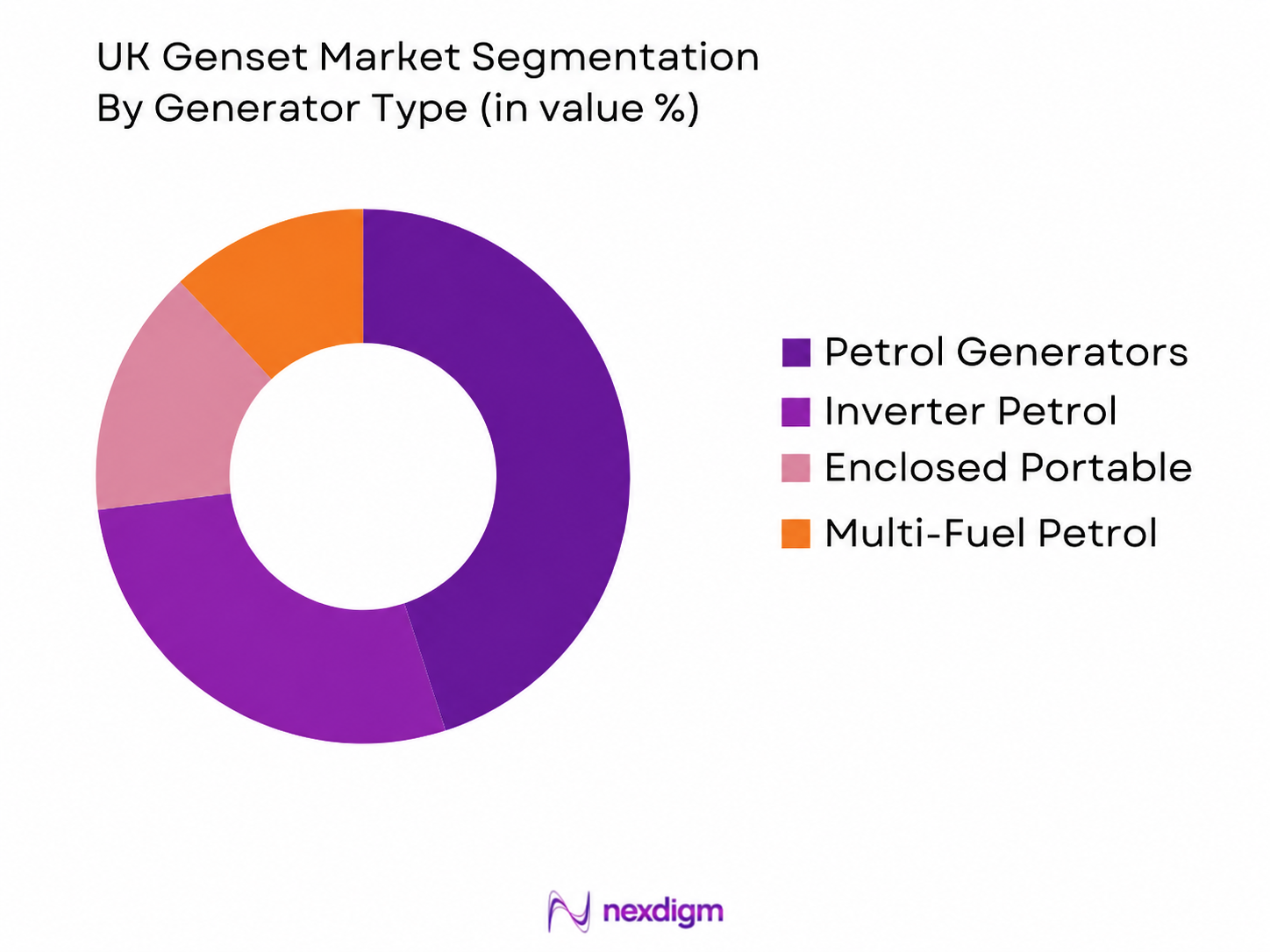
The UK Genset Market is segmented into conventional open-frame petrol generators, inverter petrol generators, enclosed portable generators and multi-fuel petrol-compatible generators. Open-frame petrol generators hold the dominant market position because construction contractors, mobile mechanics, agricultural users and small businesses generally require relatively high output, straightforward maintenance and portability rather than permanently installed backup systems. Open-frame units commonly cover applications involving power tools, compressors, lighting equipment, pumps and temporary workshop loads. UK distributors currently offer petrol generators extending from approximately 1,000 W to 12 kVA, illustrating the broad usable capacity range available to professional and household users. At the same time, inverter generators are becoming increasingly important because they provide more stable electrical output for electronics, improved fuel management and lower operating noise. Pramac specifically markets inverter units around clean and stable power, fuel efficiency and lower noise characteristics, while Hyundai maintains both open-frame and inverter products within its UK generator portfolio.
By Power Output
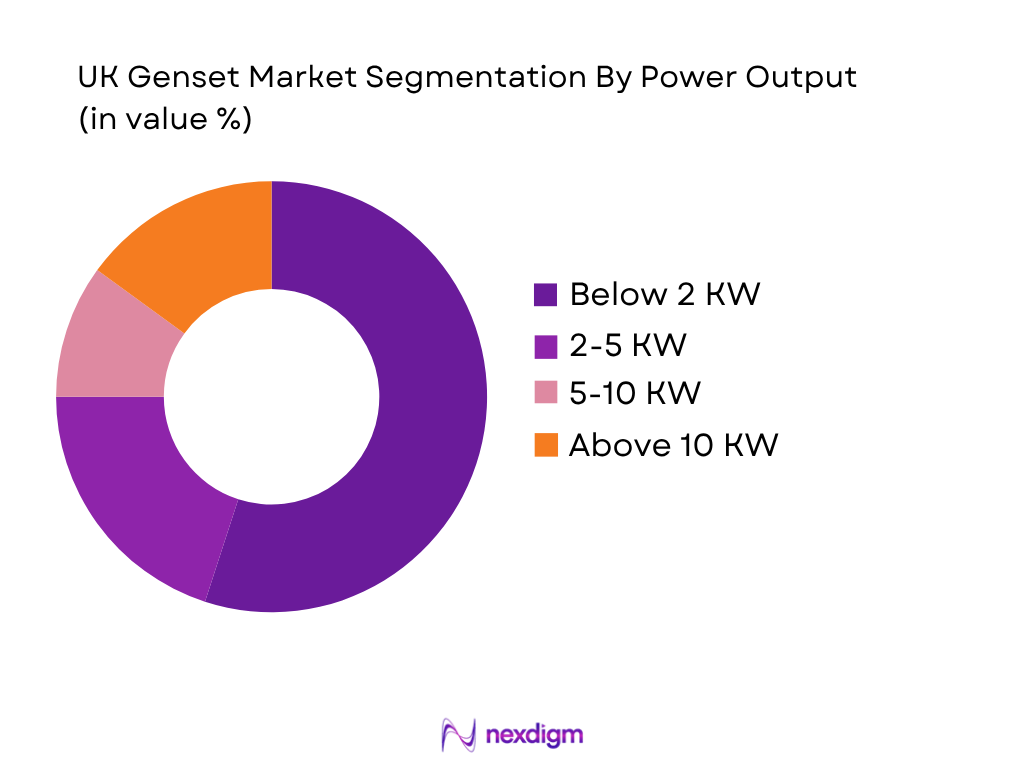
The UK Genset Market is segmented into below 2 kW, 2–5 kW, 5–10 kW and above 10 kW generator categories. The 2–5 kW segment maintains a dominant position because this output range balances portability with sufficient capacity for tradespeople, caravans, mobile service operations, small construction applications and emergency household loads. These gensets can support combinations of power tools, lighting, refrigerators, pumps and electronic equipment without the greater size and fuel requirement associated with larger systems. Honda, Hyundai and Pramac all compete strongly in compact portable and inverter-generator categories, supporting widespread product availability across professional and recreational channels. Higher-capacity 5–10 kW petrol generators remain important on work sites where several tools or heavier equipment must operate simultaneously. Petrol products above 10 kW are comparatively more specialised because larger commercial and industrial users frequently migrate toward diesel, gas or stationary systems for extended runtime. UK petrol-generator distribution nevertheless extends to around 12 kVA, indicating continuing demand for high-output mobile petrol systems in selected professional applications.
Competitive Landscape
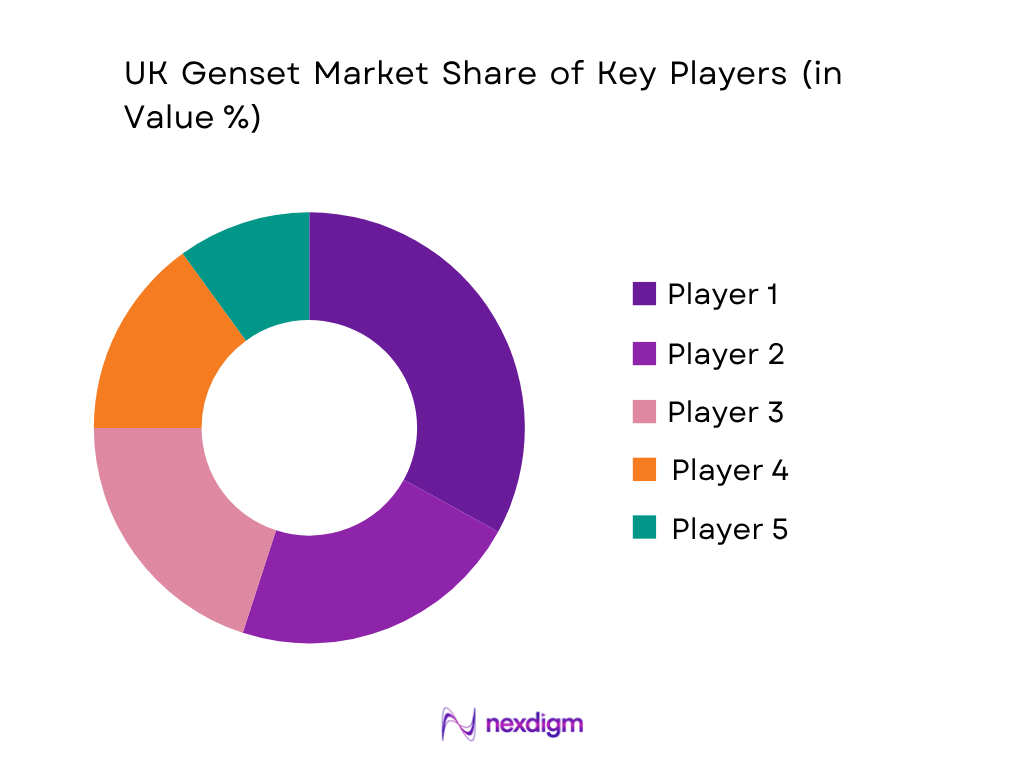
The UK Genset Market includes global engine and generator manufacturers alongside specialised UK power-equipment distributors. Honda competes strongly in premium portable and inverter systems, Hyundai Power Products addresses both recreational and professional applications, and Pramac covers inverter, portable professional and higher-output generators. Generac brings broader backup-power expertise, while Champion Power Equipment participates through petrol and multi-fuel portable products. Competitive differentiation increasingly centres on power-to-weight ratio, inverter technology, fuel efficiency, noise control, automatic voltage regulation, portability and safety features.
| Major Player | Establishment Year | Headquarters | Petrol Generator Range | Inverter Capability | Typical Output Coverage | AVR / Output Stability | Portability Focus | UK Channel Position |
| Honda Motor Co. | 1948 | Tokyo, Japan | ~ | ~ | ~ | ~ | ~ | ~ |
| Hyundai Power Products / Genpower | 2006* | Pembrokeshire, UK | ~ | ~ | ~ | ~ | ~ | ~ |
| Pramac | 1966 | Siena, Italy | ~ | ~ | ~ | ~ | ~ | ~ |
| Generac | 1959 | Wisconsin, USA | ~ | ~ | ~ | ~ | ~ | ~ |
| Champion Power Equipment | 2003 | Las Vegas, USA | ~ | ~ | ~ | ~ | ~ | ~ |
UK Genset Market Analysis
Growth Drivers
Expansion of Critical Digital Infrastructure and Need for Resilient Backup Power
The UK Genset Market is increasingly supported by the expansion of data centres, telecommunications infrastructure and other power-sensitive assets where continuity of electricity supply is operationally critical. The UK government formally designated data centres as Critical National Infrastructure in 2024, placing the sector alongside energy, water and emergency-service infrastructure and increasing the strategic emphasis on operational resilience, emergency power and recovery capability. Government announcements subsequently reported more than £38 billion of new UK data-centre investment commitments since July 2024, while one proposed Hertfordshire data-centre development alone represented nearly £4 billion of investment and was associated with approximately 14,000 jobs. These projects require multiple layers of electrical resilience, including grid feeds, UPS installations, battery storage and generator sets capable of supplying power when primary electrical infrastructure is interrupted. The opportunity extends beyond hyperscale data centres because telecommunications nodes, cloud infrastructure, emergency-response assets, temporary network installations and mobile service units also require portable or vehicle-mounted generating equipment where grid availability cannot be guaranteed. Larger diesel gensets remain the dominant emergency-power technology in many critical applications, while compact petrol generators and mobile generator platforms support field maintenance, temporary works, mobile technical operations and smaller distributed sites. The economic scale supporting this infrastructure demand is considerable. World Bank data records UK economic output at approximately USD 4.00 trillion in 2025, with GDP per capita of roughly USD 57,602, showing the scale of an economy dependent on reliable digital and physical infrastructure. The IMF’s April 2026 World Economic Outlook places UK nominal GDP at roughly USD 4.26 trillion in 2026, providing further evidence of the economic value exposed to power interruptions and infrastructure downtime. Data-centre expansion is particularly relevant because grid access itself has emerged as a constraint. The UK government stated in 2025 that grid access represented the single largest challenge facing new data-centre developments, prompting reforms intended to accelerate connections for strategically important projects. Where grid connections are delayed, temporary generation can support construction, commissioning, testing and enabling works before permanent electrical connections are completed. Once facilities become operational, emergency generators remain part of multilayered continuity architecture. The Statutory Security of Supply Report also continues to emphasise maintaining sufficient electricity capacity and resilient energy systems, reinforcing the commercial importance of backup generation even within a highly developed national grid. Automotive and mobile genset suppliers can therefore target telecom contractors, data-centre developers, electrical contractors, network operators and temporary-power rental businesses with trailer-mounted units, compact mobile generators and integrated control systems. The shift toward higher-value applications also raises demand for automatic start capability, remote diagnostics, parallel operation, acoustic enclosures, low-emission engines and integration with batteries or UPS systems. Consequently, the UK’s digital-infrastructure buildout does not simply increase generator deployment; it shifts genset requirements toward higher availability, better monitoring and more sophisticated electrical integration. The principal supporting sources are the UK Department for Science, Innovation and Technology, Department for Energy Security and Net Zero, World Bank and International Monetary Fund.
Construction, Infrastructure and Temporary Mobile Power Requirements
Construction and infrastructure development form a second major driver of the UK Genset Market because worksites frequently require portable or trailer-mounted electricity before permanent grid supplies are established or in locations where fixed connections are operationally impractical. Office for National Statistics data shows that Great Britain’s new-work construction output reached approximately £140.684 billion in 2024, establishing a substantial activity base for temporary lighting, power tools, pumps, welding equipment, site cabins, security systems and mobile maintenance operations. Dedicated infrastructure construction accounted for £33.9 billion of new work in 2024, while electricity-infrastructure construction increased materially and other infrastructure covering areas such as communications and air transport also expanded. These activities are directly relevant to mobile generators because road projects, rail works, utility construction, communications deployment and electrical-network upgrades often occur across dispersed sites where portable power must move with contractors and equipment. The construction market remained active into 2026. Office for National Statistics figures show that monthly construction output increased in January, February and March 2026, including a 1.5 index-related monthly rise in March, while repair and maintenance activity continued to support equipment utilisation across existing infrastructure and buildings. More importantly for equipment suppliers, UK market-sector infrastructure investment reached £31.3 billion in 2025 in 2023 chained-volume terms, while infrastructure net stocks were estimated at £506.7 billion. Energy infrastructure alone represented £18.8 billion of investment and £198.9 billion of infrastructure stock. The size of these asset bases creates recurring requirements not only during original construction but also during maintenance, repair, emergency intervention and refurbishment. Portable petrol generators are particularly relevant to light construction, trade contractors, mobile workshops and short-duration jobs where output requirements are comparatively modest and equipment must be easily transported in vans, pickups or service vehicles. Larger mobile diesel sets serve civil engineering, infrastructure and industrial projects with heavier continuous loads. Manufacturers increasingly differentiate through inverter technology, electric starting, automatic voltage regulation, low-noise enclosures, multiple socket configurations and telematics. The macroeconomic environment provides additional scale. The World Bank places UK GDP at about USD 4.00 trillion in 2025, while the IMF’s 2026 World Economic Outlook puts nominal output at approximately USD 4.26 trillion. This large economic base supports extensive construction, utility and facility-management activity requiring mobile equipment fleets. Genset demand is also linked to the rental model used extensively by construction contractors. Rental operators can deploy units between projects, creating demand for robust engines, standardised service components, fleet telematics and equipment capable of handling repeated transportation and variable loads. Infrastructure electrification does not eliminate this requirement because grid upgrades themselves often require temporary generation when substations, cables or circuits are isolated for maintenance. Generator suppliers can therefore position products not simply as emergency devices but as mobile productivity equipment. The strongest opportunities exist around compact petrol-powered units for trades and mobile-service operations, mid-sized trailer-mounted sets for construction sites and hybrid generator-battery packages where fuel consumption, noise and emissions must be controlled. The principal supporting sources are the Office for National Statistics, World Bank and International Monetary Fund.
Market Challenges
Tightening Non-Road Mobile Machinery Emission Compliance
Emission regulation is a significant challenge for the UK Genset Market because generator sets used on construction sites and other mobile applications fall within the wider regulatory framework governing internal-combustion engines used in non-road mobile machinery. In London, requirements are particularly stringent. Current Greater London Non-Road Mobile Machinery rules apply emission-stage requirements to engines generally within the 37 kW to 560 kW range, creating direct implications for mobile generator fleets used on regulated construction sites. Practical London guidance issued for sites states that constant-speed engines typically used in generators are required to meet Stage V requirements across relevant applications, meaning older equipment may need replacement, approved exemptions or emissions-control modifications before deployment. For fleet owners, rental providers and contractors, this creates a technology-management challenge. A generator may remain mechanically serviceable while becoming unsuitable for particular projects because its engine certification does not meet the required emissions stage. The resulting requirement to maintain documentation for engine type approval, emissions performance and site registration raises administrative complexity in addition to equipment-management requirements. The UK Vehicle Certification Agency also maintains the regulatory type-approval framework for non-road engines, reinforcing the need for equipment suppliers to understand pollutant limits and applicable engine approvals before bringing gensets into regulated applications. This challenge is becoming strategically more important as the broader economy invests in cleaner energy and infrastructure. Office for National Statistics data indicates that market-sector energy infrastructure investment reached £18.8 billion in 2025, while total market infrastructure investment reached £31.3 billion. Increasing investment in modern infrastructure means construction projects are simultaneously becoming larger power users and more demanding in environmental compliance. Suppliers consequently face pressure to improve after-treatment systems, engine calibration, noise control and fuel efficiency without reducing genset reliability. Smaller petrol units must also respond to expectations for reduced carbon monoxide output, improved combustion control and safer operating systems, particularly in applications near workers or populated areas. Macroeconomic conditions compound the challenge because contractors must balance equipment replacement against wider capital requirements. World Bank data values the UK economy at approximately USD 4.00 trillion in 2025, while IMF data places nominal GDP around USD 4.26 trillion in 2026. This scale supports substantial equipment demand, but it also means regulatory requirements can affect thousands of contractors and rental fleets rather than a narrow specialist market. Manufacturers must therefore maintain compliant models across multiple power ratings while ensuring spare-parts availability and technician capability. Regulation may additionally accelerate substitution toward battery storage, hybrid power systems and grid connections on projects where conventional generators struggle to meet environmental objectives. The market challenge is therefore two-sided: suppliers must continue serving applications where combustion generators remain technically necessary while reducing the environmental disadvantages that encourage customers to switch technologies. Vendors capable of combining Stage V engines, low-noise operation, automatic idle control, remote monitoring and battery integration will be better positioned than manufacturers relying on basic conventional gensets. The principal supporting sources are the Greater London Authority, Vehicle Certification Agency, Office for National Statistics, World Bank and International Monetary Fund.
Grid Modernisation and Competition from Battery-Based Temporary Power
The rapid development of the UK’s electricity system presents a structural challenge for conventional automotive and mobile gensets because battery storage, grid reinforcement and low-carbon electricity increasingly provide alternatives to continuous petrol- or diesel-powered generation. The UK electricity system is undergoing substantial investment. Office for National Statistics data shows that market-sector energy infrastructure investment reached £18.8 billion in 2025, contributing to total infrastructure investment of £31.3 billion, while energy infrastructure stocks reached £198.9 billion. Electricity construction had already increased in 2024 while broader government policy moved toward the Clean Power 2030 framework. As grid infrastructure becomes stronger and connection processes are reformed, some sites that historically relied on long-duration generator operation can increasingly access temporary grid connections or electrically charged battery systems. Renewable electricity generation has also expanded. Department for Energy Security and Net Zero statistics show renewable generation reaching historically high levels in recent reporting periods, indicating a fundamental change in the electricity supply mix. This creates competitive pressure on genset operators because customers increasingly evaluate temporary power according to noise, local air pollutants, carbon emissions and fuel logistics rather than only purchase price and rated output. Battery energy storage can operate silently, provide instantaneous response and eliminate on-site combustion during discharge. For construction sites located close to residential properties, hospitals or central-city locations, these advantages can be substantial. Conventional generators therefore risk losing runtime hours even where they remain installed. Instead of operating continuously, a generator may increasingly function as a charging source or emergency backup for a battery-based microgrid. This reduces fuel consumption and engine operating hours but also changes the specification of the genset market toward equipment capable of efficient variable-load operation, automatic start-stop cycles and digital communication with energy-management systems. The national economy provides sufficient scale for this transition to influence procurement materially. World Bank figures value UK GDP at approximately USD 4.00 trillion in 2025, while IMF data indicates nominal GDP of roughly USD 4.26 trillion in 2026. Large infrastructure owners, rental companies and contractors therefore have the capital base to evaluate alternative technologies rather than relying automatically on traditional combustion generators. Grid policy is another competitive factor. Government reforms announced in 2025 were intended to accelerate connections for strategic industries, including data centres and clean-energy projects, directly addressing one reason customers historically required temporary generation for extended periods. Petrol gensets face particular pressure in low-output applications because portable lithium battery power stations can substitute for generators used to operate electronics, lighting and smaller tools. Diesel equipment retains stronger advantages at higher continuous loads, but it too faces hybridisation. The challenge for traditional manufacturers is therefore not that generator sets disappear; rather, customer expectations shift from standalone combustion equipment toward integrated energy systems. Manufacturers lacking inverter control, remote communication, automatic start-stop functions, battery charging optimisation or renewable-energy interfaces may find their equipment increasingly restricted to basic low-value applications. The principal supporting sources are the Department for Energy Security and Net Zero, Office for National Statistics, UK Government, World Bank and International Monetary Fund.
Market Opportunities
Hybrid Generator-Battery Systems and Intelligent Mobile Power Platforms
The transition toward cleaner temporary power creates a major opportunity for UK Genset suppliers to reposition conventional generator sets as components of hybrid mobile energy systems rather than standalone engines running continuously. Current infrastructure investment supports this transition. The Office for National Statistics recorded £31.3 billion of UK market-sector infrastructure investment in 2025, including £18.8 billion within energy infrastructure, while the corresponding market-sector infrastructure stock reached £506.7 billion. These assets require ongoing construction, inspection, emergency maintenance and temporary electrical supply, but project owners increasingly seek lower-noise and lower-emission solutions. A hybrid platform allows the generator to operate close to an efficient load point for limited periods, recharge a battery pack and shut down while the battery supplies lighter loads. This architecture is particularly attractive for construction compounds where overnight demand may consist primarily of lighting, communications, refrigeration, surveillance equipment and welfare facilities. Instead of idling a combustion generator for prolonged periods, battery storage can support these loads silently while the generator starts only when battery state of charge falls or high-power equipment is activated. The opportunity is amplified by London emissions requirements, which impose strict standards on non-road engines and therefore encourage contractors to reduce unnecessary combustion-engine runtime. Hybridisation provides genset manufacturers with a route to remain relevant within increasingly stringent environmental frameworks. Products can incorporate Stage V engines, lithium battery modules, solar inputs, automatic transfer controls and intelligent power-management software. Remote telematics can report fuel level, battery state, engine operating hours, fault codes and load demand to fleet managers, supporting predictive maintenance and reducing unnecessary site visits. The economic environment provides a substantial customer base for these solutions. World Bank data puts UK GDP at around USD 4.00 trillion in 2025, while the IMF places 2026 nominal economic output near USD 4.26 trillion. Construction and infrastructure users can therefore justify investment in technology that improves whole-life equipment utilisation even if the initial system is more sophisticated than a basic generator. Hybrid systems also address several longstanding genset problems simultaneously: low-load engine operation, excessive noise, fuel logistics and unnecessary maintenance hours. In mobile service vehicles, battery-generator combinations can power tools and equipment without continuous vehicle idling. Telecommunications maintenance teams can use similar platforms for emergency network restoration. Event operators can combine battery modules with small generators to maintain uninterrupted temporary electricity while reducing nighttime noise. Manufacturers can additionally offer modular systems where batteries and generators are sized independently according to site load. Rental companies represent a particularly important customer group because the same hybrid system can be redeployed across construction, events, telecoms and emergency-power applications. The future opportunity therefore lies less in simply increasing generator engine output and more in developing digitally managed mobile energy platforms that combine combustion reliability with battery efficiency. The principal supporting sources are the Office for National Statistics, Greater London Authority, World Bank and International Monetary Fund.
Data Centres, Telecom Networks and High-Reliability Mobile Backup Applications
The expansion of high-value digital infrastructure creates a substantial opportunity for UK Genset manufacturers and rental providers supplying mobile backup, commissioning and emergency-response equipment. The government designated data centres as Critical National Infrastructure in 2024, recognising their role in supporting healthcare records, financial transactions, communications systems, public services and cloud computing. Since July 2024, the UK has recorded more than £38 billion of announced data-centre investment commitments, while a major Hertfordshire development proposal alone represented nearly £4 billion and was associated with approximately 14,000 jobs. These facilities require permanently installed standby generation, but their construction and maintenance also create demand for automotive and mobile gensets. Temporary units can provide commissioning power, support electrical testing, maintain critical loads while switchgear is serviced and provide contingency coverage when installed generators or grid circuits are unavailable. The opportunity extends into telecommunications because mobile networks, fibre infrastructure and edge-computing facilities require emergency electricity at geographically distributed locations. Portable or trailer-mounted units can be dispatched by service vehicles following storms, cable failures, transformer faults or localised supply interruptions. The wider scale of UK digital infrastructure reinforces the potential. Government-backed broadband programmes have committed £1.2 billion of public funding for gigabit infrastructure, with major expenditure occurring through the 2023–2025 implementation period. Every expansion of distributed communications infrastructure increases the number of sites where emergency mobile power may be required during maintenance or network disruptions. Grid-connection constraints further strengthen the near-term opportunity. In 2025, the government identified electricity-grid access as the single largest constraint facing new data-centre developments and introduced reforms intended to accelerate strategic connections. Until permanent connections become available, temporary generation may be necessary during enabling works and construction. Even after grid connection, regulatory expectations surrounding resilience mean backup systems remain essential. The World Bank values UK GDP at approximately USD 4.00 trillion in 2025, while IMF data places 2026 nominal GDP at around USD 4.26 trillion, demonstrating the economic value supported by digital services and the potentially high cost of infrastructure downtime. For genset suppliers, the attractive segment is therefore not limited to basic standby machines. High-reliability applications demand synchronisation controls, automatic transfer systems, load-bank compatibility, parallel operation, acoustic attenuation, remote monitoring and rapid-service support. Mobile rental businesses can maintain fleets specifically configured for data-centre commissioning and emergency operations. Smaller petrol or inverter generators can support network technicians, temporary communications systems and field equipment, while larger trailer-mounted diesel sets provide multi-kilowatt or megawatt-scale contingency power. Hybrid battery-generator platforms can further improve response for low-load telecom applications. The UK’s expanding AI, cloud and digital-services ecosystem therefore provides a route for genset companies to move toward higher-value reliability services rather than competing only on equipment specifications. The principal supporting sources are the UK Government, Office for National Statistics, World Bank and International Monetary Fund.
Future Outlook
The UK Genset Market is expected to expand at approximately ~ CAGR during 2026–2035, although future growth will increasingly depend on product innovation rather than unrestricted expansion of traditional petrol equipment. Portable petrol generators will continue to serve construction, mobile trades, emergency response, recreation and household backup applications because they offer rapid deployment without fixed infrastructure. Construction output continued increasing in recent annual data, maintaining a large underlying base of temporary and mobile power applications. The product mix is expected to move toward inverter-controlled, quieter and more fuel-efficient units. Pramac already positions inverter generators around clean electrical output for sensitive electronics, while Honda incorporates advanced inverter technologies and connectivity within higher-end portable products. Such systems are well aligned with users powering laptops, diagnostic systems, battery chargers and electronic tools. Safety and emissions compliance will become more important differentiators. The Health and Safety Executive warns against using petrol-powered equipment indoors or in enclosed areas because of carbon-monoxide exposure. Outdoor equipment placed on the UK market is also subject to noise-emission requirements involving measurement, technical documentation and guaranteed sound-power labelling. Weather resilience remains another important underlying demand factor. Ofgem reports that severe storms, including Storm Darragh, caused prolonged outages affecting large numbers of homes and businesses, demonstrating the continuing role of portable backup generation where temporary restoration of essential loads is required.
Major Players
- Honda Power Equipment
- Hyundai Power Products
- Pramac
- Generac Power Systems
- Champion Power Equipment
- Briggs & Stratton
- Stephill Generators
- Clarke International
- SIP Industrial Products
- Excel Power
- Westinghouse Outdoor Power Equipment
- Yamaha Motor Power Products
- Könner & Söhnen
- Loncin
- Warrior Power Products
Key Target Audience
- Petrol and portable generator manufacturers
- Power-equipment distributors and dealers
- Construction and infrastructure contractors
- Equipment-rental and plant-hire companies
- Automotive workshops and mobile service operators
- Outdoor events, leisure and caravan equipment suppliers
- Investments and venture capitalist firms
- Government and regulatory bodies (Health and Safety Executive, Office for Product Safety and Standards, Environment Agency, Ofgem, Vehicle Certification Agency)
Research Methodology
Step 1: Identification of Key Variables
The first stage involves constructing the complete UK Genset Market ecosystem across manufacturers, engine suppliers, alternator suppliers, dealers, rental businesses, contractors and end users. Key variables include generator output, rated and peak power, engine displacement, fuel-tank capacity, runtime, inverter architecture, noise level, portability, AVR configuration, socket arrangement and applicable product-safety requirements.
Step 2: Market Analysis and Construction
Historical market demand is assessed through bottom-up analysis of construction, household backup, commercial mobile-power, leisure and equipment-rental applications. Supply-side analysis evaluates petrol-generator portfolios, distributor availability, kW ranges, product configuration and channel presence. Construction activity, power-outage exposure and regulatory requirements are triangulated to identify applications where portable petrol units have commercially relevant demand.
Step 3: Hypothesis Validation and Expert Consultation
Market hypotheses are validated through CATIs with generator manufacturers, distributors, rental companies, construction contractors and technical dealers. Discussions assess petrol-versus-diesel selection, inverter adoption, preferred output ranges, seasonal demand, emergency purchasing patterns, noise constraints, runtime expectations, maintenance requirements and safety considerations.
Step 4: Research Synthesis and Final Output
The final stage reconciles demand-side estimates with generator model availability and manufacturer portfolios. Honda, Hyundai, Pramac and other supplier product ranges are compared across output, generator architecture and professional-use positioning. Results are cross-checked against UK construction activity, outage resilience, noise regulation and carbon-monoxide guidance before generating the final market and forecast framework.

- Executive Summary
- Research Methodology (Market Definitions and Assumptions, Automotive Genset Scope, Abbreviations, Market Sizing Approach, Top-Down Analysis, Bottom-Up Analysis, Installed-Base Assessment, Generator Shipment Analysis, Demand-Side Assessment, Supply-Side Assessment, OEM and Distributor Interviews, Rental Fleet Assessment, Data Triangulation, Forecasting Framework, Limitations and Future Conclusions)

- Definition and Scope
- Market Evolution and Industry Genesis
- Development of Portable, Mobile and Stationary Generator Ecosystem
- Generator Manufacturing, Assembly and Distribution Ecosystem
- Engine–Alternator–Controller–Enclosure Value Chain

- Growth Drivers (Grid Resilience Requirements, Increasing Backup-Power Requirements, Growth of Data Centres, Automotive Manufacturing Continuity Requirements, Expansion of Construction Activity, Telecom Network Reliability, Temporary Power Demand, Expansion of Equipment Rental Fleets)
- Market Challenges (Stage V Emission Compliance, Diesel Generator Decarbonisation Pressure, Generator Noise Restrictions, Fuel Storage Requirements, Rising Competition from Battery Energy Storage, Generator Maintenance Complexity, Skilled Service Technician Availability)
- Market Opportunities (Hybrid Generator-Battery Systems, HVO-Compatible Generator Fleets, Low-Emission Mobile Gensets, Data-Centre Backup Systems, EV Charging Backup Power, Smart Remote Monitoring, Generator Fleet Digitalisation, Synchronised Modular Power Systems)
- Market Trends (Generator-BESS Integration, Stage V Engine Adoption, Remote Generator Monitoring, Automatic Load Management, Predictive Maintenance, Low-Noise Acoustic Enclosures, Multi-Generator Synchronisation, Inverter Generator Adoption)
- Government Regulations (UK Non-Road Mobile Machinery Requirements, Stage V Engine Emission Standards, London NRMM Low Emission Zone Requirements, Environmental Permitting Requirements, Generator Noise Regulations, Fuel Storage and Handling Requirements, Carbon Reduction Policies, Workplace Generator Safety Requirements)
- SWOT Analysis
- Porter’s Five Forces Analysis
- PESTLE Analysis

- By Market Value (2020-2025)
- By Generator Unit Sales (2020-2025)
- By Installed Generator Capacity (2020-2025)

- By Fuel Type (In Value %)
Diesel Gensets
Petrol/Gasoline Gensets
Natural Gas Gensets
LPG Gensets
Dual-Fuel and Multi-Fuel Gensets - By Power Rating (In Value %)
Below 10 kVA
10–30 kVA
31–75 kVA
76–200 kVA
201–500 kVA - By Generator Configuration (In Value %)
Portable Open-Frame Generators
Portable Inverter Generators
Mobile Trailer-Mounted Generators
Stationary Open Gensets
Acoustic/Silent Enclosed Gensets - By Region (In Value %)
Greater London
South East England
East of England
West Midlands
East Midlands

- Market Positioning of Major Players
- Cross Comparison Parameters (Power Rating Range, Fuel Technology Portfolio, Stage V Compliance Capability, Generator Runtime and Fuel Efficiency, Acoustic/Noise Performance, AMF/ATS and Remote Monitoring Capability, Rental and Dealer Network Reach, Aftermarket Service and Spare Parts Coverage)
- SWOT Analysis of Major Players
- Detailed Profiles of Major Companies
Cummins Inc.
Caterpillar Inc.
FG Wilson
Rehlko Power Systems
Rolls-Royce Power Systems / mtu
Pramac / Generac
Atlas Copco
HIMOINSA
JCB Power Products
Aggreko
Stephill Generators
Honda Power Equipment
Champion Power Equipment
Hyundai Power Products
Teksan Generator

- Automotive Manufacturing Demand Assessment
- Construction and Infrastructure Demand Assessment
- Data Centre Generator Demand Assessment
- Telecommunication Generator Demand Assessment
- Commercial and Industrial Generator Demand Assessment

- By Market Value (2026-2035)
- By Generator Unit Sales (2026-2035)
- By Installed Generator Capacity (2026-2035)


 Request a Sample
 Ask for Customization
 Get a Quote
 Enquire Now