
 Download PDF
Market Overview
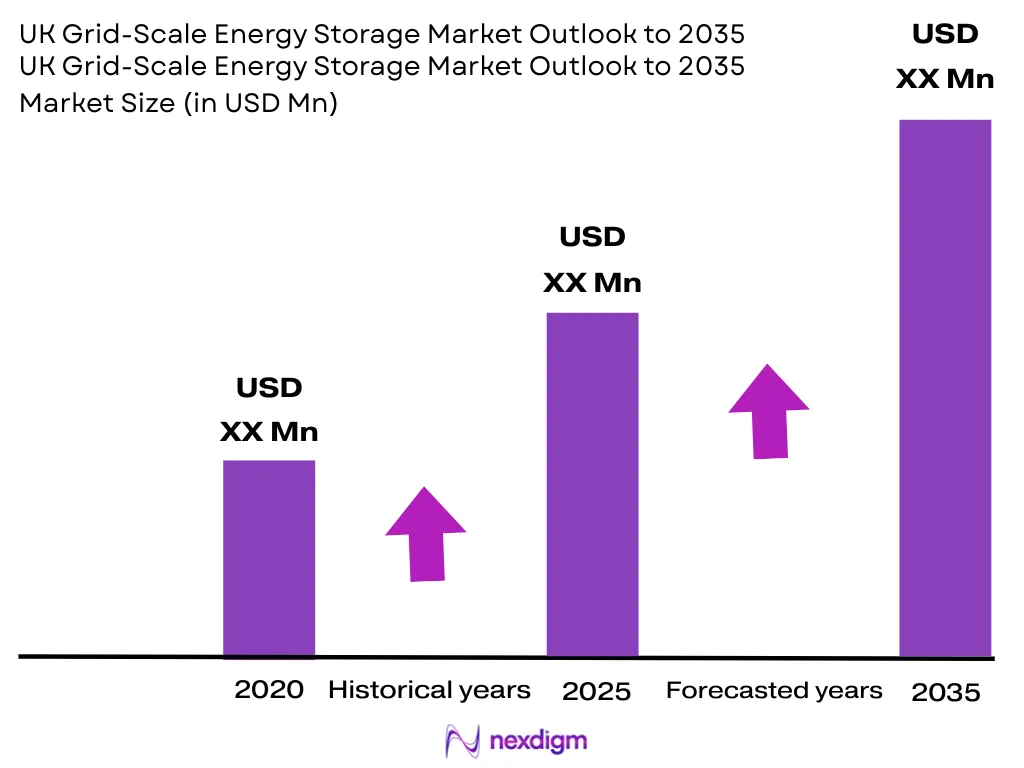
The UK Grid-Scale Energy Storage Market was valued at USD ~ Million in 2024 and is anticipated to expand at a CAGR of ~ % during 2026–2035. The market is primarily driven by rapid expansion of offshore wind and solar generation capacity, rising grid balancing and frequency response requirements, and government net-zero targets and decarbonization policy. According to Spherical Insights, the United Kingdom battery energy storage system market grew from USD 227.4 million in 2024 and is projected to reach USD 6,984.3 million by 2035, registering a strong CAGR of 36.52 percent, driven by renewable energy expansion, net-zero targets, grid flexibility requirements, and rising power demand from data centres. The United Kingdom held the dominant position in the European energy storage market in 2025, according to Market Data Forecast, remaining one of the most advanced and active energy storage markets in Europe, sustaining consistent demand for battery, liquid air, and pumped hydro storage capacity across the national grid.
Market Segmentation
By Technology
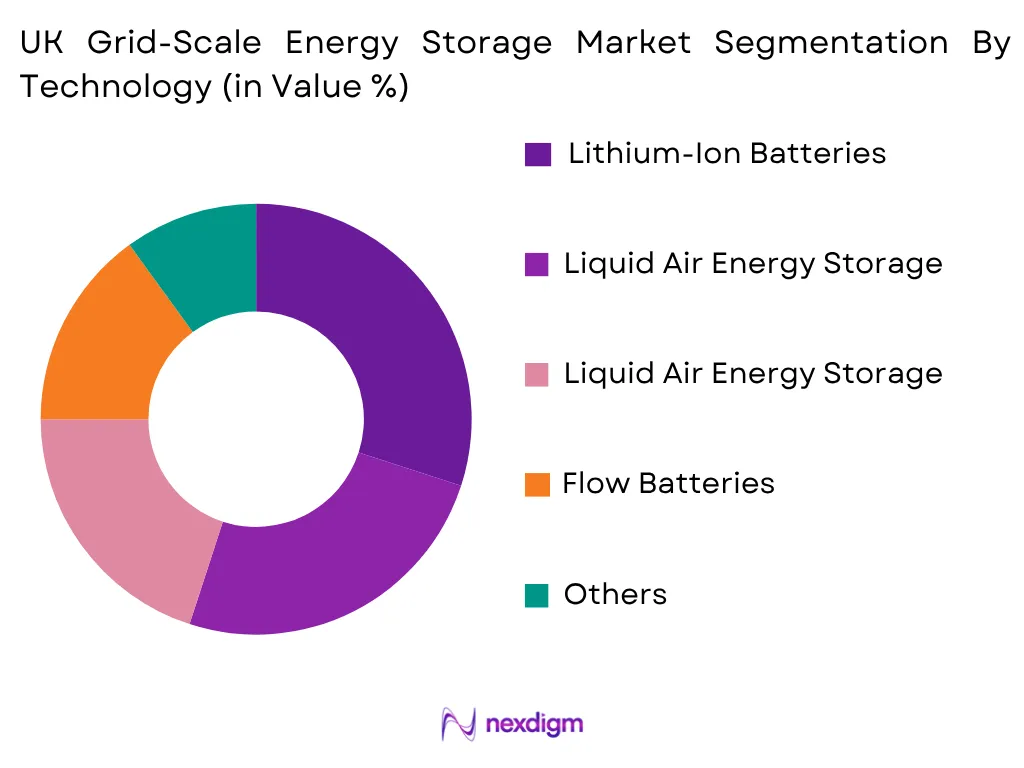
Among these, Lithium-Ion Batteries hold the largest share of the UK Grid-Scale Energy Storage Market, accounting for the largest market share in 2024, according to Spherical Insights, with adoption in the UK growing due to greater energy density, longer lifespan, fast response time, and reduced costs of lithium-ion batteries suited to backup power applications, frequency management, and grid-scale energy storage. The Pillswood project, developed by Harmony Energy and regarded as Europe’s largest Battery Energy Storage System by capacity at launch, can produce up to 98 MW of power and store up to 196 MWh of energy, providing a two-hour supply of power at maximum capacity, according to Mobility Foresights. At the same time, Liquid Air Energy Storage is emerging as a significant long-duration alternative, exemplified by Centrica plc’s June 2024 announcement of a strategic partnership and GBP 70 million investment in Highview Power’s first clean energy storage project in Carrington, Manchester, reflecting growing investment diversification beyond conventional lithium-ion technology.
By Application
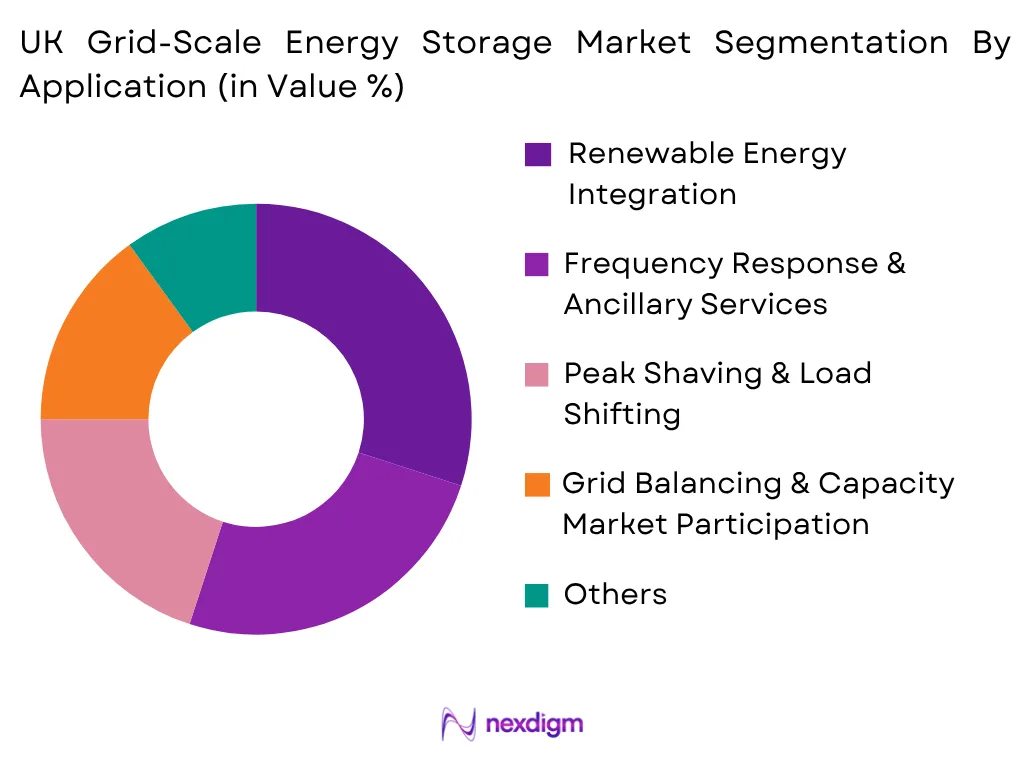
The Renewable Energy Integration segment holds the leading application share, driven by the need for grid balancing and large-scale energy management solutions as the UK continues to expand its renewable energy generation, particularly in offshore wind, according to IMARC Group. Energy storage solutions provide the means to store excess energy and then discharge it into the grid when required, making renewable energy more feasible, while also supporting the grid during peak demand periods. Meanwhile, Frequency Response & Ancillary Services remains a critical application as grid operators increasingly rely on storage technology to manage the variable energy generation from renewables such as solar and wind, according to Mordor Intelligence. The utility scale segment held the leading application share of the UK energy storage market in 2025, according to Market Data Forecast, driven by the need for grid balancing, renewable energy integration, and large-scale energy management solutions across the national transmission and distribution network.
Competitive Landscape
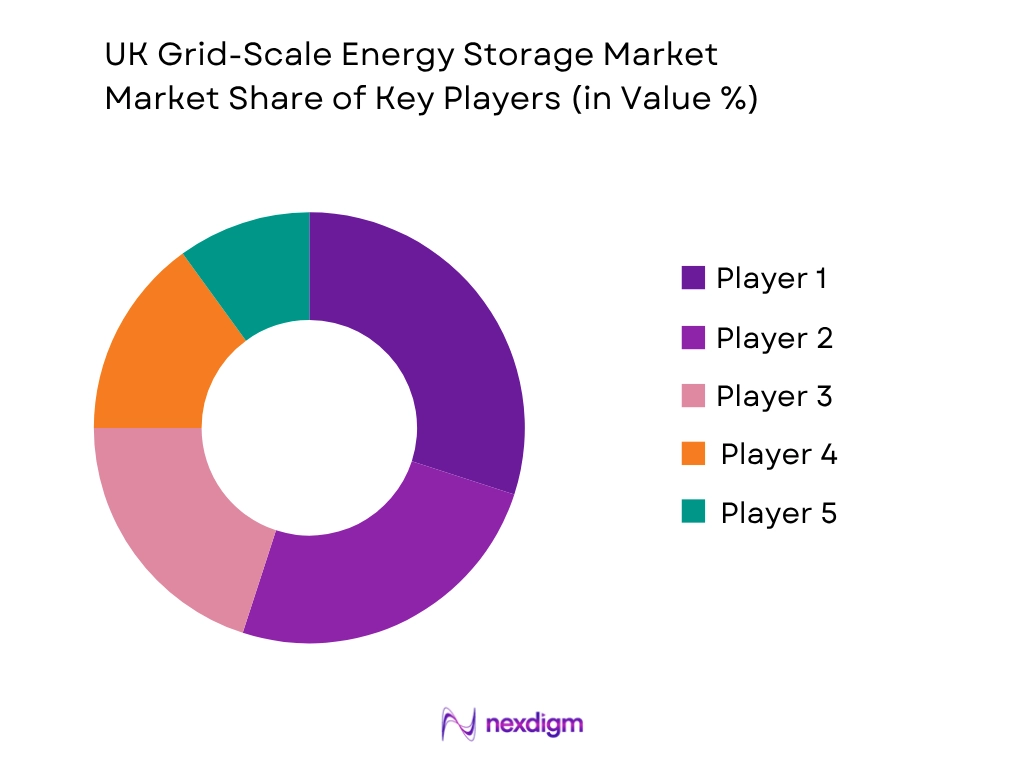
The UK Grid-Scale Energy Storage Market is moderately fragmented, with key players including Fluence Energy, Gresham House Energy Storage Fund, Tesla Energy, Zenobē Energy, Statera Energy, Harmony Energy, TagEnergy, EDF Renewables UK, Anesco, and Root-Power, according to Spherical Insights. Harmony Energy Income Trust’s Pillswood project, launched as Europe’s largest Battery Energy Storage System by capacity, illustrates the scale of development activity among UK-focused independent power producers and investment trusts. Centrica plc’s GBP 70 million investment in Highview Power’s Carrington liquid air energy storage project, announced in June 2024, signals continued diversification of the competitive landscape beyond battery technology, with major utilities including National Grid, SSE, and EDF Renewables UK expanding storage portfolios alongside specialist developers. Competition is primarily based on project pipeline scale, grid connection access, financing capability, and the ability to participate competitively in Capacity Market auctions and the Balancing Mechanism.
| Company | Establishment Year | Headquarters | Primary Technology Portfolio | Project Pipeline / Capacity
|
Operational Presence | Major End-Use Industries | Key Strategic Focus | Certifications & Compliance |
| Zenobē Energy | 2017 | ~ | ~ | ~ | ~ | ~ | ~ | ~ |
| Fluence Energy, Inc. | 2018 | ~ | ~ | ~ | ~ | ~ | ~ | ~ |
| Harmony Energy | 2017 | ~ | ~ | ~ | ~ | ~ | ~ | ~ |
| Gresham House Energy Storage Fund | 2018 | ~ | ~ | ~ | ~ | ~ | ~ | ~ |
| EDF Renewables UK | 2002 | ~ | ~ | ~ | ~ | ~ | ~ | ~ |
UK Grid-Scale Energy Storage Market Analysis
Growth Drivers
Rapid Expansion of Offshore Wind and Renewable Generation
The UK grid-scale energy storage market is experiencing sustained growth due to rapid expansion of offshore wind and solar generation capacity. As the UK continues to expand its renewable energy generation, particularly in offshore wind, the demand for effective energy storage is becoming increasingly critical, according to IMARC Group. These systems are essential for balancing the intermittent nature of renewable sources while also supporting the grid during peak demand periods. As consumer awareness of renewable energy grows, there is also rising demand for energy storage solutions that can integrate seamlessly with home and business energy systems, driving further innovation across the sector. The United Kingdom held the dominant position in the European energy storage market in 2025, according to Market Data Forecast, reflecting strong policy support and significant renewable capacity requiring grid-scale storage integration.
Rising Data Centre Power Demand and Grid Flexibility Requirements
The steady rise in power demand from data centres and grid flexibility requirements remain major drivers for grid-scale energy storage consumption. Major drivers of the UK battery energy storage system market include renewable energy expansion, net-zero targets, grid flexibility requirements, rising power demand from data centres, and supportive government policies, according to Spherical Insights. Adoption of lithium-ion battery technology in the UK has grown due to its appropriateness for backup power applications, frequency management, grid-scale energy storage, and renewable energy integration. As digital infrastructure expansion accelerates electricity demand growth, grid-scale storage capacity becomes increasingly critical to maintaining supply reliability while supporting the UK’s continued transition toward renewable-dominated generation.
Market Challenges
Grid Connection Queue Delays and Capacity Constraints
Despite steady demand growth, the UK grid-scale energy storage market faces significant challenges from grid connection queue delays and capacity constraints affecting project development timelines. As renewable generation capacity and storage project pipelines expand rapidly, transmission and distribution network capacity has struggled to keep pace, creating multi-year connection queues for new storage projects seeking to connect to the national grid. This bottleneck delays project commissioning and revenue generation for developers, requiring continued investment in network reinforcement and grid capacity expansion to support the scale of storage deployment needed to meet the UK’s renewable integration and net-zero targets.
Regulatory Uncertainty and High Capital Costs for Long-Duration Storage
The UK’s evolving regulatory framework under the Review of Electricity Market Arrangements (REMA) presents a significant compliance and planning challenge for grid-scale energy storage developers. Uncertainty regarding future market design, Capacity Market rules, and Balancing Mechanism revenue stacking opportunities complicates long-term investment planning for storage projects, particularly long-duration technologies such as liquid air and pumped hydro storage that require substantial upfront capital investment. High upfront capital costs for long-duration storage technologies, combined with volatility in balancing mechanism and wholesale electricity prices, create financing challenges for developers seeking to secure project financing for technologies beyond conventional lithium-ion battery systems.
Market Opportunities
Rising Investment in Long-Duration and Liquid Air Energy Storage
The UK’s growing need for long-duration grid balancing capacity creates significant opportunities for investment in liquid air energy storage and other long-duration technologies. Centrica plc’s June 2024 announcement of a strategic partnership and GBP 70 million investment in Highview Power’s first clean energy storage project in Carrington, Manchester, illustrates the commercial viability of diversifying beyond conventional lithium-ion battery technology toward longer-duration storage solutions. As the UK’s renewable generation mix continues to expand, particularly offshore wind, developers investing early in long-duration storage technologies capable of providing multi-hour grid balancing capacity are positioned to capture growing demand from National Energy System Operator balancing services and Capacity Market contracts.
Expansion of Co-Located Storage and Capacity Market Participation
The UK’s expanding renewable generation capacity and Capacity Market framework create substantial long-term opportunities for co-located storage development and market participation. The Pillswood project, developed by Harmony Energy and regarded as Europe’s largest Battery Energy Storage System by capacity, demonstrates the commercial scale achievable in the UK market, providing crucial balancing services to the electricity grid network and enabling further replacement of fossil fuel power stations with renewable energy, according to Mobility Foresights. As declining battery costs and improved energy efficiency continue to support deployment across utility, commercial, and residential applications, according to Market Data Forecast, developers and investment trusts expanding project pipelines are well positioned to capture growing demand across the UK’s evolving electricity market.
Future Outlook
The UK Grid-Scale Energy Storage Market is expected to witness sustained expansion over the forecast period, supported by continued expansion of offshore wind and renewable generation capacity, rising power demand from data centres, and increasing government support for grid flexibility and decarbonization strategies. Continued investment in long-duration storage technologies, co-located renewable and storage projects, and grid connection infrastructure will further accelerate deployment across the industry. The market is also likely to benefit from the UK’s position as one of Europe’s most advanced energy storage markets, enabling greater investment in advanced, technology-diverse storage solutions capable of supporting the country’s net-zero transition and evolving electricity market design.
Major Players
- Fluence Energy, Inc.
- Gresham House Energy Storage Fund
- Tesla Energy
- Zenobē Energy
- Statera Energy
- Harmony Energy
- TagEnergy
- EDF Renewables UK
- Anesco
- Root-Power
- Highview Power
- National Grid plc
- SSE plc
- RWE Renewables UK
- Centrica plc
Key Target Audience
- Grid-Scale Energy Storage Developers and Operators
- Transmission System Operators and Distribution Network Operators
- Renewable Energy Generators and Independent Power Producers
- Utilities and Energy Supply Companies
- Data Centre and Commercial & Industrial Power Users
- Investment Trusts and Project Finance Firms
- Government and Regulatory Bodies (Ofgem, National Energy System Operator (NESO), Department for Energy Security and Net Zero (DESNZ))
- Battery and Storage Technology Equipment Suppliers
Research Methodology
Step 1: Identification of Key Variables
The research process begins with identifying the complete ecosystem of the UK Grid-Scale Energy Storage Market, including battery and equipment suppliers, storage developers and operators, transmission and distribution network operators, renewable energy generators, and regulatory authorities. Extensive secondary research is conducted using company annual reports, government publications, trade associations, regulatory filings, industry journals, and proprietary databases to determine the variables influencing market demand, pricing, project pipeline, and technological developments.
Step 2: Market Analysis and Construction
Historical market information is collected and analyzed to estimate market size, installed capacity, project pipeline activity, and pricing trends. A combination of top-down and bottom-up approaches is used to estimate market revenues and validate segment-level performance. Consumption patterns across frequency response, renewable integration, peak shaving, and capacity market applications are evaluated to establish an accurate representation of the industry.
Step 3: Hypothesis Validation and Expert Consultation
The preliminary findings are validated through Computer-Assisted Telephone Interviews (CATIs) and structured discussions with storage developers, grid operators, project financiers, regulatory experts, and senior executives operating within the UK grid-scale energy storage industry. These interviews help verify market assumptions, competitive developments, technology adoption trends, pricing dynamics, and future investment opportunities while refining the overall market estimates.
Step 4: Research Synthesis and Final Output
The final stage integrates insights obtained from primary interviews with quantitative information collected through secondary sources. Data triangulation techniques are applied to reconcile differences between supply-side and demand-side estimates, ensuring robust market forecasting. The report is then reviewed through multiple quality assurance checkpoints to deliver a comprehensive analysis covering market size, segmentation, competitive landscape, future outlook, and strategic recommendations for industry stakeholders.

- Executive Summary
- Research Methodology (Market Definitions and Assumptions, Abbreviations, Market Sizing Approach, Top-Down Analysis, Bottom-Up Analysis, Demand-Side Assessment, Supply-Side Assessment, Primary Industry Interviews, Secondary Research Validation, Data Triangulation, Forecasting Framework, Limitations and Future Conclusions)

- Definition and Scope
- Market Evolution and Industry Genesis
- Timeline of Major Industry Developments
- Energy Storage Industry Value Chain Analysis
- Supply Chain Analysis

- Growth Drivers (Rapid Expansion of Offshore Wind and Solar Generation Capacity, Rising Grid Balancing and Frequency Response Requirements, Government Net-Zero Targets and Decarbonization Policy, Growing Power Demand from Data Centres, Declining Battery Costs and Improved Energy Density, Increasing Private Investment and Project Financing Activity)
- Market Challenges (Grid Connection Queue Delays and Capacity Constraints, Volatility in Balancing Mechanism and Wholesale Electricity Prices, High Upfront Capital Costs for Long-Duration Storage Technologies, Regulatory Uncertainty Under Electricity Market Reform, Land Availability and Planning Permission Delays, Supply Chain Dependency on Imported Battery Cells)
- Market Opportunities (Investment in Long-Duration and Liquid Air Energy Storage, Growth in Co-Located Storage with Offshore Wind Projects, Expansion of Capacity Market and Ancillary Service Contracts, Grid-Scale Storage for Data Centre Power Resilience, Second-Life Battery Repurposing for Stationary Storage, Cross-Border Interconnector-Linked Storage Development)
- Market Trends (Rising Adoption of Two-Hour-Plus Duration Battery Systems, Growth in Co-Location with Solar and Wind Assets, Liquid Air Energy Storage Commercialization, Consolidation Through Investment Trusts and Fund Vehicles, Data Centre-Driven Demand for Dedicated Storage Capacity, Declining Levelized Cost of Storage)
- Government Regulations (Ofgem Licensing and Market Oversight, National Energy System Operator (NESO) Balancing Mechanism Requirements, Capacity Market Auction Rules, Contracts for Difference (CfD) Scheme, Review of Electricity Market Arrangements (REMA), Planning Permission and Grid Connection Requirements)
- Import and Export Analysis (Trade Volume, Major Import Sources, Export Destinations, HS Code Analysis, Trade Balance)
- Raw Material Availability Analysis (Lithium-Ion Battery Cells, Cathode and Anode Materials, Power Conversion Systems, Liquid Air and Cryogenic Equipment)
- Technology Landscape (Lithium-Ion Battery Systems, Liquid Air Energy Storage, Flow Battery Technology, Battery Management and Grid Integration Software, Second-Life Battery Repurposing)
- Sustainability Assessment (Renewable Energy Integration, Carbon Footprint Reduction, Battery Recycling and Second-Life Applications, Net-Zero Alignment, Circular Economy Integration)
- PESTLE Analysis
- SWOT Analysis
- Porter’s Five Forces Analysis
- Stakeholder Ecosystem
- Competition Ecosystem

- By Market Value (2020-2025)
- By Installed Capacity (2020-2025)
- By Average Selling Price (2020-2025)

- By Technology (In Value %)
Lithium-Ion Batteries
Flow Batteries
Liquid Air Energy Storage
Pumped Hydro Storage
Flywheel & Other Technologies - By Application (In Value %)
Frequency Response & Ancillary Services
Renewable Energy Integration
Peak Shaving & Load Shifting
Grid Balancing & Capacity Market Participation - By Duration (In Value %)
Short Duration (Under 2 Hours)
Medium Duration (2-4 Hours)
Long Duration (Over 4 Hours) - By End User (In Value %)
Transmission System Operators
Distribution Network Operators
Independent Power Producers
Commercial & Industrial Users - By Region (In Value %)
England
Scotland
Wales
Northern Ireland

- Market Share of Major Players (By Value, Capacity, Technology Type, Application, Ownership Model)
- Cross Comparison Parameters (Technology Portfolio Breadth, Project Pipeline and Development Capacity, Grid Connection Portfolio, Financing and Capital Access, Operational Capacity, Regulatory Compliance & Certifications, Customer Base Across Segments, Innovation & New Technology Deployment Frequency)
- SWOT Analysis of Major Players
- Pricing Analysis by Technology and Duration Category
- Project Pipeline and Capacity Analysis
- Operational Footprint Analysis
- Grid Connection and Interconnection Analysis
- Innovation Benchmarking
- Detailed Profiles of Major Companies
Fluence Energy, Inc.
Gresham House Energy Storage Fund
Tesla Energy
Zenobē Energy
Statera Energy
Harmony Energy
TagEnergy
EDF Renewables UK
Anesco
Root-Power
Highview Power
National Grid plc
SSE plc
RWE Renewables UK
Centrica plc

- Consumption Pattern Analysis (Industrial Usage, Project Capacity, Duration Requirements, Seasonal Demand, Co-Location Activity)
- Purchasing Criteria (Round-Trip Efficiency, Cost per MWh, Duration Capability, Grid Connection Availability, Regulatory Compliance, Response Time)
- Procurement and Developer Selection Analysis
- Sustainable Storage Adoption Assessment
- Premium vs Standard Storage Duration Demand
- Technology Attribute Preference Analysis (Round-Trip Efficiency, Response Time, Duration Capability, Cycle Life, Safety Performance, Levelized Cost of Storage)
- Grid Stability and Renewable Integration Influence on Technology Selection
- Pain Point Analysis
- Decision-Making Process

- By Market Value (2026-2035)
- By Installed Capacity (2026-2035)
- By Average Selling Price (2026-2035)


 Request a Sample
 Ask for Customization
 Get a Quote
 Enquire Now