
 Download PDF
Market Overview
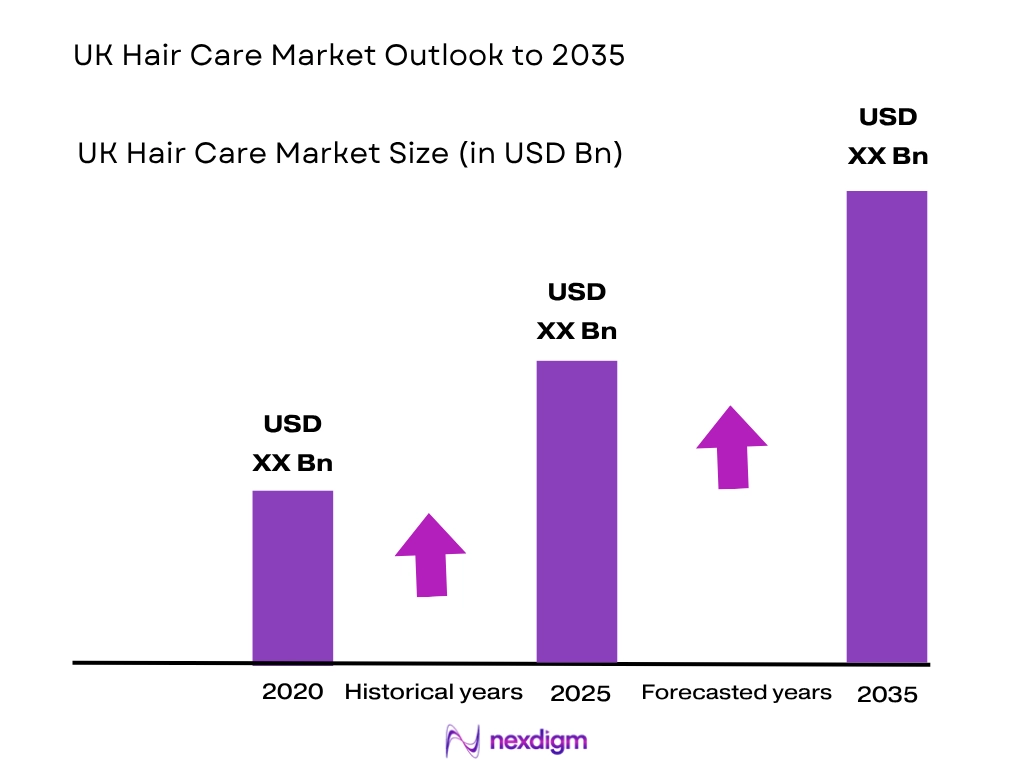
The UK Hair Care Market is valued at USD ~ billion, with the previous annual industry baseline reported at USD ~ billion under retail selling price coverage across shampoo, conditioners, colourants, styling agents and other haircare products. Growth is driven by scalp-care routines, premium shampoo and conditioner upgrades, natural ingredient preference, e-commerce adoption, personalised product discovery and social-media-led beauty influence. The market is forecast to expand at 4.42% CAGR toward USD ~ billion.
England, especially Greater London, Manchester, Birmingham, Leeds and the South East, dominates UK hair care demand because of dense retail networks, higher beauty-store concentration, salon penetration, premium consumer spending and stronger online beauty adoption. The UK population reached 69.3 million, rising by 755,300 people over the previous annual estimate, while London had the highest regional disposable household income at GBP ~ per head, supporting premium and salon-grade haircare purchases.
Market Segmentation
By Product Type
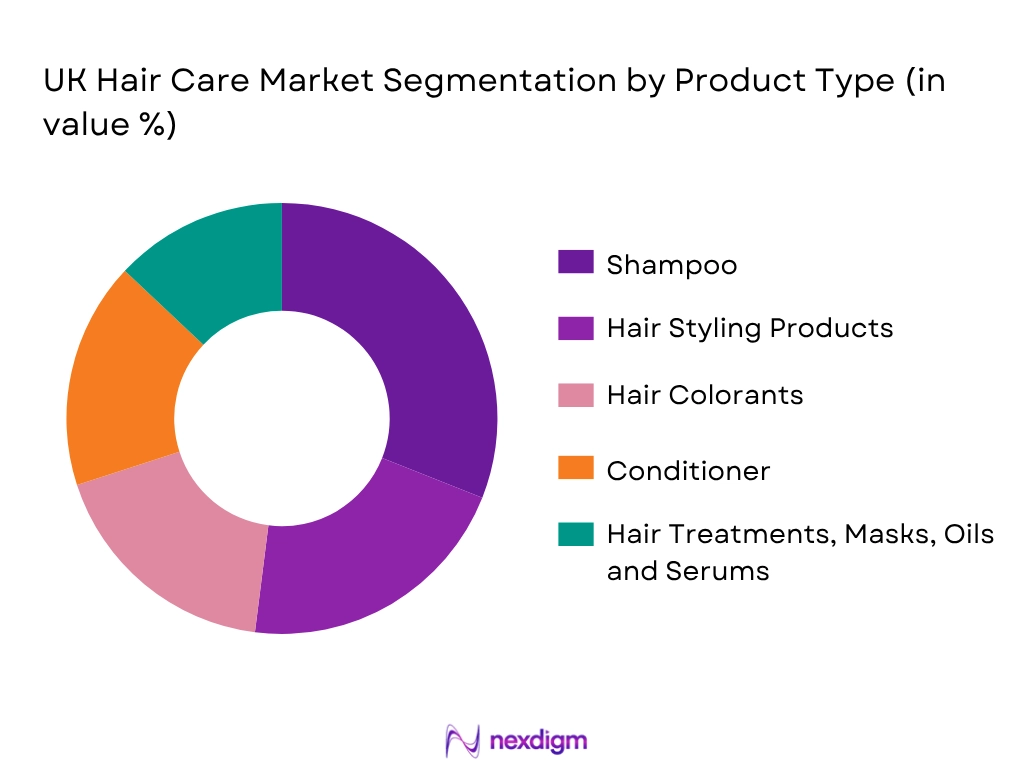
The UK Hair Care Market is segmented by product type into shampoo, conditioner, hair styling products, hair colourants, and hair treatments. Recently, shampoo has held the dominant market share under product type because it remains the highest-frequency replenishment product in household personal care baskets. UK consumers use shampoo across mass, masstige, professional and anti-dandruff routines, giving the segment wider penetration than masks, serums or colourants. The segment is also supported by supermarket availability, Boots and Superdrug shelf space, private label activity, scalp-care positioning, sulphate-free variants and specialised products for curly, colour-treated, oily, dry and sensitive-scalp consumers. Shampoo’s dominance is further reinforced by strong brand portfolios from L’Oréal, P&G, Unilever, Kenvue, Henkel and Kao, which collectively cover basic cleansing, anti-dandruff, bond repair, volume, hydration and salon-grade sub-categories. Mordor also identifies shampoo as the leading UK product type, while Market Research Future describes shampoo as the largest segment.
By Distribution Channel
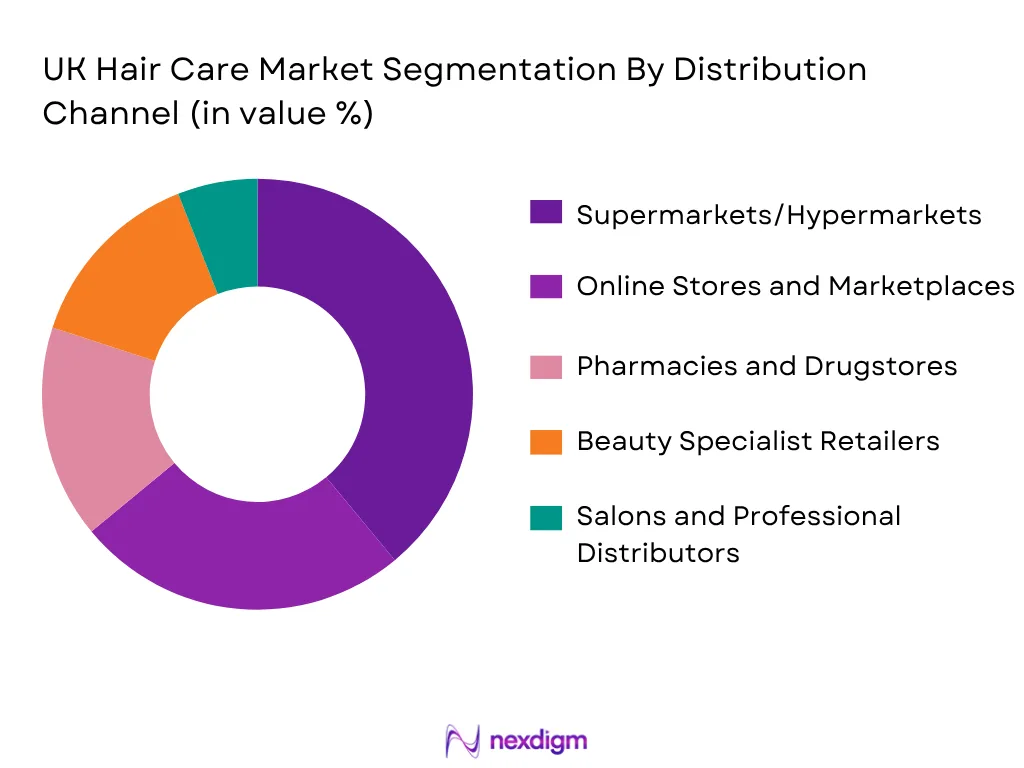
The UK Hair Care Market is segmented by distribution channel into supermarkets and hypermarkets, pharmacies and drugstores, online stores, health and beauty specialists, and salons/professional distributors. Recently, supermarkets and hypermarkets have held the dominant market share because hair care is a high-repeat, basket-led category purchased during routine grocery trips. Tesco, Sainsbury’s, Asda, Morrisons, Waitrose and discounters provide broad access to shampoos, conditioners, styling products, anti-dandruff ranges and value packs, making the channel highly effective for replenishment-led categories. Supermarkets are also supported by loyalty-card pricing, multibuy promotions, seasonal beauty offers and private-label shelf space. Online stores are gaining quickly because of marketplace discovery, TikTok-led beauty searches, product reviews and premium brand access, but supermarkets retain an advantage in daily-use mass haircare because of physical availability, impulse replacement and household shopping frequency. MRFR identifies supermarkets as the leading UK distribution channel by revenue range.
Competitive Landscape
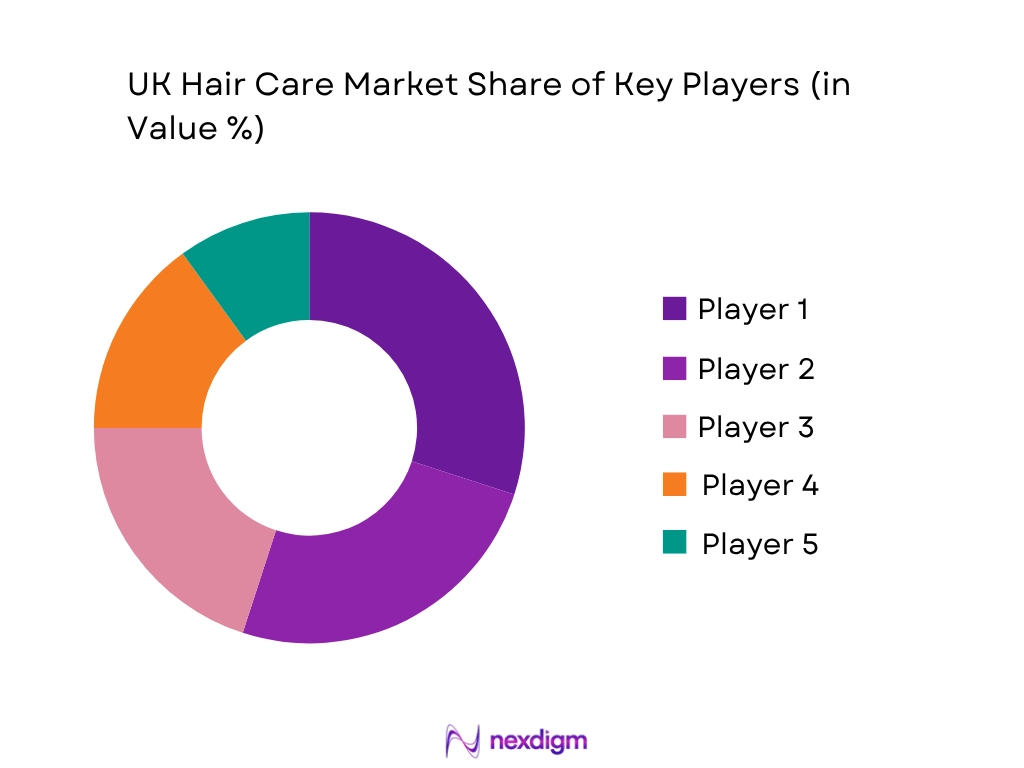
The UK Hair Care Market is moderately consolidated at the top, with multinational beauty and FMCG groups controlling mass shampoo, conditioner, styling, colourant, scalp-care and professional salon portfolios. L’Oréal, Procter & Gamble, Unilever, Henkel and Kao compete across retail and professional channels, while Wella, Olaplex, K18, Moroccanoil, THG Beauty and premium niche brands intensify competition in bond repair, salon-grade care, curly hair, scalp wellness and digital beauty retail. MRFR lists L’Oréal, P&G, Unilever, Estée Lauder, Henkel, Coty, Shiseido, Revlon and Kao among major UK hair care players.
| Company | Establishment Year | Headquarters | Key UK Hair Care Brands | Product Strength | Channel Strength | Price Tier | Market-Specific Focus | Competitive Positioning |
| L’Oréal Groupe | 1909 | Clichy, France | ~ | ~ | ~ | ~ | ~ | ~ |
| Procter & Gamble | 1837 | Cincinnati, United States | ~ | ~ | ~ | ~ | ~ | ~ |
| Unilever | 1929 | London, United Kingdom | ~ | ~ | ~ | ~ | ~ | ~ |
| Henkel AG & Co. KGaA | 1876 | Düsseldorf, Germany | ~ | ~ | ~ | ~ | ~ | ~ |
| Kao Corporation | 1887 | Tokyo, Japan | ~ | ~ | ~ | ~ | ~ | ~ |
UK Hair Care Market Analysis
Growth Drivers
Scalp Health
Scalp health is a strong growth driver in the UK Hair Care Market because it links routine shampoo purchases with treatment-led products such as anti-dandruff shampoo, scalp exfoliants, scalp oils and leave-on scalp serums. The UK has a large addressable consumer base of 69,281,400 people, with the population increasing by 755,300 people in the latest mid-year estimate; this supports repeat-use personal care demand across supermarkets, pharmacies, salons and online retail. NHS guidance reinforces the category’s treatment role: dandruff is described as a common scalp condition, and consumers are advised to use anti-dandruff shampoo containing one of 3 active ingredient groups selenium sulphide, ketoconazole, or coal tar with salicylic acid and to use it for 1 month to assess improvement. This creates a clear basis for medicated, pharmacy-led and dermatologist-positioned scalp-care ranges. The macroeconomic setting also supports resilient essential-care demand: the UK economy recorded USD 3.69 trillion in GDP and USD 53,246.4 GDP per capita, while consumer inflation stood at 3.3, creating pressure on discretionary purchases but preserving demand for hygiene-led, problem-solution products.
Hair Damage Repair
Hair damage repair is gaining relevance in the UK Hair Care Market because consumers are managing colour treatment, heat styling, scalp sensitivity, breakage, dryness and post-chemical-care needs within at-home routines. NHS hair dye guidance notes that hair dye reactions may include itching, burning, dryness, tightness, soreness and blisters, with symptoms taking up to 72 hours to appear; it also advises consumers to test dye on a hair strand at least 48 hours before use, strengthening the case for gentler colour-care shampoos, bond repair systems, post-colour conditioners and scalp-protective treatments. The NHS hair loss page also states that normal shedding can be 50 to 100 hairs a day, while stress, illness, weight loss and iron deficiency can contribute to temporary hair loss, supporting demand for strengthening, breakage-control and hair-fall-support ranges. The demographic base adds scale: the UK population reached 69,281,400, while England’s median age was 40.2 years, Scotland and Wales were 42.8 years, and Northern Ireland was 40.3 years, indicating a mature consumer base where greying, colouring, thinning and repair-led routines become more relevant.
Premium Beauty Adoption
Premium beauty adoption is supported by higher-income household cohorts, professional salon influence and consumers trading up from basic shampoo-conditioner routines to treatment systems, masks, serums, bond repair, colour protection and salon-grade brands. ONS reported UK median household disposable income at GBP36,700 in the financial year ending 2024, while the richest fifth recorded GBP71,100 and the poorest fifth recorded GBP16,800, showing a clear income ladder for value, mass, masstige and premium haircare positioning. Real households’ disposable income per head grew by 1.7 in Quarter 4 after 0.6 growth in Quarter 3, driven by wages and salaries, while the household saving ratio reached 12.0, giving higher-income consumers capacity to purchase premium treatments, professional shampoos, scalp serums and routine bundles. The macroeconomic backdrop also supports premium affordability in urban and higher-income areas, with World Bank reporting UK GDP of USD 3.69 trillion and GDP per capita of USD 53,246.4. For UK haircare brands, this favours premiumisation through efficacy-led claims, salon endorsement, ingredient science and smaller high-value treatment formats.
Market Challenges
Cost-of-Living Pressure
Cost-of-living pressure is a direct challenge for the UK Hair Care Market because shampoo, conditioner, styling and treatment products compete with essential household categories inside grocery and pharmacy baskets. ONS reported median household disposable income of GBP 36,700, but the poorest fifth recorded only GBP16,800, while the richest fifth recorded GBP 71,100, creating uneven affordability across premium masks, serums, salon-grade shampoos and specialist scalp treatments. The World Bank reported UK consumer inflation at 3.3, while ONS’ March 2026 inflation bulletin recorded CPIH at 3.4 and CPI at 3.3, indicating continued pressure on household purchasing decisions. Retail demand also remains cautious: ONS reported that retail sales volumes rose by only 0.7 in 2024 after falls of 2.9 and 4.1 in the preceding two years, meaning shoppers remain selective despite some volume recovery. For haircare, this pushes consumers toward larger packs, promotions, private label, multipurpose shampoos and fewer-step routines, while premium products must justify their role through visible repair, scalp relief or salon-equivalent performance.
Promotional Intensity
Promotional intensity is a major challenge in the UK Hair Care Market because the category is heavily exposed to supermarket, drugstore, e-commerce and seasonal discount calendars. ONS stated that the official Black Friday date was 29 November 2024, and its December retail period covered 5 weeks, from 24 November to 28 December, creating a long promotional window for beauty, personal care and online retail. ONS also reported that online spending values rose by 1.5 in December, while online sales values rose by 1.7 compared with December 2023; the proportion of sales made online increased from 26.5 in November to 27.0 in December. In the same month, non-food store sales volumes increased by 1.1, while clothing stores rose by 4.4, indicating promotional competition for the same discretionary consumer wallet. For haircare brands, this environment compresses brand differentiation because shoppers can compare shampoo, conditioner, serum and treatment offers across supermarkets, Boots, Superdrug, Amazon and beauty e-commerce platforms within seconds.
Opportunities
Scalp Serums
Scalp serums represent a future-facing opportunity in the UK Hair Care Market because scalp care is moving beyond anti-dandruff shampoo into leave-on formats, barrier-support products, exfoliating treatments and ingredient-led routines. The opportunity is supported by NHS guidance that dandruff should be treated with anti-dandruff shampoo, with consumers advised to use it for 1 month and potentially try more than 1 type to find an effective product. This creates scope for adjunct scalp serums positioned around dryness, itch management, flaking, oil balance and sensitive-scalp comfort. The addressable base is substantial: the UK population reached 69,281,400, with 1,235,300 people arriving to live in the UK for 12 months or more, supporting diverse hair type, scalp need and product-format demand. Digital retail also improves discovery: ONS reported online spending values increased by 1.5 in December and the online share of retail sales reached 27.0, allowing niche scalp-serum brands to scale through search, reviews, creator content and subscription replenishment without relying only on physical shelf space.
Hair Growth Support
Hair growth support is an opportunity in the UK Hair Care Market because hair fall, thinning, breakage and scalp wellbeing are linked to both cosmetic and emotional concerns. NHS states that normal hair shedding is 50 to 100 hairs a day, while hair loss can be caused by illness, stress, cancer treatment, weight loss and iron deficiency; it also notes that finasteride and minoxidil are the main treatments for male pattern baldness, with minoxidil also used for female pattern baldness. This gives brands room to position cosmetic haircare around hair strength, breakage reduction, scalp conditioning, density appearance and routine adherence without making unsubstantiated medical claims. Demographics strengthen the opportunity: ONS reported growth in the population aged 65 years and over across all UK countries, including increases of 2.0 in Scotland and Northern Ireland, 1.8 in England and 1.5 in Wales; median ages were 42.8 years in Scotland and Wales, 40.3 years in Northern Ireland and 40.2 years in England. An ageing and mature consumer base increases relevance for thinning, greying, scalp comfort and density-support routines.
Future Outlook
The UK Hair Care Market is expected to grow steadily as consumers move from basic cleansing to targeted hair and scalp routines. Demand will be shaped by scalpification, bond repair, personalised formulations, textured-hair inclusion, salon-grade retail products and premium treatment formats. Online beauty platforms will gain importance, but supermarkets, Boots, Superdrug and salon networks will continue to anchor distribution. The market’s forecasted CAGR for the period is 4.42%, with long-term value expansion supported by hair health, ingredient transparency and premiumisation. Hair care will increasingly behave like skincare, with consumers purchasing products based on scalp barrier health, dandruff control, microbiome claims, peptides, keratin, bond-building technologies and clinically framed benefits. Vogue’s coverage of the “skinification” trend notes that hair and scalp treatments are growing faster than the overall category, reflecting consumer migration toward targeted scalp serums, AHA scalp exfoliants and microbiome-supporting formats.
Major Players
- L’Oréal Groupe
- Procter & Gamble
- Unilever
- Kao Corporation
- Henkel AG & Co. KGaA
- Wella Company
- Church & Dwight Co., Inc.
- Kenvue Inc.
- Shiseido Company, Limited
- The Estée Lauder Companies Inc.
- Olaplex Holdings, Inc.
- K18 / Aquis Hairsciences Inc.
- Moroccanoil
- Amika
- The Hut Group / THG Beauty
Key Target Audience
- Hair care product manufacturers
- Beauty and personal care brand owners
- Salon chains and professional haircare distributors
- Supermarkets, pharmacies and specialist beauty retailers
- E-commerce marketplaces and online beauty platforms
- Ingredient suppliers and cosmetic formulation companies
- Investments and venture capitalist firms
- Government and regulatory bodies, including Office for Product Safety and Standards, Department for Business and Trade, Competition and Markets Authority, Advertising Standards Authority, and UK Health Security Agency
Research Methodology
Step 1: Identification of Key Variables
The initial phase involves constructing an ecosystem map for the UK Hair Care Market, covering manufacturers, professional salon distributors, supermarkets, pharmacies, beauty retailers, e-commerce platforms, ingredient suppliers and regulatory bodies. The objective is to identify the variables that influence market demand, including product type, price tier, hair concern, claims, format, packaging and channel mix.
Step 2: Market Analysis and Construction
The second phase compiles historical and current market indicators, including retail selling price coverage, shampoo and conditioner demand, hair colourant revenue, styling product movement, supermarket sales ranges and online channel expansion. The market model is built through a top-down review of published industry values and a bottom-up build-up across product categories, SKUs, retail formats and professional salon flows.
Step 3: Hypothesis Validation and Expert Consultation
Market hypotheses are validated through interviews with brand managers, category buyers, salon owners, professional distributors, packaging vendors and ingredient suppliers. These discussions test assumptions around shampoo dominance, supermarket channel strength, premium treatment growth, scalp-care adoption, private-label pressure and online beauty discovery.
Step 4: Research Synthesis and Final Output
The final phase integrates secondary research, channel benchmarking, company profiling, pricing checks, product-claim mapping and expert validation. The resulting market estimates and strategic conclusions are aligned with observed UK retail behaviour, product availability, regulatory requirements and competitive positioning across mass, masstige, premium and professional hair care.

- Executive Summary
- Research Methodology (Market Definitions and Assumptions, Abbreviations, Market Sizing Approach, Top-Down Demand Mapping, Bottom-Up SKU and Channel Build-Up, Retail Audit Framework, Salon and Professional Channel Interviews, Consumer Hair-Routine Survey, Brand Benchmarking, Ingredient and Claims Mapping, Price-Pack Architecture, Limitations and Future Conclusions)

- Definition and Scope
- Market Genesis and Evolution
- Timeline of Major Players and Brand Entry
- Business Cycle and Replenishment Behaviour
- Supply Chain and Value Chain Analysis
- Category Architecture and Retail Shelf Structure
- Consumer Hair Routine Mapping
- UK Hair Type and Hair Concern Landscape
- Professional Salon-to-Consumer Product Flow
- Role of Beauty Retailers, Grocers, Pharmacies and Marketplaces

- Growth Drivers (Scalp Health, Hair Damage Repair, Premium Beauty Adoption, Social Commerce, Male Grooming, Ageing Population, Textured Hair Care Demand)
- Market Challenges (Cost-of-Living Pressure, Promotional Intensity, Private Label Competition, Claims Compliance, Ingredient Restrictions, Salon Footfall Volatility)
Opportunities (Scalp Serums, Hair Growth Support, Anti-Frizz Systems, Refill Packs, Inclusive Hair Care, Premium Minis, Dermatological Hair Care) - Trends (Skinification of Hair, Bond Repair, Clean Beauty, Heat Protection, Purple Shampoo, Hair Oiling, Dry Shampoo Usage, TikTok-Led Discovery)
- Government Regulation and Compliance (UK Cosmetics Regulation, Responsible Person, Product Safety Report, SCPN Notification, Claims Substantiation, Labelling, Allergen Disclosure, UK REACH, Packaging EPR)
- SWOT Analysis (Brand Equity, Product Innovation, Ingredient Scrutiny, Retail Concentration, Premiumisation, Online Disruption)
- Stakeholder Ecosystem (Brand Owners, Contract Manufacturers, Ingredient Suppliers, Packaging Suppliers, Retailers, Salons, E-Commerce Platforms, Influencers, Regulators)
- Porter’s Five Forces (Buyer Power, Supplier Power, Threat of Substitutes, Threat of New Entrants, Competitive Rivalry)
- PESTLE Analysis (Economic Pressure, Consumer Safety, Sustainability Policy, Social Beauty Trends, E-Commerce Technology, Regulatory Compliance)
- Supply Chain Risk Analysis (Ingredient Sourcing, Aerosol Packaging, Fragrance Inputs, Salon Distribution, Import Dependency, Retail Inventory Cycles)
- Pricing and Promotion Analysis (EDLP, Multibuy, Clubcard Pricing, Loyalty Pricing, Salon Premium, Online Discounting, Bundle Pricing)
- Channel Margin Analysis (Grocery Margin, Pharmacy Margin, Beauty Retail Margin, Salon Margin, Marketplace Commission, DTC Fulfilment Cost)

- By Value (2020-2025)
- By Volume (2020-2025)
- By Average Selling Price (2020-2025)
- By Unit Sales (2020-2025)
- By Price Tier (2020-2025)
- By Retail Sell-Out and Professional Sell-In (2020-2025)

- By Product Category (In Value%)
Shampoo
Conditioner
Hair Mask and Deep Treatment
Hair Oil and Serum
Hair Styling Products
At-Home Hair Colourants
Scalp Care and Anti-Dandruff Treatments
Dry Shampoo
Leave-In Conditioner and Detanglers
Bond Repair and Damage Repair Systems - By Hair Concern (In Value%)
Damaged and Chemically Treated Hair
Dry and Dehydrated Hair
Frizz-Prone Hair
Thinning Hair and Hair Fall
Dandruff and Flaky Scalp
Colour-Treated Hair
Curly, Coily and Textured Hair
Fine and Limp Hair
Blonde, Grey and Silver Hair
Sensitive Scalp - By Price Tier (In Value%)
Value and Discount Hair Care
Mass-Market Hair Care
Masstige Hair Care
Premium Retail Hair Care
Prestige and Luxury Hair Care
Professional Salon-Grade Hair Care - By Distribution Channel (In Value%)
Supermarkets and Hypermarkets
Pharmacies and Drugstores
Health and Beauty Retail Chains
Online Marketplaces
Specialist Beauty E-Commerce Platforms
Hair Salons and Professional Distributors
Department Stores and Premium Beauty Retailers
Discount Retailers and Value Stores - By End User (In Value%)
Female Consumers
Male Grooming Consumers
Children and Family Hair Care Buyers
Gen Z Beauty Consumers
Millennial Routine Builders
Mature and Grey-Hair Consumers
Professional Hair Stylists and Salons
Curly, Coily and Textured Hair Consumers - By Ingredient and Claim Positioning (In Value%)
Sulphate-Free Hair Care
Silicone-Free Hair Care
Paraben-Free Hair Care
Vegan and Cruelty-Free Hair Care
Natural and Organic Hair Care
Dermatologically Tested and Sensitive Scalp Formulas
Bond-Building and Plex Technology Products
Peptide, Keratin and Protein-Based Products
Scalp Microbiome and Barrier-Care Products - By Format and Packaging (In Value%)
Bottles
Tubes|
Jars and Tubs
Sprays and Mists
Aerosols
Pump Packs
Sachets and Single-Use Treatments
Refill Packs
Shampoo and Conditioner Bars
Travel Minis and Trial Sizes - By Region (In Value%)
England
Scotland
Wales
Northern Ireland
Greater London
South East England
North West England
Midlands
Yorkshire and Humber

- Market Share of Major Players (by Product Category, by Distribution Channel, by Price Tier, by Hair Concern Positioning, by Professional vs Retail Hair Care)
- Cross Comparison Parameters(Brand Portfolio Depth, Hero SKU Strength, Hair Concern Coverage, Professional Salon Reach, Grocery and Drugstore Distribution, Beauty E-Commerce Visibility, Average Selling Price Ladder, Claims and Ingredient Technology)
- Competitive Benchmarking Matrix (Mass Hair Care, Premium Hair Care, Professional Hair Care, Scalp Care, Bond Repair, Dry Shampoo, Hair Colourants, Textured Hair Care)
- SWOT Analysis of Major Players (Brand Equity, Retail Reach, Innovation Pipeline, Pricing Power, Claims Credibility, Salon Advocacy, Digital Engagement, Sustainability Positioning)
- Pricing Analysis by SKU and Pack Size (Shampoo Bottle, Conditioner Bottle, Mask Jar, Serum Bottle, Dry Shampoo Aerosol, Hair Colour Kit, Scalp Treatment, Bond Repair Treatment)
- Promotional and Retail Visibility Analysis (Multibuy, Loyalty Pricing, Online Bundles, Gift Sets, Trial Kits, Seasonal Hair Edits, Salon Retail Displays, Marketplace Ratings)
- Detailed Profiles of Major Companies
L’Oréal Groupe
Procter & GambleUnilever
Kao Corporation
Henkel AG & Co. KGaA
Wella Company
Church & Dwight Co., Inc.
Kenvue Inc.
Shiseido Company, Limited
The Estée Lauder Companies Inc.
Olaplex Holdings, Inc.
K18 / Aquis Hairsciences Inc.
Moroccanoil
Amika
The Hut Group / THG Beauty

- Market Demand and Utilization (Shampoo Frequency, Hair Oil Usage, Conditioner Adoption, Serum Usage, Hair Color Frequency, Salon Treatment Frequency)
- Purchasing Power and Budget Allocation (Mass Monthly Basket, Premium Monthly Basket, Salon Spend, Online Basket Size, Quick-Commerce Basket Size)
- Needs, Desires and Pain Point Analysis (Hair Fall, Dandruff, Frizz, Damage Repair, Greying, Chemical Exposure, Sticky Hair Oil, Scalp Irritation, Product Overload)
- Decision-Making Process (Brand Trust, Dermatologist Recommendation, Influencer Recommendation, Family Usage, Retailer Push, Salon Recommendation, Online Reviews, Trial Pack Availability)
- Customer Cohort Analysis (Gen Z, Millennials, Working Women, Men’s Grooming Consumers, Mothers/Kids, Grey-Coverage Consumers, Premium Salon Users, Rural Value Consumers)
- Brand Switching and Loyalty Analysis (Discount-Led Switching, Ingredient-Led Switching, Hair Concern-Led Switching, Salon Influence, D2C Trial, Sachet-to-Bottle Migration)

- By Value (2026-2035)
- By Volume (2026-2035)
- By Average Selling Price (2026-2035)
- By Unit Sales (2026-2035)
- By Price Tier (2026-2035)


 Request a Sample
 Ask for Customization
 Get a Quote
 Enquire Now