

 Download PDF
Market Overview
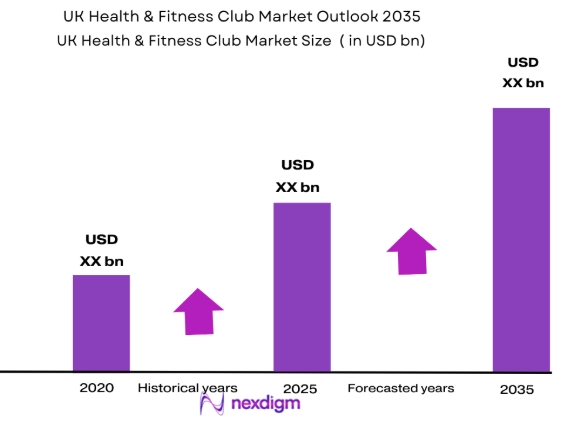
The UK Health & Fitness Club market is valued at USD ~ billion, based on IMARC Group’s UK fitness and gym market assessment, with the forecast trajectory indicating a CAGR of 2.10% through the medium-term outlook. The sector is driven by higher health awareness, budget gym adoption, boutique formats, hybrid fitness platforms, wearable technology, and wellness-oriented services. LeisureDB also reports 7,009 UK gyms, 10.7 million members, and £5.9 billion in sector value in the latest annual industry reading.
England and London dominate the UK Health & Fitness Club market because of dense population catchments, higher disposable income, stronger commercial real estate concentration, and the presence of large private operators. England accounts for 5,778 gyms, 9.1 million members, and £5.2 billion in value, while London has 826 gyms, 1.8 million members, and £1.38 billion in value. These locations attract premium clubs, boutique studios, corporate memberships, and high-frequency urban users.
Market Segmentation
By Club Type
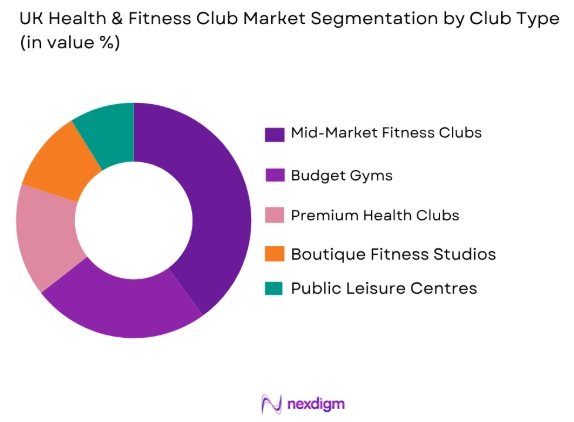
The UK Health & Fitness Club market is segmented by club type into budget gyms, mid-market fitness clubs, premium and luxury health clubs, boutique fitness studios, public leisure centres, and corporate fitness centres. Recently, budget gyms have held a dominant market share under this segmentation because they combine low monthly pricing, flexible contracts, 24/7 access, dense urban and suburban presence, and scalable operations. Operators such as PureGym, The Gym Group, and JD Gyms have expanded aggressively by targeting price-sensitive consumers, students, young professionals, and residential catchments outside prime city centres. PwC’s Strategy& analysis noted that low-cost gyms had become a major force in the private sector, with PureGym and The Gym Group accounting for a large part of the low-cost club base.
By Service Model
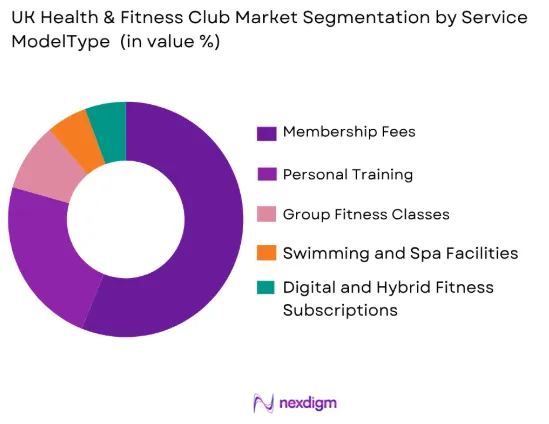
The UK Health & Fitness Club market is segmented by service model into membership fees, personal training, group fitness classes, swimming and spa facilities, digital and hybrid fitness subscriptions, and wellness and recovery services. Recently, membership fees have held a dominant market share under this segmentation because recurring access remains the central revenue model for both private gyms and public leisure centres. The model is supported by direct-debit billing, flexible contracts, app-led joining, and strong demand for affordable access to structured exercise. LeisureDB reported that market value growth was being driven by rising membership fees, while member numbers reached 10.7 million, confirming the importance of recurring subscription revenue in the sector’s commercial structure.
Competitive Landscape
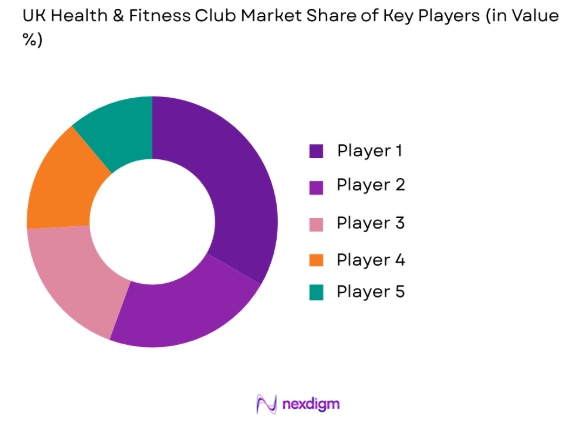
The UK Health & Fitness Club market is led by a mix of low-cost national chains, premium racquets-and-wellness clubs, healthcare-linked fitness operators, and public leisure contractors. PureGym is the largest private operator by number of gyms and members, while GLL is identified as the leading public operator by number of gyms. The competitive structure is becoming more consolidated in budget gyms, while premium and boutique formats continue to compete through service quality, location, classes, wellness amenities, and community-led positioning.
| Company | Establishment Year | Headquarters | UK Club Footprint | Membership / User Base | Business Model | Price Positioning | Core Services | Expansion Indicator |
| PureGym | 2009 | Leeds, UK | 410 UK gyms | ~ | ~ | ~ | ||
| The Gym Group | 2007 | Croydon, UK | National low-cost estate | ~ | ~ | ~ | ~ | ~ |
| David Lloyd Clubs | 1982 | Hatfield, UK | Large premium UK estate | ~ | ~ | ~ | ~ | ~ |
| Nuffield Health | 1957 | Epsom, UK | 110 fitness and wellbeing centres | ~ | ~ | ~ | ~ | ~ |
| JD Gyms | 2013 | Bury, UK | 89 gyms | ~ | ~ | ~ | ~ | ~ |
UK Health & Fitness Club Market Analysis
Growth Drivers
Rising Health Awareness and Preventive Wellness Adoption
The UK Health & Fitness Club Market is supported by rising preventive-health behaviour, as Sport England recorded 30.0 million adults in England completing 150 minutes or more of weekly physical activity during the mid-November 2023 to mid-November 2024 period. Fitness activities also gained 904,000 additional adult participants compared with the previous 12-month period, showing stronger demand for structured gym, weights, and exercise-machine usage. This demand is reinforced by macroeconomic resilience, with the World Bank reporting UK GDP at USD 3.69 trillion and GDP per capita at USD 53,246.4 in 2024, supporting continued consumer participation in paid wellness services. Sources: Sport England, World Bank.
Rising Adoption of Hybrid Fitness and Digital Platforms
The UK Health & Fitness Club Market is increasingly shaped by digital booking, app-based memberships, connected equipment, online coaching, and hybrid fitness access. Ofcom’s Online Nation report states that its annual study tracks what UK people do online and how online content providers serve them, while the 2024 digital environment supports fitness operators using mobile-first onboarding, class reservations, digital workouts, and retention tools. The World Bank reports UK GDP per capita at USD 53,246.4 in 2024, and ONS recorded real household disposable income per head rising in Quarter 4 2024, giving operators a stronger base for digital add-ons linked to physical club access. Sources: Ofcom, World Bank, ONS.
Market Challenges
High Operating Costs and Rental Pressures
The UK Health & Fitness Club Market faces operating pressure from rent, wages, utilities, and site maintenance, especially for large gyms, swimming-pool-led facilities, boutique studios, and premium clubs requiring high-quality fit-outs. The IMF reported UK rent inflation at 9 percent in April 2024, while wage growth and services inflation stood at 5.7 percent and 5.9 percent respectively, creating pressure on staff-heavy and property-heavy club models. ONS also recorded consumer-facing services declining by 0.3 percent across 2024, indicating a difficult environment for discretionary service businesses. These conditions challenge operators trying to maintain facility quality, staffing, and member experience. Sources: IMF, ONS.
Member Retention and Churn Challenges
The UK Health & Fitness Club Market faces retention pressure because activity participation is uneven across age, gender, health condition, and socio-economic groups. Sport England recorded 11.8 million inactive adults and 5.3 million fairly active adults in England, creating a large pool of people who may start but struggle to sustain regular fitness-club use. Activity levels were lower among women at 14.6 million active adults compared with 15.1 million men, while adults with disability or long-term health conditions showed lower activity participation than adults without such conditions. This creates retention risk for gyms unless onboarding, coaching, accessibility, and community engagement improve. Sources: Sport England, World Bank.
Opportunities
Growth of Women-Centric and Community-Based Fitness Models
The UK Health & Fitness Club Market has a clear opportunity in women-centric and community-based formats because Sport England recorded 14.6 million active women compared with 15.1 million active men in England, while women’s activity levels remained below men’s levels. The same source also shows that adults in lower socio-economic groups and adults with disability or long-term health conditions are less active, creating demand for inclusive clubs, local community fitness, women-only sessions, low-intimidation strength training, and accessible programming. With the UK population at around 69 million in 2024 according to World Bank Data360, operators can expand participation by targeting underserved groups rather than only high-frequency gym users. Sources: Sport England, World Bank Data360.
Integration of Fitness Clubs with Healthcare and Rehabilitation Services
The UK Health & Fitness Club Market has an opportunity to integrate with rehabilitation, physiotherapy, long-term condition support, and preventive healthcare pathways. NHS England reported 7.6 million referral-to-treatment pathways waiting to start treatment at the end of August 2024, with around 6.4 million unique patients, showing pressure on formal healthcare capacity. Fitness clubs can support supervised exercise, mobility, strength, cardiac-wellness, MSK recovery, and healthy-ageing services when delivered with qualified professionals and referral partnerships. Sport England also recorded 11.8 million inactive adults, indicating a large population that could benefit from structured, supported activity outside hospital settings. Sources: NHS England, Sport England, World Bank.
Future Outlook
The UK Health & Fitness Club market is expected to grow steadily as clubs shift from basic fitness access to broader wellness, recovery, prevention, and hybrid engagement models. Growth will be supported by rising health consciousness, younger consumer participation, budget gym penetration, corporate wellness demand, and active ageing programs. Operators will focus on yield growth, member retention, digital onboarding, personalisation, and selective expansion rather than only opening more clubs.
Major Players
- PureGym
- The Gym Group
- David Lloyd Clubs
- Nuffield Health Fitness & Wellbeing
- JD Gyms
- GLL / Better
- Everyone Active
- Bannatyne Health Club
- Virgin Active UK
- Fitness First UK
- Anytime Fitness UK
- Snap Fitness UK
- Third Space
- Énergie Fitness
- Gymbox
Key Target Audience
- Fitness club chains and gym operators
- Boutique fitness studio operators
- Private equity investors
- Investments and venture capitalist firms
- Commercial real estate developers and landlords
- Corporate wellness program buyers
- Health insurance and employee benefits providers
- Government and regulatory bodies, including Department for Culture, Media and Sport, Department of Health and Social Care, Sport England, ukactive, and local authorities
Research Methodology
Step 1: Identification of Key Variables
The initial phase involves constructing an ecosystem map covering gym chains, public leisure operators, boutique studios, equipment suppliers, landlords, digital fitness providers, corporate wellness buyers, and health-linked service providers. This step uses desk research, public company filings, operator disclosures, industry reports, and secondary databases to identify the variables influencing market size, demand, pricing, and participation.
Step 2: Market Analysis and Construction
In this phase, historical market data for the UK Health & Fitness Club market is compiled and reviewed. This includes market value, number of clubs, member base, penetration levels, pricing movement, and revenue contribution from memberships, personal training, group classes, and wellness services. The objective is to build a consistent revenue model using both top-down industry data and bottom-up operator analysis.
Step 3: Hypothesis Validation and Expert Consultation
Market hypotheses are validated through interviews with gym operators, franchise owners, club managers, personal trainers, equipment vendors, landlords, and corporate wellness stakeholders. These discussions help assess member acquisition costs, churn, pricing sensitivity, occupancy, class utilisation, and service-mix profitability. The insights are used to refine segment-level assumptions and validate market direction.
Step 4: Research Synthesis and Final Output
The final phase involves triangulating secondary research, company-level operating data, interview findings, and market modelling. The output provides a validated view of market size, segmentation, competition, growth drivers, challenges, and future opportunities. The final analysis is structured to support market entry, expansion planning, investment screening, and partnership decisions in the UK Health & Fitness Club market.

- Executive Summary
- Research Methodology (Market Definitions and Assumptions, Abbreviations, Market Sizing Approach, Bottom-Up Revenue Mapping, Membership Volume Mapping, Demand-Side and Supply-Side Triangulation, Primary Interviews with Gym Operators, Fitness Chains, Equipment Suppliers, Personal Trainers and Corporate Wellness Providers, Regulatory Mapping Framework, Data Validation Models, Limitations and Future Assumptions)

- Definition and Scope
- Evolution of Health & Fitness Club Ecosystem in the UK
- Healthcare and Preventive Wellness Linkages with Fitness Clubs
- Business Cycle and Membership Seasonality
- Fitness Club Operating Models and Value Chain
- Role of Government, Public Health Policies and Wellness Campaigns
- Corporate Wellness, Insurance and Reimbursement Landscape

- Growth Drivers
Rising Health Awareness and Preventive Wellness Adoption
Increasing Demand for Budget and Flexible Gym Memberships
Growth of Boutique Fitness and Specialized Training Formats
Expansion of Corporate Wellness Programs
Rising Adoption of Hybrid Fitness and Digital Platforms - Market Challenges
High Operating Costs and Rental Pressures
Member Retention and Churn Challenges
Shortage of Skilled Personal Trainers and Fitness Professionals
Intense Competition from Low-Cost Operators
Consumer Sensitivity to Membership Pricing - Opportunities
Expansion of Boutique and Premium Fitness Concepts
Growth of Women-Centric and Community-Based Fitness Models
Integration of Fitness Clubs with Healthcare and Rehabilitation Services
Development of AI-Enabled Personalized Fitness Programs
Expansion of Recovery, Wellness and Longevity Services - Trends
Shift Toward Hybrid Fitness Memberships
Growing Demand for Strength Training and Functional Fitness
Rise of Wellness-Led Club Formats
Increasing Popularity of Wearables and Connected Fitness
Personalized Coaching and Data-Driven Member Engagement - Regulatory Landscape
- SWOT Analysis
- Stakeholder Ecosystem
- Porter’s Five Forces
- Competitive Landscape Structure

- By Value, 2020–2025
- By Membership Volume, 2020–2025
- By Number of Clubs, 2020–2025
- By Average Revenue per Member, 2020–2025
- By Offline vs Digital Fitness Contribution, 2020–2025

- By Club Type (in Value %)
Budget Gyms
Mid-Market Fitness Clubs
Premium and Luxury Health Clubs
Boutique Fitness Studios
Leisure Centres and Community Fitness Facilities
Corporate and Workplace Fitness Centres - By Membership Type (in Value %)
Monthly Memberships
Annual Memberships
Pay-As-You-Go Access
Class Packages
Corporate Memberships
Student and Youth Memberships - By Service Offering (in Value %)
Gym Floor Access
Group Fitness Classes
Personal Training
Swimming and Spa Facilities
Digital Fitness and Hybrid Subscriptions
Nutrition, Wellness and Recovery Services - By Consumer Demographics (in Value %)
Young Adults
Working Professionals
Students
Women-Focused Fitness Consumers
Senior Citizens
Health-Conscious and Lifestyle Disease Management Consumers - By Location Type (in Value %)
Urban Centres
Suburban Locations
Retail Parks and High Streets
Corporate and Business Districts
University and Student Hubs
Residential Community Locations - By Revenue Stream (in Value %)
Membership Fees
Personal Training Revenue
Group Class Revenue
Merchandise and Fitness Product Sales
Food, Beverage and Supplements
Digital Fitness Subscriptions
Spa, Recovery and Wellness Services

- Market Share Analysis
- Cross Comparison Parameters, Revenue per Club, Members per Club, Average Monthly Membership Fee, Personal Training Penetration Rate, Class Occupancy Rate, Member Retention Rate, Digital Subscription Contribution %, Club Expansion Rate
- SWOT Analysis of Key Players
- Pricing Benchmarking
- Company Profiles
PureGym
The Gym Group
David Lloyd Clubs
Nuffield Health Fitness & Wellbeing Centres
Virgin Active UK
JD Gyms
Bannatyne Health Club
Everyone Active
Better Leisure Centres
Fitness First UK
Anytime Fitness UK
Snap Fitness UK
Third Space
Énergie Fitness
1Rebel
F45 Training UK
Barry’s UK
Gymbox

- Demand Patterns and Fitness Consumption Behaviour
- Membership Preferences and Price Sensitivity
- Customer Journey Mapping
- Pain Points
- Brand Switching Behaviour
- Member Retention and Churn Analysis

- By Value, 2026–2035
- By Membership Volume, 2026–2035
- By Number of Clubs, 2026–2035
- By Average Revenue per Member, 2026–2035
- By Offline vs Digital Fitness Contribution, 2026–2035


 Request a Sample
 Ask for Customization
 Get a Quote
 Enquire Now