

 Download PDF
Market Overview
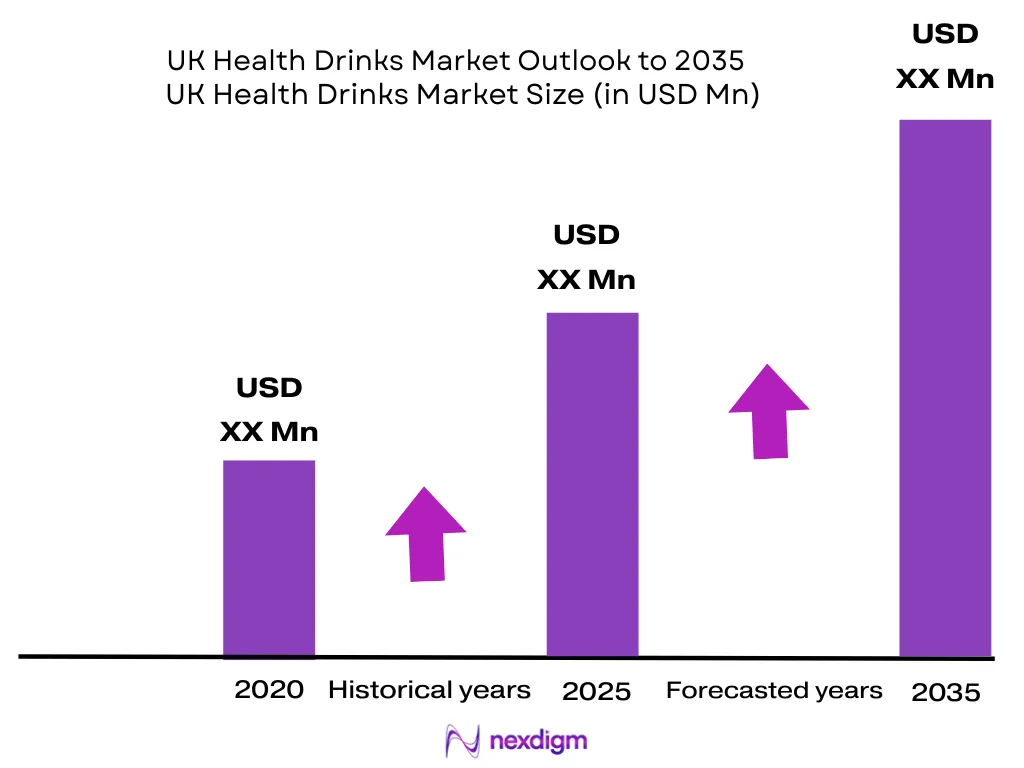
The UK Health Drinks Market is valued at USD ~ million, based on functional drinks revenue, and is forecast to grow at 7.81% CAGR through the long-range outlook period. The market is driven by sports drinks, fortified juices, dairy and dairy alternative drinks, functional water, and energy drinks. The UK population reached 69,281,400, rising by 755,300 from the previous mid-year estimate, supporting wider beverage consumption occasions. London, Birmingham, Manchester, Leeds, Glasgow, Edinburgh, Bristol, Liverpool, and Cardiff dominate the UK Health Drinks Market because they combine dense population, supermarket access, forecourt retail, gyms, offices, universities, convenience stores, health food retail, and delivery platforms. England and Wales together reached 61,806,682 residents, while Scotland reached 5,546,900 residents, creating large regional demand clusters for energy drinks, protein RTDs, kombucha, kefir, functional water, and vitamin drinks.
Market Segmentation
By Product Type
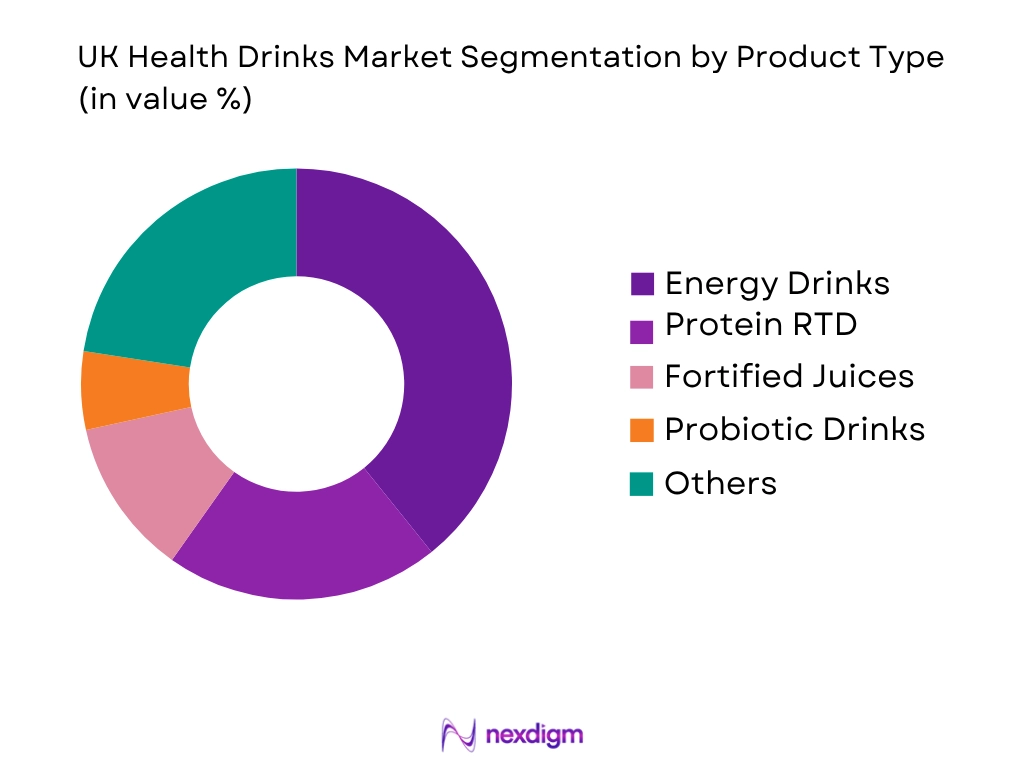
UK Health Drinks Market is segmented by product type into energy drinks, sports and hydration drinks, functional water, protein RTDs, dairy-based probiotic drinks, fortified juices, kombucha, prebiotic drinks, and plant-based wellness drinks. Energy drinks hold the dominant market share under this segmentation due to strong cold-vault placement, forecourt distribution, convenience-store availability, student consumption, gaming occasions, gym-adjacent usage, and frequent single-serve purchases. Brands such as Red Bull, Monster, Lucozade Energy, Rockstar, and emerging zero-sugar energy products have built strong recall through impulse retail and lifestyle positioning. The segment has also benefited from reformulation into sugar-free and low-calorie variants, helping brands respond to the Soft Drinks Industry Levy and consumer concerns around sugar. Public market references also identify energy drinks and shots as the largest UK functional drinks type in recent category tracking.
By Distribution Channel
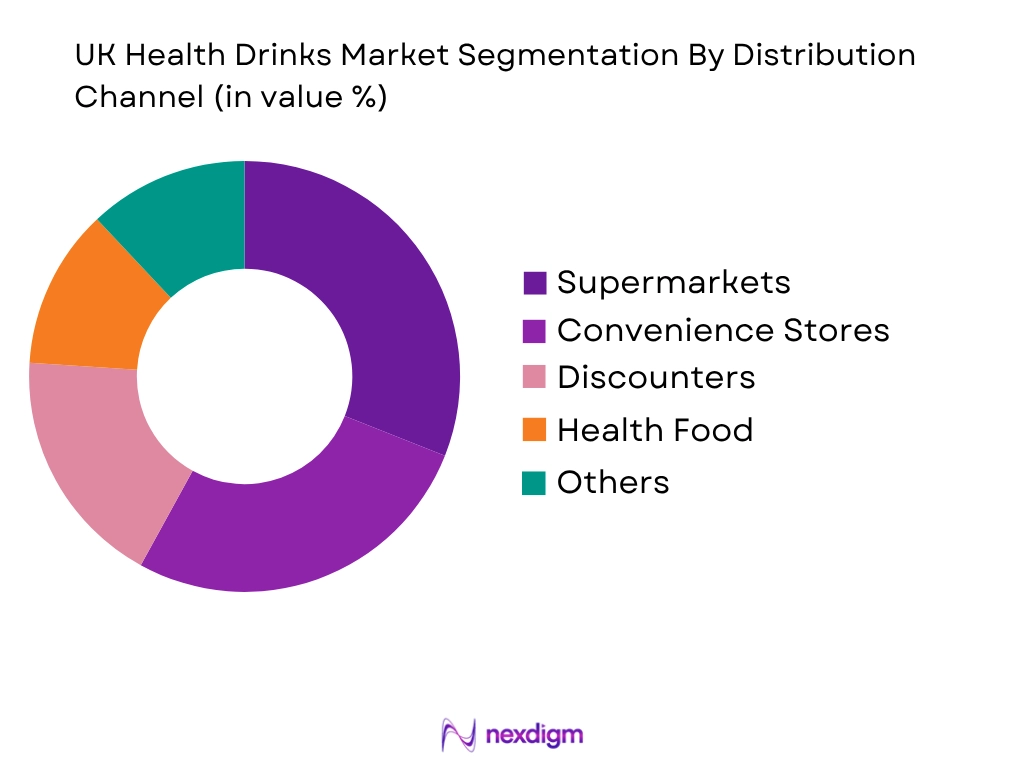
UK Health Drinks Market is segmented by distribution channel into supermarkets and hypermarkets, convenience stores and forecourts, discounters, health food stores, e-commerce, DTC, pharmacies, gyms, foodservice, juice bars, cafes, and vending. Supermarkets and hypermarkets dominate the distribution channel segmentation because they provide the widest assortment across energy drinks, sports drinks, functional water, kefir, kombucha, vitamin shots, protein RTDs, and plant-based beverages. These outlets offer chilled cabinets, multipacks, loyalty-card pricing, health aisles, meal-deal adjacency, and private-label alternatives, making them central for both trial and repeat purchase. UK grocery chains also provide better visibility for regulated reformulated products, allowing consumers to compare sugar profile, pack size, claims, price tier, and functional benefits in one retail environment. Spherical Insights also identifies hypermarkets and supermarkets as the dominant UK functional drinks channel.
Competitive Landscape
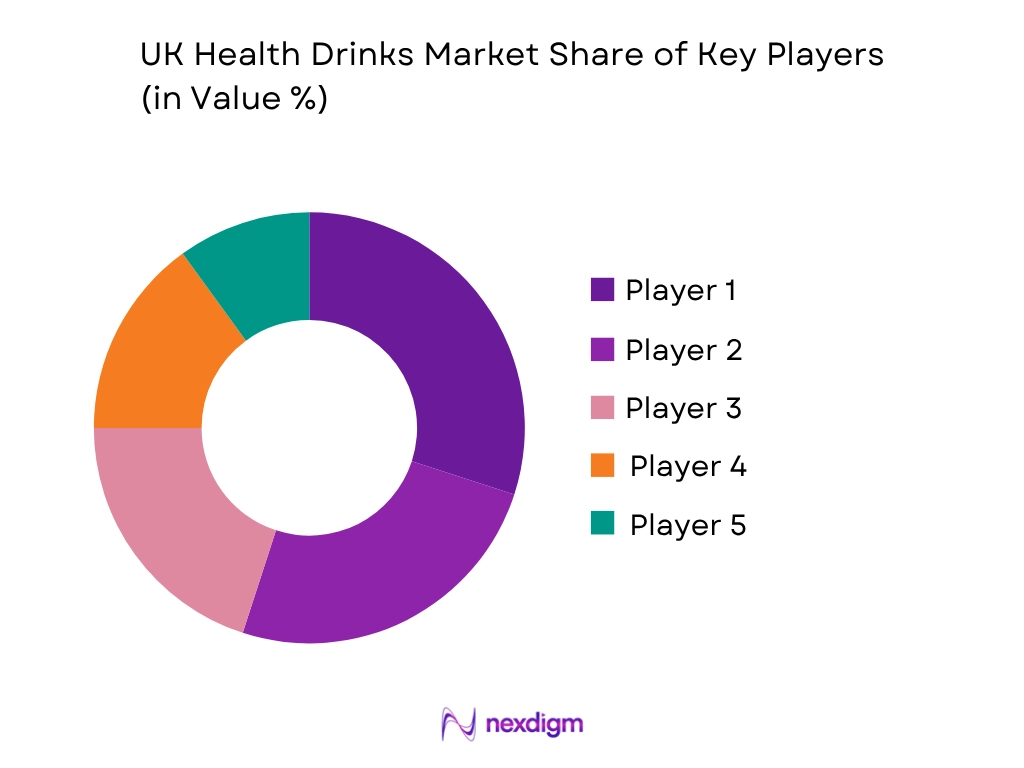
The UK Health Drinks Market is led by large beverage companies, specialist nutrition brands, dairy and probiotic players, and challenger wellness brands. Suntory Beverage & Food GB&I leads through Lucozade and Ribena-related functional positioning, while Coca-Cola, Red Bull, Monster, PepsiCo, Britvic, Danone, Yakult, Huel, Innocent, TRIP, Remedy, Bio&Me, and Moju compete across energy, sports hydration, protein, gut health, vitamin shots, mood drinks, and low-sugar adult soft drinks. Competition is shaped by grocery distribution, cold-cabinet access, sugar-levy compliance, HFSS exposure, functional claims, flavour breadth, and digital brand activation.
| Company | Establishment Year | Headquarters | Key Health Drink Brands | Dominant Category | Core Channel Strength | Functional Positioning | Regulatory Relevance | Market-Specific Strength |
| Suntory Beverage & Food GB&I | 1899 | Uxbridge, UK / Osaka, Japan group base | ~ | ~ | ~ | ~ | ~ | ~ |
| The Coca-Cola Company Great Britain | 1886 | London, UK / Atlanta, USA group base | ~ | ~ | ~ | ~ | ~ | ~ |
| Red Bull UK | 1987 | London, UK / Fuschl, Austria group base | ~ | ~ | ~ | ~ | ~ | ~ |
| Monster Energy UK | 1935 | Uxbridge, UK / California, USA group base | ~ | ~ | ~ | ~ | ~ | ~ |
| Huel | 2014 | Tring, Hertfordshire | ~ | ~ | ~ | ~ | ~ | ~ |
UK Health Drinks Market Analysis
Growth Drivers
Active Lifestyle Demand Supporting Sports Hydration and Protein RTDs
The UK Health Drinks Market is supported by a large active-consumer base that directly fits sports drinks, electrolyte waters, protein RTDs, recovery drinks, and low-sugar energy beverages. Sport England’s latest Active Lives release shows 30.9 million adults in England completed at least 150 minutes of moderate-intensity activity per week during the November 2024 to November 2025 reporting period; the same source records 5.1 million adults as fairly active and 11.8 million adults as inactive, creating both current demand and conversion potential for hydration and nutrition-led beverages. The macro base is also sizeable: the World Bank records UK GDP at USD 3.69 trillion and GDP per capita at USD 53,246.4 in 2024, supporting a developed retail environment for functional waters, energy drinks, protein shakes, and premium gut-health beverages. The ONS records the UK population at 69,281,400 in mid-2024, creating scale for grocery, gym, convenience, forecourt, and workplace consumption occasions.
Urban Population Scale and Digital Access Supporting Omnichannel Health Drink Sales
The UK Health Drinks Market benefits from concentrated population, dense grocery networks, forecourts, convenience retail, gyms, universities, offices, and e-commerce access. ONS records the UK population at 69,281,400 in mid-2024, while England and Wales reached 61,806,682 people after adding 706,900 people from the previous mid-year estimate. Scotland’s official mid-2024 population estimate reached 5,546,900, adding 40,900 people over the year. This population concentration supports repeat consumption occasions for energy drinks, kombucha, kefir, protein RTDs, vitamin shots, and functional water in cities and commuter corridors. Digital discovery also matters for challenger health drink brands: World Bank records 97 internet users per 100 people in the UK in 2024, supporting DTC subscriptions, marketplace variety packs, influencer-led launches, retail-media promotions, and product education around gut health, sugar-free energy, electrolyte hydration, CBD alternatives, and protein nutrition. The UK’s USD 3.69 trillion GDP also supports modern retail infrastructure and beverage distribution sophistication.
Market Challenges
Sugar Regulation and Reformulation Pressure on Functional Beverages
The UK Health Drinks Market faces sustained reformulation pressure because many energy drinks, sports drinks, fortified juices, dairy drinks, and functional soft drinks must manage sugar content while maintaining taste and functional positioning. UK government guidance for the Soft Drinks Industry Levy states that the lower threshold is being reduced from 5 grams of total sugar per 100 millilitres to 4.5 grams per 100 millilitres, while the government also plans to extend levy coverage to milk-based drinks that were previously outside the core scope. The government states the changes could remove 17 million calories a day from national intake and generate GBP 1 billion in health and economic benefits. This is market-specific because protein dairy drinks, flavoured milks, RTD coffees, sports drinks, and functional juice drinks may need recipe redesign, sweetener reformulation, or repositioning. Brands that cannot meet the new thresholds risk weaker retailer support, reduced health credibility, and poorer alignment with low-sugar consumer expectations.
Compliance Risk Around HFSS, CBD, Caffeine, and Novel Functional Claims
The UK Health Drinks Market faces regulatory complexity because brands increasingly use claims around energy, focus, gut health, relaxation, immunity, protein, hydration, and mood. The Food Standards Agency states CBD extracts, CBD isolates, synthetic CBD products, and products containing CBD are classed as novel foods; it also states there are currently no CBD extracts or isolates authorised as novel foods, making CBD drinks a high-compliance product area. The FSA’s CBD product register was last updated on 13 April 2026, showing that authorisation status remains an active issue for manufacturers and retailers. HFSS rules also affect placement and promotions for products classified as less healthy, while high-caffeine energy drinks require careful labelling and responsible retail policies. The health context adds pressure: NHS England reports 30 adults per 100 were living with obesity and 66 adults per 100 were overweight or living with obesity in 2024, increasing scrutiny of sugar, caffeine, and wellness claims.
Market Opportunities
Gut Health, Weight Management, and Low-Sugar Nutrition Drinks
The UK Health Drinks Market has a clear opportunity in kefir, kombucha, prebiotic soda, fibre drinks, protein RTDs, vitamin shots, and low-sugar functional beverages because public-health indicators support demand for better nutrition formats. NHS England reports 30 adults per 100 living with obesity and 66 adults per 100 overweight or living with obesity in 2024; it also records obesity prevalence rising with age, from 18 adults per 100 among people aged 16 to 24 to between 35 and 36 adults per 100 among people aged 55 to 74. These conditions support market growth for beverages positioned around satiety, digestive health, protein intake, reduced sugar, and everyday wellness. The UK also has a large base of active consumers: Sport England records 30.9 million adults meeting 150 minutes of weekly activity in the latest period, directly supporting recovery drinks, clear protein drinks, electrolyte hydration, and functional waters. The opportunity is strongest for products that combine credible ingredient dosage, clear nutrition labels, low sugar, and convenient single-serve formats. Sources: NHS England, Sport England.
Expansion Through Grocery, Convenience, Gym, and Digital Health Drink Ecosystems
The UK Health Drinks Market has future growth opportunity through joined-up distribution across supermarkets, convenience stores, forecourts, gyms, workplaces, health-food stores, pharmacy aisles, DTC subscriptions, and online marketplaces. ONS records 69,281,400 UK residents in mid-2024, including 61,806,682 residents in England and Wales, giving health drink brands a large launch and repeat-purchase base. World Bank records UK GDP per capita at USD 53,246.4 in 2024, supporting a consumer environment where premium kombucha, protein RTDs, kefir, vitamin shots, electrolyte waters, and nootropic drinks can sit alongside mainstream energy and sports drinks. Digital reach improves the opportunity: World Bank records 97 internet users per 100 people in the UK in 2024, allowing brands to educate consumers on gut health, hydration, sugar-free energy, protein, and relaxation occasions before converting them through grocery or DTC. IMF’s 2026 UK profile also shows GDP at USD 4.26 trillion, indicating continued macro scale for modern beverage retail and investment-led brand expansion.
Future Outlook
The UK Health Drinks Market is expected to show sustained growth, supported by sugar reduction, functional hydration, gut health, protein RTDs, sports nutrition, low-calorie energy drinks, and adult wellness soft drinks. The market’s long-range outlook is supported by a forecast 7.81% CAGR, with demand shifting toward beverages that provide measurable functional benefits beyond refreshment. Over the next phase of market development, health drinks will become more segmented by use occasion. Morning energy, workday focus, gym recovery, gut health, immunity, alcohol moderation, and evening relaxation will create clearer product territories. Energy drinks will remain important, but growth will increasingly come from zero-sugar variants, protein RTDs, kefir, kombucha, functional water, vitamin shots, and prebiotic soft drinks. Regulation will shape product strategy. The Soft Drinks Industry Levy and HFSS promotion restrictions make sugar reduction and compliant merchandising critical. Government guidance confirms that HFSS rules restrict location and volume-price promotions for less healthy products, while the Food Standards Agency’s CBD novel food framework affects mood and relaxation beverages using CBD ingredients.
Major Players
- Suntory Beverage & Food GB&I
- The Coca-Cola Company Great Britain
- Red Bull UK
- Monster Energy UK
- PepsiCo UK
- Britvic plc
- Danone UK & Ireland
- Yakult UK
- Huel
- Innocent Drinks
- AG Barr plc
- Bio&Me
- TRIP
- Remedy Drinks UK
- Moju
Key Target Audience
- Functional beverage manufacturers
- Energy drink and sports hydration companies
- Protein RTD and complete nutrition drink producers
- Gut health, kombucha, kefir, and probiotic beverage brands
- Supermarket, convenience, forecourt, health food, and pharmacy retail chains
- Beverage ingredient suppliers, co-packers, bottlers, and packaging manufacturers
- Investments and venture capitalist firms
- Government and regulatory bodies (Food Standards Agency, Department of Health and Social Care, HM Revenue & Customs, Competition and Markets Authority, Advertising Standards Authority)
Research Methodology
Step 1: Identification of Key Variables
The initial phase involves constructing an ecosystem map of the UK Health Drinks Market across manufacturers, retailers, distributors, ingredient suppliers, co-packers, gyms, pharmacies, foodservice operators, and regulators. Key variables include product type, functional claim, sugar profile, packaging format, retail channel, price tier, and consumer use occasion.
Step 2: Market Analysis and Construction
This phase compiles historical and current data for energy drinks, sports drinks, functional water, fortified juices, protein RTDs, kefir, probiotic drinks, kombucha, plant-based drinks, and mood beverages. The market is constructed through top-down revenue analysis and bottom-up SKU mapping across grocery, convenience, forecourts, e-commerce, gyms, and health food retail.
Step 3: Hypothesis Validation and Expert Consultation
Market hypotheses are validated through structured interviews with beverage manufacturers, grocery category managers, convenience distributors, ingredient suppliers, co-packers, and specialist retailers. These consultations verify channel performance, cold-chain requirements, sugar-reduction pressure, functional claim credibility, pricing architecture, and consumer adoption patterns in the UK Health Drinks Market.
Step 4: Research Synthesis and Final Output
The final phase integrates secondary research, expert validation, competitive benchmarking, and segment-level triangulation. Findings are reconciled through top-down and bottom-up methods to ensure consistency across market size, segmentation, competitive landscape, distribution structure, future outlook, and strategic recommendations for the UK Health Drinks Market.

- Executive Summary
- Research Methodology (Market Definitions and Assumptions, Functional Drink Taxonomy, Abbreviations, Market Sizing Approach, Top-Down Assessment, Bottom-Up SKU Mapping, Retail Audit Approach, Soft Drinks Levy Mapping, HFSS Compliance Review, Primary Research Approach, Trade Channel Validation, Limitations and Future Conclusions)

- Definition and Scope
- Overview Genesis
- Evolution of Health Drink Consumption
- Timeline of Major Players
- Business Cycle

- Growth Drivers (Health Awareness, Sugar Reduction, Fitness Culture, Gut Health, Protein Consumption, Convenience Retail, Digital Commerce, No/Low Alcohol Lifestyle)
- Market Challenges (HFSS Compliance, Sugar Levy, Caffeine Scrutiny, Claim Substantiation, CBD Regulation, Premium Price Sensitivity, Chilled Logistics)
- Opportunities (Low Sugar, Gut Health, Protein RTD, Functional Hydration, Adult Soft Drinks, CBD Alternatives, Women’s Health, Personalised Nutrition)
- Trends (Zero Sugar, Gut Health, Prebiotic Soda, Kombucha, Proteinisation, Functional Water, Mood Drinks, Clean Label, Sustainable Packaging)
- SWOT Analysis
- Porter’s Five Forces

- By Value (2020-2025)
- By Volume (2020-2025)
- By Average Retail Price (2020-2025)

- By Product Category (In Value %)
Energy Drinks
Sports and Hydration Drinks
Functional and Enhanced Water
Vitamin and Immunity Drinks
Protein RTD and Meal Support Drinks - By Ingredient Platform (In Value %)
Caffeine-Based Formulations
Electrolyte-Based Formulations
Probiotic Culture Formulations
Prebiotic Fibre Formulations
Protein-Based Formulations - By Distribution Channel (In Value %)
Supermarkets and Hypermarkets
Convenience Stores and Forecourts
Discounters
Health Food and Specialist Retail
Pharmacies and Drugstores
Gyms, Fitness Studios, and Sports Clubs - By Region (In Value %)
England
Scotland
Wales
Northern Ireland
London

- Market Share of Major Players on the Basis of Value and Volume (Energy Drinks, Sports Drinks, Functional Water, Protein RTD, Kombucha, Probiotic Drinks)
- Cross Comparison Parameters (Functional Claim Portfolio, UK Grocery Distribution Reach, Sugar Levy and HFSS Compliance, Chilled Cabinet Penetration, SKU and Flavour Breadth, Ingredient Differentiation, Price Tier and Pack Architecture, Digital and Influencer Strength)
- SWOT Analysis of Major Players
- Detailed Profiles of Major Companies
Suntory Beverage & Food GB&I
The Coca-Cola Company Great Britain
Red Bull UK
Monster Energy UK
PepsiCo UK
Britvic plc
Danone UK & Ireland
Yakult UK
Huel
Innocent Drinks
AG Barr plc
Bio&Me
TRIP
Remedy Drinks UK
Moju

- Supermarkets and Hypermarkets
- Convenience Stores and Forecourts
- Discounters
- Health Food and Specialist Retail
- Pharmacies and Drugstores

- By Value (2026-2035)
- By Volume (2026-2035)
- By Average Retail Price (2026-2035)


 Request a Sample
 Ask for Customization
 Get a Quote
 Enquire Now