
 Download PDF
Market Overview
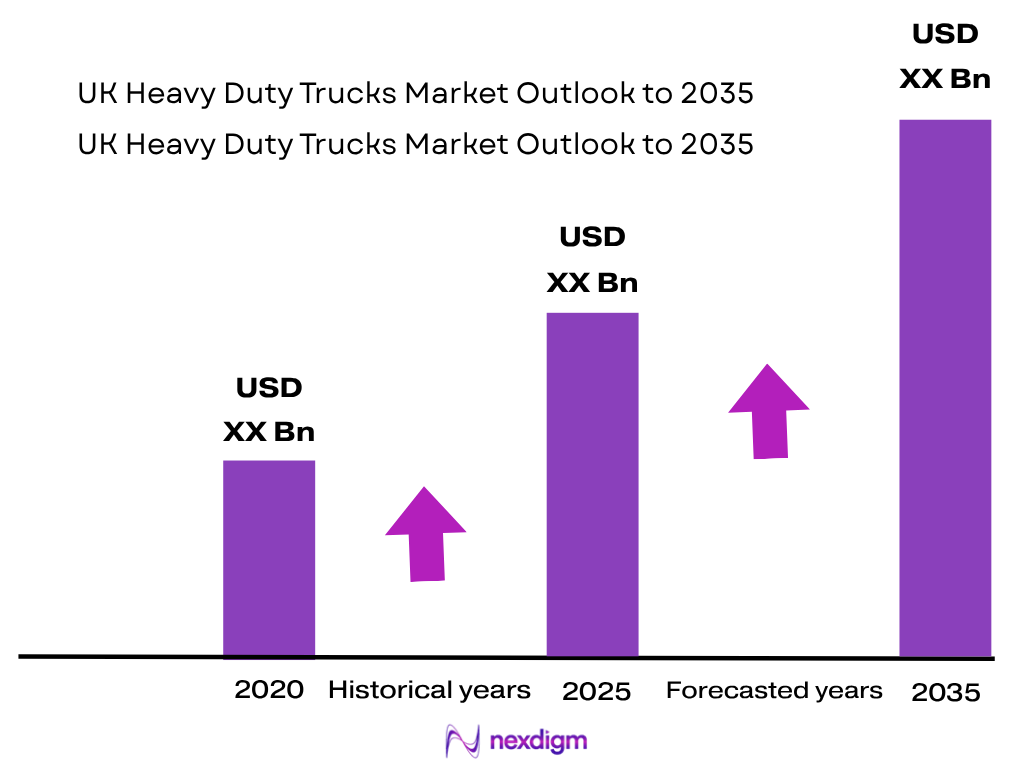
The UK Heavy Duty Trucks Market is valued at approximately ~USD XX billion, based on the requested placeholder valuation. Underlying fleet demand remains substantial: new HGV registrations reached 44,988 units in the latest completed annual period compared with 46,227 units in the preceding period. Rigid-truck registrations increased from 24,439 units to 25,909 units, while articulated trucks moved from 21,788 units to 19,079 units, reflecting differing fleet-replacement cycles across distribution, long-haul and vocational applications.
England dominates the UK Heavy Duty Trucks Market because it contains the largest concentration of freight corridors, distribution centres, ports, retailers, construction activity and logistics fleets. New HGV registrations in England stood at 39,041 units in the latest annual period compared with 40,464 units previously, while Scotland recorded 3,470 units, Wales 1,223 units, and Northern Ireland 1,236 units. The Midlands, South East and North West are particularly important because of motorway connectivity, warehousing clusters, manufacturing activity and access to major ports.
Market Segmentation
By Vehicle Configuration
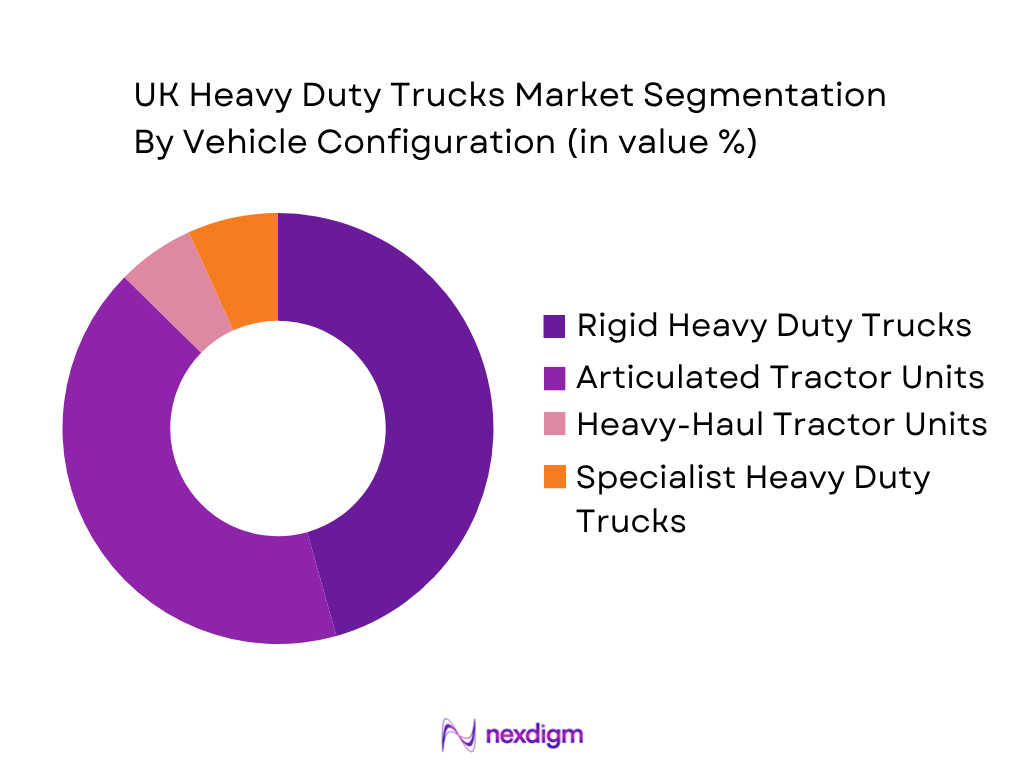
The UK Heavy Duty Trucks Market is segmented into articulated tractor units, rigid heavy-duty trucks, heavy-haul tractors and specialist heavy-duty vehicles. Rigid heavy-duty trucks account for the dominant share of new-vehicle value in this analytical segmentation, supported by their broad use across retail distribution, parcel logistics, construction, refuse collection, municipal services, food distribution and regional freight. UK fleets require rigid trucks across multiple weight bands, creating demand for box bodies, curtainsiders, refrigerated bodies, tippers, mixers and refuse bodies. Articulated tractors nevertheless form the core of long-distance freight because they offer higher payload capacity and operational flexibility with interchangeable trailers. Department for Transport freight statistics also highlight this application distinction: rigid vehicles lifted 588 million tonnes of domestic goods, whereas articulated HGVs lifted 998 million tonnes. Articulated vehicles additionally recorded an average haul length of 134 kilometres, compared with 58 kilometres for rigid HGVs, reinforcing their importance in longer-distance trunking.
By Application Type
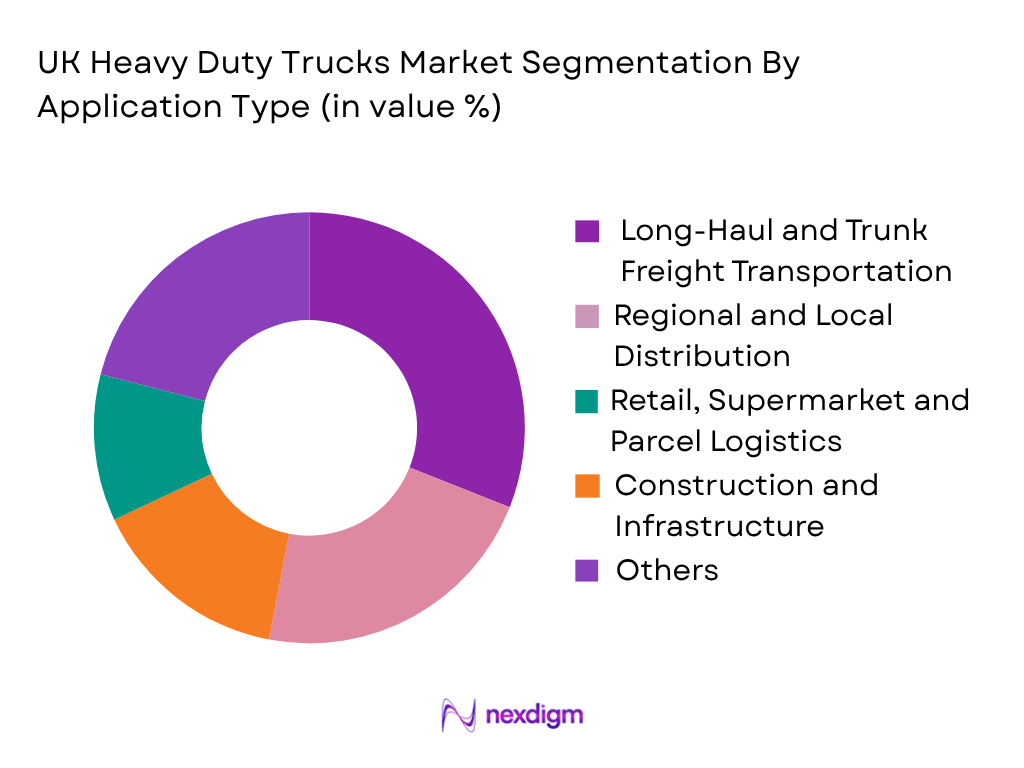
The UK Heavy Duty Trucks Market is segmented into long-haul freight, regional distribution, retail and supermarket logistics, construction, refuse and municipal operations, port haulage, temperature-controlled transport and specialist heavy transport. Long-haul and trunk freight represents the dominant application segment, reflecting the UK economy’s dependence on road transport for movement between ports, national distribution centres, manufacturing regions and retail networks. GB-registered HGVs moved 168 billion tonne-kilometres of domestic goods and travelled 19.4 billion vehicle-kilometres, demonstrating the scale of heavy-truck utilisation. Long-haul operations primarily support articulated 6×2 tractor units and high-capacity trailers, while regional distribution uses both artics and 18–26 tonne rigids. Retail, parcel and food logistics create high-frequency replacement demand because utilisation is intensive and delivery schedules depend on vehicle uptime. Construction and refuse applications form smaller but technically important segments because they require vocational chassis, multiple axles, PTO systems, specialist bodies and severe-duty drivetrains.
Competitive Landscape
The UK Heavy Duty Trucks Market is concentrated around established European manufacturers with extensive fleet relationships, dealer networks and full-line rigid and tractor portfolios. DAF, Scania, Volvo Trucks, Mercedes-Benz Trucks and MAN represent major competitive forces, while Renault Trucks and IVECO further strengthen competition. DAF benefits from the strategically important Leyland manufacturing operation in the UK, whereas competing OEMs differentiate through fuel-efficient diesel drivelines, electric HGV portfolios, telematics, uptime contracts, vocational configurations and national dealer coverage. Current SMMT registration data continue to place DAF, Volvo, Scania, Mercedes-Benz and MAN among the leading HGV marques.
| Company | Establishment Year | Headquarters | UK HGV Portfolio | Tractor Capability | Rigid/Vocational Capability | Zero-Emission HGV Capability | UK Manufacturing / Assembly Position | Fleet Service & Uptime Capability |
| DAF Trucks N.V. / Leyland Trucks | 1928 | Eindhoven, Netherlands | ~ | ~ | ~ | ~ | ~ | ~ |
| Scania | 1891 | Södertälje, Sweden | ~ | ~ | ~ | ~ | ~ | ~ |
| Volvo Trucks | 1927 | Gothenburg, Sweden | ~ | ~ | ~ | ~ | ~ | ~ |
| Mercedes-Benz Trucks | 1896 truck heritage | Leinfelden-Echterdingen, Germany | ~ | ~ | ~ | ~ | ~ | ~ |
| MAN Truck & Bus | 1758 industrial heritage | Munich, Germany | ~ | ~ | ~ | ~ | ~ | ~ |
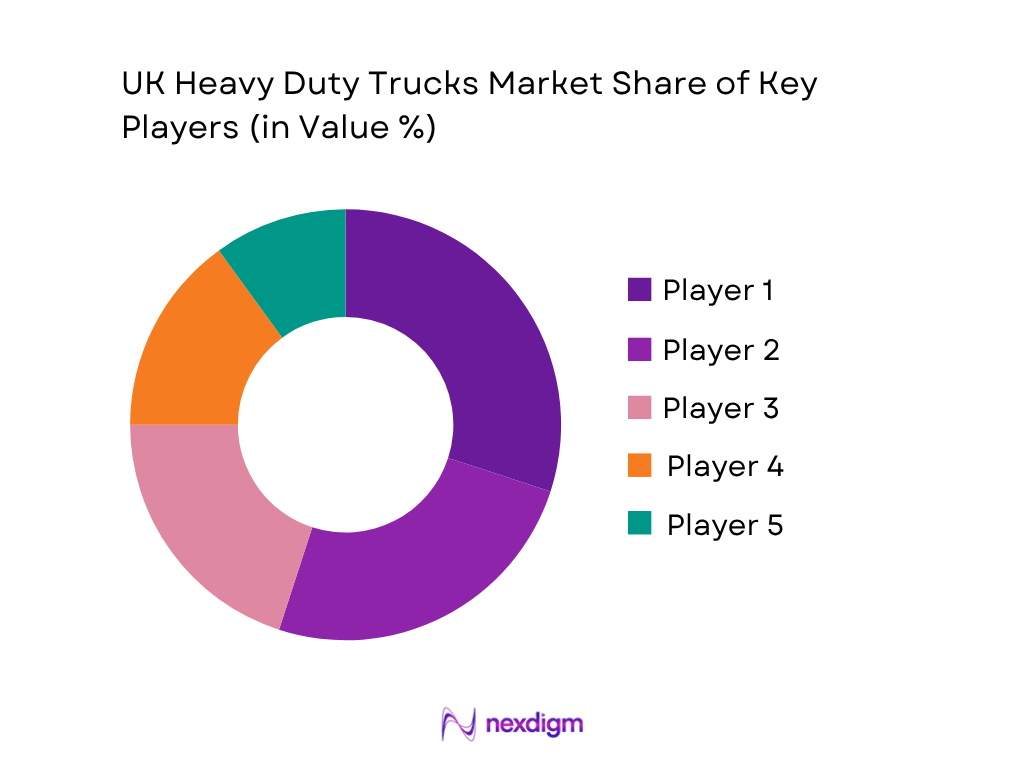
UK Heavy Duty Trucks Market Analysis
Growth Drivers
High Road-Freight Intensity Sustains Heavy Duty Truck Replacement Demand
The UK Heavy Duty Trucks Market is fundamentally supported by the scale and intensity of domestic road freight. Department for Transport data show that GB-registered HGVs lifted 1.59 billion tonnes of goods in 2024, moved 168 billion tonne-kilometres, and travelled 19.4 billion vehicle-kilometres, compared with 1.55 billion tonnes, 167 billion tonne-kilometres, and 19.0 billion vehicle-kilometres in 2023. Road transport accounted for 168 billion tonne-kilometres out of 206 billion tonne-kilometres of total domestic freight movement, demonstrating the central role of trucks in national supply chains. Articulated HGVs alone lifted 998 million tonnes, while rigid HGVs transported 588 million tonnes, supporting demand across long-haul, retail, construction, food distribution and regional logistics applications. The economic base supporting freight activity is also substantial: World Bank data place UK GDP at USD 3,686,033 million in 2024 and GDP per capita at USD 53,246.4. With such large goods flows requiring reliable road transportation, operators must continuously renew tractors, rigid trucks and vocational vehicles to maintain fleet availability, payload capacity and operational reliability. This creates recurring demand for heavy-duty vehicles, replacement powertrains, telematics, maintenance contracts and uptime services.
Large Installed HGV Fleet Supports Continuous Vehicle Renewal and Aftermarket Demand
The scale of the UK’s operating HGV fleet creates a strong structural driver for new vehicle replacement, servicing and lifecycle support. Department for Transport vehicle licensing statistics record approximately 518,000 licensed HGVs in 2024, while SMMT’s subsequent fleet data show more than 626,000 HGVs operating in 2025 under its broader commercial-vehicle parc methodology. New HGV registrations reached 44,988 units in 2024, including 25,909 rigid trucks, 19,079 articulated trucks, and 18,570 tractor-body vehicles. Demand remained substantial despite fleet-cycle normalisation, with 40,504 new HGVs entering service in 2025. The installed fleet generates recurring requirements for tyres, brakes, transmissions, diesel aftertreatment, telematics, inspections, replacement components and dealer maintenance, meaning market activity extends well beyond first-time vehicle registrations. The UK also had 9,654 firms holding Standard International HGV operator licences and 88,494 vehicles covered by those licences in the latest relevant licensing period, highlighting a large professional freight operating base. World Bank data record UK GDP at USD 3,686,033 million in 2024, providing the macroeconomic scale underpinning freight, retail, manufacturing and construction activity. The combination of a large operating parc and continuous replacement requirements therefore sustains heavy-duty truck demand across economic cycles.
Market Challenges
Cyclical Fleet Renewal and Weaker Recent Freight Activity Constrain New Truck Demand
The UK Heavy Duty Trucks Market faces a significant challenge from the cyclical nature of fleet replacement and fluctuations in freight volumes. New HGV registrations decreased from 44,988 units in 2024 to 40,504 units in 2025, while first-half registrations reached 18,158 units in 2026 after 8,687 trucks were registered during the second quarter alone. Freight activity also softened after the stronger 2024 operating period. Department for Transport data show that GB-registered HGVs lifted 1.59 billion tonnes, moved 168 billion tonne-kilometres, and travelled 19.4 billion kilometres in 2024, whereas corresponding 2025 activity declined to 1.53 billion tonnes, 162 billion tonne-kilometres, and 19.0 billion vehicle-kilometres. This matters directly to truck manufacturers because lower freight utilisation can encourage fleets to extend vehicle holding periods rather than immediately replace tractors and rigids. Articulated vehicles are particularly sensitive to long-haul freight conditions and capital expenditure cycles, while construction and distribution trucks are influenced by their respective end markets. The wider economy nevertheless remains large, with World Bank data recording UK GDP at USD 3,686,033 million in 2024 and GDP per capita at USD 53,246.4. Consequently, the challenge is not a lack of freight infrastructure but uneven timing of fleet renewal within a mature truck market.
Charging and Grid Readiness Remain Major Constraints on Zero-Emission HGV Deployment
The transition toward battery-electric heavy trucks is constrained by the mismatch between vehicle availability and depot-energy infrastructure readiness. UK vehicle licensing statistics recorded only 270 newly registered zero-emission HGVs in 2024 across the broader DVLA HGV classification, while SMMT’s truck-specific series recorded 217 zero-emission heavy trucks in its market definition. Uptake subsequently increased to 587 zero-emission HGV registrations in 2025, taking the cumulative recorded total above 1,000 units, but this remains small compared with 40,504 total new HGV registrations during that year and a national operating parc exceeding 626,000 HGVs. Infrastructure therefore becomes critical as fleets move beyond pilot deployments. SMMT has reported that some operators face depot-to-grid connection waits of up to 15 years, creating uncertainty for fleets seeking to install high-capacity charging for rigid trucks and tractor units. Heavy trucks require substantially greater depot power, parking dwell time and route-energy planning than passenger vehicles, making network connections a core adoption bottleneck. World Bank data place UK GDP at USD 3,686,033 million in 2024, showing that the constraint exists within a large advanced economy rather than an immature transport market. Faster grid access and high-power truck charging are therefore necessary before electrification can scale across mainstream haulage fleets.
Market Opportunities
Battery-Electric Heavy Trucks Create an Expanding Fleet-Decarbonisation Opportunity
Battery-electric HGVs represent an important future growth opportunity as current adoption remains low but product availability and real-world fleet deployment are increasing. SMMT recorded 217 zero-emission truck registrations in 2024, followed by 587 registrations in 2025, while the UK passed 1,000 cumulative new zero-emission HGV registrations. Manufacturers supplied 21 different zero-emission HGV models during 2025, demonstrating that electric offerings are expanding beyond isolated prototypes into multiple rigid, refuse, distribution and tractor applications. The Electric Freightway programme provides further operational evidence: 161 of the 587 zero-emission HGVs registered in 2025 were delivered through the programme, which brings together more than 30 industry partners across vehicle supply, charging infrastructure, fleet operation and energy services. This provides a current base from which depot-return distribution, regional haulage and selected trunk routes can develop further. The macroeconomic environment is supportive, with World Bank data recording UK GDP at USD 3,686,033 million in 2024 and GDP per capita at USD 53,246.4. The combination of a large economy, sizeable freight sector and expanding zero-emission model availability creates opportunities not only for truck OEMs but also for battery suppliers, e-axle manufacturers, charging providers, fleet software companies and high-voltage service networks.
Regional Distribution, Refuse and Vocational Fleets Provide Early Electrification Growth Potential
Regional distribution and vocational applications offer a particularly strong future opportunity because their predictable operating patterns make them more compatible with depot charging than unrestricted long-haul freight. UK HGV demand already includes a significant rigid-truck base, with 25,909 new rigid HGVs registered in 2024, compared with 19,079 articulated trucks. In 2025, approximately 2,459 new refuse disposal trucks entered service, highlighting the scale of a vocational category that commonly returns to the same depot and follows repeatable daily routes. Department for Transport data further show that rigid HGVs lifted 588 million tonnes of domestic freight in 2024 and operated with an average haul length of approximately 58 kilometres, compared with 134 kilometres for articulated HGVs. These shorter operating patterns create favourable use cases for electric refuse vehicles, urban distribution trucks, supermarket delivery fleets, municipal trucks and regional rigid vehicles because charging can be concentrated at known operating bases. The supporting economy remains substantial, with World Bank data showing UK GDP of USD 3,686,033 million in 2024. As electric truck product availability expands, these existing rigid and vocational duty cycles provide manufacturers with a practical route to scale zero-emission vehicle deployments before charging infrastructure becomes sufficiently widespread for unrestricted long-haul operations.
Future Outlook
The UK Heavy Duty Trucks Market is forecast to grow at approximately ~X.X% CAGR during 2026–2035, using the requested placeholder forecast. Market development will be shaped by normal fleet-replacement requirements alongside a progressive transition from conventional Euro VI diesel trucks toward battery-electric, alternative-fuel and potentially hydrogen-powered heavy vehicles. Diesel trucks will remain important during the transition because the installed fleet, long-distance duty cycles and payload requirements of articulated operations cannot be replaced immediately. At the same time, urban distribution, supermarket logistics, refuse fleets, municipal vehicles and predictable regional routes provide increasingly practical applications for battery-electric rigid trucks and tractor units.
The zero-emission segment remains at an early stage. SMMT recorded 217 zero-emission HGV registrations in 2024, indicating that the market is still substantially dominated by combustion-powered vehicles. Manufacturers therefore have significant scope to expand electric product availability, depot-energy partnerships, charging support, driver training, high-voltage maintenance and financing solutions as operators progressively renew fleets.
Major Players
- DAF Trucks N.V. / Leyland Trucks – DAF XG+ / XG / XF / XD / XB Heavy Duty Trucks
- Scania (Great Britain) Limited – Scania R-Series / S-Series / P-Series / G-Series Heavy Duty Trucks
- Volvo Trucks UK Limited – Volvo FH / FH Aero / FM / FMX / FE Heavy Duty Trucks
- Mercedes-Benz Trucks UK Limited – Actros / Arocs / eActros Heavy Duty Trucks
- MAN Truck & Bus UK Limited – MAN TGX / TGS / TGM Heavy Duty Trucks
- Renault Trucks UK Limited – Renault Trucks T / T High / C / K / E-Tech Heavy Duty Trucks
- IVECO Limited – IVECO S-Way / X-Way / T-Way / S-eWay Heavy Duty Trucks
- Dennis Eagle Limited – Elite+ / Olympus Refuse and Municipal Heavy Duty Vehicles
- Isuzu Truck UK Limited – N-Series / F-Series Heavy Commercial Trucks
- Daimler Truck / FUSO UK – FUSO Canter / eCanter Heavy Commercial Vehicles
- Ford Trucks UK – F-MAX / F-LINE Tractor and Construction Trucks
- Electra Commercial Vehicles Limited – Electric Heavy Duty and Vocational Trucks
- Hydrogen Vehicle Systems – Hydrogen-Electric Heavy Goods Vehicle Platforms
- Volta Commercial Vehicles – Volta Zero Urban Electric Heavy Truck
- Terberg DTS UK – Terminal / Yard / Distribution Heavy Duty Tractor Platforms
Key Target Audience
- Heavy Duty Truck Manufacturers
- Road Haulage and Freight Fleet Operators
- Retail, Distribution and Third-Party Logistics Fleets
- Heavy Duty Truck Dealers and Aftermarket Service Networks
- Truck Bodybuilders, Trailer and Heavy Vehicle Component Manufacturers
- Charging Infrastructure, Hydrogen and Fleet Energy Providers
- Investments and Venture Capitalist Firms
- Government and Regulatory Bodies (Department for Transport, Driver and Vehicle Standards Agency, Driver and Vehicle Licensing Agency, Office of the Traffic Commissioner, Department for Energy Security and Net Zero)
Research Methodology
Step 1: Identification of Key Variables
The initial phase involves constructing an ecosystem map covering UK truck manufacturers, fleet operators, dealers, bodybuilders, leasing companies, logistics providers, component suppliers and infrastructure companies. Extensive desk research identifies the critical variables influencing demand, including HGV registrations, rigid-articulated mix, weight class, application, fleet utilisation, freight activity, replacement cycles, powertrain selection and zero-emission readiness.
Step 2: Market Analysis and Construction
Historical registration and fleet information is analysed using both top-down and bottom-up approaches. Vehicle registrations are mapped by manufacturer, truck configuration, weight category, body type, powertrain and fleet application. Freight activity, vehicle kilometres, operator requirements and replacement behaviour are then triangulated to construct market value, unit-demand and segment-level estimates for the UK Heavy Duty Trucks Market.
Step 3: Hypothesis Validation and Expert Consultation
Market hypotheses are validated through structured discussions and computer-assisted telephone interviews with truck OEM representatives, fleet operators, dealers, bodybuilders, leasing providers and service organisations. These consultations assess procurement criteria, replacement cycles, utilisation, payload requirements, diesel and zero-emission adoption, charging constraints, maintenance expectations and dealer-selection factors, helping refine assumptions produced through secondary research.
Step 4: Research Synthesis and Final Output
The final phase combines fleet-side demand analysis with OEM registration, product and distribution assessments. Bottom-up vehicle configuration analysis is reconciled with road-freight indicators, application requirements and competitive positioning. The resulting framework provides an integrated assessment of market structure, fleet demand, technology transition, zero-emission opportunities, aftermarket requirements and the long-term competitive outlook for the UK Heavy Duty Trucks Market.

- Executive Summary
- Research Methodology (Market Definition and Scope, UK Heavy Duty Truck Taxonomy, Heavy Goods Vehicle Weight Classification, Rigid and Articulated Truck Classification, Tractor and Vocational Truck Mapping, Fleet Population Assessment, New HGV Registration Assessment, OEM Registration and Shipment Mapping, Road Freight Demand Assessment, Fleet Replacement Analysis, Diesel and Alternative Powertrain Mapping, Dealer and Service Network Assessment, Market Sizing Framework)

- Definition and Scope
- UK Heavy Duty Truck Industry Evolution and Technology Development
- Heavy Duty Truck Manufacturing and Assembly Process
- Heavy Duty Truck Value Chain Analysis
- UK Heavy Duty Truck Supply Chain Analysis
- Engine, Transmission, Axle, Cab and Chassis Ecosystem Analysis
- UK Heavy Duty Truck Manufacturing, Assembly and Import Footprint Assessment
- Fleet Procurement, Dealer and Heavy Duty Truck Service Framework

- Growth Drivers (High Domestic Road Freight Dependence, Fleet Replacement Demand, Growth of Regional Distribution Networks, E-Commerce and Parcel Freight Movement, Infrastructure and Construction Activity, Retail and Supermarket Distribution Demand, Port and Container Freight Activity, Increasing Demand for Higher-Uptime Fleet Operations)
- Market Challenges (Road Freight Cycle Volatility, Fleet Capital Requirements, Driver Availability Constraints, Euro VI Compliance Complexity, Heavy Duty Truck Maintenance Requirements, Depot Charging Infrastructure Constraints, Zero-Emission Truck Payload Trade-Offs, Battery Weight and Range Constraints)
- Market Opportunities (Battery Electric Regional Distribution Trucks, Zero-Emission Urban Rigid Trucks, Electric Refuse Collection Vehicles, Battery Electric Tractor Units, Hydrogen Fuel Cell Long Haul Applications, Depot Charging Infrastructure, Advanced Fleet Telematics, Predictive Maintenance)
- Market Trends (Integrated Engine-Transmission Powertrains, Automated Manual Transmission Standardisation, Downsped Drivetrains, Aerodynamic Tractor Optimization, Predictive Cruise Control, Connected Truck Platforms, Over-the-Air Software Updates, Battery Electric HGV Deployment)
- Regulatory and Standards Landscape (Department for Transport Heavy Goods Vehicle Policy, Driver and Vehicle Standards Agency Annual Testing Requirements, Driver and Vehicle Licensing Agency Registration Requirements, Traffic Commissioner Operator Licensing Framework, Heavy Goods Vehicle Road User Levy, Drivers’ Hours Regulations, Tachograph Requirements, Road Vehicles Construction and Use Regulations, Zero Emission Truck Grant Framework)
- SWOT Analysis
- Porter’s Five Forces Analysis
- PESTLE Analysis
- Stakeholder Ecosystem
- Competition Ecosystem

- By Market Value (2020-2025)
- By New Heavy Duty Truck Registration Volume (2020-2025)
- By Rigid Heavy Duty Truck Registration Volume (2020-2025)
- By Articulated Heavy Duty Truck Registration Volume (2020-2025)
- By Heavy Duty Tractor Unit Registration Volume (2020-2025)
- By Vocational Heavy Duty Truck Registration Volume (2020-2025)

- By Vehicle Configuration (In Value %)
Articulated Tractor Units
Rigid Heavy Duty Trucks
4×2 Tractor Units
6×2 Tractor Units
6×4 Tractor Units
2-Axle Rigid Trucks
3-Axle Rigid Trucks
4-Axle Rigid Trucks
Heavy Haul Tractor Units
Specialized Heavy Duty Trucks - By Truck Configuration (In Value %)
Truck Tractors
Rigid Distribution Trucks
Vocational Trucks
Construction Trucks
Refuse Collection Trucks
Municipal and Utility Trucks
Heavy Haul Trucks
Terminal and Yard Tractors
Specialty Heavy Duty Trucks - By Application Type (In Value %)
Long Haul Freight Transportation
Regional Haul Freight Transportation
Local and Urban Distribution
Retail and Supermarket Distribution
Parcel and E-Commerce Logistics
Port and Container Haulage
Construction and Infrastructure
Refuse and Waste Management
Utilities and Public Services
Municipal and Local Authority Fleets
Food and Beverage Distribution
Automotive Logistics
Tank and Bulk Transportation
Temperature-Controlled Logistics
Specialized Heavy Transport - By Powertrain Type (In Value %)
Euro VI Diesel Heavy Duty Trucks
High-Efficiency Diesel Heavy Duty Trucks
Hydrotreated Vegetable Oil Compatible Trucks
Compressed Natural Gas Trucks
Liquefied Natural Gas Trucks
Biomethane Heavy Duty Trucks
Battery Electric Heavy Duty Trucks
Hydrogen Fuel Cell Heavy Duty Trucks
Hybrid Electric Heavy Duty Trucks
Other Alternative Fuel Heavy Duty Trucks - By Fleet Ownership Type (In Value %)
Large For-Hire Haulage Fleets
Private Corporate Fleets
Retail and Supermarket Fleets
Third-Party Logistics Fleets
Owner-Drivers and Small Hauliers
Regional and Local Fleets
Construction Fleets
Municipal and Local Authority Fleets
Refuse and Waste Fleets
Port and Container Haulage Fleets
Leasing and Rental Fleets
Specialized Heavy Haul Fleets - By Region (In Value %)
England
Greater London and South East
East of England
East Midlands
West Midlands
North West England
North East England
Yorkshire and the Humber
South West England
Scotland
Wales
Northern Ireland
Major UK Port and Freight Corridors
Other UK

- Market Share of Major Players (By Revenue, Registration Volume, Rigid Trucks, Articulated Trucks, Tractor Units, Vocational Trucks, Powertrain Type, Fleet Application)
- Cross Comparison Parameters (UK HGV Tractor and Rigid Portfolio Breadth, 18-44 Tonne GVW and GCW and Axle Configuration Coverage, Diesel Euro VI Powertrain and Integrated Driveline Capability, Battery Electric and Hydrogen HGV Readiness, Long Haul Regional Distribution Construction Refuse and Municipal Application Coverage, Payload Range Charging and Depot-Energy Compatibility, UK Dealer Service Parts Uptime and Fleet Telematics Network, UK Assembly Localization Bodybuilder Integration and Fleet Decarbonisation Support)
- SWOT Analysis of Major Players
- Competitive Positioning Matrix
- Product and Technology Portfolio Benchmarking
- Pricing and Distribution Network Benchmarking
- Market Entry Strategy Assessment
- Detailed Profiles of Major Companies
DAF Trucks N.V. / Leyland Trucks – DAF XG+ / XG / XF / XD / XB Heavy Duty Trucks
Scania (Great Britain) Limited – Scania R-Series / S-Series / P-Series / G-Series Heavy Duty Trucks
Volvo Trucks UK Limited – Volvo FH / FH Aero / FM / FMX / FE Heavy Duty Trucks
Mercedes-Benz Trucks UK Limited – Actros / Arocs / eActros Heavy Duty Trucks
MAN Truck & Bus UK Limited – MAN TGX / TGS / TGM Heavy Duty Trucks
Renault Trucks UK Limited – Renault Trucks T / T High / C / K / E-Tech Heavy Duty Trucks
IVECO Limited – IVECO S-Way / X-Way / T-Way / S-eWay Heavy Duty Trucks
Dennis Eagle Limited – Elite+ / Olympus Refuse and Municipal Heavy Duty Vehicles
Isuzu Truck UK Limited – N-Series / F-Series Heavy Commercial Trucks
Daimler Truck / FUSO UK – FUSO Canter / eCanter Heavy Commercial Vehicles
Ford Trucks UK – F-MAX / F-LINE Tractor and Construction Trucks
Electra Commercial Vehicles Limited – Electric Heavy Duty and Vocational Trucks
Hydrogen Vehicle Systems – Hydrogen-Electric Heavy Goods Vehicle Platforms
Volta Commercial Vehicles – Volta Zero Urban Electric Heavy Truck
Terberg DTS UK – Terminal / Yard / Distribution Heavy Duty Tractor Platforms

- Fleet Buyer Segmentation
- Fleet Procurement Behaviour
- OEM and Dealer Selection Criteria
- Fleet Buyer Pain Points
- Powertrain and Technology Adoption Assessment
- Replacement and Repurchase Behaviour

- By Market Value (2026-2035)
- By New Heavy Duty Truck Registration Volume (2026-2035)
- By Rigid Heavy Duty Truck Registration Volume (2026-2035)
- By Articulated Heavy Duty Truck Registration Volume (2026-2035)
- By Heavy Duty Tractor Unit Registration Volume (2026-2035)
- By Vocational Heavy Duty Truck Registration Volume (2026-2035)


 Request a Sample
 Ask for Customization
 Get a Quote
 Enquire Now