
 Download PDF
Market Overview
The UK Herbicide Market is valued at USD ~ million with national consumption at 79 thousand tons, supported by cereal, oilseed rape, potato, sugar beet, grassland and amenity weed-control demand. Wheat area declined from 1,720 thousand hectares to 1,531 thousand hectares, while harvested wheat production moved from 13.98 million tonnes to 11.15 million tonnes, sustaining demand for pre-drilling glyphosate, residual stacks and spring broadleaf herbicides. East Anglia, East Midlands, Yorkshire and Humber, Scotland, South East England and Northern Ireland dominate herbicide demand because they concentrate winter wheat, spring barley, potatoes, sugar beet, grassland and mixed arable rotations. Winter barley area reached 384 thousand hectares, spring barley area reached 810 thousand hectares, oilseed rape area moved from 391 thousand hectares to 293 thousand hectares, and sugar beet area increased from 99 thousand hectares to 102 thousand hectares, supporting region-specific herbicide programmes.
Market Segmentation
By Crop Type
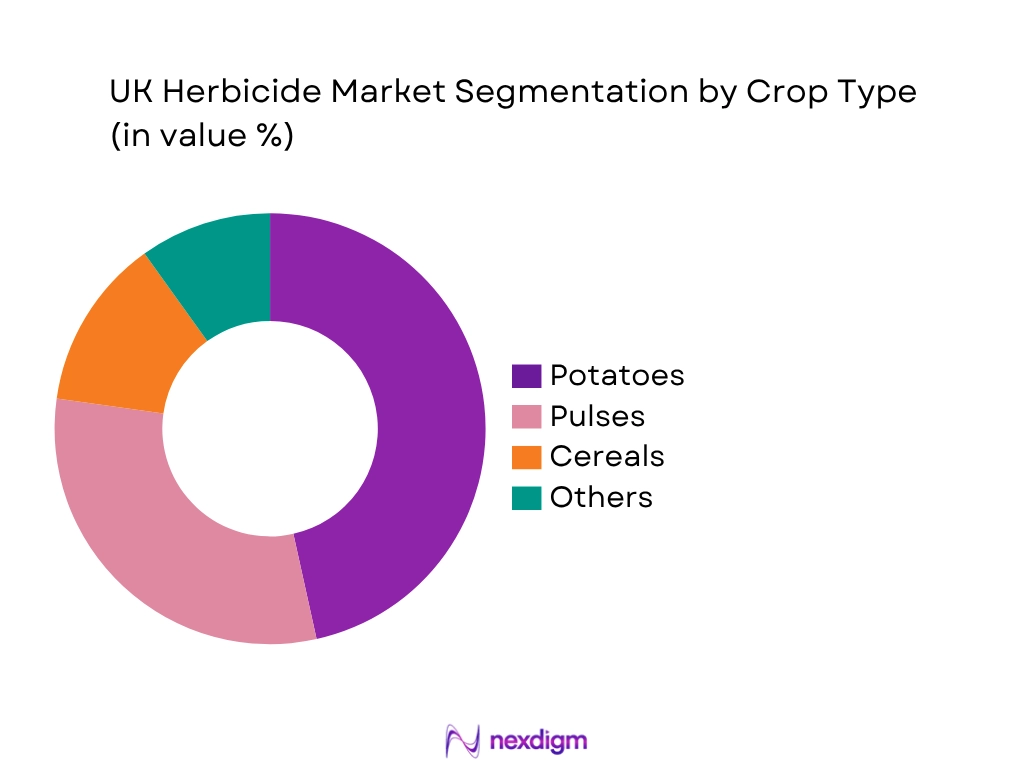
UK Herbicide Market is segmented by crop type into cereals and grains, oilseed rape and pulses, potatoes and sugar beet, grassland and pasture, and amenity, rail and industrial vegetation. Recently, cereals and grains have a dominant market share in the UK under crop type segmentation because wheat and barley occupy the largest arable base and require sequential weed-control programmes. Wheat alone covered 1,531 thousand hectares, while barley production reached 7.1 million tonnes, supported by 810 thousand hectares of spring barley and 384 thousand hectares of winter barley. Cereal growers depend on glyphosate for stale seedbeds, prosulfocarb, flufenacet, pendimethalin and diflufenican for pre-emergence grassweed suppression, and sulfonylurea or phenoxy products for post-emergence broadleaf control. Black-grass and Italian ryegrass pressure further strengthens demand for residual herbicide stacks in winter cereal systems.
By Application Timing
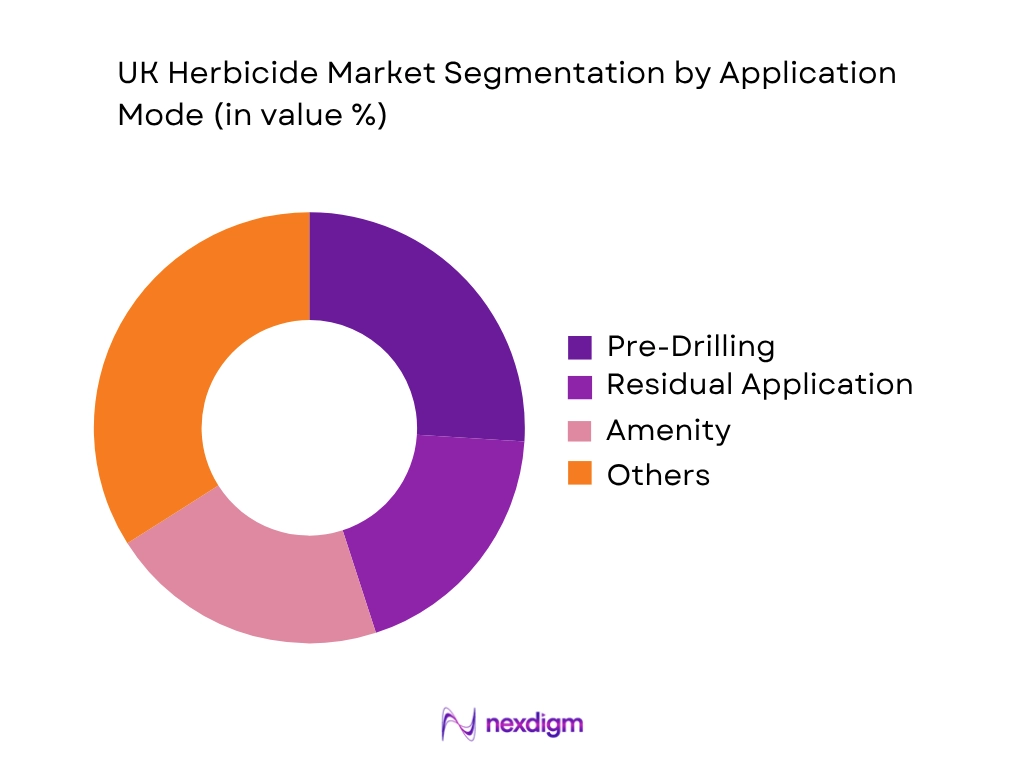
UK Herbicide Market is segmented by application timing into pre-drilling and stale seedbed, pre-emergence residual application, early post-emergence, spring post-emergence, and amenity or non-crop maintenance. Recently, pre-emergence residual application has a dominant market share in the UK under application timing segmentation because the country’s cereal weed-control strategy is heavily structured around early-season grassweed suppression. AHDB states that relying only on herbicides for black-grass control is not sustainable because resistance is increasing, and it highlights resistance detection across almost every county in England. This makes pre-emergence residual stacks central to grower programmes, especially in winter wheat and winter barley. Products based on flufenacet, prosulfocarb, pendimethalin and diflufenican are used before or shortly after crop emergence to reduce black-grass, Italian ryegrass and brome populations before spring control options become limited.
Competitive Landscape
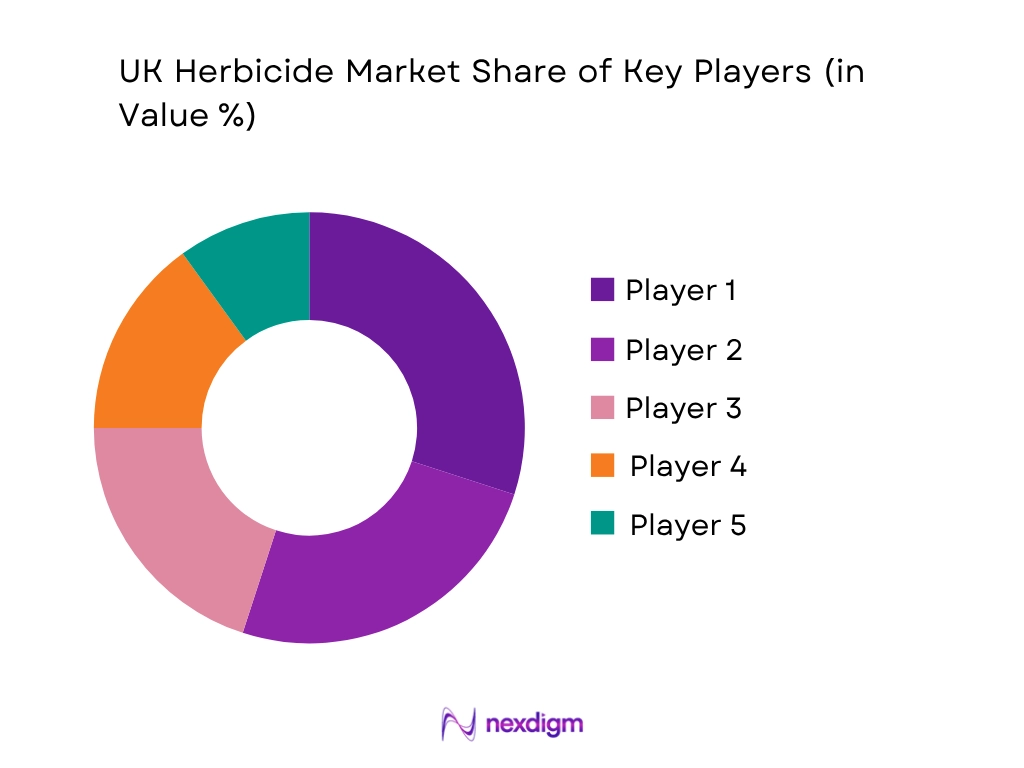
The UK Herbicide Market is led by multinational crop protection companies and specialist off-patent suppliers, including Bayer CropScience UK, BASF Agricultural Solutions UK, Syngenta UK, Corteva Agriscience UK and ADAMA Agricultural Solutions UK. The competitive structure is shaped by cereal herbicide portfolios, glyphosate exposure, residual grassweed chemistry, oilseed rape herbicides, potato and vegetable programmes, stewardship support, and access through merchants, agronomists and buying groups. HSE’s glyphosate renewal process is especially important because approval has been extended until 15 December 2026 while the renewal assessment continues.
| Company | Establishment Year | Headquarters | Key UK Herbicide Portfolio | Crop Focus | Channel Strength | Regulatory Exposure | Resistance-Management Role | Strategic Position |
| Bayer CropScience UK | 1863 | Leverkusen, Germany | ~ | ~ | ~ | ~ | ~ | ~ |
| BASF Agricultural Solutions UK | 1865 | Ludwigshafen, Germany | ~ | ~ | ~ | ~ | ~ | ~ |
| Syngenta UK | 2000 | Basel, Switzerland | ~ | ~ | ~ | ~ | ~ | ~ |
| Corteva Agriscience UK | 2019 | Indianapolis, USA | ~ | ~ | ~ | ~ | ~ | ~ |
| ADAMA Agricultural Solutions UK | 1945 | Airport City, Israel | ~ | ~ | ~ | ~ | ~ | ~ |
UK Herbicide Market Analysis
Growth Drivers
Cereal-Centric Arable Farming Sustaining Herbicide Demand
The UK Herbicide Market is supported by cereal-heavy arable farming, where wheat and barley require pre-drilling, pre-emergence and post-emergence weed-control programmes. Defra reported UK wheat area at 1,531 thousand hectares and wheat harvested production at 11.15 million tonnes, while barley production reached 7.1 million tonnes, with spring barley area at 810 thousand hectares and winter barley area at 384 thousand hectares. These crop volumes sustain demand for glyphosate-based stale seedbed use, flufenacet, prosulfocarb, pendimethalin, diflufenican and spring broadleaf herbicides. The sector is also supported by a large macroeconomic base: World Bank reported UK GDP at USD 3.69 trillion and GDP per capita at USD 53,246.4, giving the country a high-capacity farm input and distribution system. The market-specific relevance is clear because cereal growers remain dependent on chemical weed control to protect crop establishment, reduce grassweed competition and maintain workable drilling schedules across East Anglia, East Midlands, Yorkshire and Scotland.
Grassweed Resistance Increasing Need for Residual Herbicide Programmes
The UK Herbicide Market is driven by persistent black-grass, Italian ryegrass, brome and wild oat pressure, especially in winter cereals grown on heavy soils. AHDB identifies black-grass as a leading arable weed problem and states that near-complete control is required to prevent population build-up; its guidance also highlights the need to combine non-chemical control with herbicides. AHDB’s 2025 update confirmed the first three UK glyphosate-resistant Italian ryegrass cases in Kent, Gloucestershire and North Yorkshire, increasing the need for resistance-management programmes rather than single-product dependence. Defra crop data shows the scale of affected arable systems: wheat covered 1,531 thousand hectares, winter barley covered 384 thousand hectares, and oilseed rape covered 293 thousand hectares. World Bank macro data further supports farm input capacity, with UK GDP at USD 3.69 trillion and GDP per capita at USD 53,246.4. This creates sustained demand for residual stacks, pre-emergence herbicide sequencing, agronomist-led product selection and stewardship-led weed-control programmes.
Market Challenges
Glyphosate Renewal Uncertainty Affecting Core Weed-Control Programmes
The UK Herbicide Market faces regulatory uncertainty around glyphosate, a core non-selective herbicide used for stale seedbeds, pre-drilling burndown, cover-crop destruction, reduced-tillage farming and amenity weed control. HSE stated that glyphosate approval in Great Britain has been extended until 15 December 2026 so the renewal assessment can be completed. This creates planning risk for manufacturers, merchants, contractors and growers because glyphosate is embedded in winter wheat, barley, oilseed rape, potato and grassland weed-management programmes. Defra’s crop statistics show why the exposure is material: wheat covered 1,531 thousand hectares, spring barley covered 810 thousand hectares, winter barley covered 384 thousand hectares, and potatoes covered 118 thousand hectares. The wider macroeconomic setting remains strong, with World Bank reporting UK GDP at USD 3.69 trillion and GDP per capita at USD 53,246.4, but regulatory delay can still affect label continuity, procurement cycles, product inventories and grower confidence. The challenge is therefore market-specific and tied directly to herbicide programme dependency.
Weather Volatility Disrupting Crop Area and Herbicide Application Windows
The UK Herbicide Market is challenged by weather volatility, because herbicide demand depends on drilling dates, soil moisture, crop establishment and spray windows. Defra reported that winter planting was severely hampered by wet weather and flooding, with East Midlands and Yorkshire and Humber particularly affected. Wheat area fell to 1,531 thousand hectares, winter barley area fell to 384 thousand hectares, and oilseed rape area fell to 293 thousand hectares, while spring barley area increased to 810 thousand hectares as growers adjusted rotations. These shifts change herbicide timing, moving demand away from some autumn residual programmes and toward spring crop programmes, broadleaf control and revised stale seedbed strategies. The UK’s macroeconomic base remains sizeable, with World Bank recording GDP of USD 3.69 trillion and GDP per capita of USD 53,246.4, but farm-level execution depends on field conditions rather than national economic capacity. For herbicide suppliers, the challenge is inventory risk, regional demand swings, delayed applications and altered active ingredient requirements across cereals, oilseed rape and root crops.
Market Opportunities
Integrated Weed Management and Precision Application Support
The UK Herbicide Market has an opportunity in stewardship-led herbicide programmes that combine chemical control with integrated weed management and precision application. Defra’s integrated pest management guidance states that the Sustainable Farming Incentive includes 4 paid IPM actions and 3 paid precision farming actions, creating a policy-supported framework for growers to assess weed, pest and disease strategies. This supports demand for herbicides that work within reduced-risk programmes, variable-rate spraying, patch application, weed mapping and agronomist-supported resistance management. AHDB’s black-grass guidance reinforces the opportunity because it recommends combining non-chemical methods with herbicides to protect efficacy. The opportunity is market-specific because UK cereal farms remain exposed to major grassweed problems across wheat and barley systems, including 1,531 thousand hectares of wheat and 1,194 thousand hectares of combined spring and winter barley. World Bank macro data shows a supportive operating environment, with UK GDP at USD 3.69 trillion and GDP per capita at USD 53,246.4. Current policy and crop data support future growth in precision-compatible herbicide programmes.
Specialist Crop Herbicide Programmes in Potatoes, Sugar Beet and Vegetables
The UK Herbicide Market has an opportunity in specialist crops where crop safety, pre-emergence residual control and label specificity are critical. Defra reported potato area at 118 thousand hectares, harvested potato production at 5.137 million tonnes, sugar beet area at 102 thousand hectares, harvested sugar beet production at 7.817 million tonnes, and fresh vegetable planted area at 97 thousand hectares. These crops require more tailored herbicide programmes than broadacre cereals because growers must manage ridged beds, broadleaf weeds, annual grasses, volunteer crops, crop residues and food-chain compliance. Sugar beet is also concentrated around East of England, East Midlands and Yorkshire supply chains, where Defra noted around 2,300 growers supplying British Sugar. The macroeconomic environment supports premium crop-protection adoption, with World Bank reporting UK GDP at USD 3.69 trillion and GDP per capita at USD 53,246.4. This creates future opportunity for manufacturers offering selective herbicides, crop-safe residuals, tank-mix guidance, stewardship documentation and agronomy support for potatoes, sugar beet, pulses, vegetables and protected horticulture.
Future Outlook
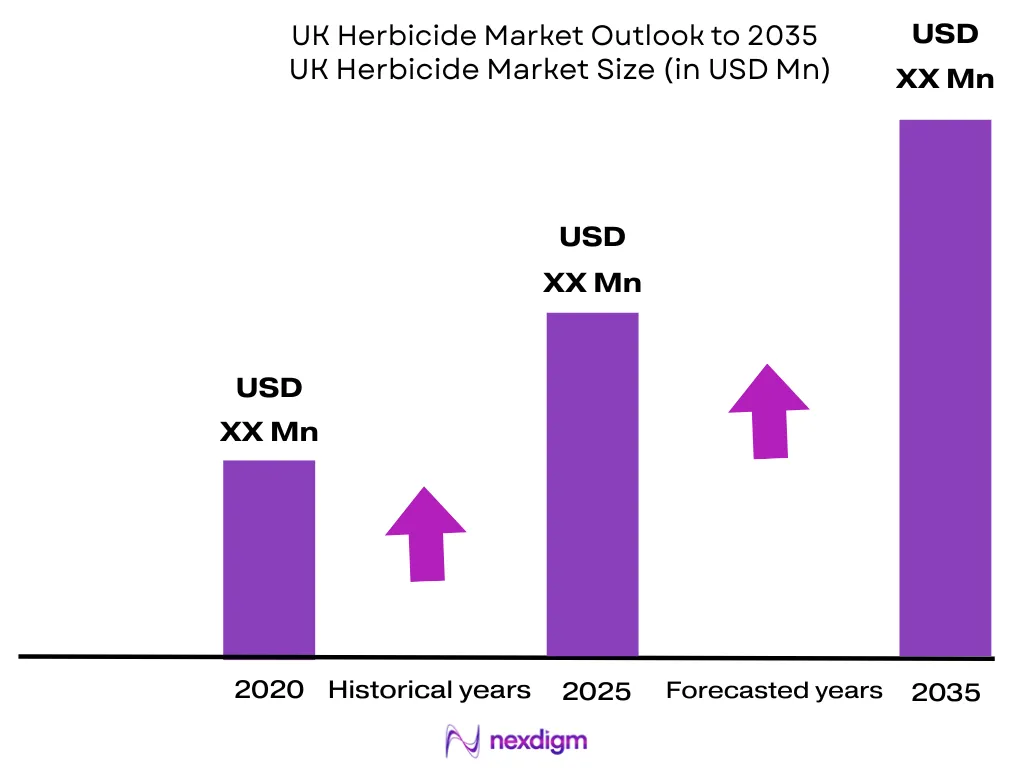
The UK Herbicide Market is expected to show modest long-term expansion, with a forecasted CAGR of 0.6% during 2026-2035, aligned with IndexBox’s long-term UK herbicide value forecast to USD 656 million by 2035. Growth will be slow because arable acreage is mature, active ingredient regulation remains strict, and several core herbicide chemistries face environmental or renewal scrutiny. Over the next decade, demand will shift from volume-led herbicide use toward stewardship-led, resistance-focused and precision-targeted programmes. UK growers will continue using glyphosate for reduced tillage, cover-crop destruction and stale seedbeds if renewal conditions remain workable. Cereal herbicide demand will remain linked to black-grass, Italian ryegrass, brome and wild oat control, while specialist crop opportunities will come from potatoes, sugar beet, vegetables, pulses, grassland and amenity weed management. Water stewardship, drift reduction and integrated weed management will become stronger purchasing criteria.
Major Players
- Bayer CropScience UK
- BASF Agricultural Solutions UK
- Syngenta UK
- Corteva Agriscience UK
- FMC Agro UK
- UPL UK
- ADAMA Agricultural Solutions UK
- Nufarm UK
- Certis Belchim UK
- Albaugh UK
- Life Scientific UK
- Sumitomo Chemical UK
- Gowan Crop Protection UK
- Rainbow Agro UK
- Barclay Chemicals UK
Key Target Audience
- Herbicide manufacturers and formulators
- Agricultural merchants and crop protection distributors
- Agronomy advisory networks and BASIS-qualified agronomist groups
- Large arable farms and contract farming businesses
- Potato, sugar beet, vegetable and specialist crop growers
- Amenity, rail and industrial vegetation management contractors
- Investments and venture capitalist firms
- Government and regulatory bodies
Research Methodology
Step 1: Identification of Key Variables
The initial phase involves constructing an ecosystem map for the UK Herbicide Market, covering manufacturers, importers, formulators, agricultural merchants, agronomists, buying groups, arable farms, amenity contractors and regulators. Key variables include active ingredient approvals, crop area, treated area, application timing, weed resistance, distribution channel and product withdrawal exposure.
Step 2: Market Analysis and Construction
In this phase, historical herbicide value, consumption, crop production, planted area, pesticide usage and channel dynamics are compiled. Public sources such as Defra crop statistics, HSE pesticide usage publications, HSE active substance notices, AHDB weed management guidance and company product portfolios are used to construct the market model.
Step 3: Hypothesis Validation and Expert Consultation
Market hypotheses are validated through interviews with agricultural merchants, independent agronomists, manufacturer representatives, arable growers, contractors and specialist crop advisers. These consultations test assumptions on glyphosate reliance, pre-emergence cereal programmes, black-grass control, oilseed rape contraction, water stewardship and merchant purchasing behaviour.
Step 4: Research Synthesis and Final Output
The final phase combines desk research, primary validation and bottom-up crop programme analysis into a structured market report. The output includes market size, segmentation, competitive benchmarking, growth drivers, challenges, opportunities, future outlook and strategic recommendations for manufacturers, distributors, investors, farmers and regulatory stakeholders.

- Executive Summary
- Research Methodology (Market Definitions and Assumptions, Abbreviations, Market Sizing Approach, Crop-Acreage Normalization, Treated Area Mapping, Active Ingredient Demand Assessment, Pesticide Usage Survey Integration, Distributor and Agronomist Interviews, Farm-Level Herbicide Programme Validation, Primary Research Approach, Secondary Research Sources, Bottom-Up and Top-Down Triangulation, Limitations and Future Conclusions)

- Definition and Scope
- Overview Genesis
- Evolution of Herbicide Use in UK Arable Farming
- Business Cycle
- Crop Protection Value Chain and Supply Chain Analysis

- Growth Drivers (Cereals Area Dependence, Black-Grass and Ryegrass Pressure, Minimum-Tillage Adoption, Glyphosate Use, Residual Herbicide Stacking, Precision Spraying Adoption)
- Market Challenges (Glyphosate Renewal Risk, Flufenacet Review Exposure, Prosulfocarb Drift, Water Contamination, Herbicide Resistance, Product Withdrawal, Amenity Restrictions)
- Opportunities (New Residual Chemistry, Glyphosate Alternatives, Mechanical and Chemical Integration, Precision Weed Control, Stewardship-Led Branding, Specialist Crop Programmes)
- Market Trends (Reduced Active Ingredient Availability, Integrated Weed Management, Direct Drilling, Delayed Drilling, Non-Chemical Weed Control, Digital Agronomy)
- SWOT Analysis
- Porter’s Five Forces

- By Value (2020-2025)
- By Volume (2020-2025
- By Treated Area (2020-2025)

- By Active Ingredient (In Value %)
Glyphosate
Prosulfocarb
Flufenacet
Pendimethalin
Diflufenican - By Crop Type (In Value %)
Winter Wheat
Spring Barley
Winter Barley
Oilseed Rape - By Distribution Channel (In Value %)
Agricultural Merchants
Agronomy Advisory Networks
Farmer Buying Groups
Cooperatives and Farmer-Owned Channels
Direct Manufacturer and Key Account Sales - By Region (In Value %)
East Anglia
East Midlands
Yorkshire and Humber
South East England
South West England

- Market Share of Major Players (Value Share, Volume Share, Branded Share, Generic Share, Treated Area Influence)
- Cross Comparison Parameters (UK Active Ingredient Registration Strength, Cereal Herbicide Portfolio Breadth, Black-Grass and Ryegrass Control Capability, Glyphosate Portfolio and Renewal Exposure, Water Stewardship and Drift Mitigation Support, Merchant and Agronomist Network Reach, Specialist Crop Herbicide Coverage, Precision Spraying and Digital Agronomy Partnerships)
- SWOT Analysis of Major Players
- Detailed Profiles of Major Companies
Bayer CropScience UK
BASF Agricultural Solutions UK
Syngenta UK
Corteva Agriscience UK
FMC Agro UK
UPL UK
ADAMA Agricultural Solutions UK
Nufarm UK
Certis Belchim UK
Albaugh UK
Life Scientific UK
Sumitomo Chemical UK
Gowan Crop Protection UK
Rotam / Rainbow Agro UK
Barclay Chemicals UK

- Market Demand and Utilization
- Farm Input Budget Allocation
- Purchasing Power and Procurement Behaviour
- Regulatory and Compliance Requirements
- Needs, Desires and Pain Point Analysis

- By Value (2026-2035)
- By Volume (2026-2035)
- By Treated Area (2026-2035)


 Request a Sample
 Ask for Customization
 Get a Quote
 Enquire Now