

 Download PDF
Market Overview
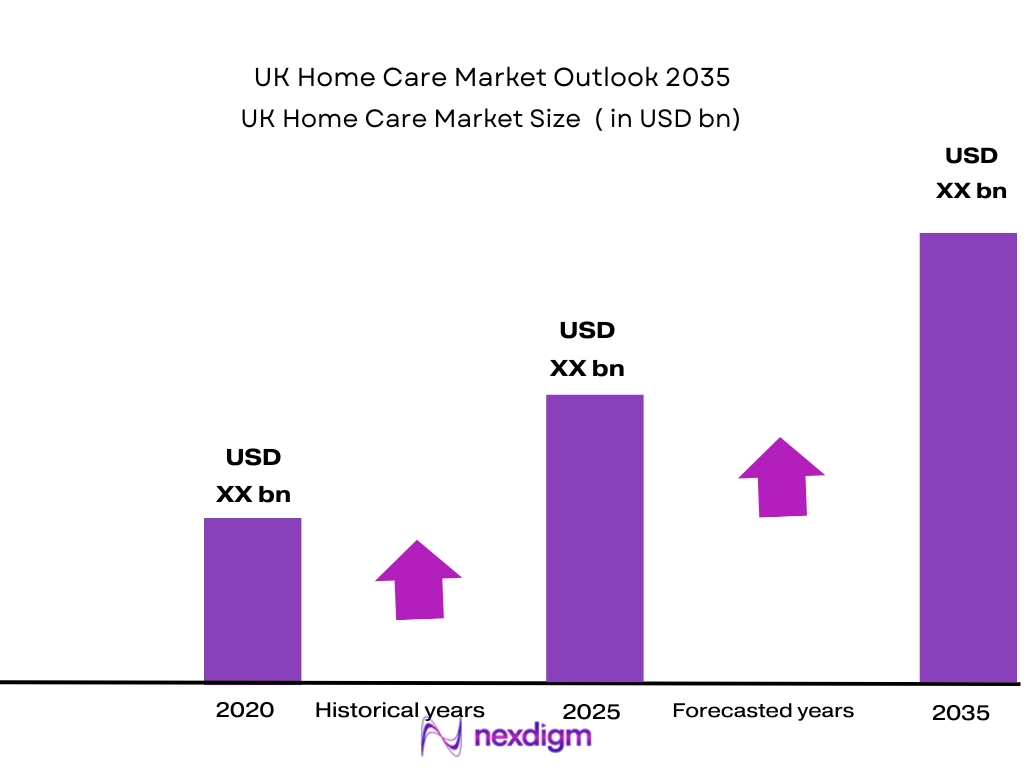
The UK home care market recorded an estimated value of USD ~ billion based on a recent historical assessment, supported by rising demand for domiciliary care, live-in support, dementia services, and post-hospital rehabilitation. Market expansion has been driven by an ageing population, increased chronic disease prevalence, pressure on hospital infrastructure, and growing preference for aging-in-place care models. Public expenditure on adult social care and rising private-pay adoption have also strengthened service utilization across residential communities and urban healthcare networks.
London remained the dominant regional center for the UK home care market due to high elderly population density, strong healthcare spending capacity, and extensive availability of organized care providers and digital health platforms. Major urban regions including Manchester, Birmingham, Glasgow, and Leeds also demonstrated strong service demand because of expanding NHS integration programs, rising home-based treatment acceptance, and increasing numbers of care-dependent adults. England continued to lead the market landscape owing to advanced healthcare infrastructure, large provider networks, and wider adoption of technology-enabled remote care services.
Market Segmentation
By Service Type
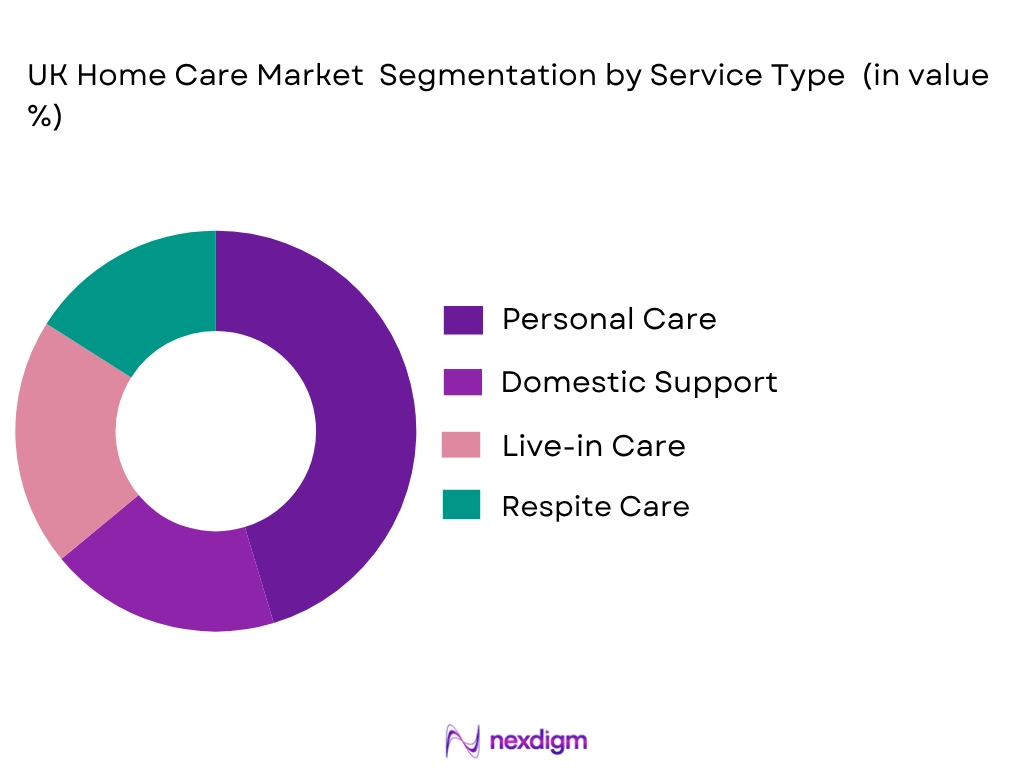
UK home care market is segmented by service type into personal care, domestic support, live-in care, nursing and complex care, respite care, dementia care, and palliative care. Recently, personal care has a dominant market share due to increasing elderly dependence on assistance for daily activities including bathing, medication management, mobility support, and meal preparation. The segment benefits from sustained referrals through local authorities and NHS discharge programs, while also receiving higher acceptance among private-pay households seeking independent living arrangements. Personal care providers maintain stronger workforce availability and operational scalability compared to specialized nursing services, allowing wider regional coverage. Rising prevalence of chronic illnesses and dementia-related conditions has further increased recurring care requirements, enabling personal care agencies to generate consistent long-term client retention across urban and suburban communities.
By Funding Source
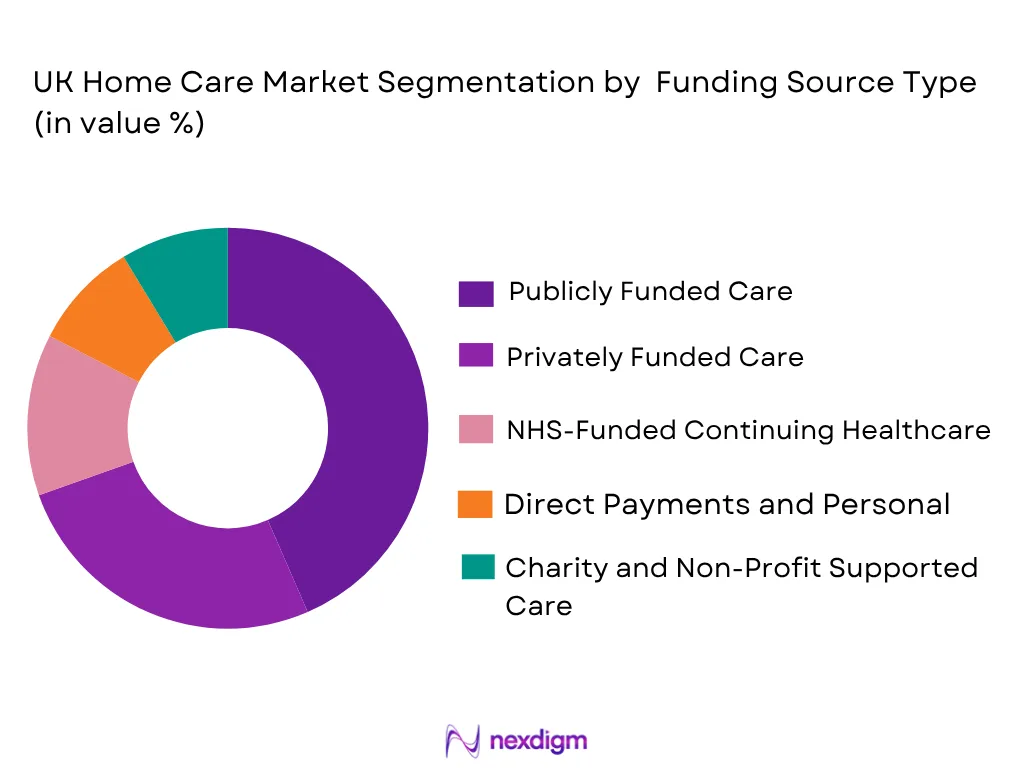
UK home care market is segmented by funding source into publicly funded care, privately funded care, NHS continuing healthcare, direct payments and personal budgets, and charity-supported care. Recently, publicly funded care has a dominant market share due to continued dependence on local authority support programs and NHS-backed social care services for elderly and vulnerable populations. Government-backed funding mechanisms enable broader accessibility for low-income households and individuals requiring long-duration care support. Publicly funded care also dominates because councils maintain contractual agreements with major domiciliary care providers, ensuring steady service demand across counties and metropolitan areas. Increasing pressure on hospitals to reduce inpatient occupancy has encouraged higher referrals toward community-based home care services, further reinforcing public-sector involvement in the market. The availability of structured reimbursement systems and integrated care pathways has additionally strengthened adoption across England, Scotland, Wales, and Northern Ireland.
Competitive Landscape
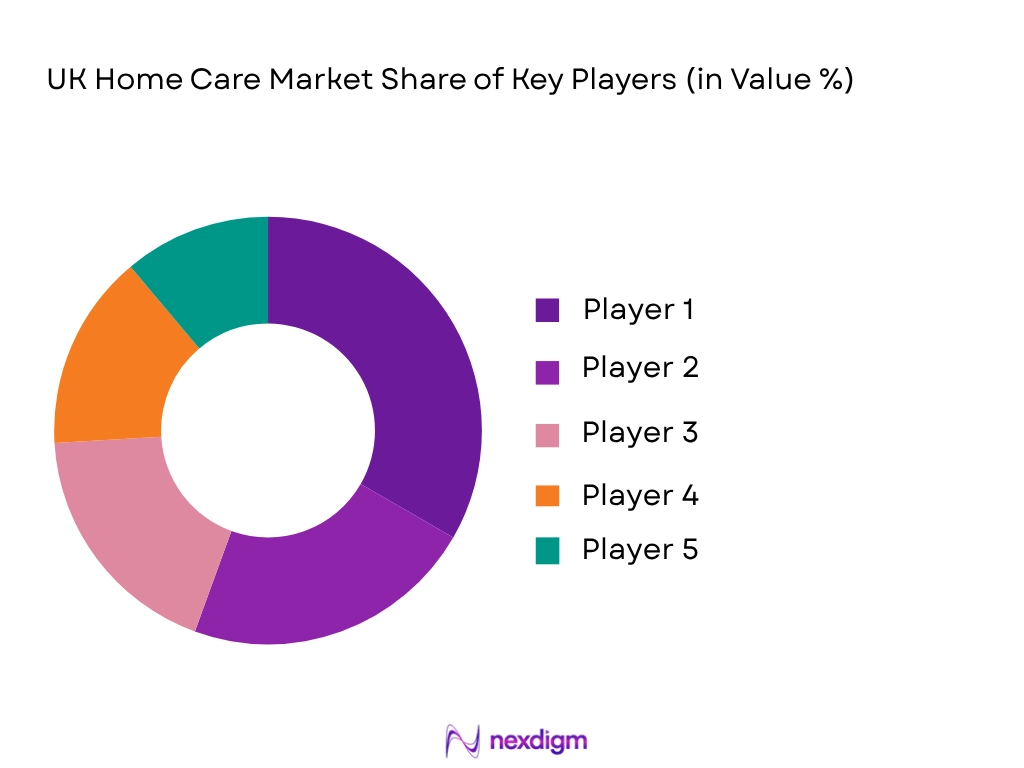
The UK home care market remains moderately fragmented with the presence of regional agencies, franchise operators, NHS-linked care providers, and technology-enabled care platforms. Market consolidation has accelerated through acquisitions and strategic partnerships aimed at expanding workforce availability, regional coverage, and digital service delivery capabilities. Leading companies continue investing in AI-enabled scheduling systems, electronic care records, and remote patient monitoring technologies to improve service efficiency and client retention. Franchise-led expansion models and integrated care partnerships have also strengthened the competitive positioning of organized operators across the UK.
| Company Name | Establishment Year | Headquarters | Technology Focus | Market Reach | Key Products | Revenue | Care Workforce Size |
| Home Instead | 1994 | Milton Keynes, UK | ~ | ~ | ~ | ~ | ~ |
| Helping Hands Home Care | 1989 | Alcester, UK | ~ | ~ | ~ | ~ | ~ |
| Bluebird Care | 2004 | Petersfield, UK | ~ | ~ | ~ | ~ | ~ |
| Cera Care | 2016 | London, UK | ~ | ~ | ~ | ~ | ~ |
| Prestige Nursing + Care | 1945 | London, UK | ~ | ~ | ~ | ~ | ~ |
UK Home Care Market Analysis
Growth Drivers
Ageing Population Growth Rate
The UK home care market is strongly supported by the country’s ageing population base. The World Bank recorded the UK’s total population at 69,226,000 people and the population aged 65 and above at 13,498,909 people in 2024, creating a large care-dependent user base for domiciliary care, personal care, dementia support, and live-in assistance. World Bank also recorded UK life expectancy at 81 years, which supports longer care duration and higher dependence on home-based support. NHS Digital reported 499,068 patients with a recorded dementia diagnosis in England on 30 November 2024, directly strengthening demand for recurring home care services. Source: World Bank, NHS Digital.
Hospital Discharge and Reablement Demand
Hospital discharge pressure is a market-specific driver for UK home care because delayed transfers increase the need for rapid domiciliary care packages, reablement workers, and community-based support. CQC reported that in April 2024, waits for care home beds and home-based care accounted for a daily average of nearly 4,000 people delayed in acute hospitals after stays of 14 days or longer. NHS England confirms that discharge delay datasets track people who no longer meet criteria to reside, people discharged, and people not discharged by day-end. These figures support demand for home care providers that can absorb patients leaving hospitals. Source: CQC, NHS England.
Market Challenges
Care Worker Shortage
Care worker shortage remains a direct operational challenge for the UK home care market because non-residential care depends on consistent field staffing. Skills for Care reported that CQC non-residential services in England had 595,000 filled posts and 59,000 vacant posts in 2024/25, giving a total workforce requirement of 655,000 posts across local authority and independent services. The same source reported that filled posts increased by 21,000 while vacant posts decreased by 7,700, but the remaining vacancy base still restricts service acceptance, visit reliability, and hospital-discharge responsiveness. Source: Skills for Care.
Regulatory Compliance Burden
Regulatory complexity affects the UK home care market because providers must meet CQC inspection, safeguarding, medication, recordkeeping, and quality governance requirements while operating across dispersed home settings. CQC’s State of Care report noted that 2024 ratings included 19 homecare agencies marked with insufficient evidence to rate, reflecting the depth of assessment requirements in domiciliary care. CQC also reported quality-domain ratings for homecare agencies across safe, effective, caring, responsive, and well-led categories, showing that compliance is not a single registration exercise but an ongoing operating burden. This increases documentation workload and management intensity for providers. Source: CQC.
Opportunities
Technology-Enabled Care Platforms
Technology-enabled care platforms represent a major opportunity for the UK home care market because digital records, scheduling systems, and remote monitoring can improve coordination across carers, families, NHS teams, and local authorities. UK government statistics reported that 69.1% of CQC-registered adult social care provider locations in England had adopted Digital Social Care Records by May 2024, compared with 55.0% in May 2023. NHS England’s virtual ward statistics also reported national virtual ward capacity of 12,733 beds in December 2024, supporting wider acceptance of care-at-home models.
Dementia and Complex Care Specialization
Dementia and complex care specialization offers a strong future opportunity for UK home care providers because the diagnosed care population is already large and requires recurring, condition-specific support. NHS Digital recorded 499,068 patients with a dementia diagnosis in England on 30 November 2024, while GOV.UK reported that the number of people aged 65 and above with a formal dementia diagnosis reached 483,000 by December 2024. These figures justify expansion of dementia-trained carers, medication support, behavioural support, respite care, and live-in services. Providers with specialist training and digital care records can capture higher demand from families and NHS-linked pathways. Source: NHS Digital, GOV.UK.
Future Outlook
The UK home care market is expected to witness sustained growth during the next five years due to rising elderly populations, increasing chronic disease prevalence, and stronger demand for personalized home-based healthcare solutions. Digital transformation initiatives including AI-enabled care coordination, telehealth systems, and remote monitoring technologies are expected to improve operational efficiency and treatment accessibility across residential settings. Government support for community-based healthcare and Integrated Care Systems will continue encouraging hospital discharge programs and domiciliary care adoption. Expanding private-pay demand, workforce modernization, and specialized care services including dementia and palliative care are also likely to create long-term growth opportunities for organized providers operating across the UK.
Major Players
- Home Instead
- Helping Hands Home Care
- Bluebird Care
- Right at Home UK
- Caremark
- Cera Care
- The Good Care Group
- Prestige Nursing + Care
- Agincare
- MiHomecare
- City & County Healthcare Group
- Radis Community Care
- Alina Homecare
- Nurseplus Care at Home
- Trinity Homecare
Key Target Audience
- Investments and venture capitalist firms
- Government and regulatory bodies
- NHS organizations
- Home care service providers
- Healthcare technology companies
- Insurance providers
- Private equity firms
- Elderly care facility operators
Research Methodology
Step 1: Identification of Key Variables
The research process began with identification of core market variables including service demand, workforce availability, funding models, pricing structures, and digital healthcare adoption rates. Secondary information was collected from government databases, NHS publications, Care Quality Commission records, company reports, and healthcare associations to establish baseline market assumptions and operational indicators.
Step 2: Market Analysis and Construction
Quantitative market construction was conducted using bottom-up and top-down analytical approaches to estimate market size, segment contribution, and regional demand patterns. Revenue modeling considered publicly funded care expenditure, private-pay service utilization, workforce deployment, and technology-enabled healthcare penetration across the UK home care ecosystem.
Step 3: Hypothesis Validation and Expert Consultation
Primary interviews were conducted with healthcare executives, domiciliary care agencies, digital care platform providers, and policy specialists to validate market assumptions and growth projections. Expert consultation supported verification of workforce trends, pricing structures, investment activity, and technology integration patterns influencing the competitive landscape.
Step 4: Research Synthesis and Final Output
The final stage involved triangulation of quantitative and qualitative findings to ensure data consistency and analytical accuracy throughout the report. Market forecasts, segmentation structures, competitive assessments, and strategic insights were synthesized into a structured report designed to support investment planning, operational expansion, and business decision-making.

- Executive Summary
- Research Methodology (Market Definitions and Scope of Home Care Services, Classification Framework: Domiciliary Care, Live-in Care, Personal Care, Nursing Care, Respite Care, CQC Data Utilization Approach, NHS and Local Authority Data Mapping, Primary Interviews with Home Care Providers and Commissioners, Bottom-Up Care Hours Modelling, Top-Down Social Care Expenditure Validation, Assumptions on Care Fees, Wage Inflation, and Utilization Rates, Limitations and Data Triangulation Techniques, TAM/SAM/SOM Modelling Framework Based on Care Demand and Service Penetration)

- Definition and Scope
- Evolution of the Home Care Ecosystem in the UK
- Timeline of Regulatory and Funding Reforms
- Health and Social Care Lifecycle Integration
- Value Chain Analysis
- Stakeholder Ecosystem

- Growth Drivers
Ageing Population Growth Rate
Demand for Ageing-in-Place Services
Hospital Discharge and Reablement Demand
Private Pay Market Expansion
Digital Care Adoption Rate - Market Challenges
Care Worker Shortage
Wage Inflation and Margin Pressure
Local Authority Fee Constraints
Regulatory Compliance Burden
High Staff Turnover Rate - Opportunities
Technology-Enabled Care Platforms
Remote Monitoring and Telecare
Dementia and Complex Care Specialization
Untapped Private Pay Segment
Integrated Care System Partnerships - Market Trends
Digital Care Planning Adoption
AI-Based Scheduling and Workforce Optimization
Remote Patient Monitoring
Outcome-Based Care Contracts
Consolidation Among Home Care Providers - Government Regulations
CQC Regulatory Framework
Care Act Compliance
NHS Continuing Healthcare Framework
Safeguarding and DBS Requirements
Minimum Wage and Employment Regulations
Data Protection and GDPR Compliance - SWOT Analysis
- Porter’s Five Forces
- Workforce Digitization Impact
- Health and Social Care Integration Analysis

- By Value, 2020–2025
- By Care Hours Delivered, 2020–2025
- By Average Fee per Care Hour, 2020–2025

- By Service Type ( In Value %)
Personal Care
Domestic Support
Live-in Care
Respite Care - By Funding Source ( In Value %)
Publicly Funded Care
Privately Funded Care
NHS-Funded Continuing Healthcare
Direct Payments and Personal Budgets
Charity and Non-Profit Supported Care - By Client Type ( In Value %)
Older Adults
Adults with Physical Disabilities
Adults with Learning Disabilities
People with Dementia - By Care Delivery Model ( In Value %)
Hourly Visiting Care
Live-in Care
Overnight Care
Technology-Enabled Home Care
Hybrid Health and Social Care Models - By Region ( In Value %)
England
Scotland
Wales
Northern Ireland
London

- Market Share of Major Players
- Cross Comparison Parameters (Service Portfolio Breadth,
Average Hourly Care Fee, CQC Rating, Number of Care Workers, Regional Coverage, Technology Platform Capability, Private Pay Client Share, Client Retention Rate) - SWOT Analysis of Major Players
- Pricing Benchmarking
- Detailed Profiles of Major Companies
Home Instead
Helping Hands Home Care
Bluebird Care
Right at Home UK
Caremark
Cera Care
The Good Care Group
City & County Healthcare Group
Allied Healthcare
MiHomecare
Prestige Nursing + Care
Agincare
Radis Community Care
Alina Homecare
Walfinch

- Care Demand Patterns and Seasonality
- Cost Sensitivity and Fee Elasticity
- Family Decision-Making Criteria
- Compliance and Safeguarding Burden
- Pain Point Analysis
- End User TAM Analysis

- By Value, 2026–2035
- By Care Hours Delivered, 2026–2035
- By Average Fee per Care Hour, 2026–2035


 Request a Sample
 Ask for Customization
 Get a Quote
 Enquire Now