
 Download PDF
Market Overview
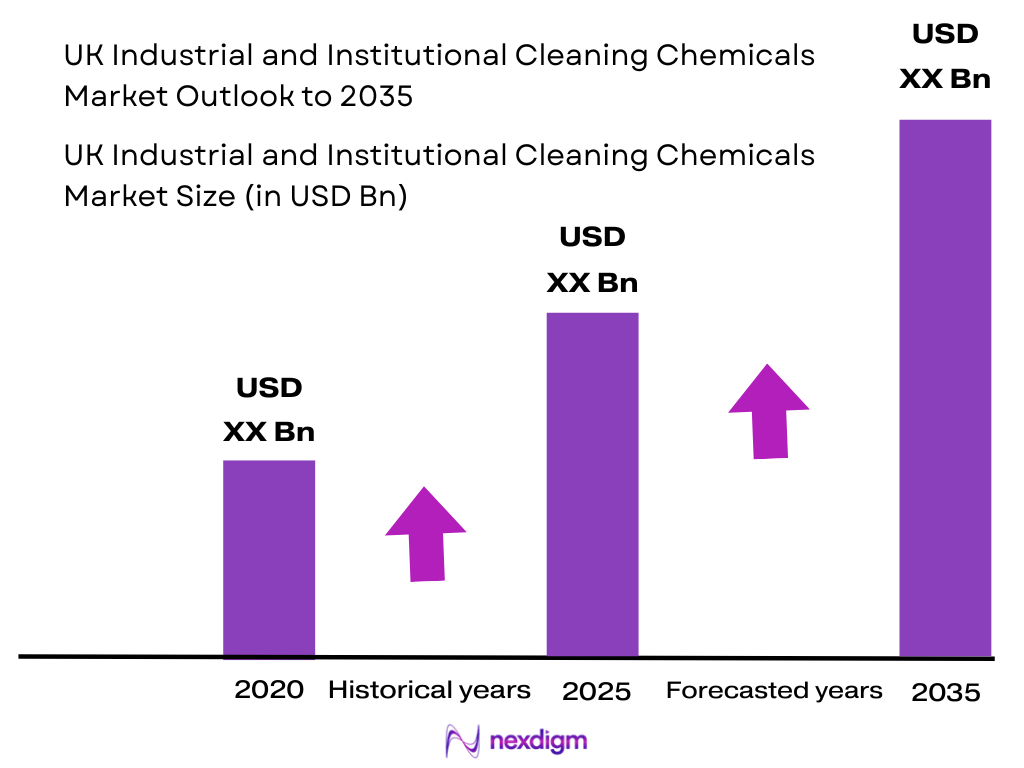
The UK Industrial and Institutional Cleaning Chemicals Market is valued at ~USD XX billion in 2024, under the defined market scope, with the market supported by recurring chemical consumption across healthcare, food and beverage manufacturing, hospitality, foodservice, commercial buildings, industrial facilities, transportation and contract cleaning operations. The wider economic environment provides a substantial underlying demand base: the UK economy reached approximately £2,905 billion in GDP in 2024, while annual real GDP growth was 1.1.
London, Greater London, the South East, the North West and the West Midlands represent important demand centres for UK industrial and institutional cleaning chemicals because of their concentration of commercial buildings, healthcare facilities, hospitality operations, manufacturing sites, logistics infrastructure and professional cleaning employment. ONS data provides detailed employment estimates by occupation, industry and geography, allowing the professional cleaning ecosystem to be assessed at regional level. (Office for National Statistics) London is particularly important because of its dense concentration of offices, hotels, restaurants, healthcare facilities, transport infrastructure and public buildings.
Market Segmentation
By Product Type
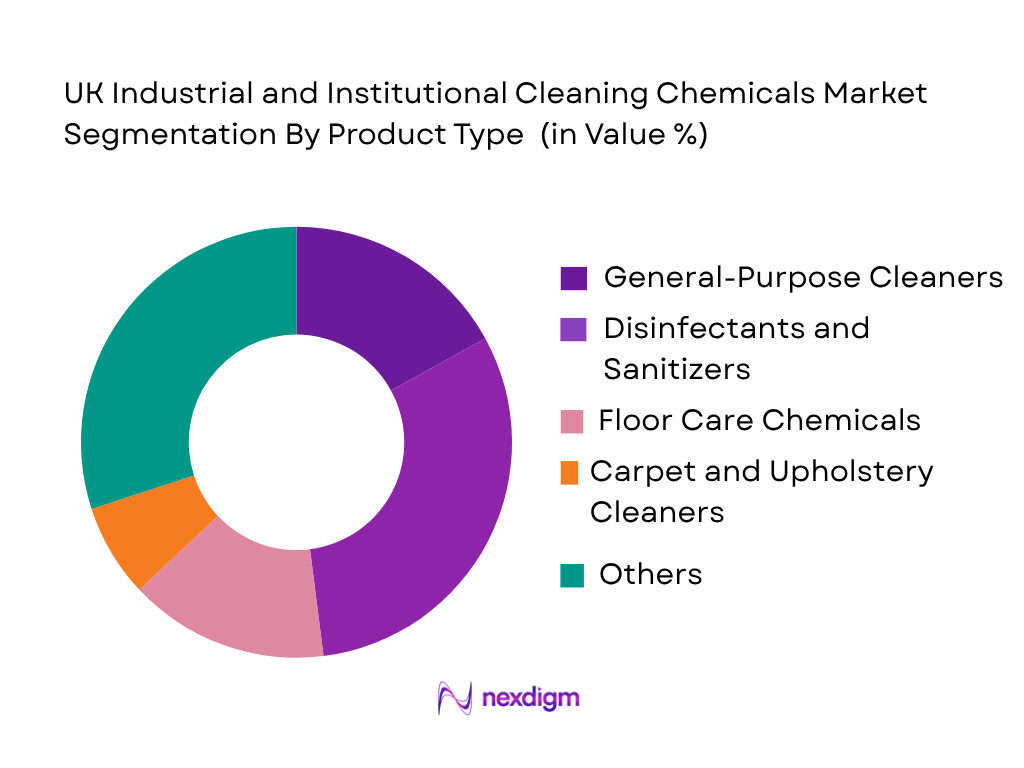
The UK Industrial and Institutional Cleaning Chemicals Market is segmented by product type into general-purpose cleaners, disinfectants and sanitizers, floor-care chemicals, carpet and upholstery cleaners, kitchen and food-service cleaners, laundry chemicals, warewashing chemicals, industrial degreasers, restroom cleaners, glass and surface cleaners, and specialty and precision cleaners. Disinfectants and sanitizers are expected to represent the dominant product category under the defined segmentation because their consumption is directly connected with hygiene protocols, infection prevention, food safety and high-touch surface management. The Food Standards Agency recommends regular cleaning of hands, work surfaces, utensils, cooking equipment and high-touch areas and specifies that suitable disinfectants should be used according to manufacturer instructions. (GOV.UK) Healthcare and care environments create another recurring application base, while hospitality and foodservice operators require repeated surface and equipment sanitation. Demand also benefits from professional specifications requiring validated efficacy, correct contact time and controlled chemical application. Other product groups remain important, particularly degreasers in manufacturing and food processing, laundry chemicals in healthcare and hospitality, and floor-care products in commercial facilities. The combination of regulatory hygiene requirements and recurring cleaning cycles supports the leading position of disinfectant and sanitation chemistry.
By End-Use Industry
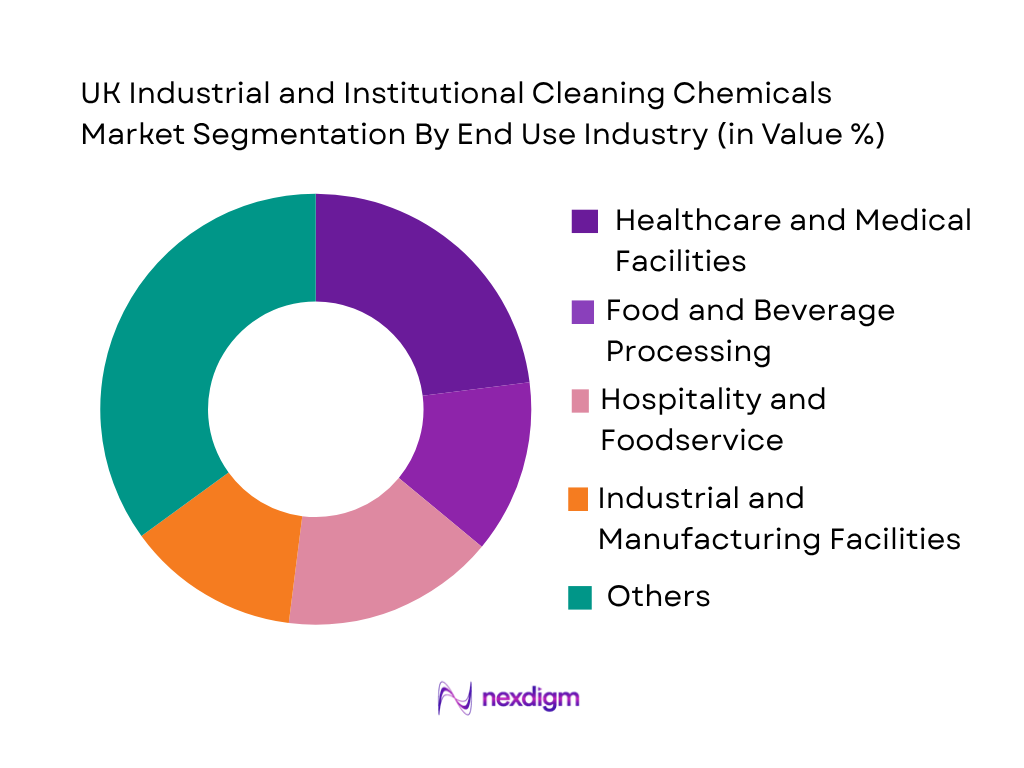
The UK Industrial and Institutional Cleaning Chemicals Market is segmented by end-use industry into healthcare and care facilities, food and beverage manufacturing, hospitality and foodservice, industrial and manufacturing facilities, commercial offices and buildings, retail facilities, education and institutional facilities, transportation and logistics, government facilities, and sports and leisure facilities. Healthcare and care facilities are expected to hold the dominant position because cleaning requirements are closely tied to infection prevention, environmental hygiene, patient safety and defined cleaning frequencies. Healthcare operators require specialised surface disinfectants, detergents, instrument-cleaning products, laundry chemistry and restroom sanitation products. Food processing represents another high-intensity segment because cleaning and disinfection must be integrated into production operations and food-contact surface controls. The FSA specifically recommends cleaning and disinfecting food areas and equipment between tasks, particularly after raw-food handling, and recommends cleaning schedules covering what is cleaned, how often it is cleaned and which products are used. (GOV.UK) Hospitality, manufacturing and commercial facilities create additional recurring demand through housekeeping, equipment cleaning, floor maintenance, laundry and sanitation. This broad facility base makes institutional and industrial demand structurally recurring rather than dependent on occasional purchases.
Competitive Landscape
The UK Industrial and Institutional Cleaning Chemicals Market is characterised by multinational cleaning-chemistry suppliers, specialist professional-cleaning manufacturers, janitorial distributors and equipment-led solution providers. Companies compete through breadth of professional product portfolios, disinfectant efficacy, formulation technology, regulatory support, dispensing systems, sustainability credentials, technical service and distribution reach. Large suppliers benefit from established relationships with healthcare, hospitality, food-processing, facility-management and industrial customers, while specialist companies differentiate through application-specific chemistry and professional cleaning expertise.
| Company | Established | Headquarters | Key Product Coverage | End-Use Strength | Technology Focus | Distribution Model | Sustainability / Compliance Focus | Professional Service Capability |
| Ecolab | 1923 | St. Paul, USA | ~ | ~ | ~ | ~ | ~ | ~ |
| Diversey | 1923 | Fort Mill, USA | ~ | ~ | ~ | ~ | ~ | ~ |
| Reckitt | 1823 | Slough, UK | ~ | ~ | ~ | ~ | ~ | ~ |
| SC Johnson Professional | 1886 | Racine, USA | ~ | ~ | ~ | ~ | ~ | ~ |
| Kärcher | 1935 | Winnenden, Germany | ~ | ~ | ~ | ~ | ~ | ~ |
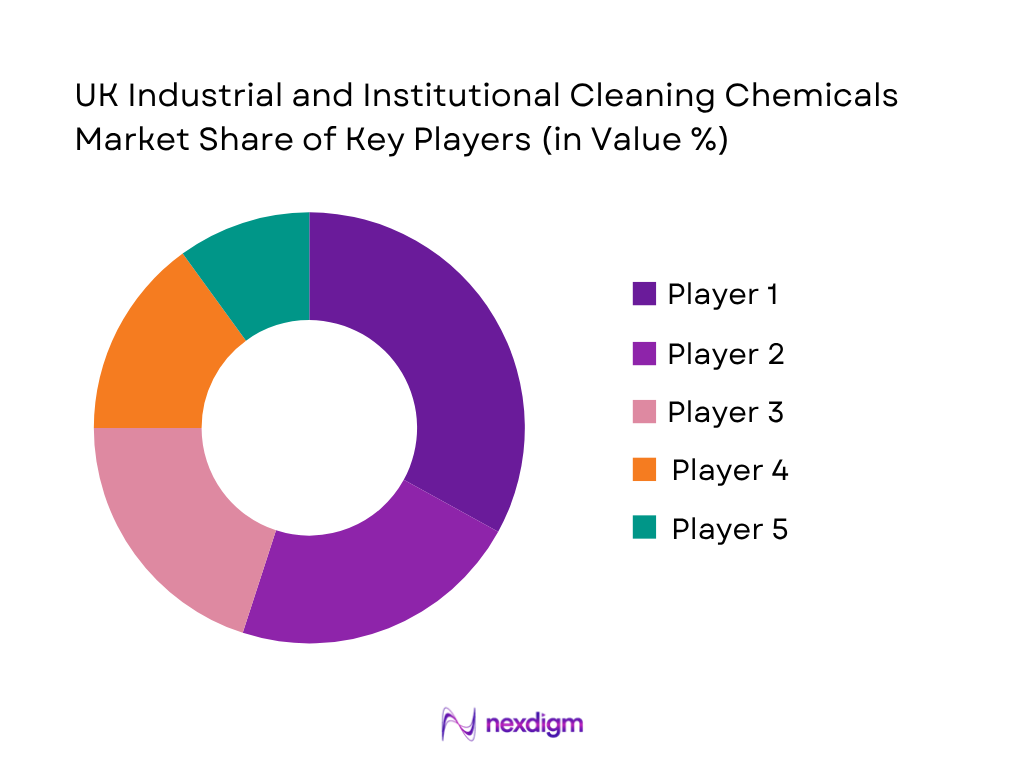
UK Industrial and Institutional Cleaning Chemicals Market Analysis
Growth Drivers
Healthcare Infection-Control Requirements
Healthcare remains a structurally intensive application area for UK industrial and institutional cleaning chemicals because hospitals, care facilities and clinical environments require frequent cleaning, disinfection and sanitation across patient rooms, operating areas, washrooms and high-touch surfaces. NHS England recorded 27.4 million A&E attendances in 2024/25, with 20.2 million patients seen within 4 hours, demonstrating the scale of environments requiring continuous infection-control operations. NHS data also recorded approximately 1.4 million emergency admissions with bacterial infections as the primary diagnosis during 2024/25 and around 2.7 million admissions where bacterial infection appeared in any diagnosis. The NHS additionally delivered a record 18 million treatments during 2024, compared with 17.35 million in 2023. These activity volumes sustain recurring requirements for disinfectants, surface cleaners, restroom chemicals, instrument and equipment cleaning agents, and specialised hygiene formulations. For I&I chemical suppliers, healthcare demand is therefore linked not only to hospital capacity but also to treatment throughput and the need for repeated cleaning cycles across healthcare estates.
Food Manufacturing Hygiene
Food and beverage production represents another major demand centre because manufacturing sites require systematic cleaning of processing equipment, production floors, drains, food-contact surfaces, storage areas and sanitation zones. Official UK data recorded £39.3 billion of gross value added from food and drink manufacturing in 2024, compared with £37.1 billion in 2023. The wider UK food chain generated £147.8 billion of GVA, while non-residential catering contributed £46.1 billion and food and drink retail generated £44.1 billion. UK manufacturers collectively recorded £452.2 billion of product sales in 2024, with food remaining the largest manufacturing division and accounting for £94.9 billion when applying the published 21% division share to the reported total; for publication, the directly reported manufacturing total and food-sector GVA should be prioritised. This sizeable production and catering ecosystem supports recurring use of alkaline cleaners, acidic descalers, degreasers, sanitizers, disinfectants and automated cleaning-in-place chemistry.
Market Challenges
UK Chemical Compliance Requirements
Regulatory compliance creates a substantial technical and administrative burden for I&I cleaning-chemical manufacturers because formulations must satisfy requirements covering chemical classification, labelling, worker exposure, environmental release and, where applicable, biocidal-product authorisation. The scale of the underlying UK industrial economy increases the number of commercial formulations and professional-use applications requiring compliance management. UK manufacturers recorded £452.2 billion of product sales in 2024, while manufacturing employment was approximately 2.583 million jobs in the June 2024 Workforce Jobs data. Chemical suppliers serving manufacturing, healthcare, food processing and institutional facilities must therefore manage formulation documentation, hazard communication and application-specific requirements across numerous professional-use settings. The challenge is intensified for multinational suppliers operating across both EU and Great Britain regulatory frameworks, because product registrations, classifications and supply-chain documentation may need to be maintained separately. For cleaning-chemical producers, compliance complexity can affect formulation selection, active ingredients, product claims, labelling, safety data and customer qualification requirements, making regulatory capability an important competitive requirement rather than a purely administrative function.
Raw Material Supply Exposure
UK I&I cleaning-chemical producers remain exposed to supply-chain conditions affecting surfactants, solvents, builders, disinfectant actives, enzymes, chelating agents and specialty additives, particularly where specialised inputs are internationally sourced. The country’s trade-intensive industrial structure provides evidence of this exposure: UK Food, Feed and Drink imports reached £64.1 billion in 2024, while exports reached £24.6 billion. Although these figures cover the broader food chain rather than cleaning chemicals specifically, they demonstrate the scale of internationally dependent industrial supply networks that cleaning-chemical suppliers serve. Manufacturing itself generated £452.2 billion in product sales during 2024, creating substantial downstream demand for reliable chemical inputs while simultaneously exposing suppliers to disruptions in imported raw materials. This becomes particularly relevant for specialised disinfectant actives, high-performance surfactants and formulation components that may have limited domestic production alternatives. Consequently, manufacturers must manage supplier qualification, inventory resilience, alternative formulations and regulatory implications when replacing an unavailable ingredient. Supply disruption can be especially problematic where an alternative raw material changes product performance, safety classification or regulatory status.
Market Opportunities
Green Cleaning Chemistry
The transition toward lower-impact cleaning chemistry creates opportunities for suppliers that can reduce hazardous inputs while maintaining the cleaning performance required by healthcare, food processing, hospitality and industrial customers. The UK economy generated £2,905 billion of GDP in 2024, with real GDP growth of 1.1, providing a large economic base across which sustainability requirements can influence institutional procurement. Food and drink manufacturing generated £39.3 billion of GVA, while non-residential catering generated £46.1 billion, creating substantial professional-use environments where concentrated, biodegradable or lower-impact formulations can be deployed. Opportunity areas include readily biodegradable surfactants, enzymatic cleaners, lower-VOC formulations, low-residual disinfectants and products designed to reduce water requirements without compromising hygiene performance. Suppliers can also differentiate through formulations that combine regulatory compliance with reduced aquatic toxicity, improved worker handling characteristics and lower packaging intensity. The opportunity is particularly relevant where large institutional and industrial buyers are seeking to reconcile hygiene performance with environmental objectives. Rather than relying solely on new demand, suppliers can capture value by reformulating established product categories such as degreasers, floor cleaners, disinfectants, kitchen cleaners and washroom chemicals around lower-impact ingredients and more concentrated delivery formats.
Automated Dosing and Water-Efficient Chemistry
Automated dosing and concentrated chemistry provide an opportunity to improve consistency, reduce chemical overuse and support water-efficiency objectives across large professional cleaning operations. UK service industries generated £3,661.4 billion of turnover in 2024, while wholesale and retail trade generated £1,629.8 billion, demonstrating the scale of commercial premises where professional cleaning systems are deployed. The UK construction industry also recorded £140.684 billion of new work in 2024, alongside 370,770 VAT- and PAYE-registered construction firms in Great Britain during the third quarter. These commercial and industrial assets require repeatable cleaning regimes across offices, retail facilities, logistics sites, manufacturing premises and newly developed buildings. Automated dosing systems allow chemical concentration to be controlled at point of use, while concentrated formulations can reduce the volume of product transported, stored and dispensed. Water-efficient chemistry can further support facilities seeking effective cleaning with reduced rinsing requirements. Suppliers therefore have an opportunity to combine chemicals with dosing equipment, closed dispensing systems, digital monitoring and application-specific formulations, moving the market toward integrated cleaning solutions rather than standalone chemical sales.
Future Outlook
Over the forecast period, the UK Industrial and Institutional Cleaning Chemicals Market is expected to expand as professional facilities place greater emphasis on hygiene assurance, worker safety, environmental performance and cleaning efficiency. Demand is expected to shift toward concentrated formulations, low-residual chemistry, enzymatic products, automated dosing and sustainable ingredients. Healthcare, food processing, hospitality and industrial manufacturing should remain major application areas because cleaning is embedded in operating procedures rather than treated as a discretionary activity. Regulatory compliance will continue to influence product selection, particularly through UK chemical classification, workplace exposure and biocidal-product requirements.
The market should also benefit from increasing use of technology-enabled dispensing systems that control dilution and reduce chemical wastage. Green procurement can strengthen demand for products with improved biodegradability, reduced packaging and lower environmental impact. At the same time, suppliers will need to manage the technical requirements associated with efficacy, surface compatibility, contact time, worker exposure and regulatory documentation. The result is likely to be a gradual transition from commodity cleaning chemicals toward higher-performance, application-specific and compliance-oriented professional formulations.
Major Players
- Ecolab
- Diversey
- Reckitt
- Procter & Gamble Professional
- SC Johnson Professional
- The Clorox Company
- Zep
- Kärcher
- Jangro
- Selden Research
- Robert Scott
- Evans Vanodine International
- Bio-Productions
- Christeyns
- Nilfisk
Key Target Audience
- Industrial and Institutional Cleaning Chemical Manufacturers
- Janitorial and Sanitation Product Distributors
- Facility Management and Contract Cleaning Companies
- Healthcare Procurement and Infection-Control Departments
- Food and Beverage Processing Companies
- Hospitality and Foodservice Operators
- Investments and Venture Capitalist Firms
- Government and Regulatory Bodies (Health and Safety Executive, Environment Agency, Food Standards Agency, Department for Environment, Food & Rural Affairs)
Research Methodology
Step 1: Identification of Key Variables
The initial phase involves mapping the UK industrial and institutional cleaning chemicals ecosystem across manufacturers, distributors, facility-management providers and end-use industries. Product categories, formulation types, chemical inputs, cleaning applications and purchasing channels are defined to establish the market boundary. Regulatory variables including GB CLP, UK REACH, COSHH and GB Biocidal Products Regulation requirements are incorporated into the framework. HSE confirms that COSHH requires employers to assess and control exposure to hazardous substances used in workplaces.
Step 2: Market Analysis and Construction
Historical market information is compiled through product-category analysis, end-use assessment, distribution-channel mapping and facility-demand analysis. The bottom-up model evaluates chemical consumption across healthcare, food processing, hospitality, manufacturing, commercial buildings and other institutional facilities. Demand intensity is assessed through cleaning frequency, application type, facility scale, chemical concentration and professional-use requirements. ONS employment and industry datasets are used as supporting indicators for geographic and industry-level demand assessment.
Step 3: Hypothesis Validation and Expert Consultation
Market hypotheses are validated against information from professional cleaning operators, chemical suppliers, distributors, facility managers and industrial users. Expert discussions assess product adoption, formulation preferences, procurement criteria, regulatory requirements, dosing practices and substitution patterns. Particular attention is given to healthcare disinfection, food-processing sanitation, industrial degreasing and sustainable chemistry. Regulatory requirements are cross-checked against official UK guidance to ensure that market assumptions remain consistent with applicable chemical-safety obligations.
Step 4: Research Synthesis and Final Output
The final stage triangulates demand-side findings with supplier portfolios, distribution structures, end-use requirements and regulatory evidence. Market estimates are reconciled across product, application, end-use industry, formulation and geography. Competitive benchmarking evaluates product breadth, professional distribution, technical capabilities, sustainability positioning and customer coverage. The final output integrates quantitative market assessment with qualitative industry analysis to provide an actionable view of the UK industrial and institutional cleaning chemicals ecosystem.

- Executive Summary
- Research Methodology (Market Definition and Scope, Product Inclusion and Exclusion Criteria, Market Sizing Framework, Top-Down Assessment, Bottom-Up Assessment, Demand-Side Validation, Supply-Side Validation, Primary Industry Interviews, Distributor and End-User Validation, Consumption-Intensity Assessment, Data Triangulation, Forecasting Framework, Assumptions and Limitations)

- Definition and Scope
- Industry Evolution and Development of Professional Cleaning Chemistry
- UK Industrial and Institutional Cleaning Chemicals Ecosystem
- Industry Value Chain

- Growth Drivers (Healthcare Infection-Control Requirements, Food Manufacturing Hygiene, Hospitality and Foodservice Activity, Commercial Building Occupancy, Manufacturing Output, Contract Cleaning Expansion, Demand for Concentrated Chemistry, Automated Cleaning and Dosing)
- Market Challenges (UK Chemical Compliance Requirements, REACH and GB REACH Obligations, Hazardous Substance Controls, Environmental Discharge Requirements, Raw Material Supply Exposure, Imported Specialty Chemical Dependency, Skilled Cleaning Workforce Constraints, Formulation Compliance Complexity)
- Market Opportunities (Green Cleaning Chemistry, Enzymatic Formulations, Bio-Based Surfactants, Low-VOC Products, Concentrated Cleaning Systems, Automated Dosing, Precision Cleaning, Water-Efficient Chemistry, Sustainable Packaging, Low-Residual Disinfection)
- Market Trends (Green Cleaning Adoption, Safer Chemistry, Concentrated Formulations, Enzyme-Based Cleaning, Low-Residual Products, Refillable Systems, Smart Chemical Dispensing, IoT-Enabled Dosing, Water Reduction, Plastic Reduction, Sustainable Procurement)
- Government Regulations and Compliance (GB REACH, UK REACH Registration, Health and Safety at Work Requirements, COSHH, CLP Regulation, Biocidal Products Regulation, Environmental Permitting, Food Hygiene Regulations, Food-Contact Material Requirements, Workplace Exposure Controls)
- SWOT Analysis
- Porter’s Five Forces Analysis
- PESTLE Analysis

- By Market Value (2020-2025)
- By Volume Consumption (2020-2025)
- By Product Category (2020-2025)
- By Formulation Type (2020-2025)
- By End-Use Industry (2020-2025)
- By Application (2020-2025)
- By Distribution Channel (2020-2025)
- By Customer Type (2020-2025)
- By Region (2020-2025)

- By Product Type (In Value %)
General-Purpose Cleaners
Disinfectants and Sanitizers
Floor Care Chemicals
Carpet and Upholstery Cleaners
Kitchen and Food-Service Cleaners
Laundry Chemicals
Warewashing Chemicals
Industrial Degreasers
Restroom and Washroom Cleaners
Glass and Surface Cleaners
Specialty and Precision Cleaners - By Formulation Type (In Value %)
Ready-to-Use Liquids
Concentrated Liquids
Powders
Gels
Foams
Tablets and Solid Doses
Wipes and Pre-Moistened Formats - By Raw Material / Chemistry Type (In Value %)
Surfactant-Based Chemistry
Solvent-Based Chemistry
Acid-Based Chemistry
Alkaline Chemistry
Enzyme-Based Chemistry
Biocide and Antimicrobial Chemistry
Chelating-Agent-Based Chemistry
Bio-Based and Plant-Derived Chemistry - By End-Use Industry (In Value %)
Healthcare and Care Facilities
Food and Beverage Manufacturing
Hospitality and Foodservice
Industrial and Manufacturing Facilities
Commercial Offices and Buildings
Retail and Shopping Facilities
Education and Institutional Facilities
Transportation and Logistics
Government and Public Facilities
Sports, Leisure and Entertainment Facilities - By Cleaning Application (In Value %)
Hard-Surface Cleaning
Floor Cleaning and Maintenance
Equipment and Machinery Cleaning
Clean-in-Place Systems
Manual Dishwashing
Automatic Warewashing
Industrial Degreasing
Parts and Component Cleaning
Laundry and Textile Cleaning
Restroom Sanitation
High-Touch Surface Disinfection
Precision and Electronic Equipment Cleaning - By Distribution Channel (In Value %)
Direct Manufacturer Sales
Janitorial and Sanitation Distributors
Industrial Chemical Distributors
Wholesale Distribution
Facility Management Procurement
Specialist B2B Cleaning Suppliers
Online B2B Channels

- Market Share Analysis of Major Players (By Value, Product Category, End-Use Industry, Distribution Channel)
- Cross Comparison Parameters (Product Portfolio Breadth, Professional SKU Coverage, UK Manufacturing Footprint, GB-REACH Compliance Capability, Sustainable Chemistry Portfolio, Automated Dosing Capability, Janitorial Distribution Reach, Facility-Management Contract Coverage)
- SWOT Analysis of Major Players
- Detailed Profiles of Major Companies
Ecolab UK
Diversey UK
Reckitt
P&G Professional
SC Johnson Professional
The Clorox Company
Zep UK
Kärcher UK
Jangro
Selden Research
Robert Scott
Evans Vanodine International
Bio-Productions
Christeyns UK
Nilfisk UK

- Cleaning Consumption Behavior
- Institutional Cleaning Demand Patterns
- Industrial Cleaning Demand Patterns
- Healthcare Cleaning Chemical Consumption
- Food and Beverage Cleaning Behavior

- By Market Value (2026-2035)
- By Volume Consumption (2026-2035)
- By Product Category (2026-2035)
- By Formulation Type (2026-2035)
- By End-Use Industry (2026-2035)
- By Application (2026-2035)
- By Distribution Channel (2026-2035)
- By Customer Type (2026-2035)
- By Region (2026-2035)


 Request a Sample
 Ask for Customization
 Get a Quote
 Enquire Now