
 Download PDF
 Download PDF
Market Overview
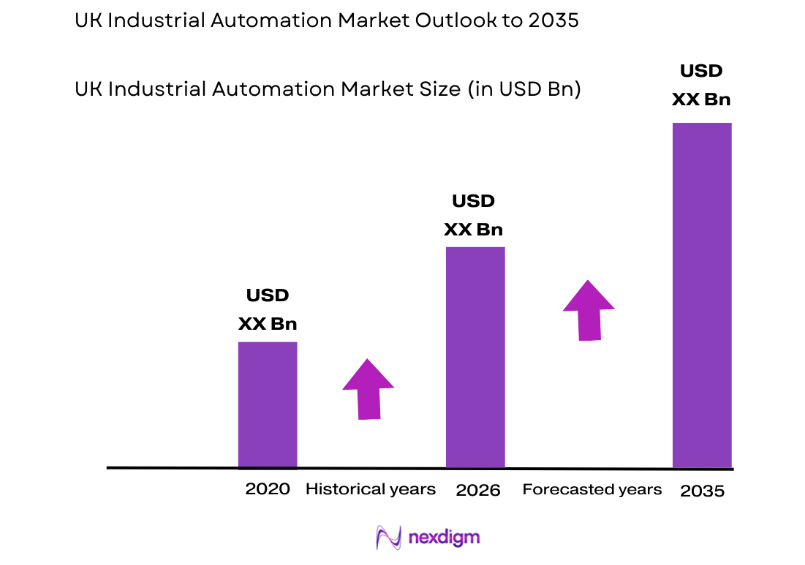
The UK Industrial Automation market is projected to reach USD ~ billion in 2025, driven by the increasing adoption of automation technologies across industries such as manufacturing, automotive, and energy. The demand for industrial automation is being fueled by the need to improve operational efficiency, reduce labor costs, and enhance product quality. Technologies like robotics, AI, and IoT are playing a significant role in automating complex manufacturing processes, enabling smarter and more agile operations in various sectors.
Key regions such as London, Manchester, and the West Midlands dominate the UK Industrial Automation market due to their established industrial infrastructure and access to cutting-edge technology. London is a hub for technological innovations and digital transformation, while the West Midlands is home to a large automotive manufacturing base, where automation plays a critical role in streamlining production. Manchester, with its focus on advanced manufacturing and engineering, is also a significant player in the adoption of automation technologies. These cities are driving demand for automation solutions, supported by a combination of skilled labor, government incentives, and industrial growth.
Market Segmentation
By Product Type
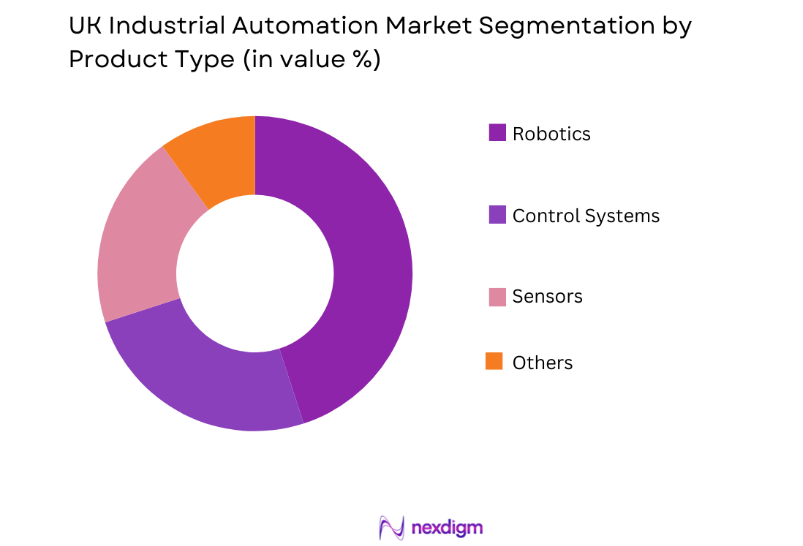
The UK Industrial Automation market is segmented by product type into robotics, control systems, sensors, and others. Recently, robotics has captured the dominant market share due to its widespread application across industries such as manufacturing, automotive, and electronics. Robotics is integral to automating tasks such as assembly, welding, and packaging, allowing companies to improve efficiency and reduce costs. The increasing adoption of collaborative robots (cobots) that work alongside human operators has also contributed to the growing demand for robotic solutions. As industries move toward Industry 4.0, the demand for robots that can handle complex tasks with high precision continues to rise, solidifying robotics as the dominant sub-segment.
By End-User Industry
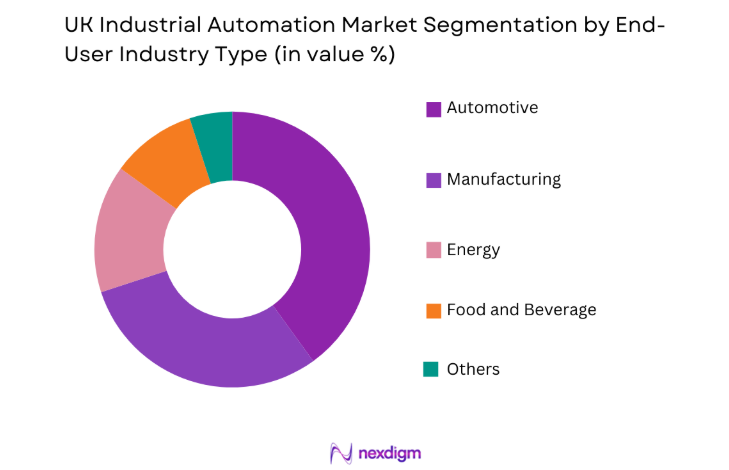
The UK Industrial Automation market is segmented by end-user industry into automotive, manufacturing, energy, food and beverage, and others. The automotive industry holds a dominant market share in industrial automation due to the increasing demand for automation in vehicle production processes. Robotics and automation systems are heavily used for tasks such as assembly, painting, and quality inspection. The push toward electric vehicles (EVs) and the growing demand for customized manufacturing are further driving the need for automation technologies in the automotive sector. Additionally, the focus on reducing production costs, improving quality control, and ensuring worker safety in automotive manufacturing continues to fuel the demand for automation solutions.
Competitive Landscape
The UK Industrial Automation market is characterized by intense competition, with both global players and local companies striving to meet the growing demand for automation solutions. Key players are focusing on continuous innovation, strategic partnerships, and acquisitions to expand their market presence. Robotics and control system manufacturers are incorporating AI and machine learning into their offerings to enhance the intelligence and adaptability of their automation solutions. As the market for industrial automation expands, consolidation is expected to increase, with companies seeking to leverage technological advancements and expand their customer base. Government initiatives promoting digital transformation in manufacturing are further encouraging competition.
| Company Name | Establishment Year | Headquarters | Technology Focus | Market Reach | Key Products | Revenue | Additional Parameter |
| Siemens | 1847 | Munich, Germany | ~ | ~ | ~ | ~ | ~ |
| Rockwell Automation | 1903 | Milwaukee, USA | ~ | ~ | ~ | ~ | ~ |
| ABB | 1988 | Zurich, Switzerland | ~ | ~ | ~ | ~ | ~ |
| Honeywell | 1906 | Morris Plains, USA | ~ | ~ | ~ | ~ | ~ |
| Mitsubishi Electric | 1921 | Tokyo, Japan | ~ | ~ | ~ | ~ | ~ |
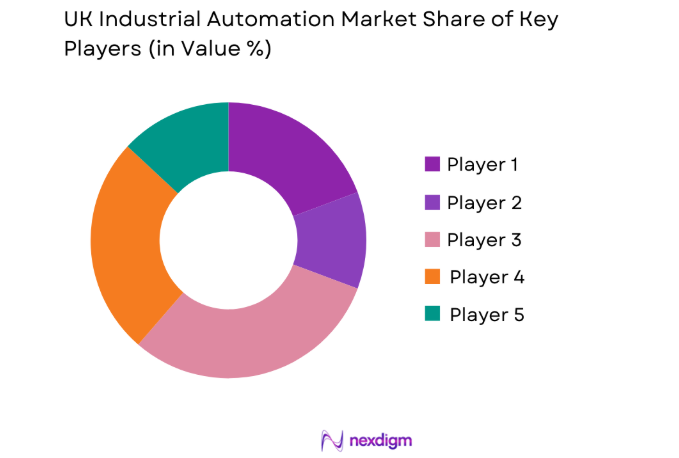
UK Industrial Automation Market Analysis
Growth Drivers
Technological Advancements in Robotics
Technological advancements in robotics are a key driver of the UK Industrial Automation market. Robotics technology has evolved significantly in recent years, allowing for more flexible, adaptable, and cost-effective automation solutions. The introduction of collaborative robots (cobots), which can work alongside human operators, has expanded the applications of robotics in industries such as automotive, electronics, and food processing. Robotics systems are now capable of performing increasingly complex tasks, from precision assembly to inspection and maintenance, driving the need for more advanced robotic solutions. Furthermore, the integration of artificial intelligence (AI) and machine learning in robotic systems enables real-time decision-making, predictive maintenance, and optimization of production processes. These technological advancements have made robotics more accessible and beneficial to a broader range of industries, fueling the growth of industrial automation in the UK.
Government Initiatives and Industry 4.0 Adoption
Government support and the adoption of Industry 4.0 technologies are significant growth drivers for the UK Industrial Automation market. The UK government has implemented various policies and initiatives to encourage the adoption of digital technologies in manufacturing, with a focus on automation and smart manufacturing. Programs aimed at promoting automation in SMEs, as well as the establishment of innovation hubs and digital manufacturing initiatives, have created a favorable environment for industrial automation growth. The adoption of Industry 4.0, which involves integrating IoT, cloud computing, and AI into manufacturing processes, is also driving the demand for automation technologies. By improving operational efficiency, reducing costs, and enhancing product quality, Industry 4.0 technologies are transforming traditional manufacturing processes and accelerating the shift toward fully automated production systems. As the UK continues to invest in its manufacturing infrastructure and workforce, the adoption of industrial automation solutions will continue to grow.
Market Challenges
High Initial Investment Costs
One of the significant challenges in the UK Industrial Automation market is the high initial investment costs associated with automation systems. While automation offers significant long-term benefits, such as increased productivity, reduced labor costs, and enhanced product quality, the upfront costs of acquiring and implementing automation technologies can be prohibitive for many businesses, particularly small and medium-sized enterprises (SMEs). The purchase of industrial robots, control systems, sensors, and software platforms, as well as the necessary training for employees and integration with existing systems, requires significant capital investment. Additionally, the cost of ongoing maintenance and updates for automation systems can add to the financial burden. This challenge is particularly acute in industries with tight profit margins, where companies may hesitate to make the necessary investments in automation. Overcoming this barrier will require companies to explore financing options, such as leasing or government subsidies, to make automation solutions more accessible to a broader range of businesses.
Integration with Legacy Systems
Integrating industrial automation solutions with existing legacy systems poses another significant challenge in the UK market. Many businesses, particularly in traditional manufacturing sectors, rely on older equipment and systems that were not designed for integration with modern automation technologies. The process of upgrading or replacing legacy systems to ensure compatibility with automation solutions can be complex, time-consuming, and costly. In some cases, companies may need to overhaul their entire production line to fully integrate automation technologies, which can lead to extended downtime and production delays. Furthermore, the lack of standardized interfaces and protocols across different automation systems can create interoperability issues, making it more difficult to achieve seamless integration. Overcoming this challenge requires companies to invest in system upgrades or work with solution providers to develop customized automation systems that can interface with legacy equipment.
Opportunities
Expansion of Smart Manufacturing and IoT Integration
The expansion of smart manufacturing and the integration of the Internet of Things (IoT) present significant opportunities for the UK Industrial Automation market. Smart manufacturing involves the use of connected devices, sensors, and AI to optimize production processes and improve decision-making in real-time. IoT technologies enable the seamless exchange of data between machines, sensors, and control systems, providing greater visibility into production workflows and enabling predictive maintenance, process optimization, and quality control. As more companies adopt smart manufacturing practices, the demand for industrial automation technologies that can support IoT integration will increase. Furthermore, the UK’s commitment to becoming a leader in digital manufacturing and Industry 4.0 will drive further investment in IoT-enabled automation systems. This creates a significant opportunity for automation solution providers to develop innovative systems that can integrate seamlessly with IoT networks, further enhancing operational efficiency and competitiveness.
Increased Demand for Energy Efficiency Solutions
The growing demand for energy efficiency in industrial operations presents a significant opportunity for the UK Industrial Automation market. As businesses face increasing pressure to reduce energy consumption and minimize environmental impact, automation technologies that optimize energy use are becoming more essential. Energy-efficient automation solutions, such as smart grids, energy management systems, and automated control systems, allow businesses to monitor and manage their energy usage more effectively. In the manufacturing sector, automation technologies can reduce energy waste by optimizing production schedules, adjusting machine settings in real-time, and identifying areas where energy consumption can be reduced. The UK government’s focus on sustainability and carbon reduction targets is also driving the adoption of energy-efficient automation solutions. Companies that provide energy-saving automation technologies are well-positioned to capture growth opportunities in the expanding green economy, as businesses seek to meet regulatory requirements and improve their environmental footprint.
Future Outlook
The UK Industrial Automation market is expected to experience steady growth over the next five years, driven by the continued adoption of Industry 4.0 technologies and advancements in robotics, AI, and IoT. The shift towards smart manufacturing, coupled with government initiatives aimed at fostering digital transformation in the manufacturing sector, will support this growth. As industries increasingly focus on sustainability and energy efficiency, demand for automation technologies that reduce energy consumption and improve productivity will rise. Additionally, the UK’s emphasis on becoming a global leader in digital and green manufacturing will continue to create opportunities for innovation and expansion in the industrial automation sector.
Major Players
- Siemens
- Rockwell Automation
- ABB
- Honeywell International
- Mitsubishi Electric
- General Electric
- Schneider Electric
- Bosch Rexroth
- Emerson Electric
- Yaskawa Electric
- FANUC Corporation
- Omron Corporation
- Beckhoff Automation
- Panasonic
- Rethink Robotics
Key Target Audience
- Investments and venture capitalist firms
- Government and regulatory bodies
- Manufacturing industry leaders
- Automation technology providers
- Industrial system integrators
- Energy and utilities companies
- Transportation industry players
Research Methodology
Step 1: Identification of Key Variables
Key market drivers, challenges, and trends affecting industrial automation, such as technological advancements, regulatory support, and economic factors, are identified.
Step 2: Market Analysis and Construction
An in-depth analysis of market trends, segmentation, and competitive landscape is conducted to construct a comprehensive market model that accurately represents current conditions.
Step 3: Hypothesis Validation and Expert Consultation
Industry experts, stakeholders, and academic professionals are consulted to validate assumptions and refine the market analysis based on real-world insights.
Step 4: Research Synthesis and Final Output
The research findings are synthesized into a comprehensive report, providing actionable insights, recommendations, and forecasts for stakeholders in the UK Industrial Automation market.

- Executive Summary
- Research Methodology (Definitions, Scope, Industry Assumptions, Market Sizing Approach, Primary & Secondary Research Framework, Data Collection & Verification Protocol, Analytic Models & Forecast Methodology, Limitations & Research Validity Checks)

- Market Definition and Scope
- Value Chain & Stakeholder Ecosystem
- Regulatory / Certification Landscape
- Sector Dynamics Affecting Demand

- Growth Drivers
Increasing Demand for Robotics in Automotive Manufacturing
Rise of Smart Factories and Industry 4.0 Adoption
Government Support for Digital Transformation in Manufacturing - Market Challenges
High Initial Capital Investment for Automation Solutions
Complex Integration with Legacy Systems
Lack of Skilled Workforce for Advanced Automation - Market Opportunities
Smart Factory Adoption in Small and Medium Enterprises
Increasing Use of Automation in Logistics and Warehousing
Growth of Predictive Maintenance and IoT Solutions - Trends
Adoption of Collaborative Robots in Manufacturing
Integration of AI and Machine Learning in Industrial Automation - Government Regulations
- SWOT Analysis
- Porter’s Five Forces

- By Market Value, 2020-2025
- By Installed Units, 2020-2025
- By Average System Price, 2020-2025
- By System Complexity Tier, 2020-2025

- By System Type (In Value%)
Industrial Robots
Programmable Logic Controllers
Distributed Control Systems
Supervisory Control and Data Acquisition Systems
Industrial Machine Vision Systems - By Platform Type (In Value%)
Automotive Manufacturing Automation Platforms
Electronics and Semiconductor Manufacturing Platforms
Energy and Utilities Automation Platforms
Logistics and Warehouse Automation Platforms - By Fitment Type (In Value%)
New Industrial Automation Installations
Retrofit Automation for Existing Facilities
Integrated Smart Factory Automation Systems
Modular Industrial Automation Solutions - By End User Segment (In Value%)
Automotive and Industrial Manufacturing
Electronics and Semiconductor Manufacturing
Energy and Utilities Sector

- Market Share Analysis
- Cross Comparison Parameters (Automation System Flexibility, Integration Capabilities, Robotics Portfolio, Industry Application, After-Sales Service, Pricing Strategy, Innovation in R&D)
- SWOT Analysis of Key Competitors
- Pricing & Procurement Analysis
- Key Players
Siemens AG
Schneider Electric
Rockwell Automation
Mitsubishi Electric
Omron Corporation
Honeywell International
Emerson Electric
Bosch Rexroth
Fanuc Corporation
KUKA AG
Hitachi Industrial Equipment Systems
Delta Electronics
Keyence Corporation
Yaskawa Electric
ABB Ltd

- Automotive Manufacturers Integrating Robotics for Efficiency
- Electronics Manufacturers Deploying Automation for Precision
- Energy Companies Using Automation for Infrastructure Monitoring
- Logistics Providers Adopting Automation for Warehouse Management

- Forecast Market Value, 2026-2035
- Forecast Installed Units, 2026-2035
- Price Forecast by System Tier, 2026-2035
- Future Demand by Platform, 2026-2035


 Request a Sample
 Ask for Customization
 Get a Quote
 Enquire Now