

 Download PDF
Market Overview
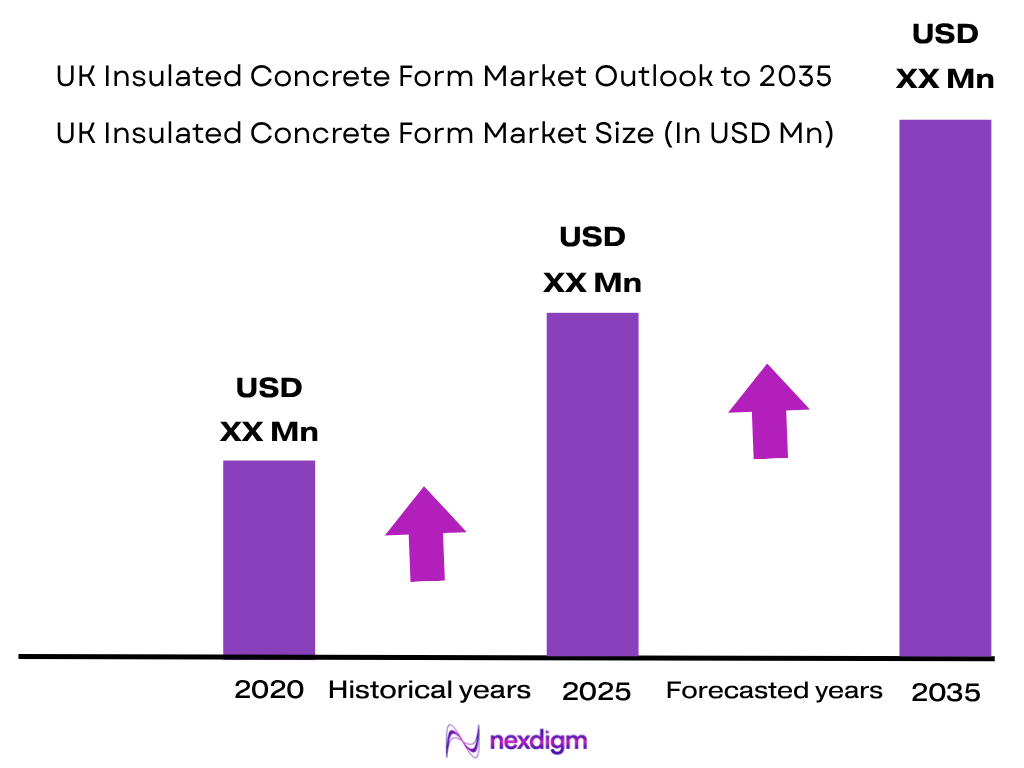
The UK Insulated Concrete Form Market is valued at approximately GBP ~XX million, supported by low-energy residential construction, self-build housing, basements and increasing fabric-performance requirements. Great Britain recorded GBP 140.684 billion of new construction work in the latest complete period, compared with approximately GBP 138.780 billion in the preceding period. England also recorded 64,851 individuals on self-build and custom-build registers and 4,302 serviced-plot permissions, providing an addressable pipeline for ICF-based housing systems.
South East England, South West England, the Midlands, London and South Wales represent important UK ICF demand and supply clusters because they combine residential development, self-build activity, basement construction and access to specialist manufacturers and installers. Homes England recorded 14,295 housing completions in its latest half-year period versus 11,718 previously, while South East and South West England remained significant affordable-housing delivery regions. South Wales additionally supports domestic ICF production, including PolySteel manufacturing operations in Newport.
Market Segmentation
By Formwork Architecture
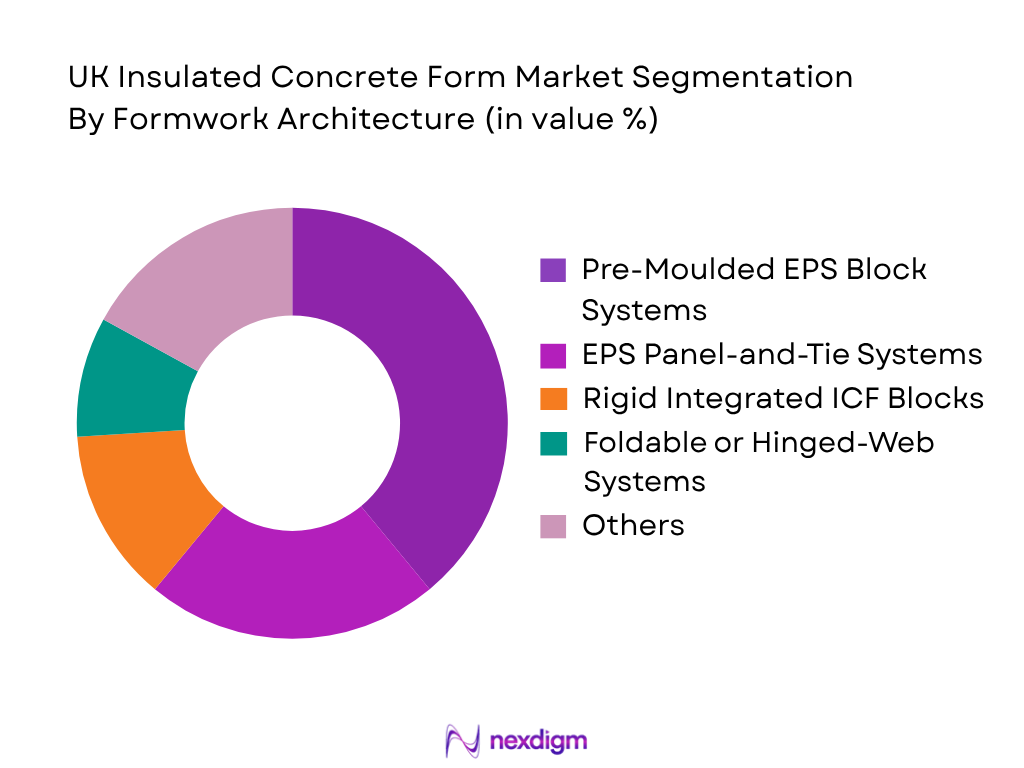
The UK Insulated Concrete Form Market is segmented into pre-moulded EPS blocks, EPS panel-and-tie systems, rigid integrated blocks, foldable-web systems, variable-width panel systems, woodcrete permanent formwork and other hybrid systems. Pre-moulded EPS block systems hold the dominant report-model market share because they provide a practical combination of permanent insulation, concrete formwork, structural continuity and rapid site assembly. The UK Insulating Concrete Formwork Association identifies a substantial supplier ecosystem for EPS ICF, including Altherm, Amvic, Beco Wallform, Build Homes Better, Econekt, IntegraSpec, Nudura, PolySteel and Thermohouse. EPS blocks are particularly suited to detached homes, self-build developments, basements, pools and retaining walls because the same form remains permanently around the concrete core after pouring. Suppliers increasingly differentiate through interlocking geometry, bracing requirements, web or tie design, concrete-core flexibility and insulation thickness. PolySteel, for example, offers rigid steel-tie forms manufactured domestically, while other systems use polymer webs or panel-and-tie arrangements. This broad system availability makes EPS block-based construction the most established ICF architecture within the UK market.
By Building Type
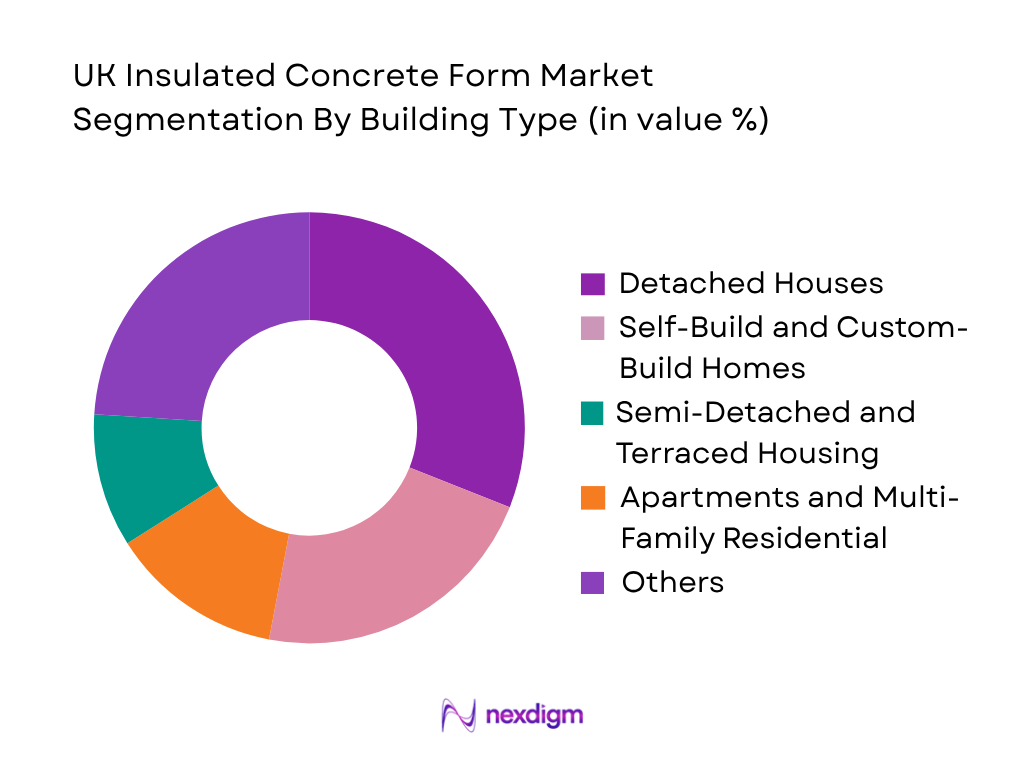
The UK Insulated Concrete Form Market is segmented into detached houses, semi-detached and terraced houses, multi-family residential buildings, self-build and custom-build homes, social and affordable housing, commercial buildings, education and healthcare facilities, hospitality properties and industrial buildings. Detached and self-build residential construction collectively represent the dominant demand environment, because ICF allows design flexibility, high airtightness, thermal continuity, basement integration and simplified construction of complex wall geometries. Government self-build data recorded 64,851 individuals on local authority registers and 766 groups, while 4,302 planning permissions were granted for serviced plots suitable for self-build and custom-build activity. ICF also benefits from the structural characteristics of reinforced concrete for large openings, cantilevers, below-ground rooms and swimming pools frequently associated with individually designed housing. Residential adoption is further supported by increasing emphasis on fabric performance under UK building-energy regulation. Commercial and institutional penetration remains smaller but benefits from fire resistance, acoustic performance, structural durability and the ability to construct multi-storey concrete envelopes using permanent insulated formwork.
Competitive Landscape
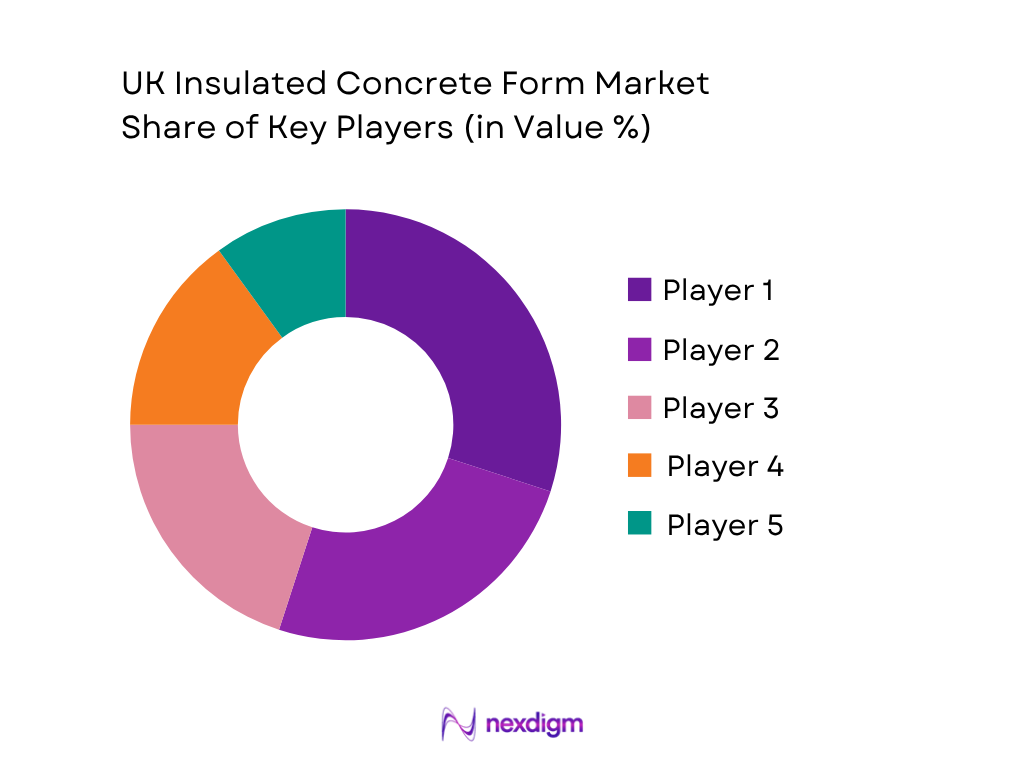
The UK Insulated Concrete Form Market comprises domestic manufacturers, UK distributors of international systems and integrated building-envelope suppliers. Competition centres on achievable wall thermal performance, concrete-core flexibility, certification, UK stock availability, basement suitability, installation training and structural-design support. Domestic manufacturing provides supply-chain advantages for companies such as PolySteel, while Beco Wallform has a long-established UK presence. International systems including Nudura, Amvic and BEWI compete through product engineering, broader building-envelope portfolios and established technical platforms.
| Major Player | Established | Headquarters | ICF Architecture | Concrete Core Flexibility | Thermal Performance Capability | Basement / Retaining Applications | UK Supply Position | Technical / Installer Support |
| Beco Wallform | 1992 | Brigg / Dartford, UK | ~ | ~ | ~ | ~ | ~ | ~ |
| PolySteel UK | 2008 | Salisbury, UK | ~ | ~ | ~ | ~ | ~ | ~ |
| Nudura | 2001 | Ontario, Canada / Tremco CPG | ~ | ~ | ~ | ~ | ~ | ~ |
| Amvic Building System | 1997 | Toronto, Canada | ~ | ~ | ~ | ~ | ~ | ~ |
| BEWI | 1980 | Frøya, Norway | ~ | ~ | ~ | ~ | ~ | ~ |
UK Insulated Concrete Form Market Analysis
Growth Drivers
Expansion of Residential and Public Housing Construction
The expansion of UK residential and public housing construction is strengthening the addressable base for the UK Insulated Concrete Form Market because ICF systems are deployed in structural external walls, basements, retaining structures and energy-efficient housing. The Office for National Statistics recorded GBP 140,684 million of new construction work in Great Britain during 2024, including an additional GBP 3,826 million of public new-housing work and GBP 1,731 million of private infrastructure work. Homes England separately recorded 38,308 housing starts and 36,872 completions across its programmes between April 2024 and March 2025, including 30,087 affordable-housing starts. These volumes create a substantial project base for permanent insulated formwork, reinforced concrete cores, EPS components, reinforcement and specialist installation services. The broader macroeconomic environment also provides significant construction capacity: World Bank data places UK GDP at USD 3,686,033.04 million and GDP per capita at USD 53,246.4 in 2024. The combination of major housing delivery and sustained construction investment supports greater consideration of ICF where developers require structural durability, thermal continuity, airtightness and simplified wall construction.
Expansion of Self-Build and Custom-Build Housing
Self-build and custom-build housing is another direct growth driver for the UK Insulated Concrete Form Market because ICF is particularly suitable for individually designed detached homes, complex architectural geometries, basements and fabric-first construction where the building owner has greater influence over structural-system selection. Ministry of Housing, Communities and Local Government data recorded 64,851 individuals and 766 groups on England’s self-build and custom-build registers at 30 October 2024. During the same reporting period, 3,999 new individuals joined the registers and local authorities granted 4,302 planning permissions for serviced plots suitable for self-build and custom housebuilding. Homes England additionally delivered 15,682 housing starts and 14,295 housing completions between April and September 2024, reinforcing the broader residential project pipeline. World Bank data records UK GDP at USD 3,686,033.04 million and GDP per capita at USD 53,246.4 in 2024. These conditions support ICF adoption because self-build customers frequently prioritize low-energy performance, airtight envelopes, structural longevity, basement integration, large openings and construction systems capable of combining insulation and reinforced-concrete structure within a single wall assembly.
Market Challenges
Constrained New-Housing Project Pipeline
A constrained new-housing pipeline represents a material challenge for the UK Insulated Concrete Form Market because demand for ICF blocks, panels, concrete cores and installation services depends directly on residential schemes progressing from planning into structural construction. Ministry of Housing, Communities and Local Government data recorded 107,530 new-build dwelling starts in England during the year ending December 2024. In the final quarter, seasonally adjusted starts stood at 30,860 dwellings, while completions reached 36,830 dwellings. During the same year, 217,910 new-dwelling Energy Performance Certificates were lodged, illustrating substantial activity but also a finite addressable pool for competing structural-wall technologies. Reduced project availability increases competition between ICF, masonry cavity walls, timber frame and structural insulated panels, especially where developers prioritize familiar construction methods. It can also reduce distributor stock turnover and specialist-installer utilization. World Bank data places UK GDP at USD 3,686,033.04 million and GDP per capita at USD 53,246.4 in 2024. ICF suppliers therefore need early-stage specification engagement, structural engineering support and demonstrable construction-programme benefits to convert housing projects into actual system demand.
Installer Capability and Contractor Financial Resilience
Installer capability and contractor financial resilience remain important challenges for the UK Insulated Concrete Form Market because ICF construction requires correct form alignment, reinforcement placement, bracing, opening preparation, concrete-pour sequencing and finishing coordination. Office for National Statistics data records approximately 1.4 million construction employees in Great Britain during 2024, while continuing skilled-labour shortages were reported across the construction industry. Financial pressure adds execution risk: the Insolvency Service recorded 4,102 construction-company insolvencies in England and Wales during the 12 months to November 2024, making construction the industry with the largest insolvency count in that release. Across all sectors, 23,872 companies entered insolvency procedures during 2024, comprising 18,840 creditors’ voluntary liquidations, 3,230 compulsory liquidations, 1,597 administrations and 202 company voluntary arrangements. Contractor failure or insufficient ICF experience can disrupt structural pours, waterproofing interfaces and project schedules. World Bank data records UK GDP at USD 3,686,033.04 million and GDP per capita at USD 53,246.4 in 2024. Suppliers therefore require stronger approved-installer networks, site training, technical supervision and contractor qualification processes.
Market Opportunities
Building-Envelope Regulation and Fabric-First Construction
The strengthening of building-envelope requirements creates a significant future opportunity for the UK Insulated Concrete Form Market because ICF combines permanent insulation, reinforced concrete structure and reduced thermal discontinuities within one wall system. The Ministry of Housing, Communities and Local Government published the Future Homes and Buildings Standards package and revised Approved Document L in March 2026, reinforcing the policy direction toward better energy and greenhouse-gas performance in new buildings. This regulatory environment increases the strategic relevance of wall systems capable of supporting low thermal transmittance, airtight construction and robust junction detailing. Current construction activity provides a substantial base for future specification: the Office for National Statistics recorded GBP 140,684 million of new construction work during 2024, while Homes England supported 38,308 housing starts and 36,872 completions between April 2024 and March 2025. World Bank data records UK GDP at USD 3,686,033.04 million and GDP per capita at USD 53,246.4 in 2024. ICF suppliers can capitalize through verified thermal calculations, certified wall systems, airtightness detailing and integrated foundation-to-wall solutions for residential and affordable-housing developers.
Self-Build, Affordable Housing and Specialist Structural Applications
Expansion across self-build housing, affordable housing and specialist concrete applications creates another future opportunity for the UK Insulated Concrete Form Market because these projects place greater emphasis on design flexibility, thermal continuity, reinforced structural performance and basement integration. England’s self-build and custom-build registers contained 64,851 individuals and 766 groups at 30 October 2024, while local authorities granted 4,302 serviced-plot planning permissions during the reporting period. Homes England separately enabled 38,308 housing starts between April 2024 and March 2025, including 30,087 affordable-housing starts, alongside 36,872 total completions. These current indicators create potential demand channels beyond mainstream speculative development, including bespoke detached homes, low-energy housing, social housing, basements, retaining structures and other reinforced-concrete building applications. World Bank data places UK GDP at USD 3,686,033.04 million and GDP per capita at USD 53,246.4 in 2024. Suppliers that combine certified ICF products with structural engineering, installer training, waterproofing detailing, local stock availability and on-site technical assistance are positioned to convert this established project base into broader specification and long-term ICF adoption.
Future Outlook
The UK Insulated Concrete Form Market is forecast to expand at approximately ~XX% CAGR during 2026–2035, with demand increasingly influenced by tighter building-envelope regulation, housing delivery, self-build construction and greater emphasis on low-energy structural systems. The Future Homes and Buildings Standards strengthen the regulatory direction toward highly energy-efficient buildings and low-carbon heating, improving the strategic relevance of well-insulated, airtight wall technologies such as ICF.
Residential construction will remain central to market development. Great Britain generated GBP 140.684 billion of new construction work in the latest complete annual dataset, while public new housing was one of the largest positive contributors to new-work growth. The combination of housing requirements and regulatory emphasis on building-fabric performance should strengthen specification interest in wall systems that integrate insulation, concrete structure and airtightness within a single construction method.
Major Players
- Nudura
- Amvic Building Systems
- Beco Wallform
- PolySteel
- BEWI
- Thermohouse
- Altherm ICF
- Econekt
- IntegraSpec
- Build Homes Better
- R-Wall
- Velox Systems
- Quad-Lock Building Systems
- Ecobrix / Durisol UK
- ICF Building Solutions
Key Target Audience
- Insulated Concrete Form Manufacturers and System Suppliers
- Residential Developers and Housebuilders
- Self-Build and Custom-Build Developers
- Basement, Swimming Pool and Specialist Concrete Contractors
- Building Material, EPS and Concrete Manufacturers
- Architects, Structural Engineering Practices and Building-System Specifiers
- Investments and Venture Capitalist Firms
- Government and Regulatory Bodies (Ministry of Housing, Communities and Local Government, Building Safety Regulator, Homes England, Scottish Government, Welsh Government, Department for Communities Northern Ireland)
Research Methodology
Step 1: Identification of Key Variables
The initial phase involves developing an ecosystem map of the UK Insulated Concrete Form Market, covering ICF manufacturers, EPS moulders, woodcrete suppliers, ready-mix concrete providers, reinforcement suppliers, distributors, approved installers, structural engineers, architects, developers and contractors. Critical variables include wall area installed, block dimensions, concrete-core width, insulation thickness, U-value capability, building application, domestic manufacturing, import dependence, certification coverage and installer-network availability.
Step 2: Market Analysis and Construction
Historical market analysis is developed using an integrated top-down and bottom-up approach. The top-down assessment evaluates residential construction, self-build activity, basement development, commercial construction and regulatory requirements, while the bottom-up model analyses supplier volumes, ICF wall area, blocks or panels required per square metre, project mix and application categories. Both approaches are reconciled to establish market value, installed wall area and segmentation structure.
Step 3: Hypothesis Validation and Expert Consultation
Market hypotheses are validated through computer-assisted telephone interviews with ICF system suppliers, distributors, installers, structural engineers, architects, concrete contractors and residential developers. Discussions assess system selection criteria, EPS versus woodcrete preferences, concrete-core configurations, project qualification requirements, installer availability, certification, U-value requirements, basement suitability, construction sequencing and competitive substitution from masonry, timber-frame and structural insulated panel construction.
Step 4: Research Synthesis and Final Output
The final phase integrates supplier intelligence, construction indicators, regulatory requirements, certification data and project-level ICF consumption assumptions. Bottom-up wall-area estimates are triangulated against top-down residential and non-residential construction indicators to validate market structure. Competitive analysis then evaluates thermal performance, system architecture, concrete-core flexibility, UK manufacturing, BBA or KIWA certification, approved installer networks, basement capability and technical support before producing the final UK Insulated Concrete Form Market outlook.

- Executive Summary
- Research Methodology (Market Definition and Scope, UK Insulated Concrete Form Market Classification, ICF Wall System Demand Assessment, EPS and Woodcrete Formwork Consumption Mapping, Domestic Manufacturing Capacity Assessment, Import Dependency Analysis, Concrete Core and Insulation Configuration Assessment, Residential Construction Demand Mapping, Basement and Retaining Wall Application Assessment, Installer and Distributor Network Mapping, BBA and KIWA Certification Assessment, Primary Industry Interviews, Top-Down Market Sizing, Bottom-Up Wall Area and Company Revenue Assessment, Supply Chain Analysis, Data Triangulation, Pricing Assessment, Forecasting Framework)

- Definition and Scope
- UK Insulated Concrete Form Industry Evolution and Development of Permanent Insulated Formwork, Low-Energy Housing and Modern Methods of Construction Ecosystem
- Expanded Polystyrene Panel, Moulded EPS Block, Woodcrete Formwork, Concrete Core and Building Envelope Industry Structure
- UK Insulated Concrete Form Value Chain Analysis
- UK Insulated Concrete Form Supply Chain Analysis
- ICF Manufacturer, EPS Producer, Woodcrete Supplier, Ready-Mix Concrete Producer, Reinforcement Supplier, Distributor, Structural Engineer, Installer, Main Contractor, Developer and Building Owner Ecosystem Analysis
- Insulated Concrete Form Integration Across Residential Housing, Basements, Retaining Walls, Commercial Buildings, Swimming Pools and Low-Energy Construction Applications

- Growth Drivers (Higher Building Fabric Energy Performance Requirements, Future Homes and Buildings Standards, Demand for Airtight Building Envelopes, Reduction of Thermal Bridging, Self-Build and Custom-Build Adoption, Skilled Masonry Labour Constraints, Faster Structural Shell Construction, Basement and Flood-Resilient Housing Applications, Modern Methods of Construction Adoption)
- Market Challenges (Higher Upfront System Familiarisation Requirements, Installer Training Requirements, Concrete Pour Quality Control, Formwork Blowout Risk, Limited Architect and Contractor Familiarity, Competition from Timber Frame and Structural Insulated Panels, Embodied Carbon Scrutiny of Concrete and EPS, Imported ICF Lead Times, Certification and Warranty Requirements)
- Market Opportunities (Low-Energy Residential Development, Passivhaus-Compatible ICF Systems, Affordable and Social Housing, Basement and Flood-Resilient Construction, High-Density Residential Applications, UK-Manufactured ICF Expansion, Lower-Carbon Concrete Integration, Recycled-Content EPS Systems, Woodcrete ICF Adoption, Complete Foundation-Wall-Roof Building Systems)
- Market Trends (Fabric-First Construction, Lower U-Value Wall Systems, Improved Airtightness, Thicker External Insulation Layers, Graphite EPS Adoption, Integrated Insulated Raft Foundations, Single-Source Building Envelope Packages, BBA-Certified Systems, Installer Training Networks, Digital Design and Structural Detailing)
- Regulatory and Standards Landscape (Building Regulations Part L Energy and Greenhouse Gas Emissions, Approved Document B Fire Safety, Approved Document C Site Preparation and Moisture Resistance, Approved Document E Resistance to Sound, Approved Document A Structure, Future Homes and Buildings Standards, BBA Certification, KIWA Certification, NHBC Requirements, Building Safety Regulatory Framework)
- SWOT Analysis
- Porter’s Five Forces Analysis
- PESTLE Analysis
- Stakeholder Ecosystem
- Competition Ecosystem

- By Market Value (2020-2025)
- By ICF Wall Area Installed (2020-2025)
- By ICF Block and Panel Consumption Volume (2020-2025)
- By Residential ICF Wall Area (2020-2025)
- By Non-Residential ICF Wall Area (2020-2025)
- By Above-Ground ICF Wall Area (2020-2025)
- By Basement and Below-Ground ICF Wall Area (2020-2025)
- By Domestic ICF Production Volume (2020-2025)

- By Formwork Architecture (In Value %)
Pre-Moulded EPS Block Systems
EPS Panel-and-Tie Systems
Foldable or Hinged-Web ICF Systems
Rigid Integrated ICF Blocks
Variable-Width Panel Systems
Woodcrete Permanent Formwork Systems
Hybrid Insulated Concrete Form Systems
Specialty High-Insulation ICF Systems - By Application Type (In Value %)
Above-Ground External Walls
Internal Load-Bearing Walls
Basement Walls
Foundations
Retaining Walls
Party Walls
Swimming Pool Structures
Garden Rooms and Ancillary Buildings
Commercial Structural Walls
Multi-Storey Building Envelopes - By Building Type (In Value %)
Detached Houses
Semi-Detached Houses
Terraced Housing
Apartments and Multi-Family Residential Buildings
Self-Build and Custom-Build Homes
Social and Affordable Housing
Commercial Buildings
Educational Buildings
Healthcare and Care Facilities
Hospitality and Leisure Buildings
Industrial and Agricultural Buildings - By Thermal Performance Category (In Value %)
Standard Building Regulation-Compliant ICF
Enhanced Low-U-Value ICF
Low-Energy Building ICF
Passivhaus-Oriented ICF
High-Thermal-Mass ICF Systems
Low-Thermal-Bridge ICF Systems
High-Airtightness ICF Envelopes
Net-Zero-Ready Building Envelope Systems - By Distribution and Delivery Model (In Value %)
Direct Manufacturer Supply
National ICF Distributor Supply
Regional Authorized Distributor Supply
Installer-Led Supply
Supply-and-Fit Packages
Main Contractor Procurement
Developer Direct Procurement
Self-Builder Direct Purchase
Design-Supply-Technical Support Packages

- Market Share of Major Players (By UK Revenue, ICF Wall Area, Formwork Architecture, Insulation Material, Building Application, Thermal Performance Category, UK Manufacturing and Distribution Footprint, Customer Segment Distribution)
- Cross Comparison Parameters (UK ICF Revenue, ICF System and Formwork Architecture Breadth, Achievable Wall U-Value and Thermal Performance Range, Concrete Core Width and Structural Configuration Flexibility, BBA KIWA and Building Regulation Certification Coverage, Basement Retaining Wall and Above-Ground Application Capability, UK Manufacturing Distribution and Approved Installer Footprint, Structural Design Training and On-Site Technical Support Capability)
- SWOT Analysis of Major Players
- Competitive Positioning Matrix
- ICF Wall-System and Product Portfolio Benchmarking
- Pricing and ICF System Category Benchmarking
- Thermal, Structural and Building Envelope Performance Assessment
- Manufacturing, Distribution and Approved Installer Network Assessment
- Above-Ground, Basement and Retaining-Wall Application Positioning
- Detailed Profiles of Major Companies
Nudura
Amvic Building Systems
Beco Wallform
PolySteel
BEWI
Thermohouse
Altherm ICF
Econekt
IntegraSpec
Build Homes Better
R-Wall
Velox Systems
Quad-Lock Building Systems
Ecobrix / Durisol UK
ICF Building Solutions

- Self-Builder ICF Selection Assessment
- Housebuilder and Residential Developer ICF Adoption Analysis
- Social and Affordable Housing Provider Requirement Assessment
- Architect and Specifier ICF System Evaluation
- Structural Engineer Concrete-Core and Reinforcement Requirement Assessment
- Main Contractor Installation and Programme Assessment
- Basement Contractor ICF Procurement Analysis
- Swimming Pool Contractor ICF System Requirement Assessment
- Commercial Developer Building Envelope Assessment
- Low-Energy Housing Developer ICF Procurement Analysis

- By Market Value (2026-2035)
- By ICF Wall Area Installed (2026-2035)
- By ICF Block and Panel Consumption Volume (2026-2035)
- By Residential ICF Wall Area (2026-2035)
- By Non-Residential ICF Wall Area (2026-2035)
- By Above-Ground ICF Wall Area (2026-2035)
- By Basement and Below-Ground ICF Wall Area (2026-2035)
- By Domestic ICF Production Volume (2026-2035)


 Request a Sample
 Ask for Customization
 Get a Quote
 Enquire Now