

 Download PDF
Market Overview
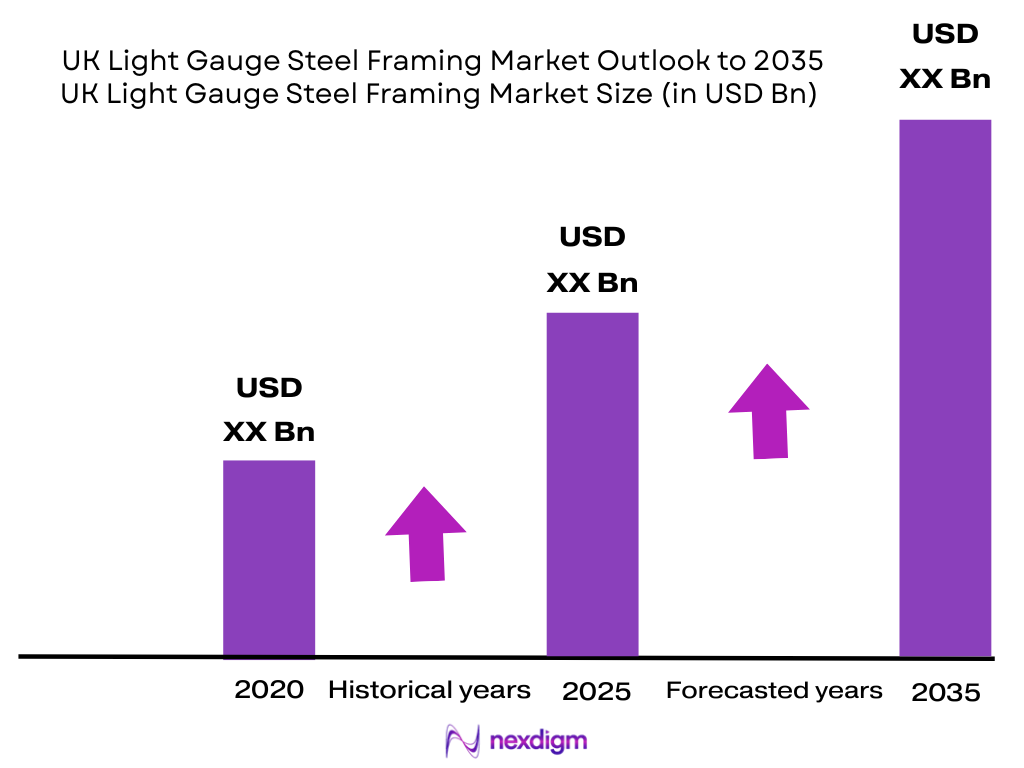
The UK Light Gauge Steel Framing Market is valued at ~ billion, supported by residential, commercial, institutional, SFS infill and off-site construction demand. Great Britain’s construction new-work value increased from approximately GBP 138.7 billion to GBP 140.7 billion across the two latest annual observations. Light steel demand is driven by multi-storey infill walls, apartments, student accommodation, hotels, healthcare projects and factory-manufactured building systems requiring lightweight, dry and dimensionally precise framing. London, South East England, West Midlands, North West England and major cities including Manchester, Birmingham and Leeds represent important UK Light Gauge Steel Framing demand centres because they concentrate multi-storey residential, Build-to-Rent, student accommodation, commercial and mixed-use development. Construction output expanded in the latest observation after a preceding period in which new work weakened, while London and regional cities continue to favour SFS infill for framed buildings where rapid façade closure, low structural weight and dry installation are valuable.
Market Segmentation
By Framing System
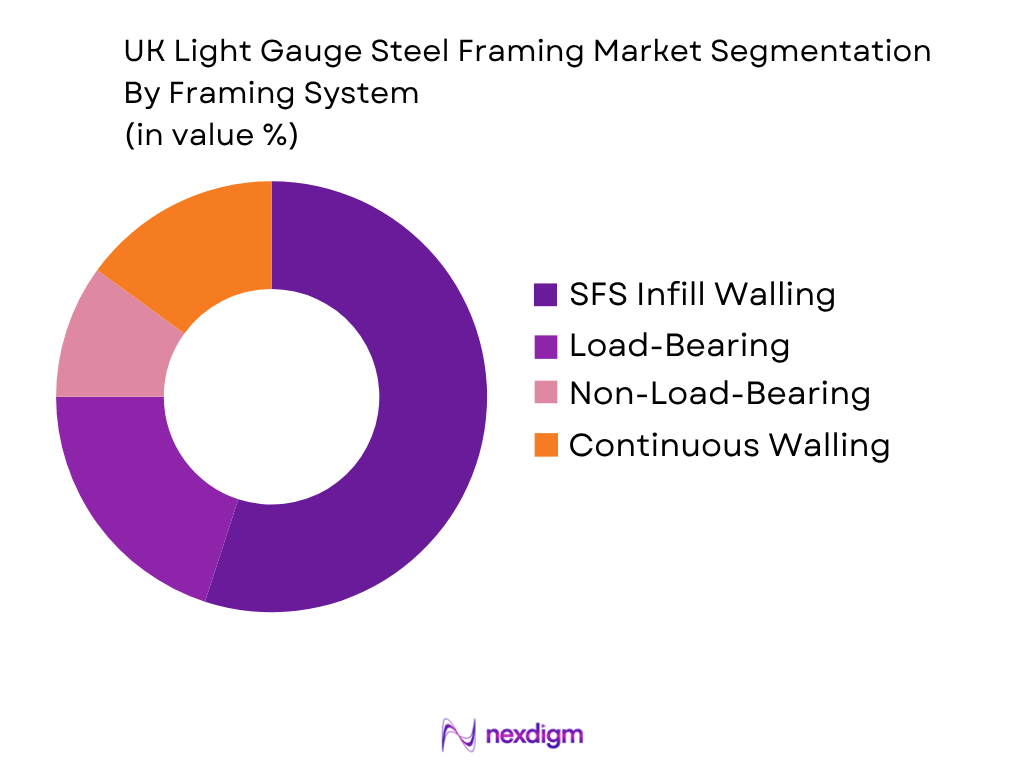
The UK Light Gauge Steel Framing Market is segmented into SFS infill walling, load-bearing light gauge steel framing, non-load-bearing internal steel framing, external continuous walling, and floor and roof framing systems. SFS infill walling represents the dominant segment in the report model because it is extensively integrated into concrete and hot-rolled steel multi-storey structures to form lightweight external wall zones. Infill systems span between floor slabs and support cladding while resisting façade wind loads, allowing the primary building frame to remain structurally independent. UK construction practice has established SFS as a common solution for apartments, hotels, student accommodation, healthcare and commercial projects. Metsec identifies infill walling as the most common application for its UK SFS products, while industry guidance notes that prefabricated or site-assembled C-section walls can materially accelerate enclosure relative to traditional blockwork.
By Application
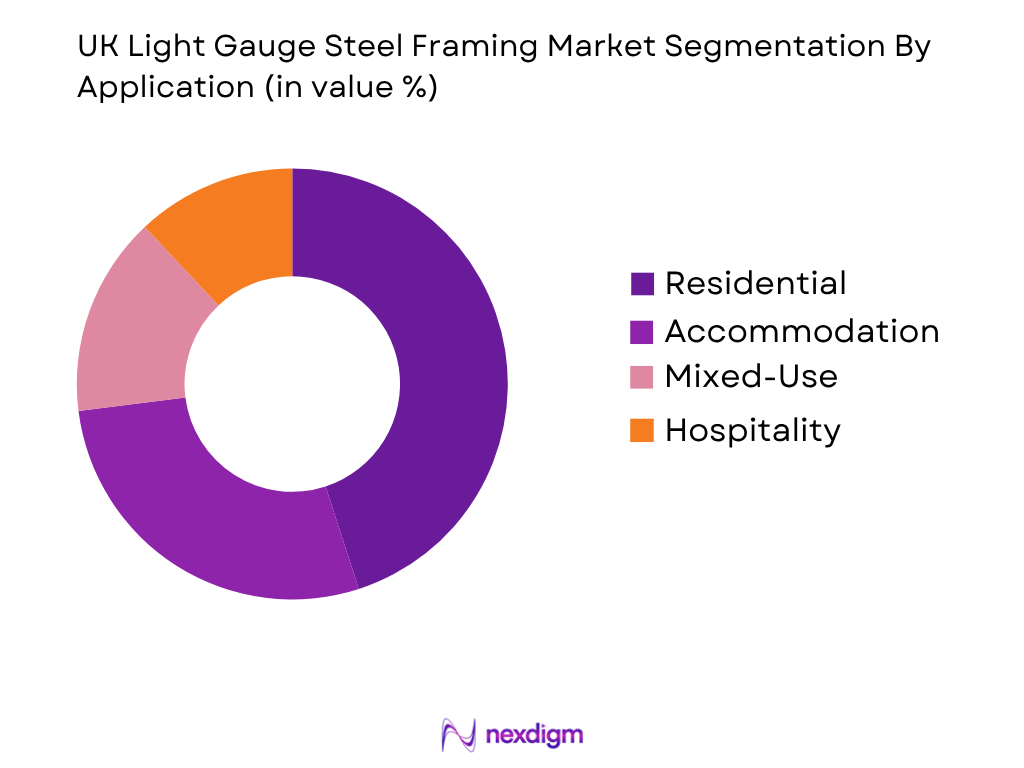
The UK Light Gauge Steel Framing Market is segmented into residential apartments and Build-to-Rent, student accommodation, commercial and mixed-use buildings, healthcare and education, hospitality, industrial and logistics, and data centres. Residential apartments and Build-to-Rent represent the dominant segment in the report model because multi-storey housing combines repeated wall layouts, large façade areas and programme-sensitive construction, all of which suit SFS and panelised light steel systems. Light steel can be deployed as non-load-bearing façade infill around a concrete or structural-steel frame or as a complete load-bearing system for suitable low- and mid-rise projects. Housing delivery constraints also increase interest in industrialised construction methods. Homes England reported that housing starts in England declined sharply during the latest calendar cycle, while labour shortages, planning delays and contractor insolvencies remained constraints, strengthening the strategic case for faster, factory-controlled framing approaches.
Competitive Landscape
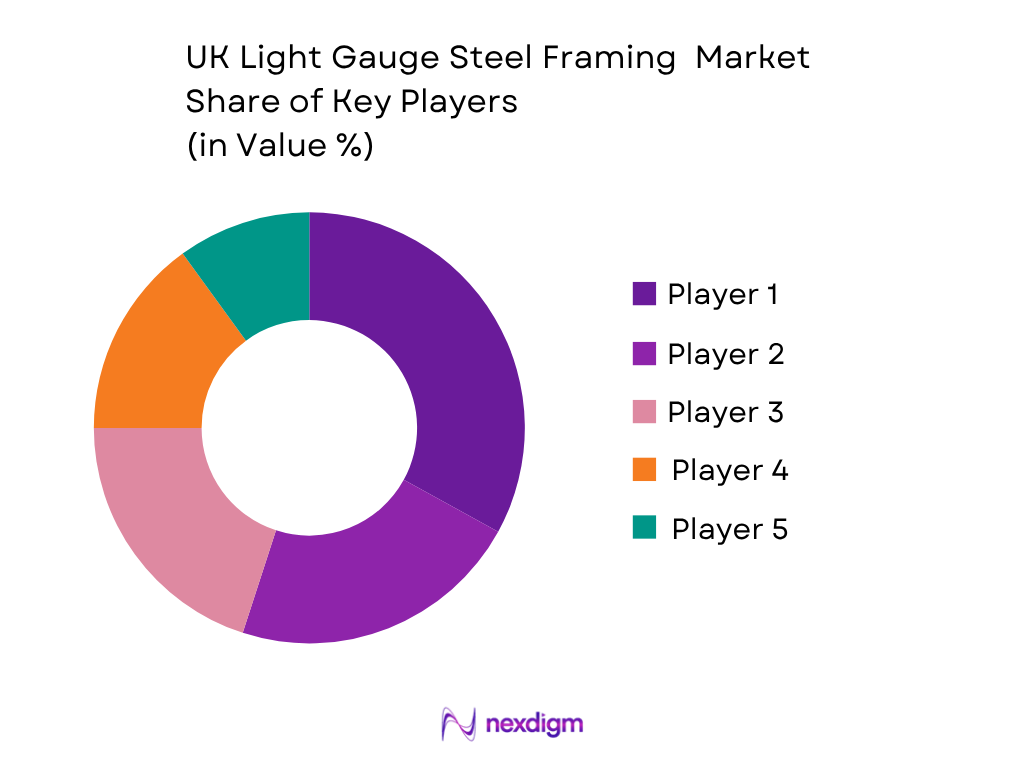
The UK Light Gauge Steel Framing Market includes integrated cold-roll-forming manufacturers, SFS specialists, structural LGS suppliers and off-site system providers. Competition is increasingly based on more than section availability: structural engineering, BIM detailing, fire-performance evidence, manufacturing automation, panelisation and technical support are critical differentiators. Metsec, Hadley, Frameclad and other leading suppliers operate across both conventional SFS and more engineered structural applications, while compliance with Building Safety Regulator expectations is becoming more important for higher-risk and fire-sensitive buildings.
| Company | Establishment | Headquarters | Core LGS/SFS Offering | Structural Capability | Manufacturing Capability | Engineering/BIM Support | Off-Site Capability | Compliance Positioning |
| Hadley Group | 1964 | Smethwick, West Midlands | ~ | ~ | ~ | ~ | ~ | ~ |
| voestalpine Metsec plc | 1931 | Oldbury, West Midlands | ~ | ~ | ~ | ~ | ~ | ~ |
| Frameclad | 25+ years manufacturing experience | Kingswinford, West Midlands | ~ | ~ | ~ | ~ | ~ | ~ |
| Kingspan Steel Building Solutions / Framing Systems | Group origins 1965 | Kingscourt, Ireland / UK operations | ~ | ~ | ~ | ~ | ~ | ~ |
| Studco Building Systems UK | 1976 group origins | UK operations / global group | ~ | ~ | ~ | ~ | ~ | ~ |
UK Light Gauge Steel Framing Market Analysis
Growth Drivers
Expansion of Multi-Storey Residential, SFS Infill and Institutional Construction
The expansion of multi-storey residential, institutional and mixed-use construction is an important growth driver for the UK Light Gauge Steel Framing Market because these buildings require large quantities of steel framing systems for external infill walls, internal partitions, façade support, shaft walls and, in selected developments, complete load-bearing structures. Office for National Statistics data show that total new construction work in Great Britain reached £140,684 million in 2024, representing an increase of £1,904 million from the preceding annual observation. Public new construction was particularly supportive, while residential, education, healthcare and other institutional projects provided a broad pipeline of applications suited to light-gauge steel. England also recorded 221,070 net additional dwellings in the 2023–24 housing-supply period, of which 198,610 were newly built homes, 21,590 resulted from changes of use, 4,360 resulted from conversions, and 1,900 arose from other gains, offset by 5,390 demolitions. These volumes provide a substantial physical construction base for steel studs, tracks, SFS infill, floor joists, façade framing and prefabricated wall systems. The significance of LGS is particularly pronounced in multi-storey developments because SFS infill walls can be installed between reinforced-concrete or structural-steel floor slabs without assuming responsibility for the building’s primary gravity frame. This reduces wall dead load compared with masonry and allows rapid enclosure of apartment, hotel, student-accommodation and mixed-use buildings. The current construction pipeline remains sizeable into 2026. Homes England-supported programmes delivered 42,433 housing starts on site and 40,332 housing completions between April 2025 and March 2026, including 32,243 affordable-home completions. This provides an identifiable development pool where modern methods of construction, including panelised and light-steel systems, can be incorporated where project design and procurement allow. Macroeconomic conditions provide additional context. The International Monetary Fund’s 2024 Article IV assessment recorded a UK population of 68.1 million, GDP per capita of USD 49,049, projected real GDP growth of 0.7 in 2024, unemployment of 4.2, and average inflation of 2.7. These figures characterize a large, mature economy with substantial housing, healthcare, education and commercial-building requirements but also pressure to improve construction productivity. For LGS manufacturers, the structural opportunity extends beyond whole-building steel framing. A concrete-framed apartment building can still consume significant SFS tonnage in its façade zone; a school may use steel studs throughout internal partitioning; healthcare developments require extensive fire-rated and acoustic wall systems; and mixed-use buildings combine residential, retail and service areas with different framing specifications. Demand is therefore spread across multiple parts of the building rather than being dependent solely on projects choosing LGS as their principal structural material. Continued construction activity, housing delivery requirements and the prevalence of multi-storey framed buildings support recurring demand for structural studs, SFS sections, deflection tracks, bracing systems and associated connectors. The ability of LGS to combine low weight, dry installation, dimensional consistency and suitability for pre-engineering makes it particularly relevant where contractors need to enclose buildings quickly and coordinate façade installation with interior trades.
Increasing Adoption of Off-Site Construction and Modern Methods of Construction
Growing emphasis on off-site manufacturing and modern methods of construction creates another major driver for the UK Light Gauge Steel Framing Market because cold-formed steel can be digitally designed, roll formed, punched and assembled into panels or modules before reaching the construction site. This characteristic aligns with UK efforts to improve construction productivity and housing delivery while reducing dependence on labour-intensive site processes. Homes England explicitly states in its 2024–25 annual reporting that it supports greater adoption of Modern Methods of Construction through land, investment and grant programmes, positioning industrialised building methods as a mechanism for improving housing outcomes. Homes England activity enabled 38,308 housing starts and 36,872 completions during 2024–25, while its subsequent 2025–26 programmes generated 42,433 starts and 40,332 completions. These current numbers provide a sizeable pipeline of housing projects where panelisation, prefabricated walls, volumetric modules and digitally manufactured framing systems can potentially compete with traditional site-built construction. Light gauge steel is particularly well suited to this transition because a digital building model can be converted into production instructions for roll-forming equipment. Steel sections can be manufactured to specified lengths, service penetrations can be pre-punched, and complete wall panels can be assembled under factory-controlled conditions before transport. UK government research into volumetric modular construction has specifically examined light gauge steel volumetric systems, including structural, fire and thermal considerations, demonstrating that the technology is already embedded within the policy and regulatory discussion surrounding modern construction. The current construction market is large enough to support industrialised production systems. ONS recorded £140,684 million of new construction work in 2024, while construction new orders increased by £2,447 million in the first quarter of 2025 compared with the preceding quarter, driven particularly by infrastructure and private industrial projects. The macroeconomic context further reinforces the productivity requirement: the IMF’s 2024 UK assessment recorded a population of 68.1 million, GDP per capita of USD 49,049, projected GDP growth of 0.7, unemployment of 4.2, and average inflation of 2.7. In an economy with high labour and land intensity, construction technologies that improve factory productivity and shorten site programmes can become increasingly relevant. LGS panelisation can reduce repeated site measuring and cutting, while manufacturing waste can be captured centrally rather than dispersed across numerous building sites. Factory production can also make quality-control procedures more repeatable, with wall panels checked against digital drawings before dispatch. For developers, these characteristics are particularly relevant in Build-to-Rent, affordable housing, student accommodation, hotels, healthcare facilities and other asset classes that use repeated room or unit layouts. For manufacturers, the opportunity shifts the value proposition away from simply selling individual studs and tracks toward providing engineered wall panels, floor cassettes, roof systems, modular frames, detailing services and installation sequencing. This can support deeper integration between roll-forming manufacturers, structural engineers, architects and main contractors. As Homes England and the wider construction sector continue to seek more productive housing-delivery methods, LGS suppliers capable of connecting BIM, DfMA, automated fabrication and site installation can participate in a higher-value segment than conventional commodity section supply.
Market Challenges
Building Safety, Fire-Performance and Technical Compliance Requirements
Increasing scrutiny of building safety and structural fire performance represents a major challenge for the UK Light Gauge Steel Framing Market because light-gauge steel walls must be assessed as complete engineered assemblies rather than simply as individual steel sections. The Building Safety Regulator published dedicated research on light gauge steel frame walls on 22 December 2025, examining how load-bearing walls respond when exposed to fire. The work identified a material distinction between one-sided and two-sided fire exposure, with the regulator concluding that two-sided exposure can significantly reduce the load-bearing fire resistance of an LGS wall compared with one-sided exposure. The study also examined the effect of cavity insulation and thermal gradients, making fire resistance dependent on the configuration of boards, insulation, steel studs and the overall assembly rather than on steel member strength alone. This raises the engineering and documentation threshold for manufacturers targeting apartments, student accommodation, healthcare, hotels and other fire-sensitive applications. The issue is particularly important because the UK construction market continues to deploy substantial volumes of multi-storey housing and institutional space. England recorded 221,070 net additional dwellings in the 2023–24 supply period, including 198,610 new-build homes, while Homes England programmes subsequently generated 38,308 starts and 36,872 completions in 2024–25 and 42,433 starts with 40,332 completions in 2025–26. These projects create demand for LGS and SFS but simultaneously increase the number of projects where fire-test evidence, compartmentation, wall-board specifications, connection detailing and quality assurance must be carefully documented. The macroeconomic backdrop also increases pressure on developers and suppliers to manage compliance efficiently. The IMF’s 2024 assessment recorded UK GDP per capita of USD 49,049, a population of 68.1 million, projected GDP growth of 0.7, unemployment of 4.2, and average inflation of 2.7. In a mature construction market, failures involving fire testing or documentation can impose major programme and reputational consequences. The technical challenge extends beyond fire resistance. Government research on volumetric light gauge steel construction identifies thermal bridging at locations such as connections to ground-floor slabs, between modules, at roofs and around cantilevered components as a specific risk requiring careful detailing. LGS systems must therefore simultaneously satisfy structural loading, fire, thermal, acoustic, moisture and durability requirements. For SFS infill, designers must also account for wind loads, floor-edge deflection, movement of the primary frame and cladding loads. These requirements make the market less accessible to suppliers competing only on commodity section availability. Manufacturers need tested wall build-ups, structural calculations, BIM details, connection specifications, traceable steel grades and clearly defined installation procedures. Specialist installers must then reproduce these requirements correctly on site. Building-safety reforms therefore create a higher barrier to market participation: the commercial opportunity remains significant, but product approval and technical competence become essential preconditions. Larger integrated suppliers with engineering and testing resources may gain an advantage, while smaller roll-forming businesses may face increasing difficulty providing the evidence packages demanded by main contractors, façade specialists, building-control professionals and higher-risk building projects.
Construction Cyclicality, Housing Delivery Constraints and Skilled-Labour Pressure
The UK Light Gauge Steel Framing Market is also challenged by volatility in construction activity and continuing labour, planning and contractor-capacity constraints, which can delay the projects that generate demand for steel studs, SFS sections, structural framing and prefabricated panels. Homes England reported that overall housing starts in England fell by 28 between 2023 and 2024, while completions declined by 6, with the agency specifically identifying rising labour costs, skills shortages, planning delays and contractor insolvencies as constraints on housing supply. Although these values are rates rather than physical counts, the underlying housing statistics illustrate the scale of the affected market: England still recorded 221,070 net additional dwellings in the 2023–24 period, including 198,610 new builds, but housing delivery weakened materially as development conditions deteriorated. Construction output has also been uneven. ONS recorded total new work of £140,684 million in 2024, yet by the three months to November 2025 total construction output had fallen 1.1, representing the largest three-month decline since March 2023. Monthly conditions remained volatile into 2026: February construction output increased 1.0 after an upwardly revised 0.5 rise in January and a 1.3 fall in December 2025. This variability affects LGS suppliers directly because manufacturers must purchase coil, schedule roll-forming capacity and manage project-specific inventory before individual construction packages are installed. A delayed apartment or commercial project can postpone demand for thousands of metres of SFS sections, deflection tracks, brackets and fasteners, while a cancelled modular project can leave highly customised components without an alternative end use. Labour availability adds another challenge. ONS maintains dedicated vacancy data for the construction sector, while Homes England continues to identify labour skills shortages as a current limitation on housing delivery. LGS can reduce some labour requirements through factory prefabrication, but installation itself still requires skilled workers who understand stud orientation, track fixing, screw patterns, bracing, deflection allowances, structural openings and fire-rated wall configurations. Structural LGS requires even greater competence because errors can affect load paths and building stability. The macroeconomic environment offers limited insulation from these sector-specific pressures. The IMF’s 2024 Article IV assessment recorded population at 68.1 million, GDP per capita at USD 49,049, projected real GDP growth of only 0.7, unemployment of 4.2, and annual-average inflation of 2.7. Slow economic expansion can restrain property-development confidence and increase sensitivity to financing and programme risk. The UK government’s 2026 steel strategy provides another indicator of the scale and complexity of material demand: approximately 0.3 million tonnes of steel were procured for public projects during the 2024–25 financial year, illustrating the wider competition for steel products across infrastructure and building applications. For LGS manufacturers, construction volatility therefore combines demand risk with manufacturing risk. Structural sections are produced in different thicknesses, depths and lengths; project-specific specifications can make inventory less fungible than standard commodity products; and lower utilisation can weaken the economics of automated roll-forming lines. Distributors face similar issues in deciding which structural and SFS profiles to stock. The market opportunity remains substantial, but suppliers must diversify across residential, healthcare, education, commercial refurbishment, data centres and industrial construction to reduce dependence on a single volatile project category.
Market Opportunities
Expansion of Panelised LGS, DfMA and Digitally Integrated Off-Site Manufacturing
Panelised light gauge steel systems represent a significant future opportunity for the UK market because current housing and construction data demonstrate a substantial demand pool that must be delivered despite workforce, programme and productivity constraints. Homes England-enabled activity reached 38,308 housing starts and 36,872 completions in 2024–25, followed by 42,433 starts and 40,332 completions in 2025–26, while 32,243 of the latter completions were affordable homes. These current delivery volumes create opportunities for construction systems that can standardise repetitive residential layouts and move labour into controlled factory environments. Homes England has explicitly identified Modern Methods of Construction as an area it supports through land, investment and grant programmes, establishing policy alignment with industrialised building systems. Light gauge steel is technically well suited to this approach because wall geometry can be created digitally and transferred into automated roll-forming equipment. Sections can be cut to exact lengths and punched before assembly, reducing manual field fabrication and allowing wall panels to reach site in installation sequence. Panelisation also gives manufacturers an opportunity to integrate windows, sheathing interfaces, service penetrations or other components depending on the project scope. UK government research into volumetric modular construction has examined light gauge steel specifically, confirming that it is one of the structural technologies relevant to industrialised construction. The opportunity is supported by the scale of the wider building sector: ONS recorded £140,684 million of new construction work in 2024, while new construction orders subsequently increased by £2,447 million during the first quarter of 2025 compared with the fourth quarter of 2024. Macroeconomic indicators explain why productivity improvements can be commercially attractive. The IMF’s 2024 UK assessment reported a population of 68.1 million, GDP per capita of USD 49,049, projected GDP growth of 0.7, unemployment of 4.2, and annual-average inflation of 2.7. Against this backdrop, developers need housing and institutional buildings while controlling programme duration, labour exposure and rework. Panelised LGS can address these pressures through repetitive manufacturing, dimensional accuracy and dry construction. The opportunity is especially relevant for Build-to-Rent apartments, student accommodation, affordable housing, hotels and healthcare projects where numerous rooms or units share similar dimensions. A fabricator can engineer a family of wall panels once and reproduce them with controlled tolerances, rather than framing each wall from individual site-cut members. Digital workflows create an additional source of differentiation. BIM data can feed into design-for-manufacture-and-assembly systems, allowing each stud or track to carry project-specific dimensional information. This can improve traceability, which is increasingly valuable under the UK’s evolving building-safety regime. Manufacturers can therefore expand beyond commodity framing into engineered wall kits, panelised façades, load-bearing frames, floor cassettes and volumetric module structures. Specialist software and machine suppliers also benefit because growth in panelisation increases demand for automated roll-forming, punching, marking and production-management systems. Current housing output and government-backed MMC activity establish the evidence base for this opportunity without relying on speculative future housing figures: the commercial potential comes from improving how already-required homes and buildings are produced.
Affordable Housing, Public-Sector Construction and Higher-Performance Steel Systems
Affordable housing and public-sector construction provide another future growth opportunity for the UK Light Gauge Steel Framing Market because current government-supported building activity is creating a pipeline of homes, schools and institutional assets where repeatable, compliant and efficiently manufactured framing systems can compete. Homes England-supported programmes delivered 40,332 housing completions during 2025–26, of which 32,243 were affordable homes, alongside 42,433 housing starts. In the preceding programme period, Homes England activity enabled 38,308 starts and 36,872 completions. These figures establish a meaningful current demand base for housing providers, developers and contractors seeking construction methods capable of delivering repeatable units while limiting site labour exposure. Government steel procurement provides a second indicator of addressable opportunity. The UK steel strategy reported that public projects procured approximately 0.3 million tonnes of steel during the 2024–25 financial year, demonstrating substantial government-linked consumption of steel products across the built environment and infrastructure. Not all of this tonnage is relevant to light framing, but it shows the scale of public-sector steel demand and the potential value of domestic cold-formed steel systems where project specifications allow. ONS construction data reinforce the wider building context, with £140,684 million of new construction work recorded in 2024. Future opportunity for LGS suppliers is therefore not limited to private apartments: schools, hospitals, supported housing, public residential programmes and institutional buildings can all use steel framing for partitions, façades and, where structurally appropriate, complete framing systems. The IMF’s 2024 macroeconomic indicators provide additional context: the UK had a population of 68.1 million, GDP per capita of USD 49,049, projected real GDP growth of 0.7, unemployment of 4.2, and average inflation of 2.7. These conditions support continued demand for essential public infrastructure while increasing the importance of efficient capital deployment. LGS can offer particular benefits where projects require lightweight structures or rapid enclosure. A lighter wall system reduces demand on primary steel or concrete frames and foundations, while dry construction avoids the curing periods associated with blockwork or cast materials. Steel sections can also be produced to consistent mechanical properties and exact dimensions, which supports engineering repeatability across standardised public-housing or institutional designs. However, the opportunity is increasingly tied to technical performance rather than simply construction speed. Building Safety Regulator research published in 2025 examined LGS wall performance under fire, indicating that future successful suppliers will need robust tested assemblies, appropriate insulation and board configurations, clear structural calculations and strong installation control. This creates an opportunity for higher-performance systems that bundle the steel frame with documented fire, acoustic, thermal and structural solutions. Domestic steel-policy developments can also favour suppliers capable of demonstrating traceability and UK manufacturing participation. For established manufacturers, public-sector and affordable-housing demand can justify investment in panelisation, automated fabrication and engineered system packages. For specialist fabricators, partnership opportunities exist with housing associations, main contractors, off-site manufacturers and façade contractors. The long-term growth mechanism is therefore based on converting today’s identifiable housing and public-building pipeline into greater use of engineered LGS systems by offering faster production, predictable quality and compliance evidence. Suppliers able to integrate steel framing with building-safety documentation, DfMA and repeatable factory production can position themselves for opportunities that extend beyond traditional SFS commodity supply into complete building-system solutions.
Future Outlook
The UK Light Gauge Steel Framing Market is forecast to expand at ~ CAGR during 2026–2035 under the placeholder forecast framework. Growth is expected to come from SFS infill, panelised housing, Build-to-Rent, student accommodation, healthcare, education and data-centre construction. At the same time, tighter building-safety scrutiny will raise the technical threshold for suppliers, shifting competitive advantage toward tested systems, traceable design documentation and integrated engineering support. The strongest structural opportunity is expected in off-site and panelised construction. Steel framing can be digitally detailed and cut, punched and assembled in a controlled factory environment before delivery. UK industry guidance notes that pre-cut C-sections can virtually eliminate cutting waste, while rapid dry-envelope systems can achieve meaningful programme reductions compared with conventional masonry infill. This makes LGS particularly relevant where repeated apartment layouts, constrained urban sites and schedule certainty favour industrialised construction. Building safety will substantially influence future product development. The Building Safety Regulator published dedicated research on light gauge steel frame walls exposed to fire in December 2025, examining load-bearing fire resistance under different exposure conditions. The study found that two-sided fire exposure can materially reduce load-bearing resistance compared with one-sided exposure. This increases the importance of tested assemblies, board specifications, cavity insulation configuration and complete wall-system performance rather than relying solely on steel member capacity. Approved Document B is also undergoing staged updates affecting 2025, 2026 and 2029, including withdrawal of national fire-test classifications and wider changes to fire-safety provisions. These changes increase the value of suppliers capable of providing traceable testing, engineering evidence and complete system documentation.
Major Players
- Hadley Group
- voestalpine Metsec plc
- Kingspan Steel Building Solutions / Kingspan Framing Systems
- Frameclad
- EOS Framing
- Fusion Steel Framing
- Sigmat
- Intrastack
- British Gypsum / Saint-Gobain
- Knauf UK
- Studco Building Systems UK
- BW Industries
- Ayrshire Metals
- FRAMECAD
- Howick Ltd.
Key Target Audience
- Light Gauge Steel Framing and SFS Manufacturers
- Cold-Formed Steel Roll Formers and Fabricators
- Main Contractors and Specialist SFS Contractors
- Residential, Build-to-Rent and Student Housing Developers
- Off-Site, Panelised and Modular Construction Companies
- Steel Coil Suppliers and Construction-Material Distributors
- Investments and Venture Capitalist Firms
- Government and Regulatory Bodies (Ministry of Housing, Communities and Local Government, Building Safety Regulator, Homes England, Office for Product Safety and Standards)
Research Methodology
Step 1: Identification of Key Variables
The initial phase constructs the UK Light Gauge Steel Framing Market ecosystem covering coil suppliers, cold-roll formers, SFS manufacturers, structural LGS fabricators, specialist installers, developers, main contractors and off-site manufacturers. Critical variables include construction output, residential starts, SFS penetration, steel tonnes per project, installed wall area, section thickness, building height, panelisation and route to market. Government and industry datasets are used to establish the construction base, while technical literature identifies typical framing applications and system boundaries. Structural LGS, SFS infill, non-load-bearing framing and modular systems are separated to prevent double counting.
Step 2: Market Analysis and Construction
The top-down market model begins with UK residential and non-residential construction activity and allocates addressable floor and façade area according to building type. SFS penetration, wall-area ratios, section spacing, steel intensity and framing-system mix are applied to estimate theoretical cold-formed steel consumption. The bottom-up model evaluates manufacturer output, roll-forming capability, project volumes, contractor procurement and project bills of materials. Steel tonnage and installed framing value are reconciled across manufacturers, distributors and installers so material moving through multiple supply-chain stages is counted once.
Step 3: Hypothesis Validation and Expert Consultation
Market hypotheses are validated through CATIs and structured interviews with LGS manufacturers, SFS contractors, façade specialists, developers, structural engineers, architects and modular construction companies. Interviews examine section selection, steel thickness, fire-performance requirements, lead times, procurement models, installation productivity and competitive positioning. Additional validation focuses on Building Safety Regulator requirements, panelisation, BOPAS or equivalent system assurance, engineering responsibility and project-specific fire documentation. Findings that conflict with secondary data are rechecked before incorporation into the market model.
Step 4: Research Synthesis and Final Output
The final phase triangulates construction statistics, manufacturer capabilities, contractor interviews and project-level steel consumption to develop the UK Light Gauge Steel Framing Market model. Demand is segmented by framing system, component type, application, construction method, building height, route to market and region. Forecast scenarios incorporate housing delivery, Build-to-Rent, SFS penetration, off-site construction, steel availability, building-safety requirements and competition from timber and masonry. Base-case, accelerated-MMC and construction-downside scenarios are used to evaluate long-term market resilience.

- Executive Summary
- Research Methodology (Market Definitions and Assumptions, Abbreviations, LGS and SFS Market Boundary, Cold-Formed Steel Product Mapping, Project Floor-Area Mapping, Steel Tonnage Conversion, Housing and Non-Residential Construction Mapping, Market Sizing Approach, Top-Down Analysis, Bottom-Up Analysis, Demand-Side Assessment, Supply-Side Assessment, Manufacturer and Fabricator Assessment, Contractor Interviews, Project Bill-of-Materials Analysis, Off-Site Construction Assessment, Data Triangulation, Forecasting Framework, Scenario Analysis, Limitations and Future Conclusions)

- Definition and Scope
- Evolution of Light Gauge Steel Construction in the UK
- Transition from Masonry, Timber Frame and Traditional Steel Construction to Light Steel Systems
- Structural LGS versus Steel Framing System Infill Ecosystem
- Cold-Formed Steel Framing Manufacturing Process

- Growth Drivers (SFS Adoption in Multi-Storey Buildings, Build-to-Rent Development, Student Accommodation, Affordable Housing Delivery, Off-Site Construction, Noncombustible Structural Systems, Dimensional Accuracy, Construction Labour Constraints)
- Market Challenges (Construction Slowdown, Steel Price Volatility, Competition from Timber Frame, Thermal Bridging, Fire-Performance Scrutiny, Building Safety Compliance, Skilled Installer Availability, Project Financing Constraints)
- Market Opportunities (Panelised Housing, Modular Construction, High-Rise SFS Infill, Data Centres, Healthcare, Student Housing, Digital Design-to-Manufacturing, Low-Waste Steel Construction)
- Market Trends (Factory Panelisation, DfMA Adoption, BIM-to-Fabrication Integration, Increased SFS Use, Pre-Assembled Façade Panels, High-Performance Coatings, Design Standardisation, Golden Thread Documentation)
- Technology Substitution Analysis (Timber Frame, Structural Timber, Hot-Rolled Steel, Concrete, Masonry, SIPs, Precast Concrete, Hybrid Construction)
- SWOT Analysis
- Porter’s Five Forces Analysis
- PESTLE Analysis

- By Market Value (2020-2025)
- By Cold-Formed Steel Tonnage (2020-2025)
- By Linear Metres of Framing Members (2020-2025)
- By Installed Framing Area (2020-2025)

- By Component Type (In Value %)
C-Section Studs
U-Section Tracks
Floor Joists
Roof Rafters and Trusses
SFS Infill Studs - By Framing System (In Value %)
Load-Bearing Light Gauge Steel Framing
Steel Framing System Infill Walls
Non-Load-Bearing Internal Partition Framing
External Wall and Façade Support Framing
Floor and Ceiling Framing - By Application (In Value %)
Build-to-Rent Residential Developments
Private Residential Apartments
Affordable and Social Housing
Student Accommodation
Hotels and Hospitality - By Region (In Value %)
London
South East England
East of England
South West England
West Midlands


- Residential Developer Demand
- Build-to-Rent Developer Demand
- Housing Association Demand
- Student Housing Developer Demand
- Main Contractor Procurement

- By Market Value (2026-2035)
- By Cold-Formed Steel Tonnage (2026-2035)
- By Linear Metres of Framing Members (2026-2035)


 Request a Sample
 Ask for Customization
 Get a Quote
 Enquire Now