
 Download PDF
Market Overview
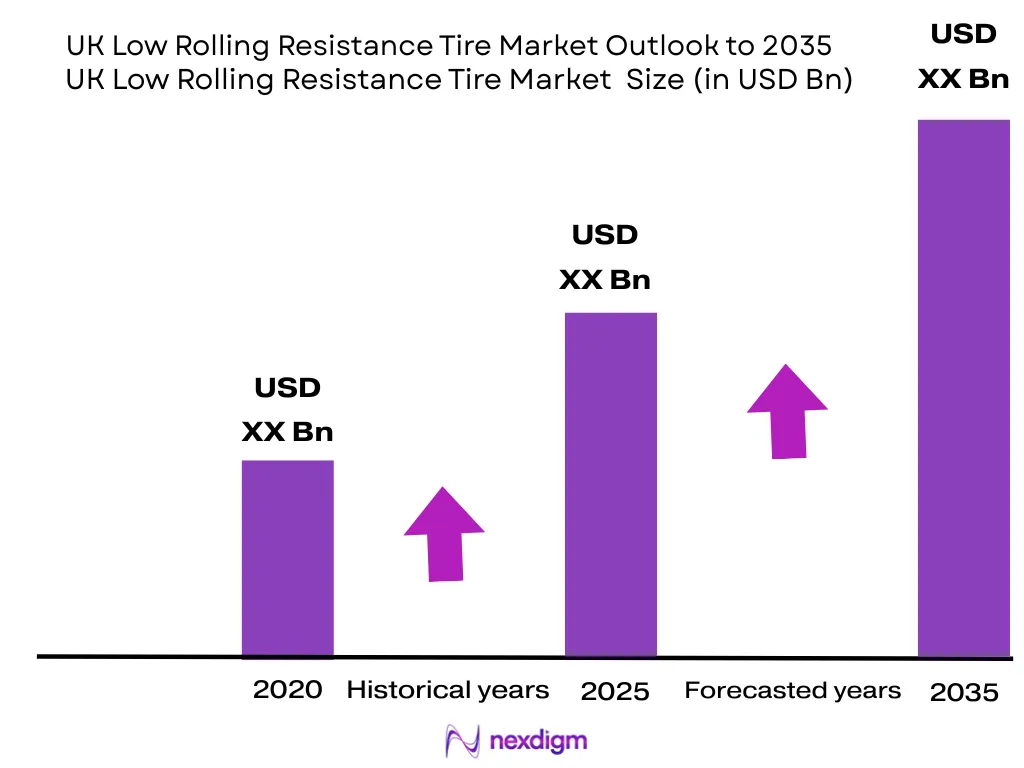
The UK Low Rolling Resistance Tyre Market is valued at approximately ~ billion, compared with ~ billion in the preceding reporting period. Demand is supported by licensed vehicles increasing from approximately 41.3 million to 41.7 million, while first registrations rose from around 2.53 million to 2.61 million vehicles. Great Britain’s road traffic also increased from about 330.8 billion to 336.2 billion vehicle miles, enlarging tyre wear and replacement requirements.
London, South East England, the West Midlands, North West England and Scotland dominate the UK Low Rolling Resistance Tyre Market because they combine large vehicle populations, extensive motorway use, dense tyre-fitting networks and major passenger, van and freight fleets. London creates concentrated taxi, private-hire and delivery demand, while the Midlands supports vehicle manufacturing and national distribution. England’s major road corridors also carry intensive car, van and commercial traffic, strengthening replacement frequency and fleet interest in energy-efficient tyres.
Market Segmentation
By Vehicle Type
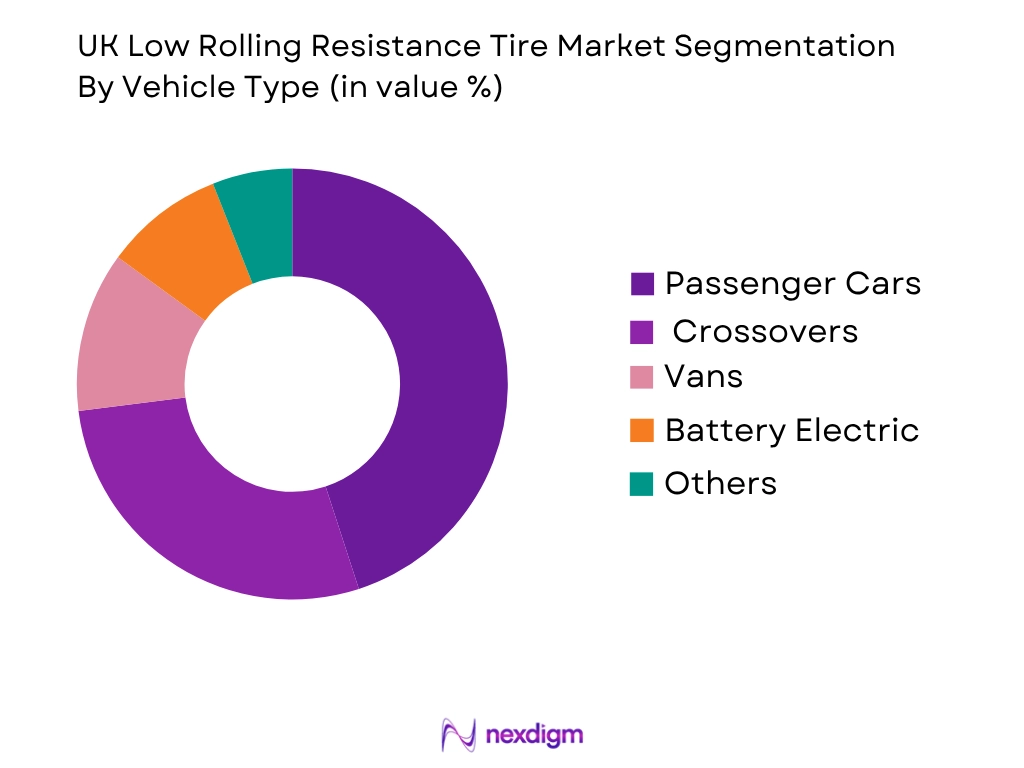
The UK Low Rolling Resistance Tyre Market is segmented into passenger cars, SUVs and crossovers, vans and light commercial vehicles, battery-electric and hybrid vehicles, heavy goods vehicles, buses and other specialist vehicles. Passenger cars hold the dominant market share, supported by a national car parc exceeding 36 million vehicles and approximately 256.1 billion car and taxi miles travelled in Great Britain.
Passenger cars generate replacement demand across touring, all-season, all-weather, run-flat and performance categories. Low rolling resistance products are increasingly fitted to petrol, hybrid and electric cars because they contribute to energy efficiency without requiring changes to the vehicle powertrain. National tyre chains, independent fitters, online platforms and autocentres provide broad passenger fitment coverage. The sub-segment also benefits from tyre labels, which allow motorists to compare fuel efficiency with wet grip and external noise.
By Sales Channel
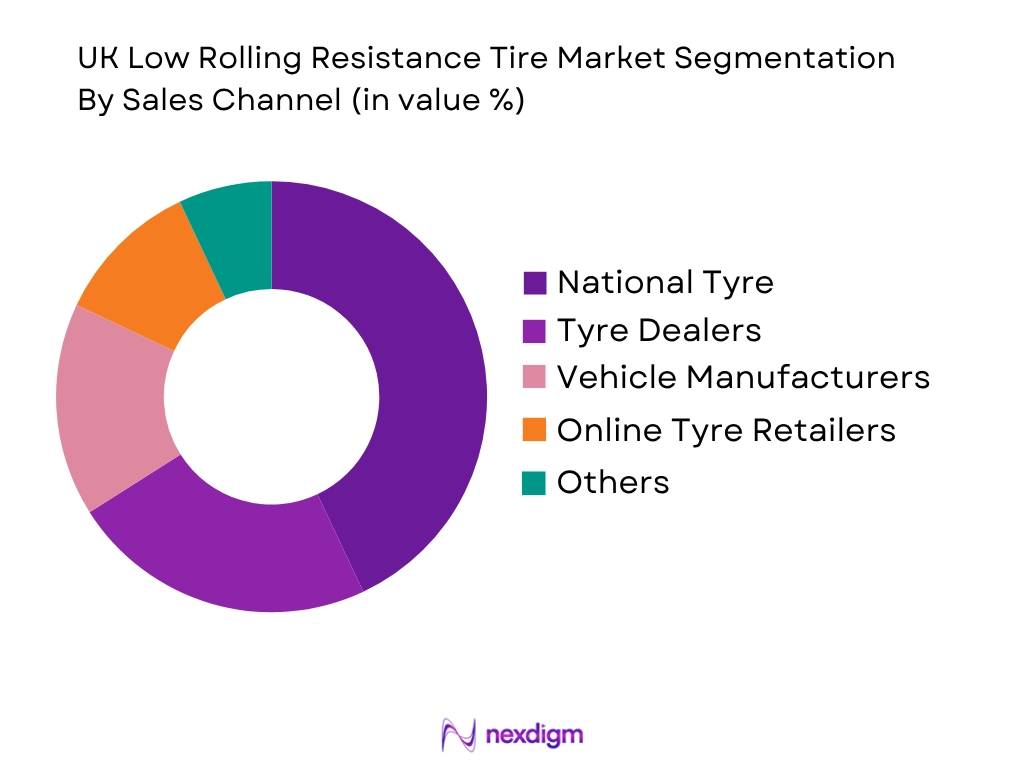
The UK Low Rolling Resistance Tyre Market is segmented into national tyre and autocentre chains, independent tyre dealers, vehicle manufacturers and franchised dealerships, online tyre retailers, independent garages, commercial fleet dealers and mobile-fitting providers. National tyre and autocentre chains hold the dominant market share, owing to their extensive fitting networks, brand portfolios, online booking systems and ability to combine tyre sales with alignment, servicing and MOT-related work.
These chains can stock multiple efficiency classes and recommend tyres according to registration number, vehicle weight, annual mileage and propulsion type. Their national coverage also supports fleet accounts and standardized service levels. Independent dealers remain important through local relationships and flexible brand selection, while online retailers are increasing price transparency. However, the physical requirement for installation, balancing, valve replacement and alignment keeps fitting networks central to purchase conversion.
Competitive Landscape
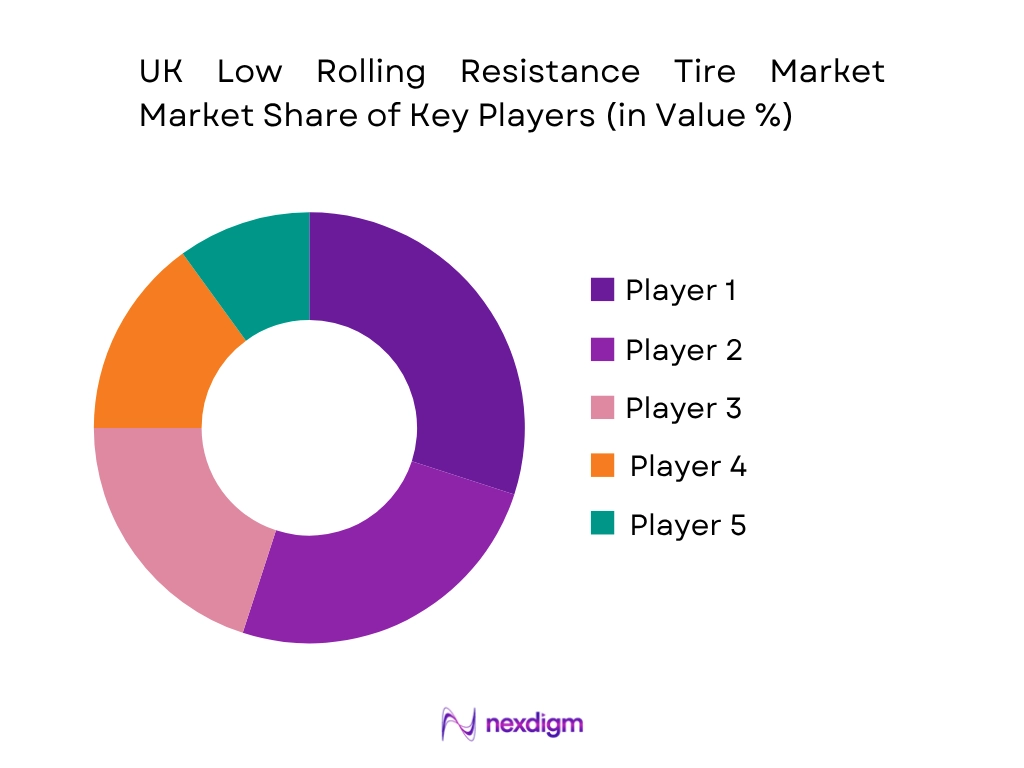
The UK Low Rolling Resistance Tyre Market is dominated by major international tyre manufacturers with established OEM relationships, replacement portfolios and dealer networks. Michelin, Bridgestone, Goodyear, Continental and Pirelli compete through fuel-efficient compounds, EV-specific product lines, vehicle homologation and performance across wet grip, tread life and noise. Their scale enables significant investment in silica technology, functionalised polymers, connected tyres and circular materials.
| Company | Establishment Year | UK or Regional Headquarters | Core LRR Applications | OEM Fitment Capability | Replacement Reach | EV Tyre Capability | Commercial Offering | Technology Differentiator |
| Michelin Tyre plc | 1889 | Stoke-on-Trent, England | ~ | ~ | ~ | ~ | ~ | ~ |
| Bridgestone UK | 1931 group heritage | Warwick, England | ~ | ~ | ~ | ~ | ~ | ~ |
| Goodyear Tyres UK | 1898 | Birmingham-area UK operations | ~ | ~ | ~ | ~ | ~ | ~ |
| Continental Tyre Group UK | 1871 | West Drayton, England | ~ | ~ | ~ | ~ | ~ | ~ |
| Pirelli UK Tyres | 1872 | Burton-on-Trent, England | ~ | ~ | ~ | ~ | ~ | ~ |
UK Low Rolling Resistance Tyre Market Analysis
Growth Drivers
Expanding Vehicle Parc and High Road-Mileage Exposure
The UK’s expanding vehicle parc and rising road utilisation are strengthening demand for low rolling resistance tyres across passenger cars, SUVs, vans and commercial fleets. Department for Transport records show 41.7 million licensed vehicles at the end of 2024, including 1.394 million zero-emission vehicles, while 2.605 million vehicles were registered for the first time. Motor traffic on Great Britain’s roads reached 336.2 billion vehicle miles in 2024 and increased to 342.6 billion vehicle miles in 2025. Car and taxi traffic accounted for 256.1 billion miles in 2024, while van traffic reached 58.5 billion miles. This extensive mileage increases tyre deformation, heat generation and tread wear, creating recurring replacement demand and magnifying the energy impact of rolling resistance. Lower-energy tyres are particularly relevant for high-mileage commuters, private-hire vehicles, delivery vans and fleet cars because even modest efficiency improvements accumulate over long operating distances. The regulatory tyre label also makes rolling resistance visible through fuel-efficiency classification, alongside wet-grip and external-noise information. Broader economic activity supports continued mobility: UK GDP expanded by approximately 1.1% in 2024, while the IMF projected growth of 1.0% in 2026 for a population of 69.85 million. Although subdued growth may constrain discretionary purchases, drivers and fleets must continue replacing worn or damaged tyres, enabling efficiency-focused products to compete through energy savings, vehicle-range support and total operating-cost reduction.
Growth of Electric Vehicles, Vans and Energy-Efficient OEM Fitments
The expansion of electric vehicles and high-utilisation vans is increasing the technical and commercial importance of low rolling resistance tyres in the UK. At the end of 2024, the licensed zero-emission fleet reached 1.394 million vehicles, while 410,000 zero-emission vehicles were registered for the first time during the year. New registrations accelerated further in 2025, when 473,000 zero-emission cars and 31,000 zero-emission light goods vehicles entered service. Battery-electric vehicles benefit directly from reduced tyre energy loss because rolling resistance affects usable driving range, while their heavier battery packs and immediate torque require reinforced, high-load and wear-resistant tyre structures. Van demand provides another growth platform. Van traffic reached 58.5 billion vehicle miles in 2024, rose to 59.5 billion miles in the twelve months ending June 2025 and reached 59.9 billion miles in the period ending September 2025. Delivery operators, utilities, construction businesses and service fleets therefore have strong incentives to use tyres that reduce energy consumption without increasing downtime. Original-equipment manufacturers are also using efficiency-oriented tyres to support vehicle-level consumption and emission objectives, familiarising drivers with low rolling resistance fitments before the replacement cycle begins. The IMF projected UK GDP growth of 1.0% in 2026, while inflation was expected to exceed 3.5% toward the end of the year. Under these conditions, motorists and fleets may place greater emphasis on products that demonstrate measurable lifetime operating benefits rather than relying only on the lowest initial purchase consideration.
Market Challenges
Balancing Rolling Resistance with Wet Grip, Durability and EV Load Requirements
The principal technical challenge for the UK Low Rolling Resistance Tyre Market is reducing energy loss without weakening wet braking, tread life, noise performance or load-carrying capability. This balance is especially important in the UK’s wet maritime climate, where replacement tyres must deliver predictable braking and handling across frequent rain, variable temperatures and winter conditions. UK tyre labels classify fuel efficiency through rolling resistance while separately communicating wet grip and external rolling noise, demonstrating that efficiency cannot be assessed in isolation. The Vehicle Certification Agency’s 2024 surveillance programme tested 30 tyre products across 3 tyre sizes, covering SUV, high-performance and people-carrier applications, against rolling resistance, wet-grip and noise requirements. Electric vehicles make optimisation more difficult because battery weight raises vertical load and immediate motor torque can accelerate tread wear. The licensed zero-emission fleet reached 1.394 million vehicles in 2024, while 473,000 zero-emission cars were newly registered in 2025, increasing the number of vehicles requiring high-load, low-noise and range-efficient replacement products. Great Britain’s road traffic also rose from 336.2 billion vehicle miles in 2024 to 342.6 billion miles in 2025, placing additional durability demands on tyre compounds and carcasses. Manufacturers must therefore use silica, functionalised polymers, reinforced structures and optimised tread geometry without producing premature wear or inferior wet braking. The IMF’s projected 1.0% GDP growth in 2026 may increase consumer scrutiny of replacement intervals, making durability failures commercially damaging even where energy performance is technically strong.
Consumer Label Interpretation, Maintenance Dependence and Imported Product Competition
Low rolling resistance performance can be undermined by weak consumer understanding, incorrect maintenance and replacement with tyres that do not match the vehicle’s original efficiency requirements. UK tyre labels provide fuel-efficiency, wet-grip and external-noise information, but motorists must still interpret several performance variables simultaneously. A product with a stronger rolling resistance class may differ in tread life, seasonal capability, load index or wet braking, making dealer guidance important. The problem is commercially significant across a parc of 41.7 million licensed vehicles and annual road use of 342.6 billion vehicle miles in 2025. Incorrect inflation increases casing deformation and heat generation, while poor alignment creates irregular wear; both reduce the real-world efficiency benefit of an advanced tyre. Vehicle-model proliferation adds another challenge because dealers must stock increasing numbers of rim diameters, speed ratings, load indices and EV-specific fitments. Imported budget products intensify price competition, particularly during a period when the IMF projected UK economic growth of only 1.0% in 2026 and consumer-price growth of approximately 3.2%. Cost-conscious drivers may prioritise immediate affordability over efficiency labels or lifecycle performance. Regulatory compliance also requires suppliers and online distributors to display tyre information accurately, increasing administrative responsibilities across fragmented sales channels. Market-surveillance testing in 2024 examined 30 separate tyres, illustrating the range of products requiring verification. Manufacturers and retailers must respond through clearer label explanations, registration-based fitment systems, pressure-maintenance education and transparent comparisons covering efficiency, wet grip, noise, load capacity and expected service life.
Market Opportunities
EV-Specific High-Load, Low-Noise and Range-Optimised Tyres
The expanding UK electric-vehicle parc creates a substantial future opportunity for manufacturers and distributors offering high-load, low-noise and range-optimised tyres. The country had 1.394 million licensed zero-emission vehicles at the end of 2024, compared with approximately 1.02 million vehicles a year earlier. First registrations included 410,000 zero-emission vehicles during 2024, followed by 473,000 zero-emission cars and 31,000 zero-emission light goods vehicles in 2025. These current registrations create a growing replacement pipeline as original tyres wear and vehicles move beyond initial manufacturer service arrangements. EV tyres must address battery-related weight, immediate torque, reduced powertrain noise and range sensitivity. Manufacturers can differentiate through reinforced load ratings, lightweight carcasses, acoustic foam, optimised contact patches and compounds that reduce hysteresis without shortening tread life. Opportunity also exists in dealer education and digital fitment because consumers need to distinguish between EV-approved tyres, OEM-marked products and conventional alternatives. Registration-based online platforms can display load index, efficiency class, wet grip, noise and vehicle compatibility together, reducing incorrect replacement. Great Britain recorded 342.6 billion vehicle miles in 2025, while zero-emission vehicle registrations continued increasing, demonstrating an active rather than theoretical service base. The IMF projected a population of 69.85 million and GDP growth of 1.0% in 2026. In a restrained economic environment, products that can document range preservation, durability and lower energy loss may gain stronger acceptance among private owners, leasing companies, used-EV retailers and corporate fleets.
Connected Fleet Tyres, Van Applications and Commercial Retreading
High-mileage van, logistics and public-sector fleets create an opportunity to combine low rolling resistance tyres with connected monitoring, mobile fitting and casing-management services. Van traffic reached 58.5 billion vehicle miles in 2024, increased to 59.5 billion miles in the twelve months ending June 2025 and reached 59.9 billion miles in the period ending September 2025. Lorries travelled approximately 16.7 billion miles during the latter period, while motorway traffic totalled 70.6 billion miles. These operating distances make energy consumption, tread life and vehicle downtime material procurement considerations. Fleet-oriented suppliers can offer pressure and temperature monitoring, digital tread-depth inspection, automatic inflation, alignment management and predictive replacement scheduling. These services help preserve rolling resistance performance throughout the tyre lifecycle because underinflation and irregular wear can eliminate efficiency gains. Electric delivery vans create an additional application: 31,000 zero-emission light goods vehicles were registered for the first time in 2025, compared with roughly 23,000 units in 2024. Retreading also presents potential for heavy commercial fleets because a well-managed casing can support multiple service lives while reducing material consumption. The strongest proposition is not simply a low rolling resistance tyre, but a managed cost-per-mile programme incorporating tyre selection, fitting, pressure control, roadside support and casing recovery. UK traffic increased to 342.6 billion vehicle miles in 2025, while the IMF projected GDP growth of 1.0% in 2026. Fleet operators facing moderate economic growth and elevated energy costs are therefore likely to value verified operating savings, reduced downtime and consolidated performance reporting.
Future Outlook
The UK Low Rolling Resistance Tyre Market is forecast to expand at approximately ~XX% CAGR during the forecast period. Growth will be supported by increasing vehicle mileage, tyre-labelling visibility, fleet energy management and the expansion of battery-electric and hybrid vehicles. Low rolling resistance technology will increasingly become a standard design objective across passenger, SUV, van and commercial portfolios rather than a separate niche category. Product differentiation will depend on the ability to combine efficiency with wet grip, durability, load capacity and noise reduction. The UK had 1.394 million licensed zero-emission vehicles at the end of the latest complete reporting period, compared with approximately 1.02 million previously. First registrations included 410,000 zero-emission vehicles, of which 382,000 were cars. The following year added 473,000 new zero-emission cars and 31,000 zero-emission light goods vehicles, enlarging the future replacement base for range-efficient tyres. EVs strengthen the commercial case for low rolling resistance because tyre energy losses directly affect usable driving range. However, battery weight and instant torque increase load and tread-wear requirements. Manufacturers will therefore focus on high-load indices, reinforced carcasses, acoustic technologies and compounds that control wear without sacrificing efficiency.
Major Players
- Michelin Tyre plc
- Bridgestone UK
- Goodyear Tyres UK
- Continental Tyre Group UK
- Pirelli UK Tyres
- Hankook Tyre UK
- Yokohama HPT
- Sumitomo Rubber Europe
- Toyo Tyre UK
- Kumho Tyre UK
- Nokian Tyres UK
- Giti Tire UK
- Sailun Tyre Europe
- Nexen Tire Europe
- Apollo Tyres UK
Key Target Audience
- Passenger, van and commercial tyre manufacturers
- Vehicle OEMs and electric-vehicle manufacturers
- National tyre dealers and autocentre chains
- Independent tyre wholesalers and fitting networks
- Commercial, leasing, delivery and mobility fleets
- Raw material, compound and connected-tyre technology suppliers
- Investments and venture capitalist firms
- Government and regulatory bodies (Department for Transport, Driver and Vehicle Standards Agency, Vehicle Certification Agency, Office for Zero Emission Vehicles, Environment Agency and Competition and Markets Authority)
Research Methodology
Step 1: Identification of Key Variables
The initial phase constructs an ecosystem map covering tyre manufacturers, vehicle OEMs, raw-material suppliers, wholesalers, fitters, fleets, online retailers, retreaders and regulators. Key variables include vehicle parc, annual mileage, replacement frequency, rolling resistance class, tyre size, propulsion type, channel structure and average selling value.
Step 2: Market Analysis and Construction
Historical vehicle licensing, road traffic, tyre demand, EV adoption and fleet activity are compiled. Top-down analysis assesses total tyre expenditure and efficiency-class penetration, while bottom-up analysis estimates units using vehicle populations, replacement cycles, tyres per vehicle and application-level fitment.
Step 3: Supply-Side Assessment
Manufacturers are evaluated according to low rolling resistance portfolios, OEM approvals, EV capability, commercial offerings, UK distribution, label performance and sustainable-material development. Wholesale availability, dealer inventories, mobile-fitting coverage and online listings are used to reconstruct organized supply.
Step 4: Demand-Side Assessment
Passenger motorists, EV owners, van operators, taxi fleets and commercial transport companies are analysed by annual mileage, energy use, replacement behaviour and total cost of ownership. The assessment examines label awareness, wet-grip priorities, dealer recommendations, price sensitivity and fleet procurement requirements.

- Executive Summary
- Research Methodology (Market Definitions and Assumptions, Low Rolling Resistance Tyre Qualification Criteria, Abbreviations, Market Sizing Approach, Top-Down Analysis, Bottom-Up Analysis, Vehicle Parc–Based Demand Modelling, OE Fitment Assessment, Replacement Cycle Analysis, Fleet Demand Assessment, Primary Industry Interviews, Data Triangulation, Forecasting Framework, Limitations and Future Conclusions)

- Definition and Scope
- Market Evolution and Industry Genesis
- Timeline of Major Industry Developments
- Low Rolling Resistance Tyre Technology Evolution
- Passenger Car, Van and Commercial Tyre Ecosystem
- Original Equipment and Replacement Tyre Market Structure

- Growth Drivers (Fuel-Efficiency Labelling, Vehicle Electrification, High Road Mileage, Van Fleet Expansion, Fleet Decarbonisation, Consumer Energy-Cost Awareness)
- Market Challenges (Wet-Grip Trade-Off, Tread-Life Balance, EV Tyre Wear, Consumer Understanding, Imported Competition, Material Volatility)
- Market Opportunities (EV Tyres, Van Fleets, Connected Tyres, Retreading, Sustainable Materials, Digital Retailing)
- Market Trends (Electrification, Larger Rim Diameters, Smart Tyres, Sustainable Materials, Omnichannel Fitting, Fleet Digitisation)
- Government Regulations (Tyre Labelling, Rolling Resistance Testing, Wet-Grip Requirements, Noise Limits, Type Approval, Product Safety)
- SWOT Analysis
- Porter’s Five Forces Analysis
- PESTLE Analysis
- Stakeholder Ecosystem

- By Market Value (2020-2025)
- By Tyre Sales Volume (2020-2025)
- By Original Equipment Tyre Volume (2020-2025)

- By Tyre Type (In Value %)
Passenger Car Tyres
SUV and Crossover Tyres
Van and Light Commercial Vehicle Tyres
Pickup and Utility Vehicle Tyres
Heavy Goods Vehicle Tyres
Bus and Coach Tyres
Trailer Tyres - By Vehicle Type (In Value %)
Passenger Cars
Sports Utility Vehicles
Crossovers
Light Commercial Vehicles and Vans
Heavy Goods Vehicles
Buses and Coaches - By Sales Channel (In Value %)
Vehicle Manufacturers
Franchised Vehicle Dealerships
National Tyre and Autocentre Chains
Independent Tyre Dealers
Independent Garages
Automotive Service Centres - By English Region (In Value %)
London
South East England
East of England
South West England
West Midlands
East Midlands
North West England

- Market Share of Major Players (By Value, Unit Volume, Passenger Tyres, Van Tyres, Commercial Tyres, Distribution Channel)
- Cross Comparison Parameters (Low Rolling Resistance Product Portfolio Breadth, Passenger–SUV–Van–HGV Vehicle Coverage, UK and European OEM Fitment Portfolio, Rolling Resistance–Wet Grip–Noise–Tread-Life Performance Balance, EV High-Load–Range–Noise Optimisation Capability, UK Dealer–Wholesale–Online–Mobile Fitting Network Reach, Commercial Fleet–Retread–Casing Management Capability, Sustainable Materials–Connected Tyre–Digital Service Innovation)
- SWOT Analysis of Major Players
- Pricing Analysis by Tyre SKU and Vehicle Application
- Detailed Profiles of Major Companies
Michelin Tyre plc
Bridgestone UK
Goodyear Tyres UK
Continental Tyre Group UK
Pirelli UK Tyres
Hankook Tyre UK
Yokohama HPT
Sumitomo Rubber Europe
Toyo Tyre UK
Kumho Tyre UK
Nokian Tyres UK
Giti Tire UK
Sailun Tyre Europe
Nexen Tire Europe
Apollo Tyres UK

- Individual Passenger Car Owner Analysis
- SUV and Crossover Owner Analysis
- Van and Light Commercial Vehicle Operator Analysis
- Electric Vehicle Owner Analysis
- Hybrid and Plug-In Hybrid Owner Analysis

- By Market Value (2026-2035)
- By Tyre Sales Volume (2026-2035)
- By Original Equipment Tyre Volume (2026-2035)


 Request a Sample
 Ask for Customization
 Get a Quote
 Enquire Now