

 Download PDF
Market Overview
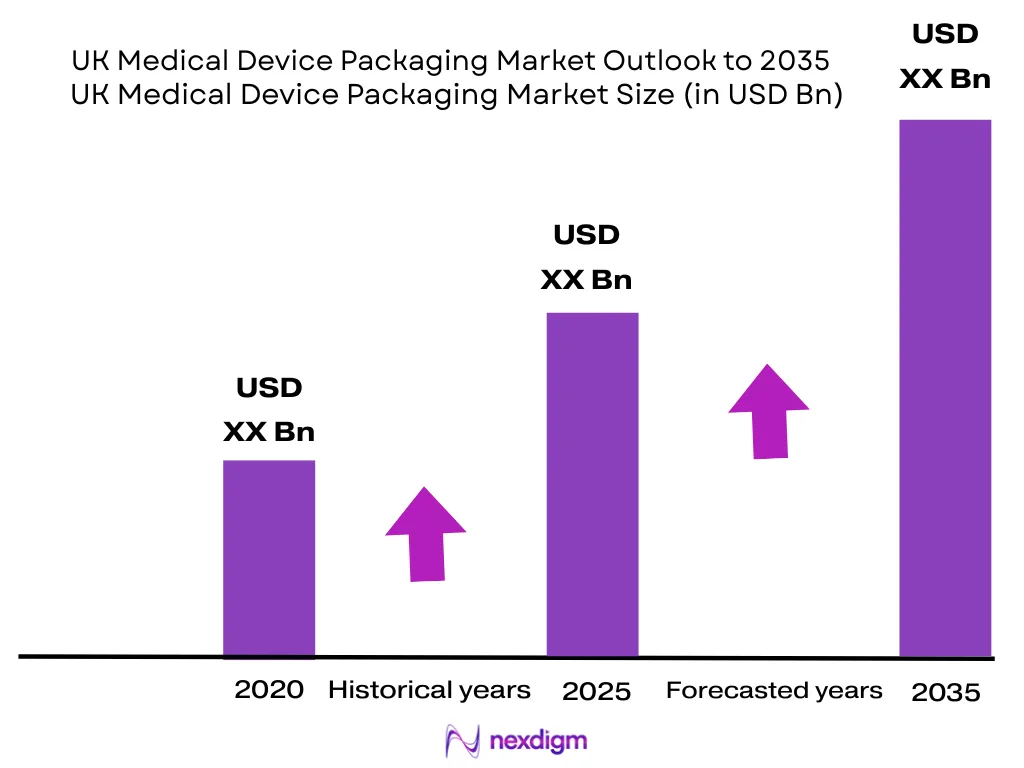
The UK medical device packaging market is valued at approximately ~ billion, compared with ~ billion in the preceding annual period. Demand is supported by a medical-technology sector employing 196,000 people, compared with 154,200 employees in the earlier reporting base, and by almost 2 million medical products registered for use. Sterile devices, diagnostics, implants and single-use consumables require validated pouches, trays, lidding systems, protective cartons and traceable labels. Cambridge, Oxford, London, Manchester, Cheshire, the Midlands and Scotland’s Central Belt dominate the UK medical device packaging market because they combine medical-technology companies, hospitals, laboratories, contract manufacturers and specialist life-science workforces. These clusters benefit from proximity to product-development teams, testing facilities and logistics infrastructure. Human health and social-work output increased by 0.9 percentage points, while national economic output expanded by approximately 1.1 percentage points, sustaining demand for regulated healthcare products and associated packaging.
Market Segmentation
By Packaging Format
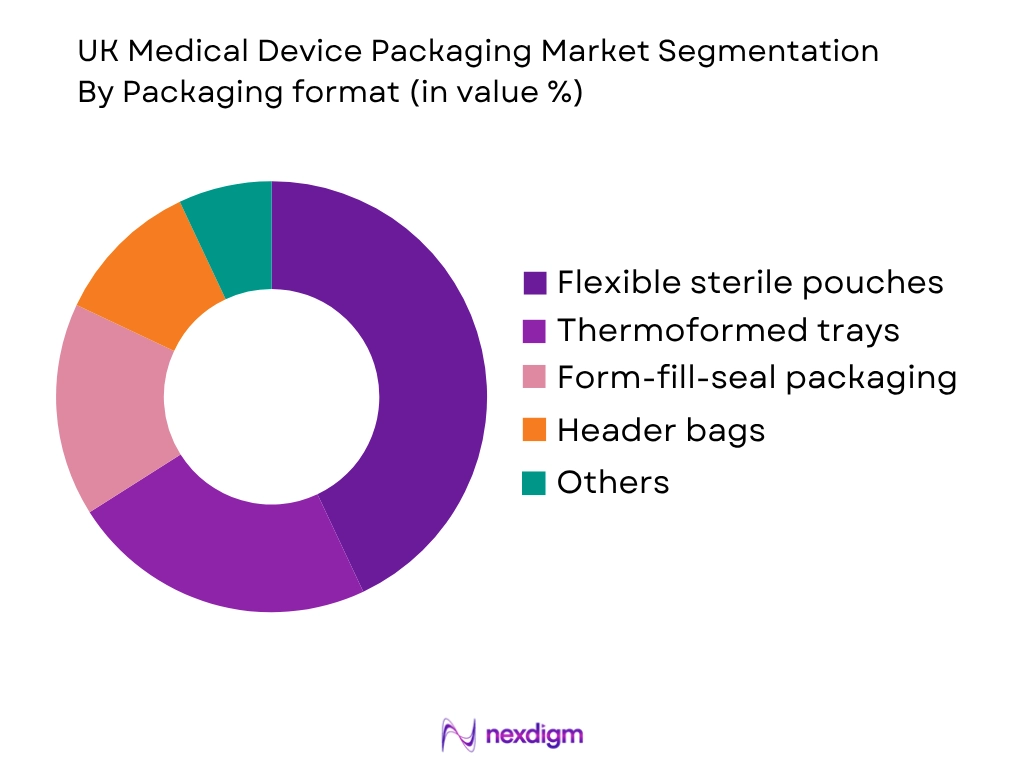
The UK medical device packaging market is segmented into flexible sterile pouches, thermoformed trays, form-fill-seal packs, header bags, blister packs, rigid containers and other protective systems. Flexible sterile pouches hold the dominant share because they accommodate wound-care products, catheters, surgical accessories, dental devices, diagnostics and numerous single-use consumables. Pouches can combine transparent films with medical-grade paper or spun-bonded polyolefin, supporting product visibility, microbial protection and controlled peel opening. Their low material weight also reduces storage and transportation requirements compared with rigid systems. Thermoformed trays remain essential for orthopedic implants, cardiovascular devices and fragile instruments that require immobilization or puncture protection. Form-fill-seal packs are suited to standardized, high-volume products, while header bags serve long or irregularly shaped devices. Format selection ultimately depends on sterilisation method, device geometry, opening requirements and distribution risk.
By Packaging Material
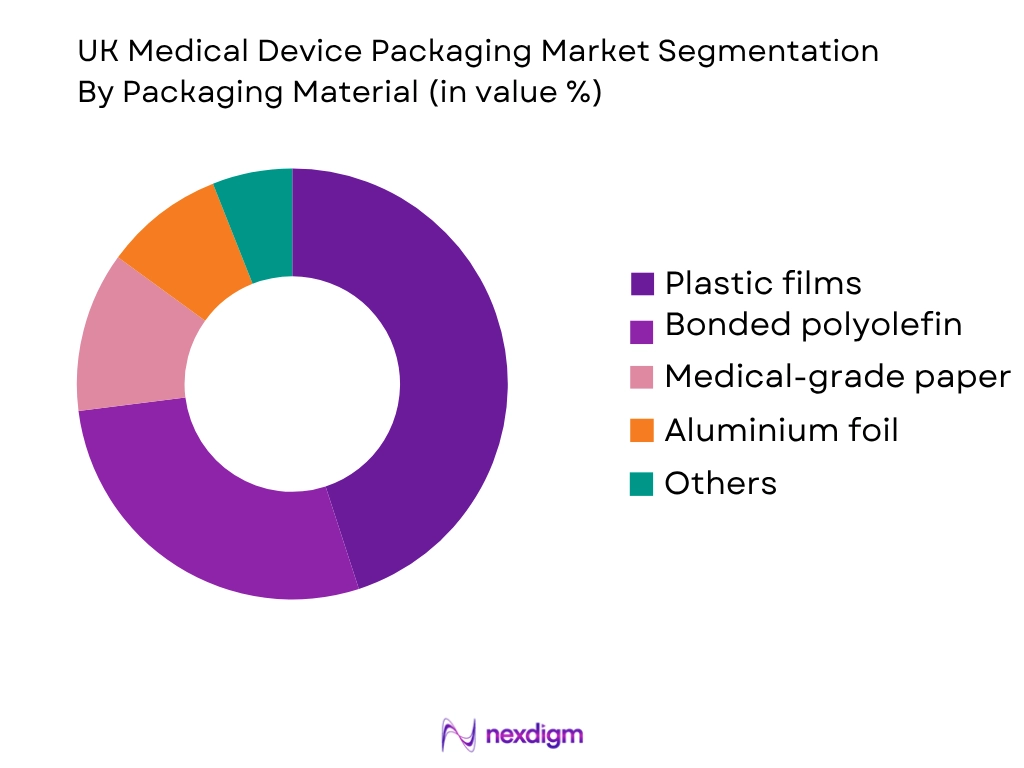
The UK medical device packaging market is segmented into plastic films and thermoforming sheets, spun-bonded polyolefin, medical-grade paper, paperboard, aluminium laminates and specialist barrier materials. Plastic films and thermoforming sheets dominate because polyethylene, polypropylene, PETG, APET and multilayer structures provide clarity, sealability, puncture resistance and dimensional stability. These substrates can be converted into flexible pouches, rigid tray bottoms, blister packs and automated form-fill-seal structures. Spun-bonded polyolefin is strategically important for terminally sterilised products because it provides microbial protection, low particulate generation and compatibility with several sterilisation methods. Medical-grade paper remains widely used for breathable, cost-efficient ethylene-oxide-compatible packaging. Aluminium structures serve products requiring enhanced moisture, oxygen or light protection. Increasing NHS sustainability requirements are encouraging downgauging, PVC substitution and reduced secondary packaging, although sterile-barrier changes require extensive validation before implementation.
Competitive Landscape
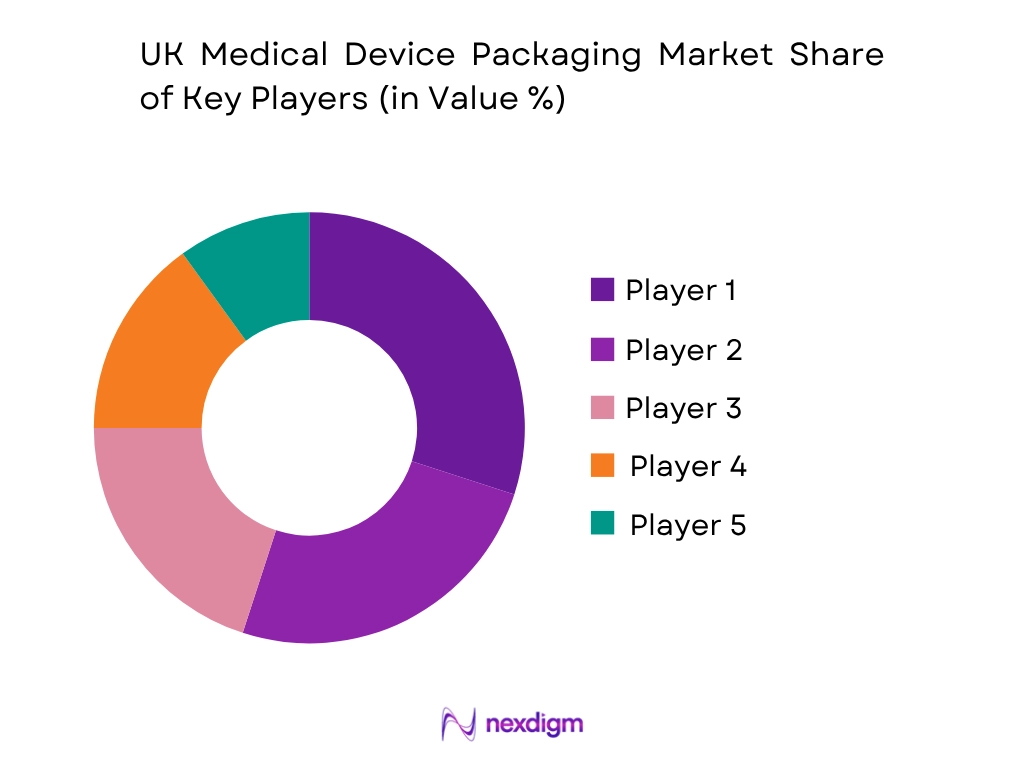
The UK medical device packaging market includes multinational healthcare-packaging groups, specialist sterile-barrier converters, medical-material suppliers and domestic contract-packaging businesses. Amcor, Oliver Healthcare Packaging, TekniPlex Healthcare, DuPont and Nelipak have influential positions because they combine material science, package engineering and regulated-market experience. Competition is determined by cleanroom capability, sterilisation compatibility, package-validation support, formal change control, manufacturing resilience and the ability to serve both Great Britain and Northern Ireland regulatory pathways.
| Company | Establishment year | Headquarters | Core packaging formats | Material capabilities | Sterilisation compatibility | Validation support | UK market role | Sustainability capability |
| Amcor | 1860 | Zurich, Switzerland | ~ | ~ | ~ | ~ | ~ | ~ |
| Oliver Healthcare Packaging | 1890 | Trevose, United States | ~ | ~ | ~ | ~ | ~ | ~ |
| TekniPlex Healthcare | 1967 | Wayne, United States | ~ | ~ | ~ | ~ | ~ | ~ |
| DuPont | 1802 | Wilmington, United States | ~ | ~ | ~ | ~ | ~ | ~ |
| Nelipak Healthcare Packaging | 1953 | Phoenix, United States | ~ | ~ | ~ | ~ | ~ | ~ |
UK Medical Device Packaging Market Analysis
Growth Drivers
Expansion of Medical Technology Manufacturing and Clinical Innovation
Expansion of the UK medical-technology ecosystem is increasing demand for validated sterile pouches, thermoformed trays, breathable lidding, protective inserts, procedure-kit packaging and traceable secondary cartons. Official UK statistics recorded approximately £48.0 billion in medical-technology turnover during the 2023–2024 reporting period. The broader life-sciences industry included more than 6,000 businesses generating approximately £147 billion, providing an established commercial base for diagnostic devices, surgical equipment, implants, digital-health products and home-monitoring systems. Each newly commercialised device requires packaging development based on physical geometry, puncture risk, sterilisation method, intended shelf life and clinical presentation. Clinical-development activity adds further demand for prototype and low-volume packaging. The Medicines and Healthcare products Regulatory Agency reported continuing growth in medical-device clinical-investigation activity, including applications involving artificial intelligence, neurological technologies and other innovative products. Clinical-stage packaging must provide accurate device identification, controlled lot traceability and a design that can be scaled into commercial production after regulatory clearance. This benefits specialist converters offering rapid pouch development, prototype thermoforming, cleanroom assembly, controlled labelling and validation support. The size of the regulated product environment also supports packaging consumption. UK government strategy identifies just under 2 million medical products registered for use in the country. Approximately 17 units out of every 100 units of annual UK medical-technology expenditure are associated with implants and prostheses, while surgical equipment accounts for another 16 units. Both categories commonly require higher-value packaging than basic non-sterile consumables because implants and instruments may need rigid retention, double sterile barriers, puncture protection and controlled transfer into operating theatres. Macroeconomic capacity supports this industrial demand. World Bank data valued UK economic output at approximately US$3.686 trillion in 2024, while the Office for National Statistics recorded £452.2 billion in UK manufacturers’ product sales. The manufacturing base gives medical-device companies access to polymer conversion, precision tooling, automation, printing and logistics capabilities required for specialised packaging. Device innovation therefore affects both packaging quantity and technical value. Wearable sensors need moisture and electrostatic protection; long catheters require header bags or elongated trays; implants require secure fixation; and diagnostic cartridges need dimensional stability and contamination control. Growth in the UK medical-technology sector consequently strengthens demand for suppliers capable of supporting package design, sterilisation compatibility, accelerated aging, integrity testing and commercial-scale conversion.
Stronger Post-Market Surveillance and Regulatory Packaging Control
The strengthening of UK medical-device regulation is increasing the importance of packaging integrity, traceability and lifecycle documentation. The Medical Devices (Post-market Surveillance Requirements) (Amendment) Regulations 2024 inserted a new post-market surveillance framework into the UK Medical Devices Regulations and took effect across Great Britain in 2025. Manufacturers must operate more systematic processes for collecting safety and performance information, identifying trends, investigating incidents and implementing corrective actions. Packaging failures involving damaged sterile barriers, incomplete seals, unreadable labels or compromised tamper evidence can therefore trigger documented investigations and regulatory action. This framework raises the commercial value of controlled packaging systems. Medical-device manufacturers need suppliers that can provide material certificates, batch traceability, validated sealing parameters and formal notifications before changing a film, coating, adhesive, paper grade or manufacturing site. A package that maintains product quality at release but fails during transport or aging may expose the manufacturer to complaints, field corrective actions or product withdrawal. Consequently, package-integrity testing, accelerated aging, distribution simulation and seal-strength monitoring are becoming central elements of supplier qualification. The UK’s regulatory scale makes these controls particularly relevant. Government strategy references just under 2 million products registered for use in the national market. The Medicines and Healthcare products Regulatory Agency’s 2024–2025 annual report also documents continued investment in regulatory safety, scientific assessment and operational improvement. A large product register creates substantial recurring demand for controlled artwork, unique device identification, importer information, UK Responsible Person details and destination-specific packaging records. Regulatory divergence adds complexity. Great Britain operates its own device-registration and market-access framework, while Northern Ireland retains significant alignment with European Union medical-device rules. From 28 May 2026, applicable products entering the Northern Ireland and wider European framework must be registered through the European Database on Medical Devices before placement on the market. Device manufacturers supplying both regulatory territories may therefore require separate markings, authorised-representative details, importer information and controlled label variants. The macroeconomic environment supports investment in these compliance capabilities. UK GDP reached approximately US$3.686 trillion in 2024, while medical technology generated £48.0 billion in turnover during the official reporting period. These figures show that regulatory packaging requirements apply within a substantial healthcare and manufacturing economy rather than a niche product base. Regulatory strengthening therefore acts as a market driver by increasing demand for qualified sterile-barrier suppliers, digital document control, automated seal inspection and formal package-failure analysis. Packaging companies able to serve both Great Britain and Northern Ireland with controlled specifications and multi-market labelling will gain an advantage over general converters lacking medical-device quality systems.
Market Challenges
High Cleanroom, Validation and Qualification Requirements
Medical-device packaging involves high initial and continuing investment because production frequently requires classified cleanrooms, calibrated sealing equipment, precision thermoforming tools, environmental monitoring, automated inspection and specialist testing laboratories. A new package may require installation qualification, operational qualification and performance qualification before commercial use. Manufacturers must then conduct accelerated aging, real-time aging, seal-strength testing and simulated transport studies to demonstrate that the packaging remains functional throughout its intended lifecycle. The challenge is intensified by the number and diversity of products supplied in the UK. Government strategy identifies just under 2 million registered medical products, spanning basic consumables, surgical devices, diagnostic instruments, implants and active technologies. Each device can differ in weight, shape, sharpness, sensitivity and sterilisation exposure. A pouch qualified for a wound dressing cannot automatically be used for a catheter, orthopedic implant or diagnostic cartridge. Material and tooling expenditure can occur before device demand reaches commercial scale. Emerging medical-technology companies often require small clinical batches, repeated design modifications and several package configurations for different study sites. Thermoforming tools, sealing fixtures and printed components may become obsolete if the device changes during development. Established device manufacturers present the opposite challenge: their volumes may justify automated lines, but they expect redundant capacity, formal disaster-recovery planning and uninterrupted supply. The wider manufacturing environment does not eliminate these pressures. The Office for National Statistics recorded £452.2 billion in UK manufacturers’ product sales in 2024, but this was £14.5 billion below the preceding annual total of £466.7 billion. Medical packaging projects must therefore compete for capital in a manufacturing environment affected by energy costs, labour availability and cautious investment decisions. Macroeconomic growth also remained limited. The Office for National Statistics recorded annual real GDP growth equivalent to 1 unit for every 100 units in 2024 and approximately 1.3 units in 2025. The comparatively moderate expansion increases pressure on packaging suppliers to improve equipment utilisation and avoid excessive inventory. Cleanroom operations create ongoing expenses beyond equipment purchase. Suppliers must maintain air control, cleaning programmes, pest management, environmental records, line clearance and controlled personnel practices. Sterile-packaging converters also require trained quality personnel to investigate non-conformances and maintain validation files. High initial requirements therefore limit the number of suppliers capable of entering the market. Smaller converters may offer film or carton production but lack the cleanroom, laboratory and documentation systems necessary for regulated devices. This creates opportunities for established specialists, but it also constrains overall capacity and can lengthen lead times when new products require rapid qualification.
Sterilisation Compatibility, Material Availability and Specialist Skills
Technical complexity is a major constraint because packaging materials respond differently to ethylene oxide, gamma irradiation, electron-beam irradiation, steam and low-temperature sterilisation. Radiation may affect colour, flexibility and mechanical strength; steam can distort materials that lack adequate thermal resistance; and oxidative processes may interact with adhesives, coatings or printed components. Packaging engineers must evaluate these effects while ensuring microbial protection, controlled opening, shelf-life stability and device visibility. The challenge applies across an unusually broad product landscape. The UK has just under 2 million medical products registered for use, while official statistics identify approximately £48.0 billion in medical-technology turnover. This means packaging development must serve both high-volume commodity devices and complex implants with significantly different performance requirements. Medical-grade material availability adds another constraint. Spun-bonded polyolefin, coated medical paper, speciality thermoforming films and validated sealant layers are supplied through tightly controlled global chains. Device manufacturers may specify an exact material grade that has already completed aging and sterilisation studies. Replacing it because of shortage or discontinuation can require new sealing studies, package-integrity testing and regulatory documentation. Brexit-related customs and border processes can further complicate European sourcing, particularly where device manufacturers maintain low inventories. Specialist workforce availability affects how quickly these issues can be resolved. Packaging development requires expertise in polymer science, sterile-barrier systems, cleanroom manufacturing, tooling, human factors and quality assurance. These skills are narrower than general manufacturing experience. The UK medical-technology subsector supports a large employment base, while the broader life-sciences industry includes more than 6,000 businesses, increasing competition for experienced packaging and quality personnel. The problem is not limited to package design. Operators must understand line clearance, material identification and seal-process controls. Laboratory staff must interpret peel-force variation, leakage results and aging behaviour. Regulatory personnel must connect packaging changes to technical documentation for Great Britain, Northern Ireland and export destinations. Manufacturing conditions add pressure. ONS data show that UK manufacturing output recorded no annual expansion across 2024, while output in the fourth quarter declined by the equivalent of 0.6 units for every 100 units. Suppliers therefore face technical investment requirements within a relatively constrained production environment. Sterilisation compatibility and limited specialist capacity can delay product launch, restrict material substitutions and increase dependence on established suppliers. The strongest market participants will be those maintaining qualified alternatives, experienced validation teams, technical laboratories and close relationships with sterilisation providers.
Market Opportunities
Automated Package Inspection and Digital Process Control
Automation represents a major opportunity because UK medical-device packaging requires high consistency across a large and diverse regulated-product base. Just under 2 million medical products are registered for use in the country, and the medical-technology subsector generates approximately £48.0 billion in turnover. These figures support demand for automated seal inspection, digital batch records, robotic product loading and non-destructive package-integrity testing. Connected sealing systems can continuously record temperature, pressure, dwell time and line speed. Rather than relying only on periodic manual checks, manufacturers can identify parameter drift before it creates a large quantity of defective pouches or tray seals. Machine-vision systems can detect wrinkles, channels, contamination, missing labels and incomplete seals. Vacuum-decay, pressure-decay and high-voltage testing can identify leakage without destroying every evaluated package. The opportunity is reinforced by increasing clinical-development activity. The Medicines and Healthcare products Regulatory Agency has reported record levels of medical-device clinical-investigation activity, including applications involving neurological systems and artificial intelligence. Clinical programmes typically require flexible production, controlled labelling and rapid movement between prototypes and validated commercial packages. Automated lines with recipe control and electronic records can support these small batches while preserving traceability. Digital package design also reduces physical development cycles. Three-dimensional modelling can optimise tray cavities, device-retention features and peel-tab placement before tools are manufactured. Simulation can identify potential stress concentration during distribution. Rapid tooling and digital printing can then produce clinical or launch quantities without committing to large inventories. The broader economic base supports adoption. World Bank data valued UK GDP at approximately US$3.686 trillion in 2024, while manufacturers generated £452.2 billion in product sales. These figures demonstrate sufficient industrial capacity for investment in robotics, inspection equipment, data systems and specialist engineering services. Digital systems also support stronger post-market surveillance. When a complaint is received, manufacturers can retrieve the exact material lot, sealing parameters, operator record and inspection outcome associated with the affected device. This improves root-cause analysis and reduces the scope of corrective actions. Future opportunity will therefore extend beyond selling packaging materials. Suppliers can offer integrated development, automated conversion, digital traceability and package-integrity analytics. Contract packagers with flexible cleanroom automation will be especially well positioned to serve start-ups, diagnostics businesses and manufacturers introducing high-mix, lower-volume products.
NHS Sustainability Procurement and International Regulatory Collaboration
NHS procurement policy creates a future growth opportunity for medical-device packaging suppliers that can reduce material use and document environmental performance without weakening sterility or clinical usability. The NHS has committed to reach net zero for emissions it controls directly by 2040 and for emissions influenced through purchased goods and services by 2045. Its supplier roadmap requires all relevant procurements to apply at least 10 units out of every 100 evaluation units to net-zero and social-value considerations. This policy gives packaging weight, transport efficiency and material composition greater influence in supplier selection. Opportunities include smaller thermoformed trays, downgauged films, reduced header areas, fibre-based secondary cartons, reusable distribution totes and packaging systems that eliminate unnecessary components. Suppliers can also help medical-device manufacturers calculate packaging-related emissions and complete NHS sustainability assessments. The opportunity is substantial because NHS expenditure includes device categories with demanding packaging requirements. Government strategy states that implants and prostheses represent approximately 17 units per 100 units of annual UK medical-technology expenditure, while surgical equipment represents 16 units. These categories often use rigid trays, double sterile barriers and protective transit packaging, giving redesign projects measurable potential to reduce material and distribution volume. International regulatory collaboration provides a second opportunity. A 2026 UK policy statement outlined a proposed framework for recognising medical devices approved by trusted international regulators. Greater regulatory reliance could help manufacturers introduce devices to Great Britain more efficiently, while creating demand for package platforms that can support multiple markets through controlled variations in labelling and representation details. Northern Ireland also connects UK packaging operations with the European regulatory system. From 28 May 2026, applicable products must be registered through EUDAMED before placement on the relevant market. Packaging suppliers that can manage UKCA, CE, UKNI, importer and authorised-representative information across controlled artwork versions will become valuable regulatory partners. The economic and industrial base supports this opportunity. The UK medical-technology subsector generates approximately £48.0 billion in turnover, and the wider life-sciences industry includes more than 6,000 businesses. These companies need packaging solutions suitable for NHS procurement, private healthcare and international exports.
Future Outlook
The UK medical device packaging market is forecast to expand at approximately ~% CAGR during the forecast period. Growth will be supported by expanding medical-device innovation, increasing diagnostic activity, home healthcare, wearable technologies and NHS demand for procedure-ready products. The market will also be shaped by regulatory divergence between Great Britain and Northern Ireland, stronger post-market surveillance and greater supplier sustainability requirements. The UK medical-technology subsector employs approximately 196,000 people, demonstrating the depth of its product-development, manufacturing and commercial infrastructure. The sector includes digital health, diagnostics, surgical devices, implants, rehabilitation products and single-use consumables. Each category generates different packaging requirements, ranging from non-sterile protective cartons to double sterile-barrier implant systems. Medical-device innovation will create recurring demand for package development rather than only increased packaging volume. The MHRA reported a 17 percentage-point increase in approved medical-device clinical investigations in its latest published comparison. Clinical investigations require low-volume controlled packaging, accurate labelling, traceability and scalable designs that can progress into commercial manufacturing.
Major Players
- Amcor
- Oliver Healthcare Packaging
- TekniPlex Healthcare
- DuPont
- Nelipak Healthcare Packaging
- SteriPack Group
- Klöckner Pentaplast
- Wipak Group
- ProAmpac
- Coveris
- Constantia Flexibles
- Riverside Medical Packaging
- Sirane Group
- Sterimed
- West Pharmaceutical Services
Key Target Audience
- Medical device packaging manufacturers and sterile-barrier converters
- Medical device and diagnostic equipment manufacturers
- Contract development and manufacturing organisations
- Contract packaging and sterilisation service providers
- Medical-grade polymer, paper and barrier-material suppliers
- Packaging machinery, integrity-testing and inspection-equipment providers
- Investments and venture capitalist firms
- Government and regulatory bodies
Research Methodology
Step 1: Identification of Key Variables
The initial phase constructs an ecosystem map covering medical-device manufacturers, packaging converters, substrate suppliers, contract packagers, sterilisation providers, laboratories and NHS procurement organisations. Critical variables include device output, packaging units per device, sterile-barrier format, material consumption, sterilisation method, cleanroom capacity and regulatory destination. Definitions distinguish primary sterile barriers from protective, secondary and tertiary packaging.
Step 2: Market Analysis and Construction
Historical demand is assessed using medical-technology production, imports, exports, converter revenues, material consumption and installed packaging capacity. The top-down model converts device-category shipments into packaging-unit demand. The bottom-up model aggregates revenue from pouch, tray, lidding, rollstock, protective-packaging and contract-packaging suppliers before reconciling results through material-weight, yield and average-realisation checks.
Step 3: Hypothesis Validation and Expert Consultation
Market hypotheses are validated through computer-assisted telephone interviews with packaging engineers, medical-device manufacturers, converters, sterilisation companies and testing laboratories. Interviews assess format penetration, line utilisation, qualification periods, package failures, supplier concentration and sustainability requirements. Responses are classified according to device risk, package format, sterilisation method and customer scale.
Step 4: Research Synthesis and Final Output
The final phase integrates government publications, regulatory guidance, company disclosures and primary research. Market size is triangulated across converter revenue, packaging shipments, device output and material demand. Forecast assumptions incorporate medical-device innovation, NHS procurement, contract packaging, sustainability requirements and Great Britain–Northern Ireland regulatory divergence. Competitive positioning is validated against cleanroom capability, technical services and customer qualification.

- Executive Summary
- Research Methodology (Market Definitions and Assumptions, Medical Device Packaging Taxonomy, Abbreviations, Market Sizing Approach, Top-Down Analysis, Bottom-Up Converter Revenue Aggregation, Device Shipment-to-Packaging Unit Conversion, Demand-Side Assessment, Supply-Side Capacity Mapping, Import–Export Reconciliation, Primary Industry Interviews, Data Triangulation, Forecasting Framework, Scenario Analysis, Limitations and Future Conclusions)

- Definition and Scope
- Market Evolution and Industry Genesis
- Timeline of Major Industry Developments
- Medical Device Packaging Business Cycle
- Packaging Demand Linkage with UK Medical Technology Production
- Medical Device Classification and Packaging Requirement Mapping

- Growth Drivers (Expansion of UK MedTech Production, NHS Demand for Single-Use Devices, Increasing Surgical and Diagnostic Activity, Growth of Home Healthcare Devices, Expansion of Minimally Invasive Procedures, In-Vitro Diagnostic Innovation, Medical Technology Export Activity and Higher Traceability Requirements)
- Market Challenges (Great Britain–Northern Ireland Regulatory Divergence, Medical-Grade Material Import Dependence, Sterilisation Capacity Constraints, Long Packaging Qualification Cycles, Specialty Substrate Availability, Packaging Seal Failure Risk, Skilled Packaging Engineering Shortages and Sustainability–Sterility Trade-Offs)
- Market Opportunities (Domestic Sterile Barrier Production, Recyclable Healthcare Packaging, PVC-Free Packaging, Custom Implant Trays, Packaging for Wearable Devices, Contract Packaging Expansion, Automated Package Integrity Testing and Regional Packaging-Sterilisation Hubs)
- Market Trends (Tyvek-Based Sterile Barriers, Thermoformed Tray Optimisation, Double Sterile Barrier Systems, Down-Gauged Films, Digital Package Prototyping, Human-Factors-Led Opening Design, Automated Seal Inspection, Cleanroom Packaging Outsourcing and Packaging Sustainability Scorecards)
- SWOT Analysis
- Porter’s Five Forces Analysis
- PESTLE Analysis

- By Market Value (2020-2025)
- By Packaging Units (2020-2025)
- By Medical-Grade Material Consumption (2020-2025)

- By Packaging Format (In Value %)
Flexible Sterile Pouches
Thermoformed Trays
Header Bags
Form-Fill-Seal Packs
Blister Packs
Clamshell Packaging - By Packaging Material (In Value %)
Medical-Grade Paper
Spun-Bonded Polyolefin and Tyvek
Polyethylene Films
Polypropylene Films
Polyethylene Terephthalate Films and Sheets
PETG Thermoforming Materials - By End-User Organisation (In Value %)
Large Medical Device Manufacturers
Domestic Medical Technology Companies
Multinational Medical Device Subsidiaries
Contract Development and Manufacturing Organisations
Original Equipment Manufacturers
NHS Hospital and Sterile Services Units - By Geographic Market (In Value %)
London and South East England
East of England
North West England
Yorkshire and the Humber
West Midlands
East Midlands

- Market Share of Major Players
- Cross Comparison Parameters (Sterile Barrier Product Portfolio, Medical-Grade Material Expertise, UK Cleanroom Manufacturing Footprint, Sterilisation Compatibility Coverage, Packaging Validation and Testing Capability, UK Medical Device Customer Coverage, Custom Tooling and Prototyping Capability, Sustainable Healthcare Packaging Portfolio)
- SWOT Analysis of Major Players
- Detailed Profiles of Major Companies
Amcor
Oliver Healthcare Packaging
TekniPlex Healthcare
DuPont
Nelipak Healthcare Packaging
SteriPack Group
Klöckner Pentaplast
Wipak Group
ProAmpac
Coveris
Constantia Flexibles
Riverside Medical Packaging
Sirane Group
Sterimed
West Pharmaceutical Services

- Packaging Demand and Utilisation Assessment
- Medical Device Manufacturer Procurement Criteria
- Packaging Supplier Qualification Process
- Packaging Engineer Decision-Making Process
- Regulatory and Quality Team Requirements
- Large Medical Device Manufacturer Analysis

- By Market Value (2026-2035)
- By Packaging Units (2026-2035)
- By Medical-Grade Material Consumption (2026-2035)


 Request a Sample
 Ask for Customization
 Get a Quote
 Enquire Now