
 Download PDF
Market Overview
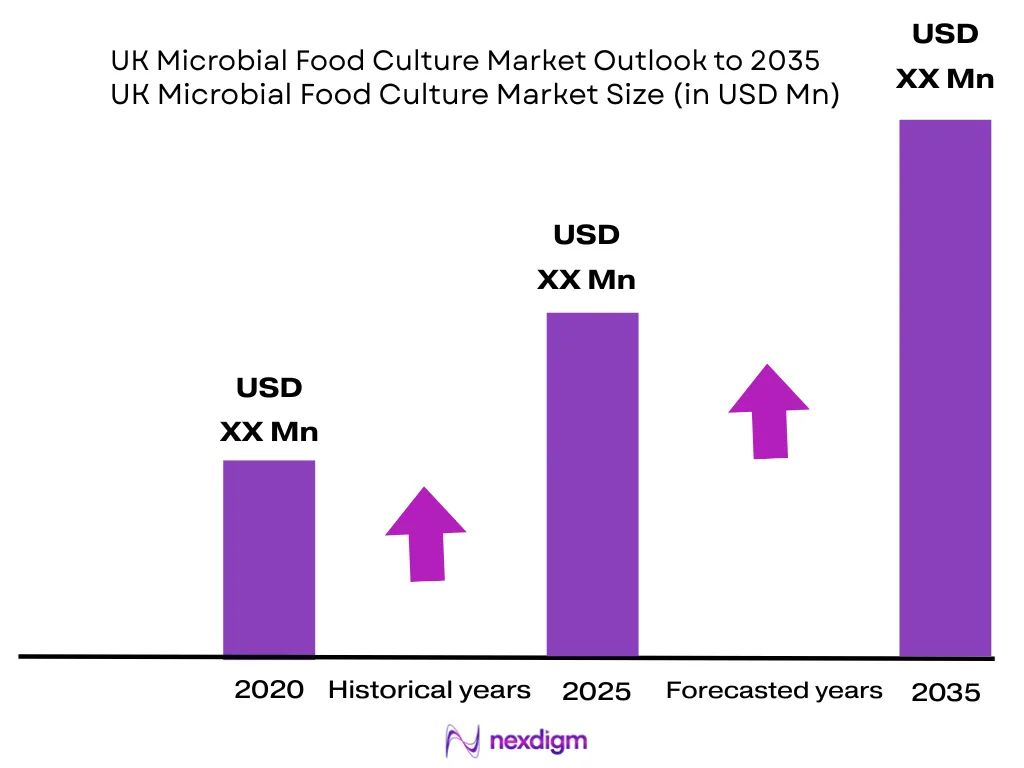
The UK Microbial Food Culture Market is valued at USD ~ million, based on a five-year historical analysis, and is forecast to grow at % CAGR during the forecast period. Demand is driven by cheese, yogurt, kefir, cultured dairy, sourdough, fermented vegetables, kombucha, probiotics and clean-label biopreservation. UK dairies processed 1,206 million litres of milk in the latest December release, while the food and drink manufacturing sector recorded turnover of more than GBP 148 billion. The UK Microbial Food Culture Market is dominated by England, Scotland, Wales and Northern Ireland, with key clusters across South West England, Yorkshire, the Midlands, Scotland, Wales and Northern Ireland. Dominance is supported by dairy processing, cheddar production, artisan cheese, yogurt, cultured dairy, fermented meat, sourdough and functional food manufacturing. The UK has 12,515 food and drink manufacturers, while cheese remains the largest manufactured dairy product, with cheddar comprising 71 units per 100 of cheese output.
Market Segmentation
By Culture Type
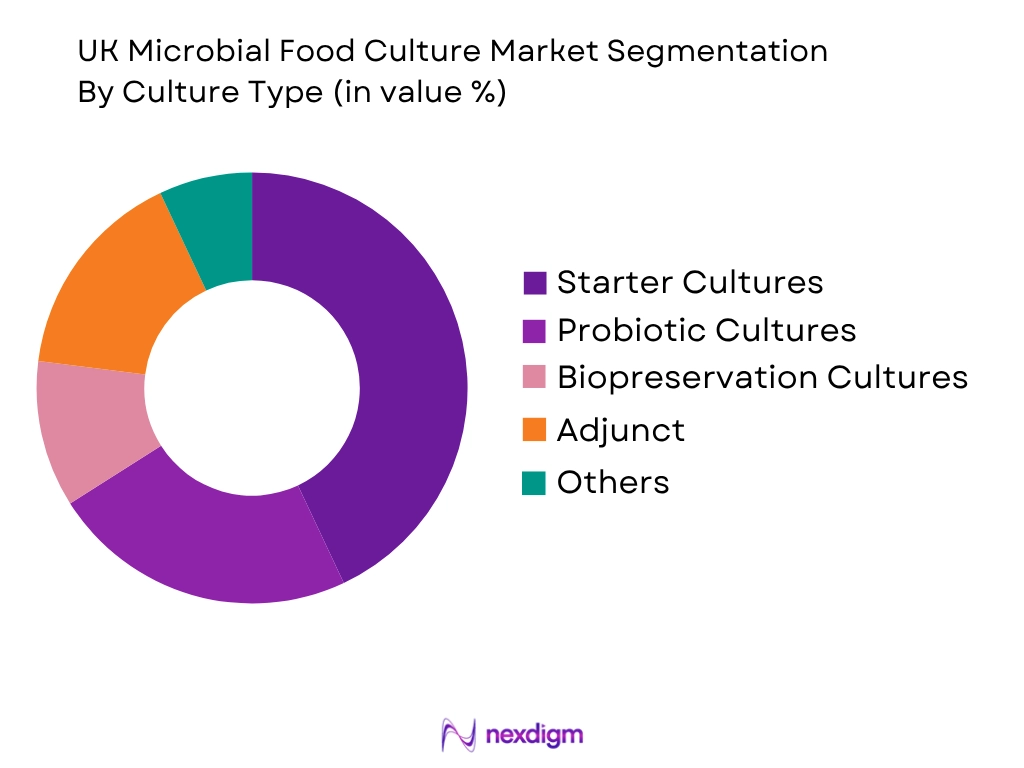
UK Microbial Food Culture Market is segmented by culture type into starter cultures, probiotic cultures, protective cultures, adjunct cultures, ripening cultures, aroma cultures, direct vat set cultures and specialty encapsulated systems. Recently, starter cultures have a dominant market share in the UK under culture type segmentation because cheese, yogurt, kefir, fermented milk, cream cheese, cultured butter and sour cream require controlled acidification, pH reduction, texture formation, flavour development and process consistency. Cheddar, Stilton, Wensleydale, Red Leicester and soft cheese producers depend on thermophilic and mesophilic cultures for reliable fermentation and ripening. Yogurt and kefir manufacturers also need fast-acidifying, mild-flavour and viscosity-supporting cultures that maintain product quality across chilled retail distribution.
By Application
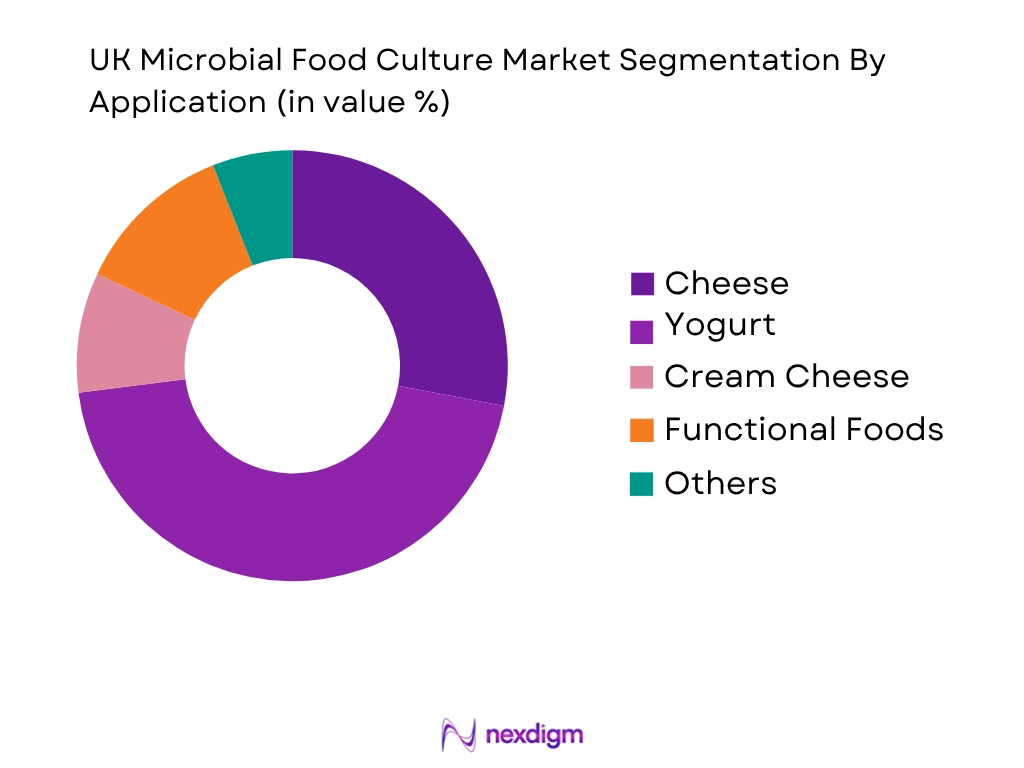
UK Microbial Food Culture Market is segmented by application into cheese, yogurt, kefir, fermented milk, cultured butter, cream cheese, cottage cheese, sourdough, fermented meat, charcuterie, fermented vegetables, kombucha, fermented beverages, plant-based yogurt alternatives, plant-based cheese alternatives and probiotic foods. Recently, cheese has a dominant market share under application segmentation because the UK has a mature cheese manufacturing base led by cheddar and supported by Stilton, Wensleydale, Red Leicester, Cheshire, Double Gloucester, soft cheese and blue cheese. Cheese processors use starter, adjunct, ripening, aroma, gas-forming, mould and protective cultures for acidification, texture, rind development, flavour, melt, moisture and shelf-life control. Demand is strengthened by industrial cheddar manufacturing and premium artisan cheese production.
Competitive Landscape
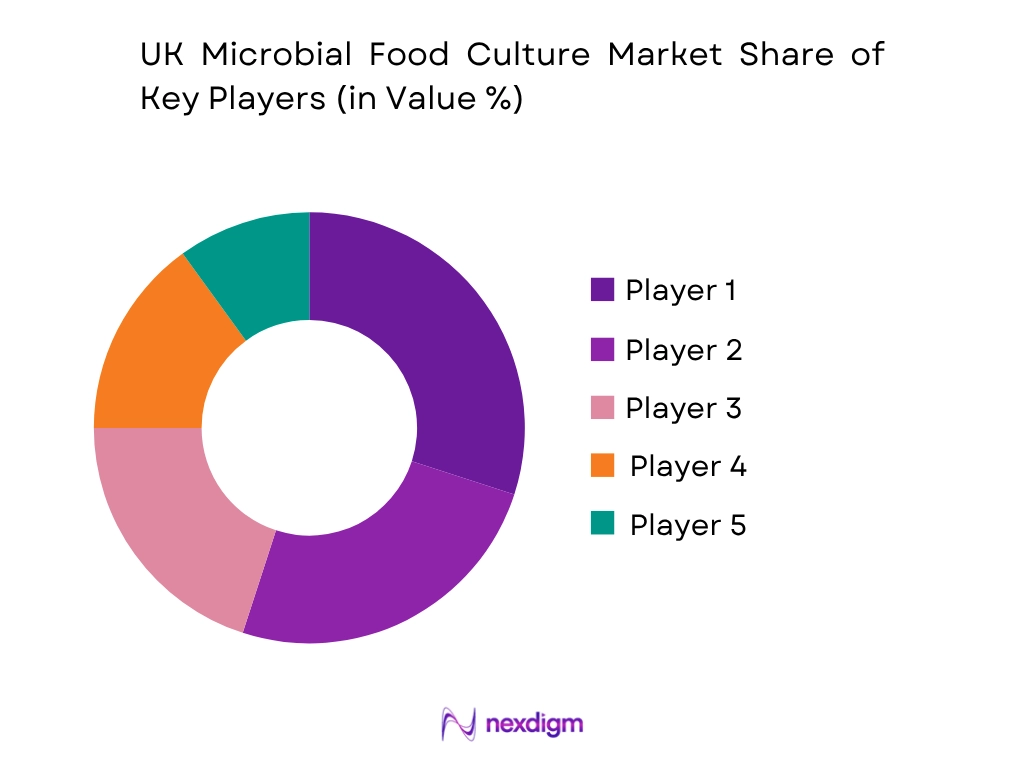
The UK Microbial Food Culture Market is concentrated among global culture houses, dairy ingredient firms, probiotic strain suppliers, fermentation specialists and local ingredient distributors. Competition is shaped by strain bank depth, starter culture reliability, phage-robust rotation systems, probiotic viability, cold-chain dependability, FSA/FSS documentation, novel food compliance support, clean-label biopreservation and technical service for cheddar, yogurt, kefir, sourdough, fermented meats and plant-based dairy alternatives.
| Company | Establishment Year | Headquarters | Core Culture Focus | UK Market Role | Key Applications | Regulatory Capability | Innovation Capability | Market-Specific Capability |
| Novonesis UK | 2024 | Bagsværd, Denmark | ~ | ~ | ~ | ~ | ~ | ~ |
| IFF UK | 1958 | New York, USA | ~ | ~ | ~ | ~ | ~ | ~ |
| dsm-firmenich UK | 2023 | Kaiseraugst, Switzerland | ~ | ~ | ~ | ~ | ~ | ~ |
| Lallemand Specialty Cultures UK | 1915 | Montreal, Canada | ~ | ~ | ~ | ~ | ~ | ~ |
| Kerry Bio-Science UK | 1972 | Tralee, Ireland | ~ | ~ | ~ | ~ | ~ | ~ |
UK Microbial Food Culture Market Analysis
Growth Drivers
Large dairy-processing and cheese-production base
The UK Microbial Food Culture Market is supported by a substantial dairy-processing system that requires starter, adjunct, ripening, protective and probiotic cultures for acidification, texture development, flavour formation, mould control and shelf-life management. Defra reported that UK dairies processed 1,206 million litres of milk in December 2024 and manufactured 504 million litres of liquid milk during the month. Cheese remained the largest manufactured dairy product, with cheddar accounting for 71 units out of every 100 units of total cheese production. In May 2024, dairies processed 1,332 million litres of milk and produced 46,400 tonnes of cheese, demonstrating the operational scale exposed to culture performance. World Bank data placed UK GDP at USD 3.69 trillion, GDP per capita at USD 53,246.4, and population at 69.23 million in 2024. This processing and consumption base creates sustained demand for mesophilic starters, thermophilic cultures, blue-mould cultures, surface-ripening systems and phage-rotation programs across cheddar, Stilton, Wensleydale, yogurt, kefir, cream cheese and cultured dairy manufacturing.
Food-manufacturing scale and expanding fermented-product trade
The UK Microbial Food Culture Market benefits from a broad food-manufacturing and agri-food economy that supports industrial fermentation across dairy, sourdough, fermented vegetables, charcuterie, kombucha and plant-based alternatives. ONS reported total UK manufacturers’ product sales of GBP 452.2 billion in 2024, while Defra recorded agri-food employment of 4.2 million people during the fourth quarter. Food and drink manufacturing contributed GBP 37.1 billion to food-chain gross value added, providing a substantial processing base for microbial culture adoption. Dairy trade also increases demand for standardized fermentation and refrigerated stability: AHDB reported that yogurt imports increased by 40,900 tonnes and cheese-and-curd imports by 16,800 tonnes during 2024. World Bank data recorded UK GDP of USD 3.69 trillion and GDP per capita of USD 53,246.4. These indicators support investment in direct-vat-set cultures, probiotic strains, clean-label protective cultures and fermentation systems capable of delivering consistent acidity, viscosity and flavour across retail, private-label, foodservice and export-oriented production.
Market Challenges
Food-safety documentation and probiotic-claim restrictions
The UK Microbial Food Culture Market faces a demanding compliance environment because culture suppliers must document strain identity, intended use, microbiological safety, viable counts, allergen controls, manufacturing quality and shelf-life performance. Probiotic and functional-food applications also require careful claim management under the Great Britain nutrition and health-claims framework, restricting how gut-health and live-culture benefits can be communicated. This burden affects a large operational base: Defra reported 1,206 million litres of milk processed by UK dairies in December 2024, while the agri-food sector employed 4.2 million people. ONS recorded manufacturers’ product sales of GBP 452.2 billion, illustrating the scale of regulated food production exposed to supplier-approval requirements. The UK National Reference Laboratory’s 2024–2025 programme covered pathogens including Listeria monocytogenes, Salmonella, pathogenic E. coli and coagulase-positive staphylococci, reinforcing the importance of validated hygiene and contamination controls. Culture suppliers with incomplete safety dossiers, strain traceability or claim substantiation face delayed approvals from cheese, yogurt, kefir, fermented-meat and functional-food manufacturers.
Bacteriophage exposure, viability loss and process variability
The UK Microbial Food Culture Market is technically constrained by bacteriophage contamination, cold-chain interruption, raw-milk variability and strain-performance differences across industrial and artisan fermentation. Defra reported 1,332 million litres of milk available to processors and 46,400 tonnes of cheese production in May 2024, showing how culture failure can affect high-volume dairy batches. UK dairies also processed 1,206 million litres in December, while cheddar represented 71 units out of every 100 units of cheese production. Starter cultures can experience slow acidification under changes in milk protein, fat, mineral balance, salt concentration or sanitation conditions, while probiotics can lose viable counts during freeze-dried storage, transport and refrigerated shelf life. Protective cultures must also perform consistently against mould and yeast without creating unwanted acidity or flavour. These risks are intensified by the UK’s active dairy trade, including 40,900 additional tonnes of yogurt imports and 16,800 additional tonnes of cheese-and-curd imports in 2024. Suppliers therefore require phage-rotation systems, validated cold-chain handling, lot-level quality control and rapid technical troubleshooting.
Market Opportunities
Protective cultures for clean-label preservation and food-waste reduction
The UK Microbial Food Culture Market has a significant opportunity in protective cultures that help dairy, bakery, fermented-meat and chilled-food manufacturers control mould, yeast and spoilage while reducing dependence on conventional preservatives. The commercial base is substantial: ONS reported UK manufacturers’ product sales of GBP 452.2 billion in 2024, while food and drink manufacturing generated GBP 37.1 billion of food-chain gross value added. Defra recorded 1,206 million litres of milk processed by dairies in December and confirmed that cheese remained the largest manufactured dairy product. The agri-food sector employed 4.2 million people, indicating a large network of processors, distributors and foodservice operators exposed to shelf-life and waste-management pressures. Protective cultures can be applied in cheddar, soft cheese, yogurt, cream cheese, sourdough, chilled dips, charcuterie and plant-based products to suppress spoilage organisms and improve refrigerated stability. Suppliers that combine biopreservation strains with shelf-life validation, sensory testing and retailer-ready documentation can convert current clean-label and waste-reduction requirements into recurring industrial culture programs.
Next-generation probiotics and plant-based fermentation platforms
The UK Microbial Food Culture Market has a growth opportunity in documented probiotic strains, kefir systems, synbiotic foods and cultures designed for oat, soy, pea, almond and coconut matrices. World Bank data recorded a UK population of 69.23 million, GDP of USD 3.69 trillion, and GDP per capita of USD 53,246.4 in 2024, supporting demand for premium functional foods and differentiated fermented products. AHDB reported that yogurt imports increased by 40,900 tonnes, reflecting strong domestic demand for cultured dairy formats, while cheese-and-curd imports rose by 16,800 tonnes. The UK also produced 46,400 tonnes of cheese in May 2024, demonstrating the scale of existing fermentation expertise. Suppliers can target high-protein yogurt, drinkable cultures, kefir, probiotic snacks, plant-based yogurt, plant-based cheese and fermented beverages with acid-tolerant strains, encapsulated cultures, spore-forming probiotics and multi-strain blends. The strongest opportunities lie with systems that improve acidification, reduce plant-protein off-notes, build creaminess and maintain viable counts through processing and chilled shelf life.
Future Outlook
Over the next phase, the UK Microbial Food Culture Market is expected to expand through cheese, yogurt, kefir, probiotic foods, sourdough, fermented vegetables, kombucha, fermented meat, clean-label chilled foods and plant-based dairy alternatives. Starter cultures will remain central because cheese and fermented dairy manufacturers need consistent acidification, flavour, texture and yield control.
Major Players
- Novonesis UK
- International Flavors & Fragrances UK
- dsm-firmenich UK
- Lallemand Specialty Cultures UK
- Kerry Bio-Science UK
- Sacco System UK
- CSK Food Enrichment UK
- Bioprox UK
- Dalton Biotecnologie UK
- ADM Biotics UK
- Probi UK
- BioGaia UK
- Biocatalysts Ltd
- Angel Yeast UK
- Special Ingredients Ltd
Key Target Audience
- Microbial food culture manufacturers
- Dairy processors and cheese manufacturers
- Yogurt, kefir and fermented milk manufacturers
- Probiotic and functional food manufacturers
- Bakery, sourdough and fermented vegetable manufacturers
- Plant-based dairy alternative and fermented beverage manufacturers
- Investments and venture capitalist firms
- Government and regulatory bodies
Research Methodology
Step 1: Identification of Key Variables
The initial phase involves mapping culture houses, strain banks, dairy processors, cheese manufacturers, yogurt producers, kefir brands, bakery manufacturers, fermented meat processors, kombucha producers and plant-based dairy companies. Variables include culture type, microorganism type, form, functionality, end-use application, distribution route and regulatory status.
Step 2: Market Analysis and Construction
Historical data is compiled across dairy processing, cheese output, yogurt, fermented milk, kefir, sourdough, fermented vegetables, kombucha, probiotic foods and plant-based fermentation. The top-down approach assesses food manufacturing and dairy indicators, while the bottom-up approach evaluates culture usage by application and processing format.
Step 3: Hypothesis Validation and Expert Consultation
Market hypotheses are validated through interviews with culture suppliers, dairy technologists, cheese manufacturers, probiotic formulators, bakery fermentation specialists, fermented beverage producers and regulatory experts. These consultations test assumptions on starter adoption, protective culture demand, probiotic viability, phage control and plant-based fermentation performance.
Step 4: Research Synthesis and Final Output
The final phase integrates secondary research, food safety regulation review, dairy production data, supplier benchmarking and expert inputs. Data triangulation is applied across manufacturer demand, culture supplier portfolios, technical performance and end-user requirements to prepare the final market report.

- Executive Summary
- Research Methodology (Market Definitions and Assumptions, Culture Classification Framework, Microorganism Mapping, Fermented Food Category Mapping, FSSAI Probiotic and Functional Food Review, Dairy Standard Review, Strain Safety Assessment, Market Sizing Approach, Top-Down Analysis, Bottom-Up Analysis, Demand-Side Assessment, Supply-Side Assessment, Primary Industry Interviews, Data Triangulation, Forecasting Framework, Limitations and Future Conclusions)

- Definition and Scope
- Evolution and Industry Genesis
- Timeline of Major Industry Developments
- Role of Microbial Cultures in UK Fermented Food Manufacturing
- Starter Culture, Protective Culture and Probiotic Culture Ecosystem

- Growth Drivers (Large Food Manufacturing Base, Cheese and Yogurt Production, Cultured Dairy and Kefir Demand, Probiotic and Gut Health Product Demand, Clean-Label Biopreservation Adoption, Shelf-Life Extension Requirements in Chilled Retail, Fermented Meat and Charcuterie Processing, Sourdough and Artisan Bakery Expansion, Plant-Based Fermentation Innovation, Direct Vat Set Culture Adoption)
- Market Challenges (FSA/FSS Food Safety Documentation Burden, UK Novel Food and Probiotic Claim Complexity, Cold Chain and Culture Viability Requirements, Bacteriophage Contamination Risk, Culture Performance Variability, Raw Milk Quality and Seasonal Composition Variability, High Cost of Strain Development, Shelf-Life Claim Validation, Probiotic Survivability in Processing and Storage, Allergen and Cross-Contamination Controls)
- Market Opportunities (Protective Cultures for Clean-Label Shelf-Life Extension, British Cheese Culture Customisation, Cheddar, Stilton, Wensleydale and Red Leicester Starter Optimisation, Next-Generation Probiotic Strains, Plant-Based Dairy Culture Platforms, Kefir and Fermented Milk Culture Systems, Postbiotic and Paraprobiotic Ingredient Development, Fermented Meat Bioprotection, Synbiotic Food Formulations, Non-GMO and Organic-Compatible Culture Systems)
- Market Trends (Multi-Strain Culture Blends, Fast-Acidifying Starter Cultures, Phage-Robust Culture Rotation, Protective Biopreservation Cultures, Clean-Label Shelf-Life Extension, High-Protein Yogurt Cultures, Low-Sugar Fermented Dairy Cultures, Plant-Based Cheese Ripening Cultures, Probiotic Stability Enhancement, Encapsulated Culture Delivery, Regional British Cheese Culture Standardisation)
- Government Regulations (Food Standards Agency Food Safety Framework, Food Standards Scotland Requirements, UK Assimilated Novel Food Regulation, Food Hygiene Regulations, HACCP Requirements, Dairy Hygiene Controls, Fermented Meat Safety Requirements, Labelling and Health Claim Compliance, Allergen Control Rules, Organic and Non-GMO Certification Requirements)
- SWOT Analysis
- Porter’s Five Forces Analysis
- PESTLE Analysis

- By Market Value (2020-2025)
- By Consumption Volume (2020-2025)
- By Starter Culture Demand (2020-2025)

- By Culture Type (In Value %)
Starter Cultures
Protective Cultures
Probiotic Cultures
Adjunct Cultures
Ripening Cultures - By Application (In Value %)
Cheese
Cheddar
Stilton
Red Leicester
Wensleydale - By Distribution Channel (In Value %)
Direct Sales to Dairy and Food Manufacturers
Culture House Key Account Sales
Specialty Ingredient Distributors
Dairy Ingredient Distributors
Fermentation Technology Suppliers - By Region (In Value %)
England
Scotland
Wales
Northern Ireland

- Market Share of Major Players (By Value, Volume, Culture Type, Microorganism Type, Application, End User, Region, Distribution Channel, Starter vs Protective vs Probiotic Portfolio)
- Cross Comparison Parameters (Starter Culture Portfolio Breadth, Protective Culture and Biopreservation Capability, Probiotic Strain Library Strength, FSA/FSS and Novel Food Documentation Strength, Phage-Robust Culture Rotation Capability, Dairy and British Cheese Application Lab Capability, Plant-Based Fermentation Expertise, UK Cold Chain and Technical Service Footprint)
- SWOT Analysis of Major Players
- Detailed Profiles of Major Companies
Novonesis UK
International Flavors & Fragrances UK
dsm-firmenich UK
Lallemand Specialty Cultures UK
Kerry Bio-Science UK
Sacco System UK
CSK Food Enrichment UK
Bioprox UK
Dalton Biotecnologie UK
ADM Biotics UK
Probi UK
BioGaia UK
Biocatalysts Ltd
Angel Yeast UK
Special Ingredients Ltd

- Cheese Manufacturer Analysis
- Yogurt and Fermented Milk Manufacturer Analysis
- Kefir and Probiotic Drink Manufacturer Analysis
- Cream Cheese and Cultured Dairy Manufacturer Analysis
- Fermented Meat and Charcuterie Processor Analysis
- Bakery and Sourdough Manufacturer Analysis

- By Market Value (2026-2035)
- By Consumption Volume (2026-2035)
- By Starter Culture Demand (2026-2035)


 Request a Sample
 Ask for Customization
 Get a Quote
 Enquire Now