

 Download PDF
Market Overview
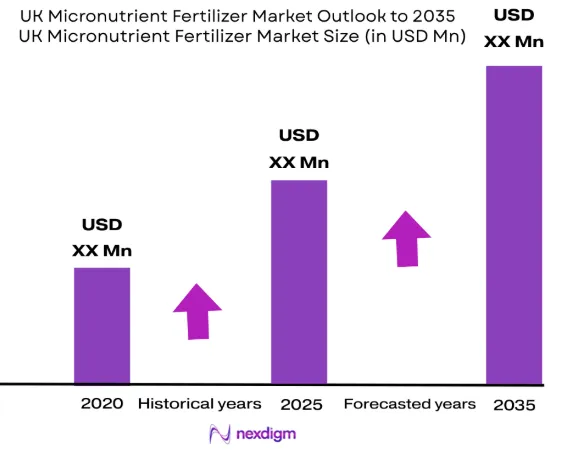
The UK Micronutrient Fertilizer Market is estimated at approximately USD ~ million in 2024, compared to around USD ~ million in 2023, supported by rising awareness of micronutrient deficiencies in arable soils and increasing adoption of precision nutrient management practices. The market is primarily driven by demand from cereal, oilseed rape, horticultural, and vegetable growers. Zinc, boron, manganese, and copper deficiencies continue to impact crop productivity across major farming regions, encouraging the adoption of foliar and soil-applied micronutrient solutions. Increased emphasis on sustainable agriculture, nutrient-use efficiency, and maximizing crop yields from limited arable land further supports market expansion. The market is projected to register a CAGR of 5.8% during 2026–2035.
Market Segmentation
By Nutrient Type
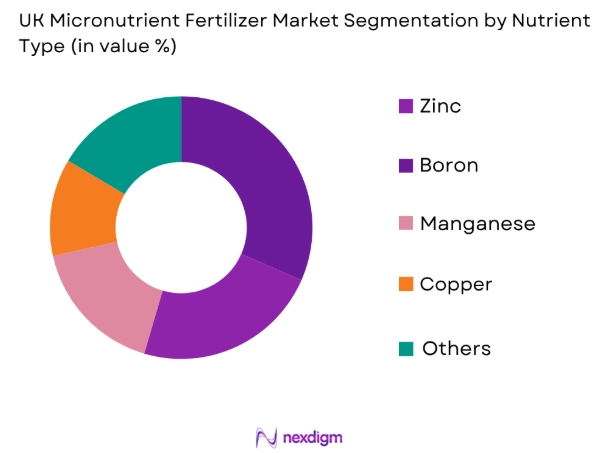
By Micronutrient Type, the UK Micronutrient Fertilizer Market is segmented into zinc fertilizers, boron fertilizers, manganese fertilizers, copper fertilizers, and others. Zinc fertilizers hold the dominant position due to widespread zinc deficiencies observed in cereal-growing soils and the critical role of zinc in plant enzyme activation, chlorophyll formation, and grain development. Wheat, barley, maize, and oilseed rape producers increasingly rely on zinc supplementation to improve crop vigor and maximize yield potential. The growing adoption of foliar nutrition programs and precision farming technologies has further accelerated zinc fertilizer demand. Additionally, agronomic advisors frequently recommend zinc-based products as part of integrated nutrient management programs because of their proven impact on crop quality and nutrient uptake efficiency. The availability of both chelated and conventional zinc formulations has enhanced accessibility for growers across different farm sizes, reinforcing the segment’s leadership within the UK market.
By Crop Type
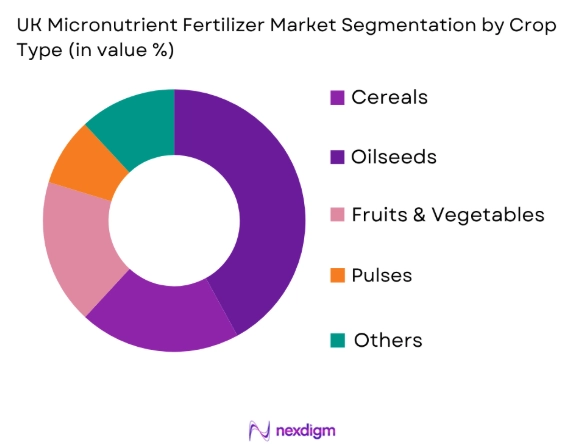
By Crop Type, the UK Micronutrient Fertilizer Market is segmented into cereals, oilseeds, fruits and vegetables, pulses, and others. Cereals account for the largest share due to the extensive cultivation of wheat, barley, oats, and rye throughout England and Scotland. Micronutrient deficiencies, particularly manganese, zinc, and copper, can significantly reduce grain yields and quality, making nutrient supplementation a standard agronomic practice. Farmers increasingly utilize micronutrient fertilizers alongside conventional NPK programs to optimize nutrient availability during critical growth stages. The economic importance of cereal production and the need to maintain productivity under changing climatic conditions continue to support strong demand for micronutrient products. Furthermore, precision agriculture technologies and soil testing programs have improved identification of nutrient deficiencies, leading to more targeted micronutrient applications across cereal-producing regions and reinforcing the dominance of this segment.
Competitive Landscape
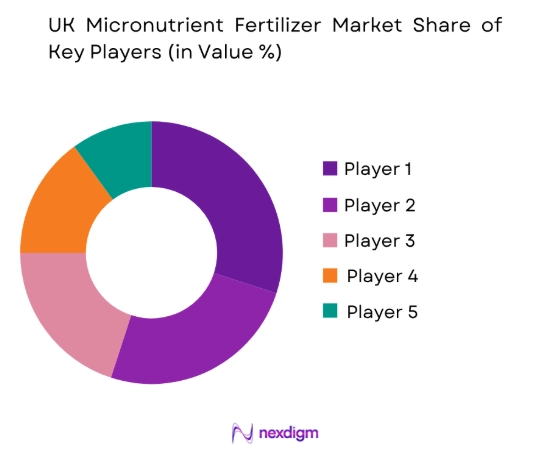
The UK Micronutrient Fertilizer Market is characterized by the presence of established global fertilizer manufacturers and specialized crop nutrition providers. Competition is driven by product innovation, agronomic support services, formulation technologies, distribution networks, and crop-specific nutrient solutions. Companies increasingly focus on chelated micronutrients, precision agriculture integration, and sustainable nutrient management products to strengthen their market position.
| Company | Establishment Year | Headquarters | Key Micronutrients | Chelated Portfolio | Distribution Strength | R&D Focus | Crop Coverage | Sustainability Focus |
| Haifa Group | 1966 | ~ | ~ | ~ | ~ | ~ | ~ | ~ |
| BASF Agricultural Solutions | 1865 | ~ | ~ | ~ | ~ | ~ | ~ | ~ |
| Yara International | 1905 | ~ | ~ | ~ | ~ | ~ | ~ | ~ |
| ICL Group | 1968 | ~ | ~ | ~ | ~ | ~ | ~ | ~ |
| Syngenta Biologicals (Valagro) | 1980 | ~ | ~ | ~ | ~ | ~ | ~ | ~ |
UK Micronutrient Fertilizer Market Analysis
Growth Drivers
Increasing Micronutrient Deficiency in UK Agricultural Soils
Micronutrient deficiencies across UK agricultural land are becoming a major driver for micronutrient fertilizer adoption. The United Kingdom maintains approximately 17.2 million hectares of agricultural land, including more than 4.7 million hectares of arable land, creating substantial demand for nutrient management solutions. The agricultural sector generates around GBP 14.9 billion in gross value added, highlighting the economic importance of maintaining crop productivity. Soil monitoring programs have consistently identified deficiencies of zinc, manganese, boron, and copper across intensive cereal-growing regions such as East Anglia, Yorkshire, and the East Midlands. Wheat cultivation exceeds 1.6 million hectares while barley cultivation surpasses 1.1 million hectares, increasing the need for targeted micronutrient applications. With the UK economy valued at more than USD 3.5 trillion and farmers seeking to maximize yields from limited arable land, micronutrient fertilizers are increasingly regarded as essential inputs for maintaining productivity, improving crop quality, and supporting long-term soil fertility.
Growth of Precision Agriculture and High-Value Crop Production
Precision agriculture adoption across the UK is accelerating the use of micronutrient fertilizers. The country has a GDP per capita exceeding USD 52,000, supporting investment in advanced farming technologies and nutrient management systems. The UK cultivates more than 170,000 hectares of vegetables and approximately 120,000 hectares of horticultural crops, where micronutrient deficiencies can directly affect crop quality, marketability, and storage performance. More than 104,000 agricultural holdings operate across the country, with increasing adoption of soil testing, nutrient mapping, satellite imagery, and variable-rate fertilizer application technologies. In addition, agri-food exports exceed GBP 24 billion, encouraging growers to maintain stringent quality standards demanded by both domestic and international markets. The integration of digital farming tools with crop nutrition programs is improving nutrient-use efficiency and increasing demand for chelated and specialty micronutrient fertilizers that can deliver targeted performance and measurable yield benefits.
Market Challenges
Volatility in Raw Material Supply and Import Dependency
The UK micronutrient fertilizer market remains highly dependent on imported raw materials and specialty nutrient compounds. The country imports hundreds of billions of pounds worth of goods annually, making agricultural input supply chains vulnerable to global trade disruptions, transportation bottlenecks, and geopolitical uncertainties. Many micronutrient products rely on zinc, boron, copper, manganese, and molybdenum compounds sourced from international mining and chemical processing industries. Any disruption in major supplying regions can affect product availability and delivery schedules for UK distributors and growers. Agriculture contributes approximately GBP 14.9 billion to the economy, yet farmers often operate under tight profit margins, making consistent access to micronutrient products critical during key planting and crop development stages. The challenge is particularly pronounced for high-value chelated micronutrient formulations that require sophisticated manufacturing processes and globally sourced ingredients, increasing the sector’s exposure to fluctuations in supply and availability.
Regulatory Compliance and Environmental Restrictions
Environmental compliance requirements represent a significant challenge for the UK micronutrient fertilizer market. Agricultural activities extend across more than 17 million hectares of farmland, placing increasing emphasis on nutrient stewardship, environmental protection, and sustainable land management. Regulatory frameworks governing fertilizer registration, labeling, storage, and application have become more rigorous, requiring manufacturers and distributors to invest in product testing, certification, and documentation. At the same time, environmental land management programs encourage more efficient nutrient use and seek to reduce potential impacts on water quality and ecosystems. Farmers are increasingly expected to demonstrate responsible fertilizer application practices while maintaining crop productivity. For smaller suppliers, compliance with evolving regulations can increase operational complexity and delay product introductions. As environmental sustainability remains a central policy objective, market participants must continuously adapt formulations and business practices to meet changing standards while remaining competitive and profitable.
Market Opportunities
Expansion of Sustainable Agriculture and Regenerative Farming
The growing emphasis on sustainable and regenerative agriculture presents a major opportunity for the UK micronutrient fertilizer market. More than 70% of the UK’s land area is dedicated to agricultural use, creating a substantial foundation for advanced soil fertility and crop nutrition programs. Government-backed environmental land management initiatives are encouraging practices that improve soil health, biodiversity, and nutrient-use efficiency. With a population exceeding 68 million people and limited opportunities for significant expansion of arable land, increasing productivity on existing farmland has become a strategic priority. Micronutrient fertilizers support regenerative farming systems by enhancing nutrient availability, improving plant resilience, and promoting healthier crop development. As farmers adopt conservation agriculture techniques, cover cropping systems, and soil monitoring technologies, demand for specialized micronutrient products that align with sustainability objectives is expected to strengthen. This creates opportunities for suppliers offering innovative formulations designed to improve both agricultural productivity and environmental outcomes.
Rising Demand for Foliar Nutrition and Specialty Fertilizer Technologies
Advanced foliar nutrition technologies represent a significant opportunity within the UK micronutrient fertilizer market. Cereals occupy more than 2.7 million hectares of farmland, while the horticulture sector contributes over GBP 3 billion annually to agricultural output, creating strong demand for efficient nutrient delivery systems. The UK’s highly developed economy supports investment in precision spraying equipment, crop monitoring tools, and advanced farm management technologies that enhance nutrient application accuracy. Foliar micronutrient fertilizers provide rapid nutrient uptake and allow growers to address deficiencies during critical growth stages without disrupting existing fertilization programs. Products containing chelated zinc, boron complexes, manganese formulations, and multi-micronutrient blends are increasingly incorporated into crop nutrition strategies to improve crop quality and yield performance. As precision agriculture adoption expands and growers seek greater efficiency from every hectare of cultivated land, specialty micronutrient fertilizers are expected to gain broader acceptance across both arable and horticultural farming operations.
Future Outlook
The UK Micronutrient Fertilizer Market is expected to witness steady expansion over the forecast period, supported by increasing emphasis on sustainable crop production and nutrient-use efficiency. Rising adoption of precision agriculture technologies, digital nutrient management tools, and site-specific fertilizer application practices will drive demand for advanced micronutrient products. Regulatory focus on environmental sustainability and soil health management is expected to encourage growers to adopt targeted nutrient supplementation strategies. Furthermore, growth in horticulture, specialty crops, and high-value agricultural production is likely to create new opportunities for manufacturers offering innovative micronutrient formulations. Forecast CAGR (2026–2035): 5.8%
Major Players
- Yara International
- ICL Group
- Haifa Group
- BASF Agricultural Solutions
- Bayer Crop Science
- Syngenta Biologicals (Valagro)
- UPL Limited
- CF Industries
- K+S Group
- Origin Enterprises PLC
- Compass Minerals
- AgroLiquid
- The Andersons Inc.
- Koch Agronomic Services
- SQM Plant Nutrition
Key Target Audience
- Micronutrient Fertilizer Manufacturers
- Agricultural Input Distributors
- Crop Nutrition Solution Providers
- Commercial Farming Enterprises
- Horticulture and Greenhouse Operators
- Investments and Venture Capitalist Firms
- Government and Regulatory Bodies
- Precision Agriculture Technology Providers
Research Methodology
Step 1: Identification of Key Variables
The study begins with mapping the complete UK micronutrient fertilizer ecosystem, including manufacturers, distributors, agronomists, regulators, and end-users. Secondary research is conducted to identify critical variables such as micronutrient consumption patterns, crop-specific demand, nutrient deficiency prevalence, and regulatory requirements influencing market development.
Step 2: Market Analysis and Construction
Historical market performance is analyzed using industry publications, trade statistics, company disclosures, and agricultural databases. Market revenues are assessed through product segmentation, application methods, crop coverage, and regional consumption patterns. Demand trends are evaluated alongside agricultural production and nutrient management practices.
Step 3: Hypothesis Validation and Expert Consultation
Preliminary findings are validated through interviews with fertilizer manufacturers, distributors, agronomists, and crop nutrition specialists. Insights regarding market dynamics, product adoption, technological advancements, and customer purchasing behavior are incorporated to refine market estimates and segment-level assessments.
Step 4: Research Synthesis and Final Output
The final phase combines primary and secondary findings through data triangulation and bottom-up validation. Market estimates are cross-verified against company-level information, trade flows, and end-user consumption patterns to ensure consistency and reliability of the final market assessment.

- Executive Summary
- Research Methodology (Market Definitions and Assumptions, Abbreviations, Market Sizing Framework, Bottom-Up and Top-Down Validation Approach, Primary Industry Interviews, Secondary Research Sources, Data Triangulation Methodology, Limitations and Forecasting Assumptions)

- Definition and Scope
- Market Evolution and Industry Genesis
- Micronutrient Fertilizer Ecosystem Overview
- Agricultural Input Value Chain Analysis
- Supply Chain Mapping and Import Dependency Structure

- Growth Drivers (Crop Yield Enhancement Requirements, Soil Micronutrient Deficiencies, Precision Agriculture Adoption, Sustainable Farming Practices, High-Value Crop Expansion)
- Market Challenges (High Product Costs, Regulatory Compliance Burden, Farmer Awareness Gaps, Volatile Input Costs, Import Dependency)
- Market Opportunities (Bio-Based Micronutrients, Precision Nutrient Management, Controlled Release Technologies, Greenhouse Farming Expansion, Carbon Farming Programs)
- Market Trends (Chelated Product Adoption, Digital Agronomy Integration, Customized Nutrient Blends, Fertigation Growth, Regenerative Agriculture Practices)
- Government Regulations (Fertilising Products Regulation, UK REACH Compliance, Environmental Land Management Schemes, Nutrient Management Standards, Import Certification Requirements)
- PESTLE Analysis
- SWOT Analysis
- Porter’s Five Forces Analysis
- Stakeholder Ecosystem
- Competition Ecosystem

- By Market Value (2020-2025)
- By Volume Consumption (2020-2025)
- By Average Selling Price (2020-2025)

- By Nutrient Type (In Value %)
Zinc Fertilizers
Boron Fertilizers
Manganese Fertilizers
Copper Fertilizers
Iron Fertilizers
Molybdenum Fertilizers
Chelated Micronutrients
Multi-Micronutrient Blends - By Crop Type (In Value %)
Cereals
Oilseeds
Fruits
Vegetables
Pulses
Turf & Ornamental Crops
Forage Crops - By Form Type (In Value %)
Chelated Micronutrients
Non-Chelated Micronutrients
Liquid Micronutrients
Granular Micronutrients
Powder Micronutrients - By Application Method (In Value %)
Soil Application
Foliar Spray
Fertigation
Seed Treatment
Controlled Release Application - By End User (In Value %)
Commercial Farms
Contract Farming Operations
Horticulture Growers
Greenhouse Operators
Turf Management & Landscaping
Agricultural Cooperatives

- Market Share of Major Players (Market Share by Value, Volume, Micronutrient Portfolio, Crop Coverage, Distribution Reach, Regional Penetration)
- Cross Comparison Parameters (Micronutrient Product Portfolio Strength, Chelated Micronutrient Portfolio, Manufacturing Capacity, Distribution Network Reach, Agronomic Advisory Services, Crop-Specific Product Offerings, Sustainability & Environmental Compliance, R&D and Innovation Pipeline)
- SWOT Analysis of Major Players
- Pricing Analysis Basis SKUs (Zinc Sulphate, Boron Ethanolamine, Manganese Sulphate, Copper Oxychloride, Iron Chelates, Molybdenum Fertilizers, EDTA Chelates, Multi-Micronutrient Blends, Liquid Micronutrients, Granular Micronutrients)
- Detailed Profiles of Major Companies
Yara International
CF Industries UK
ICL Group
Haifa Group
Nouryon
BASF Agricultural Solutions
Bayer Crop Science
Syngenta
UPL Limited
K+S Group |
Origin Enterprises PLC
Compass Minerals
The Andersons Inc.
AgroLiquid
Valagro (Syngenta Biologicals)

- Crop Nutrient Requirement Assessment
- Micronutrient Utilization Patterns
- Purchasing Power and Farm Economics
- Nutrient Deficiency Pain Point Analysis
- Adoption Barriers and Challenges
- Decision-Making Framework for Product Selection
- Brand Awareness and Loyalty Analysis
- Precision Agriculture Adoption Assessment

- By Market Value (2026-2035)
- By Volume Consumption (2026-2035)
- By Average Selling Price (2026-2035)


 Request a Sample
 Ask for Customization
 Get a Quote
 Enquire Now