
 Download PDF
Market Overview
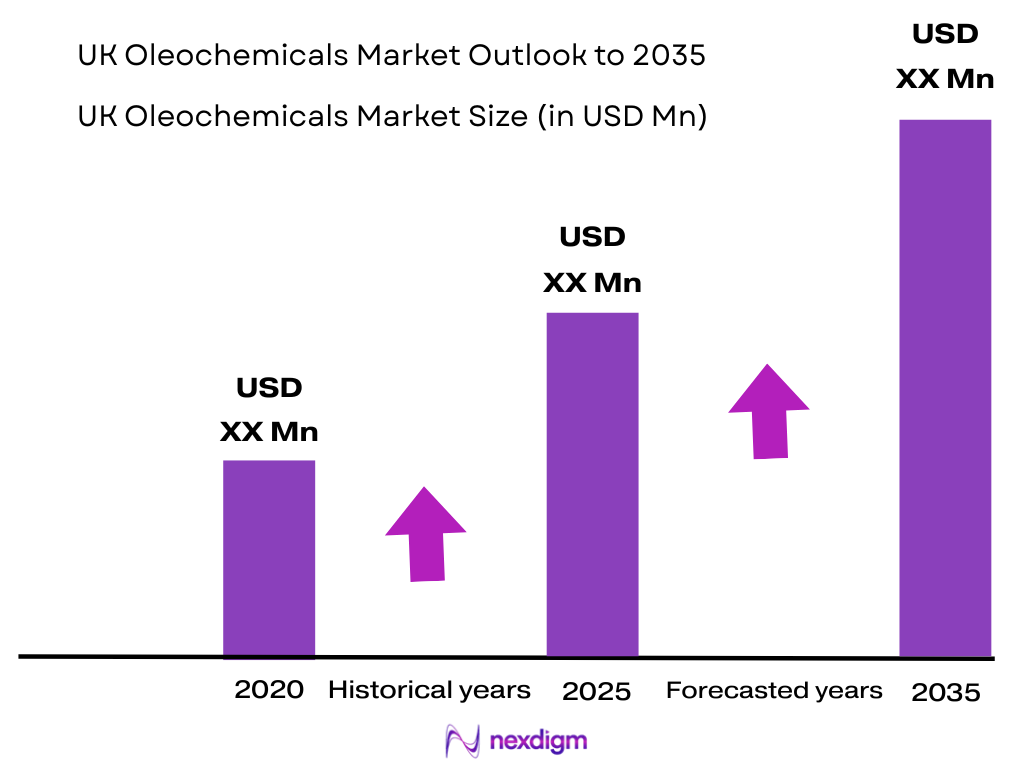
The UK oleochemicals market is valued at USD ~1,100 million in 2024 and is projected to expand at a CAGR of ~5.5% during 2026-2035. The market growth is supported by increasing adoption of renewable chemical ingredients across personal care, home care, pharmaceuticals, food processing, and industrial applications. Oleochemicals derived from natural fats and oils are increasingly replacing petrochemical-based alternatives due to sustainability requirements and regulatory pressure. Industry sources estimate the UK oleochemicals market generated approximately USD 1,160.8 million in 2025, highlighting strong demand momentum across bio-based chemical applications.
The UK oleochemicals market is primarily concentrated around industrial clusters in England, particularly Yorkshire, North West England, and the Midlands, due to established chemical manufacturing infrastructure, logistics connectivity, and proximity to downstream industries. Cities such as London, Manchester, Leeds, Liverpool, and Hull contribute significantly through their personal care manufacturing, specialty chemical processing, consumer goods production, and distribution networks. The presence of chemical companies, ports, and industrial hubs supports efficient importation of palm derivatives, vegetable oils, and specialty oleochemical feedstocks required for domestic manufacturing.
Market Segmentation
By Product Type
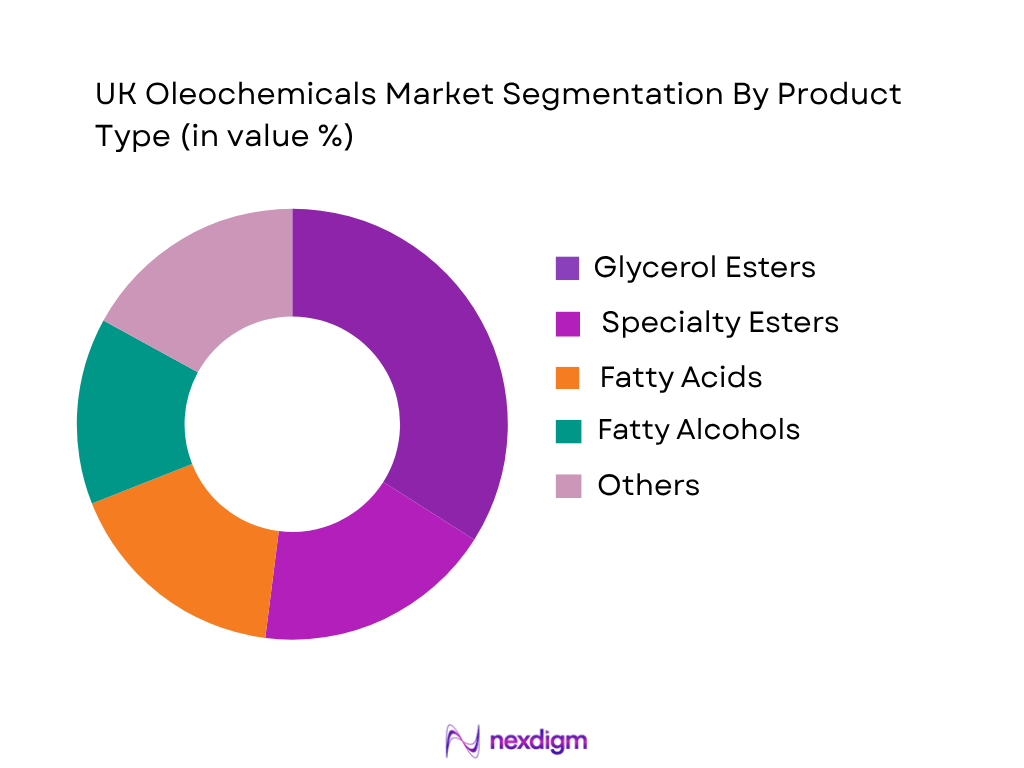
The UK oleochemicals market is segmented by product type into fatty acids, fatty alcohols, glycerol esters, specialty esters, fatty acid methyl esters (FAME), fatty amines, and alkoxylates. Among these, glycerol esters represent the leading product category due to extensive utilization in personal care formulations, cosmetics, food applications, and pharmaceutical preparations. Glycerol esters provide functional benefits such as emulsification, lubrication, and texture enhancement, making them highly preferred among manufacturers. Increasing demand for clean-label ingredients and sustainable formulation solutions has further strengthened their adoption. Fatty acid methyl esters are expected to witness faster growth due to increasing applications in bio-based lubricants, industrial formulations, and renewable chemical solutions.
By Application Industry
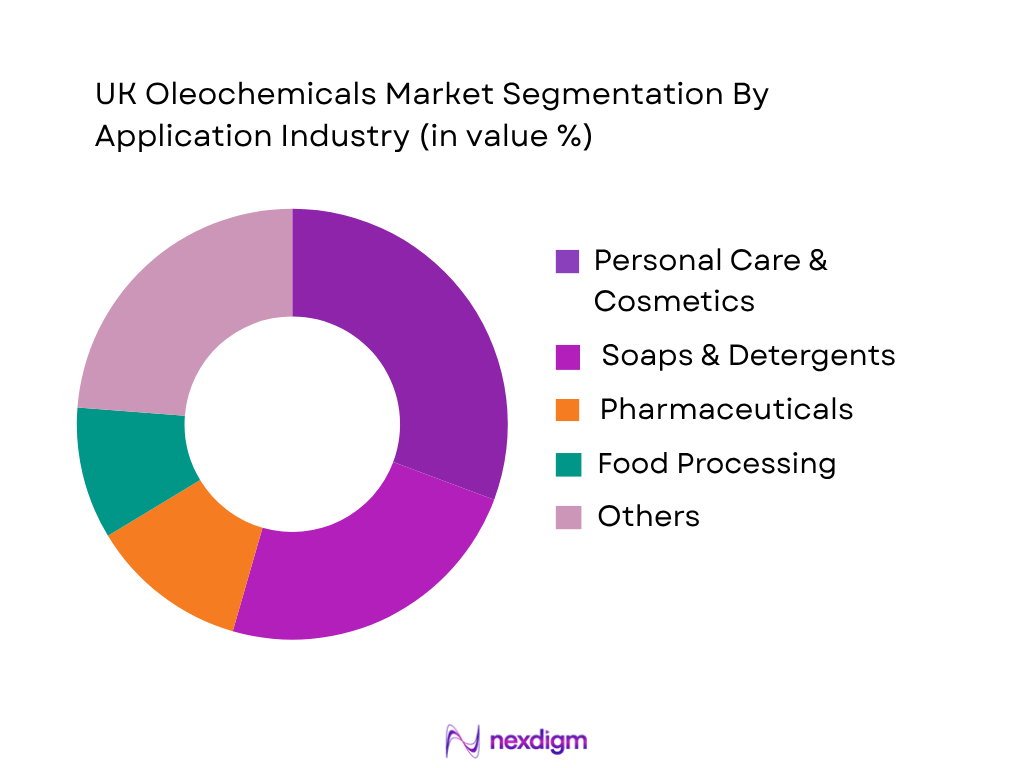
The UK oleochemicals market is segmented by application into personal care and cosmetics, soaps and detergents, pharmaceuticals, food processing, lubricants, polymers, coatings, and industrial chemicals. The personal care and cosmetics segment dominates the market due to strong demand for natural emollients, surfactants, moisturizers, and specialty ingredients used in skincare, haircare, and cosmetic formulations. UK consumers’ preference toward sustainable beauty products has encouraged manufacturers to replace synthetic ingredients with bio-based alternatives. The home care and detergent segment also represents a significant demand contributor due to increasing adoption of biodegradable surfactants and environmentally friendly cleaning products.
Competitive Landscape
The UK oleochemicals market consists of global integrated chemical companies, specialty ingredient manufacturers, and oleochemical producers supplying domestic industries. Competition is influenced by sustainable feedstock sourcing, specialty product development, production capabilities, certification compliance, and downstream application expertise. Major companies operating in the market include Croda International, BASF, Evonik, Oleon, Wilmar International, and other global oleochemical suppliers.
| Company | Establishment Year | Headquarters | Key Product Focus | UK Market Presence | Sustainability Capability | Major End-Use Markets | Production Capability |
| Croda International | 1925 | UK | ~ | ~ | ~ | ~ | ~ |
| BASF | 1865 | Germany | ~ | ~ | ~ | ~ | ~ |
| Evonik Industries | 2007 | Germany | ~ | ~ | ~ | ~ | ~ |
| Oleon | 1957 | Belgium | ~ | ~ | ~ | ~ | ~ |
| Wilmar International | 1991 | Singapore | ~ | ~ | ~ | ~ | ~ |
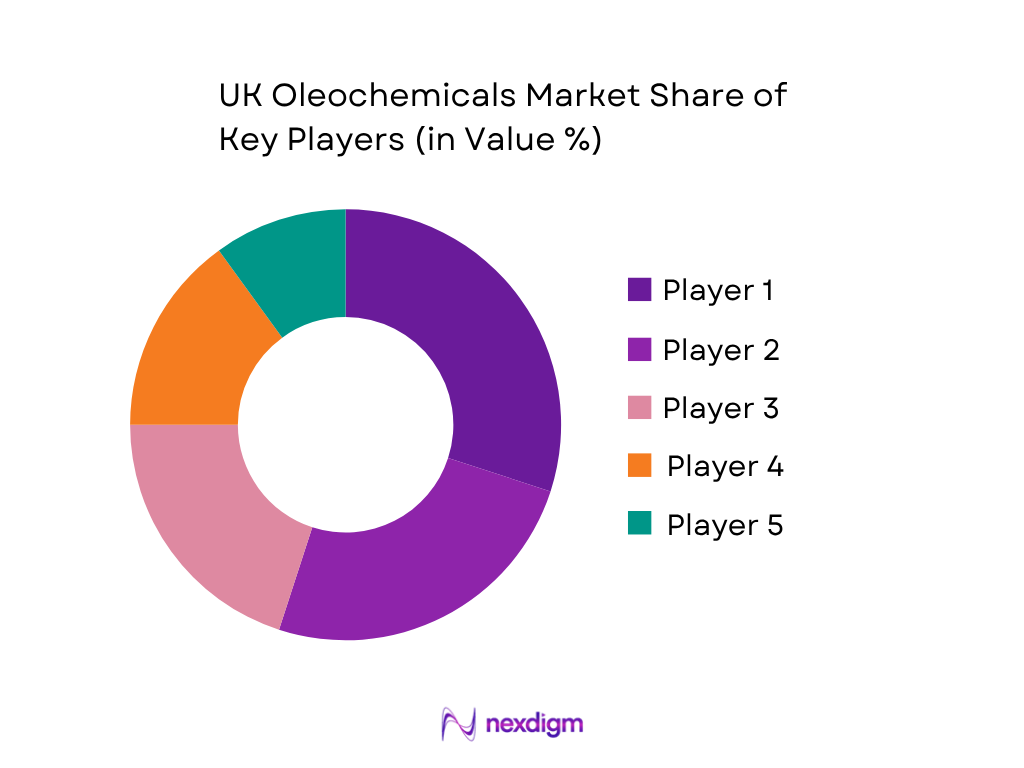
UK Oleochemicals Market Analysis
Growth Drivers
Increasing Demand for Sustainable and Bio-Based Chemical Ingredients
The UK oleochemicals market is benefiting from the accelerating transition toward renewable and sustainable chemical solutions across personal care, home care, pharmaceuticals, and industrial manufacturing sectors. The demand shift is supported by the UK’s broader environmental transition policies and industrial decarbonization initiatives. The UK government reported that renewable energy accounted for 45.8% of total electricity generation in 2024, reflecting the country’s increasing focus on low-carbon technologies and sustainable production systems (Department for Energy Security and Net Zero). This sustainability-driven industrial environment is encouraging manufacturers to replace petroleum-derived ingredients with bio-based alternatives such as fatty acids, fatty alcohols, glycerine, and specialty esters. The UK cosmetics and personal care sector also supports oleochemical adoption, with the Office for National Statistics reporting that the UK personal care and cosmetics-related manufacturing ecosystem remains a significant contributor within consumer goods production. Additionally, the UK generated approximately 13.5 million tonnes of waste packaging in 2022, according to the Environment Agency, increasing regulatory pressure on manufacturers to adopt environmentally responsible ingredients and production practices. These macroeconomic and regulatory conditions are strengthening demand for renewable oleochemical solutions with improved biodegradability, traceability, and lower environmental impact.
Expansion of Personal Care, Home Care and Specialty Chemical Manufacturing
The growth of downstream industries such as cosmetics, detergents, pharmaceuticals, and specialty chemicals is supporting increased consumption of oleochemical derivatives in the UK market. Oleochemicals are widely used as emulsifiers, surfactants, emollients, stabilizers, and formulation additives across these industries. The UK household and consumer goods sector benefits from strong domestic consumption fundamentals, supported by population growth and urban concentration. According to the World Bank, the UK population reached approximately 68.3 million people in 2024, creating a large consumer base for personal care products, cleaning solutions, and packaged consumer goods that utilize oleochemical ingredients. The World Bank also reported that the UK urban population represented approximately 84% of total population in 2024, supporting higher demand for packaged personal care products, detergents, and convenience-oriented household products. Furthermore, UK pharmaceutical manufacturing remains a strategically important sector, with the UK government reporting that life sciences exports exceeded GBP 39 billion in 2023, demonstrating strong industrial capacity for advanced formulations and specialty ingredients. These economic conditions support increasing utilization of oleochemical derivatives in high-value applications requiring sustainable and functional chemical ingredients.
Market Challenges
Dependence on Imported Feedstocks and Global Agricultural Supply Chain Volatility
The UK oleochemicals market faces supply chain challenges due to significant dependence on imported vegetable oils and bio-based feedstocks, including palm oil, palm kernel oil, and other natural oils required for oleochemical production. The country’s limited domestic production of tropical oil crops increases exposure to international agricultural supply fluctuations and geopolitical disruptions. According to the UK Department for Environment, Food & Rural Affairs, the UK imported approximately 2.4 million tonnes of vegetable oils and fats in 2023, highlighting the country’s reliance on international supply networks for edible and industrial oil requirements. Additionally, the Food and Agriculture Organization reported that global vegetable oil production remained concentrated among major producing regions, creating vulnerability to climate-related disruptions, trade restrictions, and agricultural yield changes. The UK’s import dependence is further influenced by sustainability requirements, including traceability and certification expectations for palm-derived materials. The UK government’s trade statistics reported total UK goods imports exceeding GBP 760 billion in 2024, reflecting the scale of international dependency across industrial supply chains. These conditions create challenges for oleochemical manufacturers in maintaining consistent raw material availability, managing supply risks, and ensuring sustainable sourcing compliance.
Regulatory Compliance and Sustainability Requirements Increasing Operational Complexity
The UK oleochemicals market is experiencing increasing operational challenges due to stringent chemical safety, environmental, and sustainability regulations. Manufacturers supplying oleochemical ingredients to cosmetics, pharmaceuticals, food, and industrial applications must comply with regulatory frameworks including UK REACH, environmental reporting requirements, and sustainability certification standards. The Health and Safety Executive reported that thousands of substances remain subject to registration and compliance requirements under UK REACH, increasing documentation and regulatory obligations for chemical manufacturers. The UK government’s Environment Act and net-zero framework have also increased expectations for industries to reduce emissions and improve resource efficiency. According to the Department for Energy Security and Net Zero, UK greenhouse gas emissions were approximately 384 million tonnes of carbon dioxide equivalent in 2023, maintaining pressure on industrial sectors to reduce environmental impact through cleaner production methods. Additionally, the Environment Agency reported that industrial facilities continue to face increasing environmental monitoring requirements under UK permitting systems. These regulatory developments create challenges for oleochemical producers by increasing compliance costs, requiring investment in sustainable manufacturing processes, and demanding greater transparency across feedstock sourcing and production operations.
Market Opportunities
Growth Potential from Circular Feedstocks and Waste-Derived Oleochemical Production
The increasing focus on circular economy practices creates opportunities for UK oleochemical manufacturers to expand the use of alternative feedstocks such as used cooking oil, recycled oils, and waste-derived raw materials. The UK has a developed waste collection infrastructure that can support future adoption of circular oleochemical production models. According to the Environment Agency, England generated approximately 222.9 million tonnes of total waste in 2022, demonstrating the availability of large-scale waste streams that can potentially support resource recovery initiatives. The UK government has also emphasized resource efficiency through its Circular Economy Package and waste reduction strategies, encouraging industries to increase recycling and reuse practices. The Department for Environment, Food & Rural Affairs reported that UK recycling rates for household waste reached approximately 44% in 2023, indicating established waste management systems that can support further development of recovered feedstock applications. In the oleochemicals sector, circular feedstocks provide opportunities to produce sustainable fatty acids, esters, and biodiesel-related derivatives while reducing dependence on virgin agricultural resources. The combination of regulatory support, industrial sustainability goals, and existing waste collection infrastructure creates opportunities for companies investing in advanced recycling technologies and low-carbon oleochemical solutions.
Rising Adoption of Specialty Oleochemicals in High-Value Applications
The UK oleochemicals market has significant opportunities through increasing demand for specialty derivatives used in premium applications such as cosmetics, pharmaceuticals, advanced lubricants, and functional chemical formulations. Specialty oleochemicals provide higher performance characteristics including improved stability, biodegradability, and formulation flexibility, making them suitable for industries seeking sustainable alternatives. The opportunity is supported by the strength of UK high-value manufacturing sectors. According to the UK government’s Department for Business and Trade, the UK life sciences sector generated approximately GBP 100 billion in annual turnover in 2023, demonstrating strong demand for advanced pharmaceutical and healthcare-related ingredients. The UK cosmetics industry also continues to expand, supported by consumer demand for natural and sustainable formulations. Additionally, the Office for National Statistics reported that UK manufacturing contributed approximately GBP 200 billion in gross value added in 2023, highlighting the scale of industrial demand for specialty chemical inputs. As manufacturers across consumer goods and industrial sectors increasingly prioritize renewable ingredients, specialty oleochemicals such as bio-based esters, surfactants, and emollients provide opportunities for innovation-driven suppliers to develop differentiated products aligned with sustainability and performance requirements.
Future Outlook
Over the next decade, the UK oleochemicals market is expected to demonstrate steady expansion driven by sustainability regulations, increasing preference for renewable chemical ingredients, and growing demand from personal care and household product manufacturers. The transition toward bio-based formulations and circular feedstock utilization will create opportunities for specialty oleochemical producers. Companies focusing on traceable sourcing, low-carbon manufacturing, and innovative derivatives are expected to gain competitive advantage.
Major Players
- Croda International
- BASF
- Evonik Industries
- Oleon
- Wilmar International
- IOI Oleochemical Industries
- KLK OLEO
- Emery Oleochemicals
- Kao Corporation
- Vantage Specialty Chemicals
- Cargill
- AAK AB
- Nouryon
- Corbion
- Ecogreen Oleochemicals
Key Target Audience
- Personal Care and Cosmetics Manufacturers
- Home Care and Detergent Manufacturers
- Pharmaceutical Ingredient Producers
- Food Ingredient Manufacturers
- Chemical Manufacturing Companies
- Investments and Venture Capitalist Firms (Private Equity Firms, Chemical Sector Investment Funds, Sustainability-Focused Investment Groups)
- Government and Regulatory Bodies (UK Department for Environment, Food & Rural Affairs (DEFRA), Health and Safety Executive (HSE), Environment Agency)
- Specialty Chemical Distributors and Industrial Suppliers
Research Methodology
Step 1: Identification of Key Variables
The initial stage involves developing a comprehensive ecosystem map of the UK oleochemicals market by identifying major stakeholders across the entire value chain. This includes feedstock suppliers, oleochemical manufacturers, specialty chemical producers, distributors, and downstream industries such as personal care, home care, pharmaceuticals, and industrial applications. Key variables such as production capacity, feedstock availability, product categories, application demand, import dependency, and sustainability adoption are defined through extensive secondary research and industry databases.
Step 2: Market Analysis and Construction
This phase focuses on collecting and analyzing historical market information related to UK oleochemical production, consumption patterns, pricing trends, and demand contribution from end-use industries. The market model is constructed using both top-down and bottom-up approaches by evaluating company revenues, production capabilities, application-level demand, and industry consumption trends. Product categories including fatty acids, glycerol esters, specialty esters, fatty alcohols, and fatty acid methyl esters are assessed to determine market contribution.
Step 3: Hypothesis Validation and Expert Consultation
Market assumptions and preliminary findings are validated through discussions with industry professionals, chemical manufacturers, distributors, and downstream application companies operating within the oleochemicals ecosystem. Expert interactions are conducted to verify production dynamics, supply chain conditions, sustainability adoption, pricing factors, and future demand patterns. These insights help refine market estimates and validate qualitative factors influencing the UK oleochemicals industry.
Step 4: Research Synthesis and Final Output
The final phase integrates insights collected from secondary research, primary interviews, company analysis, and market modeling activities. Direct assessment of major oleochemical manufacturers and downstream users is conducted to validate product demand, competitive positioning, strategic initiatives, and emerging opportunities. The final report presents a comprehensive analysis covering market size, segmentation, competitive landscape, growth drivers, challenges, and future opportunities within the UK oleochemicals market.

- Executive Summary
- Research Methodology (Market Definitions and Scope, Oleochemicals Classification Framework, Primary and Secondary Research Approach, Market Sizing Methodology, Top-Down Analysis, Bottom-Up Analysis, Demand-Side Assessment, Supply-Side Assessment, Producer Capacity Mapping, Feedstock Availability Assessment, Import-Export Data Analysis, Industry Expert Interviews, Value Chain Validation, Data Triangulation, Forecasting Model, Assumptions and Limitations)

- Definition and Scope
- Oleochemicals Industry Evolution and Market Development Timeline
- UK Oleochemicals Industry Ecosystem Analysis
- UK Oleochemicals Value Chain Analysis
- UK Oleochemicals Supply Chain Analysis
- UK Oleochemicals Production Landscape
- UK Oleochemicals Trade Dynamics

- Market Growth Drivers (Increasing Demand for Bio-Based Chemicals, UK Net Zero Initiatives, Rising Adoption of Sustainable Ingredients in Personal Care, Expansion of Green Chemistry Applications, Growing Demand for Renewable Surfactants, Shift Away from Fossil-Based Feedstocks, Increasing Circular Economy Adoption)
- Market Challenges (Palm Oil Sustainability Concerns, Feedstock Price Volatility, Dependence on Imported Raw Materials, Limited Domestic Oleochemical Production Capacity, Certification Compliance Costs, Competition from Petrochemical Alternatives)
- Market Opportunities (Expansion of Specialty Oleochemicals, Sustainable Beauty Ingredient Growth, Renewable Surfactant Development, Bio-Based Lubricant Adoption, Waste-Derived Feedstock Commercialization, Pharmaceutical Grade Glycerine Demand)
- Market Trends (Clean Beauty Ingredient Adoption, Green Surfactant Innovation, Traceable Supply Chains, Low Carbon Oleochemical Production, Biotechnology-Based Oleochemical Development, Premium Specialty Ingredient Demand)
- Technology Landscape (Oleochemical Refining Technologies, Hydrolysis Technology, Fractionation Technology, Hydrogenation Processes, Esterification Technology, Enzymatic Processing, Biotechnology-Based Production)
- Raw Material Availability Analysis
- Environmental Sustainability Analysis
- SWOT Analysis
- Porter’s Five Forces Analysis
- PESTLE Analysis
- Stakeholder Ecosystem Analysis
- Competition Ecosystem Analysis

- By Market Value (2020-2025)
- By Volume Consumption (2020-2025)
- By Average Selling Price (2020-2025)
- By Production Volume (2020-2025)
- By Import Volume (2020-2025)
- By Export Volume (2020-2025)

- By Product Type (In Value %)
Fatty Acids
Fatty Alcohols
Glycerol and Glycerine
Fatty Acid Esters
Surfactants
Amides and Amine Derivatives
Other Oleochemical Derivatives - By Feedstock Type (In Value %)
Palm Oil-Based Oleochemicals
Rapeseed Oil-Based Oleochemicals
Soybean Oil-Based Oleochemicals
Sunflower Oil-Based Oleochemicals
Animal Fat-Based Oleochemicals
Used Cooking Oil-Based Oleochemicals
Other Renewable Feedstocks - By Application Industry (In Value %)
Personal Care and Cosmetics
Home Care and Detergents
Food and Beverage
Pharmaceuticals
Industrial Lubricants
Plastics and Polymers
Agriculture Chemicals
Paints, Coatings and Adhesives - By Distribution Channel (In Value %)
Direct Industrial Sales
Chemical Distributors
Specialty Chemical Distributors
Online Chemical Marketplaces
Contract Manufacturing Channels - By End-User Category (In Value %)
Large Chemical Manufacturers
Specialty Ingredient Producers
Consumer Goods Manufacturers
Pharmaceutical Companies
Small and Medium Chemical Enterprises

- Market Share Analysis of Major Players
- Cross Comparison Parameters (Product Portfolio Breadth, Oleochemical Production Capacity, Feedstock Integration Level, Specialty Oleochemical Capability, Sustainable Certification Portfolio, Geographic Manufacturing Footprint, Application Industry Coverage, Research and Development Intensity)
- Pricing Analysis
- Production Capacity Benchmarking
- Sustainability Benchmarking
- Innovation Benchmarking
- Detailed Profiles of Major Companies
BASF
Croda International
Evonik Industries
KLK OLEO
Wilmar International
IOI Oleochemical Industries
Emery Oleochemicals
Kao Corporation
Oleon
Ecogreen Oleochemicals
Vantage Specialty Chemicals
Azelis
Brenntag
Azelis UK
Nouryon

- End-User Industry Consumption Assessment
- Personal Care Industry Demand Analysis
- Home Care Industry Demand Analysis
- Industrial User Analysis
- Procurement Decision Analysis
- Sustainability Preference Analysis
- Product Attribute Preference Analysis

- By Market Value (2026-2035)
- By Volume Consumption (2026-2035)
- By Average Selling Price (2026-2035)
- By Production Volume (2026-2035)
- By Import Volume (2026-2035)
- By Export Volume (2026-2035)


 Request a Sample
 Ask for Customization
 Get a Quote
 Enquire Now