

 Download PDF
Market Overview
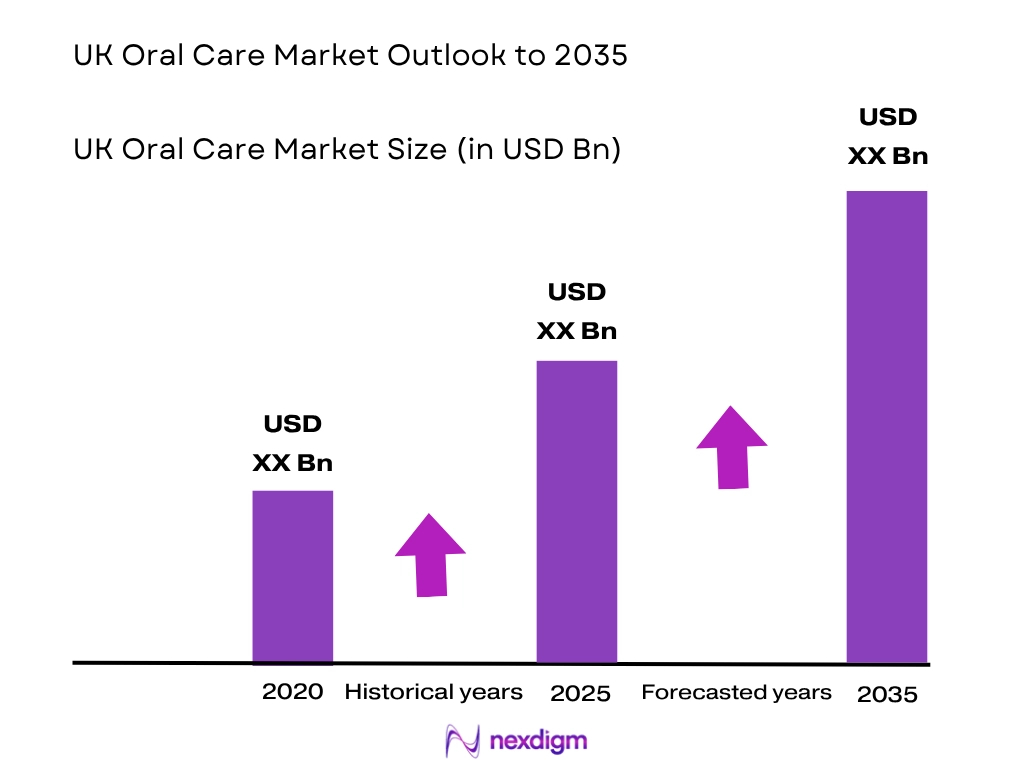
The UK Oral Care Market generated USD ~ billion in revenue, after a prior valuation of USD ~billion, driven by daily-use toothpaste, sensitivity care, gum-health products, electric toothbrush upgrades, and premium whitening regimens. NHS England delivered 34 million dental treatment courses and recorded 18 million adult patients plus 6.6 million child patients, reinforcing preventive product demand through dentist-led oral hygiene routines.
London, South-East England, South-West England and East Anglia dominate demand because of higher retail density, stronger private dentistry adoption, premium pharmacy access, and concentration of high-income wellness consumers. Nexdigm specifically tracks South-East, London, South-West and East-Anglia outlooks, while the CMA notes the private dentistry market reached £~ billion in 2023–2024, supporting premium toothpaste, whitening, gum-care and electric brush consumption.
Market Segmentation
By Product Type
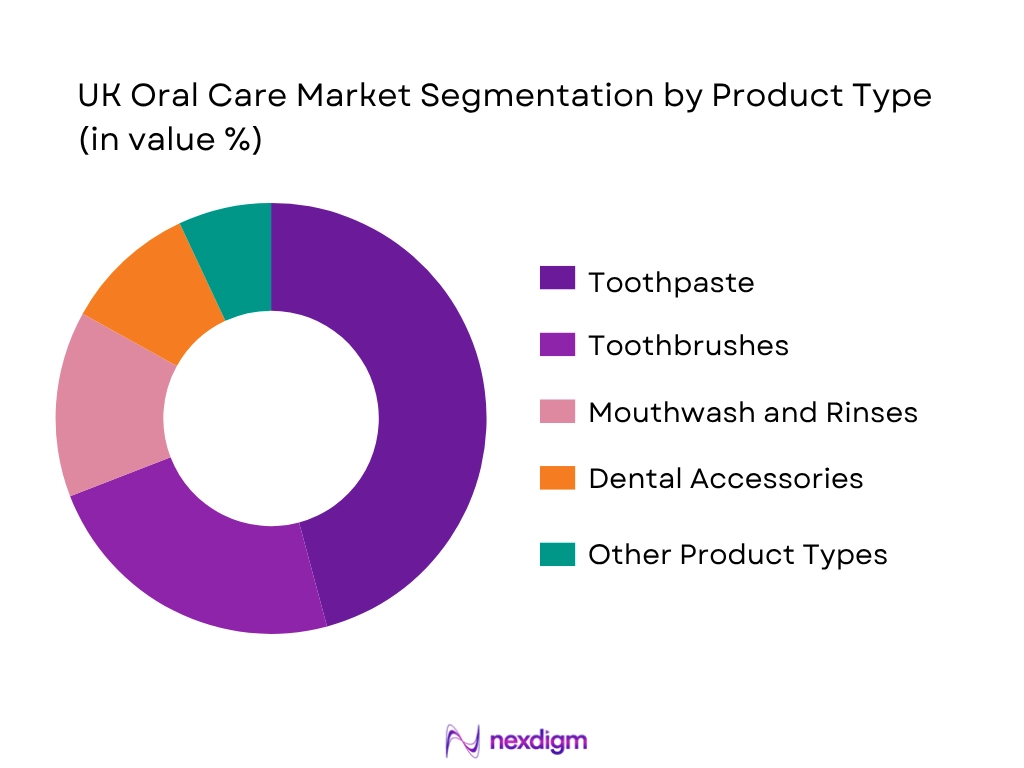
Product Type: The UK Oral Care Market is segmented into toothpaste, toothbrush and replacement heads, mouthwash and rinse, dental accessories, denture care and whitening products. Toothpaste dominates the market because it is the highest-frequency oral care product used across adults, children, denture users and sensitivity-care consumers. The segment benefits from broad availability across supermarkets, Boots, Superdrug, Amazon UK and discounters. Therapeutic sub-categories such as sensitivity relief, gum health, enamel repair and whitening also raise average selling prices. As per Nexdigm, toothpaste is the largest revenue-generating UK oral care product segment, while also noting that toothpaste leads globally because of daily usage, affordability and wide consumer access.
By Distribution Channel
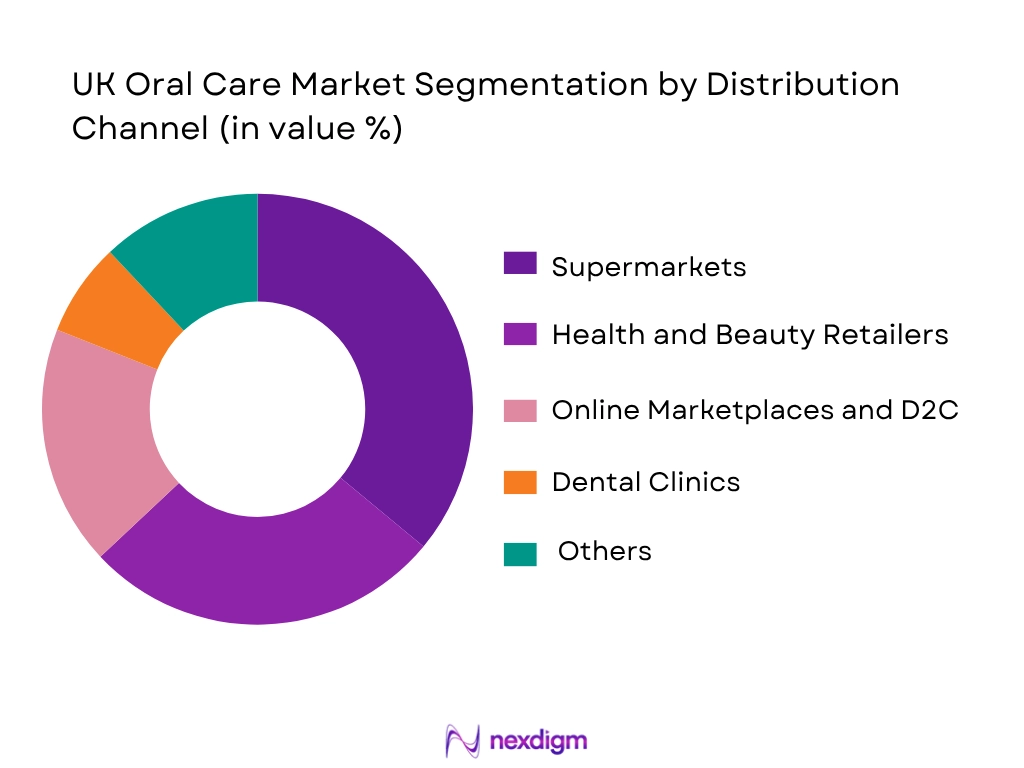
The UK Oral Care Market is segmented into supermarkets, health and beauty retailers/pharmacies, online marketplaces and D2C, dental clinics, discounters and convenience stores. Supermarkets dominate because oral care is purchased as part of regular grocery replenishment, especially toothpaste, manual brushes and mouthwash. Tesco, Sainsbury’s, Asda and Morrisons also use multibuy promotions and loyalty pricing to drive oral care basket conversion. Health and beauty retailers remain important for therapeutic, premium and whitening-led oral care, but supermarkets retain higher household penetration due to purchase frequency, convenience and price visibility. Online channels are growing through electric toothbrush bundles, replacement-head subscriptions and premium whitening kits.
Competitive Landscape
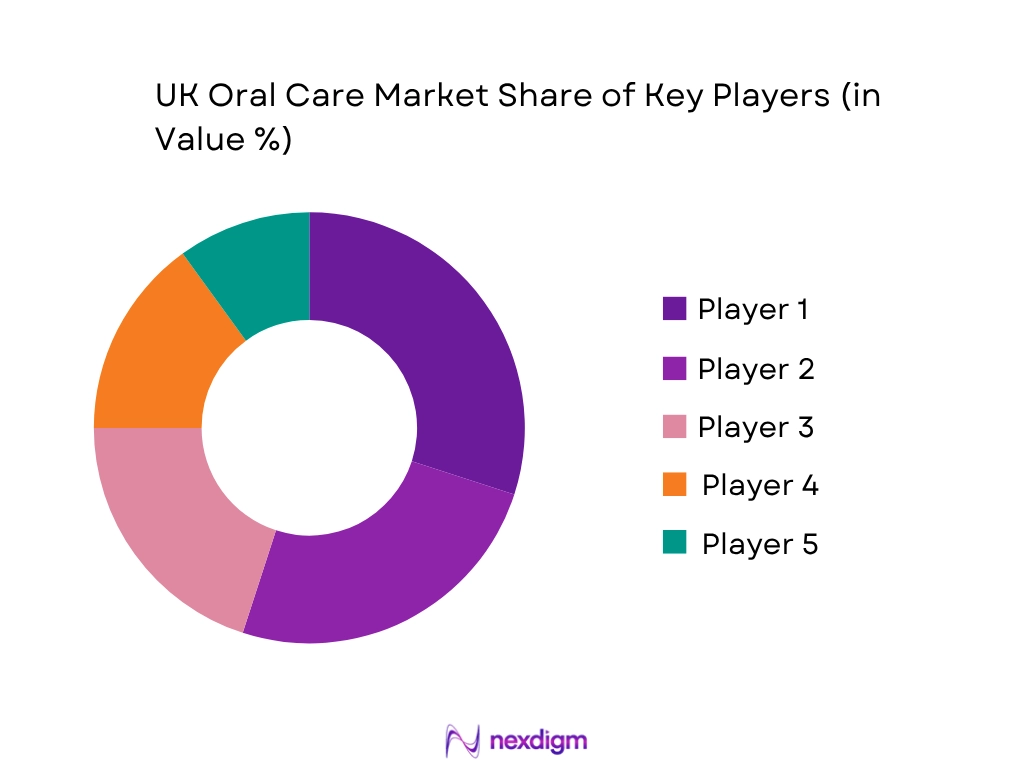
The UK Oral Care Market is led by global consumer health and FMCG groups with strong brand equity, dentist recommendation strength and national retail distribution. Colgate-Palmolive, Haleon, Procter & Gamble, Philips and Unilever compete across mass, therapeutic and premium oral care. Haleon is particularly strong in specialist oral health through Sensodyne, parodontax and Polident, while Philips and P&G drive electric toothbrush penetration through Sonicare and Oral-B.
| Company | Establishment Year | Headquarters | Key UK Oral Care Brands | Core Segment | UK Route-to-Market | Innovation Focus | Price Positioning | Strategic Strength |
| Colgate-Palmolive | 1806 | New York, USA | ~ | ~ | ~ | ~ | ~ | ~ |
| Haleon | 2022 | Weybridge, UK | ~ | ~ | ~ | ~ | ~ | ~ |
| Procter & Gamble | 1837 | Cincinnati, USA | ~ | ~ | ~ | ~ | ~ | ~ |
| Philips | 1891 | Amsterdam, Netherlands | ~ | ~ | ~ | ~ | ~ | ~ |
| Unilever | 1929 | London, UK | ~ | ~ | ~ | ~ | ~ | ~ |
UK Oral Care Market Analysis
Growth Drivers
Preventive Oral Health Awareness
Preventive oral health awareness is a major growth driver for the UK Oral Care Market because public dental activity continues to generate repeated household demand for toothpaste, toothbrushes, fluoride products, mouthwash and interdental aids. NHS England recorded 34 million dental treatment courses and 73 million units of dental activity in England, with 18 million adult patients and 6.6 million child patients seen through NHS dentistry. Preventive treatment behaviour is visible in clinical activity: 31 adult courses out of every 100 included scale and polish, while 56 child courses out of every 100 included fluoride varnish. These treatment volumes support the use of daily cavity-prevention toothpaste, kids’ fluoride toothpaste, gum-care products and dentist-recommended oral hygiene routines. The macroeconomic base also supports category resilience: the World Bank reported UK GDP at USD 3.69 trillion, GDP per capita at USD 53,246.4, and population at 69 million, indicating a large high-income consumer base for recurring hygiene purchases. NHS England’s dental recovery plan also committed to 1.5 million additional NHS dentistry treatments or 2.5 million appointments, reinforcing preventive care visibility and category education.
Cosmetic Dentistry Influence
Cosmetic dentistry is strengthening demand for whitening toothpaste, enamel-care toothpaste, premium electric toothbrushes, stain-removal products and alcohol-free mouthwash in the UK Oral Care Market. The influence is linked to a larger private dental ecosystem and a sizeable registered dental workforce. The General Dental Council recorded 125,736 dental professionals on the UK register at the end of 2024, including 46,362 dentists and 79,374 dental care professionals, creating a broad professional base for cosmetic and preventive oral care recommendations. NHS dental access limitations also push some consumers toward private and elective dental pathways, where whitening, polishing, aligner care and maintenance routines increase oral care product usage at home. The macroeconomic setting supports premiumization in select consumer cohorts: the World Bank recorded UK GDP per capita at USD 53,246.4, while IMF data showed the UK as a high-income economy with projected real GDP growth of 1.4 and average consumer price growth of 2.1 in its 2026 outlook. For oral care brands, this supports positioning around visible smile improvement, whitening maintenance, enamel protection and professional-style homecare devices rather than only basic hygiene.
Market Challenges
NHS Dental Access Pressure
NHS dental access pressure is a market-specific challenge because it weakens routine dentist contact for some consumers while increasing untreated oral health risk. NHSBSA recorded 35 million dental treatment courses in England in 2024/25, including 23 million adult courses and 12 million child courses, but the National Audit Office stated that the dental recovery plan was not on course to deliver the targeted 1.5 million additional courses and would still leave 2.6 million fewer courses than in 2018/19 even if achieved. This creates uneven oral care guidance, especially for children, lower-income families and older adults. For brands, the challenge is that dentist recommendation remains important for sensitivity, gum-health, interdental and fluoride products, but access constraints limit consistent professional reinforcement. The UK’s population base reached 69,281,400, increasing by 755,300 people, which adds more potential oral care users but also increases demand pressure on dental infrastructure. IMF projected UK inflation at 3.2 in 2026, adding further pressure on household discretionary choices and dental service affordability.
Private Label Price Competition
Private label price competition is a challenge for branded toothpaste, mouthwash, manual toothbrushes and basic dental accessories because oral care is heavily distributed through grocery and pharmacy retail. UK retail sales in Great Britain reached GBP 517 billion, and the country had 304,560 retail businesses at the start of 2025, creating a dense retail environment where supermarkets, pharmacies and discounters can push own-label toothpaste, mouthwash, floss and brush multipacks. For every retail pound spent in 2024, 39 pence was spent in food shops, which is important because oral care is often bought during grocery replenishment. Branded players must therefore defend shelf space through clinical claims, dentist recommendation, whitening benefits, sensitivity credentials and promotional execution. The macroeconomic pressure makes value formats more relevant: World Bank data recorded UK GDP growth at 1.1 in 2024, while IMF data shows inflation pressures continuing into 2026. In this environment, branded oral care companies face a dual challenge: protecting premium therapeutic SKUs while competing with retailer-owned cavity protection, whitening and family toothpaste alternatives.
Market Opportunities
Interdental Cleaning Penetration
Interdental cleaning is a strong future opportunity for the UK Oral Care Market because it directly connects with gum health, orthodontic care, ageing dentition and dentist-led preventive routines. NHSBSA reported 73 million units of dental activity and 34 million dental treatment courses in England, creating repeated clinical contact points where dentists and hygienists can recommend interdental brushes, floss, tape, picks and water flossers. The General Dental Council recorded 79,374 dental care professionals in the UK, including hygienists and therapists who are central to gum-care education and interdental cleaning instruction. The population base also supports expansion: ONS recorded the UK population at 69,281,400, while England and Wales alone reached 61,806,682 residents. For brands, the opportunity is to convert toothpaste-only users into multi-step oral care users through gum-health claims, bleeding-gum prevention positioning, orthodontic cleaning kits and senior oral care bundles. NHS dental access pressure can also push consumers to self-manage preventive routines between appointments, increasing the role of at-home interdental products.
Alcohol-Free Mouthwash
Alcohol-free mouthwash is a future growth opportunity because it aligns with preventive oral hygiene, gum care, sensitivity routines, family use and consumers seeking milder everyday formulations. NHS England recorded 18 million adults and 6.6 million children seen through NHS dentistry, while 56 child courses out of every 100 included fluoride varnish and 31 adult courses out of every 100 included scale and polish, showing a broad preventive-care base that can support adjunct products such as alcohol-free fluoride rinses and gum-care rinses. The opportunity is particularly relevant for users who avoid alcohol-based mouthwash because of dryness, sensitivity, irritation, orthodontic appliances or family suitability. The UK’s high-income macro base supports this transition: World Bank data recorded GDP per capita at USD 53,246.4 and population at 69 million, while IMF projected continuing economic expansion in 2026. Retail infrastructure also supports distribution, with 304,560 retail businesses and strong supermarket/pharmacy reach across Great Britain. Brands can position alcohol-free mouthwash around gum health, enamel protection, breath freshness and post-dental-treatment maintenance without relying on aggressive antiseptic cues.
Future Outlook
The UK Oral Care Market is expected to expand steadily, supported by premium therapeutic toothpaste, electric toothbrush upgrades, whitening routines, and dentist-recommended preventive care. The market is forecast to grow at a 6.1% CAGR through the near-term public forecast period, with longer-range 2026–2035 planning aligned to global oral care growth of around 6.7%. Growth will be shaped by pharmacy-led therapeutic products, online device bundles, private dentistry influence, and stronger demand for gum-health and sensitivity solutions.
Cost-of-living pressure will keep private label and promotional packs relevant, but premiumization will persist in categories where consumers perceive clinical value, such as sensitivity toothpaste, gum-care mouthwash, electric brush heads and whitening products. The CMA’s review of the £8.4 billion private dentistry market also indicates a broader shift in UK oral health expenditure from basic NHS-led treatment to private, preventive and cosmetic care.
Major Players
- Colgate-Palmolive
- Haleon
- Procter & Gamble
- Unilever
- Johnson & Johnson
- Philips Sonicare
- TePe
- Church & Dwight
- Spotlight Oral Care
- Curaprox
- Boots Own Brand
- Superdrug Own Brand
- Waken Mouthcare
- Brushd
- The Humble Co.
Key Target Audience
- Oral care product manufacturers
- Toothpaste and mouthwash brands
- Electric toothbrush and oral hygiene device companies
- Retail pharmacy chains
- Supermarket and grocery retail chains
- Dental clinic groups and private dental chains
- Investments and venture capitalist firms
- Government and regulatory bodies (Competition and Markets Authority, Medicines and Healthcare products Regulatory Agency, Office for Product Safety and Standards, NHS England, Department of Health and Social Care)
Research Methodology
Step 1: Identification of Key Variables
The initial phase involves mapping the UK oral care ecosystem, including toothpaste, toothbrush, mouthwash, interdental care, whitening and denture care categories. Key variables include product type, benefit claim, retail channel, pricing tier, consumer cohort, dentist recommendation influence and regional demand concentration.
Step 2: Market Analysis and Construction
Historical market data is compiled from public market-research sources, retail channel structures and oral health indicators. The analysis evaluates category penetration, oral care basket composition, premium SKU adoption, pharmacy contribution, online sales contribution and product-level revenue generation.
Step 3: Hypothesis Validation and Expert Consultation
Market hypotheses are validated through structured interviews with oral care manufacturers, pharmacy category managers, dental professionals, distributors and e-commerce sellers. These discussions refine assumptions on therapeutic toothpaste adoption, electric toothbrush replacement cycles, promotional intensity and channel-level margins.
Step 4: Research Synthesis and Final Output
The final phase triangulates desk research, company profiling, category benchmarking and primary discussions. This synthesis supports market sizing, segmentation shares, competitive positioning, future outlook and strategic recommendations for stakeholders operating in the UK Oral Care Market.

- Executive Summary
- Research Methodology (Market Definitions and Scope, Top-Down Market Sizing, Bottom-Up SKU-Level Validation, Retail Audit Approach, Dentist and Hygienist Interview Coverage, Consumer Cohort Sampling, Oral Care Basket Analysis, Price-Pack Architecture Mapping, Brand Share Triangulation, Channel Margin Assumptions, Limitations and Forecast Assumptions)

- Definition and Scope
- Market Genesis and Evolution
- Oral Health Burden and Consumer Need-State Mapping
- UK Oral Care Business Cycle
- Supply Chain and Value Chain Analysis
- Retail, Pharmacy, Dental Clinic and E-Commerce Ecosystem
- Role of NHS Dentistry, Private Dentistry and Preventive Oral Care
- Brand Architecture Across Mass, Therapeutic, Premium and Natural Oral Care

- Growth Drivers (Preventive Oral Health Awareness, Cosmetic Dentistry Influence, Sensitivity Incidence, Gum Health Awareness, Electric Toothbrush Adoption, Premium Therapeutic Claims)
- Market Challenges (NHS Dental Access Pressure, Private Label Price Competition, Promotional Dependency, Claim Substantiation, Fluoride and Peroxide Compliance, Cost-of-Living Trade-Down)
- Market Opportunities (Interdental Cleaning Penetration, Alcohol-Free Mouthwash, Kids Premium Oral Care, Sustainable Toothbrushes, Subscription Brush Heads, Dentist-Led D2C Brands)
- Market Trends (Whitening Toothpaste, Enamel Repair Claims, SLS-Free Formulas, Vegan Oral Care, Smart Toothbrushes, Recyclable Packaging, Gum Health Regimens)
- Regulatory Landscape (UK Cosmetics Regulation, Fluoride Limit, Hydrogen Peroxide Limit, Cosmetic Claims, MHRA Classification, ASA Advertising Scrutiny, Product Safety Notifications)
- SWOT Analysis (Brand Equity, Clinical Credibility, Channel Concentration, Private Label Pressure)
- PESTLE Analysis (Dental Policy, Inflation, Ageing Population, E-Commerce, Sustainability, Ingredient Regulation)
- Porter’s Five Forces (Supplier Power, Retailer Power, Buyer Power, Substitution Risk, Competitive Rivalry)
- Stakeholder Ecosystem (Manufacturers, Retailers, Pharmacies, Dentists, Hygienists, Dental Laboratories, Online Platforms, Regulators)
- Pricing and Promotion Analysis (Multibuy Offers, Clubcard Pricing, Boots Advantage Card, Superdrug Health & Beautycard, Subscribe-and-Save, Premium Brush Bundles)
- SKU and Pack-Size Analysis (75ml Toothpaste, 100ml Toothpaste, 500ml Mouthwash, Twin Packs, Replacement Brush Heads, Travel Packs)

- By Value (2020-2025)
- By Volume (2020-2025)
- By Average Selling Price (2020-2025)
- By Per Capita Oral Care Spend (2020-2025)
- By Household Oral Care Basket Value (2020-2025)
- By Retail and Pharmacy Sell-Out Value (2020-2025)

- By Product Type (In Value%)
Toothpaste
Manual Toothbrush
Electric Toothbrush and Replacement Heads
Mouthwash and Rinse
Dental Floss, Tape and Picks
Interdental Brushes
Denture Cleansers and Adhesives
Whitening Strips, Pens and Kits
Kids Oral Care - By Toothpaste Benefit Claim (In Value%)
Cavity Protection
Sensitivity Relief
Gum Health
Whitening
Enamel Repair
Tartar Control
Breath Freshening
Natural and Herbal
Kids Fluoride Toothpaste - By Consumer Age Group (In Value%)
Kids
Teens
Adults
Seniors
Denture Users
Orthodontic Users - By Price Positioning (In Value%)
ValueMass
Masstige
Premium
Dentist-Recommended
Therapeutic - By Distribution Channel (In Value%)
Supermarkets
Health and Beauty Retailers
Retail Pharmacies
Online Marketplaces
Brand D2C
Dental Clinics
Discounters
Convenience Stores - By Region (In Value%)
England
Scotland
Wales
Northern Ireland
London
South East
North West
Midlands
Yorkshire and Humber - By Purchase Mission (In Value%)
Daily Hygiene Replenishment
Sensitivity Treatment
Gum Care Treatment
Whitening Occasion
Kids Dental Routine
Denture Maintenance
Travel Oral Care
Orthodontic Cleaning

- Market Share of Major Players (Value Share, Volume Share, Product Category Share, Channel Share, Therapeutic Segment Share)
- Competitive Positioning Matrix (Mass Oral Care, Therapeutic Oral Care, Premium Electric Oral Care, Natural Oral Care, Private Label Oral Care)
- Cross Comparison Parameters (Toothpaste SKU Breadth, Electric Brush Portfolio Depth, Dentist Recommendation Strength, Sensitivity and Gum Care Claims, Fluoride/Peroxide Compliance, Retail Pharmacy Presence, Online Rating Strength, Promotional Intensity)
- SWOT Analysis of Major Players (Brand Trust, Clinical Equity, Portfolio Gaps, Channel Dependency)
- Pricing Analysis by SKU (Toothpaste ml Pricing, Mouthwash litre Pricing, Brush Head Unit Pricing, Electric Brush ASP, Whitening Kit ASP)
- Distribution Benchmarking (Tesco, Sainsbury’s, Asda, Morrisons, Boots, Superdrug, Amazon UK, Dental Clinics, Discounters)
- Innovation Benchmarking (Whitening, Enamel Repair, Sensitivity Relief, Gum Health, Alcohol-Free Mouthwash, Smart Brush Technology, Sustainable Materials)
- Detailed Profiles of Major Companies
Colgate-Palmolive
Haleon
Procter & Gamble
Unilever
Johnson & Johnson
Philips Sonicare
TePe
Church & Dwight
Spotlight Oral Care
Curaprox
Boots Own Brand
Superdrug Own Brand
Waken Mouthcare
Brushd
The Humble Co.

- Demand and Utilization (Brush Frequency, Mouthwash Usage, Flossing Frequency, Interdental Brush Adoption, Replacement Cycle)
- Purchasing Power and Basket Mix (Household Oral Care Spend, Premium Toothpaste Affordability, Electric Brush Upgrade Propensity)
- Need-State and Pain-Point Analysis (Sensitivity, Bleeding Gums, Staining, Bad Breath, Cavities, Denture Fit, Orthodontic Cleaning)
- Decision-Making Process (Dentist Recommendation, Retail Promotions, Brand Trust, Clinical Claims, Online Reviews, Ingredient Preference)
- Consumer Cohort Analysis (Families with Children, Gen Z Whitening Seekers, Premium Oral Health Shoppers, Seniors, Denture Wearers, Eco-Conscious Buyers)
- B2B End-User Analysis (Dental Practices, Orthodontic Clinics, Care Homes, Hospitals, Hospitality, Travel Retail)

- By Value (2026-2035)
- By Volume (2026-2035)
- By Average Selling Price (2026-2035)
- By Premium Oral Care Contribution (2026-2035)
- By Online Oral Care Contribution (2026-2035)
- By Therapeutic Oral Care Contribution (2026-2035)


 Request a Sample
 Ask for Customization
 Get a Quote
 Enquire Now