
 Download PDF
Market Overview
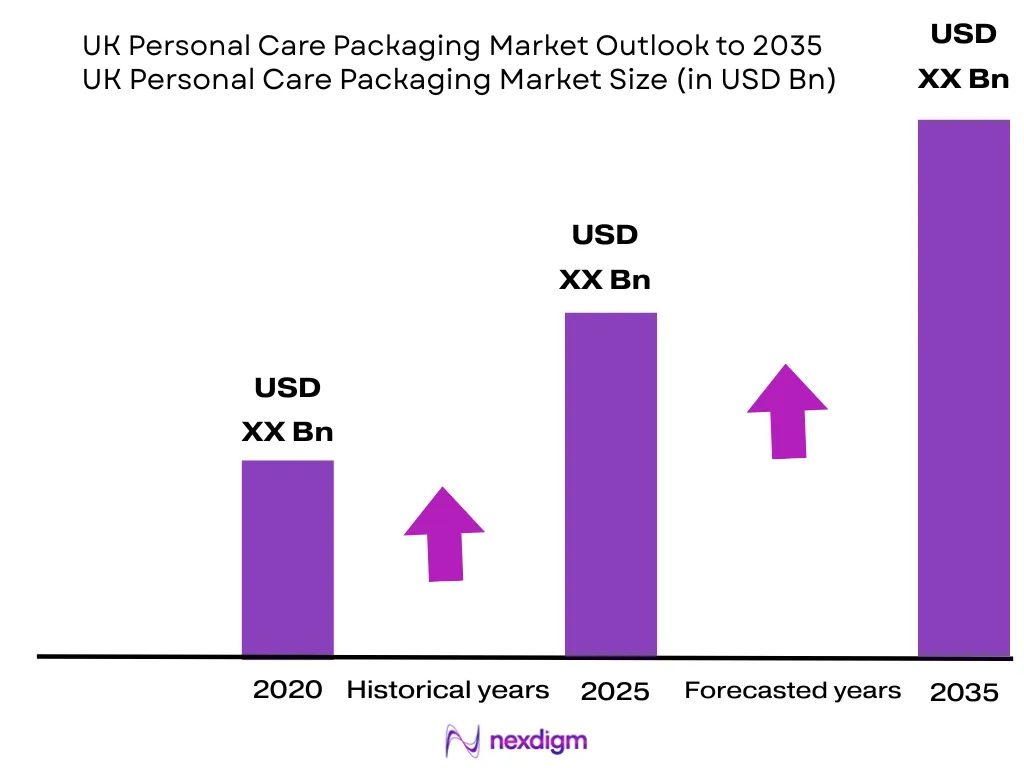
The UK Personal Care Packaging Market is valued at approximately USD ~ billion, compared with USD ~ billion in the preceding annual period. These figures are placeholders because official statistics do not isolate personal-care-packaging revenue. Demand is supported by recurring purchases of skin care, hair care, toiletries, fragrance and grooming products, alongside national GDP growth of approximately 1 unit for every 100 units and extensive health-and-beauty, pharmacy and e-commerce distribution.London, Southeast England, Northwest England, Yorkshire, the Midlands and Scotland dominate the UK Personal Care Packaging Market. London and the Southeast concentrate beauty brands, retailers, importers and product-development teams. The Northwest supports chemicals and aerosol production, while Yorkshire and the Midlands provide plastics, bottles, closures, cartons and contract filling. Scotland contributes premium personal care, natural formulations and distribution. These clusters provide access to tooling, decoration, logistics and skilled manufacturing services.
Market Segmentation
By Packaging Product Type
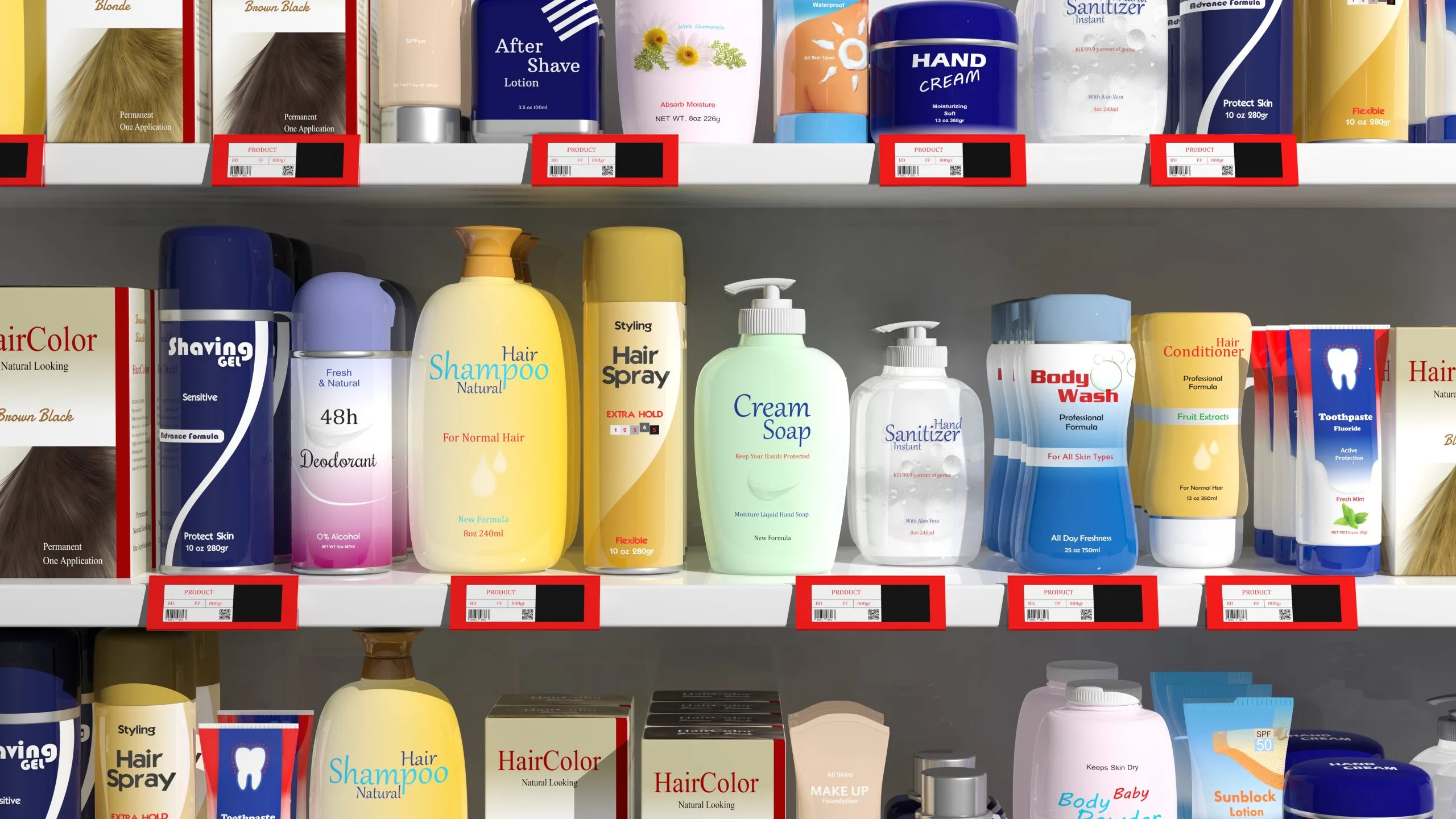
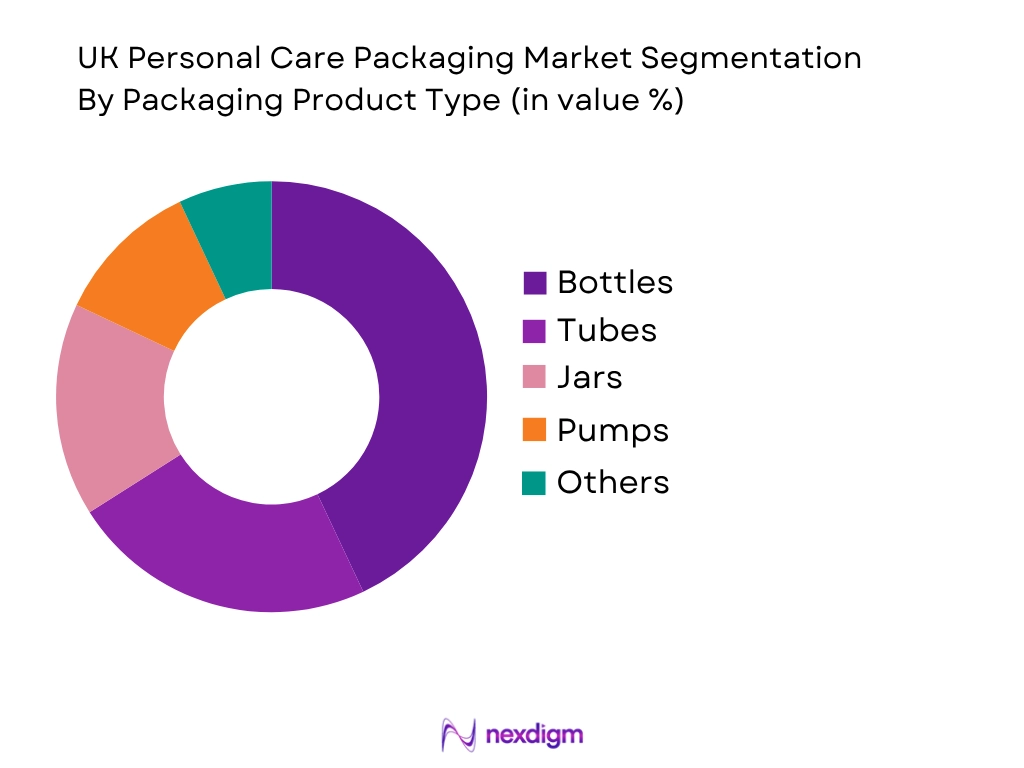
The UK Personal Care Packaging Market is segmented into bottles, tubes, jars, pumps and airless packaging, pouches, aerosol containers, roll-ons, sticks and secondary cartons. Bottles hold the dominant market share because they are used across shampoos, conditioners, body washes, lotions, cleansers, hand-care products and liquid soaps. PET, HDPE and polypropylene bottles support high-speed filling, several closure types and national retail distribution. They can also incorporate recycled resin to address Plastic Packaging Tax exposure. Tubes remain important for toothpaste, facial cleansers, sunscreens and treatment creams. Airless packaging is increasingly relevant for active skin-care formulations, while refill pouches and cartridges support material reduction. E-commerce has raised demand for secure pump locks, tamper evidence and containers capable of surviving horizontal shipment, vibration and repeated parcel handling.
By Packaging Material
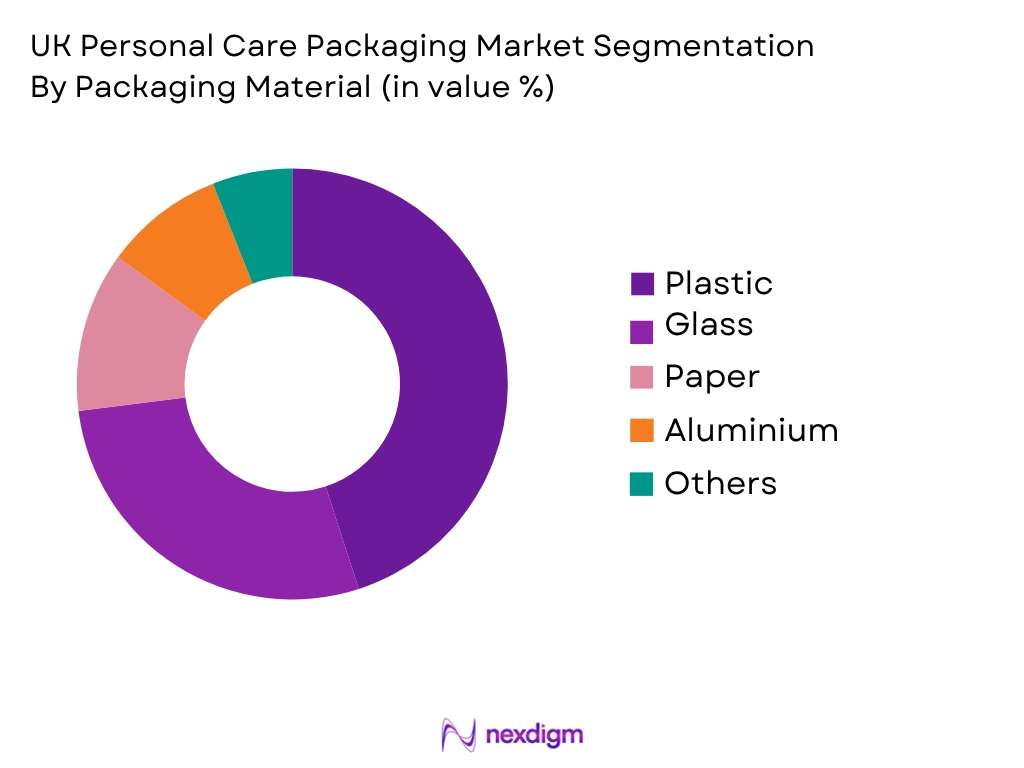
The UK Personal Care Packaging Market is segmented into plastic, glass, paper and paperboard, aluminium and steel, flexible laminates, moulded fibre and other materials. Plastic accounts for the dominant market share because PET, HDPE, LDPE and polypropylene offer low weight, impact resistance, chemical compatibility and integration with pumps and closures. Recycled plastic has gained commercial importance because packaging containing less than 30 units of recycled material per 100 units can be liable for Plastic Packaging Tax. Glass remains important for fragrance, facial oils and prestige skin care, while aluminium supports aerosols and premium components. Paperboard dominates secondary cartons, gift boxes and e-commerce protection. Material decisions increasingly consider formula stability, EPR fees, component separability and whether packaging can be collected and recycled through UK waste systems.
Competitive Landscape
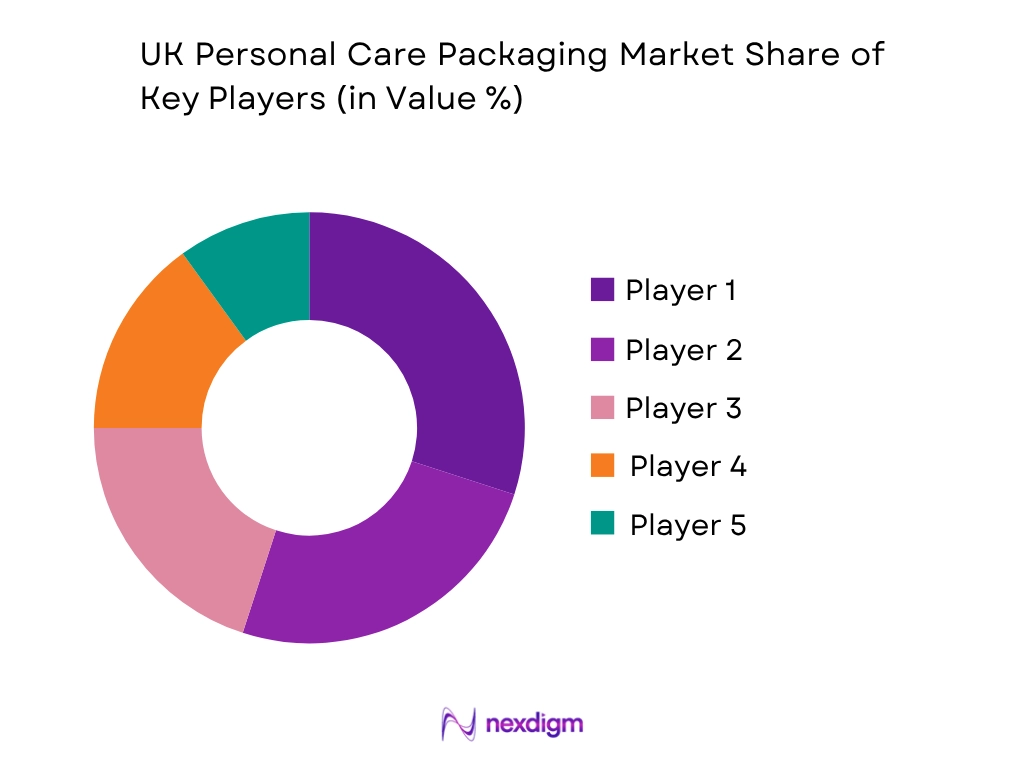
The UK Personal Care Packaging Market includes international dispensing specialists, rigid-plastic manufacturers, flexible-packaging companies, glass producers and domestic packaging distributors. AptarGroup and Silgan compete through pumps, sprayers and airless systems, while Berry Global and Amcor provide rigid and flexible formats. Albéa is prominent in tubes and beauty packaging. UK specialists compete through low minimum orders, custom decoration and proximity to indie brands and contract manufacturers. Competition increasingly depends on recycled-content documentation, EPR readiness, parcel testing, refill systems and Great Britain–Northern Ireland regulatory capability.
| Company | Established | Headquarters | Core portfolio | Dispensing capability | Material capability | Decoration capability | Sustainability capability | UK relevance |
| AptarGroup | 1992 | Crystal Lake, United States | ~ | ~ | ~ | ~ | ~ | ~ |
| Berry Global | 1967 | Evansville, United States | ~ | ~ | ~ | ~ | ~ | ~ |
| Silgan Dispensing Systems | 1987 | Stamford, United States | ~ | ~ | ~ | ~ | ~ | ~ |
| Amcor | 1860 | Zurich, Switzerland | ~ | ~ | ~ | ~ | ~ | ~ |
| Albéa Group | 2004 | Gennevilliers, France | ~ | ~ | ~ | ~ | ~ | ~ |
UK Personal Care Packaging Market Analysis
Growth Drivers
Large Consumer Base and Omnichannel Personal Care Consumption
The UK’s expanding consumer base supports recurring demand for bottles, tubes, jars, aerosol cans, pumps, refill pouches and secondary cartons used across skin care, hair care, oral care, deodorants, fragrance and grooming. The national population reached 69,281,400 in 2024, compared with 68,526,200 in 2023, adding 755,300 residents within one year. This growth increases the number of households purchasing personal-care products through supermarkets, pharmacies, health-and-beauty chains, department stores and e-commerce platforms. The UK economy also expanded by 1 unit for every 100 units in 2024, following weaker performance in the preceding period, while services remained the main contributor to output. Packaging demand is particularly concentrated around London, Southeast England, the Midlands, Yorkshire and Northwest England, where beauty brands, contract manufacturers, converters and fulfilment centres operate. Omnichannel sales require packages to perform both on retail shelves and inside parcel networks. Pumps must remain locked, caps must resist loosening, and glass containers require protective inserts. The combination of population growth, dense metropolitan consumption and nationwide online delivery therefore supports demand for attractive, lightweight and leakage-resistant formats that can serve mass, prestige and direct-to-consumer product portfolios.
Plastic Taxation and Packaging Data Requirements
UK packaging regulation is accelerating the use of recycled resin, lighter components and better packaging records across personal-care brands. Plastic Packaging Tax applies to plastic packaging manufactured in or imported into the UK when recycled plastic content remains below 30 kilograms per 100 kilograms. The applicable rate was £217.85 per tonne from April 2024, increased to £223.69 per tonne from April 2025 and reached £228.82 per tonne from April 2026. These amounts create a measurable incentive for manufacturers of shampoo bottles, lotion jars, tubes, caps and pumps to qualify recycled PET, polyethylene and polypropylene. Extended Producer Responsibility adds a second driver by requiring affected organisations to record packaging supplied or imported and, from 2025, meet obligations calculated from 2024 data. Personal-care companies manage numerous fragrances, formulations, package sizes and promotional variants, making component-level records commercially important. Suppliers able to document polymer type, package weight, recycled content and household-packaging classification can support brands more effectively than converters offering only basic containers. This regulatory environment encourages packaging redesign around downgauging, removable pumps, simplified labels and refillable systems while increasing demand for digital specification management and traceable material declarations.
Market Challenges
Multicomponent Packaging and Recycling Constraints
Personal-care packaging frequently combines materials that protect formulas and deliver precise doses but complicate collection and recycling. A lotion pump can include polypropylene, polyethylene, a metal spring, elastomer seals and a dip tube, while a decorated bottle may contain adhesives, inks, sleeves and barrier layers. Simplifying these systems without reducing dispensing performance is technically difficult. UK Extended Producer Responsibility base fees illustrate the financial importance of material selection: confirmed first-year fees included £423 per tonne for plastic, £196 per tonne for paper and board, £192 per tonne for glass, £266 per tonne for aluminium and £259 per tonne for steel. From later periods, fee modulation is intended to impose different charges according to recyclability. Personal-care companies therefore need to evaluate every component rather than only the primary bottle. However, eliminating a spring, gasket or barrier can cause leakage, poor priming, formula drying or incomplete product evacuation. Recycled materials may also introduce colour, odour or mechanical variation when used with fragrances, alcohol, oils and surfactants. Brands must conduct compatibility, temperature-cycling, torque, pump-performance and accelerated-aging tests before conversion. This increases development time and can leave existing moulds or decorated inventory commercially stranded when packaging policy or retailer requirements change.
High Production Costs and Imported Component Dependence
UK personal-care packaging manufacturers face pressure from labour, energy, tooling and imported specialist components. Domestic companies produce bottles, tubes, glass containers, cartons and labels, but high-end airless pumps, fragrance sprayers, metallised collars, elastomers and specialised decoration equipment may originate from continental Europe or Asia. Cross-border sourcing exposes brands to freight disruption, customs procedures, exchange-rate movement and minimum-order requirements. The UK economy grew by 1 unit for every 100 units in 2024 and by approximately 1.3 units in 2025, but production activity remained weaker than services, limiting the speed at which some manufacturing costs could be absorbed through volume growth. Custom personal-care packaging also requires moulds, samples, colour matching and filling-line trials before commercial orders begin. Smaller or emerging brands may need only limited quantities, leaving suppliers unable to distribute tooling and qualification costs across long production runs. Formula compatibility further restricts substitution when imported components become unavailable. A replacement pump or closure may deliver a different dose, interact with the formulation or fail parcel-distribution testing. Suppliers consequently maintain safety stock, dual sources and technical documentation, increasing working-capital requirements. These factors favour large converters and distributors with international procurement networks, while limiting the ability of smaller UK suppliers to compete in highly customised prestige and treatment-product packaging.
Market Opportunities
Refillable and Recycled-Content Packaging Systems
Refillable systems present a substantial opportunity as brands seek to lower material consumption, Plastic Packaging Tax exposure and EPR liabilities. At-home refill pouches, replaceable cartridges and reusable pump bottles are particularly suitable for shampoo, conditioner, hand wash, body care and premium skin-care products. The tax exemption threshold of 30 kilograms of recycled plastic per 100 kilograms provides an immediate incentive to incorporate PCR resin where formula compatibility permits. HMRC data covering 2024–2025 indicate that 51 units per 100 units of recorded non-taxable plastic-packaging tonnage were declared exempt because they met or exceeded this recycled-content threshold. Refill formats can provide an additional reduction by allowing the consumer to retain the most material-intensive dispenser and replace only the inner product container. The strongest future designs will use mono-material pouches, detachable pumps and cartridges that can be changed without complicated cleaning. Glass and aluminium outer containers can also support prestige positioning when combined with lightweight refills. Packaging suppliers can expand beyond component manufacturing by providing life-cycle assessment, recycled-content evidence, leakage testing and consumer-use validation. This allows brands to evaluate not only visual design but also packaging tax, disposal fees, transport weight and material retained through repeated use.
Digital Decoration and E-Commerce-Ready Packaging
Digital printing, connected labels and parcel-tested dispensing systems provide a future growth opportunity across the UK’s indie, prestige and direct-to-consumer personal-care sectors. The population reached 69.3 million in 2024, with England and Wales accounting for 61,806,682 residents, creating a dense addressable base for online product launches and subscription models. Digital decoration allows suppliers to manufacture limited editions, regional variants, sample kits and multiple fragrances without producing separate printing plates or holding large inventories of pre-printed components. QR codes can provide ingredient information, recycling guidance, authenticity checks, tutorials and refill ordering while reducing the amount of copy required on physical labels. E-commerce also creates demand for lockable pumps, induction seals, tamper evidence and containers validated against drop, vibration and compression. Slim refill pouches and concentrated products can support letterbox-compatible delivery, reducing secondary packaging and failed deliveries. Packaging companies can combine stock bottles, short-run labels, contract filling and fulfilment to support smaller brands that lack internal manufacturing infrastructure. Suppliers offering variable-data printing can also link individual packages to batch records and product-information systems. This opportunity allows UK converters to generate value through speed, data management, compliance support and packaging performance rather than competing exclusively on container price.
Future Outlook
The UK Personal Care Packaging Market is forecast to expand at approximately ~% CAGR during the 2026–2035 period. The figure remains a placeholder because official agencies do not publish an isolated packaging forecast. Growth will be driven by premium skin care, e-commerce, refill systems, recycled-content demand, packaging EPR and development of high-performance dispensing. Bottles will remain the largest format because hair care, bath products and body care generate high recurring volumes. Their design will increasingly incorporate recycled PET or polyolefins, lighter walls, removable labels and closures that can be separated more easily. Plastic Packaging Tax will remain an important material-selection factor. The tax applies to plastic packaging manufactured in or imported into the UK where recycled content is below 30 units per 100 units. The rate was £217.85 per tonne from April 2024, increased to £223.69 per tonne from April 2025 and reached £228.82 per tonne from April 2026. These tax rates create a direct commercial incentive to qualify PCR PET, recycled polyethylene and recycled polypropylene. However, recycled resin adoption will remain dependent on colour, odour, mechanical performance and compatibility with fragrances, surfactants, alcohol and active ingredients. Packaging EPR will have a broader effect on package portfolios. UK organisations that import or supply packaging can be responsible for waste-management costs. Base fees for 2025–2026 included £423 per tonne for plastic, £196 for paper and card, £192 for glass, £266 for aluminium and £259 for steel. The EPR system is expected to raise the value of packaging-material data. Brands will need accurate records covering package weight, material type, household classification and units placed on the market. Packaging suppliers that can provide component-level declarations will have a competitive advantage.
Major Players
- AptarGroup
- Berry Global
- Silgan Dispensing Systems
- Amcor
- Albéa Group
- Gerresheimer
- Quadpack
- HCP Packaging
- RPC Bramlage-Wiko
- Raepak
- M&H Plastics
- Beatson Clark
- Spectra Packaging
- Allison Packaging
- Richmond Containers
Key Target Audience
- Personal care packaging manufacturers
- Cosmetics, toiletries and fragrance brands
- Contract manufacturing and filling companies
- Pumps, closures and dispensing-system suppliers
- Resin, glass, aluminium and paperboard suppliers
- Beauty retailers, pharmacies and e-commerce platforms
- Investments and venture capitalist firms
- Government and regulatory bodies (Office for Product Safety and Standards, Department for Environment Food and Rural Affairs, HM Revenue and Customs, PackUK, Environment Agency, Scottish Environment Protection Agency, Natural Resources Wales and Northern Ireland Environment Agency)
Research Methodology
Step 1: Identification of Key Variables
The initial phase constructs an ecosystem map covering personal-care brands, packaging converters, component suppliers, contract fillers, retailers, recyclers and compliance schemes. Variables include finished-product volumes, packaging units per product, material mix, dispensing penetration, package weight, recycled content, channel mix and decoration intensity.
Step 2: Market Analysis and Construction
Historical demand is assessed through personal-care production, consumer spending, packaging-company revenues, resin consumption and packaging shipments. The top-down approach converts product-category consumption into packaging units. The bottom-up approach aggregates bottles, tubes, jars, pumps, pouches, glass containers, cartons and decoration revenues.
Step 3: Hypothesis Validation and Expert Consultation
Market assumptions are validated through computer-assisted telephone interviews with brand owners, converters, contract manufacturers, dispensing suppliers and compliance specialists. Interviews assess packaging-format penetration, component values, formula compatibility, refill adoption, e-commerce failures, Plastic Packaging Tax exposure and EPR reporting.
Step 4: Research Synthesis and Final Output
The final phase integrates ONS indicators, OPSS regulation, HMRC tax requirements, EPR fee data, company disclosures and primary interviews. Market size is triangulated across revenue, packaging units, material demand and component shipments. Forecast assumptions include e-commerce, premiumisation, PCR materials, refills and regulatory costs.

- Executive Summary
- Research Methodology (Market Definitions and Assumptions, Personal Care Packaging Taxonomy, Abbreviations, Market Sizing Approach, Top-Down Personal Care Product Consumption Analysis, Bottom-Up Packaging Supplier Aggregation, Packaging Units per Finished Product, Demand-Side Assessment, Supply-Side Capacity Mapping, Import–Export Reconciliation, Retail Channel Analysis, Primary Industry Interviews, Data Triangulation, Forecasting Framework, Scenario Analysis, Limitations and Future Conclusions)

- Definition and Scope
- Personal Care Packaging Market Evolution and Industry Genesis
- Timeline of Major Packaging and Regulatory Developments
- Personal Care Packaging Business Cycle
- Packaging Demand Linkage with Cosmetics, Toiletries and Fragrance Manufacturing
- Great Britain and Northern Ireland Regulatory Market Structure

- Growth Drivers (High Personal Care Purchase Frequency, Expansion of Online Beauty Retail, Prestige Skin-Care Demand, Growth of Indie Beauty Brands, Pharmacy and Health Retail Expansion, Demand for Convenient Dispensing, Refill Adoption and Dermatology–Beauty Convergence)
- Market Challenges (Plastic Packaging Tax Exposure, EPR Packaging Fees, Complex Multicomponent Recycling, Imported Component Dependence, High Energy and Labour Costs, Short Product-Launch Cycles, E-Commerce Leakage and Great Britain–Northern Ireland Regulatory Divergence)
- Market Opportunities (Airless Dispensing, Refillable Prestige Packaging, Mono-Material Pumps, Thirty-Unit Recycled-Content Packaging, Smart Labels, Short-Run Digital Decoration, Waterless Product Packaging, Accessible Packaging and Contract Packaging for Emerging Brands)
- Market Trends (Minimalist Packaging, Clinical Aesthetics, Premium Dispensing, Refill Cartridges, Aluminium Components, Paper-Based Secondary Packaging, PCR Resin, Travel-Friendly Formats, Gender-Neutral Design and Omnichannel Packaging)
- SWOT Analysis
- Porter’s Five Forces Analysis
- PESTLE Analysis

- By Market Value (2020-2025)
- By Packaging Units (2020-2025)
- By Packaging Material Consumption (2020-2025)

- By Packaging Product Type (In Value %)
Bottles
Jars
Tubes
Pouches
Sachets
Cans and Tins - By Packaging Material (In Value %)
Polyethylene
Polypropylene
Polyethylene Terephthalate
Recycled Polyethylene Terephthalate
High-Density Polyethylene
Low-Density Polyethylene
Post-Consumer Recycled Polyolefins - By Sales and Distribution Channel (In Value %)
Supermarkets and Hypermarkets
Health and Beauty Retailers
Pharmacies
Department Stores
Specialty Beauty Retailers
Discount Retailers - By Geographic Market (In Value %)
London and Southeast England
Northwest England
West Midlands
East Midlands
Yorkshire and the Humber
Southwest England

- Market Share of Major Players
- Cross Comparison Parameters (Personal Care Packaging Portfolio Breadth, Dispensing-System Technology, UK Manufacturing Footprint, Sustainable Material and PCR Capability, Custom Moulding and Decoration Capability, E-Commerce Packaging Performance, Refill and Reuse Packaging Portfolio, UK Personal Care Brand Customer Coverage)
- SWOT Analysis of Major Players
- Detailed Profiles of Major Companies
AptarGroup
Berry Global
Silgan Dispensing Systems
Amcor
Albéa Group
Gerresheimer
Quadpack
HCP Packaging
RPC Bramlage-Wiko
Raepak
M&H Plastics
Beatson Clark
Spectra Packaging
Allison Packaging
Richmond Containers

- Packaging Attribute Preference Assessment
- Convenience and Dispensing Preference
- Premium versus Functional Packaging Preference
- Refillable Packaging Acceptance
- Recycled-Content Packaging Perception
- Glass versus Plastic Preference
- Minimalist versus Decorative Packaging Preference

- By Market Value (2026-2035)
- By Packaging Units (2026-2035)
- By Packaging Material Consumption (2026-2035)


 Request a Sample
 Ask for Customization
 Get a Quote
 Enquire Now