
 Download PDF
Market Overview
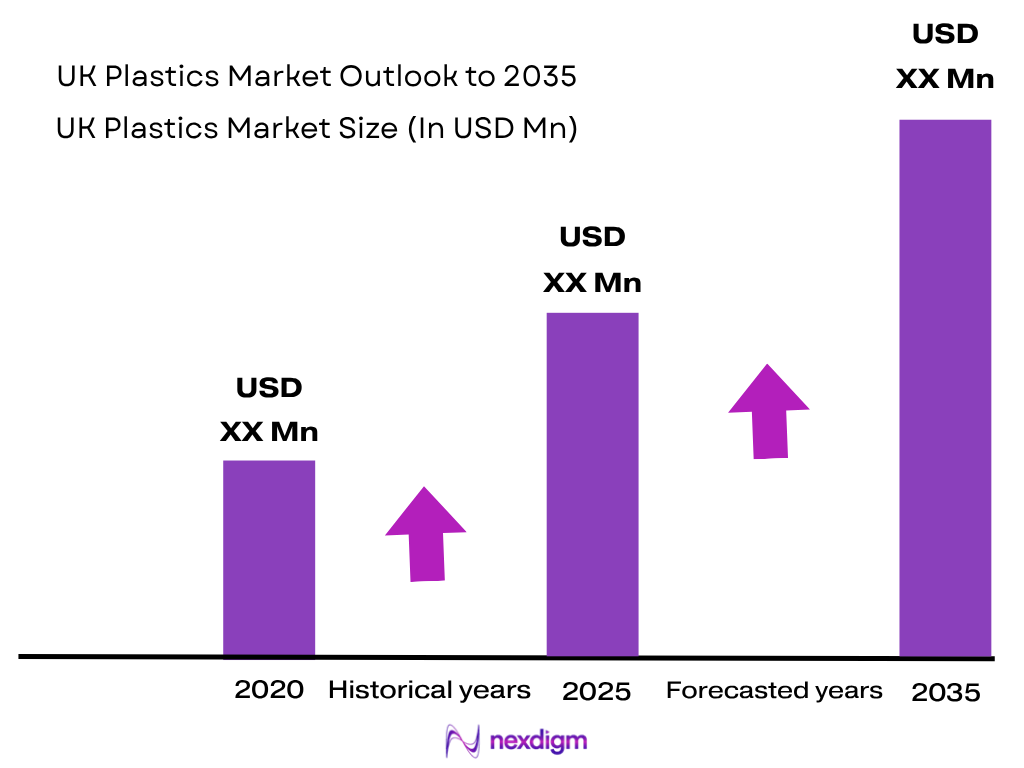
The UK Plastics Market is supported by a broad downstream manufacturing base in which polymers are converted into packaging, pipes, films, automotive components, electrical products, medical products and industrial goods. Packaging remains a particularly important demand-generating application because plastics provide lightweighting, barrier protection, durability and processing flexibility. Construction activity supports demand for PVC pipes, insulation, profiles and membranes, while automotive electrification creates additional applications for lightweight polymer components, battery-related parts and electrical systems.
The market is also being reshaped by the transition from a predominantly linear plastics model toward circular material flows. Producers, converters and brand owners are increasingly incorporating recycled polymers, designing products for recyclability and developing mono-material packaging structures. The UK regulatory environment, including Plastic Packaging Tax and extended producer responsibility requirements, is strengthening the commercial case for recycled-content integration. This creates demand across collection, sorting, mechanical recycling, advanced recycling, compounding and recycled-resin production.
Market Segmentation
By Polymer Type
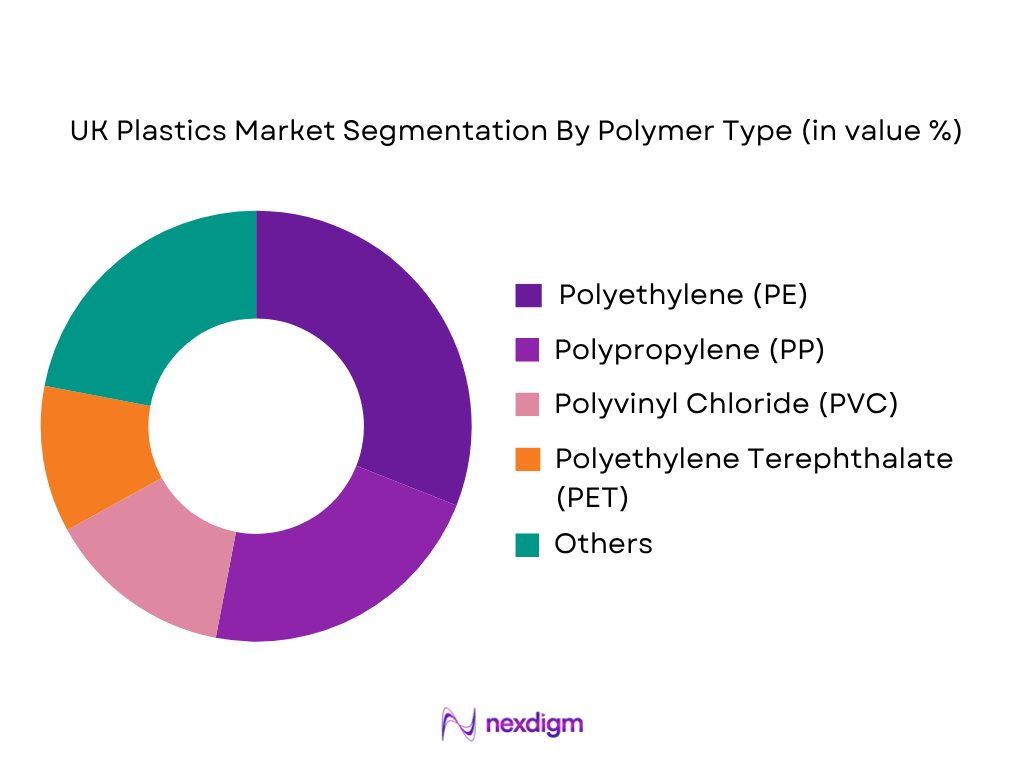
The UK Plastics Market is segmented by polymer type into polyethylene, polypropylene, polyvinyl chloride, polyethylene terephthalate, polystyrene, ABS, polyurethane, engineering plastics, specialty polymers and recycled resins. Polyethylene is expected to represent the dominant segment, with a placeholder 2024 market share of ~XX%, because PE is extensively used across flexible films, rigid containers, industrial packaging, agricultural applications, pipes and household products. Its combination of processability, chemical resistance, low density and suitability for multiple conversion technologies supports broad downstream adoption. Polypropylene follows because of its use in food packaging, automotive components, household products, medical products and electrical applications. PVC maintains strong demand through construction applications such as pipes, fittings, profiles and flooring. PET is supported by beverage containers, food packaging and textile-related applications. Engineering plastics command a smaller but strategically important position because automotive electrification, electronics and industrial equipment increasingly require materials with improved thermal, mechanical and electrical characteristics. Recycled PE, PP and PET are becoming increasingly important as converters respond to sustainability requirements and demand for circular materials.
By Application
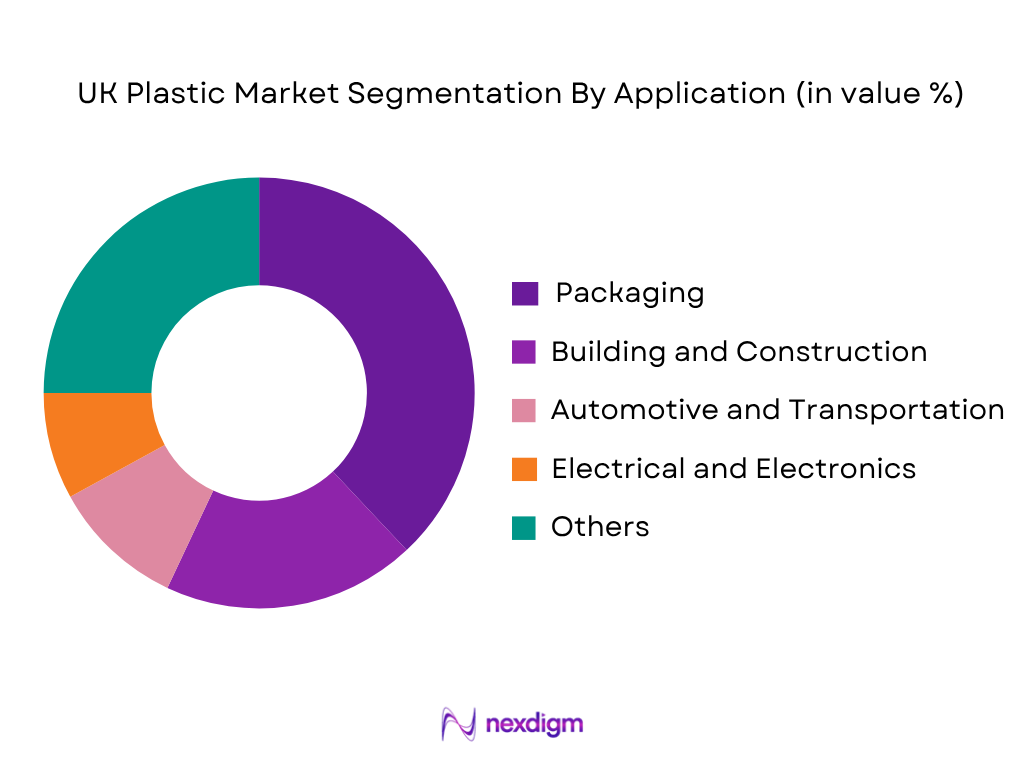
The UK Plastics Market is segmented by application into packaging, building and construction, automotive and transportation, electrical and electronics, healthcare and medical, consumer goods, industrial applications and agriculture. Packaging is expected to remain the dominant application, with a placeholder 2024 market share of ~XX%, reflecting the extensive use of plastic films, bottles, containers, closures, trays and flexible packaging formats. Demand is supported by food, beverage, pharmaceutical, household and personal-care product supply chains, where plastics provide protection, low weight and manufacturing flexibility. Construction represents another major application because PVC pipes, insulation materials, profiles, membranes and other polymer products are integrated into residential, commercial and infrastructure projects. Automotive applications are becoming increasingly important as manufacturers pursue vehicle lightweighting and greater electrical content. Healthcare demand is supported by medical devices, pharmaceutical packaging, diagnostic products and disposable components. Electrical and electronics applications benefit from polymers used for insulation, housings, connectors and protective components. The growing emphasis on recycled content is also creating opportunities for PCR materials across packaging, consumer products and industrial applications.
Competitive Landscape
The UK Plastics Market includes global polymer producers, specialty-material manufacturers, packaging companies, recycling operators and plastics processors. Competition is shaped by polymer portfolio breadth, domestic manufacturing and conversion capabilities, technical-grade development, recycled-material integration and relationships with major end-use industries. Large international chemical companies maintain strong positions in virgin polymers and engineering materials, while specialist UK operators contribute significantly to recycling, compounding and circular-polymer development.
| Company | Established | Headquarters | Core Polymer Portfolio | Recycling Capability | Major End Uses | UK Manufacturing Presence | Circular Plastics Focus |
| INEOS | 1998 | London, UK | ~ | ~ | ~ | ~ | ~ |
| SABIC | 1976 | Riyadh, Saudi Arabia | ~ | ~ | ~ | ~ | ~ |
| LyondellBasell | 2007 | Houston, USA | ~ | ~ | ~ | ~ | ~ |
| Berry Global | 1967 | Evansville, USA | ~ | ~ | ~ | ~ | ~ |
| Borealis | 1994 | Vienna, Austria | ~ | ~ | ~ | ~ | ~ |

UK Plastics Market Analysis
Growth Drivers
Packaging Consumption
Packaging consumption remains a fundamental growth driver for the UK Plastics Market because plastics are extensively used in food, beverage, pharmaceutical, household and industrial packaging. UK government data recorded 1,387,860 tonnes of plastic packaging placed on the market by obligated producers in 2024, providing a direct indication of the scale of downstream packaging demand. The same dataset recorded 1,880,160 tonnes of paper and card packaging and 2,170,516 tonnes of glass, demonstrating the broader size of the UK packaging ecosystem in which plastics compete on weight, barrier performance, durability and processing flexibility. The UK plastics industry is therefore closely linked to consumer-goods manufacturing and distribution activity. The wider industrial base also remains material to demand: the World Bank reports that industry, including construction, represented 17.1% of UK GDP in 2024, while the IMF recorded 1.0% real GDP growth for the UK. Within plastics packaging specifically, Defra reported 2.149 million tonnes of plastic packaging waste arising in 2024 under its second methodology, with 1.154 million tonnes recycled, demonstrating substantial material throughput. These volumes support continuing demand for polyethylene, polypropylene, PET and recycled polymers across flexible and rigid packaging applications.
Construction and Infrastructure Activity
Construction and infrastructure activity provides another significant demand channel for the UK Plastics Market through PVC pipes, insulation, drainage systems, roofing membranes, profiles, flooring, cable protection and other polymer-based building products. The Office for National Statistics reported £140,684 million of construction new work in Great Britain in 2024, with public-sector new work increasing by £2,592 million and private infrastructure increasing by £1,731 million. These activities directly support requirements for durable, corrosion-resistant and lightweight polymer components. The broader macroeconomic environment also supports the importance of construction-linked plastics demand. The World Bank records UK industry, including construction, at 17.1% of GDP in 2024, while IMF data show UK domestic demand increased by 1.7% and gross domestic investment reached 19.0% of GDP. Plastics are increasingly incorporated into modern construction because they can reduce component weight, provide long service life and support installation efficiency. Infrastructure applications such as water management, electrical protection and insulation create recurring demand rather than relying solely on new residential construction. ONS also reported that UK construction output increased in 2024, with construction GVA rising 0.6%, reinforcing the relevance of the sector to polymer demand. The combination of infrastructure expenditure, building refurbishment and technical polymer applications therefore supports sustained plastics consumption.
Market Challenges
Virgin Resin Feedstock Exposure
Exposure to virgin resin feedstocks remains a structural challenge for the UK Plastics Market because many polymers continue to originate from petrochemical raw materials whose availability is influenced by international energy, refining and trade conditions. The challenge is particularly relevant for polyethylene, polypropylene, PVC and other high-volume thermoplastics used by UK converters. The UK also operates within an import-intensive industrial supply chain, meaning domestic processors can be affected by international disruptions even when downstream demand remains stable. The macroeconomic environment illustrates the sensitivity of industrial activity: IMF data recorded UK CPI at 2.5% in 2024, while real GDP increased by 1.0%, indicating an environment where input-cost pressure and relatively modest economic expansion can constrain manufacturers’ ability to absorb material-cost volatility. ONS data show UK manufacturing product sales reached £452.2 billion in 2024, demonstrating the large industrial base exposed to material and energy conditions. Plastics processors additionally compete for feedstock with packaging, automotive, construction and electrical manufacturers, increasing the importance of reliable resin availability. Although recycled polymers can reduce dependence on virgin feedstocks, their availability and technical suitability vary by polymer and application. The resulting requirement for both virgin and recycled materials complicates procurement strategies and increases the importance of diversified sourcing, inventory management and polymer formulation expertise.
Plastic Waste Collection Constraints
Plastic waste collection and recycling capacity remain important challenges because the quantity of plastic entering UK packaging and consumer-product systems is substantially larger than the volume that can be converted into high-quality secondary material streams. Defra reported 2.265 million tonnes of plastic packaging waste arising in 2024 under its established methodology, while 1.154 million tonnes was recycled. Under the newer reported-packaging methodology, plastic packaging waste arising was 2.149 million tonnes, again with 1.154 million tonnes recycled. The difference between arising and recycled volumes demonstrates the scale of material requiring collection, sorting, processing or alternative treatment. The issue is also economically significant: government calculations for extended producer responsibility identified £553.69 million in modelled net waste-management costs associated with plastic packaging. The UK introduced packaging extended producer responsibility on 1 January 2025, increasing the emphasis on producer accountability and infrastructure efficiency. At the macroeconomic level, IMF data recorded UK public-sector net financial liabilities at 81.1% of GDP in 2024, highlighting the importance of efficient private-sector investment alongside public expenditure for expanding recycling capacity. For the plastics industry, collection consistency, contamination, polymer separation and regional processing capacity remain critical constraints on recycled-resin availability..
Market Opportunities
Advanced Mechanical Recycling and Post-Consumer Recycled Resin Development
Advanced mechanical recycling and higher-quality post-consumer recycled resin development create a substantial opportunity for the UK Plastics Market because existing waste streams can increasingly become feedstock for packaging, consumer goods, construction products and industrial applications. UK government data show 1,154,000 tonnes of plastic packaging was recycled in 2024, establishing a sizeable existing feedstock stream for further processing and quality improvement. HMRC also recorded 1,569,000 tonnes of plastic packaging containing at least 30% recycled content under relieved or exempt packaging declarations in the 2024–25 financial year, indicating significant movement toward recycled-content utilization. The policy environment further strengthens this opportunity. Plastic Packaging Tax requires qualifying packaging to meet a 30% recycled-content threshold to avoid the tax, while the government has legislated for a mass-balance approach for chemically recycled plastic from 2027. This creates commercial incentives for improved sorting, washing, extrusion, compounding and polymer purification. The opportunity is relevant to PE, PP and PET streams where consistent quality can support higher-value applications. The IMF reports UK gross domestic investment at 19.0% of GDP in 2024, indicating a substantial investment environment in which recycling infrastructure can attract capital. Expansion of domestic recycling therefore offers the UK plastics industry a pathway to reduce virgin-material dependence while creating additional circular-material supply.
Chemical Recycling and Mass Balance Polymers
Chemical recycling and mass-balance polymer systems present an opportunity to address plastic streams that are difficult to process through conventional mechanical recycling, particularly multilayer packaging, contaminated materials and mixed-polymer waste. The UK government has already established a policy pathway for this technology: legislation announced through the 2025 Budget framework is intended to allow chemically recycled plastic attributed through a mass-balance approach to qualify toward the 30% recycled-content threshold for Plastic Packaging Tax from 2027. The opportunity is supported by the existing scale of UK plastic waste flows. Defra recorded 2.149 million tonnes of plastic packaging waste arising in 2024, while only 1.154 million tonnes was recycled under its newer methodology. This leaves a substantial material stream requiring higher-value recovery solutions. The wider industrial environment also provides a customer base for advanced polymers: ONS recorded £452.2 billion of UK manufacturing product sales in 2024, while manufacture of electrical equipment generated £16.538 billion in product sales. Chemical recycling can therefore support applications where recycled material must meet demanding purity or performance requirements. With UK real GDP growing 1.0% in 2024 according to the IMF, future industry expansion will depend increasingly on productivity and resource efficiency rather than volume growth alone, strengthening the strategic case for advanced polymer-recovery technologies.
Future Outlook
Over the next decade, the UK Plastics Market is expected to evolve from conventional virgin-polymer consumption toward a more diversified model incorporating recycled, bio-based and advanced polymer materials. Growth in packaging, healthcare, automotive electrification, construction and electrical applications should sustain underlying polymer demand. At the same time, recycled-content requirements and waste-management policies are expected to encourage investment in sorting, reprocessing, compounding and advanced recycling infrastructure. The competitive environment is therefore likely to increasingly depend on circularity capabilities alongside traditional polymer production and conversion expertise.
Major Players
- INEOS
- SABIC
- Borealis
- LyondellBasell
- Mitsubishi Chemical Group
- Victrex
- Repsol
- Berry Global
- Mondi
- Amcor
- RPC Bramlage-Wiko
- Biffa
- Viridor
- Axion Polymers
- Recycling Technologies
Key Target Audience
- Plastic Resin Manufacturers and Polymer Producers
- Plastic Packaging Manufacturers and Converters
- Automotive Plastic Component Manufacturers
- Construction Plastic Product Manufacturers
- Healthcare and Medical Plastic Product Manufacturers
- Investments and Venture Capitalist Firms (Private Equity Funds, Infrastructure Investors, Venture Capital Funds)
- Government and Regulatory Bodies (Department for Environment, Food & Rural Affairs, Environment Agency, Department for Business and Trade)
- Plastic Recycling, Waste Management and Circular Polymer Companies
Research Methodology
Step 1: Identification of Key Variables
The initial phase involves constructing a comprehensive ecosystem map covering polymer producers, compounders, converters, packaging manufacturers, recyclers, distributors and major end-use industries within the UK Plastics Market. Secondary research is used to identify resin consumption, production, imports, exports, plastic waste generation, recycling flows and application-specific demand variables.
Step 2: Market Analysis and Construction
Historical market information is compiled across polymer categories, applications, manufacturing processes and feedstock types. A bottom-up framework evaluates polymer consumption, conversion activity, production volumes and downstream applications, while a top-down assessment validates the overall market structure using industrial production, trade and end-use indicators.
Step 3: Hypothesis Validation and Expert Consultation
Market hypotheses are developed around polymer demand, recycled-resin adoption, packaging consumption, construction applications, automotive lightweighting and circular-material deployment. Industry consultations with polymer manufacturers, converters, recycling companies and downstream users are used to validate product classifications, demand patterns, supply-chain structures and competitive positioning.
Step 4: Research Synthesis and Final Output
The final stage triangulates production, consumption, trade, waste-management and company-level information to establish a consistent market framework. Findings are cross-checked across polymer types, applications, regions and material flows, enabling the final assessment to distinguish virgin-polymer demand, recycled-polymer demand, conversion activity and circular-economy opportunities.

- Executive Summary
- Research Methodology (Market Definitions and Scope, Plastics Industry Classification, Resin-to-Product Mapping, Market Sizing Framework, Top-Down Market Estimation, Bottom-Up Production Analysis, Demand-Side Assessment, Supply-Side Assessment, Polymer Flow Mapping, Trade Flow Analysis, Primary Industry Interviews, Data Triangulation, Forecasting Framework, Scenario Analysis, Limitations and Future Conclusions)

- Definition and Scope
- UK Plastics Industry Evolution
- Plastics Industry Value Chain Analysis
- Plastics Supply Chain Analysis
- Polymer Manufacturing and Conversion Ecosystem Analysis
- Virgin-to-Recycled Polymer Flow Analysis

- Growth Drivers (Packaging Consumption, Construction and Infrastructure Activity, Automotive Lightweighting, Healthcare Plastics Demand, Electrical and Electronics Manufacturing, Food and Beverage Packaging Requirements, Domestic Recycling Demand, Industrial Polymer Applications)
- Market Challenges (Virgin Resin Feedstock Exposure, Energy-Intensive Polymer Processing, Plastic Waste Collection Constraints, Recycling Capacity Gaps, Recycled Resin Quality Variability, Regulatory Compliance Burden, Imported Polymer Dependency, Fragmented Waste Management Infrastructure)
- Market Opportunities (Advanced Mechanical Recycling, Chemical Recycling and Mass Balance Polymers, Post-Consumer Recycled Resin Development, Bio-Based Polymer Applications, Sustainable Flexible Packaging, Lightweight Automotive Components, High-Performance Engineering Plastics, Circular Polymer Supply Agreements, Domestic Recycling Infrastructure Investment)
- Market Trends (Recycled Content Integration, Lightweight Packaging, Mono-Material Packaging, Chemical Recycling Development, Bio-Based Polymer Adoption, Design-for-Recycling, Polymer Traceability, Circular Material Procurement, Advanced Sorting Technologies, Sustainable Polymer Compounding)
- Government Regulations and Standards (Plastic Packaging Tax, Extended Producer Responsibility for Packaging, Packaging Waste Regulations, Recycled Content Requirements, Waste Shipment Regulations, UK REACH, Food Contact Plastics Requirements, Environmental Permitting, Packaging Labelling Requirements, Circular Economy Policies)
- SWOT Analysis
- Porter’s Five Forces Analysis
- PESTLE Analysis

- By Market Value (2020-2025)
- By Plastic Waste Generated (2020-2025)
- By Plastic Waste Recycled (2020-2025)
- By Plastic Resin Imports (2020-2025)
- By Plastic Resin Exports (2020-2025)

- By Polymer Type (In Value %)
Polyethylene (PE)
High-Density Polyethylene (HDPE)
Low-Density Polyethylene (LDPE)
Linear Low-Density Polyethylene (LLDPE)
Polypropylene (PP)
Polyvinyl Chloride (PVC)
Polyethylene Terephthalate (PET)
Polystyrene (PS)
Expanded Polystyrene (EPS)
Acrylonitrile Butadiene Styrene (ABS)
Polyurethane (PU)
Engineering Plastics
Specialty and High-Performance Polymers
Recycled and Post-Consumer Recycled Resins - By Product Type (In Value %)
Plastic Films
Rigid Plastic Packaging
Plastic Bottles and Containers
Plastic Pipes and Fittings
Plastic Sheets and Profiles
Plastic Foams
Plastic Household Products
Plastic Industrial Components
Automotive Plastic Components
Electrical and Electronic Plastic Components
Medical and Healthcare Plastic Products
Agricultural Plastic Products
Construction Plastic Products - By Application (In Value %)
Packaging
Building and Construction
Automotive and Transportation
Electrical and Electronics
Healthcare and Medical
Consumer Goods
Agriculture
Household and Institutional Products - By Manufacturing Process (In Value %)
Injection Moulding
Blow Moulding
Extrusion
Thermoforming
Rotational Moulding
Compression Moulding
Film and Sheet Extrusion
Foam Processing
Compounding and Masterbatch Processing - By Feedstock Type (In Value %)
Virgin Petrochemical Feedstock
Post-Industrial Recycled Feedstock
Post-Consumer Recycled Feedstock
Mechanically Recycled Feedstock
Chemically Recycled Feedstock
Bio-Based Feedstock - By Region (In Value %)
England
London and South East England
Midlands
North West England
North East England
Yorkshire and the Humber
South West England
East of England
Wales
Scotland
Northern Ireland

- Market Share of Major Players (By Revenue, Polymer Type, Product Category, End-Use Industry, Manufacturing Process, Virgin Resin, Recycled Resin)
- Cross Comparison Parameters (Polymer Portfolio Breadth, Domestic Production and Conversion Footprint, Resin Grade Diversity, Recycled Polymer Integration Capability, Packaging Application Coverage, Engineering Plastics Capability, Recycling and Circularity Infrastructure, Product Development and Compounding Capability)
- SWOT Analysis of Major Players
- Detailed Profiles of Major Companies
INEOS
SABIC UK
Borealis
LyondellBasell
Mitsubishi Chemical Group
Victrex
Repsol
Berry Global
Mondi
Amcor
RPC Bramlage-Wiko
Biffa
Viridor
Axion Polymers
Recycling Technologies

- Packaging Industry Assessment
- Construction Industry Assessment
- Automotive Industry Assessment
- Healthcare and Medical Plastics Assessment
- Electrical and Electronics Assessment
- Industrial Plastics Assessment
- Agricultural Plastics Assessment
- UK Plastics Market Sustainability and Circularity Analysis
- Plastic Waste Generation Assessment

- By Market Value (2026-2035)
- By Plastic Waste Generated (2026-2035)
- By Plastic Waste Recycled (2026-2035)
- By Plastic Resin Imports (2026-2035)
- By Plastic Resin Exports (2026-2035)


 Request a Sample
 Ask for Customization
 Get a Quote
 Enquire Now