

 Download PDF
Market Overview
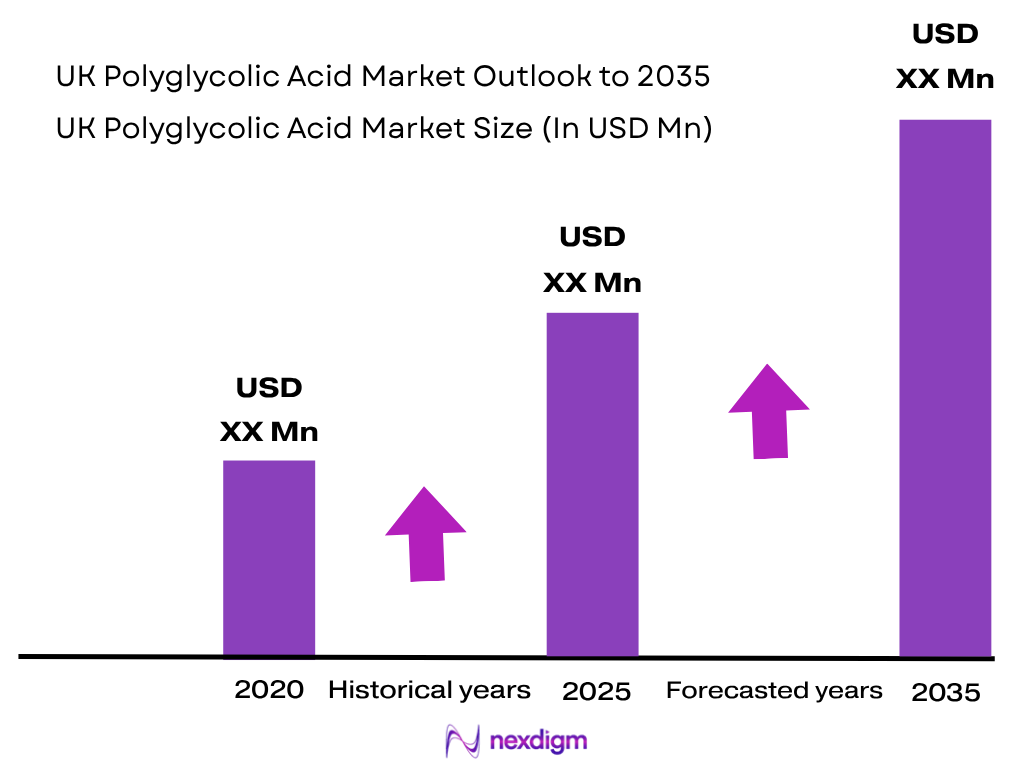
The UK Polyglycolic Acid Market is valued at approximately USD ~ million in 2024, compared with USD ~ million in 2023, supported by expanding applications of biodegradable and bioabsorbable polymers across healthcare, surgical sutures, tissue engineering, drug delivery, and specialized industrial applications. Demand is primarily influenced by the development of absorbable medical devices, increasing adoption of advanced polymeric materials, requirements for controlled degradation, and innovation in high-performance biodegradable materials. The market is projected to register a CAGR of approximately ~% during 2026–2035, reflecting increasing commercialization of PGA-based applications.
The UK Polyglycolic Acid Market is concentrated around major healthcare, life-science, advanced-materials, and manufacturing clusters, particularly London, Cambridge, Oxford, Manchester, Birmingham, and the broader South East of England. London benefits from its concentration of healthcare procurement, medical-device companies, specialist hospitals, and research-driven businesses, while Cambridge and Oxford provide strong biotechnology and advanced-materials ecosystems. Manchester and Birmingham contribute through medical manufacturing, engineering, industrial processing, and healthcare infrastructure. The UK recorded approximately ~ million hospital admissions and ~ million surgical procedures across relevant healthcare settings, supporting demand for specialized absorbable polymer materials.
Market Segmentation
By Form
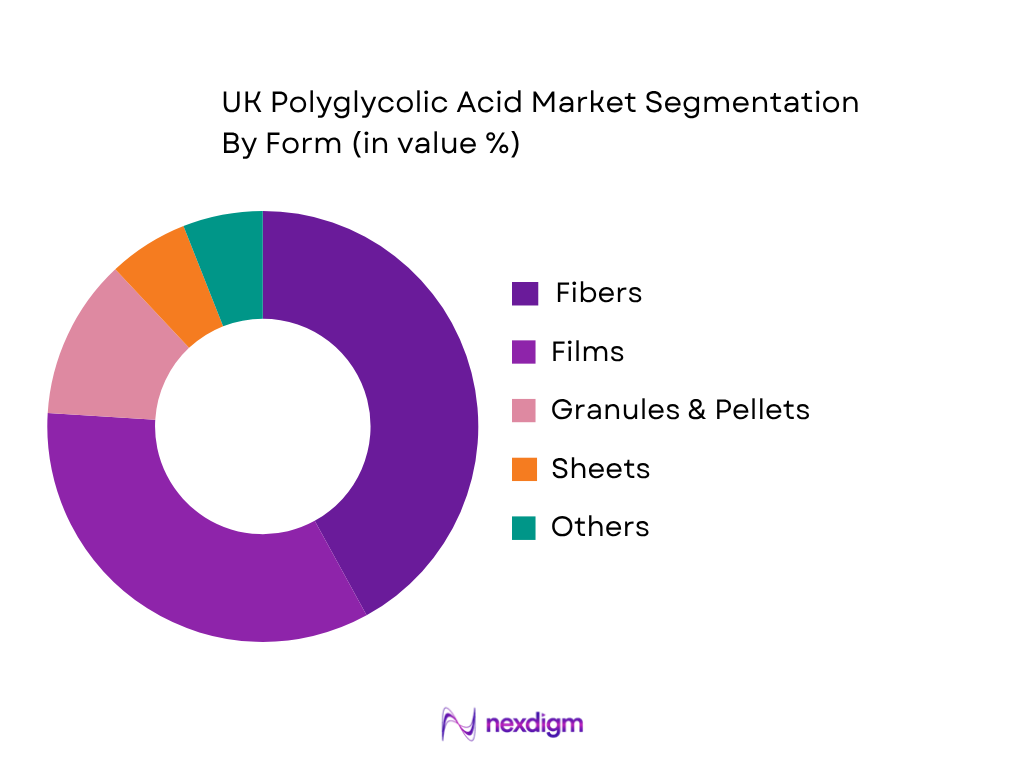
The UK Polyglycolic Acid Market is segmented by form into PGA fibers, PGA films, PGA resins, PGA sheets, PGA rods, PGA composites, and PGA-based medical components. Among these, PGA fibers are expected to account for the dominant market share, representing approximately ~% in 2024. Their leadership is closely associated with the established use of PGA in absorbable surgical sutures and other medical textile applications. PGA fibers provide high initial tensile strength, predictable hydrolytic degradation, and suitability for applications where temporary mechanical support is required. Medical-grade fiber processing also benefits from established manufacturing and conversion technologies, allowing PGA to be incorporated into braided and multifilament surgical products. The healthcare industry remains the principal demand base because absorbable sutures can eliminate the requirement for subsequent removal while gradually losing mechanical strength as tissue healing progresses. PGA’s ability to provide controlled degradation makes it particularly relevant for soft-tissue closure and specialized surgical applications. Increasing development of bioabsorbable implants, tissue-engineering structures, and advanced medical textiles can further broaden fiber consumption. Other forms, including films and resins, remain important for industrial and packaging applications but have comparatively narrower commercial penetration.
By End-Use Industry
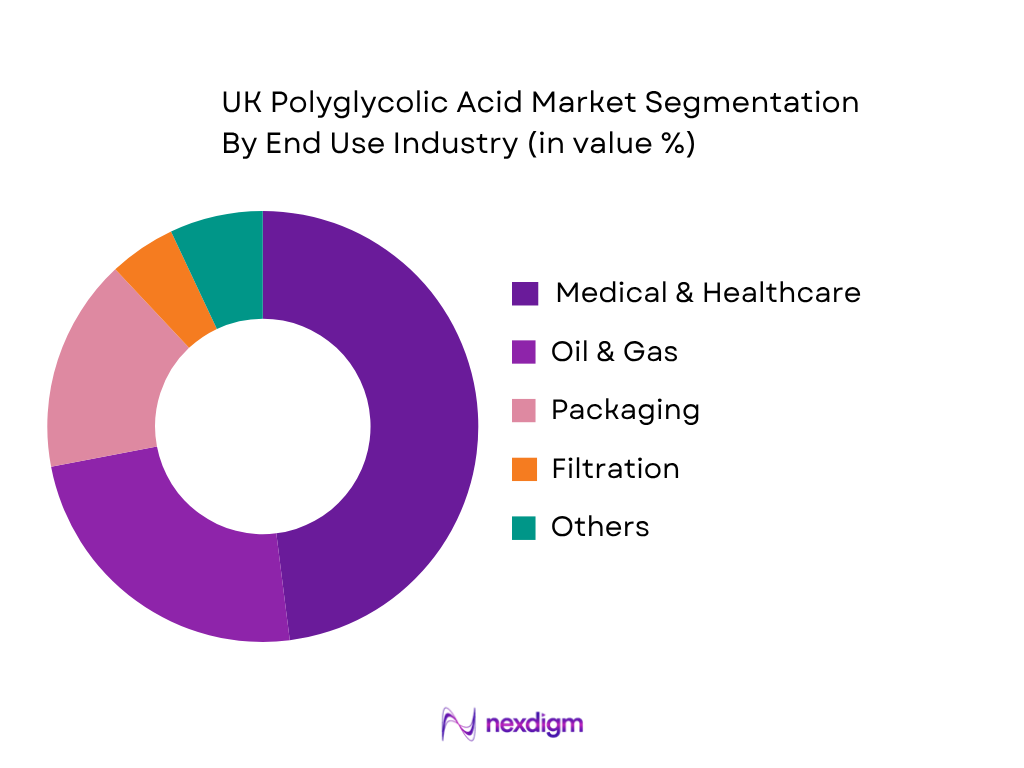
The UK Polyglycolic Acid Market is segmented by end-use industry into medical and healthcare, oil & gas, packaging, filtration, agriculture, civil engineering, industrial manufacturing, and other industrial applications. Medical and healthcare represents the dominant end-use segment, accounting for approximately ~% of the market in 2024. This dominance reflects the material’s established suitability for absorbable surgical sutures and its wider potential in bioabsorbable medical devices. PGA combines high mechanical strength with hydrolytic degradation, allowing manufacturers to engineer temporary-support products that gradually break down within the body. Demand is also supported by the UK’s advanced healthcare system, specialist surgical facilities, medical-device manufacturing capabilities, and emphasis on regulated, high-performance biomaterials. PGA is relevant to general surgery, dental procedures, ophthalmic applications, orthopaedics, tissue reinforcement, and emerging drug-delivery and tissue-engineering technologies. Medical applications typically require stringent material consistency, biocompatibility, sterilization compatibility, traceability, and quality management, creating a technically demanding but comparatively defensible market. Industrial applications such as oilfield components, high-barrier films, filtration structures, and degradable engineering components provide additional opportunities. However, their adoption depends more heavily on application-specific performance requirements, processing economics, and competition from alternative biodegradable or degradable materials.
Competitive Landscape
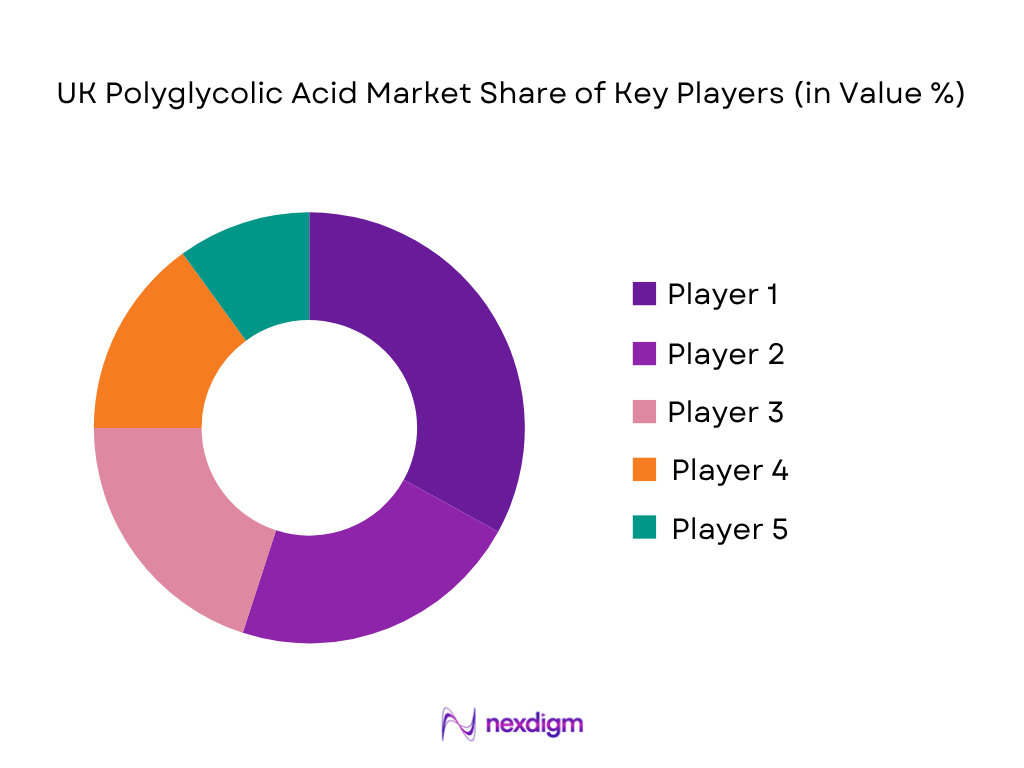
The UK Polyglycolic Acid Market comprises global polymer manufacturers, medical-device companies, surgical-suture manufacturers, specialist biomaterial suppliers, and advanced-materials companies. Competition is influenced by access to medical-grade PGA, polymerization capabilities, degradation-rate control, regulatory approvals, application-specific processing technologies, and established relationships with healthcare and industrial customers. Companies with integrated capabilities across PGA production, fiber processing, medical-device manufacturing, and regulatory qualification possess an advantage in high-value applications.
| Company | Established | Headquarters | PGA Focus | Medical Applications | Industrial Applications | Manufacturing Capability | R&D Focus |
| Kureha Corporation | 1944 | Tokyo, Japan | ~ | ~ | ~ | ~ | ~ |
| Corbion | 1919 | Amsterdam, Netherlands | ~ | ~ | ~ | ~ | ~ |
| Teleflex Incorporated | 1943 | Wayne, Pennsylvania, USA | ~ | ~ | ~ | ~ | ~ |
| Johnson & Johnson MedTech / Ethicon | 1886 | New Brunswick, New Jersey, USA | ~ | ~ | ~ | ~ | ~ |
| B. Braun | 1839 | Melsungen, Germany | ~ | ~ | ~ | ~ | ~ |
UK Polyglycolic Acid Market Analysis
Growth Drivers
Expansion of Absorbable Medical Devices
The UK’s growing clinical activity provides a direct demand base for absorbable PGA-based medical devices, particularly sutures and temporary implants. NHS England reported 18 million treatments in 2024, compared with 17.35 million in 2023, demonstrating a high volume of procedures requiring surgical consumables and wound-closure products. The UK also had a population of 69,281,400 people at mid-2024, up by 755,300 from the previous year, increasing the underlying healthcare requirement. ONS further reported UK life expectancy at age 65 of 21.2 years for females and 18.7 years for males for 2022–2024, supporting sustained demand for surgical interventions associated with an ageing population. These conditions strengthen the addressable application base for PGA because its predictable hydrolytic degradation is suited to temporary medical applications where permanent foreign material is undesirable. The UK’s medical and dental instruments and supplies exports were valued at £4.802 billion in 2024, according to ONS, highlighting the scale of the country’s broader medical-device ecosystem. Together, high procedure volumes, demographic ageing and an established medical-device manufacturing and trade base support continued adoption of bioabsorbable polymer technologies, including PGA, in surgical and advanced medical-device applications.
Demand for Bioabsorbable Sutures
Demand for PGA-based absorbable sutures is supported by the scale and continuing activity of the UK healthcare system. NHS England recorded 18 million treatments in 2024, including substantial elective activity, compared with 17.35 million treatments in 2023. This volume creates recurring requirements for surgical closure materials, while the ageing demographic increases the relevance of procedures involving soft-tissue repair and postoperative management. ONS estimates that 625,000 people aged 90 years and over were living in the UK in 2024, while the number of centenarians reached 16,600, reinforcing the long-term need for healthcare products compatible with an older patient population. The UK medical-device ecosystem also generated £4.802 billion of exports of medical and dental instruments and supplies in 2024, indicating substantial industrial capability surrounding clinical-device production. PGA’s established use in absorbable sutures is particularly relevant where controlled degradation can eliminate the need for suture-removal procedures. The combination of procedure intensity, ageing-related healthcare utilisation and established medical-device manufacturing capabilities therefore creates a strong environment for PGA-based bioabsorbable suture applications. Continued investment in surgical technologies and temporary implantable materials can further broaden the role of PGA across specialised surgical procedures and next-generation absorbable-device designs.
Market Challenges
High Polymerization Complexity
PGA production presents technical challenges because polymerisation and subsequent processing require tight control over material properties, molecular weight, moisture exposure and degradation behaviour. These requirements become particularly important when PGA is intended for regulated medical applications. The UK medical-device framework requires products to meet defined regulatory and conformity requirements before being placed on the Great Britain market, while manufacturers must also maintain appropriate technical documentation and registration with the MHRA. The regulatory environment became more demanding with the implementation of new post-market surveillance requirements from 16 June 2025, creating additional obligations covering incident notification, preventive actions and corrective actions. The broader UK medical-device manufacturing base remains substantial: ONS recorded £2.255 billion of UK exports of medical and dental instruments and supplies in 2024, illustrating the scale of the regulated ecosystem in which PGA suppliers operate. PGA manufacturers therefore face a combination of process-control and qualification requirements. Moisture-sensitive glycolide-derived materials require disciplined handling throughout polymerisation, storage and conversion, while medical-grade applications require reproducibility across batches. These technical constraints can increase development complexity, qualification timelines and manufacturing controls, particularly for smaller specialist producers attempting to establish UK supply relationships or introduce new PGA grades for sutures, implants, tissue-engineering scaffolds and drug-delivery systems.
Medical Qualification Requirements
Medical qualification requirements represent a significant barrier for PGA suppliers because polymer performance must be demonstrated consistently before materials can be incorporated into regulated medical devices. The UK requires medical devices placed on the Great Britain market to comply with the Medical Devices Regulations 2002, with registration through the MHRA required before market placement. The regulatory framework was strengthened further through the Medical Devices (Post-market Surveillance Requirements) (Amendment) Regulations 2024, which came into force on 16 June 2025 and introduced additional post-market surveillance obligations. These requirements increase the importance of traceability, technical documentation, safety monitoring and corrective-action capabilities for manufacturers using PGA. The commercial environment is also linked to a sizeable healthcare manufacturing and trade base: ONS recorded £2.255 billion in UK exports of medical and dental instruments and supplies in 2024, while NHS England reported 18 million treatments during the same period. PGA suppliers seeking to penetrate this ecosystem must therefore demonstrate material consistency, biocompatibility, degradation characteristics and application-specific performance rather than simply supply commodity polymer. Qualification can require extensive testing and validation for each medical-device application, creating barriers to rapid substitution and increasing the importance of established technical partnerships between polymer producers, medical-device manufacturers and clinical users.
Market Opportunities
Advanced Bioabsorbable Medical Devices
Advanced bioabsorbable medical devices represent an important expansion pathway for PGA as UK healthcare activity increasingly requires materials that provide temporary mechanical or structural functions before safely degrading. NHS England recorded 18 million treatments in 2024, while the UK population reached 69,281,400, creating a substantial clinical base for surgical and medical-device applications. Demographic ageing strengthens this opportunity further: ONS reported 625,000 people aged 90 and over in the UK in 2024 and life expectancy at age 65 of 21.2 years for females and 18.7 years for males. These demographic conditions support continued development of technologies addressing surgical repair, tissue regeneration and temporary implantation. PGA can contribute to such applications through controlled hydrolytic degradation, high initial strength and established biocompatibility in selected medical uses. The opportunity extends beyond conventional sutures toward temporary fixation devices, tissue-engineering structures and specialised absorbable components where permanent implants may create unnecessary long-term intervention requirements. The UK’s medical-device trade ecosystem, with £4.802 billion of exports of medical and dental instruments and supplies in 2024, provides an established industrial platform for developing and commercialising advanced polymer-enabled devices. Future innovation can therefore focus on controlled degradation profiles, composite structures and application-specific PGA formulations for increasingly specialised surgical requirements.
Drug Delivery Systems
PGA-based drug-delivery systems offer an opportunity to extend the polymer beyond conventional surgical applications into controlled-release and temporary therapeutic platforms. The UK’s established pharmaceutical and medical-device industries provide a relevant industrial foundation: ONS recorded £24.264 billion of pharmaceutical manufacturing output on a chain-volume basis in 2024, while exports of medical and dental instruments and supplies reached £4.802 billion. The country also had 69,281,400 residents at mid-2024, with 625,000 people aged 90 and over, supporting an extensive and increasingly ageing healthcare population. PGA’s predictable degradation behaviour can enable temporary matrices, microspheres and other delivery structures in which polymer breakdown is incorporated into the release mechanism. This creates potential applications in localised drug delivery, implantable systems and tissue-regeneration platforms where controlled residence time is clinically valuable. The opportunity is particularly relevant to specialised therapies requiring delivery over a defined period rather than permanent implantation. Regulatory requirements remain substantial, but the UK’s established pharmaceutical manufacturing capabilities and medical-device ecosystem can support collaboration between polymer developers, pharmaceutical manufacturers and device companies. Development efforts can consequently concentrate on tuning molecular weight, degradation rate, morphology and drug-loading characteristics to create application-specific PGA delivery platforms while maintaining the quality and regulatory controls expected for medical-grade materials.
Future Outlook
The UK Polyglycolic Acid Market is expected to develop through greater adoption of bioabsorbable materials, advanced surgical products, tissue-engineering technologies, and specialized biodegradable polymer applications. Medical applications are likely to remain the principal commercial foundation, while research into controlled degradation and advanced PGA formulations can broaden the addressable application base.
Further development of PGA-based medical devices, specialized fibers, high-barrier structures, filtration materials, and temporary industrial components could support diversification beyond conventional sutures. Regulatory qualification, polymer consistency, processing technology, and application-specific performance will remain important determinants of commercialization.
Major Players
- Kureha Corporation
- Corbion
- Teleflex Incorporated
- Johnson & Johnson MedTech / Ethicon
- B. Braun
- Peters Surgical
- Advanced Medical Solutions Group
- Healthium Medtech
- Gunze
- Resorba Medical
- Nobel Biocare
- CONMED
- Integra LifeSciences
- Integer Holdings
- Cook Medical
Key Target Audience
- PGA Resin and Specialty Polymer Manufacturers
- Medical Device and Absorbable Suture Manufacturers
- Pharmaceutical and Drug-Delivery Companies
- Healthcare Procurement Organizations and Hospital Networks
- Oil & Gas Service and Downhole Technology Companies
- Packaging, Filtration and Advanced Materials Manufacturers
- Investments and Venture Capitalist Firms (Healthcare, Biomaterials and Advanced Materials Investors)
- Government and Regulatory Bodies (Medicines and Healthcare products Regulatory Agency, Department for Business and Trade, Department for Health and Social Care)
Research Methodology
Step 1: Identification of Key Variables
The initial phase involves mapping the complete UK Polyglycolic Acid Market ecosystem, covering PGA producers, resin suppliers, medical-device manufacturers, surgical-suture producers, healthcare procurement organizations, industrial users, distributors, and regulatory stakeholders. Key variables include PGA production capacity, form, grade, application penetration, polymer-processing capability, degradation characteristics, and end-user demand.
Step 2: Market Analysis and Construction
Historical market information is compiled through structured analysis of PGA consumption, production activity, imports, exports, application demand, medical-device manufacturing, and industrial utilization. The bottom-up framework evaluates demand across individual applications, while the top-down framework cross-checks the results against healthcare, manufacturing, polymer-processing, and industrial activity indicators.
Step 3: Hypothesis Validation and Expert Consultation
Market hypotheses are validated through discussions with polymer manufacturers, medical-device companies, surgical-suture manufacturers, material converters, distributors, and relevant industry specialists. These interactions are used to assess application-level adoption, product specifications, regulatory requirements, supply-chain conditions, material substitution, and emerging commercialization opportunities.
Step 4: Research Synthesis and Final Output
The final stage integrates quantitative market construction with application-level intelligence and competitive analysis. Findings are triangulated across supplier capabilities, end-user requirements, product portfolios, regulatory developments, and technological developments. This process produces a validated assessment of the UK Polyglycolic Acid Market, including segmentation, competitive positioning, growth opportunities, and long-term market outlook.

- Executive Summary
- Research Methodology (Market Definitions and Assumptions, Scope Delimitation, PGA Value-Chain Mapping, Market Sizing Approach, Top-Down Analysis, Bottom-Up Analysis, Demand-Side Assessment, Supply-Side Assessment, Primary Research, Secondary Research, Data Triangulation, Application-Level Validation, Forecasting Framework, Sensitivity Analysis, Limitations)

- Definition and Scope
- Polyglycolic Acid Material Characteristics and Commercial Ecosystem
- UK PGA Industry Evolution and Technology Development
- UK PGA Value Chain Analysis
- UK PGA Supply Chain Analysis
- UK PGA Manufacturing and Conversion Ecosystem

- Growth Drivers (Expansion of Absorbable Medical Devices, Demand for Bioabsorbable Sutures, Advanced Surgical Procedures, Development of High-Barrier Materials, Specialty Polymer Innovation, Demand for Temporary and Degradable Components)
- Market Challenges (High Polymerization Complexity, Glycolide Feedstock Availability, Moisture Sensitivity, Hydrolytic Degradation During Processing, Limited Specialist Supplier Base, Medical Qualification Requirements, Regulatory Complexity, Competition From Alternative Resorbable Polymers)
- Market Opportunities (Advanced Bioabsorbable Medical Devices, PGA-Based Tissue Engineering, Drug Delivery Systems, High-Barrier Packaging, Advanced Filtration, Degradable Industrial Components, PGA-Based Composites, Sustainable Polymer Applications)
- Market Trends (Bioabsorbable Medical Material Development, PGA Copolymer Innovation, High-Barrier Packaging, Controlled Degradation, Medical Device Miniaturization, Advanced Fiber Development, Sustainable Polymer Substitution)
- Government and Regulatory Framework (MHRA Medical Device Requirements, UKCA Framework, UK MDR, ISO 10993, ISO 13485, Sterilization Requirements, Biocompatibility Testing, Post-Market Surveillance)
- SWOT Analysis
- Porter’s Five Forces Analysis
- PESTLE Analysis

- By Market Value (2020-2025)
- By Volume Consumption (2020-2025)
- By PGA Resin Consumption (2020-2025)
- By PGA Fiber Consumption (2020-2025)
- By PGA Film Consumption (2020-2025)
- By Medical-Grade PGA Consumption (2020-2025)

- By Form (In Value %)
PGA Fibers
PGA Films
PGA Resins
PGA Sheets
PGA Rods
PGA Composites
PGA-Based Medical Components
Other PGA Forms - By End-Use Industry (In Value %)
Medical and Healthcare
Oil & Gas
Packaging
Filtration
Agriculture
Civil Engineering
Industrial Manufacturing
Other Industrial Applications - By Medical Application (In Value %)
Absorbable Surgical Sutures
Dental Sutures
Ophthalmic Sutures
Orthopaedic Applications
Tissue Reinforcement Materials
Bioabsorbable Implants
Drug Delivery Systems
Tissue Engineering Scaffolds
Other Medical Devices - By Processing Technology (In Value %)
Melt Polymerization
Ring-Opening Polymerization
Solid-State Polymerization
Extrusion
Fiber Spinning
Film Extrusion
Injection Molding
Compression Molding
Composite Processing - By Grade (In Value %)
Medical Grade
Suture Grade
Oilfield Grade
Packaging Grade
Industrial Grade
High-Performance Grade
Biodegradable Grade

- Market Share of Major Players (By Value, Volume, Form, Grade, Medical Application, Industrial Application)
- Cross Comparison Parameters (PGA Product Portfolio Breadth, PGA Grade Availability, Medical-Grade Manufacturing Capability, Suture Manufacturing Capability, Polymer Processing Technology, Application Portfolio Breadth, UK Distribution and Customer Reach, R&D and Product Innovation Capability)
- SWOT Analysis of Major Players
- Detailed Profiles of Major Companies
Kureha Corporation
Corbion
Teleflex Incorporated
Johnson & Johnson MedTech / Ethicon
B. Braun
Peters Surgical
Advanced Medical Solutions Group
Healthium Medtech
Gunze
Resorba Medical
Nobel Biocare
CONMED
Integra LifeSciences
Integer Holdings
Cook Medical

- Medical End-User Assessment
- Procurement Behaviour
- PGA Product Preference Assessment
- Medical Device Manufacturer Requirements
- Industrial End-User Requirements
- End-User Switching Analysis

- By Market Value (2026-2035)
- By Volume Consumption (2026-2035)
- By PGA Resin Consumption (2026-2035)
- By PGA Fiber Consumption (2026-2035)
- By PGA Film Consumption (2026-2035)
- By Medical-Grade PGA Consumption (2026-2035)


 Request a Sample
 Ask for Customization
 Get a Quote
 Enquire Now