
 Download PDF
Market Overview
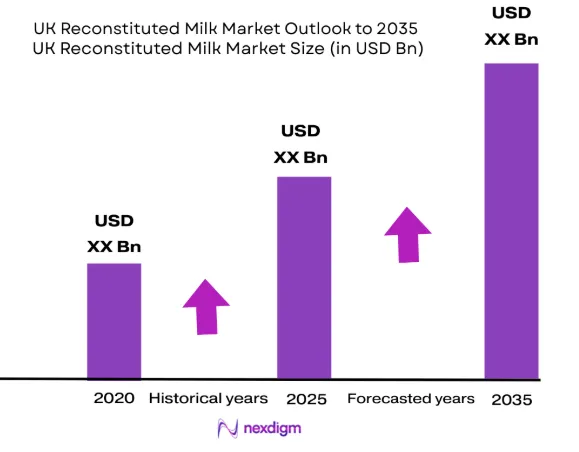
The UK Reconstituted Milk Market is valued at USD ~ billion, supported by demand from UHT milk, ESL milk, powdered milk, foodservice milk bases, dairy ingredients and public-sector catering. UK annual milk production stood at 14,890 million litres in the previous comparable milk year, while UK milk supply reached 14.2 billion litres in the latest AHDB dairy summary. DEFRA also reported 1,206 million litres of milk processed by UK dairies in a single month.England, Scotland, Wales and Northern Ireland dominate the UK Reconstituted Milk Market because they connect milk production, processing plants, supermarket contracts, foodservice procurement and public-sector catering. England leads demand through London, the South East, Midlands and large grocery chains; Wales and Scotland support farmgate milk flows; Northern Ireland is important for surplus milk and powder-linked processing. UK liquid milk utilisation accounts for 44% of milk supply, while cheese uses 33%.
Market Segmentation
By Source
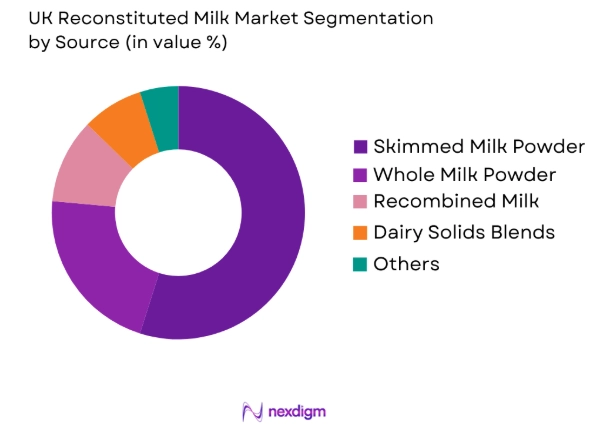
UK Reconstituted Milk Market is segmented by source into skimmed milk powder based reconstituted milk, whole milk powder based reconstituted milk, recombined milk with butterfat or cream, milk protein concentrate and dairy solids blends, and whey powder-based blends. Skimmed milk powder based reconstituted milk holds the dominant market share because it supports low-fat dairy formulation, UHT milk production, foodservice milk bases, bakery applications and institutional catering. UK processors use skimmed milk powder to standardise solids-not-fat, protein content and texture in liquid dairy, sauces, soups, desserts and prepared meals. The segment is also commercially attractive for private-label and B2B manufacturing because it allows processors to rebuild dairy solids without relying only on fresh milk intake. Its dominance is reinforced by the UK’s mature dairy-processing ecosystem, retailer specification control and large industrial food-manufacturing base.
By Application
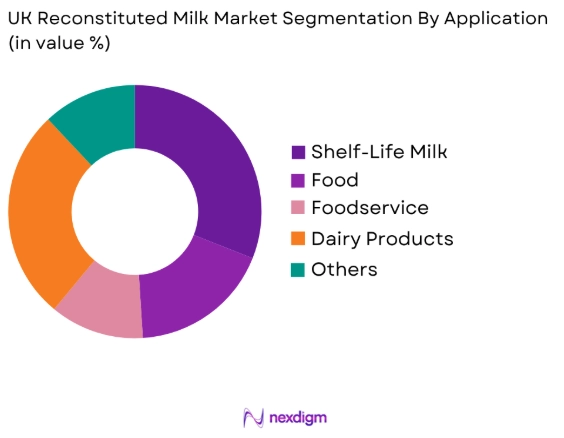
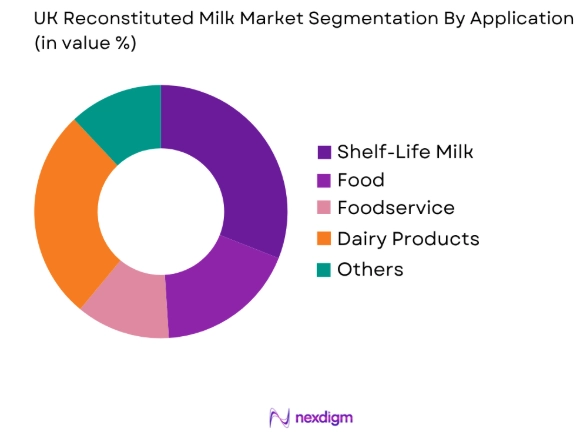
UK Reconstituted Milk Market is segmented by UHT and extended shelf-life milk, dairy products manufacturing, food and beverage processing, foodservice and HoReCa, public sector and institutional catering, and household powder reconstitution. UHT and extended shelf-life milk dominates the market because it fits UK retail requirements for longer code life, lower wastage, stable distribution and convenience-led household demand. Processors use reconstituted inputs to support aseptic cartons, ESL formats and retailer private-label milk where consistent fat, protein and solids performance is critical. The segment also benefits from public-sector and foodservice buyers that require reliable milk supply for hospitals, schools, care homes, catering kitchens and coffee-led beverage preparation. Reconstituted milk is commercially relevant because it gives processors flexibility when fresh milk intake, powder availability and retail demand do not move in the same cycle.
Competitive Landscape
The UK Reconstituted Milk Market is led by dairy cooperatives, liquid milk processors, UHT specialists, ingredient suppliers and retailer-linked private-label manufacturers. Arla Foods UK, Müller Milk & Ingredients, Saputo Dairy UK, First Milk and Dale Farm are key players because they control milk sourcing, processing scale, retail distribution, foodservice access and B2B dairy ingredients. Competition is shaped by supermarket contracts, powder access, UHT and ESL capability, public-sector procurement, private-label production and product innovation in lactose-free, fortified and high-protein dairy.
| Company | Establishment Year | Headquarters | Milk Sourcing Strength | Reconstituted Milk Linkage | UHT / ESL Capability | Powder / Ingredient Capability | Channel Strength | Strategic Positioning |
| Arla Foods UK | 2000 | Leeds, UK / Viby, Denmark | ~ | ~ | ~ | ~ | ~ | ~ |
| Müller Milk & Ingredients | 1896 | Market Drayton, UK operations | ~ | ~ | ~ | ~ | ~ | ~ |
| Saputo Dairy UK | 1954 | Weybridge, UK / Montréal, Canada | ~ | ~ | ~ | ~ | ~ | ~ |
| First Milk | 2001 | Glasgow, Scotland | ~ | ~ | ~ | ~ | ~ | ~ |
| Dale Farm | 1955 | Belfast, Northern Ireland | ~ | ~ | ~ | ~ | ~ | ~ |
UK Reconstituted Milk Market Analysis
Growth Drivers
Large Domestic Milk Processing Base Supporting Reconstituted Dairy Inputs
The UK Reconstituted Milk Market is supported by a formal dairy-processing base that can absorb skimmed milk powder, whole milk powder and dairy solids for UHT milk, ESL milk, desserts, sauces, bakery ingredients and institutional catering. DEFRA reported that UK dairies processed 1,206 million litres of milk in December 2024, while liquid milk production reached 504 million litres and milk powder production reached 9.7 thousand tonnes in the same month. AHDB also reported UK milk deliveries of 15.0 billion litres in calendar 2024, giving processors a large raw-material base for milk-solids standardisation. The macroeconomic base supports this scale: World Bank reported UK GDP at USD 3.69 trillion and GDP per capita at USD 53,246.4 in 2024, supporting household, foodservice and public-sector dairy demand.
Food Manufacturing and Liquid Milk Utilisation Create Stable B2B Demand
The UK Reconstituted Milk Market is driven by liquid milk, cheese, bakery, confectionery, ready meals and foodservice applications where consistent milk solids are required. AHDB reported UK milk supply of 14.2 billion litres in the 2024/25 milk year, while DEFRA reported the 12-month rolling average of milk available to processors at 1,189 million litres up to December 2024. DEFRA also recorded cheese production of 42.1 thousand tonnes and butter production of 14.1 thousand tonnes in December 2024, showing broad dairy-manufacturing activity that uses milk solids and cream streams alongside liquid milk. The demand base is supported by World Bank macro data showing UK GDP growth at 1.1 and consumer inflation at 3.3 in 2024, indicating continued demand pressure for efficient, shelf-stable and standardised dairy inputs.
Market Challenges
Powder-Linked Supply Exposure and Import Dependency
The UK Reconstituted Milk Market faces sourcing risk because milk powder is a core input for reconstituted milk, recombined dairy, bakery mixes, foodservice milk bases and industrial dairy formulations. World Bank WITS reported that the UK imported 8,101,060 kg of low-fat solid milk and cream from Ireland, 1,581,480 kg from France, 630,700 kg from New Zealand and 709,161 kg from Germany in 2024. For higher-fat solid milk and cream, WITS reported total UK import quantity of 11,023,300 kg, including 3,907,220 kg from the Netherlands and 2,647,400 kg from Ireland. This creates market-specific exposure to supplier concentration and border-linked dairy flows. World Bank also reported UK GDP per capita of USD 53,246.4, indicating a high-income market where supply interruptions can quickly affect retail, foodservice and ingredient buyers.
Fresh Milk Preference and Retailer Specification Pressure
The UK Reconstituted Milk Market faces a structural challenge because chilled liquid milk remains a major use of domestic milk, making consumer-facing reconstituted formats harder to position against fresh dairy. AHDB reported UK milk supply of 14.2 billion litres in the 2024/25 milk year, while DEFRA reported liquid milk production of 504 million litres in December 2024 and a 12-month rolling average of 503 million litres up to December 2024. This shows that drinking milk remains a large operational category for processors and retailers. DEFRA’s processor statistics also show that the monthly dairy survey covers the largest 33 dairies monthly and 20 dairies quarterly, indicating high reliance on major processing groups. World Bank reported UK GDP at USD 3.69 trillion, supporting a sophisticated grocery market where retailers impose strict quality, shelf-life and private-label standards.
Market Opportunities
Shelf-Stable UHT, ESL and Public-Sector Dairy Supply
The UK Reconstituted Milk Market has an opportunity in UHT, ESL and institutional dairy because powder-based milk allows longer storage, consistent solids and better supply flexibility for schools, NHS catering, care homes, prisons and defence foodservice. DEFRA reported 1,206 million litres of milk processed by UK dairies in December 2024, with liquid milk output at 504 million litres and milk powder output at 9.7 thousand tonnes, showing that processors already manage both liquid and dry dairy streams. AHDB reported UK milk deliveries of 15.0 billion litres in 2024, supporting large-scale reconstitution and standardisation. The macro base is favourable: World Bank reported UK GDP per capita of USD 53,246.4 and GDP of USD 3.69 trillion, indicating strong purchasing capacity for reliable packaged dairy formats across retail and public procurement.
B2B Dairy Ingredients for Foodservice and Processed Foods
The UK Reconstituted Milk Market has an opportunity in B2B ingredients because food manufacturers and foodservice operators use dairy solids in bakery, confectionery, soups, sauces, desserts, ready meals, coffee beverages and catering formats. DEFRA reported December 2024 milk powder production of 9.7 thousand tonnes, with a 12-month rolling average of 8.6 thousand tonnes, creating a domestic dry-solids base for reconstitution and formulation. AHDB reported that other dairy products, including milk powders, cream, butter and condensed milk, became a larger use category in 2024, while UK milk deliveries reached 15.0 billion litres. World Bank macro data shows UK GDP growth at 1.1 and GDP per capita at USD 53,246.4 in 2024, supporting value-added food manufacturing and out-of-home dairy consumption.
Future Outlook
The UK Reconstituted Milk Market is expected to expand at a forecast CAGR of 8.25% over the stated outlook period, supported by UHT milk, ESL milk, dairy ingredients, foodservice recovery, public-sector catering and retailer-led private-label expansion. Growth will also be supported by stronger demand for lactose-free milk, fortified milk, high-protein dairy beverages and powder-based food manufacturing inputs. Over the next decade, processors are expected to improve powder hydration, aseptic filling, milk-solids standardisation and waste-reduction capabilities. The most attractive opportunities will be in UHT cartons, public-sector frameworks, foodservice milk bases, bakery and dessert manufacturing, and premium functional dairy. However, fresh chilled milk preference, retail buyer power, plant-based alternatives and milk powder supply volatility will continue to shape market competitiveness.
Major Players
- Arla Foods UK
- Müller Milk & Ingredients
- Saputo Dairy UK
- First Milk
- Dale Farm
- Lakeland Dairies
- Meadow Foods
- Freshways
- Medina Dairy
- Yeo Valley
- Graham’s The Family Dairy
- Crediton Dairy
- Trewithen Dairy
- County Milk Products
- Ketrac Foods
Key Target Audience
- Dairy processors and liquid milk manufacturers
- Milk powder manufacturers and dairy ingredient suppliers
- UHT and extended shelf-life milk producers
- Food and beverage processing companies
- Supermarket, discounter and convenience retail chains
- Foodservice distributors and HoReCa procurement teams
- Investments and venture capitalist firms
- Government and regulatory bodies (Department for Environment, Food & Rural Affairs, Food Standards Agency, Food Standards Scotland, Department of Agriculture, Environment and Rural Affairs, UK Health Security Agency)
Research Methodology
Step 1: Identification of Key Variables
The initial phase involves constructing an ecosystem map for the UK Reconstituted Milk Market, covering dairy farmers, cooperatives, milk processors, milk powder suppliers, UHT manufacturers, retailers, foodservice distributors and public-sector buyers. The key variables include milk supply, powder availability, UHT output, ESL adoption, institutional demand and retailer private-label exposure.
Step 2: Market Analysis and Construction
This phase compiles historical and current information on UK milk utilisation, liquid milk production, milk powder availability, foodservice demand, retail dairy formats and dairy ingredient use. The market is constructed through top-down dairy supply analysis and bottom-up modelling based on processor capacity, product applications, channel demand and powder-to-liquid conversion.
Step 3: Hypothesis Validation and Expert Consultation
Market hypotheses are validated through structured interviews with dairy processors, food manufacturers, retail category buyers, foodservice distributors, packaging suppliers and public-sector procurement stakeholders. These consultations help refine assumptions on source mix, application demand, UHT usage, private-label contracting, institutional supply and quality specifications.
Step 4: Research Synthesis and Final Output
The final phase integrates secondary data, primary validation, company benchmarking and segment-level triangulation. The output is checked against published market values, DEFRA dairy utilisation data, AHDB milk supply indicators, company capabilities and channel-level demand to produce a commercially relevant assessment of the UK Reconstituted Milk Market.

- Executive Summary
- Research Methodology (Market definitions and assumptions, reconstituted milk versus recombined milk classification, skimmed milk powder inclusion criteria, whole milk powder inclusion criteria, fluid milk equivalent conversion, powder-to-liquid conversion ratio, bottom-up dairy processor validation, top-down UK dairy balance sheet approach, primary interviews with processors and distributors, retailer channel checks, foodservice procurement validation, import-export triangulation, limitations and forecast framework)

- Definition and Scope
- Market Genesis and Evolution
- Role of Reconstituted Milk in the UK Dairy System
- Business Cycle and Seasonality
- Supply Chain and Value Chain Analysis

- Growth Drivers (UHT and ESL milk adoption, retailer private label expansion, foodservice recovery, milk powder availability, institutional demand, value-added lactose-free dairy)
- Market Challenges (Fresh milk preference, milk powder import dependence, retail price pressure, processing cost inflation, labelling sensitivity, plant-based alternatives)
- Opportunities (Lactose-free UHT milk, fortified milk, high-protein dairy, public sector contracts, foodservice bulk formats, B2B ingredients)
- Trends (Aseptic packaging, ESL milk, lactose-free dairy, protein beverages, retailer-owned brands, sustainability-led logistics)
- SWOT Analysis
- PESTLE Analysis
- Porter’s Five Forces

- By Value (2020-2025)
- By Volume (2020-2025)
- By Average Realization Price (2020-2025)

- By Product Type (In Value %)
Whole Reconstituted Milk
Skimmed Reconstituted Milk
Recombined Milk
Fortified Reconstituted Milk
Lactose-Free Reconstituted Milk - By Distribution Channel (In Value %)
Supermarkets and Hypermarkets
Discounters
Convenience Stores
Online Grocery
Foodservice Distribution - By End User (In Value %)
Households
Dairy Processors
Food and Beverage Manufacturers
Foodservice Operators
Public Sector and Institutional Buyers - By Region (In Value %)
England
Scotland
Wales
Northern Ireland
London and South East Demand Corridor

- Market Share of Major Players (Value share, volume share, powder-equivalent share, fluid milk-equivalent share, channel-linked share)
- Cross Comparison Parameters (Milk sourcing footprint, skimmed milk powder access, whole milk powder access, UHT and aseptic processing capability, ESL processing capability, retailer private label exposure, public sector contract exposure, foodservice distribution strength)
- SWOT Analysis of Major Players
- Detailed Profiles of Major Companies
Arla Foods UK
Müller Milk & Ingredients
Saputo Dairy UK
First Milk
Dale Farm
akeland Dairies
Meadow Foods
Freshways
Medina Dairy
Yeo Valley
Graham’s The Family Dairy
Crediton Dairy
Trewithen Dairy
County Milk Products
Ketrac Foods

- Household Consumer Analysis
- Dairy Processor Analysis
- Foodservice Operator Analysis
- Public Sector Buyer Analysis
- Food Manufacturer Analysis

- By Value (2026-2035)
- By Volume (2026-2035)
- By Average Realization Price (2026-2035)


 Request a Sample
 Ask for Customization
 Get a Quote
 Enquire Now