
 Download PDF
Market Overview
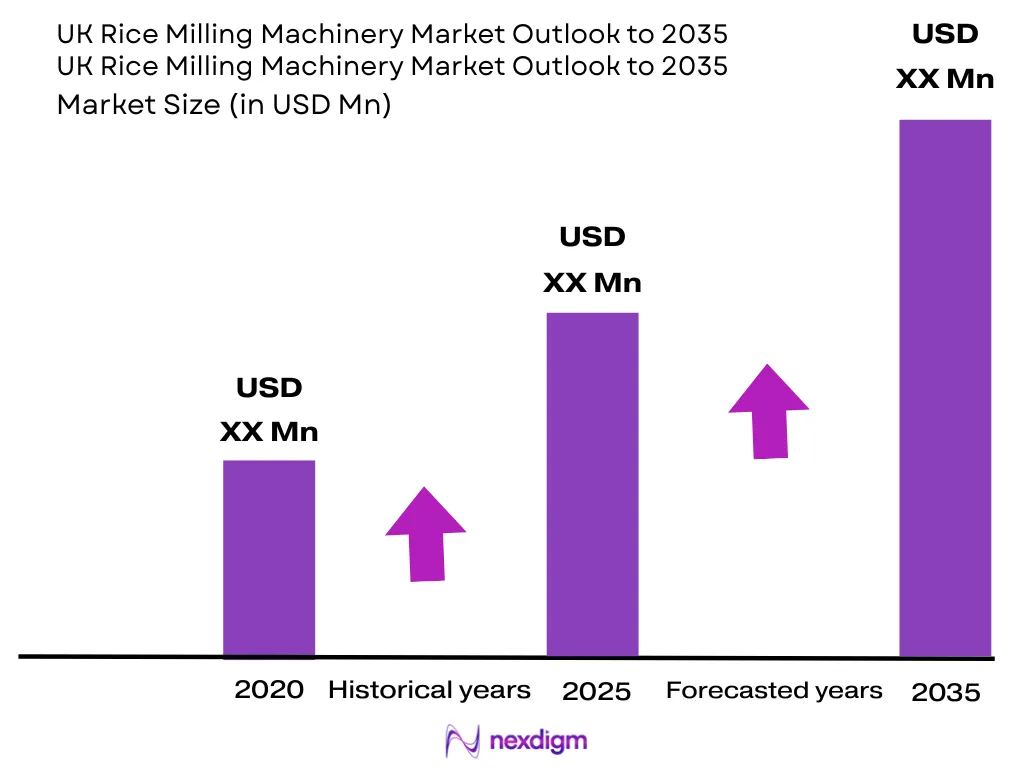
The UK Rice Milling Machinery Market was valued at USD ~ Million in 2024, supported by the country’s position as a major rice importer and processor serving one of Europe’s largest rice-consuming populations. According to data published by the Department for Environment, Food and Rural Affairs (DEFRA) and the UK’s Office for National Statistics (ONS), the United Kingdom imported approximately 500,000 metric tons of rice annually, while domestic rice consumption continued to grow driven by a diverse and multicultural population. Continuous modernization of milling and processing infrastructure, growing demand for high-quality polished and parboiled rice, increasing adoption of automated processing systems, and investments in reducing post-milling losses are key factors driving equipment demand.
Market Segmentation
By Machinery Type
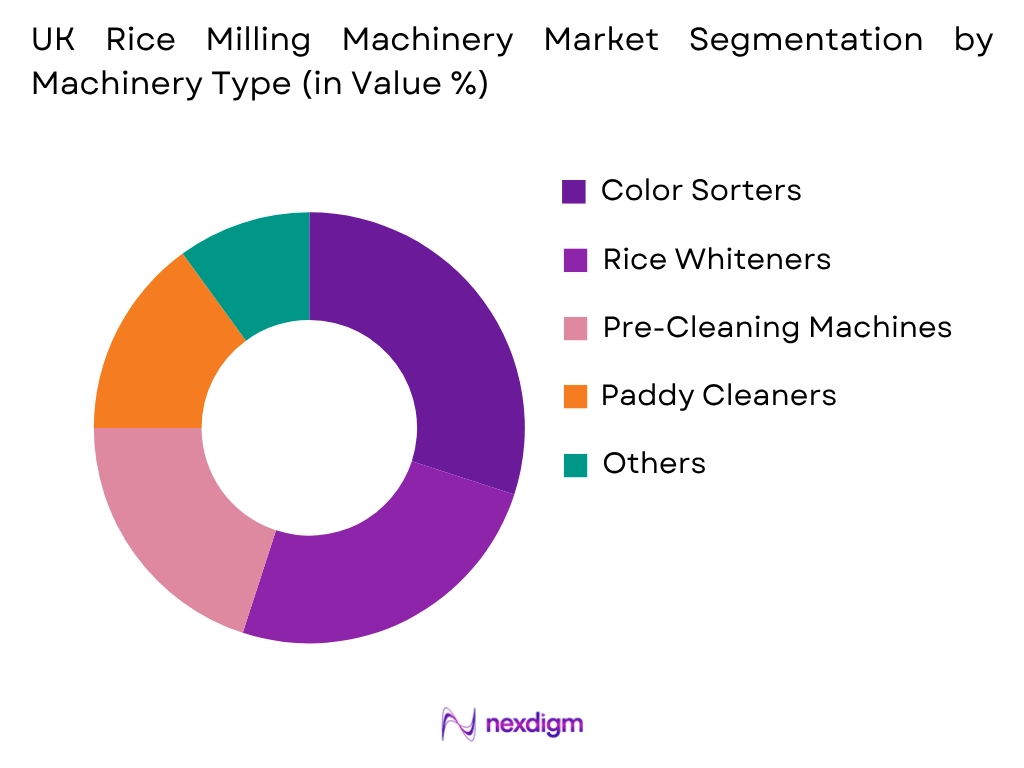
UK Rice Milling Machinery Market is segmented by machinery type into Pre-Cleaning Machines, Paddy Cleaners, Destoners, Rubber Roll Huskers, Paddy Separators, Rice Whiteners, Rice Polishers, Color Sorters, Rice Graders, Length Graders, Packaging Systems, and Complete Rice Milling Plants. Recently, Color Sorters and Rice Whiteners hold the dominant market share within this segmentation due to their indispensable role in achieving the high-quality standards demanded by UK retailers and food manufacturers. UK rice processors increasingly focus on maximizing head rice recovery, improving grain appearance, and meeting stringent retail and food safety specifications. The expansion of premium and specialty rice consumption, including basmati, jasmine, and wholegrain varieties, and the growing preference for consistently high-quality rice products have encouraged millers to upgrade sorting and whitening lines. Furthermore, replacement demand from aging equipment and increasing installation of integrated milling facilities have reinforced the dominance of these equipment categories. Their direct influence on final product quality, operational efficiency, and profitability makes them critical investments for both medium-scale and large-scale rice processing facilities operating in the UK market.
By Automation Level
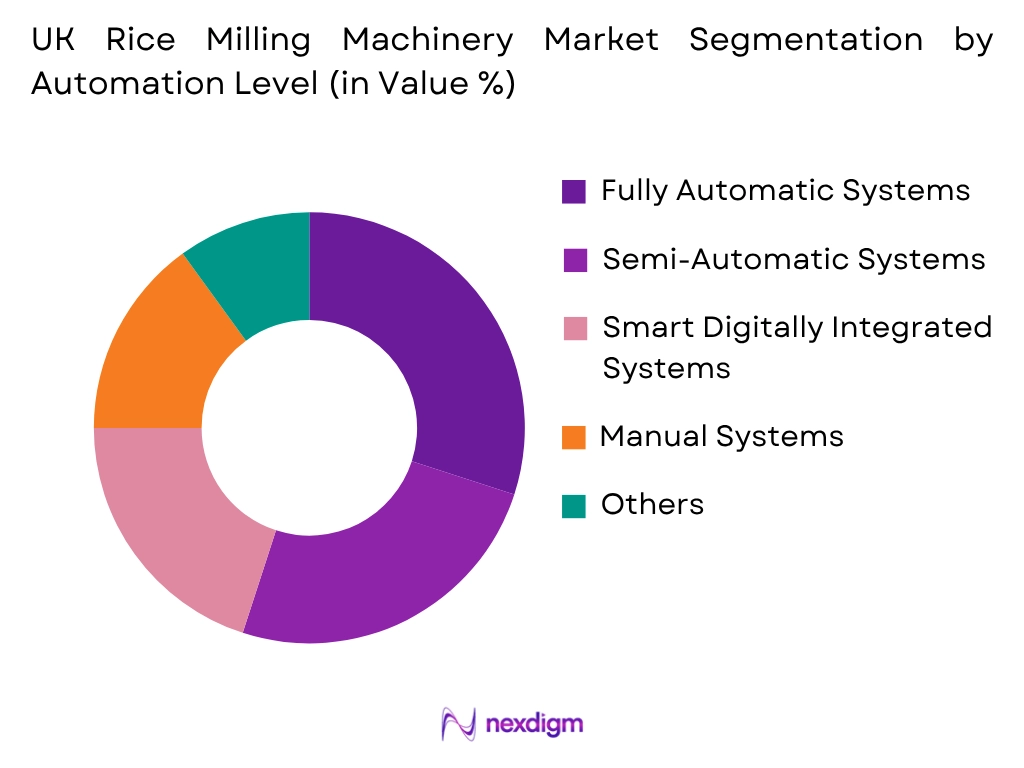
UK Rice Milling Machinery Market is segmented by automation level into Manual Systems, Semi-Automatic Systems, Fully Automatic Systems, and Smart Digitally Integrated Systems. Currently, Fully Automatic Systems dominate the market owing to their ability to enhance processing efficiency, reduce labor dependency, improve grain recovery rates, and ensure consistent product quality. The UK’s larger rice processing enterprises are increasingly investing in automated milling lines to optimize throughput and reduce operational costs, particularly given high domestic labor costs. Automated systems also facilitate real-time monitoring, quality control, and predictive maintenance capabilities. As labor costs continue to rise and major retail customer demands for food safety traceability intensify, automated solutions provide a significant competitive advantage. Additionally, export-oriented and retailer-facing mills prioritize automation to maintain quality standards aligned with British Retail Consortium (BRC) and International Food Standard (IFS) certifications, further strengthening the segment’s leadership position within the UK rice milling machinery industry.
Competitive Landscape
The UK Rice Milling Machinery Market is characterized by the presence of global technology leaders and specialized European and domestic manufacturers serving the country’s import-driven rice processing industry. International companies such as Bühler Group and Satake Corporation maintain strong positions through advanced milling technologies, while UK-based manufacturers such as Alvan Blanch Group cater to local operational requirements and after-sales support needs. Competition is primarily driven by equipment efficiency, rice recovery performance, automation capabilities, service network strength, and turnkey plant installation expertise.
| Company | Establishment Year | Headquarters | Rice Milling Portfolio | Automation Capability
|
Color Sorting Technology | Service Network | Turnkey Plant Solutions | Processing Capacity Range |
| Bühler Group | 1860 | ~ | ~ | ~ | ~ | ~ | ~ | ~ |
| Satake Corporation | 1896 | ~ | ~ | ~ | ~ | ~ | ~ | ~ |
| AGCO Corporation | 1990 | ~ | ~ | ~ | ~ | ~ | ~ | ~ |
| Alvan Blanch Group | 1952 | ~ | ~ | ~ | ~ | ~ | ~ | ~ |
| Milltec Machinery | 1998 | ~ | ~ | ~ | ~ | ~ | ~ | ~ |

UK Rice Milling Machinery Market Analysis
Growth Drivers
Rising Rice Import Volumes and Expansion of Commercial Rice Processing Infrastructure
The UK rice milling machinery market is strongly supported by the scale of domestic rice processing activity and the concentration of industrial facilities serving major urban and retail distribution networks. According to the Department for Environment, Food and Rural Affairs (DEFRA), the United Kingdom imports approximately 500,000 metric tons of rice annually, sourced primarily from India, Pakistan, Thailand, and Vietnam. The UK’s diverse and multicultural population, particularly concentrated in Greater London, the West Midlands, and other major metropolitan areas, drives sustained demand for a wide range of rice varieties including basmati, long-grain, jasmine, and parboiled types. Major rice processing and packaging facilities are located across England and Scotland, with several large-scale operations serving national supermarket supply chains and ethnic food distributors. The increasing flow of imported paddy and semi-milled rice through commercial processing facilities creates sustained demand for huskers, polishers, graders, color sorters, and packaging systems. Higher processing volumes and stricter retail quality requirements drive investment in higher-capacity equipment capable of improving throughput, reducing grain losses, and enhancing head-rice recovery rates, thereby driving replacement and modernization investments across the UK rice milling ecosystem.
Growing Consumer Demand for Premium and Specialty Rice Products
The modernization of the UK’s rice processing sector continues to be stimulated by shifting consumer preferences and increasing demand for premium, specialty, and health-oriented rice products. According to the Office for National Statistics (ONS), the United Kingdom’s population exceeds 67 million, with a significant and growing proportion of consumers regularly purchasing rice as a dietary staple. The UK grocery market, valued at over GBP 200 billion according to industry research, reflects strong retail demand for branded and premium rice products including organic, wholegrain, pre-cooked, and specialty varieties. UK rice processors and packagers are under increasing pressure from major retail chains including Tesco, Sainsbury’s, ASDA, and Waitrose to meet strict food safety, traceability, and quality standards. Modern milling equipment such as optical color sorters, automated whitening systems, and integrated packaging lines helps processors consistently meet British Retail Consortium (BRC) Global Standards and other certification requirements. Furthermore, the growing popularity of ethnic cuisines and the expansion of the food service sector continue to stimulate demand for a wider range of processed rice products. The combination of rising consumer expectations, retailer quality mandates, and increasing market sophistication is creating sustained demand for advanced rice milling and processing equipment throughout the United Kingdom.
Market Challenges
Post-Brexit Trade Adjustments and Import Dependency on Foreign Rice and Components
A significant challenge facing the UK rice milling machinery market is the combined impact of post-Brexit trade adjustments and deep reliance on imported raw materials and machinery components. The United Kingdom does not produce rice domestically at commercial scale and is entirely dependent on imports from Asia and other producing regions for its rice supply. The reconfiguration of UK trade relationships following the departure from the European Union has introduced new customs procedures, documentation requirements, and in some cases higher import costs for machinery components and spare parts previously sourced from EU-based suppliers. The International Monetary Fund has noted that the UK economy continues to navigate structural trade adjustments that affect supply chain planning and import cost management. Advanced color sorters, sensors, programmable logic controllers (PLCs), and precision grading equipment sourced from Japan, Germany, Switzerland, and China require careful procurement planning and longer lead times. This dependency is particularly challenging for smaller rice processing operations with limited procurement infrastructure. Rising global shipping costs and port congestion have further strained supply chains for both raw rice imports and capital equipment. Since modern rice mills increasingly rely on digital automation and precision processing technologies, managing import dependency while maintaining operational continuity represents a persistent structural challenge for the UK rice processing industry.
High Operating Costs and Energy Price Pressures Affecting Processing Economics
Elevated operating costs represent a major challenge for UK rice milling machinery operators, particularly in the context of persistently high energy prices and labor costs. The United Kingdom experienced significant industrial energy price increases in recent years, driven by global natural gas market disruptions and broader inflationary pressures. Rice milling operations are energy-intensive, with husking, whitening, polishing, and drying processes requiring substantial electricity and heat inputs. High energy costs directly compress processor margins and reduce the financial capacity to fund capital equipment upgrades. According to the Office for National Statistics, UK producer input prices and labor costs have risen sharply, adding further pressure on processing economics. Smaller and mid-sized rice processors operating in competitive retail supply chains face particular difficulties absorbing these cost increases while maintaining price competitiveness. Investment decisions regarding new milling equipment or processing line upgrades are increasingly subject to detailed energy efficiency analysis and return-on-investment scrutiny. While energy-efficient milling technologies present a potential offset, the initial capital requirements for advanced equipment can be prohibitive for smaller operators. These combined cost pressures create a challenging environment for sustained machinery investment and modernization across the UK rice milling sector.
Market Opportunities
Increasing Adoption of Automated Sorting, Grading, and Smart Milling Technologies
The UK rice processing industry presents significant opportunities for suppliers of advanced automation solutions. With national rice import and processing volumes approaching 500,000 metric tons annually and large-scale commercial processing concentrated in England, mill operators are increasingly investing in technologies that improve efficiency and product quality. Automated color sorters, optical inspection systems, digital process controls, and real-time monitoring platforms enable mills to reduce labor dependency while improving head-rice recovery and quality consistency. The United Kingdom’s broader digital transformation across food manufacturing and supply chain sectors supports greater acceptance of Industry 4.0 technologies. As processing facilities seek to meet stricter food safety requirements under the Food Standards Agency (FSA) framework and align with British Retail Consortium (BRC) certification demands, appetite for intelligent milling systems continues to rise. Large commercial mills supplying major supermarket chains are particularly focused on integrating sensors, predictive maintenance tools, automated packaging systems, and full traceability solutions into their operations. The growing emphasis on operational efficiency, food safety compliance, and supply chain transparency creates substantial opportunities for machinery manufacturers offering connected, data-driven processing solutions. Since many existing facilities still operate with partially automated equipment, the modernization of installed processing capacity represents a significant long-term opportunity for technology providers serving the UK rice processing industry.
Expansion of Ethnic Food Processing and Premium Retail-Oriented Milling Facilities
The continued growth of ethnic food processing and premium retail-oriented milling operations creates strong opportunities for rice milling machinery suppliers in the United Kingdom. The UK’s large and growing South Asian, East Asian, and African-Caribbean communities drive sustained demand for a diverse range of rice varieties, creating a specialized processing environment that requires versatile and precision equipment. The ethnic foods market in the UK is estimated at several billion pounds annually, with rice products representing a substantial category across retail, food service, and wholesale channels. Processors catering to basmati, jasmine, parboiled, and specialty rice segments require sophisticated equipment such as precision graders, high-capacity polishers, optical color sorting systems, and automated packaging solutions capable of meeting demanding quality specifications. Furthermore, rising interest in health-oriented rice products including wholegrain, low-GI, and organic varieties encourages investments in differentiated processing capabilities. UK government support for food manufacturing productivity, innovation grants through Innovate UK, and financing mechanisms available through the British Business Bank further strengthen the investment environment for processing modernization. As processors seek to serve an increasingly diverse and quality-conscious consumer base, demand for technologically advanced milling equipment is expected to grow across established and emerging rice-processing operations throughout the United Kingdom.
Future Outlook
The UK Rice Milling Machinery Market is expected to witness sustained growth over the forecast period, supported by increasing investments in rice processing modernization, rising demand for premium and specialty rice products, and greater adoption of automation technologies. Growing focus on maximizing head rice recovery and meeting stringent retail food safety standards will continue to encourage machinery upgrades across commercial mills. Furthermore, digitalization trends, energy-efficient milling systems, and integrated processing solutions are anticipated to reshape industry operations. Government support for food manufacturing productivity, innovation investment, and export competitiveness is also expected to contribute to long-term market expansion.
Major Players
- Satake Corporation
- Bühler Group
- AGCO Corporation
- Alvan Blanch Group
- Milltech Machinery
- Carotino UK
- GrainTec UK
- Skiold Group
- Zhengzhou VOS Machinery
- Hunan Chenzhou Grain & Oil Machinery
- Wuhan Anon Tech
- Alapala Machine Industry
- AKY Technology
- CIMBRIA Group
- Mepu Oy
Key Target Audience
- Rice Milling Plant Owners and Operators
- Agricultural Equipment Manufacturers
- Grain Processing Equipment Distributors
- Rice Processing Cooperatives
- Food Processing and Packaging Companies
- Investments and Venture Capitalist Firms
- Government and Regulatory Bodies (DEFRA – Department for Environment, Food and Rural Affairs, FSA – Food Standards Agency, HSE – Health and Safety Executive, Environment Agency, Innovate UK)
- Agricultural Infrastructure and Industrial Development Companies
Research Methodology
Step 1: Identification of Key Variables
The initial phase involves constructing a comprehensive ecosystem map covering rice importers, rice mill operators, equipment manufacturers, distributors, technology providers, and regulatory authorities within the UK Rice Milling Machinery Market. Extensive secondary research is conducted using industry databases, trade publications, company reports, and government statistics to identify the critical variables influencing market performance.
Step 2: Market Analysis and Construction
Historical industry data is compiled and analyzed to evaluate machinery installations, equipment replacement cycles, milling capacity additions, and revenue generation across major regions. Market sizing is developed through both demand-side and supply-side assessments, enabling a robust understanding of industry dynamics and competitive positioning.
Step 3: Hypothesis Validation and Expert Consultation
Market assumptions and preliminary findings are validated through computer-assisted telephone interviews (CATIs) and consultations with rice mill operators, machinery manufacturers, distributors, and industry experts. These interactions provide operational insights, purchasing behavior trends, technology adoption patterns, and future investment perspectives.
Step 4: Research Synthesis and Final Output
The final phase involves triangulating data obtained from primary interviews, secondary sources, and proprietary databases. Information regarding product segments, machinery demand, regional consumption patterns, and competitive developments is consolidated to produce a comprehensive and validated assessment of the UK Rice Milling Machinery Market.

- Executive Summary
- Research Methodology (Market Definitions and Assumptions, Abbreviations, Market Sizing Approach, Top-Down Analysis, Bottom-Up Analysis, Demand-Side Assessment, Supply-Side Assessment, Primary Industry Interviews with Rice Millers and Equipment Manufacturers, Trade Data Analysis, Data Triangulation, Forecasting Framework, Limitations and Future Conclusions)

- Definition and Scope
- Market Evolution and Industry Genesis
- Timeline of Major Industry Developments in Rice Processing Industry
- UK Rice Production and Processing Ecosystem
- Rice Milling Industry Value Chain Analysis

- Growth Drivers (Rising Imported Rice Processing Volumes, Expansion of Commercial Rice Mills, Growing Demand for Premium Rice Quality, Increasing Processing Efficiency Requirements, Adoption of Automated Milling Technologies)
- Market Challenges (High Capital Investment Requirements, Dependence on Imported Rice and Components, Post-Brexit Trade Adjustments, Limited Domestic Rice Production, Skilled Technician Shortages)
- Market Opportunities (Color Sorting Expansion, Smart Mill Automation, Energy-Efficient Milling Solutions, Rice Bran Value Recovery Systems, Integrated Turnkey Milling Plants)
- Market Trends (IoT-Enabled Milling Equipment, Optical Sorting Adoption, High Yield Milling Systems, Low Broken Rice Technologies, Digital Monitoring Platforms)
- Government Regulations (FSA Food Safety Standards, DEFRA Agricultural Compliance, HSE Industrial Safety Requirements, Environment Agency Standards, Energy Efficiency Regulations)
- SWOT Analysis
- Porter’s Five Forces Analysis
- PESTLE Analysis
- Stakeholder Ecosystem
- Competition Ecosystem
- Rice Milling Cluster Analysis
- Rice Processing Infrastructure Assessment
- Machinery Localization and Manufacturing Assessment

- By Market Value (2020-2025)
- By Units Installed (2020-2025)
- By Average Selling Price (2020-2025)

- By Machinery Type (In Value %)
Pre-Cleaning Machines
Paddy Cleaners
Destoners
Rubber Roll Huskers
Paddy Separators
Rice Whitener Machines
Rice Polishers
Rice Graders
Color Sorters
Length Graders
Packaging and Bagging Systems
Complete Rice Milling Plants - By Milling Capacity (In Value %)
Less than 2 Tons/Hour
2–5 Tons/Hour
5–10 Tons/Hour
10–20 Tons/Hour
Above 20 Tons/Hour - By Automation Level (In Value %)
Manual Systems
Semi-Automatic Systems
Fully Automatic Systems
Smart and Digitally Integrated Systems - By Rice Processing Stage (In Value %)
Pre-Processing Equipment
Husking Equipment
Whitening Equipment
Polishing Equipment
Sorting and Grading Equipment
Packaging Equipment - By End User (In Value %)
Small-Scale Rice Mills
Medium-Scale Rice Mills
Large Commercial Rice Mills
Rice Processing Cooperatives
Integrated Rice Processing Companies - By Region (In Value %)
England
Scotland
Wales
Northern Ireland
Greater London and South East
Other Regions

- Market Share of Major Players (By Value, Units Sold, Installed Base, Product Category, Milling Capacity Segment)
- Cross Comparison Parameters
- (Rice Milling Capacity Range, Head Rice Recovery Performance, Energy Consumption per Ton Processed, Automation and Digital Integration Capability, Color Sorting Accuracy, After-Sales Service Network Strength, Spare Parts Availability and Lead Time, Turnkey Plant Installation Expertise)
- SWOT Analysis of Major Players
- Pricing Analysis by Equipment Category and Capacity
- Distributor and Dealer Network Assessment
- Detailed Profiles of Major Companies
Satake Corporation
Bühler Group
AGCO Corporation
Alvan Blanch Group
Milltech Machinery
Carotino UK
GrainTec UK
Skiold Group
Zhengzhou VOS Machinery
Hunan Chenzhou Grain & Oil Machinery
Wuhan Anon Tech
Alapala Machine Industry
AKY Technology
CIMBRIA Group
Mepu Oy

- Milling Capacity Utilization Assessment (Plant Throughput, Downtime, Processing Efficiency, Recovery Rates, Operational Hours)
- Investment and Procurement Analysis (Capex Allocation, Equipment Replacement Cycles, Financing Patterns, Vendor Selection Criteria)
- Rice Recovery and Yield Optimization Assessment (Head Rice Yield, Broken Rice Ratio, Bran Recovery, Milling Losses, Product Quality Consistency)
- Operational Pain Point Analysis (Maintenance Costs, Labor Dependency, Energy Consumption, Spare Parts Availability, Machine Downtime)
- Technology Adoption Assessment (Automation Penetration, Smart Controls Usage, Sensor Integration, Data Monitoring, Predictive Maintenance Adoption)

- By Market Value (2026-2035)
- By Units Installed (2026-2035)
- By Average Selling Price (2026-2035)


 Request a Sample
 Ask for Customization
 Get a Quote
 Enquire Now