
 Download PDF
Market Overview
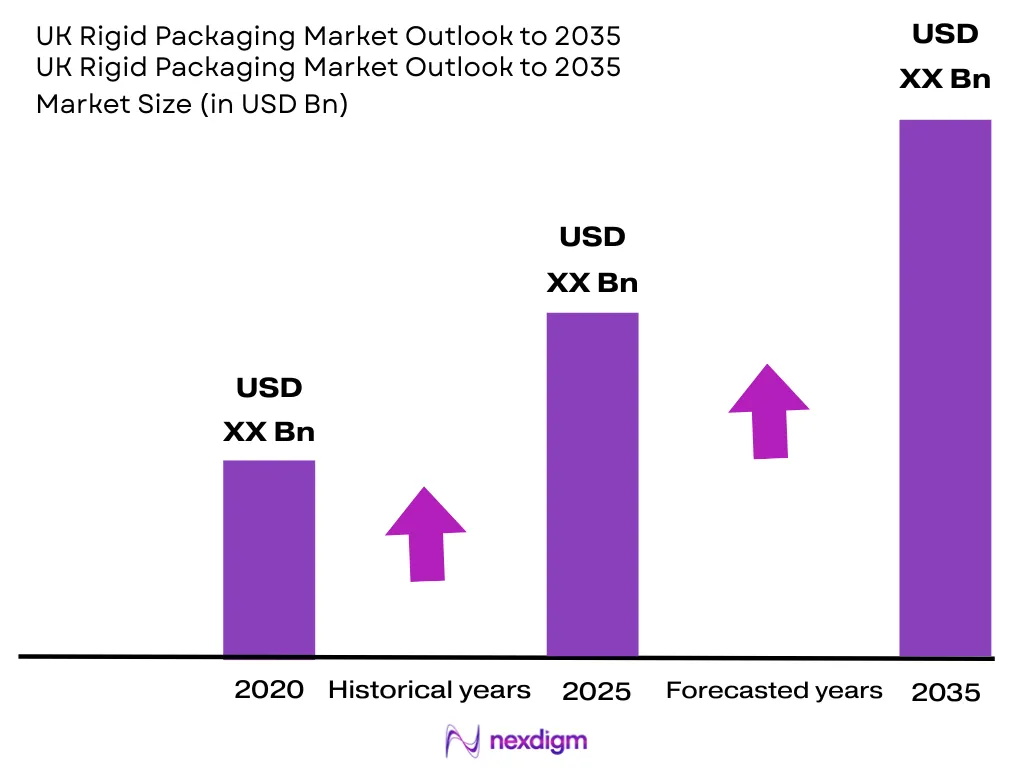
The UK Rigid Packaging Market was valued at USD ~ Billion in 2024 and is anticipated to expand at a CAGR of ~% during 2026-2035. The market is primarily driven by rising demand from the convenience food, ready-meal, and pharmaceutical sectors, alongside a sustained regulatory push toward recycled content and sustainable rigid packaging formats. According to industry estimates, rigid plastics represented the largest revenue-generating material segment within the UK packaging materials market in 2024, holding approximately 30.77% share, with the UK accounting for approximately 3.8% of the global packaging materials market and positioned as the fastest-growing regional packaging market in Europe. The UK’s rigid plastic packaging segment specifically is projected to grow at a CAGR of approximately 3.04% between 2025 and 2033, while the UK Plastic Packaging Tax, which imposes a levy of GBP 200 per tonne on plastic packaging containing less than 30% recycled content, continues to accelerate the shift toward post-consumer recycled resin and mono-material rigid packaging design across the food, beverage, and pharmaceutical sectors.
Market Segmentation
By Material
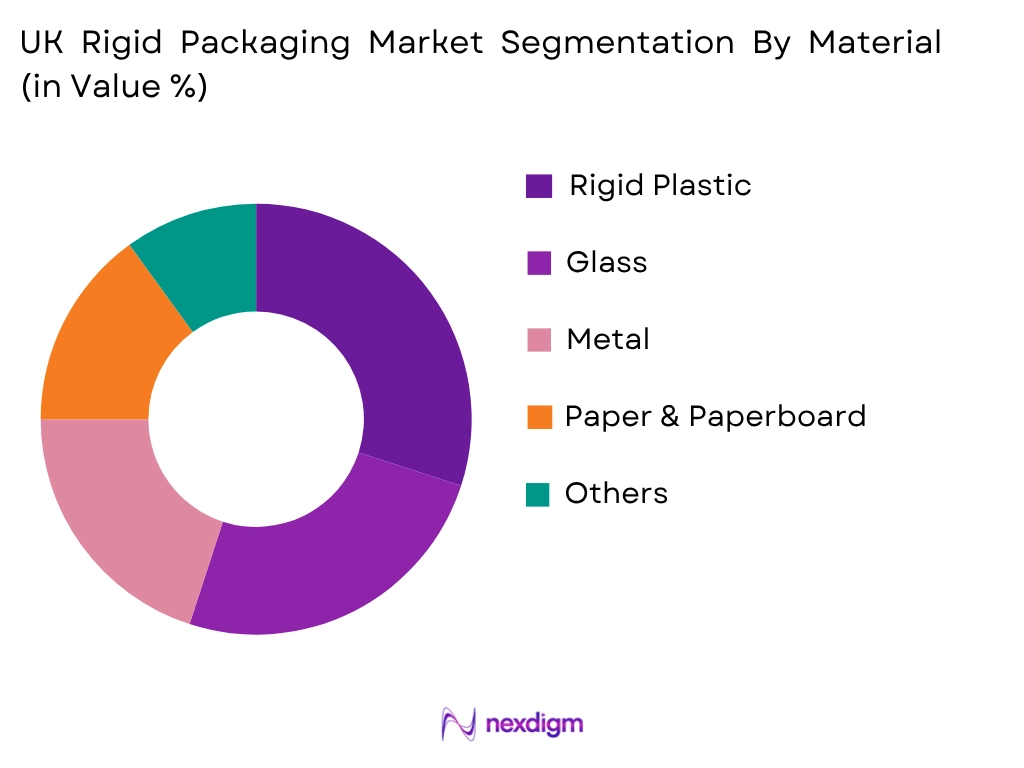
Among these, Rigid Plastic continues to hold the largest share of the UK Rigid Packaging Market, supported by its lightweight properties, cost-effectiveness, and versatility across bottles, jars, trays, and containers. Within the broader UK plastic packaging market, polyethylene held approximately 38.74% of 2025 revenue due to its versatility across films and rigid containers, while polyethylene terephthalate (PET) is forecast to post the fastest growth at approximately 3.41% CAGR, driven by its widespread use in beverage bottles and its relatively high recyclability that aligns with Plastic Packaging Tax incentives. Glass and Metal retain strong relevance in premium beverage, spirits, and preserved food categories due to their perceived quality and infinite recyclability, with Beatson Clark, a long-established UK glass container manufacturer, continuing to serve pharmaceutical and premium food and beverage brands. Paper & Paperboard continues to gain share in select rigid applications as brand owners seek curbside-recyclable alternatives, though rigid plastic’s superior barrier performance and cost efficiency continue to support its dominant position across the majority of rigid packaging applications.
By Application
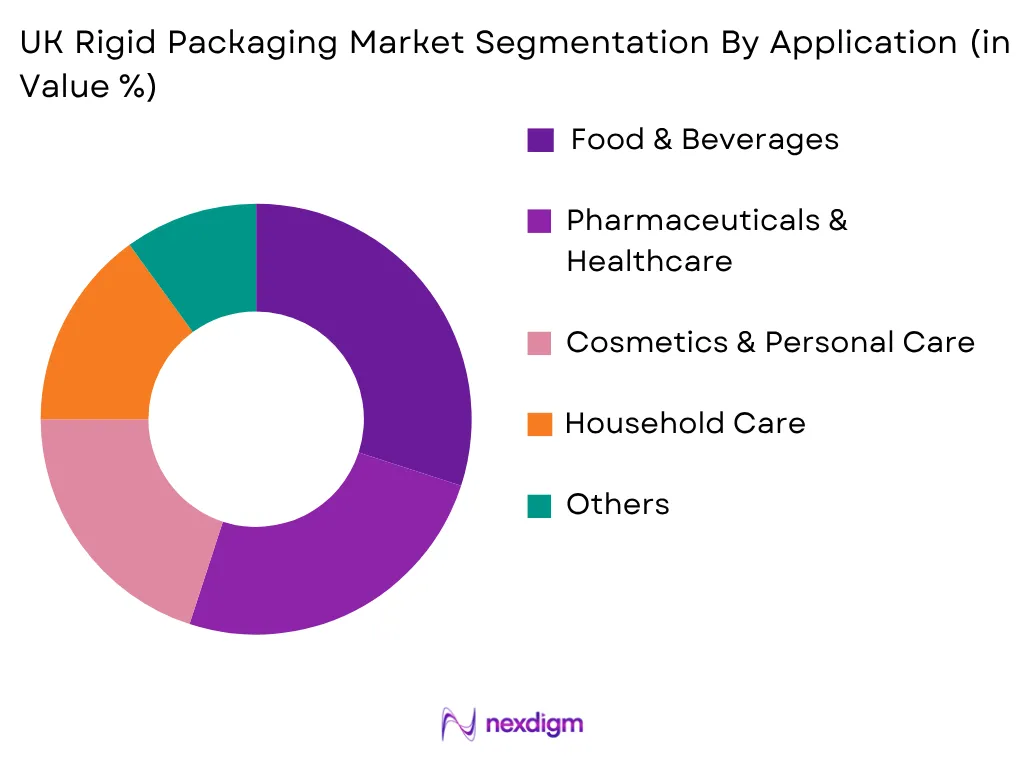
The Food & Beverage segment holds a leading share owing to extensive use of rigid packaging for shelf-life extension, portion control, and brand differentiation across dairy, bakery, and ready-meal categories, with rigid packaging remaining the dominant product type in the broader UK packaging market despite growing e-commerce-driven demand for flexible formats. Healthcare & Pharmaceuticals represents a significant and growing application area, with Glasgow and Edinburgh conversion facilities specializing in pharmaceutical-grade barrier packaging and healthcare serialization to meet stringent regulatory traceability requirements. Cosmetics & Personal Care continues to expand as premiumization trends drive demand for distinctive rigid containers and closures, while Household Care and Industrial applications maintain steady demand supported by England’s Midlands manufacturing corridor, which continues to concentrate rigid plastic production and serve automotive and industrial sectors requiring durable transit packaging and protective containers.
Competitive Landscape
The UK Rigid Packaging Market is moderately consolidated, dominated by large multinational packaging manufacturers with extensive UK production facilities alongside specialized regional converters and heritage glass and closure manufacturers. Competition is primarily based on recyclability credentials, recycled content capability, regulatory compliance, application-specific technical support, pricing, and innovation in sustainable material design. Berry Global, which incorporates the heritage of RPC Group following its 2019 acquisition, maintains an extensive UK rigid plastic manufacturing footprint, while Amcor, ALPLA, and Guala Closures continue to serve the UK’s food, beverage, and pharmaceutical sectors through established local production facilities. Beatson Clark, a long-established UK glass container manufacturer, continues to serve premium and pharmaceutical customers from its Rotherham facility. Companies are increasingly investing in post-consumer recycled content, mono-material design, and pharmaceutical serialization capabilities to meet both regulatory obligations under the Plastic Packaging Tax and EPR scheme, as well as growing retailer and consumer demand for sustainable rigid packaging credentials.
| Company | Established | Headquarters | Primary Product Portfolio | Rigid Packaging Portfolio | Manufacturing Presence | Major End-Use Industries | Key Strategic Focus | Certifications & Compliance |
| Berry Global Inc. | 1967 | ~
|
~ | ~ | ~ | ~ | ~ | ~ |
| Amcor plc | 1860 | ~
|
~ | ~ | ~ | ~ | ~ | ~ |
| Beatson Clark Limited | 1751 | ~
|
~ | ~ | ~ | ~ | ~ | ~ |
| ALPLA Werke Alwin Lehner GmbH & Co. KG | 1955 | ~ | ~ | ~ | ~ | ~ | ~ | ~ |
| Guala Closures Group S.p.A. | 1954 | ~
|
~ | ~ | ~ | ~ | ~ | ~ |
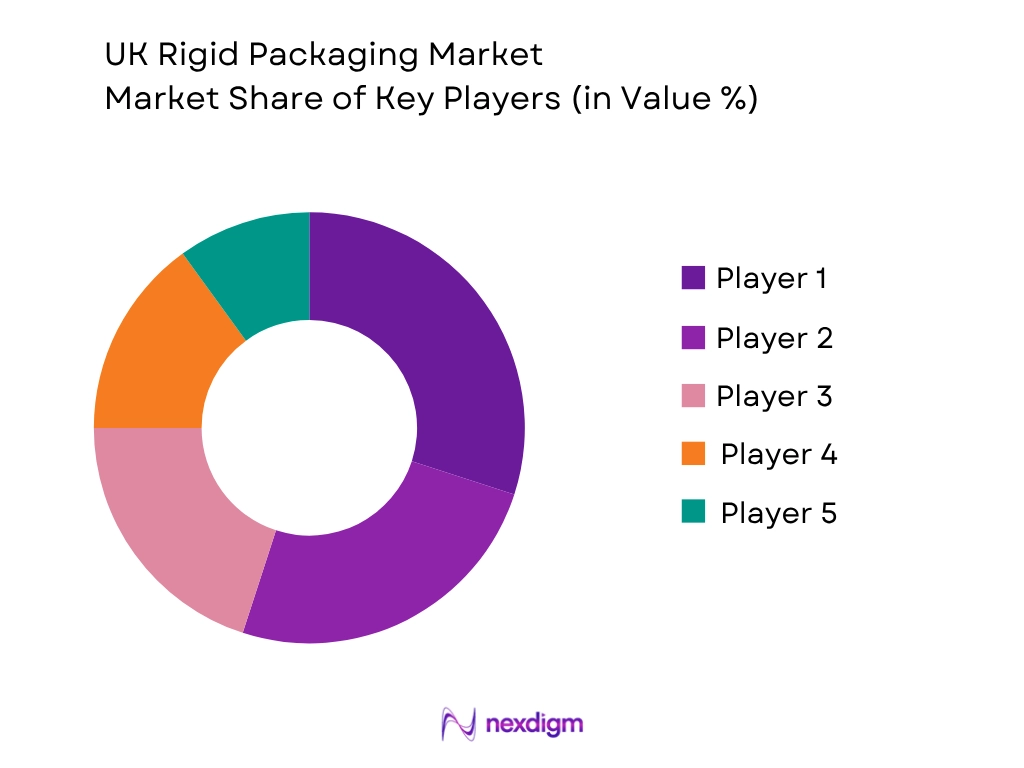
UK Rigid Packaging Market Analysis
Growth Drivers
Regulatory-Driven Shift Toward Recycled Content Under the Plastic Packaging Tax and EPR
The UK Rigid Packaging Market continues to be shaped decisively by the government’s regulatory framework favoring recycled content and sustainable material design. The Plastic Packaging Tax (PPT), introduced in April 2022, imposes a levy of GBP 200 (approximately USD 270.14) per tonne on plastic packaging containing less than 30% recycled content, financially favoring recycled resin and accelerating design shifts toward mono-material rigid packaging solutions. This fiscal mechanism now dominates capital allocation decisions across England’s Midlands manufacturing corridor and Scottish conversion facilities, compressing virgin resin demand while forcing converters to rebuild supply chains around post-consumer feedstock. The UK’s impending Extended Producer Responsibility (EPR) packaging waste regulations mandate higher recycling targets, further driving investment in mono-material rigid packaging lines that simplify mechanical reprocessing and help brand owners meet both compliance requirements and evolving retailer sustainability commitments across the food, beverage, and household care sectors.
Rising Demand from Convenience Food, Ready Meals, and Pharmaceutical Packaging
Rising demand from the UK’s convenience food, ready-meal, and pharmaceutical sectors continues to drive sustained growth in the rigid packaging market. The burgeoning food and beverage sector, particularly within the convenience food and ready-meal segments, consistently demands efficient and cost-effective rigid packaging solutions capable of extending shelf life and maintaining product freshness for time-pressed consumers. Simultaneously, Glasgow and Edinburgh conversion facilities have developed specialized expertise in pharmaceutical-grade barrier films and healthcare packaging serialization, positioning Scotland as a critical hub for compliant pharmaceutical rigid packaging that meets stringent traceability requirements under UK medicines regulations. Rigid packaging remains the dominant product type in the broader UK packaging market and is expected to experience significant growth as consumer preferences and stringent government regulations, including Extended Producer Responsibility requirements, continue to favor eco-friendly and sustainable rigid packaging materials across these expanding end-use categories.
Market Challenges
Competition from Flexible Packaging Formats in E-Commerce and Convenience Applications
The UK Rigid Packaging Market faces increasing competitive pressure from flexible packaging formats, particularly within e-commerce logistics and convenience food applications where flexible formats advance at the expense of rigid options due to lightweight convenience requirements. Food brands in ambient sauces and ready meals are accelerating format switches from glass jars to retortable polyethylene structures, cutting transport emissions and shelf-space costs, directly displacing traditional rigid glass and plastic formats in select categories. The UK Flexible Plastic Packaging Market is expected to reach approximately 1.46 million tonnes in 2025, growing at a CAGR of approximately 3.05% to reach 1.70 million tonnes by 2030, reflecting sustained volume migration toward flexible alternatives. This competitive dynamic requires rigid packaging manufacturers to continuously innovate in lightweighting, cost efficiency, and sustainability credentials to defend market share against increasingly sophisticated flexible packaging alternatives across food, beverage, and household care applications.
Raw Material Price Volatility and Post-Brexit Import Complexity
The UK Rigid Packaging Market remains exposed to significant raw material price volatility for plastic resins, glass cullet, and metal inputs, compounded by post-Brexit trade complexities affecting cross-border sourcing of raw materials and finished packaging components. Material substitution decisions increasingly weigh feedstock volatility, tax incentives, and consumer perception of recycled content, creating planning complexity for manufacturers navigating both cost pressures and regulatory compliance requirements simultaneously. New customs procedures, regulatory checks, and administrative burdens affecting cross-border trade in packaging materials continue to raise compliance workloads and stretch lead times for manufacturers reliant on imported resins, glass cullet, or specialty closures from the European Union. These combined pressures require rigid packaging manufacturers to maintain diversified sourcing strategies and closer domestic supply chain relationships to manage cost volatility and mitigate the operational complexity introduced by post-Brexit trade friction.
Market Opportunities
Growth in Post-Consumer Recycled Content and Mono-Material Rigid Packaging
The UK’s regulatory environment and shifting consumer preferences present substantial opportunities for companies investing in post-consumer recycled content and mono-material rigid packaging innovation. The Plastic Packaging Tax’s financial incentive for packaging containing 30% or more recycled content continues to drive investment in chemical recycling pilots and mono-material barrier designs that simplify mechanical reprocessing while maintaining product protection performance. The UK sustainable packaging market reached approximately USD 10.4 billion in 2025 and is expected to reach approximately USD 19.5 billion by 2034, growing at a CAGR of approximately 6.96%, reflecting sustained investment in recyclable and reduced-material rigid packaging formats. Companies developing high-recycled-content bottles and containers, mono-material closures, and innovative rigid formats capable of meeting both regulatory compliance and retailer sustainability commitments are well positioned to capture growing demand across the food, beverage, and personal care sectors.
Expansion of Pharmaceutical-Grade Barrier Packaging and Serialization Capabilities
The continued expansion of the UK’s pharmaceutical and healthcare sector presents significant opportunities for rigid packaging manufacturers specializing in barrier packaging and serialization capabilities. Glasgow and Edinburgh conversion facilities have already established specialized expertise in pharmaceutical-grade barrier films and healthcare packaging serialization, positioning Scotland as a strategic hub for compliant pharmaceutical rigid packaging capable of meeting stringent traceability requirements under UK medicines regulations. As the UK pharmaceutical manufacturing sector continues to grow and increasingly requires internationally compliant track-and-trace packaging solutions, companies with proven serialization technology and regulatory compliance expertise are well positioned to capture this expanding high-value segment. Continued investment in tamper-evident closures, child-resistant packaging, and serialized barrier containers is expected to support sustained growth in this specialized rigid packaging category through 2035.
Future Outlook
The UK Rigid Packaging Market is expected to witness steady expansion over the forecast period, supported by continued growth in convenience food, ready-meal, and pharmaceutical packaging demand, alongside ongoing regulatory pressure favoring recycled content and sustainable rigid packaging formats. Continued investment in domestic recycling infrastructure, mono-material packaging design, and pharmaceutical serialization capability is expected to further reshape the market’s material composition and competitive dynamics. Growing competition from flexible packaging alternatives will continue to challenge rigid packaging’s market position in select applications, requiring sustained innovation in lightweighting and sustainability credentials to maintain competitiveness through 2035.
Major Players
- Berry Global Inc.
- Amcor plc
- Beatson Clark Limited
- ALPLA Werke Alwin Lehner GmbH & Co. KG
- Guala Closures Group S.p.A.
- Sealed Air Corporation
- Sonoco Products Company
- Mondi Group plc
- Smurfit WestRock plc
- International Paper (DS Smith)
- Crown Holdings, Inc.
- O-I Glass, Inc.
- Nampak Plastics Europe Limited
- Graham Packaging Company, L.P.
- Silgan Holdings Inc.
Key Target Audience
- Rigid Packaging Manufacturers
- Food & Beverage Processing Companies
- Pharmaceutical and Healthcare Companies
- Personal Care and Cosmetics Manufacturers
- Retailers and Supermarket Chains
- Investment and Venture Capitalist Firms
- Government and Regulatory Bodies (Department for Environment, Food & Rural Affairs (DEFRA), Food Standards Agency (FSA), HM Revenue & Customs (HMRC), Medicines and Healthcare products Regulatory Agency (MHRA))
- Recycling and Waste Management Infrastructure Providers
Research Methodology
Step 1: Identification of Key Variables
The research process begins with identifying the complete ecosystem of the UK Rigid Packaging Market, including raw material suppliers, packaging manufacturers, converters, food and pharmaceutical processors, retailers, and regulatory authorities. Extensive secondary research is conducted using company annual reports, government publications, trade associations, customs statistics, industry journals, and proprietary databases to determine the variables influencing market demand, pricing, production, consumption, and technological developments.
Step 2: Market Analysis and Construction
Historical market information is collected and analyzed to estimate market size, import-export activity, application-wise demand, and pricing trends. A combination of top-down and bottom-up approaches is used to estimate market revenues and validate segment-level performance. Consumption patterns across food and beverage, pharmaceuticals, personal care, and household care are evaluated to establish an accurate representation of the industry.
Step 3: Hypothesis Validation and Expert Consultation
The preliminary findings are validated through Computer-Assisted Telephone Interviews (CATIs) and structured discussions with packaging manufacturers, procurement managers, retailers, food technologists, regulatory experts, and senior executives operating within the UK’s rigid packaging industry. These interviews help verify market assumptions, competitive developments, technology adoption trends, pricing dynamics, and future investment opportunities while refining the overall market estimates.
Step 4: Research Synthesis and Final Output
The final stage integrates insights obtained from primary interviews with quantitative information collected through secondary sources. Data triangulation techniques are applied to reconcile differences between supply-side and demand-side estimates, ensuring robust market forecasting. The report is then reviewed through multiple quality assurance checkpoints to deliver a comprehensive analysis covering market size, segmentation, competitive landscape, future outlook, and strategic recommendations for industry stakeholders.

- Executive Summary
- Research Methodology (Market Definitions and Assumptions, Abbreviations, Market Sizing Approach, Top-Down Analysis, Bottom-Up Analysis, Demand-Side Assessment, Supply-Side Assessment, Primary Industry Interviews, Secondary Research Validation, Data Triangulation, Forecasting Framework, Limitations and Future Conclusions)

- Definition and Scope
- Market Evolution and Industry Genesis
- Timeline of Major Industry Developments
- Rigid Packaging Industry Value Chain Analysis
- Supply Chain Analysis

- Growth Drivers (Regulatory-Driven Shift Toward Recycled Content, Rising Demand from Convenience Food and Ready Meals, Expansion of Pharmaceutical-Grade Packaging, Growth in Personal Care and Cosmetics Demand, Lightweighting and Automation Investment, Premiumization of Beverage and Spirits Packaging)
- Market Challenges (Competition from Flexible Packaging Formats, Raw Material Price Volatility, Post-Brexit Import and Trade Complexity, Rising Compliance Costs Under the Plastic Packaging Tax, Limited Recycling Infrastructure for Multi-Layer Materials, High Energy Costs for Domestic Manufacturing)
- Market Opportunities (Growth in Post-Consumer Recycled Content and Mono-Material Design, Expansion of Pharmaceutical-Grade Barrier Packaging and Serialization, Investment in Chemical and Mechanical Recycling Capacity, Premium and Direct-to-Consumer Packaging Growth, Reusable and Refillable Packaging Systems, Smart and Connected Packaging Adoption)
- Market Trends (Shift Toward Post-Consumer Recycled Resin, Growth in Mono-Material Rigid Formats, Concentration of Manufacturing in the Midlands Corridor, Rise of Pharmaceutical Serialization Packaging, Lightweighting of Rigid Formats, Premiumization of Brand Packaging Design)
- Government Regulations (UK Plastic Packaging Tax (PPT), Extended Producer Responsibility (EPR) for Packaging, Food Standards Agency (FSA) Food Contact Requirements, Retained EU Food Contact Material Regulations, Medicines and Healthcare products Regulatory Agency (MHRA) Serialization Requirements, DEFRA Resources and Waste Strategy)
- Import and Export Analysis (Trade Volume, Major Import Sources, Export Destinations, HS Code Analysis, Trade Balance)
- Raw Material Availability Analysis (Virgin and Recycled Polymers, Glass Cullet, Aluminium and Steel, Kraft Paperboard, Bio-Based Feedstocks)
- Technology Landscape (Injection and Blow Molding Technologies, Thermoforming Technologies, Mono-Material Design Technologies, Chemical Recycling Processes, Serialization and Track-and-Trace Systems)
- Sustainability Assessment (Post-Consumer Recycled Content Adoption, Recyclability and Curbside Collection Compatibility, Carbon Footprint Reduction, Circular Economy Integration, Reusable and Refillable Packaging Development)
- PESTLE Analysis
- SWOT Analysis
- Porter’s Five Forces Analysis
- Stakeholder Ecosystem
- Competition Ecosystem

- By Market Value (2020-2025)
- By Volume Consumption (2020-2025)
- By Average Selling Price (2020-2025)

- By Material (In Value %)
Rigid Plastic
Glass
Metal
Paper & Paperboard
Others - By Product Type (In Value %)
Bottles & Jars
Trays & Containers
Cans
Caps & Closures
Tubs & Cups - By Production Process (In Value %)
Injection Molding
Blow Molding
Thermoforming
Extrusion
Others - By Application (In Value %)
Food & Beverage
Healthcare & Pharmaceuticals
Cosmetics & Personal Care
Household Care
Industrial - By Region (In Value %)
England
Scotland
Wales
Northern Ireland

- Market Share of Major Players (By Value, Volume, Material Type, Application Industry, Product Type)
- Cross Comparison Parameters (Recyclable Portfolio Breadth, Recycled Content Capability, Manufacturing Capacity, Application Technical Support Capability, Regulatory Compliance & Certifications, Food & Pharmaceutical Customer Base, Innovation & New Product Launch Frequency, Post-Consumer Recycling Infrastructure)
- SWOT Analysis of Major Players
- Pricing Analysis by Material Category and Format
- Production Capacity Analysis
- Manufacturing Footprint Analysis
- Distribution Network Analysis
- Innovation Benchmarking
- Detailed Profiles of Major Companies
Berry Global Inc.
Amcor plc
Beatson Clark Limited
ALPLA Werke Alwin Lehner GmbH & Co. KG
Guala Closures Group S.p.A.
Sealed Air Corporation
Sonoco Products Company
Mondi Group plc
Smurfit WestRock plc
International Paper (DS Smith)
Crown Holdings, Inc.
O-I Glass, Inc.
Nampak Plastics Europe Limited
Graham Packaging Company, L.P.
Silgan Holdings Inc.

- Consumption Pattern Analysis (Industrial Usage, Order Volume, Product Category Penetration, Seasonal Demand, Reformulation Activity)
- Purchasing Criteria (Recyclability, Regulatory Compliance, Cost Efficiency, Shelf-Life Performance, Barrier Properties, Brand Presentation)
- Procurement and Supplier Selection Analysis
- Sustainable Packaging Adoption Assessment
- Premium vs Conventional Packaging Demand
- Product Attribute Preference Analysis (Recycled Content Percentage, Barrier Performance, Resealability, Shelf Appeal, Material Origin, Curbside Recyclability)
- Consumer Sustainability and Convenience Expectations
- Pain Point Analysis
- Decision-Making Process

- By Market Value (2026-2035)
- By Volume Consumption (2026-2035)
- By Average Selling Price (2026-2035)


 Request a Sample
 Ask for Customization
 Get a Quote
 Enquire Now