

 Download PDF
Market Overview
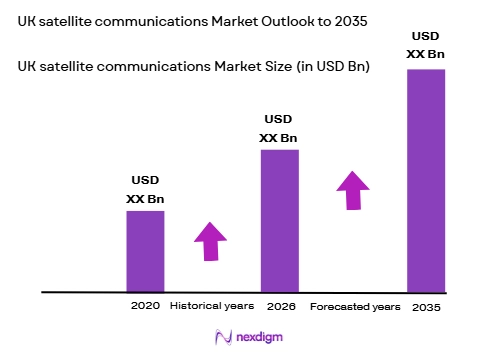
The UK satellite communications market, based on a recent historical assessment, is valued at approximately USD ~ billion, driven by the growing demand for high-speed internet, mobile services, and connectivity in remote areas. The increasing adoption of satellite technology for IoT, telemedicine, and emergency communications has further contributed to market growth. Moreover, government and private sector investments in satellite infrastructure are propelling innovation, especially in low Earth orbit (LEO) satellite deployment and 5G integration, enhancing connectivity services across the country.
Key cities like London, Edinburgh, and Glasgow dominate the UK satellite communications market, primarily due to their strong technological infrastructure and high demand for satellite services. London, as a global technology hub, hosts numerous satellite service providers and research institutions, fostering an environment conducive to innovation. Additionally, these cities benefit from the UK’s strategic policies in space exploration and communication systems, providing further opportunities for growth and positioning the country as a leader in satellite communications within Europe.
Market Segmentation
By Product Type
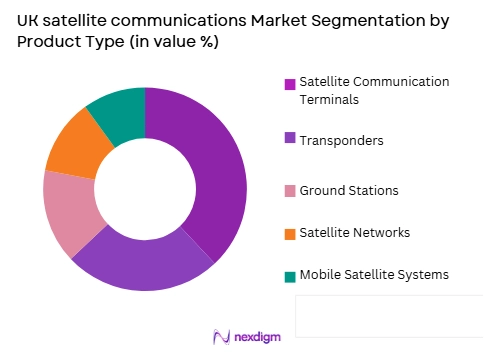
The UK satellite communications market is segmented by product type into satellite communication terminals, transponders, ground stations, satellite networks, and mobile satellite systems. Satellite communication terminals have the largest market share, driven by the increasing demand for reliable and efficient satellite communication systems for both government and commercial applications. These terminals are crucial for satellite data transmission, especially in remote and rural areas, making them a dominant player in the UK market. The expansion of satellite-based mobile services and IoT applications has significantly driven the adoption of terminals, as they support real-time communication, offering seamless connectivity in locations beyond the reach of traditional network infrastructure.
By Platform Type
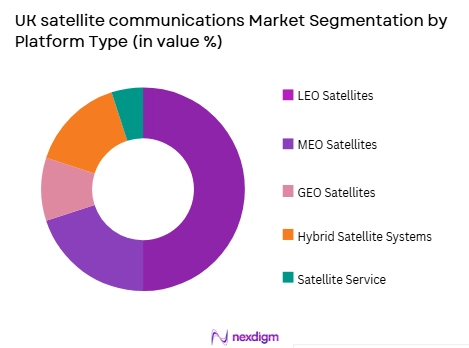
The UK satellite communications market is segmented by platform type into LEO satellites, MEO satellites, GEO satellites, hybrid satellite systems, and satellite services. LEO satellites have emerged as the dominant sub-segment, primarily due to their ability to offer low-latency services, which are critical for high-speed communication. The demand for LEO satellite systems has surged with the increasing adoption of 5G technology, providing global coverage with reduced transmission delays. Moreover, LEO satellites are cost-effective to deploy compared to GEO systems, making them an attractive option for both government and private-sector players aiming to improve connectivity in underserved regions.
Competitive Landscape
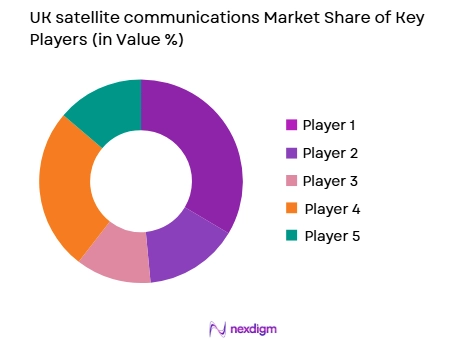
The UK satellite communications market is highly competitive, with numerous players involved in the development and deployment of satellite technologies. Major industry players have been consolidating to enhance their technological capabilities, particularly in satellite infrastructure and network services. These companies are also collaborating with governmental and regulatory bodies to expand satellite networks and improve service offerings. The presence of global players like SpaceX and regional players such as Inmarsat has resulted in significant technological advancements and competitive pricing, which has benefitted both commercial and government customers.
| Company Name | Establishment Year | Headquarters | Technology Focus | Market Reach | Key Products | Revenue | One Additional Market-Specific Parameter |
| Inmarsat | 1979 | London, UK | ~ | ~ | ~ | ~ | ~ |
| Eutelsat | 1977 | Paris, France | ~ | ~ | ~ | ~ | ~ |
| SES S.A. | 1985 | Luxembourg | ~ | ~ | ~ | ~ | ~ |
| OneWeb | 2012 | London, UK | ~ | ~ | ~ | ~ | ~ |
| SpaceX | 2002 | Hawthorne, USA | ~ | ~ | ~ | ~ | ~ |
UK satellite communications Market Analysis
Growth Drivers
Increased Demand for Global Connectivity
The increasing demand for high-speed internet and seamless communication in remote regions is a primary driver for the growth of the UK satellite communications market. Satellite networks, especially LEO systems, are uniquely positioned to provide global connectivity, offering reliable services where traditional terrestrial networks are limited or non-existent. As more sectors such as telemedicine, agriculture, and emergency services require continuous connectivity in rural or isolated areas, the satellite communications market continues to expand. Additionally, the growing use of satellite technology in IoT applications further drives the demand for reliable communication infrastructure, supporting economic growth and improving digital inclusivity across the UK. With global connectivity becoming essential for both commercial and governmental operations, the satellite communications market is poised for significant growth. The push for better global coverage and low-latency communication, especially with the integration of 5G, ensures that satellite communication solutions will play a pivotal role in the future of digital infrastructure.
Technological Advancements in Satellite Technology
The evolution of satellite technology, including the development of smaller, more cost-effective LEO satellites, is another key growth driver for the UK satellite communications market. Technological advancements in satellite design, such as reduced weight, increased bandwidth, and higher transmission capacity, have made satellite systems more affordable and capable of providing better service. The deployment of LEO satellites has become a game-changer, as they offer low-latency services at a fraction of the cost of traditional GEO satellites. Additionally, advancements in satellite miniaturization and propulsion systems have led to more efficient and environmentally sustainable satellite networks. These innovations have made satellite communications more accessible to a wider range of industries, including maritime, defense, and telecommunications. The continued development of hybrid satellite systems that combine LEO, MEO, and GEO satellites is also contributing to the market’s growth by offering more comprehensive coverage.
Market Challenges
High Capital Expenditure for Satellite Deployment
One of the primary challenges in the UK satellite communications market is the significant capital expenditure required for the deployment and maintenance of satellite networks. Building and launching satellites, particularly LEO satellites, involves substantial upfront costs, including manufacturing, transportation, and launching expenses. Furthermore, satellite systems require long-term investments for maintenance, upgrades, and monitoring, placing financial strain on companies and government agencies. While technological advancements are driving down some costs, the high capital required to establish and maintain satellite infrastructure remains a major barrier to entry for smaller players in the market. Additionally, the market faces challenges related to the operational costs of ground stations, spectrum leasing, and compliance with regulatory requirements, further complicating the economic feasibility of new satellite projects.
Spectrum Congestion and Regulatory Hurdles
The increasing number of satellites in orbit, combined with the growing demand for communication services, has led to spectrum congestion. This issue poses a significant challenge for satellite operators, as the limited available frequencies must be shared among a growing number of systems. Spectrum interference can lead to communication failures, reduced service quality, and operational inefficiencies. Regulatory bodies in the UK and globally are working to address these challenges by reallocating spectrum and implementing stricter regulations. However, compliance with these regulations is complex, and failure to obtain the necessary licenses or operate within allocated spectrum bands can result in costly delays and fines for satellite operators. Regulatory hurdles, coupled with the challenges of managing spectrum efficiently, represent key obstacles to the continued growth of the satellite communications market.
Opportunities
Integration with 5G Networks
A significant opportunity in the UK satellite communications market lies in the integration of satellite networks with 5G technology. As 5G networks expand globally, satellite communications are becoming an essential component of this infrastructure, especially in rural or remote areas where terrestrial 5G coverage is limited. By providing high-speed connectivity and low-latency communication, satellite systems can complement terrestrial 5G networks, ensuring continuous service availability across the UK. This integration offers the potential for seamless communication, enabling advanced services such as autonomous vehicles, real-time data analytics, and connected smart cities. As the UK government supports 5G rollouts, satellite communication providers have an opportunity to partner with telecommunications companies and other service providers to deliver comprehensive coverage.
Satellite Connectivity for IoT Expansion
The expanding Internet of Things (IoT) sector presents a major growth opportunity for the UK satellite communications market. IoT relies on ubiquitous connectivity to enable smart devices, sensors, and machinery to communicate and share data in real time. Satellite communication offers an ideal solution for IoT, particularly in remote areas where traditional terrestrial networks are unavailable. The growing demand for satellite-enabled IoT solutions in industries such as agriculture, logistics, and environmental monitoring is driving the market’s expansion. As IoT applications become more pervasive, the need for reliable satellite connectivity will increase, allowing satellite communications providers to tap into a rapidly growing market. Additionally, the integration of satellite IoT services with 5G networks will further enhance connectivity and operational efficiency across various sectors.
Future Outlook
The UK satellite communications market is expected to continue its growth over the next five years, driven by advancements in satellite technology, the integration of 5G networks, and the expansion of IoT applications. The growing demand for high-speed, low-latency connectivity in remote and underserved regions will fuel the adoption of LEO satellite systems. Technological developments, including miniaturization and cost reduction in satellite production, will make these systems more accessible and affordable. Regulatory support and government initiatives aimed at improving satellite infrastructure will further bolster market growth, positioning the UK as a leader in satellite communications within Europe.
Major Players
- Inmarsat
- Eutelsat
- SES S.A.
- OneWeb
- SpaceX
- Intelsat
- Telesat
- Iridium Communications
- Viasat
- Hughes Network Systems
- Telenor Satellite
- Harris Corporation
- Globalstar
- EchoStar
- Satcom Global
Key Target Audience
- Investments and venture capitalist firms
- Government and regulatory bodies
- Aerospace and defense contractors
- Telecommunications service providers
- Broadcasting companies
- IoT solution providers
- Agricultural and logistics companies
- Satellite infrastructure developers
Research Methodology
Step 1: Identification of Key Variables
Identify critical market drivers, challenges, and opportunities affecting the satellite communications market.
Step 2: Market Analysis and Construction
Analyze historical data, market trends, and forecast future market dynamics to create a comprehensive model.
Step 3: Hypothesis Validation and Expert Consultation
Validate market hypotheses through consultations with industry experts, satellite operators, and technology leaders.
Step 4: Research Synthesis and Final Output
Synthesize findings into actionable insights and develop the final report that reflects the current and future landscape of the satellite communications market.

- Executive Summary
- Research Methodology (Definitions, Scope, Industry Assumptions, Market Sizing Approach, Primary & Secondary Research Framework, Data Collection & Verification Protocol, Analytic Models & Forecast Methodology, Limitations & Research Validity Checks)

- Market Definition and Scope
- Value Chain & Stakeholder Ecosystem
- Regulatory / Certification Landscape
- Sector Dynamics Affecting Demand
- Strategic Initiatives & Infrastructure Growth

- Growth Drivers
Increased Government Investment in Satellite Infrastructure
Technological Advancements in Communication Systems
Growing Demand for Global Connectivity Solutions - Market Challenges
High Capital Expenditure in Satellite Infrastructure
Interference and Spectrum Management Issues
Regulatory and Licensing Barriers - Market Opportunities
Expansion in 5G Satellite Integration
Emerging Demand for Satellite-Based IoT Solutions
Collaborations Between Government and Private Sector for Satellite Deployment - Trends
Shift Towards Low Earth Orbit (LEO) Satellites
Increasing Use of Satellite Networks for Remote Areas
Advancements in Satellite Miniaturization - Government regulations
Regulatory Compliance for Satellite Spectrum Allocation
Satellite Licensing and Frequency Regulations
Data Protection and Privacy Laws Impacting Satellite Communications - SWOT analysis
- Porters five forces

- By Market Value, 2020-2025
- By Installed Units, 2020-2025
- By Average System Price, 2020-2025
- By System Complexity Tier, 2020-2025

- By System Type (In Value%)
Satellite Communication Terminals
Satellite Transponders
Ground Stations
Satellite Networks
Mobile Satellite Systems - By Platform Type (In Value%)
LEO Satellites
MEO Satellites
GEO Satellites
Hybrid Satellite Systems
Satellite Services - By Fitment Type (In Value%)
On-Premise Solutions
Cloud-based Solutions
Hybrid Solutions
Mobile Solutions
Integrated Solutions - By EndUser Segment (In Value%)
Telecommunications Providers
Military & Defense
Government Agencies
Broadcasting Networks
Commercial Enterprises - By Procurement Channel (In Value%)
Direct Procurement
Government Tenders
Private Sector Procurement
Online Bidding Platforms
Third-party Distributors

- Market Share Analysis
- Cross Comparison Parameters (System Type, Platform Type, Procurement Channel, End User Segment, Fitment Type, Technology Integration, Satellite Frequency Band, Global Coverage, Maintenance & Support Services, Regulatory Compliance)
- SWOT Analysis of Key Competitors
- Pricing & Procurement Analysis
- Key Players
Inmarsat
Eutelsa Communications
SES S.A
Thales Group
OneWeb
Iridium Communications
Hughes Network Systems
Telesat
Intelsat
Viasat
Harris Corporation
Globalstar
SpaceX
EchoStar Corporation
Telenor Satellite

- Telecommunications Providers’ Growing Dependence on Satellite Connectivity
- Defense Sector’s Increased Investment in Secure Satellite Communication
- Government’s Push for Enhanced Rural Connectivity
- Broadcasting Networks’ Adoption of Satellite for Global Coverage

- Forecast Market Value, 2026-2035
- Forecast Installed Units, 2026-2035
- Price Forecast by System Tier, 2026-2035
- Future Demand by Platform, 2026-2035


 Request a Sample
 Ask for Customization
 Get a Quote
 Enquire Now