
 Download PDF
Market Overview
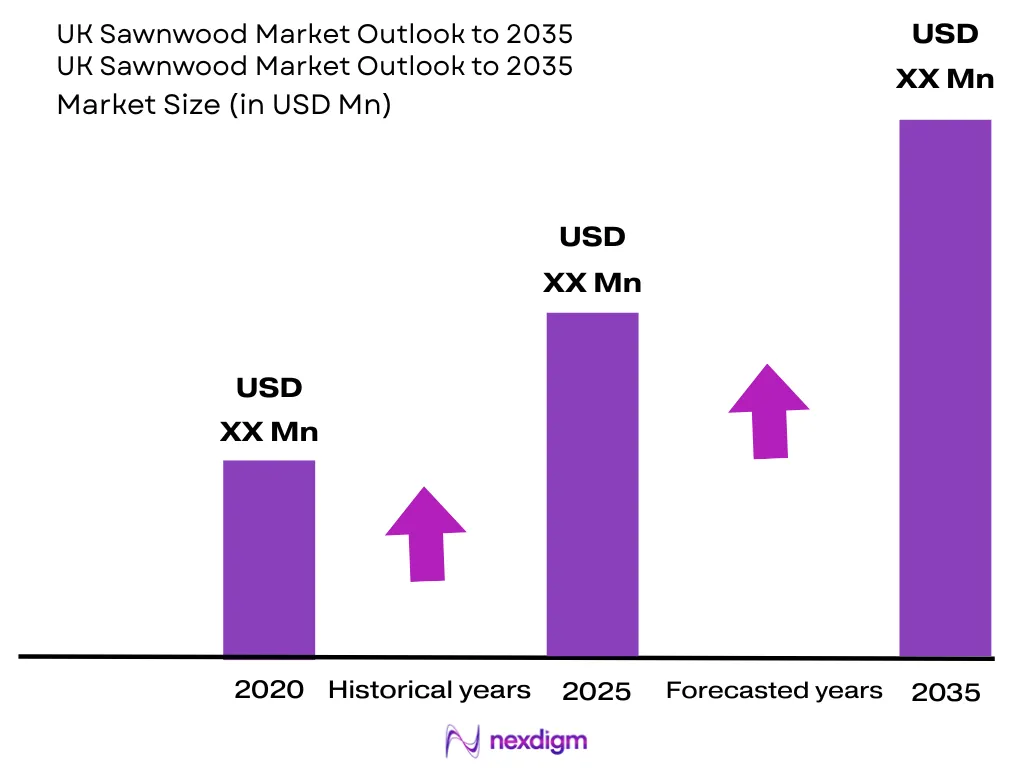
The UK Sawnwood Market was valued at approximately USD ~ Million in 2024, reflecting the country’s position as one of Western Europe’s most import-dependent timber economies. According to data published by the Food and Agriculture Organization, Forestry Commission Great Britain, and the Timber Trade Federation (TTF), the United Kingdom produces approximately 3.5 million cubic metres of sawnwood domestically each year while importing significantly larger volumes to satisfy total demand. The domestic industry is anchored by commercial conifer plantations in Scotland, Wales, Northern Ireland, and northern England, with Sitka Spruce representing the predominant species by harvested volume. The market is primarily driven by expanding residential construction activity, government targets for housing delivery, growing adoption of timber frame construction methods, rising demand for sustainably certified timber, and a well-established import supply chain sourcing lumber from Scandinavia, the Baltic states, Canada, and Central Europe.
Market Segmentation
By Wood Species Type
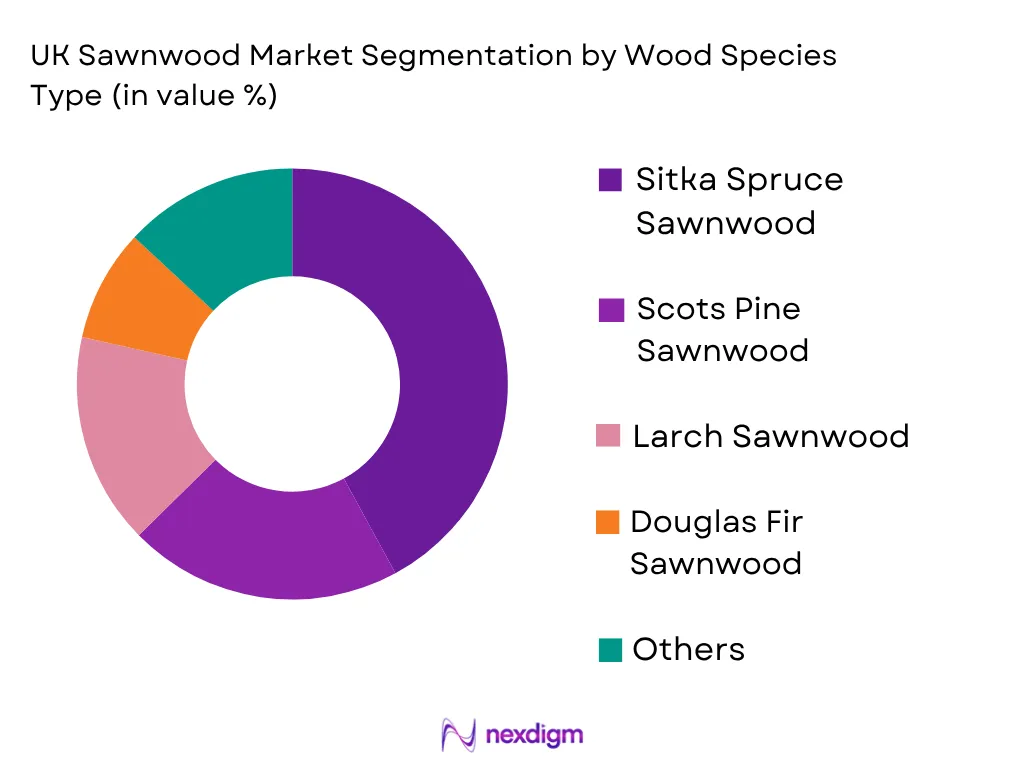
UK Sawnwood Market is segmented by wood species type into Sitka Spruce Sawnwood, Scots Pine Sawnwood, Larch Sawnwood, Douglas Fir Sawnwood, Oak and Native Hardwood Sawnwood, and Other Commercial Species. Sitka Spruce Sawnwood holds the dominant market share owing to its extensive plantation base across Scotland, Wales, Northern Ireland, and upland England, high wood volume productivity per hectare, and suitability for structural construction applications. The species accounts for the majority of conifer timber harvested from UK plantations and benefits from well-established sawmill infrastructure in Scotland and Wales capable of processing large-diameter logs into construction-grade dimensional lumber. Sitka Spruce timber is widely accepted under UK building standards for structural applications including wall framing, floor joists, roof rafters, and trussed rafter systems. The UK Forestry Commission’s planting programmes have historically prioritised Sitka Spruce for upland afforestation, creating a substantial and growing timber resource that will progressively increase domestic sawnwood supply through the forecast period. Furthermore, Sitka Spruce lumber is compatible with pressure treatment and kiln-drying processes, making it the preferred species for construction companies, timber frame manufacturers, and building material distributors requiring certified, dimensionally stable structural timber.
By End-Use Industry
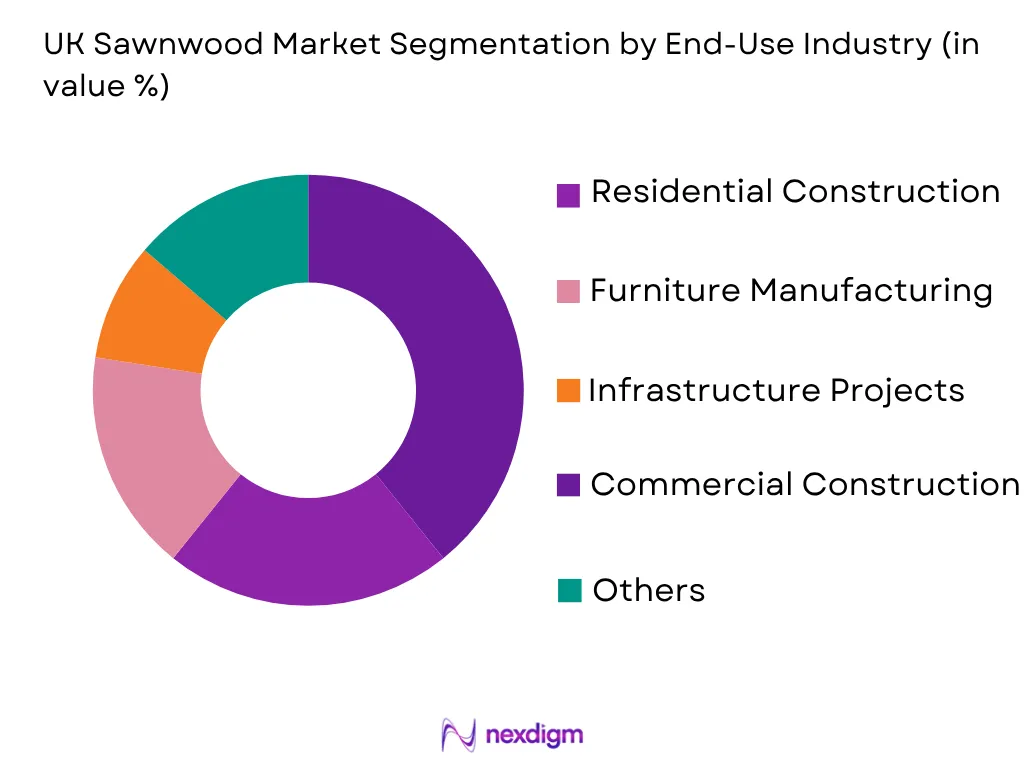
UK Sawnwood Market is segmented by end-use industry into Residential Construction, Commercial Construction, Furniture Manufacturing, Packaging & Pallets, Infrastructure Projects, and Joinery & Interior Applications. Residential Construction represents the largest market segment due to continuous demand for timber framing, roof structures, floor systems, cladding, doors, windows, and interior finishing materials. Government housing delivery targets, the growing penetration of timber frame construction in new-build residential developments, and ongoing repair, maintenance, and improvement activity in the UK’s ageing housing stock consistently support sawnwood consumption. Timber frame construction now accounts for a substantial proportion of new detached and semi-detached housing completions, particularly in Scotland where timber frame market penetration exceeds 85% of new private builds. Rising consumer and developer preference for sustainable, low-embodied-carbon construction materials has further supported sawnwood adoption across the residential sector. The segment benefits from an established supply network involving timber importers, national and regional merchant chains, builders’ merchants, and direct procurement channels serving volume housebuilders, self-build customers, and specialist timber frame manufacturers across all UK regions.
Competitive Landscape
The UK Sawnwood Market is characterised by a high degree of import dependence alongside a relatively concentrated domestic processing sector. The market includes vertically integrated forestry and sawmill operators, specialist timber importers, national timber merchants, and diversified wood products distributors. Domestic producers are led by a small number of large-scale sawmilling groups that manage significant portions of Forestry Commission and private woodland harvesting volumes. Import-oriented participants source sawnwood predominantly from Scandinavia, the Baltic states, Canada, Central Europe, and increasingly from domestic sources as UK plantation timber matures. Companies with strong UKWAS, FSC, and PEFC certification credentials are well-positioned to serve growing demand for responsibly sourced construction timber from volume housebuilders, public sector procurement frameworks, and retail timber merchants.
| Company | Establishment Year | Headquarters | Plantation Assets | Sawmill Capacity | FSC/PEFC Certification | Export Presence | Product Portfolio | End-Use Focus |
| Forestry England (FC) | 1919 | ~ | ~ | ~ | ~ | ~ | ~ | ~ |
| BSW Timber Ltd | 1848 | ~ | ~ | ~ | ~ | ~ | ~ | ~ |
| James Jones & Sons Ltd. | 1864 | ~ | ~ | ~ | ~ | ~ | ~ | ~ |
| Tilhill Forestry Ltd. | 1948 | ~ | ~ | ~ | ~ | ~ | ~ | ~ |
| Crown Timber plc | 1985 | ~ | ~ | ~ | ~ | ~ | ~ | ~ |
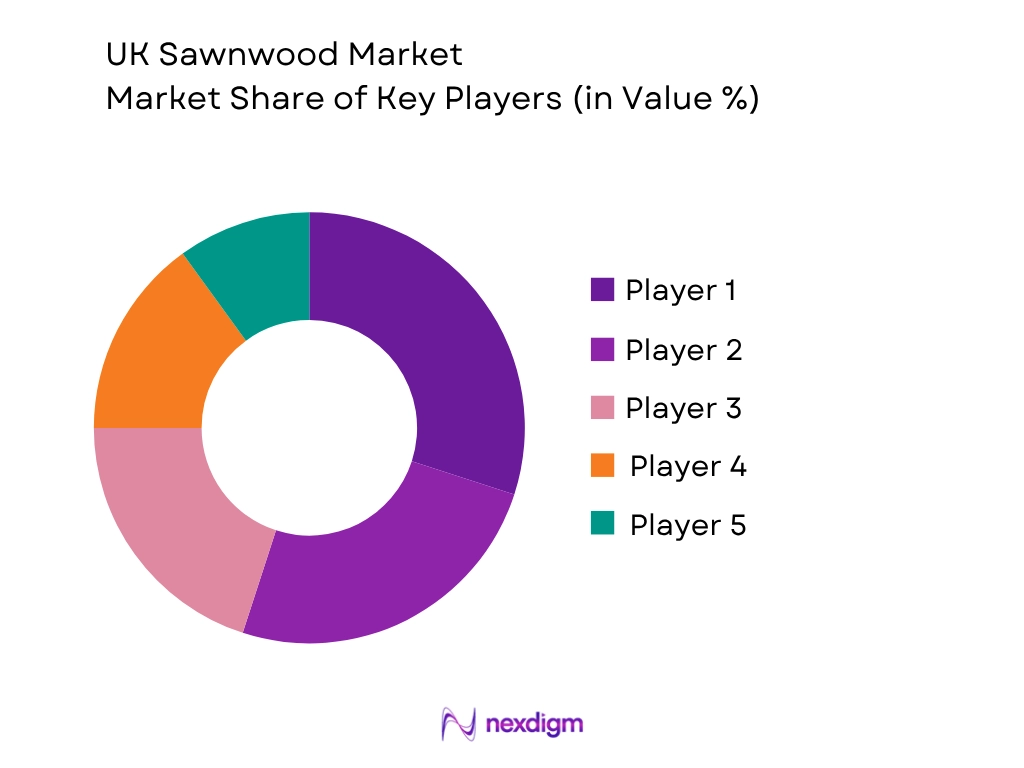
UK Sawnwood Market Analysis
Growth Drivers
Expansion of Domestic Timber Production and Plantation Maturity
The UK sawnwood industry is increasingly supported by the progressive maturation of commercial conifer plantations established across Scotland, Wales, Northern Ireland, and northern England from the mid-twentieth century onwards. According to the Forestry Commission’s Forestry Statistics, the UK’s total woodland area exceeds 3.2 million hectares, of which approximately 1.5 million hectares consist of productive conifer forest available for commercial timber harvesting. Annual timber production in Great Britain has risen consistently, with conifer softwood harvesting volumes exceeding 10 million cubic metres in recent years according to Forestry Commission data. Scotland alone contributes the majority of UK domestic timber output, with large-scale Sitka Spruce and Scots Pine harvesting operations supplying regional sawmills in Highland, Dumfries and Galloway, and the Scottish Borders. The UK government’s commitment to expanding woodland cover through the England Woodland Creation Offer, Scottish Forestry Grants, and the Wales Woodland Strategy is expected to progressively increase domestic timber supply through the forecast period. This growing domestic timber resource reduces long-term import dependency, enhances supply chain resilience, and creates opportunities for sawmill capacity expansion in Scotland and Wales. The Confederation of Forest Industries (Confor) has noted that UK homegrown timber production is set to grow substantially over the coming decade as post-war plantation forests reach harvesting maturity, presenting significant growth opportunities for the domestic sawnwood processing sector.
Residential Construction Demand and Timber Frame Adoption
The UK sawnwood market is fundamentally driven by residential construction activity and the growing penetration of timber frame building methods across new-build housing markets. The UK government’s target of delivering 300,000 new homes annually, combined with local authority housing programmes, housing association development pipelines, and private housebuilder activity, generates consistent and substantial demand for structural sawnwood products. Timber frame construction has grown significantly as a proportion of new housing completions, offering developers advantages in build speed, thermal performance, and embodied carbon reduction compared with traditional masonry methods. According to the Structural Timber Association (STA), timber frame accounted for 29% of new UK housing starts in recent years, with significantly higher penetration in Scotland, Northern Ireland, and rural areas. The growing requirement for energy-efficient housing under Part L of the Building Regulations, the Future Homes Standard, and net zero construction commitments is expected to further accelerate timber frame adoption. Repair, maintenance, and improvement (RMI) activity across the UK’s 28 million existing homes also generates substantial and relatively stable demand for sawnwood products including joinery, flooring, decking, and structural components. These combined factors create a resilient and growing market for kiln-dried, treated, and certificated structural sawnwood across all segments of the UK residential construction sector.
Market Challenges
High Import Dependency and Supply Chain Vulnerability
The UK sawnwood market faces a structural challenge arising from its significant dependence on imported timber to satisfy domestic demand. The United Kingdom imports the majority of its sawnwood consumption, sourcing primarily from Sweden, Finland, Latvia, Estonia, Canada, and Germany. This import dependency exposes the UK market to exchange rate volatility, international freight cost fluctuations, geopolitical disruptions, and supply chain disruptions arising from producing region weather events or trade policy changes. The Russian invasion of Ukraine and subsequent sanctions on Russian and Belarusian timber imports in 2022 demonstrated the vulnerability of UK supply chains to geopolitical risk, triggering significant market disruptions and price increases across the timber trade. While UK domestic production has grown, the domestic sawmill sector currently lacks the scale, species diversity, and capacity to substitute meaningfully for imported volumes in the short term. Additionally, post-Brexit trade arrangements have introduced additional customs documentation requirements and procedural complexity for timber imports from European Union member states. Smaller UK timber merchants and construction companies reliant on just-in-time supply models face particular operational exposure to import disruption events. Addressing this structural dependency requires sustained investment in domestic sawmill capacity, forest management, and homegrown timber processing infrastructure over an extended period.
Sawmill Capacity Constraints and Industry Fragmentation
The UK domestic sawmill sector is characterised by relatively limited processing capacity compared with major timber-producing nations, creating structural constraints on the industry’s ability to satisfy domestic construction demand from homegrown resources. Although large-scale sawmilling operations exist in Scotland operated by BSW Timber, James Jones & Sons, and related groups, the sector as a whole lacks the depth of processing infrastructure found in Scandinavia, Canada, or Germany. Many UK sawmills operate at smaller scales with older capital equipment, limiting production efficiency, recovery rates, and the ability to produce the full range of construction-grade dimensional products demanded by volume housebuilders. Skilled labour shortages in forest harvesting, sawmill operation, and timber engineering further constrain productivity improvements. Planning permission delays for sawmill expansion projects, environmental assessment requirements, and infrastructure access limitations in upland forestry areas add to operational development timelines. Additionally, the fragmented ownership structure of UK private woodlands, with thousands of small independent woodland owners, creates log procurement complexity and increases roundwood sourcing costs for sawmill operators. Industry consolidation, capital investment incentives, and improved cooperation between forestry management and processing sectors are needed to strengthen the domestic sawnwood supply chain and reduce structural capacity gaps.
Market Opportunities
Government Timber Procurement Policy and Net Zero Construction Demand
The UK government’s timber procurement policy and broader net zero construction commitments represent a significant structural demand opportunity for certified domestic and imported sawnwood products. The UK Government Buying Standards for timber require that all timber and wood-derived products procured for public sector use meet legally harvested and sustainability certification requirements under UKWAS, FSC, or PEFC schemes. Public sector housebuilding, school construction, healthcare facilities, and infrastructure projects represent a substantial procurement volume that must comply with these standards. The UK’s legally binding commitment to achieving net zero carbon emissions by 2050, alongside the interim target of reducing embodied carbon in new buildings, has reinforced the role of timber as a preferred low-carbon structural material. Life cycle assessment studies consistently demonstrate the embodied carbon advantages of timber-framed construction versus steel and concrete alternatives, supporting timber specification in both residential and commercial projects seeking BREEAM, LEED, or Passivhaus certification. Growing interest in mass timber construction methods, including cross-laminated timber (CLT), glulam structural systems, and engineered timber panel systems, is creating incremental demand for high-quality structural sawnwood from certified and traceable supply chains. These regulatory and sustainability-driven demand signals provide a durable growth platform for sawnwood producers and importers serving the UK construction market through the forecast period.
Homegrown Timber Processing Expansion and Value-Added Opportunities
The progressive maturation of UK commercial plantations presents a generational opportunity to expand domestic sawnwood processing capacity and capture greater value from homegrown timber resources. Current projections from the Forestry Commission and Confor indicate that UK softwood timber availability is set to increase substantially through the 2030s as large plantation cohorts reach harvesting maturity, particularly in Scotland, Wales, and Northern Ireland. Significant investment opportunities exist in new and upgraded sawmill facilities capable of processing Sitka Spruce and other plantation conifers into construction-grade, kiln-dried, and value-added wood products. The UK government’s Timber in Construction roadmap and associated innovation funding programmes aim to stimulate domestic timber processing investment and develop supply chains for mass timber structural products manufactured from homegrown resources. By investing in precision sawing technology, continuous kiln systems, structural grading automation, and CLT lamstock manufacturing capability, UK sawmill operators can increase wood recovery rates, improve product consistency, and access higher-margin construction product markets. Development of a stronger homegrown sawnwood processing sector would reduce import dependency, strengthen supply chain resilience, create rural employment in forestry and manufacturing communities, and support the UK’s broader ambitions for a sustainable, low-carbon built environment.
Future Outlook
The UK Sawnwood Market is expected to witness sustained growth over the forecast period, supported by government housing delivery targets, growing adoption of timber frame construction, expanding domestic plantation timber volumes, and rising demand for certified, low-carbon building materials. Progressive maturation of UK conifer plantations is anticipated to increase domestic sawnwood supply availability, reducing import dependency and improving supply chain resilience over the longer term. Investment in sawmill modernisation, kiln-drying infrastructure, and structural grading technology is expected to improve the competitiveness of homegrown timber products in UK construction markets. The development of mass timber structural applications, including cross-laminated timber and glulam systems, alongside government support for timber-in-construction innovation, will further strengthen the market’s growth profile. Import supply chains from Scandinavia, the Baltic states, and Central Europe are expected to remain important through the forecast period, with certified, sustainably sourced sawnwood commanding growing specification preference from volume housebuilders and commercial developers.
Major Players
- BSW Timber Ltd.
- James Jones & Sons Ltd.
- Forestry England (Forestry Commission)
- Tilhill Forestry Ltd.
- Crown Timber plc
- Arnold Laver Group
- Caledonian Timber Frame
- Norbord (now Westfraser UK)
- Vastern Timber Company
- Mayr-Melnhof Holz UK
- Timbmet Group Ltd.
- Covers Timber & Builders Merchants
- Russwood Ltd.
- Glennon Brothers (UK Operations)
- Premier Forest Products
Key Target Audience
- Forestry and Timber Production Companies
- Sawmill Operators and Wood Processing Enterprises
- Furniture Manufacturing Companies
- Residential and Commercial Construction Companies
- Building Material Distributors and Timber Merchants
- Investments and Venture Capitalist Firms
- Government and Regulatory Bodies (Forestry Commission, Natural Resources Wales, Scottish Forestry, Forest Service Northern Ireland, Department for Environment Food & Rural Affairs)
- Timber Importers, Exporters and International Timber Trading Organisations
Research Methodology
Step 1: Identification of Key Variables
The initial phase involves constructing an ecosystem map covering forestry agencies, private woodland owners, sawmills, timber importers, merchants, construction companies, and furniture manufacturers operating within the UK Sawnwood Market. Extensive secondary research is conducted using industry associations, trade databases, forestry reports, and government publications including data from the Forestry Commission, Timber Trade Federation (TTF), Structural Timber Association (STA), and Confederation of Forest Industries (Confor) to identify the variables influencing market demand and supply.
Step 2: Market Analysis and Construction
This phase focuses on gathering historical information relating to timber harvesting volumes, sawnwood production, domestic consumption, import and export performance, pricing trends, and end-use demand. Market revenues are estimated using a combination of production volumes, average selling prices, and trade flow assessments while validating relationships between supply-side and demand-side indicators.
Step 3: Hypothesis Validation and Expert Consultation
Market assumptions are validated through structured interviews with forestry executives, sawmill operators, timber importers, merchants, and industry specialists. These consultations provide operational insights regarding production capacity utilisation, procurement trends, import dynamics, pricing volatility, and technological developments, ensuring greater accuracy of market estimates.
Step 4: Research Synthesis and Final Output
The final stage integrates findings from primary and secondary research to develop market forecasts, segmentation analysis, competitive benchmarking, and strategic recommendations. Data triangulation techniques are applied to validate market estimates and generate a comprehensive assessment of the UK Sawnwood Market while ensuring consistency across all segments and stakeholder perspectives.

- Executive Summary
- Research Methodology (Market Definitions and Assumptions, Abbreviations, Market Sizing Approach, Top-Down Analysis, Bottom-Up Analysis, Demand-Side Assessment, Supply-Side Assessment, Primary Industry Interviews, Forestry Sector Validation Framework, Trade Flow Assessment, Data Triangulation, Forecasting Framework, Limitations and Future Conclusions)

- Definition and Scope
- Market Evolution and Industry Genesis
- Timeline of Major Industry Developments
- Forestry and Wood Processing Industry Ecosystem
- Sawnwood Value Chain Analysis

- Growth Drivers (Domestic Timber Production Growth, Housing Construction Activity, Timber Frame Building Adoption, Sustainable Sourcing Policy Mandates, Repair and Maintenance Demand)
- Market Challenges (Import Dependency, Sawmill Scale Constraints, Skilled Labour Shortages, Planning and Regulatory Delays, Competition from Imported Lumber)
- Market Opportunities (Homegrown Timber Processing Expansion, UKWAS/FSC Certification Demand, Mass Timber and Cross-Laminated Timber Growth, Government Timber Procurement Policy, Digital Timber Trading Platforms)
- Market Trends (Timber Frame Housing Growth, Kiln-Dried Lumber Penetration, Sawmill Modernisation, Plantation Spruce Utilisation, Net Zero Construction Practices)
- Government Regulations (UK Forestry Standard, Timber Procurement Policy, Environmental Impact Assessment Regulations, Felling Licence Requirements, Woodland Carbon Code)
- SWOT Analysis
- Porter’s Five Forces Analysis
- PESTLE Analysis
- Stakeholder Ecosystem
- Competition Ecosystem

- By Market Value (2020-2025)
- By Volume (2020-2025)
- By Average Realized Price (2020-2025)

- By Wood Species Type (In Value %)
Sitka Spruce Sawnwood
Scots Pine Sawnwood
Larch Sawnwood
Douglas Fir Sawnwood
Oak and Native Hardwood Sawnwood
Other Commercial Wood Species - By Product Form (In Value %)
Rough Sawn Lumber
Planed Sawnwood
Kiln-Dried Sawnwood
Treated Sawnwood
Structural Sawn Timber
Appearance Grade Lumber - By End-Use Industry (In Value %)
Residential Construction
Commercial Construction
Industrial Construction
Furniture Manufacturing
Packaging and Pallets
Joinery and Interior Applications
Infrastructure and Utility Projects - By Distribution Channel (In Value %)
Direct Sales to Industrial Buyers
Timber Traders and Wholesalers
Building Material Distributors
Retail Timber Merchants
Import Trading Companies - By Region (In Value %)
Scotland
England
Wales
Northern Ireland

- Market Share of Major Players (By Value, Production Volume, Import Volume, Sawmill Capacity)
- Cross Comparison Parameters (Annual Sawnwood Production Capacity, Managed Forest Area, Sawmill Recovery Rate, Kiln Drying Capacity, UKWAS/FSC Certified Timber Share, Import Revenue Share, Number of Sawmill Facilities, Product Grade Portfolio)
- SWOT Analysis of Major Players
- Benchmarking Analysis of Major Players
- Pricing Analysis (By Species, Grade, Moisture Content, Thickness, Import vs Domestic Sales)
- Detailed Profiles of Major Companies
BSW Timber Ltd.
James Jones & Sons Ltd.
Forestry England (Forestry Commission)
Tilhill Forestry Ltd.
Crown Timber plc
Arnold Laver Group
Caledonian Timber Frame
Norbord (now WestFraser UK)
Vastern Timber Company
Mayr-Melnhof Holz UK
Timbmet Group Ltd.
Covers Timber & Builders Merchants
Russwood Ltd.
Glennon Brothers (UK Operations)
Premier Forest Products

- Consumption Pattern Assessment (Consumption Frequency, Product Mix, Industry Demand Share, Volume Utilisation, Seasonal Demand)
- Sawnwood Utilisation by Industry (Construction Usage, Furniture Manufacturing Share, Packaging Consumption, Infrastructure Demand, Industrial Applications)
- Procurement and Sourcing Analysis (Contract Duration, Supplier Preference, Import Dependence, Procurement Volume, Lead Time Requirements)
- Buyer Preference Analysis (Species Preference, Grade Preference, Moisture Requirements, Certification Requirements, Delivery Expectations)
- Price Sensitivity Analysis (Price Elasticity, Grade-Based Pricing, Regional Price Variations, Volume Discounts, Contract Pricing Trends)

- By Market Value (2026-2035)
- By Volume (2026-2035)
- By Average Realized Price (2026-2035)


 Request a Sample
 Ask for Customization
 Get a Quote
 Enquire Now