

 Download PDF
Market Overview
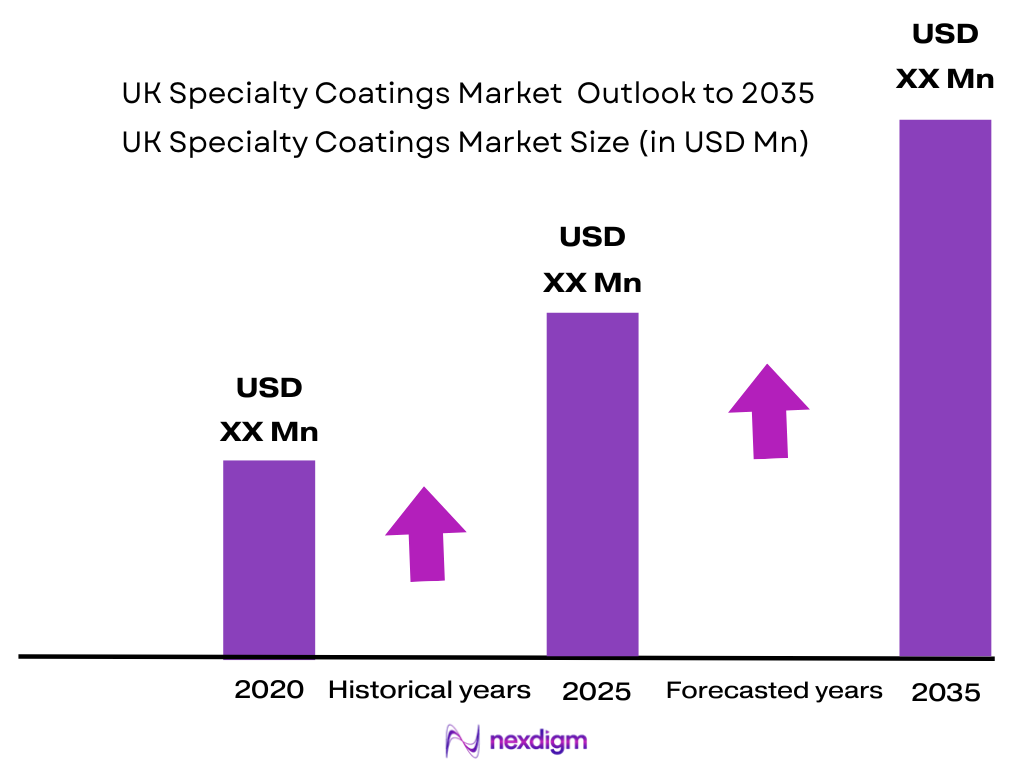
The UK Specialty Coatings Market is valued at ~USD XX billion, supported by the country’s diversified manufacturing and infrastructure base. The UK economy expanded from its preceding observation to the latest observation, while manufacturing remains an important component of economic activity. The wider paints and varnishes industry recorded USD 11.3 billion in demand in the latest observation, while domestic production reached USD 6.3 billion. These conditions support recurring demand for corrosion-resistant, protective, high-performance and functional coatings across industrial applications.
London and the South East remain important commercial and technology centres, while the Midlands, North West, Yorkshire and the Humber, Scotland and the North East provide major industrial demand pools. The UK aerospace sector generated £34 billion in turnover and £13.6 billion in value added in the latest observation, employing about 100,000 people, supporting demand for high-performance aerospace coatings. Automotive manufacturing also produced approximately 905,000 vehicles, while the aerospace, defence, security and space ecosystem generated £100 billion in turnover, reinforcing demand for specialized protective and functional coating technologies.
Market Segmentation
By Coating Technology
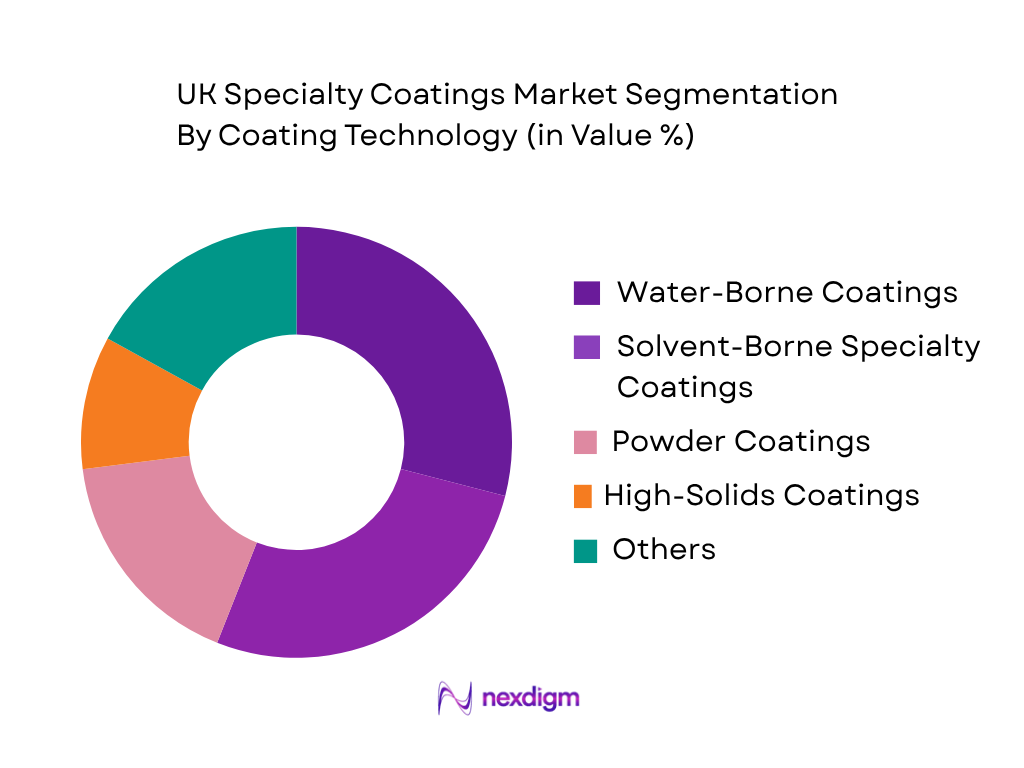
The UK Specialty Coatings Market is segmented by coating technology into water-borne coatings, solvent-borne coatings, powder coatings, high-solids coatings, UV-curable coatings, electrocoatings and radiation-cured coatings. Solvent-borne specialty coatings remain a significant segment because they provide established adhesion, durability, chemical resistance and application performance across industrial equipment, infrastructure, automotive and protective-coating applications. The established industrial base and requirement for demanding corrosion and chemical resistance continue to support their use. At the same time, powder and water-borne technologies are gaining strategic importance because manufacturers and applicators are seeking lower-emission alternatives and improved environmental compliance. The UK automotive industry produced approximately 905,000 vehicles in the latest observation, creating demand for coating systems with controlled curing, durability and appearance characteristics. Aerospace activity also provides an important high-performance application base, with the sector generating £34 billion in turnover and employing approximately 100,000 people. These industrial requirements create opportunities across both established and emerging coating technologies.
By End-Use Industry
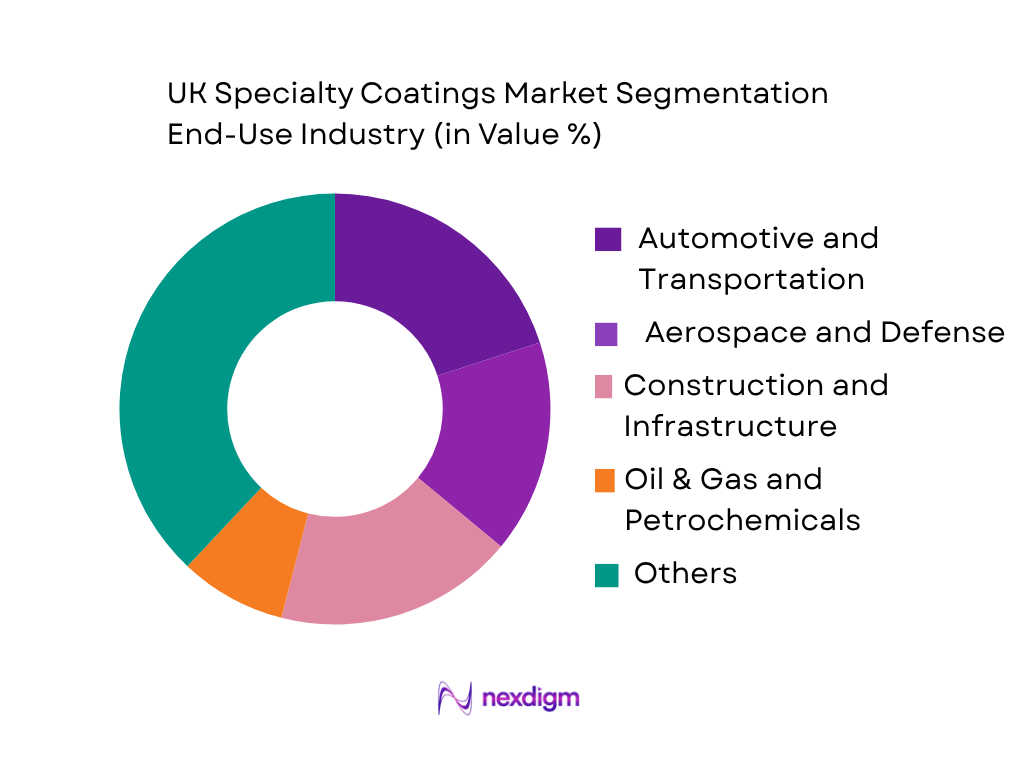
The UK Specialty Coatings Market is segmented by end-use industry into automotive and transportation, aerospace and defense, construction and infrastructure, oil and gas and petrochemicals, marine, industrial machinery, electronics, renewable energy, healthcare, and food and beverage processing. Automotive and transportation represent a major demand centre because specialty coatings are required for corrosion protection, durability, appearance, thermal management and protection of increasingly complex vehicle components. UK vehicle production reached approximately 905,000 units in the latest observation, while motor-vehicle manufacturing contributed approximately £21 billion to the economy. Aerospace is another high-value application area, with the UK aerospace sector recording £34 billion in turnover, £23.2 billion in exports and approximately 100,000 employees. Infrastructure and industrial applications similarly require protective systems to extend asset life and resist corrosion, abrasion, chemicals and weather exposure. The breadth of these end uses gives specialty coating manufacturers access to multiple industrial demand pools rather than dependence on a single application segment.
Competitive Landscape
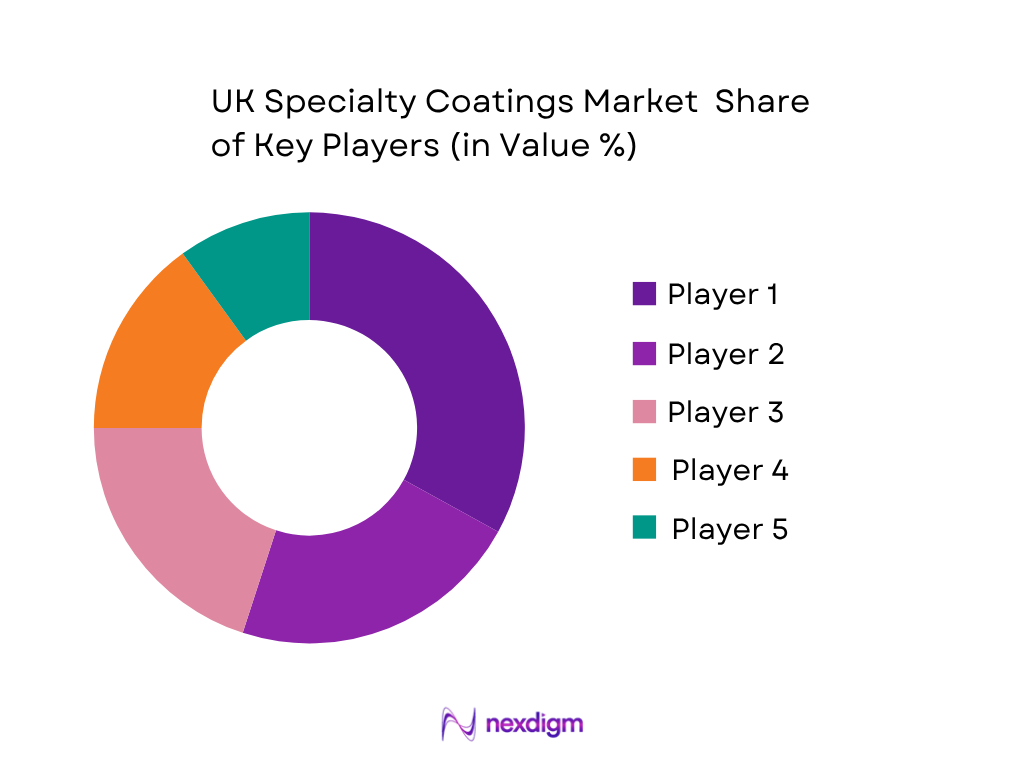
The UK Specialty Coatings Market is characterized by a combination of large multinational coatings manufacturers, global specialty-chemical companies and specialized UK formulation businesses. Companies compete through resin technologies, functional performance, application-specific formulations, technical service, regulatory compliance and distribution reach. The competitive structure is influenced by the need for qualification in demanding sectors such as aerospace and automotive, where coating specifications and performance requirements can create substantial barriers to switching suppliers. The wider UK paints and varnishes industry had 1,318 companies in the latest observation, illustrating the breadth of the domestic supplier ecosystem.
| Company | Establishment Year | Headquarters | Key Resin/Technology | Major Specialty Applications | UK Manufacturing/Technical Presence | Key End-Use Exposure | Distribution Model |
| AkzoNobel | 1792 | Amsterdam, Netherlands | ~ | ~ | ~ | ~ | ~ |
| PPG Industries | 1883 | Pittsburgh, USA | ~ | ~ | ~ | ~ | ~ |
| Sherwin-Williams | 1866 | Cleveland, USA | ~ | ~ | ~ | ~ | ~ |
| Hempel | 1915 | Kongens Lyngby, Denmark | ~ | ~ | ~ | ~ | ~ |
| Jotun | 1926 | Sandefjord, Norway | ~ | ~ | ~ | ~ | ~ |
UK Specialty Coatings Market Analysis
Growth Drivers
Aerospace Manufacturing and MRO Activity
Aerospace manufacturing and MRO activity provides a major demand base for UK specialty coatings because aircraft structures, engines, landing systems and composite components require coatings for corrosion resistance, thermal stability, chemical resistance and surface durability. The UK aerospace sector contributed £13.6 billion to the economy in 2024 and generated £34 billion in annual turnover, while direct employment reached approximately 100,000 people. Aerospace businesses also spent £1.9 billion on business R&D, demonstrating the sector’s substantial advanced-manufacturing and technology intensity. These conditions support recurring requirements for high-temperature, protective, abrasion-resistant and lightweight-compatible coating systems. The UK Government additionally announced more than £250 million of joint industrial investment for green aerospace projects, reinforcing activity in advanced aircraft technologies and associated manufacturing capabilities. The combination of aircraft production, engine manufacturing, composite structures and MRO creates multiple specialty-coating applications across the aerospace value chain. High-performance formulations are particularly relevant where conventional coatings cannot withstand elevated temperatures, hydraulic fluids, aviation fuels, abrasion or prolonged atmospheric exposure. This makes aerospace one of the most technically demanding and specification-intensive end-use industries for UK specialty coatings.
Automotive and EV Component Production
Automotive manufacturing supports specialty-coating demand through vehicle bodies, chassis, powertrain components, battery enclosures, electrical systems and lightweight materials. UK factories produced 905,233 vehicles in 2024, comprising 779,584 cars and 125,649 commercial vehicles, while the wider automotive manufacturing industry contributes approximately £93 billion in turnover and £22 billion in value added to the UK economy. More than 2,500 component providers support the domestic automotive ecosystem, creating a broad customer base for corrosion-resistant, thermal-management, electrically insulating and abrasion-resistant coatings. The transition toward EV production is also changing coating requirements because battery packs, electrical components and lightweight structures require specialized protection against moisture, chemicals, heat and electrical risks. Although total vehicle production declined in 2024, factories continued retooling for EV models, creating demand for new coating specifications and application processes. Specialty coatings therefore benefit not only from vehicle volumes but also from technological changes in vehicle architecture. This shift increases opportunities for functional coatings designed for battery systems, aluminium and composite components, thermal management and long-term corrosion protection.
Market Challenges
Volatility in Resin and Additive Supply
Specialty-coatings manufacturers face exposure to fluctuations in the availability of resins, pigments, solvents, curing agents and performance additives, particularly where specialized inputs are sourced internationally. This creates operational challenges because aerospace, automotive and industrial customers often require tightly controlled formulations and cannot easily substitute raw materials without additional testing and qualification. The UK’s manufacturing ecosystem remains deeply integrated with international supply chains, while the automotive industry alone includes more than 2,500 component providers, illustrating the complexity of downstream industrial networks. UK vehicle production also involved 905,233 vehicles in 2024, meaning disruptions in coating inputs can affect multiple manufacturing stages when production schedules and supplier qualification requirements are tightly coordinated. Specialty formulations amplify this exposure because small changes in resin chemistry, pigment dispersion or additive packages can affect adhesion, curing, corrosion resistance and appearance. Manufacturers therefore need stronger inventory planning, alternative-source qualification and formulation flexibility. The challenge is particularly significant for technically demanding applications where changing a raw material may require renewed customer validation. Supply-chain resilience consequently becomes an important competitive factor alongside coating performance, technical service and regulatory compliance.
VOC Compliance and UK Chemical Regulation
Environmental and chemical compliance creates a continuing challenge for specialty-coating manufacturers because formulations must balance performance requirements with increasingly demanding environmental and workplace expectations. Specialty coatings used in aerospace, automotive, infrastructure and industrial equipment frequently require solvent resistance, rapid curing, adhesion and durability, characteristics that can make formulation changes technically complex. The UK’s industrial base adds scale to this challenge: the aerospace sector generated £34 billion in turnover and spent £1.9 billion on R&D in 2024, while automotive manufacturing generated approximately £93 billion in turnover. These high-value industries require coatings to satisfy demanding technical specifications while manufacturers simultaneously manage regulatory requirements affecting solvents, hazardous substances, emissions and worker exposure. Substitution toward water-borne, high-solids, powder and radiation-cured systems can require investment in formulation development, application equipment and curing processes. Qualification can also be lengthy where coatings are used on aircraft, vehicles or safety-critical infrastructure. Consequently, regulatory compliance is not limited to changing a formulation; it can influence production processes, testing, equipment requirements and customer approvals. This increases development complexity and can favour suppliers with established technical and regulatory capabilities.
Market Opportunities
Aerospace High-Temperature and Advanced Protective Coatings
The UK aerospace ecosystem provides an opportunity for specialty-coating suppliers to develop high-temperature, chemical-resistant, erosion-resistant and lightweight-compatible systems for engines, aircraft structures, composites and MRO applications. The sector contributed £13.6 billion in value added in 2024, generated £34 billion in turnover and employed approximately 100,000 people, creating a substantial industrial base for specialized surface technologies. Aerospace businesses also invested £1.9 billion in R&D, indicating continued development of advanced manufacturing technologies and aircraft systems. More than £250 million of government-industry funding was announced for green aerospace projects, further supporting technological development. These conditions create opportunities for coatings that improve component durability, reduce maintenance requirements and withstand demanding thermal and chemical environments. Advanced coatings can also support lightweight composite structures and next-generation propulsion technologies where surface performance is critical. MRO provides an additional recurring application base because aircraft components require inspection, refurbishment and protective treatment throughout their operating lives. Suppliers able to combine aerospace qualification, high-temperature performance, corrosion protection and lower environmental impact can therefore address several high-value applications simultaneously. The opportunity extends from aircraft structures and engines to landing gear, composite components and specialized aerospace equipment.
EV Battery, Offshore-Wind and Infrastructure Protection
The transition toward electrification and renewable infrastructure creates opportunities for specialty coatings that provide corrosion protection, thermal management, electrical insulation and long-term durability. UK vehicle production reached 905,233 units in 2024, while offshore-wind installed capacity reached 15,916 MW, with offshore wind generating 48,805 GWh of electricity. The scale of these assets creates demand for coatings capable of protecting battery components, charging-related equipment, turbine structures, foundations and other equipment exposed to moisture, salt, chemicals and mechanical wear. Infrastructure applications provide another long-duration opportunity because bridges, rail assets, water infrastructure and industrial structures require protective systems to extend service life and reduce maintenance requirements. Offshore wind is particularly demanding because marine structures experience continuous exposure to saltwater, humidity, biological fouling and mechanical stress. Specialty coatings designed for marine corrosion, erosion, antifouling and extended service intervals can therefore command greater technical importance than conventional decorative coatings. Similarly, EV battery systems require controlled surface properties for electrical safety, thermal stability and resistance to environmental degradation. These applications support opportunities for advanced low-VOC, high-durability, functional and environmentally improved coating technologies across the UK’s energy and transportation transition.
Future Outlook
The UK Specialty Coatings Market is expected to develop through increasing demand for longer asset life, corrosion protection, low-emission formulations and advanced functional performance. Aerospace, automotive, renewable energy, infrastructure and industrial manufacturing are expected to remain important application areas. The transition toward EVs, offshore wind, advanced composites and higher-performance industrial equipment should create additional requirements for thermal, electrical, chemical, abrasion and corrosion protection. Environmental regulation is also expected to encourage formulation changes toward water-borne, powder, high-solids and other lower-emission technologies.
Major Players
- AkzoNobel N.V.
- PPG Industries, Inc.
- The Sherwin-Williams Company
- Hempel A/S
- Jotun A/S
- Axalta Coating Systems
- RPM International Inc.
- BASF SE
- Kansai Paint Co., Ltd.
- Nippon Paint Holdings Co., Ltd.
- Henkel AG & Co. KGaA
- Beckers Group
- HMG Paints Ltd.
- Teknos Group
- Mankiewicz Gebr. & Co.
Key Target Audience
- Specialty coatings manufacturers and formulators
- Resin, pigment and coating-additive manufacturers
- Automotive OEMs and component manufacturers
- Aerospace OEMs, MRO providers and defense manufacturers
- Infrastructure owners, EPC contractors and industrial asset operators
- Industrial coating applicators and specialty chemical distributors
- Investments and venture capitalist firms
- Government and regulatory bodies (Department for Business and Trade, Department for Energy Security and Net Zero, Environment Agency, Health and Safety Executive)
Research Methodology
Step 1: Identification of Key Variables
The initial phase involves mapping the UK Specialty Coatings ecosystem across resin manufacturers, additive suppliers, coating formulators, distributors, applicators, OEMs and industrial end users. Variables include coating technology, resin system, functional performance, application, substrate, end-use industry, production capacity and distribution structure. Secondary research is used to establish the market boundary and identify demand-generating industries.
Step 2: Market Analysis and Construction
Historical market information is compiled through production, consumption, import-export and end-use assessments. The analysis separates specialty coatings from conventional decorative coatings and evaluates demand by technology, function, application and end-use industry. Bottom-up calculations incorporate manufacturer portfolios, production capabilities, application demand and industrial activity to construct the market estimate.
Step 3: Hypothesis Validation and Expert Consultation
Market hypotheses are validated through discussions with coating manufacturers, formulators, distributors, applicators, raw-material suppliers and industrial buyers. Expert inputs are used to assess technology adoption, qualification requirements, substitution patterns, regulatory impacts and application-specific demand. These consultations help reconcile discrepancies between supply-side and demand-side datasets.
Step 4: Research Synthesis and Final Output
The final stage integrates primary and secondary findings through data triangulation. Manufacturer information is compared with industrial production, automotive output, aerospace activity, infrastructure demand and trade data. The resulting framework provides market estimates and forecasts across technology, end-use industry and application while identifying the competitive and regulatory factors most relevant to the UK Specialty Coatings Market.

- Executive Summary
- Research Methodology (Market Definition and Scope, Specialty-Coatings Classification, Market Boundary, Value-Volume Conversion, Top-Down Market Sizing, Bottom-Up Market Construction, Production-Side Assessment, Consumption-Side Assessment, Import-Export Reconciliation, Manufacturer Capacity Mapping, Application-Level Demand Modeling, Primary Industry Interviews, Distributor Validation, Data Triangulation, Forecasting Framework, Scenario Analysis, Assumptions and Limitations)

- Definition and Scope
- Specialty Coatings Industry Structure
- Evolution of the UK Specialty Coatings Industry
- Key Industry Development Milestones
- Specialty Coatings Value Chain
- Raw-Material-to-Formulation Value Chain
- Resin, Pigment, Additive and Solvent Supply Ecosystem

- Market Growth Drivers (Aerospace Manufacturing and MRO Activity, Automotive and EV Component Production, Infrastructure Asset Maintenance, Offshore Energy Development, Industrial Corrosion Protection, Renewable-Energy Equipment Deployment, Advanced Manufacturing, Electronics and Semiconductor Applications)
- Market Challenges (Volatility in Resin and Additive Supply, VOC Compliance, UK Chemical Regulation, Energy-Intensive Manufacturing, Skilled Formulation Requirements, Qualification Cycles, Imported Raw-Material Exposure, Environmental Compliance Costs)
- Market Opportunities (Aerospace High-Temperature Coatings, EV Battery and Component Protection, Offshore-Wind Coatings, Infrastructure Corrosion Protection, Semiconductor Coatings, Low-VOC Formulations, Bio-Based Coatings, Smart Functional Coatings, Antimicrobial Surfaces, Advanced Marine Coatings)
- Market Trends (Water-Borne Conversion, Powder-Coating Adoption, High-Solids Formulations, Low-VOC Chemistry, Bio-Based Resins, Nanocoatings, Self-Healing Coatings, Antimicrobial Surfaces, Conductive Coatings, Thermal-Barrier Systems, Advanced Anti-Corrosion Chemistry)
- Regulatory and Standards Analysis (UK REACH, UK CLP, VOC Regulations, Environmental Permitting, Pollution Prevention and Control, COSHH, Health and Safety Requirements, Product Stewardship, Construction-Product Requirements, Aerospace Coating Standards, Automotive Coating Standards)
- PESTLE Analysis
- SWOT Analysis
- Porter’s Five Forces Analysis

- By Market Value (2020-2025)
- By Consumption Volume (2020-2025)
- By Domestic Production Volume (2020-2025)
- By Domestic Consumption Volume (2020-2025)
- By Import Volume (2020-2025)
- By Average Selling Price (2020-2025)
- By Resin Consumption (2020-2025)
- By Application (2020-2025)
- By Specialty-Coating Function (2020-2025)

- By Resin Type (In Value %)
Epoxy-Based Specialty Coatings
Polyurethane-Based Specialty Coatings
Acrylic-Based Specialty Coatings
Alkyd-Based Specialty Coatings
Fluoropolymer-Based Specialty Coatings
Silicone-Based Specialty Coatings
Polyester-Based Specialty Coatings
Polyaspartic-Based Specialty Coatings
Vinyl-Based Specialty Coatings
Other Specialty Resin Systems - By Coating Technology (In Value %)
Water-Borne Specialty Coatings
Solvent-Borne Specialty Coatings
Powder Coatings
High-Solids Coatings
UV-Curable Coatings
Electron-Beam-Curable Coatings
Electrocoatings
Radiation-Cured Coatings
Thermally Cured Coatings - By Specialty Coating Function (In Value %)
Corrosion-Resistant Coatings
Chemical-Resistant Coatings
Heat-Resistant Coatings
Abrasion-Resistant Coatings
Fire-Resistant and Intumescent Coatings
Antimicrobial Coatings
Anti-Fouling Coatings
Thermal-Barrier Coatings
Conductive and ESD Coatings
Low-Friction Coatings
Self-Cleaning Coatings
Wear-Resistant Coatings - By Application (In Value %)
Protective Coatings
Industrial Equipment Coatings
Automotive OEM Coatings
Automotive Refinish Coatings
Aerospace Coatings
Marine Coatings
Oil and Gas Coatings
Pipeline Coatings
Infrastructure Coatings
Electronics and Electrical Coatings
Wood and Furniture Coatings
Concrete and Masonry Coatings - By End-Use Industry (In Value %)
Automotive and Transportation
Aerospace and Defense
Construction and Infrastructure
Oil and Gas
Petrochemicals and Chemicals
Marine and Shipbuilding
Power Generation
Industrial Machinery
Electronics and Semiconductors
Renewable Energy
Food and Beverage Processing
Medical Devices and Healthcare
General Manufacturing - By Substrate Type (In Value %)
Ferrous Metals
Non-Ferrous Metals
Steel Structures
Aluminium
Plastics and Composites
Glass
Wood and Engineered Wood
Electronic Components
Advanced Composite Materials

- Market Share of Major Players (By Value, Volume, Resin Type, Coating Technology, Application, End-Use Industry, Distribution Channel)
- Cross Comparison Parameters (Resin-System Portfolio Breadth, Specialty-Technology Portfolio, Corrosion-Protection Expertise, Aerospace Qualification Capability, Automotive OEM Penetration, Industrial Distribution Reach, R&D and Formulation Capability, Low-VOC and Sustainable-Coating Portfolio)
- SWOT Analysis of Major Players
- Detailed Profiles of Major Companies
AkzoNobel N.V.
PPG Industries, Inc.
The Sherwin-Williams Company
Axalta Coating Systems
Jotun A/S
Hempel A/S
RPM International Inc.
BASF SE
Kansai Paint Co., Ltd.
Nippon Paint Holdings Co., Ltd.
Henkel AG & Co. KGaA
Beckers Group
HMG Paints Ltd.
Teknos Group
Mankiewicz Gebr. & Co.

- Automotive and Transportation Coatings
- Aerospace and Defense Coatings
- Marine and Offshore Coatings
- Construction and Infrastructure Coatings
- Energy and Oil & Gas Coatings
- Industrial Machinery Coatings

- By Market Value (2026-2035)
- By Consumption Volume (2026-2035)
- By Domestic Production Volume (2026-2035)
- By Domestic Consumption Volume (2026-2035)
- By Import Volume (2026-2035)
- By Average Selling Price (2026-2035)
- By Resin Consumption (2026-2035)
- By Application (2026-2035)
- By Specialty-Coating Function (2026-2035)


 Request a Sample
 Ask for Customization
 Get a Quote
 Enquire Now