
 Download PDF
Market Overview
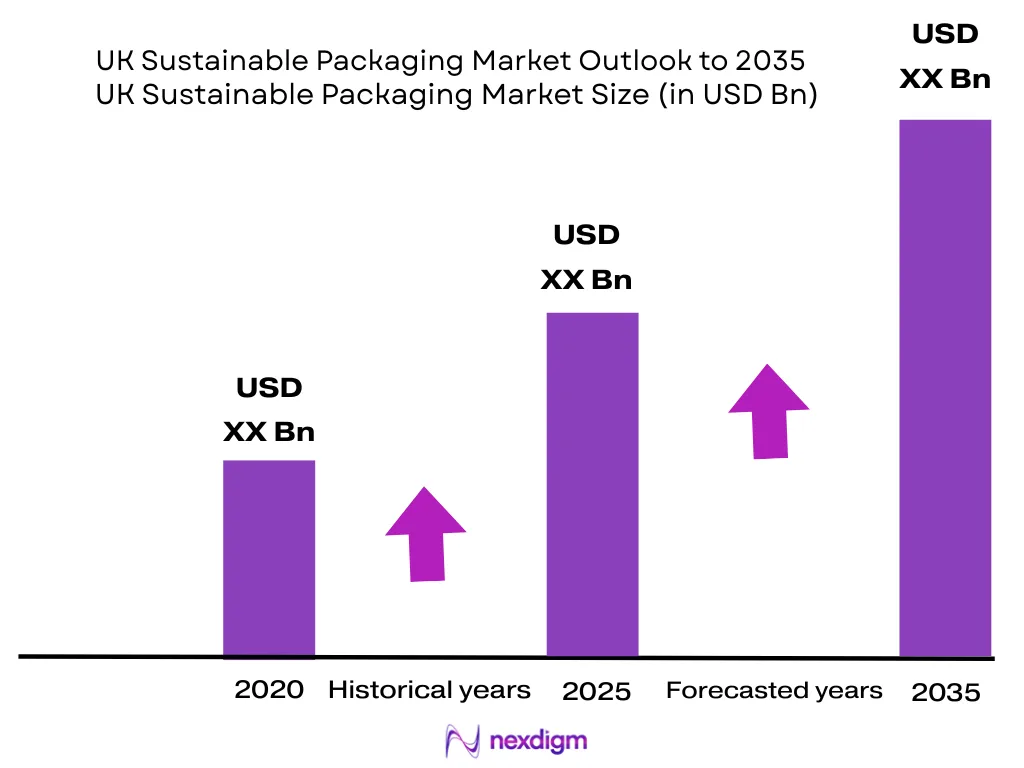
The UK Sustainable Packaging Market is valued at approximately ~ billion and is forecast to expand at a CAGR of % during 2026–2035. The population increased from 68.53 million to 69.28 million, while current-price gross domestic product rose from approximately GBP 2.75 trillion. Demand is driven by packaged food, e-commerce, retailer sustainability requirements, recycled-content integration, packaging EPR, the Plastic Packaging Tax, lightweighting, refill systems, and recyclable-material conversion. London and the South East, the North West, Yorkshire, the Midlands, South Wales, Central Scotland, and Northern Ireland dominate the UK Sustainable Packaging Market. These areas concentrate consumer-goods businesses, packaging converters, paper mills, food factories, distribution centres, ports, recyclers, and major retailers. The UK population increased by approximately 755,300 people, supporting packaged-product demand, while regional manufacturing clusters provide corrugated, flexible-plastic, metal, glass, carton, printing, fulfilment, and recovery capabilities.
Market Segmentation
By Material Type
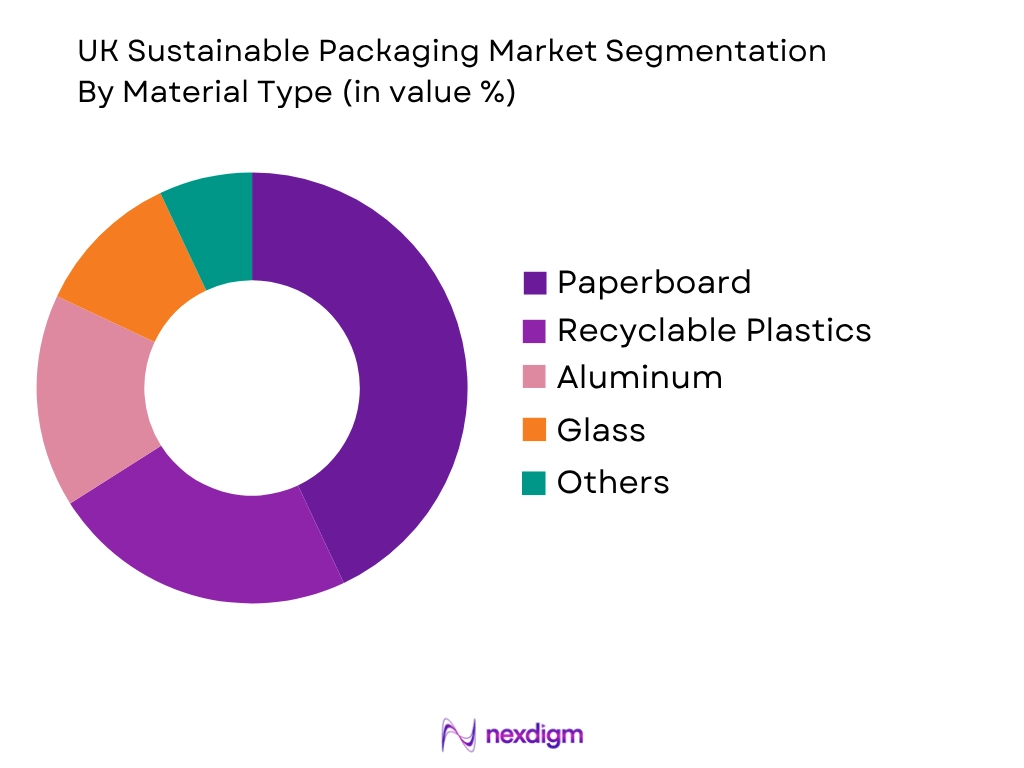
The UK Sustainable Packaging Market is segmented into paper and paperboard, recycled and recyclable plastics, aluminum and steel, glass, bio-based and compostable materials, wood, and sustainable multi-material structures. Paper and paperboard hold the dominant position because corrugated cases, folding cartons, molded fiber, paper mailers, bags, sleeves, and foodservice packs serve grocery, e-commerce, food, beverage, retail, and industrial customers. The UK also has established fiber collection, paper recycling, corrugated conversion, and retailer acceptance. Companies increasingly use paper-based alternatives for selected plastic trays, wraps, protective inserts, and flexible packs. However, paper substitution remains dependent on moisture, grease, oxygen, sealing, and shelf-life requirements. Recycled plastics remain essential for bottles, trays, tubs, films, and pouches where low weight, transparency, impact resistance, or barrier performance are required. Metals and glass retain strong positions in beverage, food, healthcare, and premium products because they can be repeatedly recovered through established material-processing systems.
By End-Use Industry
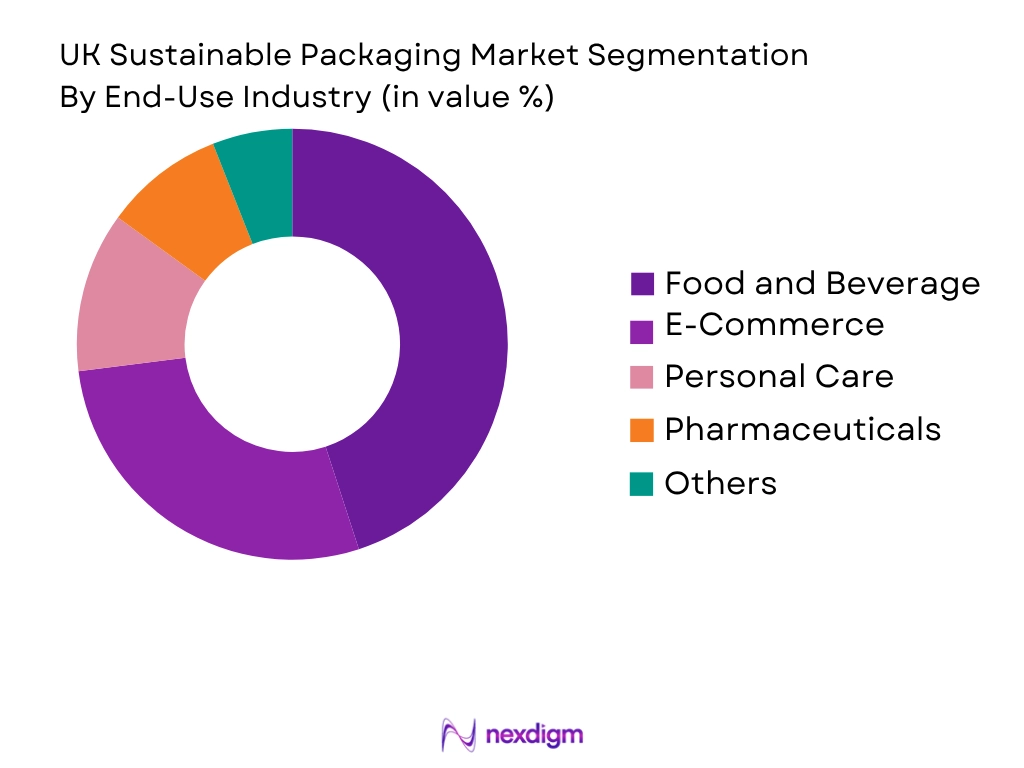
The UK Sustainable Packaging Market is segmented into food and beverage, e-commerce and retail, personal and household care, healthcare and pharmaceuticals, foodservice and hospitality, industrial goods, electronics, and other applications. Food and beverage hold the dominant market position because packaging must protect safety, quality, freshness, aroma, moisture, and shelf life while complying with food-contact requirements. The category uses high volumes of cartons, films, trays, pouches, cans, bottles, cups, corrugated cases, and labels. Grocery retailers also impose packaging scorecards covering material weight, recyclability, recycled content, component separation, and labelling. E-commerce represents another major segment because right-sized cartons, recyclable mailers, fiber protection, and return-ready formats can reduce material and distribution inefficiency. Healthcare packaging converts more slowly because sterility, tamper evidence, migration control, and product integrity take priority. Foodservice adoption is increasingly linked to reusable systems, fiber-based substitution, and compatibility with food-waste collection.
Competitive Landscape
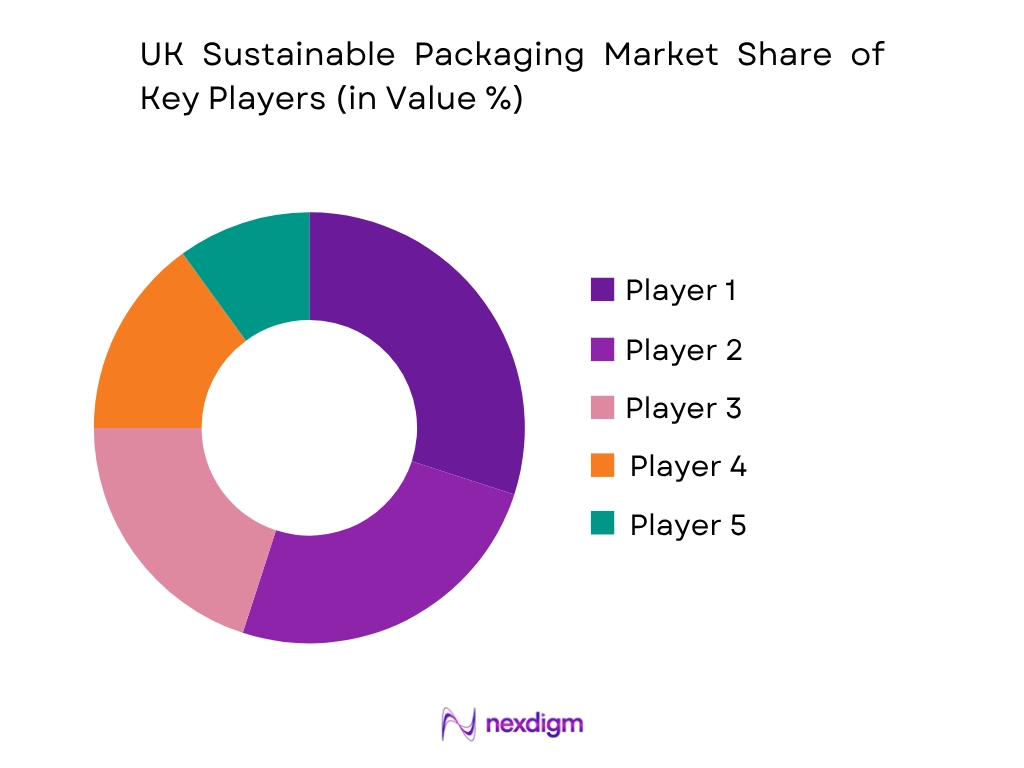
The UK Sustainable Packaging Market is led by integrated fiber-packaging groups, flexible and rigid packaging converters, carton manufacturers, and metal and glass container producers. DS Smith has a strong UK position through paper packaging and recycling operations, while Mondi and Smurfit Westrock combine renewable fiber, corrugated, paper-based flexible packaging, and circular-design services. Amcor competes across flexible, rigid, healthcare, and recycle-ready formats. Coveris is prominent in flexible films and pouches. Competition centres on recyclable-material capability, recycled content, EPR support, manufacturing reach, packaging optimization, food-contact compliance, and the ability to protect products while reducing material intensity.
| Company | Establishment Year | Headquarters | Sustainable Packaging Portfolio | Principal End Uses | Material Capabilities | UK Operating Model | Circularity Capability | Strategic Differentiation |
| DS Smith | 1940 | London, UK | ~ | ~ | ~ | ~ | ~ | ~ |
| Mondi | 1967 | Weybridge, UK and Vienna, Austria | ~ | ~ | ~ | ~ | ~ | ~ |
| Smurfit Westrock | 2024 as combined company | Dublin, Ireland | ~ | ~ | ~ | ~ | ~ | ~ |
| Amcor | 1860s heritage | Zurich, Switzerland | ~ | ~ | ~ | ~ | ~ | ~ |
| Coveris | 2013 | Vienna, Austria | ~ | ~ | ~ | ~ | ~ | ~ |
UK Sustainable Packaging Market Analysis
Growth Drivers
E-Commerce, Urban Consumption, and Packaging Optimization
The UK’s concentrated consumer economy and continued use of online retail are increasing demand for recyclable mailers, corrugated cases, molded-fiber protection, lightweight flexible packaging, return-ready containers, and right-sized shipping formats. The UK population reached approximately 69.3 million people in 2024, while England and Wales alone contained 61,806,682 residents, an increase of 706,900 people from the previous year. This consumer density supports large grocery, pharmaceutical, food-delivery, household-care, and e-commerce networks centred around London, the South East, Manchester, Birmingham, Leeds, Glasgow, Bristol, and other metropolitan areas. Online sales represented 27.0 out of every 100 pounds of retail sales in December 2024, reinforcing demand for packaging that can survive fulfilment, automated sorting, last-mile transportation, consumer opening, and possible product returns. Retail sales volumes subsequently increased by 1.3 points during 2025, after increasing by 0.2 points during 2024, indicating continued movement of packaged goods through physical and digital channels. Sustainable packaging suppliers are responding through reduced box dimensions, fewer plastic inserts, paper void fill, lighter protective structures, recyclable labels, and packaging designed to complete both outbound and return journeys. Corrugated formats benefit from established collection and paper-reprocessing infrastructure, while reusable totes can operate effectively in controlled grocery and business-to-business delivery networks. However, material reduction must not increase product damage because damaged products generate additional transport, replacement packaging, and waste. Packaging development therefore focuses on compression strength, dimensional weight, moisture resistance, closure integrity, and package-to-product ratios. Population scale, metropolitan concentration, and digital retail together support the transition from oversized, single-use shipping materials toward optimized packaging systems designed around recovery, reuse, and logistics efficiency.
Extended Producer Responsibility and Plastic Packaging Tax
The UK’s regulatory framework is creating a direct commercial incentive for producers to reduce packaging weight, increase recyclability, incorporate recycled material, and remove components that increase disposal-system costs. Packaging placed on the market during 2024 became the basis for waste-disposal fees invoiced from October 2025 under extended producer responsibility. Confirmed annual base fees were set at GBP 196 per tonne for paper and card, GBP 423 for plastic, GBP 266 for aluminum, GBP 259 for steel, GBP 192 for glass, GBP 280 for wood, and GBP 461 for fiber-based composites. These figures materially change packaging procurement because heavier or difficult-to-recycle structures create greater compliance exposure for obligated producers. The Plastic Packaging Tax provides an additional driver for recycled-content adoption. The applicable tax rate increased from GBP 217.85 per tonne in April 2024 to GBP 223.69 in April 2025 and GBP 228.82 from April 2026. Plastic packaging containing at least 30 parts recycled plastic in every 100 parts can qualify outside the tax where documentation and other requirements are satisfied. These regulations encourage brands to redesign trays, bottles, films, closures, sleeves, and pouches while requiring suppliers to provide accurate material composition, packaging weight, recycled-content evidence, and household-status classification. Fiber converters benefit where paper-based alternatives can maintain required barriers, while plastic converters are developing mono-material polyethylene and polypropylene formats. Regulatory growth is therefore not limited to higher recycling volumes. It creates recurring demand for package-level data, technical redesign, compliance software, recycled-resin verification, recyclability assessment, and supplier support capable of reducing both physical material use and producer fee exposure.
Market Challenges
Recycled Feedstock Availability and Recovery-System Limitations
The UK sustainable packaging market is constrained by uneven recovery performance across paper, plastics, metals, glass, flexible films, and composite packaging. Official waste statistics recorded a national packaging recycling rate of 64.1 parts out of 100 in 2024. Paper and cardboard achieved the strongest reported performance at 74.3 parts, followed by metals at 68.4 parts and glass at 65.7 parts. These figures show that substantial packaging still fails to reach suitable reprocessors or responsible end markets. The challenge is particularly significant for flexible plastic packaging, small-format items, multilayer pouches, black plastics, sleeves, pumps, and components that cannot be separated easily. Plastic film and bags are not required within England’s standard household plastic collection until 31 March 2027, meaning producers converting to recyclable films still face a temporary gap between technical design and widespread collection access. Recycled feedstock quality is another constraint. Plastic may contain incompatible polymers, food contamination, pigments, labels, adhesives, moisture, and odour, while recovered paper can be impaired by grease, wet-strength coatings, wax, and plastic laminates. Food-contact applications require more controlled input materials and decontamination than many non-food products. Deposit return should eventually create cleaner PET and metal streams, but the system is not scheduled to begin until 1 October 2027. Until collection, sorting, washing, and reprocessing capacity develops further, packaging manufacturers will continue competing for limited high-quality recycled PET, HDPE, polypropylene, fiber, glass cullet, and metal scrap. The principal challenge is therefore not a lack of discarded packaging. It is converting mixed and geographically dispersed waste into reliable secondary materials that meet packaging specifications for strength, odour, colour, processing stability, and regulatory suitability.
Technical Conversion and Multi-Layered Regulatory Complexity
Changing packaging materials requires extensive technical validation because sustainability improvements cannot compromise shelf life, food safety, sterility, filling-line performance, transport protection, or consumer usability. A mono-material pouch may offer improved recyclability but provide weaker oxygen or aroma protection than a conventional laminate. A molded-fiber tray can reduce plastic use but may require additional treatment to resist moisture, grease, heat, or sealing pressure. Increasing recycled content may change colour, odour, transparency, impact strength, and processing behaviour. Packaging teams must therefore conduct line trials, migration assessments, compression tests, drop tests, shelf-life studies, and transport simulations before commercial conversion. Regulatory complexity increases this burden. Producers must manage extended producer responsibility reporting, Plastic Packaging Tax evidence, recycling obligations, packaging recycling notes, single-use restrictions, food-contact requirements, environmental claims, and separate policy implementation across England, Scotland, Wales, and Northern Ireland. Simpler Recycling requirements began for most workplaces in England on 31 March 2025, while micro-firms with fewer than 10 full-time-equivalent employees have until 31 March 2027. Deposit return will cover single-use PET, aluminum, and steel drinks containers ranging from 150 millilitres to 3 litres, but businesses must prepare for registration, labelling, retailer returns, reverse logistics, and fraud control before the October 2027 launch. Environmental statements also create risk because terms such as recyclable, compostable, biodegradable, or containing recycled material must reflect realistic collection access and documented composition. Large brand owners may maintain dedicated packaging, tax, and regulatory functions, while smaller companies rely on converters or compliance schemes. The market challenge is therefore the need to coordinate material science, operational performance, tax documentation, recycling evidence, and four-nation regulatory requirements across thousands of packaging specifications.
Market Opportunities
High-Barrier Recyclable Materials and Advanced Sorting Technologies
The UK has a major opportunity to expand sustainable packaging through recyclable barrier papers, mono-material flexible films, molded fiber, wash-off labels, compatible adhesives, advanced recycled resins, optical sorting, and digital packaging identification. Approximately 12 million tonnes of packaging were historically placed on the UK market in a single year, demonstrating the scale of the material flow that can be redesigned or recovered more effectively. Current extended producer responsibility fees create a strong economic signal for innovation, particularly because plastic carries a base fee of GBP 423 per tonne, compared with GBP 196 for paper and card and GBP 192 for glass. The appropriate response is not unrestricted paper substitution, because heavier fiber structures or inadequate barriers can increase transport emissions or product waste. Instead, suppliers can develop aqueous-coated papers, repulpable grease barriers, thinner corrugated grades, high-strength molded fiber, and recyclable flexible packaging that maintains product protection. England’s requirement to collect plastic films and bags with plastic recycling from 31 March 2027 creates a clearer future pathway for polyethylene- and polypropylene-dominant flexible formats. Sorting technologies can further improve recovery. Near-infrared sensors, artificial intelligence, robotics, digital watermarks, and machine-readable labels can help material recovery facilities distinguish resin, color, format, and food-contact applications. Chemical recycling may also support difficult plastic streams, and government policy proposes mass-balance accounting for qualifying chemically recycled material from April 2027. These technologies can connect package design with improved feedstock quality, lower contamination, and verified recycled-content claims. The strongest opportunity lies in integrated solutions that combine lower material weight, sufficient product barriers, compatible components, accurate consumer disposal instructions, and a demonstrated route through collection, sorting, and reprocessing infrastructure.
Deposit Return, Simpler Recycling, and Closed-Loop Collection Systems
The implementation of deposit return and more consistent recycling collection creates an opportunity to develop closed-loop packaging supply chains for beverage containers, workplace packaging, flexible plastics, reusable formats, and foodservice materials. From 1 October 2027, customers are scheduled to pay a refundable deposit on eligible single-use PET, aluminum, and steel drinks containers between 150 millilitres and 3 litres. Government policy expects the scheme to raise in-scope container recycling to more than 90 parts out of 100 by its third operational year, creating cleaner material streams than those normally obtained from mixed municipal recycling. This provides opportunities for reverse-vending-machine suppliers, counting centres, logistics companies, beverage producers, PET reclaimers, aluminum processors, data platforms, and packaging converters using closed-loop recycled material. Simpler Recycling provides a parallel opportunity. Workplaces in England began separating core recyclable streams on 31 March 2025, while plastic film collection becomes mandatory from 31 March 2027. More consistent collection rules can improve material volumes, reduce consumer confusion, and justify investments in sorting, washing, pelletizing, paper reprocessing, and film recycling. Reusable packaging platforms can also expand in controlled environments such as offices, campuses, foodservice chains, grocery delivery, institutional catering, and business-to-business transport. These systems require durable containers, convenient return points, washing and inspection facilities, asset tracking, and high return rates. Digital tools can connect deposits, packaging identifiers, collection records, and recycled-content evidence. Current packaging policy therefore creates future growth opportunities beyond manufacturing new containers. It supports infrastructure, software, recovery services, reusable packaging pools, retailer collection points, and regional partnerships capable of returning valuable fiber, PET, aluminum, steel, and selected films into UK packaging production.
Future Outlook
The UK Sustainable Packaging Market is expected to develop significantly during 2026–2035 as packaging design becomes directly linked with producer fees, recycled-content verification, deposit return, retailer standards, and collection reforms. Market growth will come from redesigning complete packaging systems rather than simply replacing one material with another. Packaging extended producer responsibility will be a major structural influence. PackUK administers the UK-wide scheme, under which affected producers report packaging information and pay fees connected to the material they place on the market. Confirmed base fees began applying during the first operational period, while fee modulation starts from the 2026–2027 financial year. This will create stronger incentives to reduce package weight, avoid difficult-to-recycle structures, improve component compatibility, and develop reusable formats. The Plastic Packaging Tax will continue supporting recycled-content demand. Plastic packaging containing less than 30% recycled plastic is within scope, subject to applicable rules and exemptions. The tax rate increased to GBP 228.82 per tonne from April 2026, strengthening the financial case for post-consumer resin, material reduction, and improved supply-chain evidence. Proposed changes also introduce mass-balance accounting for chemically recycled plastic from April 2027 while removing pre-consumer waste from qualifying recycled content.
Major Players
- DS Smith
- Mondi
- Smurfit Westrock
- Amcor
- Berry Global
- Coveris
- Huhtamaki
- Sonoco Products Company
- Graphic Packaging International
- Sealed Air
- Tetra Pak
- SIG Group
- Ardagh Metal Packaging
- O-I Glass
- Macfarlane Group
Key Target Audience
- Packaging material manufacturers and converters
- Food, beverage, and consumer-goods brand owners
- Grocery retailers, e-commerce companies, and foodservice operators
- Recycling, deposit-return, composting, and reusable-packaging providers
- Packaging distributors and contract packagers
- Investments and venture capitalist firms
- Private-equity and strategic packaging investors
- Government and regulatory bodies
Research Methodology
Step 1: Identification of Key Variables
The initial phase involves developing an ecosystem map covering material producers, packaging converters, brand owners, retailers, PackUK, compliance schemes, local authorities, collectors, recyclers, and deposit-return operators. Secondary research defines variables including material type, packaging weight, recycled content, household classification, recyclability, tax exposure, converter capacity, and end-use requirements.
Step 2: Market Analysis and Construction
Historical information is compiled by material, format, end-use industry, packaging level, sustainability strategy, and UK nation. The bottom-up model evaluates converter shipments, packaging units, material tonnage, customer adoption, and recycled-content usage. The top-down model reviews industrial output, packaging trade, producer data, material consumption, company revenues, and relevant end-market activity.
Step 3: Hypothesis Validation and Expert Consultation
Preliminary hypotheses are validated through computer-assisted telephone interviews with packaging engineers, converters, retailers, sustainability executives, procurement teams, recyclers, compliance schemes, and regulatory specialists. These consultations assess material conversion, EPR classifications, feedstock constraints, packaging qualification, Plastic Packaging Tax evidence, deposit-return readiness, and customer switching behaviour.
Step 4: Research Synthesis and Final Output
Supply-side and demand-side findings are triangulated to reconcile converter output, material shipments, customer procurement, and recovery data. Segment shares and forecasts are tested against unit volumes, package weights, recycled-content assumptions, regulatory timelines, fee structures, manufacturing capacity, and expert feedback. The final output provides a consolidated assessment of competition and future opportunities.

- Executive Summary
- Research Methodology (Market Definitions and Assumptions, Sustainable Packaging Inclusion and Exclusion Criteria, Abbreviations, Market Sizing Approach, Top-Down Analysis, Bottom-Up Analysis, Packaging-Volume Conversion Model, Material Flow Analysis, Demand-Side Assessment, Supply-Side Assessment, Converter Capacity Assessment, Primary Industry Interviews, Data Triangulation, Regulatory Scenario Modelling, Forecasting Framework, Limitations and Future Conclusions)

- Definition and Scope
- Market Evolution and Industry Genesis
- Transition from Conventional Packaging to Circular Packaging Systems
- Evolution of Packaging Lightweighting and Material Reduction
- Development of Recycled-Content Packaging
- Expansion of Fiber-Based Packaging Substitution
- Development of Reuse, Refill and Return Systems
- Growth of Compostable and Bio-Based Packaging

- Growth Drivers (Packaging Extended Producer Responsibility, Plastic Packaging Tax, Deposit Return Scheme Preparation, Simpler Recycling, Retailer Packaging Standards, E-Commerce Optimization, Corporate Carbon Commitments and Recycled-Content Demand)
- Market Challenges (Recycled Feedstock Availability, Food-Grade PCR Constraints, Flexible Packaging Recovery Gaps, EPR Fee Exposure, Regulatory Complexity Across UK Nations, Composting Infrastructure Limitations, Material Performance Trade-Offs and Green-Claim Risk)
- Market Opportunities (High-Barrier Recyclable Paper, Mono-Material Flexible Packaging, Food-Grade Recycled Plastics, Reusable Packaging Platforms, Molded Fiber Replacement, Deposit Return Infrastructure, Smart Sorting and Closed-Loop Brand Partnerships)
- Market Trends (Paperization, Lightweighting, High-PCR Packaging, Refill Models, Right-Sized E-Commerce Packaging, Wash-Off Labels, Fiber-Based Bottles, Recyclable Barrier Coatings, Digital Product Passports and Packaging Carbon Disclosure)
- SWOT Analysis
- Porter’s Five Forces Analysis
- PESTLE Analysis

- By Market Value (2020-2025)
- By Packaging Volume (2020-2025)
- By Packaging Unit Shipments (2020-2025)

- By Material Type (In Value %)
Paper and Paperboard
Corrugated Board
Molded Fiber
Recycled Plastic
Bio-Based Plastic
Compostable Plastic
Aluminum - By End-Use Industry (In Value %)
Food and Beverage
Personal Care and Cosmetics
Household Care
Healthcare and Pharmaceuticals
E-Commerce
Retail and Consumer Goods - By Distribution Channel (In Value %)
Direct Sales to Brand Owners
Packaging Distributors
Contract Packaging Companies
Digital Packaging Platforms
Industrial Wholesalers
Retail Packaging Suppliers - By Region (In Value %)
London and South East
East of England
South West
West Midlands
East Midlands
North West

- Market Share of Major Players (By Value, Packaging Volume, Material Type, Packaging Format, End-Use Industry and UK Nation)
- Cross Comparison Parameters (Sustainable Material Portfolio Breadth, Post-Consumer Recycled Content Capability, Design-for-Recycling and Lightweighting Expertise, UK Manufacturing and Conversion Footprint, Closed-Loop Recovery and Reuse Services, EPR and Plastic Packaging Tax Support Capability, End-Use Industry Coverage, Packaging Innovation and Commercialization Speed)
- SWOT Analysis of Major Players
- Strategic Developments (Mergers, Acquisitions, Mill Investments, Recycling Partnerships, Reuse Programs, Product Launches, Capacity Expansion and Material Innovation)
- Detailed Profiles of Major Companies
DS Smith
Mondi
Smurfit Westrock
Amcor
Berry Global
Coveris
Huhtamaki
Sonoco Products Company
Graphic Packaging International
Sealed Air
Tetra Pak
SIG Group
Ardagh Metal Packaging
O-I Glass
Macfarlane Group

- Food and Beverage Brand Analysis
- Grocery Retailer Analysis
- E-Commerce and Marketplace Analysis
- Foodservice Operator Analysis
- Consumer Packaged Goods Analysis
- Healthcare and Pharmaceutical Analysis

- By Market Value (2026-2035)
- By Packaging Volume (2026-2035)
- By Packaging Unit Shipments (2026-2035)


 Request a Sample
 Ask for Customization
 Get a Quote
 Enquire Now