
 Download PDF
Market Overview
The UK Toys and Games Market is valued at GBP ~ billion, after reaching GBP ~ billion in the preceding annual cycle. Demand is driven by licensed toys, LEGO-led building sets, Squishmallows-style plush, games, puzzles, pocket-money collectibles and Christmas gifting. Toy sales declined by 3.7, compared with a 5 decline earlier, showing partial stabilization despite household spending pressure and strong demand for lower-ticket toys. London, the South East, Manchester, Birmingham, Leeds and Glasgow dominate because they combine dense family populations, specialist toy stores, high-street retail, e-commerce fulfilment, tourism-led gifting and premium toy shopping. The UK market also benefits from London Toy Fair, hosted at Olympia London, where BTHA and Circana present industry insights. England dominates national toy demand because it has the largest household base, deepest retail network and strongest logistics infrastructure.

Market Segmentation
By Product Category
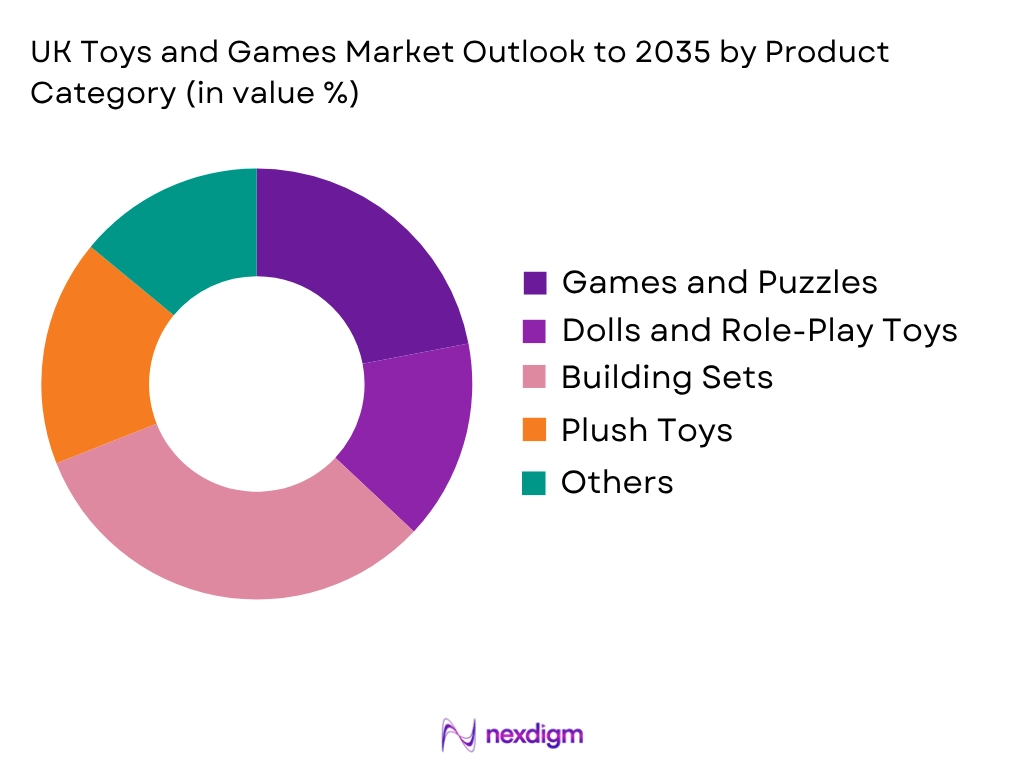
UK Toys and Games Market is segmented by product category into building sets, games and puzzles, plush toys, dolls, action figures, preschool toys, outdoor toys, arts and crafts, STEM toys, trading cards and collectibles. Recently, building sets have a dominant market share in the UK under the product category segmentation, due to the strength of LEGO, licensed construction sets, adult collector builds, STEM construction and premium display products. The category benefits from cross-age appeal because children, parents and kidult buyers all participate in building-set purchases. The Guardian, citing Circana, reported that building sets grew 25% in the following annual cycle, while LEGO floral sets were among the products supporting market recovery. Building sets also suit gifting occasions because they are available across value, mid-market and premium price tiers and can be tied to major IP such as Star Wars, Marvel, Harry Potter and Disney.
By Distribution Channel
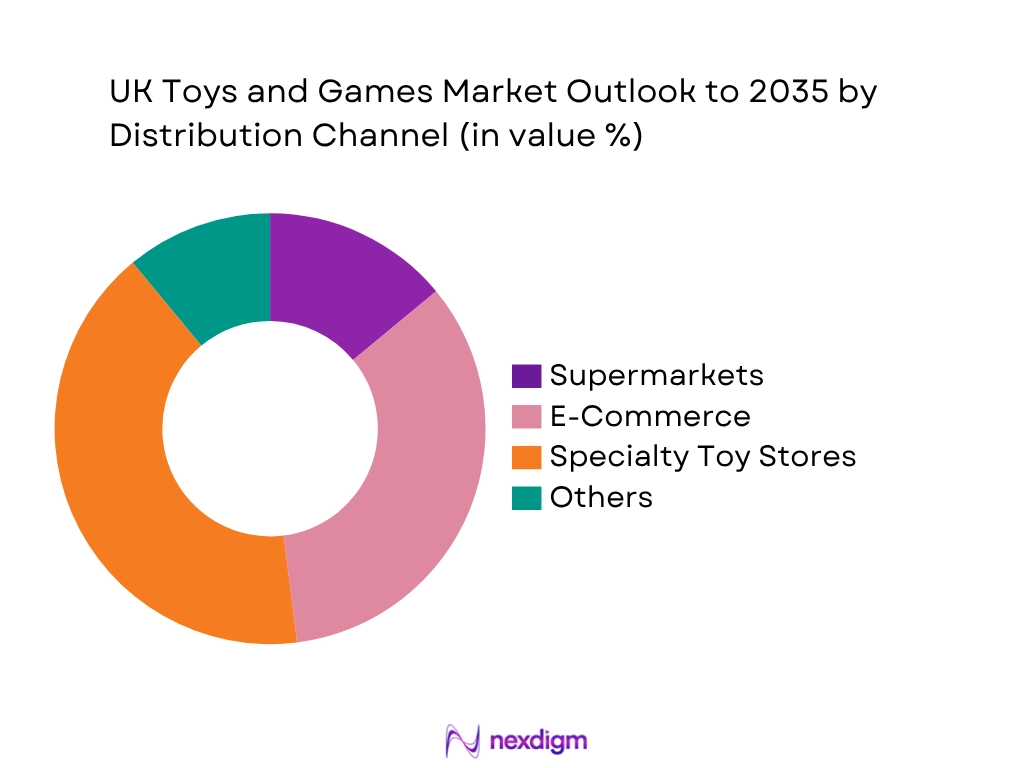
UK Toys and Games Market is segmented by distribution channel into specialist toy stores, e-commerce marketplaces, supermarkets and grocery retailers, general merchandise retailers, hobby/game stores and direct-to-consumer brand sites. Recently, specialist toy stores have a dominant market share in the UK under the distribution channel segmentation because they provide strong category depth, seasonal toy catalogues, trained retail staff, branded displays and premium gifting ranges. Smyths Toys, The Entertainer, Toymaster and Hamleys are especially relevant for Christmas, birthdays, collectibles, licensed toys and high-value purchases. E-commerce marketplaces are highly important for search-led discovery, online reviews, quick delivery and price comparison, but specialist stores remain important because toys are tactile, demonstration-led and gift-led. Supermarkets and value retailers are strong in pocket-money toys, stocking fillers and lower-ticket products, especially when households trade down during cost-of-living pressure.
Competitive Landscape
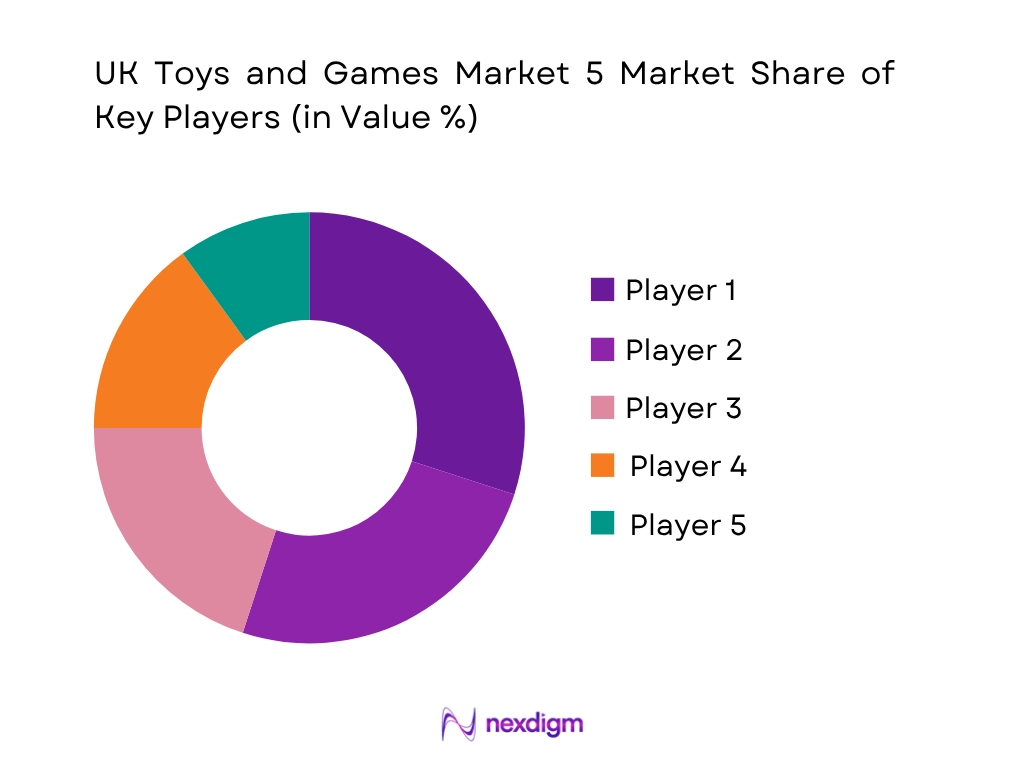
The UK Toys and Games Market is led by a mix of global toy manufacturers, UK specialist retailers, licensed toy companies and collectible-led brands. LEGO, Mattel, Hasbro, Smyths Toys and The Entertainer are among the most influential players because they control key brand franchises, national shelf visibility, e-commerce reach, Christmas merchandising and high consumer trust. Competition is shaped by building sets, licensed IP, plush collectibles, games and puzzles, pocket-money toys, UKCA/CE compliance, retailer exclusives and adult collector demand. The market’s recovery in the following cycle was driven by building sets, film-linked toys, video-game-linked toys and kidult spending.
| Company | Establishment Year | Headquarters | Core Toy Portfolio | UK Channel Strength | Licensing Strength | Consumer Cohort Focus | Compliance Position | Strategic Advantage |
| The LEGO Group | 1932 | Billund, Denmark | ~ | ~ | ~ | ~ | ~ | ~ |
| Mattel UK | 1945 | UK operations; global HQ in California | ~ | ~ | ~ | ~ | ~ | ~ |
| Hasbro UK | 1923 | UK operations; global HQ in Rhode Island | ~ | ~ | ~ | ~ | ~ | ~ |
| Smyths Toys | 1986 | Galway, Ireland | ~ | ~ | ~ | ~ | ~ | ~ |
| The Entertainer | 1981 | Amersham, UK | ~ | ~ | ~ | ~ | ~ | ~ |
UK Toys and Games Market
Growth Drivers
Large Child and Family Consumer Base Supporting Toy Demand
UK Toys and Games Market is supported by a sizeable child and family consumer base that sustains demand for building sets, plush toys, preschool toys, dolls, games, puzzles, outdoor toys, collectibles and licensed products. The Office for National Statistics records the UK population at 69,281,400 in mid-2024, an increase of 755,300 people from mid-2023, giving toy retailers a broad national household base for Christmas, birthdays and everyday gifting. UNICEF’s UN-backed population data records 14,403,544 people under age 18 in the UK, which is directly relevant to age-graded toys, learning products, action figures, character plush and pocket-money collectibles. The World Bank records UK GDP at USD 3.69 trillion and GDP per capita at USD 53,246.4 in 2024, supporting a formal consumer economy for discretionary toy purchases. IMF records UK country population at 69.85 million in 2026 and GDP at USD 4.26 trillion, reinforcing the scale of the future buyer base. This demographic foundation supports specialist toy stores, supermarkets, Amazon UK, Argos, Smyths, The Entertainer and LEGO-led premium gifting.
Omnichannel Retail Infrastructure Expanding Toy Discovery
UK Toys and Games Market is driven by omnichannel retail infrastructure because toys are discovered and purchased through specialist toy stores, Amazon UK, Argos, supermarket aisles, retailer apps, brand-owned platforms and marketplace search. The House of Commons Library reports 304,560 retail businesses as of January 2025 and Great Britain retail sales worth GBP 517 billion in 2024, showing a broad retail base for toys, games, puzzles, plush, seasonal gifts and licensed products. ONS retail data show internet sales as a continuing component of total retail sales, while the wider retail sector includes toy-relevant general merchandise, supermarkets, online retailers and specialist stores. The World Bank records UK GDP at USD 3.69 trillion and GDP per capita at USD 53,246.4 in 2024, indicating the purchasing-power base for omnichannel gifting. IMF records UK GDP at USD 4.26 trillion in 2026, reinforcing the economic scale supporting online toy fulfilment, click-and-collect and D2C collector drops. This channel base supports Smyths, The Entertainer, Hamleys, LEGO.com, Hasbro Pulse, supermarkets and e-commerce marketplaces.
Market Challenges
Toy Safety Compliance and Marketplace Risk
UK Toys and Games Market faces a compliance challenge because all toys placed on the GB market must meet the Toys Safety Regulations 2011, including essential safety requirements, conformity assessment, technical documentation, importer responsibilities and UKCA or CE marking conditions. GOV.UK guidance states that toys can be UKCA marked or CE marked under defined placing-on-market conditions, while Business Companion notes that toys must carry manufacturer/importer identification, a type or batch number and the CE or UKCA mark. This is market-specific because building sets, plush toys, infant toys, pocket-money collectibles, electronic toys, trading cards with accessories and licensed imports are all exposed to compliance checks. The challenge is commercially significant because the UK had 69,281,400 people in mid-2024 and 14,403,544 people under age 18, creating a large consumer base where unsafe toys can trigger recalls and retailer removals. The World Bank records UK GDP at USD ~ trillion in 2024, meaning toy compliance is tied to a major formal retail economy. Brands must manage testing, technical files, age warnings, traceability labels and marketplace seller controls.
Consumer Spending Pressure and Retail Volatility
UK Toys and Games Market faces consumer-spending pressure because toys are discretionary and heavily linked to Christmas, birthdays, promotions and impulse purchases. ONS retail data show retail sales volumes fell by 1.3 in April 2026 after a 0.6 rise in March 2026 and a 0.8 fall in February 2026, indicating a volatile retail backdrop for non-essential categories. ONS GDP data also show real GDP grew by 0.2 in the three months to January 2026, while monthly GDP showed no growth in January 2026. IMF records UK 2026 projected real GDP growth at 0.8, consumer prices at 3.2, and country population at 69.85 million, suggesting limited macroeconomic momentum during a period when toy retailers still need to finance inventory, promotions and seasonal stock. The World Bank records 2024 GDP per capita at USD 53,246.4, but lower growth can still push families toward pocket-money toys, discounts and value retailers. This challenge affects premium building sets, large playsets, electronic toys and licensed collectibles more than low-ticket toys.
Market Opportunities
Kidult, Collectible and Premium Building-Set Expansion
UK Toys and Games Market has a growth opportunity in kidult products, collectibles, premium building sets, anime figures, trading cards, puzzles and nostalgia-led toys because the addressable buyer base extends beyond children. ONS records UK population at 69,281,400 in mid-2024, while UNICEF/UN records 14,403,544 people under age 18, showing that toy demand includes both children and a much larger adult gifting and collecting ecosystem. This matters for LEGO adult display sets, Pokémon cards, Funko figures, anime collectibles, premium puzzles, board games and licensed film or gaming merchandise. The World Bank records UK GDP at USD 3.69 trillion and GDP per capita at USD 53,246.4 in 2024, supporting discretionary purchases in premium and hobby-oriented toy categories. IMF records 2026 GDP at USD 4.26 trillion and GDP per capita at USD 61.06 thousand, reinforcing the economic base for higher-value collector ranges and D2C limited drops. Retailers and brands can use specialist stores, hobby shops, conventions, LEGO.com, Hasbro Pulse and marketplace launches to monetize adult fandom.
Online, Click-and-Collect and D2C Toy Channel Expansion
UK Toys and Games Market has a future opportunity in online retail, click-and-collect, marketplace storefronts and brand-owned D2C channels because the country already has a large formal retail and digital commerce base. The House of Commons Library reports 304,560 retail businesses as of January 2025 and Great Britain retail sales worth GBP 517 billion in 2024, giving toy companies a broad commercial channel ecosystem. ONS internet retail sales data show online sales remain a tracked structural part of the retail industry, which is important for toy discovery through Amazon UK, Argos, Smyths online, The Entertainer, LEGO.com, Funko Shop and Hasbro Pulse. The World Bank records UK GDP at USD 3.69 trillion, GDP per capita at USD 53,246.4, and GDP growth at 1.1 in 2024, supporting a large formal consumption base. IMF records UK GDP at USD 4.26 trillion in 2026. This opportunity is strongest for licensed toys, collectibles, building sets, games, plush and STEM products where online search, reviews, pre-orders, limited drops and Christmas fulfilment are commercially important.
Future Outlook
The UK Toys and Games Market is expected to expand through building sets, licensed entertainment toys, plush collectibles, pocket-money items, games, puzzles, STEM toys and kidult products. The closest published long-term forecast indicates a 4.55% CAGR through 2035, supported by premium licensed toys, e-commerce, specialist retail, adult collectors and digital IP tie-ins. The market will remain highly seasonal, with Christmas, birthdays, Black Friday, film releases, gaming IP and collectible drops influencing stock planning. Retailers and manufacturers will need to manage UKCA/CE compliance, counterfeit marketplace products, consumer spending pressure and import-led supply-chain exposure.
Major Players
- The LEGO Group
- Mattel UK
- Hasbro UK
- Smyths Toys
- The Entertainer
- Character Options
- Moose Toys
- Spin Master
- Jazwares
- Funko
- Bandai UK
- VTech and LeapFrog UK
- Ravensburger UK
- TOMY UK
- ZURU
Key Target Audience
- Toy manufacturers and brand owners
- Licensed merchandise companies
- Specialist toy retail chains
- E-commerce marketplaces and omnichannel retailers
- Supermarket and general merchandise toy category teams
- Entertainment studios and intellectual property licensors
- Investments and venture capitalist firms
- Government and regulatory bodies, including Office for Product Safety and Standards, Trading Standards, Department for Business and Trade, HM Revenue and Customs, Competition and Markets Authority
Research Methodology
Step 1: Identification of Key Variables
The initial phase involves constructing an ecosystem map of the UK Toys and Games Market, covering manufacturers, importers, licensors, specialist retailers, e-commerce marketplaces, supermarkets, hobby stores, parents, kidults and regulators. The key variables include product category, licensed IP, channel mix, age group, price tier, seasonality, safety compliance and collector demand.
Step 2: Market Analysis and Construction
In this phase, historical and current data is compiled from published market benchmarks, industry releases, company information, retail shelf checks and e-commerce assortment mapping. The market is constructed across building sets, plush, games, puzzles, dolls, action figures, preschool toys, outdoor toys, STEM products, trading cards and collectibles.
Step 3: Hypothesis Validation and Expert Consultation
Market hypotheses are validated through computer-assisted interviews with toy manufacturers, retail buyers, distributors, licensors, specialist toy stores, hobby retailers and e-commerce sellers. These consultations validate product dominance, retail channel strength, Christmas demand, pocket-money resilience, kidult behaviour and licensed-property performance.
Step 4: Research Synthesis and Final Output
The final phase integrates top-down market indicators with bottom-up SKU, company, channel and product-level intelligence. This synthesis validates the segmentation, competitive landscape, market outlook and strategic recommendations for manufacturers, retailers, licensors, investors and regulatory stakeholders evaluating the UK Toys and Games Market.

- Executive Summary
- Research Methodology (Market Definitions and Assumptions, Abbreviations, Market Sizing Approach, Top-Down Retail Sales Assessment, Bottom-Up SKU and Channel Mapping, POS Data Review, Toy Fair and Trade Inputs, Retail Shelf Audits, E-Commerce Assortment Checks, Primary Interviews with Retail Buyers/Manufacturers/Distributors/Licensors, Compliance Review, Limitations and Forecast Assumptions)

- Definition and Scope
- Market Genesis
- Business Cycle
- Supply Chain and Value Chain Analysis

- Growth Drivers (Licensed Entertainment IP, Building Sets, Kidult Consumers, Collectibles, Games and Puzzles, Pocket-Money Toys, E-Commerce Convenience, Christmas Gift Culture, STEM Learning Demand)
- Market Challenges (Consumer Spending Pressure, Import Dependence, Retailer Margin Pressure, Counterfeit Toys, Safety Compliance, Digital Entertainment Competition, Short Product Life Cycles, Christmas Inventory Risk)
- Opportunities (Premium Collectibles, Kidult Monetization, Educational Toys, Sustainable Toys, D2C Drops, Inclusive Toys, Hobby Gaming, AI and Interactive Toys)
- Market Trends (Newstalgia, Collectibles, Pocket-Money Toys, Building Sets, Games and Puzzles, Plush, Anime Licensing, Gaming IP, D2C Drops, Sustainable Packaging)
- Government Regulation (Toys Safety Regulations, UKCA Marking, CE Marking, OPSS Guidance, Trading Standards, Product Safety and Metrology, Labelling, Age Warnings, Recall Obligations)
- SWOT Analysis
- Stakeholder Ecosystem
- Porter’s Five Forces Analysis
- PESTLE Analysis
- Competition Ecosystem

- By Value (2020-2025)
- By Volume (2020-2025)
- By Average Selling Price (2020-2025)

- By Product Category (In Value %)
Building Sets
Games and Puzzles
Plush Toys
Action Figures and Playsets
Dolls and Role-Play Toys
- By Age Group (In Value %)
Infants and Toddlers
Preschool Children
Primary School Children
Adults and Kidults - By Distribution Channel (In Value %)
Specialist Toy Stores
E-Commerce Marketplaces
Supermarkets and Grocery Retailers
General Merchandise Retailers
Hobby and Game Stores - By Geography (In Value %)
London and South East
North West and Yorkshire
Midlands
Scotland, Wales and Northern Ireland

- Market Share of Major Players (Value Share, Volume Share, Category Share, Specialist Retail Share, E-Commerce Share, Licensed Toy Share, Collectible Share)
- Cross Comparison Parameters (Product Portfolio: Building Sets/Games/Plush/Dolls/Action Figures/Collectibles/Preschool/Outdoor; Licensed IP Strength: Film/TV/Gaming/Anime/Football/Original IP; Channel Presence: Smyths/The Entertainer/Hamleys/Amazon/Argos/Supermarkets/D2C; Compliance Capability: UKCA/CE/Toys Safety Regulations/Recall Management/Importer Labelling; Kidult and Collector Strength: Premium Sets/Retro IP/Trading Cards/Limited Drops/Fandom)
- SWOT Analysis of Major Players (Brand Equity, Licensed IP Exposure, Import Dependence, Retailer Concentration, Collector Monetization, Safety Compliance)
- Pricing Analysis Basis SKUs
- Detailed Profiles of Major Companies
The LEGO Group
Mattel UK
Hasbro UK
Smyths Toys
The Entertainer
Character Options
Moose Toys
Spin Master
Jazwares
Funko
Bandai UK
VTech and LeapFrog UK
Ravensburger UK
TOMY UK
ZURU

- Parent and Household Buyer Analysis
- Child Demand Analysis
- Grandparent and Gift Buyer Analysis
- Kidult and Collector Analysis
- Hobby Gamer Analysis

- By Value, 2026-2035
- By Volume, 2026-2035
- By Average Price, 2026-2035


 Request a Sample
 Ask for Customization
 Get a Quote
 Enquire Now