
 Download PDF
Market Overview
The UK Vegetable Seed Market is positioned within the broader United Kingdom seeds market, which reached approximately USD ~ billion, while vegetable-seed demand is driven by field vegetables, protected crops, hydroponic leafy greens and retail packet seeds. Defra reported UK vegetable production at 2.4 million tonnes and vegetable production value at just over £2 billion, compared with 2.3 million tonnes and around £1.96 billion earlier. This supports demand for hybrid, treated, pelleted and disease-resistant vegetable seeds. East of England, Lincolnshire, Yorkshire, Kent, Lea Valley, Scotland and the West Midlands dominate the UK Vegetable Seed Market because they host field vegetable belts, glasshouse clusters, packhouses, propagators and supermarket-linked growers. Defra reported UK vegetable area at 97 thousand hectares, while protected vegetable output reached 254 thousand tonnes from 804 hectares. East Anglia and Lincolnshire dominate carrots, onions, brassicas and peas, while Kent and Lea Valley dominate glasshouse tomato, cucumber, pepper, lettuce and herbs.
Market Segmentation
By Breeding Technology
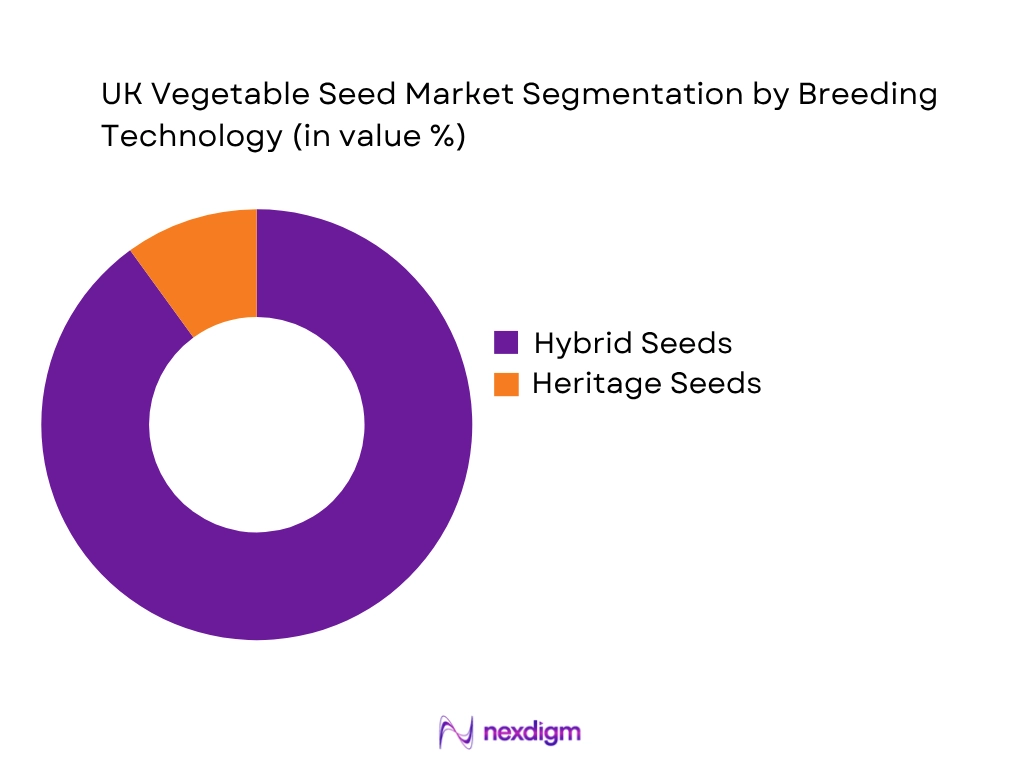
UK Vegetable Seed Market is segmented by breeding technology into hybrid seeds and open-pollinated and heritage seeds. Hybrid seeds dominate the market because commercial vegetable growers require predictable crop uniformity, disease resistance, shelf-life performance, retailer-grade output and harvest scheduling across short planting windows. UK field vegetable growers use hybrid seeds in brassicas, carrots, onions, lettuce, cucumber, tomato and pepper because supermarkets and processors require size consistency, colour uniformity, shape control and low rejection rates. Hybrid penetration is also supported by protected cultivation, where tomato, cucumber and pepper growers need varieties with high-wire suitability, disease tolerance and consistent fruit set. Open-pollinated and heritage seeds remain relevant for allotments, organic growers and amateur gardeners, but commercial adoption is lower because these varieties generally provide less uniformity and weaker retailer-grade performance. Europe vegetable seed data identifies hybrids as the dominant breeding-technology segment, and UK commercial production follows similar buyer-driven quality requirements.
By Cultivation Mechanism
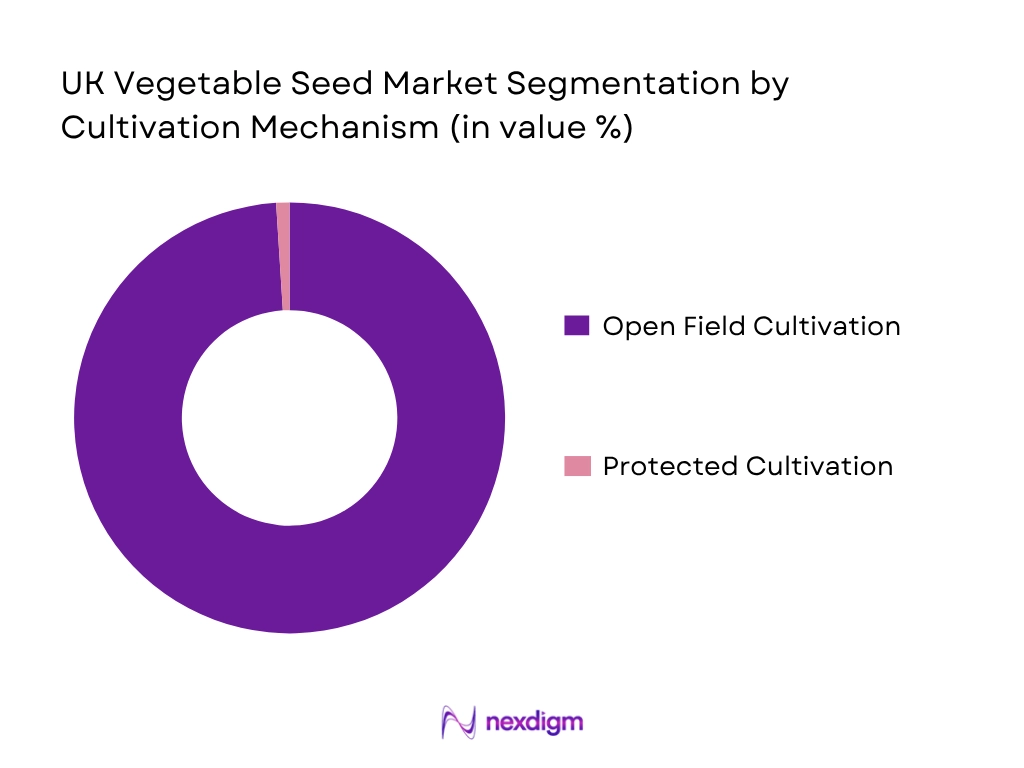
UK Vegetable Seed Market is segmented by cultivation mechanism into open field cultivation and protected cultivation. Open field cultivation dominates because most UK vegetable acreage is still dedicated to carrots, onions, brassicas, peas, beans, leeks, beetroot, lettuce and other field vegetables. Defra reported vegetable area at 97 thousand hectares, compared with only 804 hectares under protected vegetable production, showing why open-field seed demand remains structurally larger. Field vegetable growers depend on seed varieties that deliver establishment reliability, cool-soil emergence, disease resistance, mechanical-harvest suitability and packhouse-grade output. Protected cultivation has a smaller share but higher strategic value because glasshouse and hydroponic growers require premium tomato, cucumber, pepper, lettuce, basil, rocket and microgreen seeds. Demand in protected cultivation is linked to year-round supply, import substitution, energy-efficient genetics and controlled-environment crop planning.
Competitive Landscape
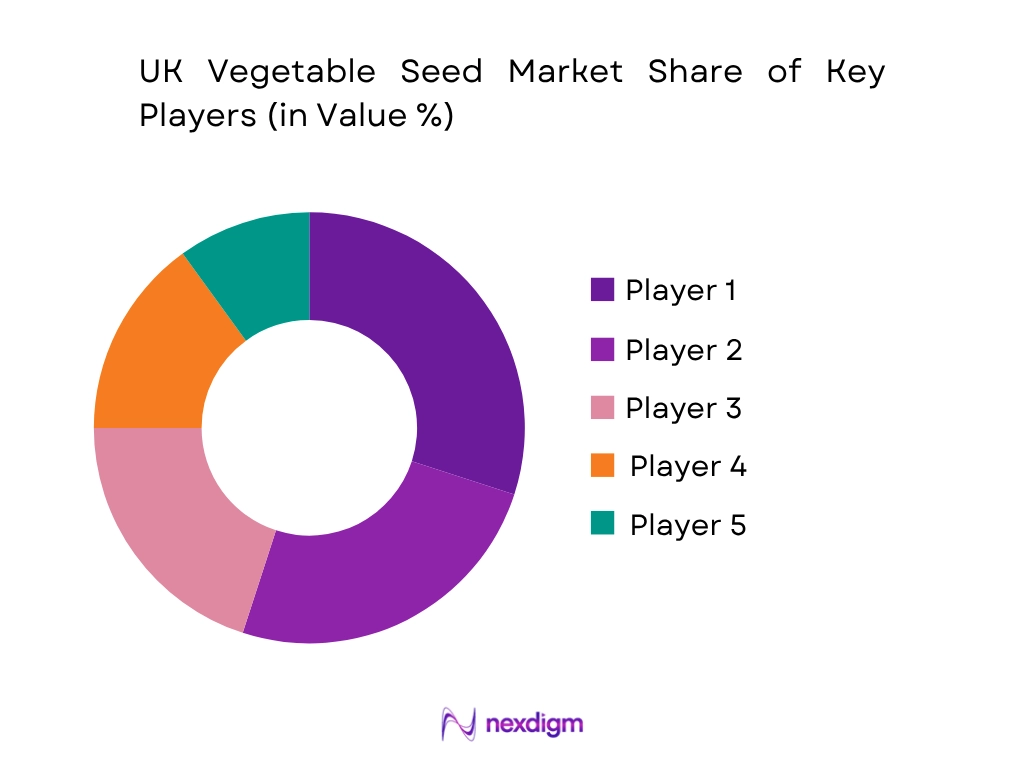
The UK Vegetable Seed Market is served by a mix of domestic breeders, global vegetable seed companies and retail packet specialists. Tozer Seeds, Elsoms Seeds and CN Seeds are important UK-origin players with strong field vegetable, herb, salad and specialist crop portfolios. Syngenta and BASF/Nunhems compete through hybrid vegetable genetics, protected-crop lines and disease-resistance packages. Competition is shaped by UK-adapted varieties, APHA-compliant seed movement, seed merchant relationships, protected-cultivation performance and retail-garden brand strength.
| Company | Establishment Year | Headquarters | Key UK Vegetable Seed Focus | Main Crop Families | Channel Strength | Protected Crop Strength | Seed Technology Focus | Market Positioning |
| Tozer Seeds | 1939 | Cobham, UK | ~ | ~ | ~ | ~ | ~ | ~ |
| Elsoms Seeds | 1844 | Spalding, UK | ~ | ~ | ~ | ~ | ~ | ~ |
| CN Seeds | 1990 | Pymoor, UK | ~ | ~ | ~ | ~ | ~ | ~ |
| Syngenta Vegetable Seeds | 2000 | Basel, Switzerland | ~ | ~ | ~ | ~ | ~ | ~ |
| BASF Vegetable Seeds / Nunhems | 1865 | Ludwigshafen, Germany | ~ | ~ | ~ | ~ | ~ | ~ |
The UK Vegetable Seed Market Analysis
Growth Drivers
Field Vegetable Production Sustains Demand for Hybrid and Precision-Sown Seeds
The UK Vegetable Seed Market is supported by a sizeable field-vegetable base that requires recurring purchases of carrot, onion, brassica, pea, bean, beetroot and salad-crop seeds. Defra reported field-vegetable production of 2.108 million tonnes and field-vegetable area of 97 thousand hectares, while total UK vegetable supply reached 4.466 million tonnes. Carrots alone produced 785 thousand tonnes, supported by a planted area of 10 thousand hectares, making carrot seed, pelleted seed and primed seed important for precision drilling. The macro base reinforces this demand: the World Bank reported UK GDP at USD 3.69 trillion, GDP per capita at USD 53,246.4, and population at 69 million people, indicating a large food-consumption economy that requires stable domestic vegetable output. For seed suppliers, this production scale supports demand for F1 hybrids, high-germination lots, cool-soil emergence traits, disease resistance, uniform maturity and varieties aligned with packhouse and supermarket specifications.
Protected Vegetable Production Strengthens Demand for High-Value Glasshouse Seeds
The UK Vegetable Seed Market is driven by protected cultivation because glasshouse and polytunnel systems need premium genetics for tomato, cucumber, pepper, lettuce and herb production. Defra reported protected vegetable production of 254 thousand tonnes from 804 hectares, compared with 249 thousand tonnes earlier, showing the intensity of output generated from a limited controlled-environment area. Protected crops rely on seeds with uniform germination, disease-tested lots, controlled plant architecture, fruit consistency and suitability for high-wire or hydroponic systems. Total vegetable supply reached 4.466 million tonnes, while imports reached 2.2 million tonnes, making domestic glasshouse production strategically relevant for supply resilience. The World Bank’s UK macro profile, with GDP of USD 3.69 trillion, GDP per capita of USD 53,246.4, and population of 69 million people, supports demand for year-round fresh produce. This creates a commercial pull for greenhouse cucumber, tomato, pepper, lettuce, basil and microgreen seed portfolios with higher technical support requirements.
Market Challenges
Weather Volatility Disrupts Planting Windows and Seed Demand Planning
The UK Vegetable Seed Market faces weather-linked risk because field vegetables depend on precise drilling, transplanting and harvesting windows. Defra reported that the year began with an exceptionally wet spring, delaying crop planting and disrupting harvesting schedules, while vegetable area declined to 97 thousand hectares and total field-vegetable production stood at 2.108 million tonnes. The Met Office reported that October to March was the wettest winter half-year for England and Wales in over 250 years, with flooding affecting eastern Scotland, Derbyshire, Nottinghamshire and the West Midlands. Carrot planting was affected by wet and cold conditions, and late-season carrots faced cavity spot, violet root rot and bacterial rots. The World Bank recorded UK GDP at USD 3.69 trillion and GDP per capita at USD 53,246.4, showing a high-income food economy, but weather variability raises seed inventory risk, shifts variety choices and increases grower need for resilient seed genetics.
Seed Marketing, Labelling and Cross-Border Rules Increase Compliance Burden
The UK Vegetable Seed Market faces operational complexity from certification, packing, sealing, labelling, supplier-address and cross-border seed-movement rules. GOV.UK states that seeds must be packed under supervision of a licensed seed sampler and cannot be marketed unless this is done; certified seed must use official labels from the APHA label contractor, while standard vegetable seed or small packets must use a supplier label. The UK Plant Health Information Portal states that standard vegetable seed can be marketed into the EU and Northern Ireland only with a supplier’s label and phytosanitary certificate, and certified vegetable seed from Great Britain is not included in the relevant draft equivalence decision. These rules affect seed merchants, importers and distributors serving a market with 97 thousand hectares of vegetable area and 4.466 million tonnes of total vegetable supply. With UK GDP at USD 3.69 trillion and population at 69 million people, compliance reliability is essential for uninterrupted commercial seed availability.
Market Opportunities
Domestic Supply Gap Creates Opportunity for UK-Adapted Vegetable Seed Portfolios
The UK Vegetable Seed Market has an opportunity in domestic-supply resilience because the country depends heavily on imported vegetables while still maintaining a large local production platform. Defra reported total vegetable supply of 4.466 million tonnes, imports of 2.2 million tonnes, exports of 75 thousand tonnes, and home production of 2.4 million tonnes. This gap supports demand for UK-adapted seeds that help domestic growers improve establishment, uniformity, shelf life and packhouse acceptance across carrots, onions, brassicas, lettuce, peas and beans. Field vegetable area reached 97 thousand hectares, while protected vegetables added 254 thousand tonnes of output from 804 hectares, giving seed companies multiple routes to serve domestic production. The World Bank reported a UK population of 69 million people, GDP of USD 3.69 trillion, and GDP per capita of USD 53,246.4, showing a large consumer market capable of sustaining demand for local fresh vegetables. This supports future positioning of resilient hybrids, pelleted lettuce, primed carrots, disease-resistant brassicas and high-uniformity onion seeds.
Controlled-Environment and Leafy-Green Systems Create Scope for Premium Seed Innovation
The UK Vegetable Seed Market has an opportunity in controlled-environment crops because high-output protected systems require specialized seeds rather than commodity field varieties. Defra reported protected vegetable production of 254 thousand tonnes from 804 hectares, while field vegetable production reached 2.108 million tonnes across 97 thousand hectares. The difference in production intensity makes protected cultivation commercially important for tomato, cucumber, pepper, lettuce, basil, rocket and microgreen seed suppliers. Protected systems need uniform seed lots, disease testing, compact growth habit, predictable germination and compatibility with hydroponic propagation. Defra also reported total UK vegetable supply of 4.466 million tonnes and vegetable imports of 2.2 million tonnes, showing scope for domestic production systems that reduce exposure to external supply disruption. The World Bank reported UK GDP per capita at USD 53,246.4, GDP at USD 3.69 trillion, and population at 69 million people, supporting demand for reliable year-round fresh produce. Seed companies can use this base to expand glasshouse tomato, cucumber, pepper, herb and leafy-green portfolios.
Future Outlook
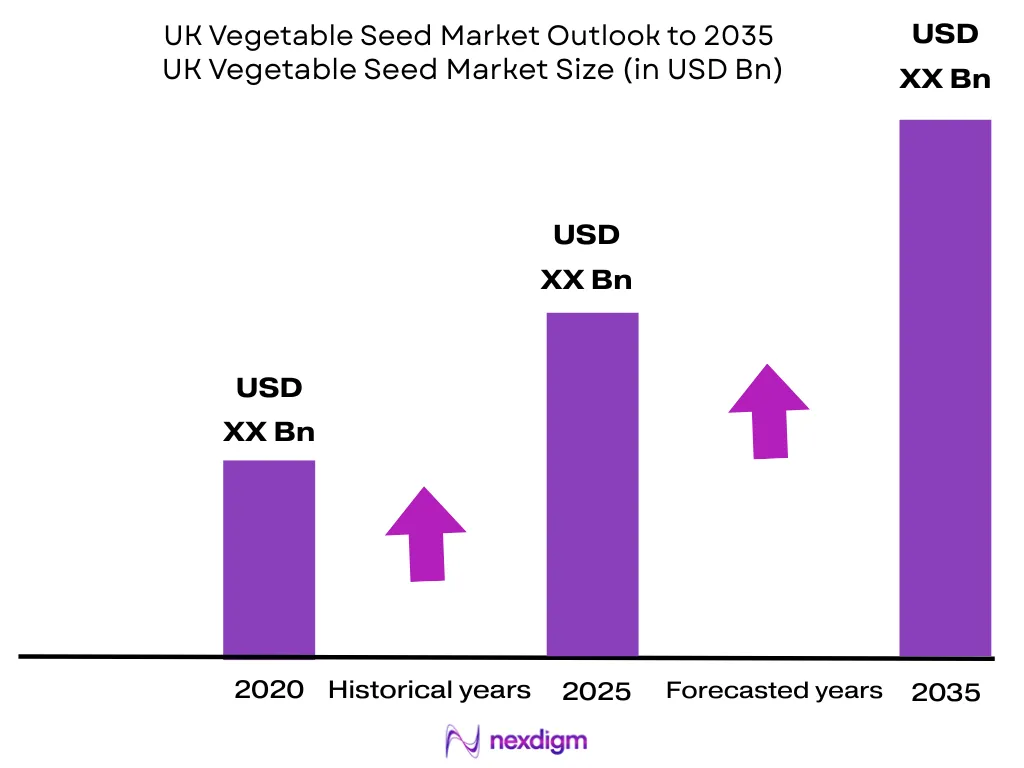
The UK Vegetable Seed Market is expected to grow steadily at around 4.6% CAGR during the long-term forecast period, using the broader UK seed-market benchmark as the nearest available country-level public indicator. Growth will be supported by domestic vegetable supply resilience, hybrid adoption, protected cultivation, hydroponic leafy greens, seed enhancement and disease-resistant varieties. Over the next phase, the UK Vegetable Seed Market will increasingly shift toward seeds designed for weather volatility, short planting windows and high retail specification compliance. Field vegetable growers will require carrots, onions, brassicas, peas and salad varieties with better establishment and harvest uniformity. Glasshouse operators will focus on tomato, cucumber and pepper varieties that perform under energy-sensitive production systems. Hydroponic and vertical farms will create demand for lettuce, herbs, rocket, basil and microgreen genetics. Seed pelleting, priming, biological coatings and digital variety selection will become more important as growers seek precision, consistency and reduced crop failure.
Major Players
- Tozer Seeds
- Elsoms Seeds
- CN Seeds
- Syngenta Vegetable Seeds
- BASF Vegetable Seeds / Nunhems
- Bayer Vegetable Seeds / Seminis / De Ruiter
- Rijk Zwaan UK
- Enza Zaden UK
- Sakata UK
- Bejo Seeds UK
- HM.CLAUSE UK
- Hazera Seeds UK
- Kings Seeds
- Mr Fothergill’s Seeds
- Johnsons Seeds
Key Target Audience
- Vegetable Seed Manufacturers
- Hybrid Vegetable Seed Breeding Companies
- Commercial Field Vegetable Growers
- Glasshouse and Protected Cultivation Operators
- Hydroponic and Vertical Farming Operators
- Seed Merchants and Agronomy Distributors
- Investments and Venture Capitalist Firms
- Government and Regulatory Bodies
Research Methodology
Step 1: Identification of Key Variables
The initial phase involves constructing an ecosystem map for the UK Vegetable Seed Market, covering breeders, seed merchants, importers, APHA-compliant packers, propagators, growers, glasshouse operators and garden retail channels. The primary objective is to identify critical variables including crop family, breeding technology, cultivation mechanism, seed treatment, seed replacement frequency and regional production concentration.
Step 2: Market Analysis and Construction
In this phase, historical data is compiled for vegetable production, planted area, protected-crop area, crop output, import dependency and grower structure. The model links seed use with commercial acreage, planting density, crop cycles, seed pack formats, seed treatment type, grower segments and channel margins to construct a validated market view.
Step 3: Hypothesis Validation and Expert Consultation
Market hypotheses are validated through structured interviews with vegetable seed suppliers, seed merchants, commercial growers, glasshouse operators, hydroponic producers and propagators. These consultations support assumptions on hybrid adoption, field crop demand, protected-crop seed usage, germination requirements, disease-resistance preference and regional sales patterns.
Step 4: Research Synthesis and Final Output
The final phase integrates secondary data, primary inputs, company portfolio mapping and bottom-up crop-demand modelling into a final report. The output is checked across market size, segmentation, competitive landscape, regulatory framework and future outlook to ensure consistency for business professionals, investors and seed suppliers.

- Executive Summary
- Research Methodology (Market Definitions and Assumptions, Vegetable Seed Taxonomy, Commercial vs Retail Seed Boundary, Hybrid/Open-Pollinated/Heirloom/Organic/Untreated Seed Classification, Market Sizing Approach, Top-Down Seed Revenue Validation, Bottom-Up Crop Area-to-Seed Requirement Model, Primary Interviews with Breeders/Distributors/Growers/Glasshouse Operators, APHA Seed Certification Validation, Variety Listing Review, Dealer Channel Mapping, Limitations and Future Conclusions)

- Definition and Scope
- Overview Genesis
- Evolution of Vegetable Breeding and Seed Supply in the UK
- Timeline of Major Players
- Business Cycle

- Growth Drivers (Hybrid Adoption, Domestic Food Security, Protected Cultivation, Seed Replacement, Retail Vegetable Standards)
- Market Challenges (Weather Volatility, Seed Import Dependence, Regulatory Complexity, Labour Constraints, Energy Costs, Disease Pressure)
- Opportunities (Protected Crop Genetics, Domestic Breeding, Organic Seeds, Pelleting and Priming, Vertical Farming, Retail Garden Seed Premiumization)
- Trends (Hybridization, Seed Enhancement, Digital Variety Selection, Protected-Crop Specialization, Heritage Seed Revival, Climate-Resilient Breeding)
- SWOT Analysis
- Porter’s Five Forces
- PESTLE Analysis

- By Value (2020-2025)
- By Volume (2020-2025)
- By Average Realization per Kilogram/Thousand Seeds (2020-2025)

- By Crop Family (In Value %)
Carrot Seeds
Onion and Allium Seeds
Brassica Seeds
Lettuce and Leafy Green Seeds
Tomato Seeds - By Distribution Channel (In Value %)
Direct-to-Grower Sales
Seed Merchants and Regional Distributors
Agronomy Distributors
Grower Cooperatives and Producer Organisations
Online B2B Platforms - By End User (In Value %)
Commercial Field Vegetable Growers
Glasshouse Growers
Hydroponic and Vertical Farm Operators
Organic Growers
Seedling Nurseries and Propagators - By Region (In Value %)
East of England
Lincolnshire and Yorkshire
Kent and South East
Scotland
West Midlands

- Market Share of Major Players (Commercial Vegetable Seed Revenue, Crop-Family Share, Hybrid Share, Retail Seed Packet Presence)
- Cross Comparison Parameters (UK-Adapted Vegetable Portfolio Breadth, Hybrid F1 Strength, Disease-Resistance Trait Depth, Protected-Cultivation Variety Portfolio, APHA/UK Seed Compliance Capability, Seed Treatment/Pelleting Capability, Merchant and Distributor Network Coverage, Trial and Technical Agronomy Support)
- SWOT Analysis of Major Players
- Detailed Profiles of Major Companies
Tozer Seeds
Elsoms Seeds
CN Seeds
Syngenta Vegetable Seeds
BASF Vegetable Seeds / Nunhems
Bayer Vegetable Seeds / Seminis / De Ruiter
Rijk Zwaan UK
Enza Zaden UK
Sakata UK
Bejo Seeds UK
HM.CLAUSE UK
Hazera Seeds UK
Kings Seeds
Mr Fothergill’s Seeds
Johnsons Seeds

- Commercial Field Vegetable Grower Analysis
- Processing Vegetable Grower Analysis
- Glasshouse Grower Analysis
- Hydroponic and Vertical Farm Operator Analysis
- Organic Grower Analysis

- By Value (2026-2035)
- By Volume (2026-2035)
- By Average Realization per Kilogram/Thousand Seeds (2026-2035)


 Request a Sample
 Ask for Customization
 Get a Quote
 Enquire Now