
 Download PDF
Market Overview
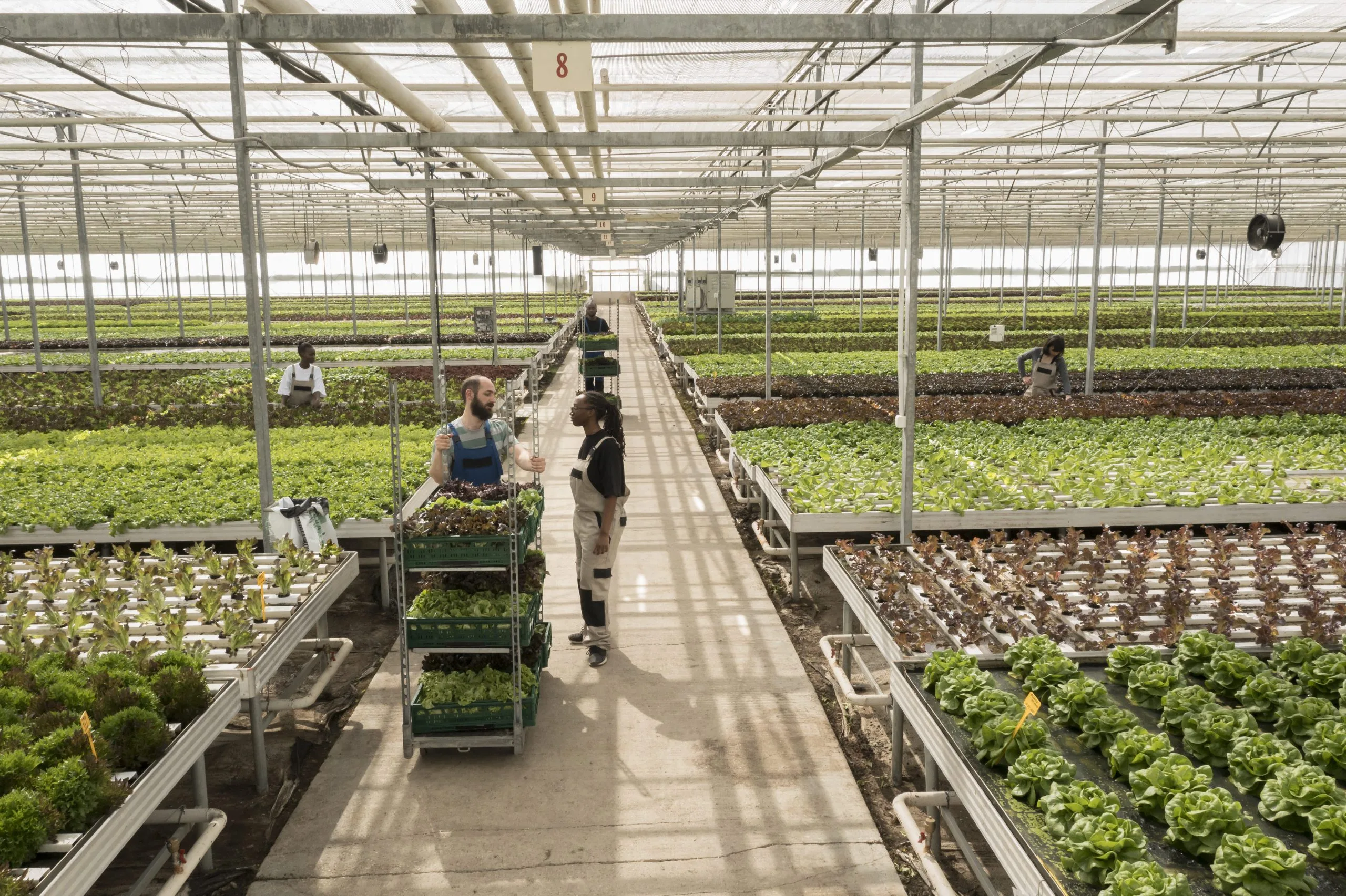
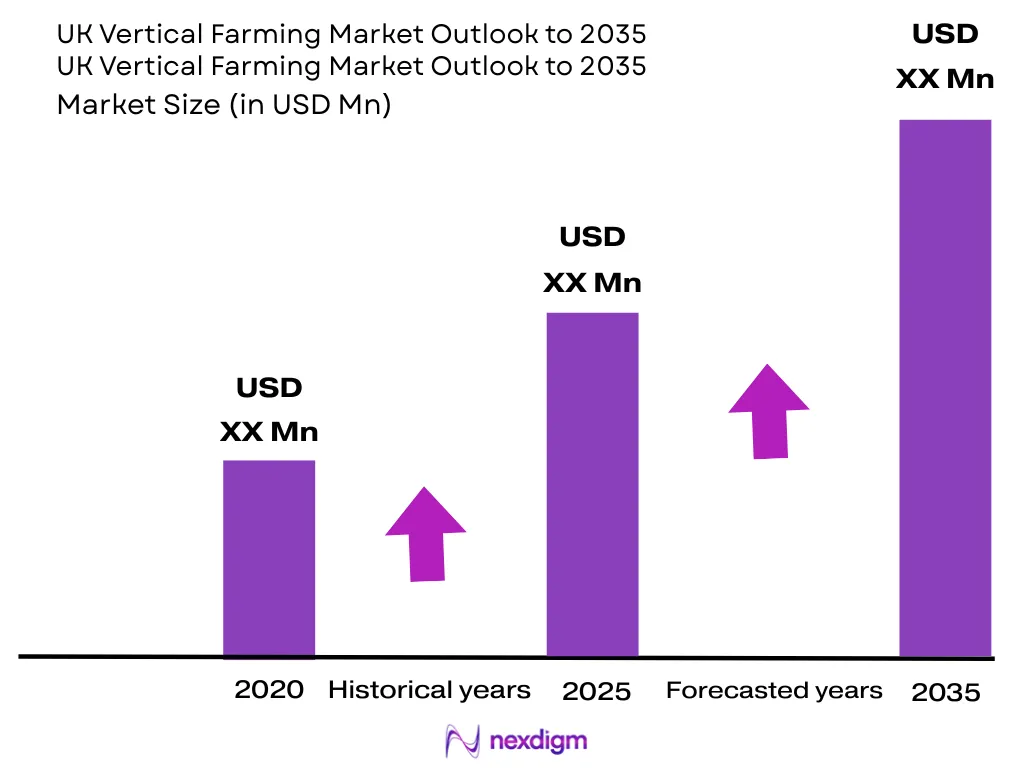
The UK Vertical Farming Market was valued at approximately USD ~ Million in 2024 and has emerged as one of the most technologically advanced segments within controlled environment agriculture in Europe. Market growth is supported by increasing demand for locally grown produce, water-efficient cultivation systems, and year-round crop production. According to the Department for Environment, Food and Rural Affairs (DEFRA), controlled environment agriculture operations continued to expand, while the UK leafy greens market sustained strong annual consumption. Rising investments in artificial intelligence, automation systems, and LED lighting infrastructure have further strengthened commercial scalability, enabling vertical farms to improve productivity and resource efficiency. The UK’s established food retail infrastructure, world-leading agri-technology research institutions, and ambitious net zero commitments have collectively reinforced its position as one of Europe’s most significant vertical farming markets.
Market Segmentation
By Crop Type
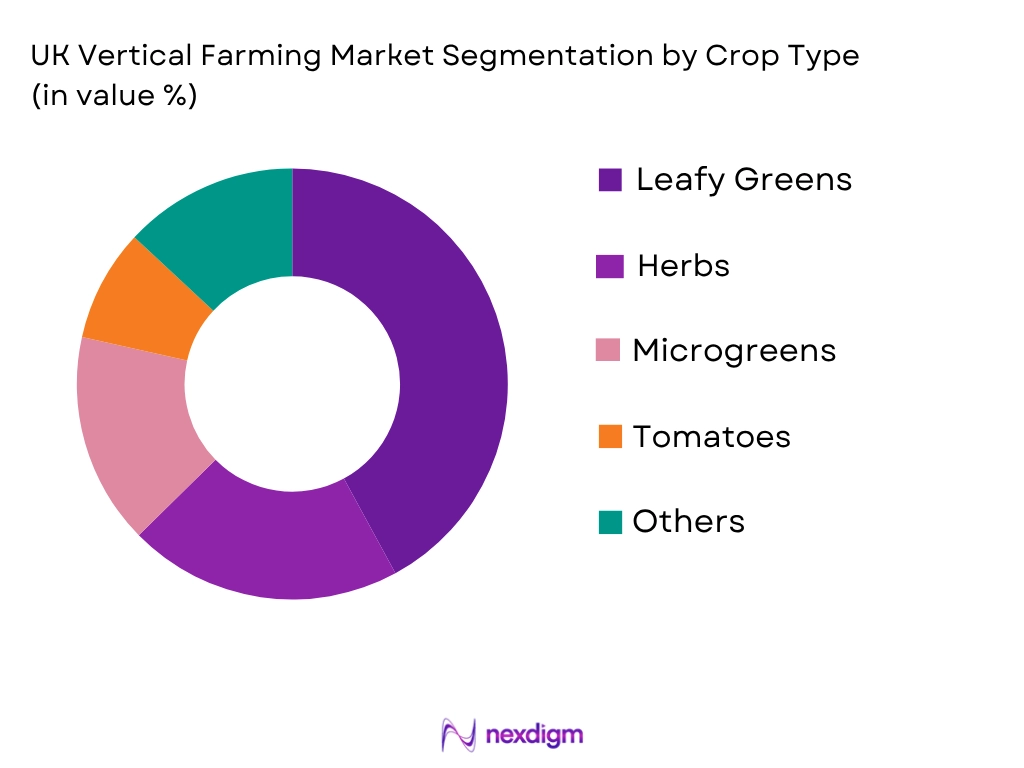
The UK Vertical Farming Market is segmented by crop type into leafy greens, herbs, microgreens, tomatoes, strawberries, cucumbers, and other specialty crops. Leafy greens dominate the market due to their short cultivation cycles, high yield density, predictable growing conditions, and strong demand from retailers and foodservice operators. Crops such as lettuce, kale, spinach, and rocket are particularly suited to stacked indoor environments because they require limited vertical space and generate multiple harvest cycles annually. Furthermore, leafy greens command premium prices owing to their pesticide-free production and superior freshness — attributes increasingly valued by health-conscious British consumers in urban centres such as London, Manchester, Birmingham, and Edinburgh. The segment also benefits from established operational expertise among commercial vertical farm operators, making it the preferred crop category for maximising profitability and facility utilisation within the UK market.
By Growing Mechanism
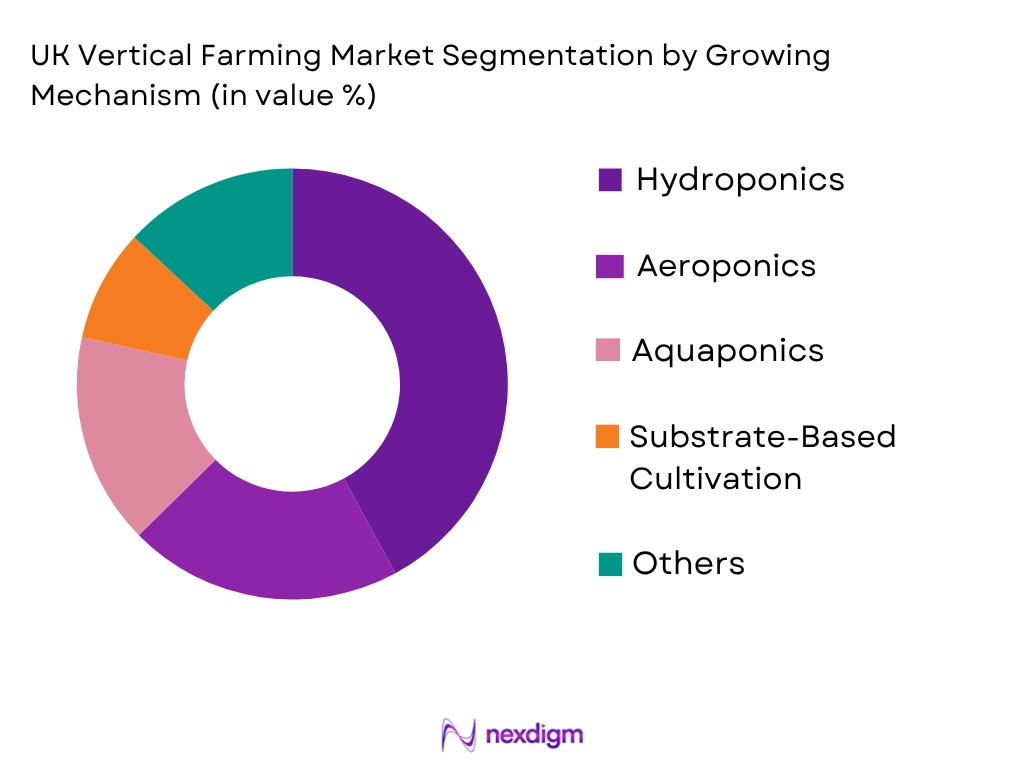
The UK Vertical Farming Market is segmented by growing mechanism into hydroponics, aeroponics, aquaponics, and substrate-based cultivation. Hydroponics holds the dominant market share due to its proven commercial viability, lower operational complexity, and consistent crop performance. The system enables precise nutrient delivery while significantly reducing water consumption compared to traditional agriculture — a benefit increasingly valued in the context of the UK’s periodic summer water stress and hosepipe restrictions. Hydroponic setups are widely adopted across commercial vertical farms because they offer predictable yields, scalability, and compatibility with automation technologies. Most leading UK operators have standardised hydroponic systems for leafy greens and herbs, resulting in lower maintenance costs and greater operational efficiency. The widespread availability of hydroponic equipment suppliers and established technical expertise further strengthens its position as the preferred cultivation method across the industry.
Competitive Landscape
The UK Vertical Farming Market is characterised by a dynamic and increasingly competitive environment led by technology-driven agricultural companies focused on indoor cultivation, automation, and sustainable food production. Leading participants continue to invest in artificial intelligence, robotics, climate-control systems, and advanced lighting technologies to improve operational efficiency and profitability. Strategic partnerships with major UK retailers — including Tesco, Sainsbury’s, Marks & Spencer, Waitrose, and Ocado — remain critical competitive advantages for commercial operators seeking consistent volume offtake and premium positioning. The market has also witnessed growing interest from international vertical farming operators establishing UK presences, alongside domestic technology developers providing turnkey growing systems to third-party operators.
| Company | Establishment Year | Headquarters | Primary Crop Focus | Growing Technology | Automation Level | Geographic Presence | Retail Partnerships | Sustainability Focus |
| Jones Food Company | 2017 | ~ | ~ | ~ | ~ | ~ | ~ | ~ |
| LettUs Grow | 2015 | ~ | ~ | ~ | ~ | ~ | ~ | ~ |
| GrowUp Farms | 2013 | ~ | ~ | ~ | ~ | ~ | ~ | ~ |
| Intelligent Growth Solutions | 2016 | ~ | ~ | ~ | ~ | ~ | ~ | ~ |
| Fischer Farms | 2019 | ~ | ~ | ~ | ~ | ~ | ~ | ~ |
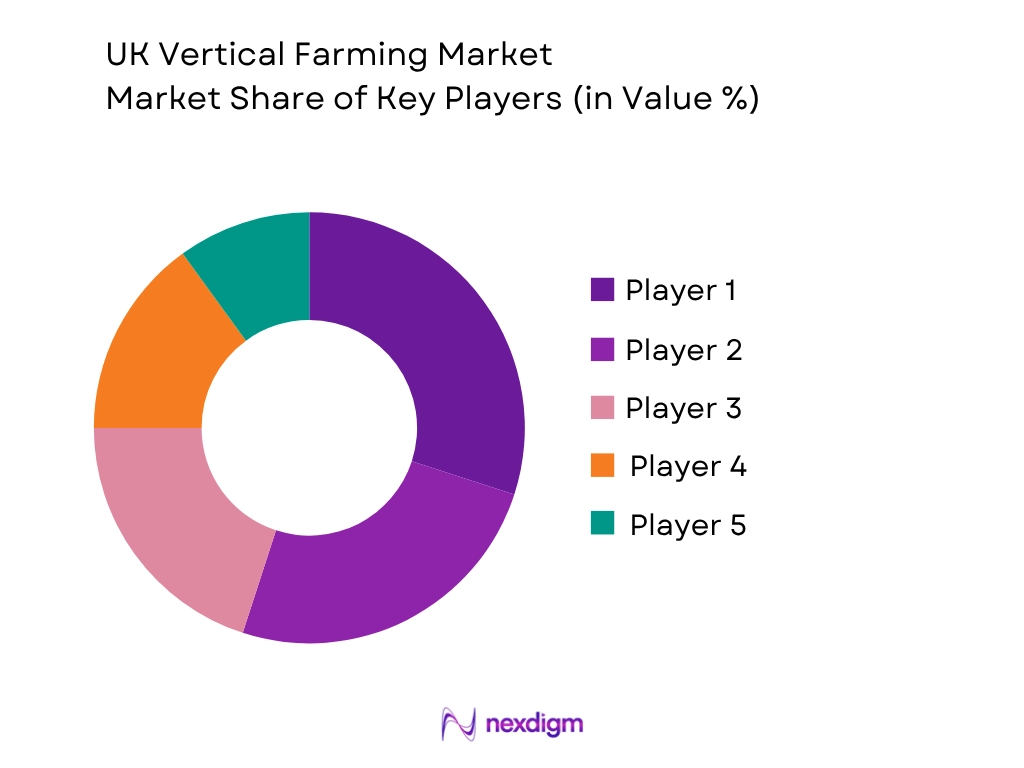
UK Vertical Farming Market Analysis
Growth Drivers
Urban Food Security and Population Concentration
The increasing concentration of population in urban areas is significantly driving the UK Vertical Farming Market as cities seek localised and resilient food production systems. According to the Office for National Statistics (ONS), the United Kingdom’s population exceeded 67 million in 2024, with more than 56 million people residing in urban areas. The World Bank reported that urban population accounted for approximately 84% of the total UK population in 2024, creating substantial demand for fresh produce near consumption centres. DEFRA reported that UK consumers spent over £120 billion annually on food and drink, with leafy greens and fresh herbs among the most frequently purchased produce categories in major supermarket chains. Vertical farming enables cultivation near major metropolitan areas such as London, Manchester, Birmingham, Leeds, and Glasgow, reducing transportation distances and minimising post-harvest losses. The UK Government’s National Food Strategy has highlighted the importance of building food system resilience, including diversification of domestic production capabilities. As UK retailers and foodservice operators increasingly prioritise supply chain resilience following Brexit-related trade disruption and post-pandemic logistics challenges, urban vertical farms offer a strategically compelling solution. The combination of dense urban populations, growing fresh produce demand, and pressure on import-dependent supply chains continues to support investment in controlled environment agriculture technologies across the country.
Increasing Adoption of Controlled Environment Agriculture Technologies
Technological advancements in controlled environment agriculture are accelerating the adoption of vertical farming systems throughout the United Kingdom. According to the Department for Energy Security and Net Zero (DESNZ), commercial LED lighting installations continued to expand across agricultural facilities due to their superior energy efficiency and crop optimisation capabilities. Innovate UK and the UK Research and Innovation (UKRI) have increased funding support for agricultural technology innovation through programmes including the Farming Innovation Programme and the Industrial Strategy Challenge Fund. The World Bank estimated UK GDP at over USD 3.1 trillion in 2024, supporting strong investment capacity for advanced agricultural infrastructure. AI-driven monitoring systems, climate-control technologies, automated nutrient delivery systems, and robotic harvesting solutions have improved productivity and operational consistency in indoor farms. The UK Intellectual Property Office recorded growing numbers of active agricultural technology patents related to sensors, automation, and environmental control systems. Additionally, the Department for Energy Security and Net Zero continues supporting energy-efficient technology deployment across commercial facilities, aligned with the UK’s legally binding 2050 net zero target. These technological improvements enable year-round crop production independent of the UK’s variable weather conditions while maximising yield per square foot. The increasing availability of automation solutions and digital farm management platforms is enhancing the commercial viability of vertical farming operations and supporting broader market expansion.
Market Challenges
High Energy Consumption and Electricity Dependence
High energy consumption remains one of the most significant challenges facing the UK Vertical Farming Market. According to the Department for Energy Security and Net Zero, total UK electricity consumption continued in 2024, while commercial electricity prices remained among the highest in Europe, significantly impacting the operating economics of energy-intensive indoor farms. Indoor farms require continuous lighting, climate control, ventilation, dehumidification, and irrigation systems to maintain optimal growing conditions year-round. The Energy and Climate Intelligence Unit has noted that the UK’s commercial electricity prices are substantially above the European average, creating a structural cost disadvantage for UK vertical farm operators relative to peers in continental Europe. Cities such as London, Manchester, and Edinburgh, which are major centres for vertical farming activity, face elevated electricity costs that compress margins for operators dependent on grid supply. The UK’s relatively limited daylight hours and frequent overcast conditions during autumn and winter months increase the supplemental lighting requirements for indoor farms compared to more southerly European markets. While renewable energy integration is expanding — with the UK government committed to clean electricity generation by 2030 — many operators still depend on grid supply at peak commercial tariffs. This creates pressure on operational margins and limits scalability for some facilities. The challenge of managing electricity costs while maintaining crop productivity remains a defining profitability constraint across the UK vertical farming sector.
Limited Crop Diversity and Commercial Scalability Constraints
Although vertical farming has demonstrated success with leafy greens and herbs in the UK, commercial scalability across a broader range of crops remains a challenge. According to DEFRA and the Agriculture and Horticulture Development Board (AHDB), the United Kingdom produced millions of tonnes of fresh vegetables and fruit annually, with field-grown produce continuing to dominate overall domestic supply volumes across commodity categories. However, many crops are not yet economically viable for large-scale vertical farming due to space requirements, pollination complexity, or longer growth cycles. The AHDB has highlighted that field-grown and glasshouse-produced vegetables continue to hold a cost advantage over vertically farmed alternatives in most commodity categories beyond premium leafy greens and speciality herbs. Crops such as brassicas, root vegetables, and many soft fruit varieties require significantly larger growing areas or more complex environmental management than current UK vertical farming systems can efficiently provide at commercially competitive cost points. Additionally, maintaining optimal environmental conditions for fruiting crops often requires greater energy and technological inputs. The UK’s Department for Environment, Food and Rural Affairs has highlighted ongoing investment requirements for sustainable agricultural infrastructure modernisation, yet many UK vertical farming companies continue to focus primarily on premium leafy greens and herbs targeting high-margin retail and foodservice channels. Until technological innovations further improve crop economics and production efficiency, product diversification may remain limited, restricting the addressable market and slowing broader adoption.
Market Opportunities
Expansion of Retail Partnerships and Local Food Supply Chains
The growing emphasis on local food sourcing presents a major opportunity for the UK Vertical Farming Market. According to the British Retail Consortium (BRC), UK supermarkets and grocery retailers are increasing procurement of domestically grown produce to meet consumer demand for freshness, food safety, and sustainability, while simultaneously reducing dependence on European imported produce following the changes in trading arrangements introduced by Brexit. ONS reported UK consumer expenditure on food and non-alcoholic drinks exceeding £140 billion annually, creating a substantial addressable market for premium indoor-grown produce. Retailers are increasingly seeking reliable year-round supply chains less vulnerable to import disruption, adverse European weather events, and seasonal availability constraints. Major UK grocery chains including Tesco, Sainsbury’s, Marks & Spencer, Waitrose, and Co-op have publicly committed to increasing the share of domestically produced fresh produce in their supply chains. Vertical farms located near major UK distribution centres and urban consumption centres can provide fresher produce with shorter delivery times, reduced food miles, and lower spoilage rates than imported alternatives. Several leading UK grocery retailers and foodservice operators have already expanded partnerships with controlled environment agriculture producers to secure consistent year-round domestic supply. As UK food retailers continue focusing on traceability, sustainability, and local sourcing commitments, vertical farming operators are well positioned to strengthen distribution networks and increase market penetration throughout the country.
Integration of Artificial Intelligence, Robotics, and Automation
The accelerating adoption of artificial intelligence, robotics, and advanced automation technologies creates significant opportunities for the future growth of the UK Vertical Farming Market. The United Kingdom is a global leader in agricultural technology development, supported by a GDP exceeding USD 3.1 trillion, substantial private-sector venture capital investment in agri-tech, and a world-leading academic research base including leading agricultural universities and institutes such as Rothamsted Research, the James Hutton Institute, and multiple Russell Group university food and agriculture research centres. According to Innovate UK, federal and devolved government funding for advanced manufacturing, automation, and digital agriculture technologies continues to support research, development, and commercialisation efforts across the UK agri-tech sector. AI-powered crop monitoring systems can analyse plant health, optimise nutrient delivery, and improve environmental controls with high precision. Robotic harvesting solutions reduce labour requirements while enhancing consistency and productivity — particularly relevant in the post-Brexit UK context where seasonal agricultural labour availability from the European Union has been significantly reduced. The Office for National Statistics continues to report labour shortages across several agricultural occupations, increasing the attractiveness of automation technologies for UK vertical farm operators. As technology costs decline and capabilities improve, vertical farming facilities can achieve greater scalability and profitability. The integration of machine learning, computer vision, predictive analytics, and robotics is expected to enhance operational performance and strengthen the competitiveness of controlled environment agriculture across the United Kingdom.
Future Outlook
The UK Vertical Farming Market is expected to witness substantial expansion over the forecast period, supported by increasing urbanisation, rising demand for locally sourced produce, and advancements in controlled environment agriculture technologies. Commercial operators are expected to prioritise automation, artificial intelligence, and energy-efficient lighting systems to enhance profitability and optimise yields. Sustainability objectives and water efficiency initiatives will continue encouraging adoption among UK retailers and foodservice buyers committed to net zero supply chain targets. Additionally, technological improvements are likely to expand the commercial viability of fruiting crops such as strawberries, tomatoes, and cucumbers. Greater integration of renewable energy systems — including on-site solar and wind-powered generation — and smart climate-control solutions will further reduce operational costs as the UK progresses toward its clean electricity target. Increasing partnerships between UK agricultural technology firms and major grocery chains are expected to strengthen market penetration and facilitate broader consumer access to domestically produced vertically farmed produce across the UK’s major cities and regions.
Major Players
- Jones Food Company
- LettUs Grow
- GrowUp Farms
- Intelligent Growth Solutions
- Fischer Farms
- Vertical Future
- Infarm (UK Operations)
- Nordic Harvest UK
- Evogro
- Harvest London
- Glinwell
- Thanet Earth
- Urban Crop Solutions UK
- Root Systems
- Association for Vertical Farming UK
Key Target Audience
- Vertical Farming Operators and Indoor Agriculture Companies
- Fresh Produce Retail Chains and Supermarkets
- Foodservice and Restaurant Procurement Organisations
- Agricultural Technology Equipment Manufacturers
- Investments and Venture Capitalist Firms
- Government and Regulatory Bodies (DEFRA, Food Standards Agency, Innovate UK, UKRI, Environment Agency)
- Controlled Environment Agriculture Infrastructure Developers
- Sustainable Food Supply Chain and Distribution Companies
Research Methodology
Step 1: Identification of Key Variables
The initial phase involves constructing an ecosystem map encompassing all major stakeholders within the UK Vertical Farming Market. Extensive secondary research is conducted through industry publications, government databases, company reports, and agricultural technology resources. The objective is to identify key variables influencing production capacity, crop yields, technology adoption, investment activity, and market growth.
Step 2: Market Analysis and Construction
This phase focuses on collecting and analysing historical industry data related to production volume, facility expansion, crop output, technology deployment, and revenue generation. Market segmentation is developed based on crop types, cultivation technologies, and end-user demand patterns across the UK’s regional markets. Supply-side and demand-side assessments are integrated to establish accurate market estimates.
Step 3: Hypothesis Validation and Expert Consultation
Market assumptions and forecasts are validated through structured interviews with vertical farm operators, agricultural technology providers, equipment manufacturers, distributors, and industry specialists. These consultations provide operational insights regarding yield performance, cost structures, expansion strategies, and future technology adoption trends specific to the UK vertical farming sector.
Step 4: Research Synthesis and Final Output
The final stage combines insights obtained from primary and secondary research sources. Data triangulation techniques are applied to validate market estimates and segment-level findings. The resulting analysis provides a comprehensive view of competitive dynamics, growth opportunities, future trends, and strategic recommendations within the UK Vertical Farming Market.

- Executive Summary
- Research Methodology (Market Definitions and Assumptions, Abbreviations, Market Sizing Approach, Top-Down Analysis, Bottom-Up Analysis, Controlled Environment Agriculture Assessment, Demand-Side Assessment, Supply-Side Assessment, Primary Industry Interviews, Data Triangulation, Forecasting Framework, Limitations and Future Conclusions)

- Definition and Scope
- Market Evolution and Industry Genesis
- Timeline of Major Industry Developments
- Vertical Farming Ecosystem Structure
- Controlled Environment Agriculture Value Chain Analysis

- Growth Drivers (Urban Food Security Requirements, Rising Demand for Pesticide-Free Produce, Increasing Adoption of Controlled Environment Agriculture, Water Efficiency Benefits, Growth of Local Food Supply Chains, Advancements in AgTech and Automation)
- Market Challenges (High Energy Consumption, Capital Intensive Infrastructure Requirements, Profitability Constraints, Technology Integration Complexity, Skilled Workforce Shortage, Crop Portfolio Limitations)
- Market Opportunities (AI-Driven Farm Optimisation, Expansion into Fruiting Crops, Pharmaceutical and Nutraceutical Crops, Carbon-Neutral Farming Models, Retailer-Owned Vertical Farms, Smart City Food Production Systems)
- Market Trends (Robotic Harvesting Systems, Digital Twin Farm Management, Dynamic Spectrum Lighting, Climate-Resilient Production Systems, Renewable Energy Integration, Hyperlocal Farming Networks)
- Government Regulations (DEFRA Controlled Environment Agriculture Programmes, Food Standards Agency Compliance, Red Tractor and LEAF Certification Standards, Water Resource Regulations, Energy Efficiency Standards, Devolved Agricultural Incentives)
- SWOT Analysis
- PESTLE Analysis
- Porter’s Five Forces Analysis
- Stakeholder Ecosystem
- Competition Ecosystem

- By Market Value (2020-2025)
- By Production Volume (2020-2025)
- By Average Selling Price (2020-2025)

- By Crop Type (In Value %)
Lettuce
Spinach
Kale
Rocket (Arugula)
Herbs (Basil, Mint, Coriander, Parsley)
Microgreens
Strawberries
Tomatoes
Cucumbers
Specialty Crops - By Farming Structure (In Value %)
Building-Based Vertical Farms
Shipping Container Farms
Greenhouse Vertical Farms
Hybrid Controlled Environment Farms - By Growing Mechanism (In Value %)
Hydroponics
Aeroponics
Aquaponics
Substrate-Based Cultivation - By Region (In Value %)
England (London, Midlands, North of England, South East)
Scotland
Wales
Northern Ireland - By End User (In Value %)
Retail Chains and Supermarkets
Foodservice and Restaurants
Quick Service Restaurants
Institutional Buyers
Direct-to-Consumer
Food Processors

- Market Share Analysis of Major Players (By Revenue, Production Volume, Cultivation Capacity, Crop Portfolio, Regional Presence)
- Market Concentration Analysis
- Cross Comparison Parameters (Cultivation Capacity, Annual Yield Output, Number of Vertical Farming Facilities, Crop Portfolio Diversity, Stacking Density Efficiency, Automation & Robotics Integration Level, Energy Consumption per Kg of Produce, Retail & Foodservice Distribution Reach)
- SWOT Analysis of Major Players
- Pricing Analysis (Per Kilogram Pricing, Premium vs Conventional Produce Pricing, Retail Channel Pricing, Crop-Wise Pricing Benchmarking)
- Detailed Profiles of Major Companies
Jones Food Company
LettUs Grow
GrowUp Farms
Intelligent Growth Solutions
Fischer Farms
Vertical Future
Infarm (UK Operations)
Nordic Harvest UK
Evogro
Harvest London
Glinwell
Thanet Earth
Urban Crop Solutions UK
Root Systems
Association for Vertical Farming UK

- Fresh Produce Consumption and Utilisation Assessment (Consumption Frequency, Freshness Preference, Local Produce Demand, Premium Produce Adoption)
- Procurement Behaviour Analysis (Contract Farming Preference, Supplier Switching Rate, Procurement Volume, Supply Consistency Requirements)
- Purchasing Power and Spending Analysis
- Sustainability-Driven Purchase Behaviour (Carbon Footprint Awareness, Water Conservation Preference, Food Miles Reduction Importance)
- Premium Pricing Acceptance Analysis

- By Market Value (2026-2035)
- By Production Volume (2026-2035)
- By Average Selling Price (2026-2035)


 Request a Sample
 Ask for Customization
 Get a Quote
 Enquire Now