

 Download PDF
Market Overview
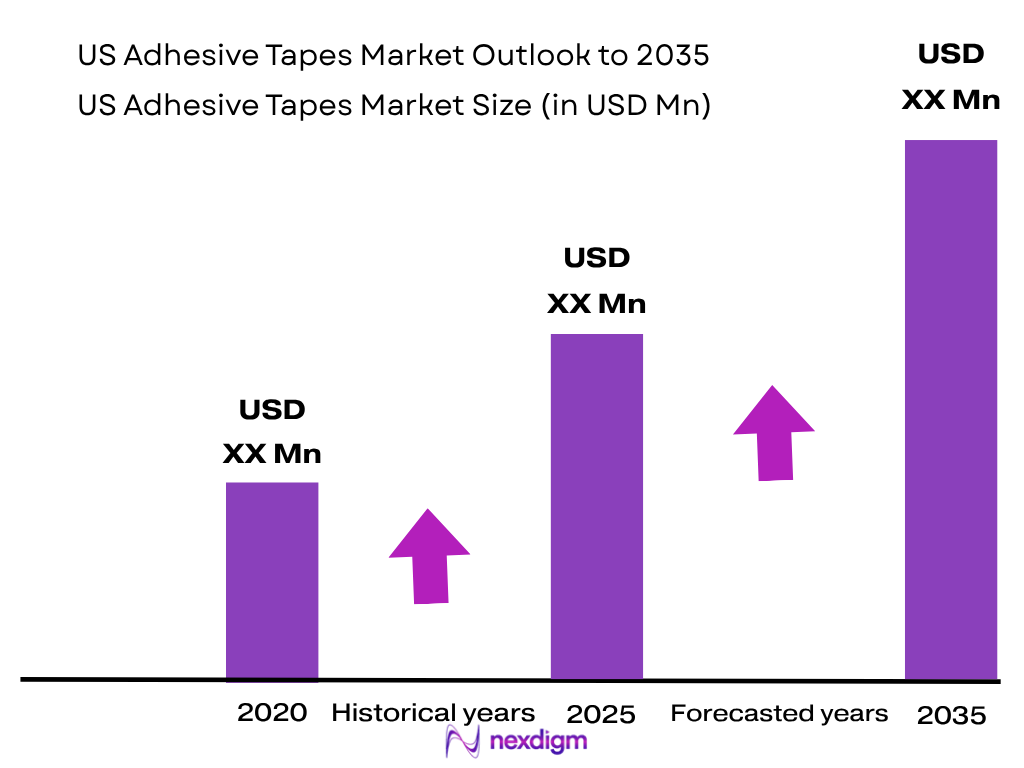
The US Adhesive Tapes Market is valued at approximately USD ~billion, with the final market value to be inserted from the selected licensed dataset. Underlying demand is supported by retail e-commerce sales rising from about USD 1.10 trillion to USD 1.19 trillion, increasing carton-sealing and packaging-tape requirements. Motor vehicles, bodies, trailers and parts manufacturing economic output also increased from USD 182.74 billion to USD 185.85 billion, sustaining automotive bonding, masking, wire-harnessing and attachment applications.
The US Adhesive Tapes Market is concentrated around California, Texas, Michigan, Ohio, Illinois and the broader Midwest and South, where packaging, automotive, electronics, construction and converting activity is extensive. Motor-vehicle manufacturing generated approximately USD 457.28 billion in sectoral output compared with USD 468.12 billion in the preceding dataset, while motor-vehicle-parts manufacturing recorded approximately USD 263.48 billion versus USD 266.02 billion. These industrial clusters favor local technical support, converting capacity, inventory availability and rapid OEM qualification.
Market Segmentation
By Product Type
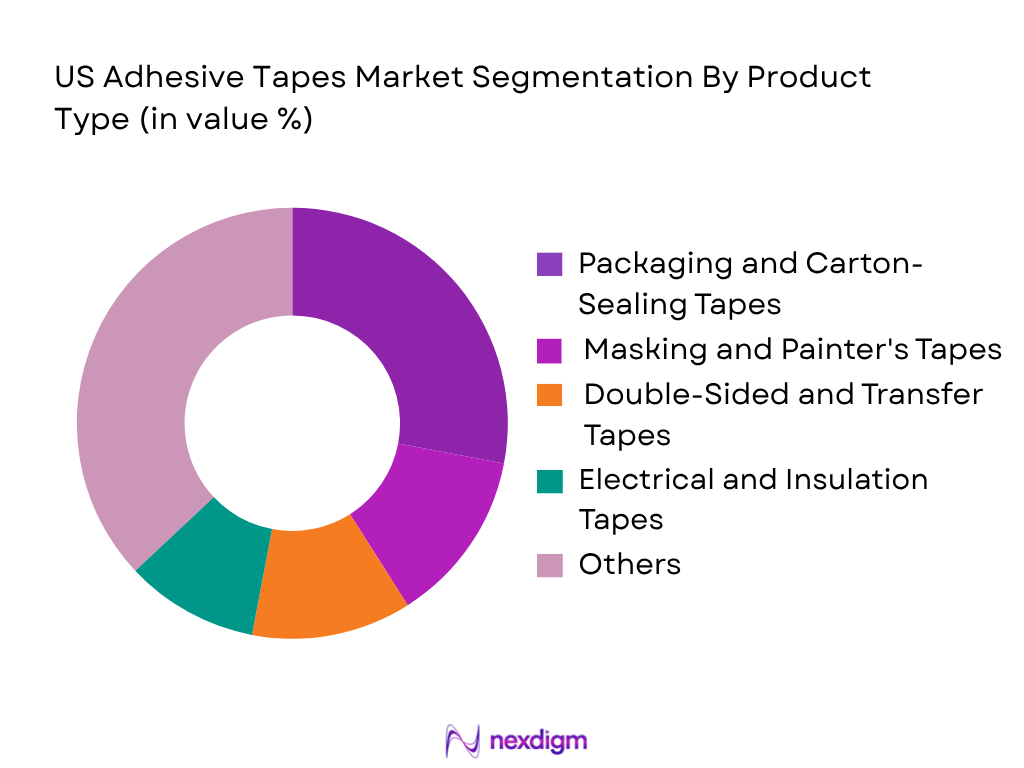
By Product Type: The US Adhesive Tapes Market is segmented into packaging and carton-sealing tapes, masking and painter’s tapes, double-sided tapes, electrical tapes, foam tapes, medical tapes, duct and cloth tapes, construction tapes, filament tapes and specialty industrial tapes. Packaging and carton-sealing tapes hold the dominant position because the United States has a highly developed parcel, warehouse, retail and e-commerce fulfillment infrastructure. U.S. retail e-commerce sales reached approximately USD 1.19 trillion in 2024, making reliable carton closure a high-frequency tape application. Packaging tapes also have relatively short replacement cycles compared with durable specialty bonding products because every outbound carton requires new material. Their demand therefore scales with shipment frequency rather than installed equipment. Specialty tapes remain strategically important because automotive, healthcare, electronics and industrial manufacturers require higher-performance adhesion, temperature resistance, conformability and die-cut formats. As manufacturing automation increases, precision-converted tapes are also replacing mechanical fasteners and liquid adhesives where cleaner application and repeatable bond-line thickness are important.
By Adhesive Chemistry
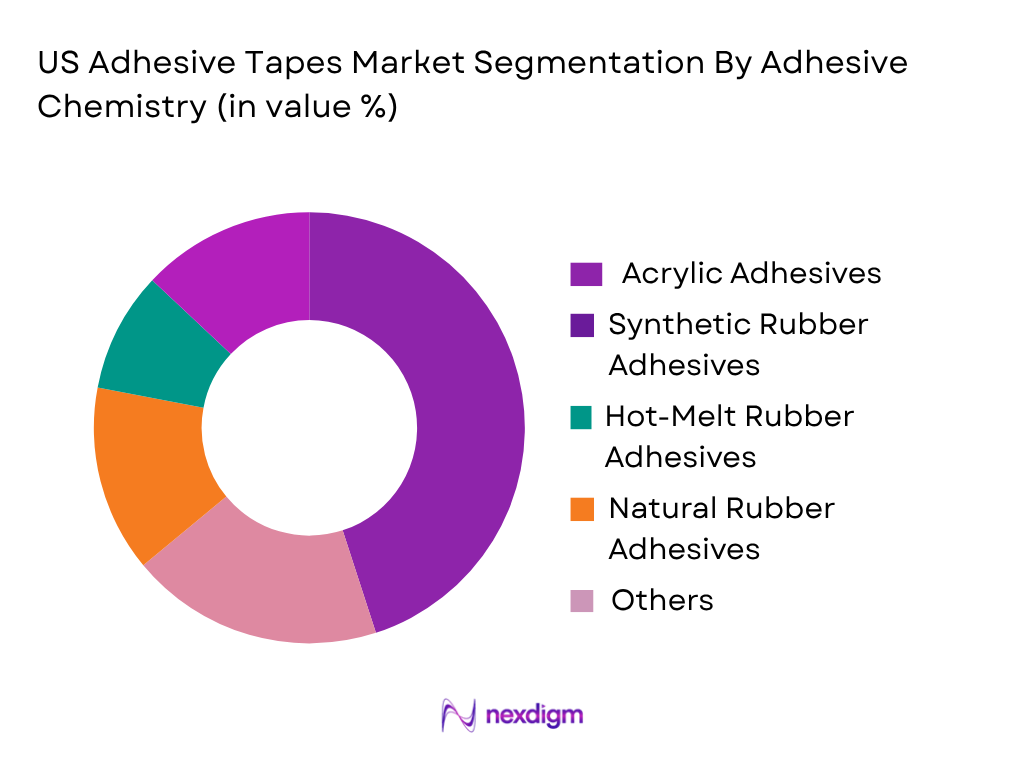
By Adhesive Chemistry: The US Adhesive Tapes Market is segmented into acrylic, natural and synthetic rubber, hot-melt rubber, silicone and hybrid adhesive systems. Acrylic adhesive tapes dominate the chemistry segmentation because acrylic pressure-sensitive adhesives combine environmental durability, UV stability, aging resistance and compatibility with a wide range of industrial applications. Avery Dennison identifies pressure-sensitive materials used in automotive, electronics, building and construction, general industrial, personal-care and medical applications, demonstrating the breadth of engineered adhesive demand. Acrylic systems are particularly suitable for applications requiring long service life and resistance to heat, weather and oxidation. Rubber-based adhesives remain important in packaging, masking and general-purpose applications because of strong initial tack, while silicone formulations occupy technically demanding niches involving high temperatures, difficult surfaces and specialized electronics or medical requirements. Future product development is increasingly focused on balancing bond performance with solvent reduction, recyclability, removability and lower environmental impact.
Competitive Landscape
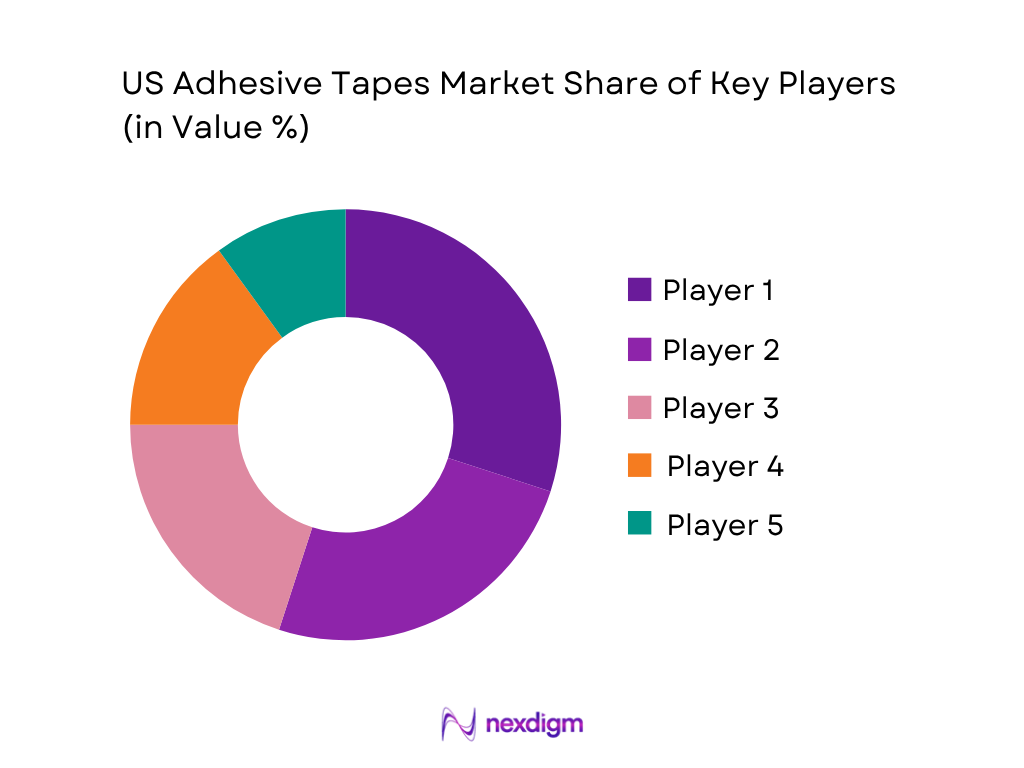
The US Adhesive Tapes Market is characterized by large diversified materials companies, global pressure-sensitive tape specialists and specialized converters. 3M, Avery Dennison, Nitto and tesa possess significant adhesive-formulation and application-engineering capabilities, while Intertape Polymer Group has a particularly strong position in packaging and industrial tapes. Avery Dennison specifically identifies 3M, tesa and Nitto among competitors in performance tapes, indicating direct competition in engineered pressure-sensitive materials. Competitive differentiation increasingly depends on proprietary adhesive chemistry, coating technology, OEM qualification support, precision converting and sustainability.
| Company | Establishment Year | Headquarters | Adhesive Chemistry Capability | Major Tape Portfolio | Key End Uses | US Manufacturing / Converting | Application Engineering | Sustainability Focus |
| 3M Company | 1902 | St. Paul, Minnesota, US | ~ | ~ | ~ | ~ | ~ | ~ |
| Avery Dennison Corporation | 1935 | Mentor, Ohio, US | ~ | ~ | ~ | ~ | ~ | ~ |
| Nitto Denko Corporation | 1918 | Osaka, Japan | ~ | ~ | ~ | ~ | ~ | ~ |
| tesa SE | 2001 as independent company; tape heritage predates it | Norderstedt, Germany | ~ | ~ | ~ | ~ | ~ | ~ |
| Intertape Polymer Group | 1980s corporate origins | Sarasota/Bradenton, Florida, US operations | ~ | ~ | ~ | ~ |
US Adhesive Tapes Market Analysis
Growth Drivers
Expansion of E-Commerce and Packaging Activity
The US Adhesive Tapes Market is strongly supported by the scale of domestic e-commerce and parcel-based retail fulfillment, where carton-sealing, reinforced packaging and tamper-evident tapes are consumed with every shipment cycle. U.S. retail e-commerce sales reached USD 1,192.6 billion in 2024, creating a substantial recurring requirement for packaging materials across fulfillment centers, warehouses, third-party logistics providers and retail distribution operations. The broader macroeconomic environment also supports tape consumption, with U.S. GDP reaching USD 28.75 trillion in 2024 and GDP per capita standing at USD 84,534, indicating a large consumer and industrial economy capable of sustaining high merchandise flows. Total U.S. goods imports reached USD 3,295.6 billion in 2024, while goods exports reached USD 2,083.8 billion, further expanding packaging, palletization and transport-protection requirements. Adhesive tapes are particularly important because packaging applications generate repeat consumption rather than one-time installed demand. Every carton moved through retail, e-commerce and industrial supply chains can require sealing, bundling, reinforcement or identification materials, supporting sustained demand for polypropylene-backed, paper-backed, filament and specialty packaging tapes.
Automotive and Advanced Manufacturing Applications
The US Adhesive Tapes Market benefits from the extensive domestic manufacturing base, where pressure-sensitive tapes are used for structural attachment, wire harnessing, masking, surface protection, vibration management, temporary fixation and component assembly. U.S. GDP reached approximately USD 29,298 billion in 2024 under updated national accounts, demonstrating the scale of the industrial economy supporting advanced material consumption. U.S. affiliates of foreign multinational companies employed 8.57 million workers in 2024, with manufacturing representing one of the largest employment concentrations and these affiliates contributing USD 1.52 trillion in value added. Imports of automotive vehicles, parts and engines increased by USD 16.1 billion in 2024, while capital-goods imports increased by USD 103.3 billion, including USD 9.0 billion in additional industrial machinery imports. These industrial flows matter directly for adhesive tapes because modern production environments increasingly use engineered acrylic, rubber and foam tapes as process aids or alternatives to clips, rivets, screws and liquid adhesives. Automotive, electronics, appliances and machinery production also require precision die-cut adhesive components, expanding opportunities for specialty converters and application-engineering suppliers.
Market Challenges
Exposure to Imported Industrial Materials and Complex Supply Chains
The US Adhesive Tapes Market depends on a broad upstream ecosystem encompassing polymer resins, tackifiers, silicone systems, specialty films, paper backings, foams, aluminum foil and release liners, making manufacturers sensitive to disruptions in international industrial-material flows. U.S. goods imports reached USD 3,295.6 billion in 2024, with capital-goods imports alone increasing by USD 103.3 billion. Computer accessories contributed an additional USD 33.5 billion, computers added USD 28.3 billion, semiconductors increased by USD 9.4 billion, and other industrial machinery increased by USD 9.0 billion. These categories are also downstream users of specialty tapes, so supply-chain disruption can simultaneously affect tape inputs and customer production schedules. U.S. GDP stood at USD 28.75 trillion in 2024, highlighting the scale of an economy deeply connected to international materials and manufacturing flows. Adhesive tape production is particularly vulnerable where specifications require precise film thickness, release characteristics or specialty polymers that cannot be substituted without requalification. Consequently, manufacturers must manage dual sourcing, domestic inventory, supplier qualification and formulation flexibility while maintaining consistent peel adhesion, shear strength, dimensional stability and environmental resistance.
Environmental Compliance in Pressure-Sensitive Tape Coating
Environmental compliance remains a market-specific operational challenge because adhesive tape manufacturing can involve solvent-based coating lines that emit volatile organic compounds and therefore require specialized capture, recovery or destruction systems. Federal environmental requirements specifically address pressure-sensitive tape and label surface-coating operations. Applicable coating-line regulations can require facilities to achieve 90 units of VOC control for every 100 units entering control equipment, creating additional technical requirements for emission capture, solvent recovery and production-line management. These obligations increase the complexity of plant design, coating-line modernization and process control. U.S. GDP reached USD 28.75 trillion in 2024, while GDP per capita stood at USD 84,534, demonstrating the scale of the industrial economy in which tape producers operate. Personal consumption expenditures were approximately USD 19,896.0 billion under updated 2024 national accounts, further illustrating the size of downstream demand. Manufacturers must therefore maintain high production reliability while managing environmental requirements, encouraging greater adoption of water-based acrylics, hot-melt adhesives, high-solids chemistries and solvent-recovery systems. Changing coating platforms, however, requires formulation validation, equipment compatibility testing and customer performance requalification.
Market Opportunities
Specialty Tapes for Construction and Building-Envelope Applications
The US Adhesive Tapes Market has substantial future opportunity in air barriers, flashing, insulation attachment, HVAC sealing, window installation and moisture-control applications as construction activity creates a large installed base requiring high-performance bonding and sealing materials. Public construction spending reached USD 492.7 billion in 2024, including USD 105.2 billion in educational construction and USD 142.7 billion in highway construction. These figures demonstrate the scale of physical infrastructure activity capable of supporting demand for foil tapes, flashing tapes, double-sided construction tapes, vapor-barrier tapes and specialty weatherproof products. U.S. GDP reached USD 28.75 trillion in 2024, while GDP per capita stood at USD 84,534, indicating substantial economic capacity supporting residential, commercial and infrastructure development. Adhesive tape manufacturers can leverage this construction base to expand into technically differentiated systems designed for long-term UV exposure, temperature cycling, moisture resistance, low-surface-energy membranes and difficult substrates. Future market development is particularly attractive for products that simplify installation, improve sealing consistency and reduce dependence on mechanical fasteners or wet-applied sealants while supporting increasingly sophisticated building-envelope and energy-efficiency requirements.
Renewable Energy and Electrification Applications
The US Adhesive Tapes Market has expanding future potential in solar modules, energy-storage systems, electrical insulation and related electrification applications because current deployment activity already provides a sizeable technical-materials platform. Approximately 30 gigawatts of solar generating capacity were added in the United States in 2024, creating downstream requirements for materials used in module assembly, edge protection, temporary positioning, electrical insulation, cable management and weather-resistant attachment. The broader economy provides substantial industrial capacity for adoption of engineered adhesive technologies, with U.S. GDP reaching USD 28.75 trillion in 2024 and GDP per capita standing at USD 84,534. Semiconductor exports increased by USD 8.1 billion in 2024, while semiconductor imports increased by USD 9.4 billion, demonstrating substantial activity across electronics-related supply chains where high-performance tapes are routinely specified. These current conditions provide a strong platform for future adoption of thermally conductive, electrically insulating, flame-retardant, high-temperature and precision die-cut adhesive products. Suppliers capable of meeting electrical, thermal and long-duration environmental requirements can expand beyond commodity applications into higher-specification energy, battery and electronics assemblies.
Future Outlook
The US Adhesive Tapes Market is expected to expand at approximately ~X.X% CAGR during 2026–2035, with the rate intentionally retained as a placeholder for the final proprietary forecast. Growth will increasingly shift toward specialty pressure-sensitive materials rather than relying solely on commodity carton-sealing demand. Automotive electrification, electronics miniaturization, medical wearables, advanced construction envelopes and manufacturing automation will increase requirements for engineered tape systems.
Automotive applications offer significant long-term potential because manufacturers are using adhesive tapes for interior attachment, exterior trim, wire harnessing, acoustic management, battery assembly and lightweight material bonding. Tapes allow OEMs to join dissimilar materials while eliminating drilling, welding or visible mechanical fasteners in selected applications. Healthcare represents another high-value growth area. Extended-wear medical tapes must balance reliable skin attachment with moisture handling, conformability, breathability and atraumatic removal. Growth in wearable diagnostics and patient-monitoring devices is creating opportunities for highly engineered skin-contact adhesive platforms.
Major Players
- 3M Company
- Avery Dennison Corporation
- Nitto, Inc. / Nitto Denko Corporation
- tesa tape, Inc.
- Intertape Polymer Group
- Shurtape Technologies, LLC
- Vybond
- Saint-Gobain Tape Solutions
- Lohmann Corporation
- Mactac
- LINTEC Corporation
- Adhesives Research, Inc.
- Pro Tapes & Specialties, Inc.
- American Biltrite Inc.
- CCT Tapes
Key Target Audience
- Adhesive Tape Manufacturers
- Pressure-Sensitive Adhesive and Performance Polymer Producers
- Tape Converters, Laminators and Precision Die-Cutters
- Automotive, Electronics, Medical Device and Packaging OEMs
- Industrial Packaging, MRO and Specialty Material Distributors
- Backing Film, Foam, Release-Liner and Tackifier Suppliers
- Investments and Venture Capitalist Firms
- Government and Regulatory Bodies (US Environmental Protection Agency, Occupational Safety and Health Administration, US Food and Drug Administration, US Department of Commerce and National Institute of Standards and Technology)
Research Methodology
Step 1: Identification of Key Variables
The first stage involves constructing a complete ecosystem map for the US Adhesive Tapes Market, covering adhesive resin suppliers, backing manufacturers, tape coaters, jumbo-roll producers, converters, distributors and OEM customers. Secondary research is used to identify market variables including tape construction, adhesive chemistry, backing type, application intensity, converting requirements, domestic manufacturing capacity, trade flows and end-use industry exposure.
Step 2: Market Analysis and Construction
Historical market demand is developed through top-down and bottom-up approaches. The top-down model assesses packaging shipments, e-commerce activity, vehicle manufacturing, construction, healthcare, electronics and industrial production. The bottom-up model evaluates manufacturer revenues, tape volumes, converted-part demand, product portfolios, importer activity and channel structure. Commodity tapes and high-performance specialty tapes are assessed separately to prevent distortion from major differences in product specification and application complexity.
Step 3: Hypothesis Validation and Expert Consultation
Market hypotheses are validated through CATI and structured discussions with tape manufacturers, adhesive formulators, converters, distributors, packaging specialists, automotive suppliers and OEM procurement personnel. Primary interviews test assumptions regarding tape consumption, adhesive chemistry preference, customer qualification requirements, converter margins, product switching barriers, supplier selection and technical-service requirements. Findings are used to reconcile inconsistencies between manufacturer-side and customer-side market estimates.
Step 4: Research Synthesis and Final Output
The final stage triangulates manufacturer information, trade statistics, industry production indicators, distributor inputs and OEM consumption patterns. Tape volumes are cross-checked against application intensity in packaging, automotive, electronics, healthcare and construction. Forecast scenarios incorporate manufacturing activity, e-commerce, lightweight bonding, EV production, medical wearable adoption, sustainability requirements and adhesive-coating technology. This process produces a validated US Adhesive Tapes Market structure, segmentation and long-term strategic outlook.

- Executive Summary
- Research Methodology (Market Definition and Scope, US Adhesive Tapes Taxonomy, Pressure-Sensitive Adhesive Tape Classification, Commodity and Specialty Tape Classification, Adhesive Chemistry Mapping, Backing Material Assessment, Tape Construction Framework, Adhesive Coating Technology Assessment, Application Mapping, Raw Material Assessment, Sustainable Tape Technology Evaluation, Market Sizing Framework)

- Definition and Scope
- US Adhesive Tapes Industry Evolution and Pressure-Sensitive Adhesive Technology Development
- Adhesive Tape Manufacturing and Coating Process
- Adhesive Tape Value Chain Analysis
- US Adhesive Tapes Supply Chain Analysis
- Adhesive Resin, Backing Material and Release-Liner Ecosystem Analysis
- US Adhesive Tapes Import Dependency and Localization Assessment
- OEM Adhesive Tape Application Architecture and Specialty Tape Solution Framework

- Growth Drivers (Expansion of E-Commerce Packaging Volumes, Increasing Lightweight Automotive Bonding, Growth of Electronics Miniaturization, Rising Adoption of Medical Wearables, Expansion of Construction Sealing Applications, Manufacturing Automation, Mechanical Fastener Replacement, Increasing High-Performance Pressure-Sensitive Adhesive Adoption)
- Market Challenges (Raw Material Price Volatility, VOC Compliance Requirements, Complex Substrate Compatibility, Long OEM Qualification Cycles, Specialty Silicone and Resin Dependency, Recycling Compatibility Challenges, Fragmented Converter Ecosystem, Imported Adhesive Tape Competition)
- Market Opportunities (EV Battery Assembly Tapes, Medical Wearable Adhesives, Solar Module Bonding Solutions, Recyclable Packaging Tapes, Low-VOC Adhesive Systems, Automation-Compatible Tape Formats, Low-Surface-Energy Bonding Solutions, Structural Bonding Tape Substitution)
- Market Trends (High-Bond Acrylic Foam Tapes, Linerless Tape Development, Paper-Based Packaging Tapes, Bio-Based Adhesive Formulations, Debond-on-Demand Technology, Thin-Gauge Electronics Tapes, Extended-Wear Medical Adhesives, Precision Die-Cut Adhesive Components)
- Regulatory and Standards Landscape (EPA Pressure-Sensitive Tape Surface-Coating Requirements, Clean Air Act VOC Regulations, OSHA Hazard Communication Requirements, TSCA Chemical Substance Requirements, FDA Requirements for Medical Adhesive Applications, ASTM Adhesive Tape Test Standards, UL Electrical Insulation Requirements, Packaging Sustainability and Recyclability Requirements)
- SWOT Analysis
- Porter’s Five Forces Analysis
- PESTLE Analysis
- Stakeholder Ecosystem
- Competition Ecosystem

- By Market Value (2020-2025)
- By Adhesive Tape Consumption Volume (2020-2025)
- By Coated Surface Area (2020-2025)
- By Domestic Production Volume (2020-2025)
- By Import Volume (2020-2025)
- By Export Volume (2020-2025)
- By Average Selling Price (2020-2025)
- By Commodity Adhesive Tape Consumption (2020-2025)
- By Specialty Adhesive Tape Consumption (2020-2025)

- By Product Type (In Value %)
Packaging and Carton Sealing Tapes
Masking and Painter’s Tapes
Double-Sided Tapes
Transfer Tapes
Duct and Cloth Tapes
Electrical and Insulation Tapes
Foam Tapes
Filament and Strapping Tapes
Medical and Healthcare Tapes
Automotive Adhesive Tapes
Construction and Building Tapes
HVAC and Foil Tapes
Protective Films and Surface Protection Tapes
Splicing Tapes
Specialty High-Performance Industrial Tapes - By Adhesive Chemistry (In Value %)
Acrylic Adhesives
Natural Rubber Adhesives
Synthetic Rubber Adhesives
Hot-Melt Rubber Adhesives
Silicone Adhesives
Hybrid Adhesive Systems
Bio-Based and Renewable-Content Adhesive Systems - By Backing Material (In Value %)
Polypropylene Film
Polyethylene Film
Polyvinyl Chloride Film
Polyethylene Terephthalate Film
Paper
Cloth and Fabric
Aluminum Foil
Copper Foil
Foam
Nonwoven Materials
Polyimide Film
Glass Cloth
Unsupported and Carrier-Free Constructions - By End-Use Industry (In Value %)
Packaging and E-Commerce
Automotive and Mobility
Building and Construction
Electrical and Electronics
Medical and Healthcare
Aerospace and Defense
Appliances
HVAC and Refrigeration
General Industrial Manufacturing
Paper, Printing and Converting
Renewable Energy
Transportation and Rail
Signs and Graphics
Retail and Consumer Applications - By Distribution Channel (In Value %)
Direct Manufacturer-to-OEM Sales
Authorized Industrial Distributors
Adhesive Tape Converters
Packaging Distributors
Electrical and Electronics Distributors
Construction Supply Distributors
Medical Material Converters and Distributors
Automotive Tier Supplier Channels
Industrial MRO Distributors
Online B2B Platforms - By Region (In Value %)
Northeast US
New York
Pennsylvania
New Jersey
New England
Midwest US
Michigan
Ohio
Illinois
Indiana
Wisconsin
South US
Texas
Georgia
North Carolina
Tennessee
Kentucky
Florida
West US
California
Washington
Arizona
Oregon

- Market Share of Major Players (By Revenue, Volume, Product Type, Adhesive Chemistry, Backing Material, End-Use Industry, Market Type, Distribution Channel)
- Cross Comparison Parameters (Adhesive Chemistry Breadth, Backing and Carrier Technology Breadth, US Coating and Converting Footprint, High-Performance Specialty Tape Capability, OEM Application Engineering and Qualification Support, Precision Die-Cutting and Custom Converting Capability, Sustainable and Low-VOC Tape Portfolio, End-Use Industry Coverage)
- SWOT Analysis of Major Players
- Competitive Positioning Matrix
- Pricing and Distribution Network Benchmarking
- Detailed Profiles of Major Companies
3M Company
Avery Dennison Corporation
Nitto, Inc.
tesa tape, Inc.
Intertape Polymer Group
Shurtape Technologies, LLC
Vybond
Saint-Gobain Tape Solutions
Lohmann Corporation
Mactac
LINTEC Corporation
Adhesives Research, Inc.
Pro Tapes & Specialties, Inc.
American Biltrite Inc.
CCT Tapes

- Buyer Segmentation
- OEM Procurement Behaviour
- Supplier Selection Criteria
- Buyer Pain Points
- Technology Adoption Assessment
- Replacement and Repurchase Behaviour

- By Market Value (2026-2035)
- By Adhesive Tape Consumption Volume (2026-2035)
- By Coated Surface Area (2026-2035)
- By Domestic Production Volume (2026-2035)
- By Import Volume (2026-2035)
- By Export Volume (2026-2035)
- By Average Selling Price (2026-2035)
- By Commodity Adhesive Tape Consumption (2026-2035)
- By Specialty Adhesive Tape Consumption (2026-2035)


 Request a Sample
 Ask for Customization
 Get a Quote
 Enquire Now