

 Download PDF
Market Overview
The US Adhesives and Sealants Market was valued at approximately USD ~ billion in 2024, according to Expert Market Research, with demand supported by construction, automotive, packaging, electronics and industrial manufacturing applications. The broader manufacturing ecosystem provides a substantial demand base: the U.S. Census Bureau recorded USD 18.88 billion in sales, value of shipments or revenue for the dedicated adhesive-manufacturing industry, covering adhesives, glues and caulking compounds. U.S. construction spending reached USD 2.154 trillion, while private construction reached USD 1.662 trillion, creating significant requirements for bonding, joint sealing, insulation and assembly applications.
The US Adhesives and Sealants Market is concentrated around major manufacturing and construction hubs rather than a single city, with regions such as Texas, California, Michigan, Ohio, Illinois and the Southeast supported by automotive, aerospace, construction, electronics, packaging and general manufacturing activity. The Census Bureau identifies 539 employer establishments within the adhesive-manufacturing industry, while U.S. motor-vehicle production reached 10,562,188 units, including 9,129,573 commercial vehicles, providing a substantial downstream bonding and sealing base. Manufacturing also represented USD 2.42 trillion of foreign direct investment in the United States, reinforcing the country’s industrial infrastructure.
Market Segmentation
By Product Type
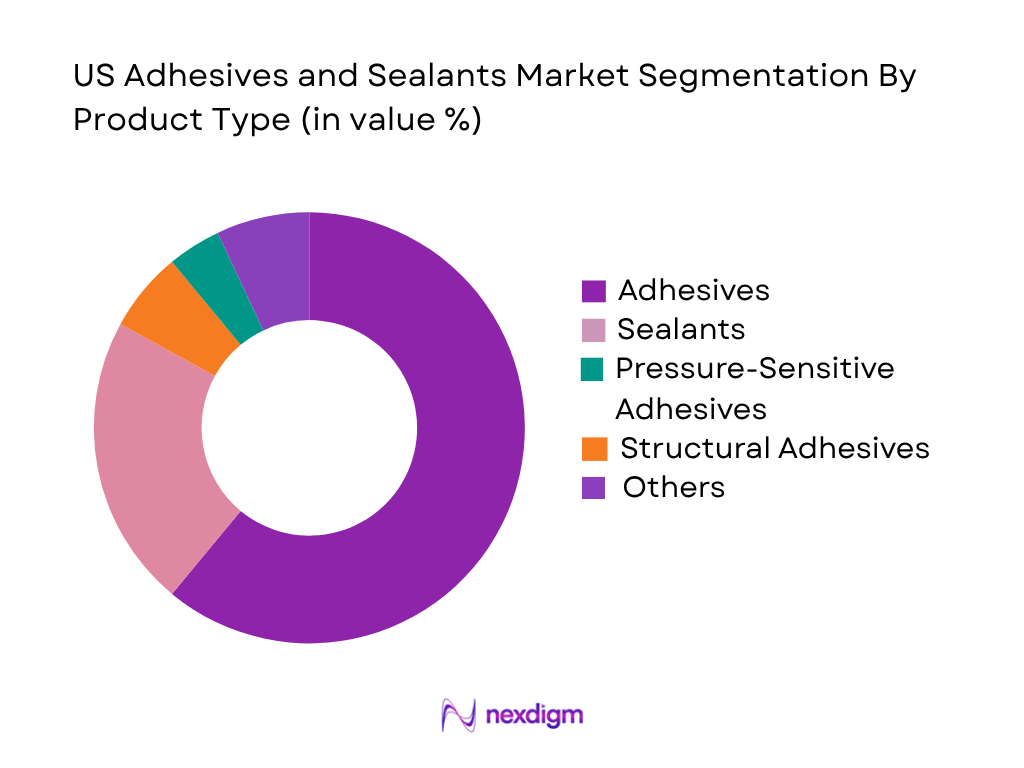
The US Adhesives and Sealants Market is segmented by product type into adhesives, sealants, pressure-sensitive adhesives, structural adhesives, hot-melt adhesives, construction adhesives, industrial adhesives, and specialty adhesives and sealants. Adhesives represent the principal product category because they serve a broad range of assembly and joining requirements across packaging, construction, automotive, electronics, woodworking and general manufacturing. Their ability to bond dissimilar substrates, reduce mechanical fastening requirements and support lightweight product designs increases their relevance across multiple manufacturing processes. Structural and construction adhesives are particularly important where manufacturers require durable bonds without adding mechanical fasteners. Pressure-sensitive technologies also support labels, tapes and converting applications. Sealants remain essential where the primary requirement is protection against moisture, air, chemicals or environmental exposure. The breadth of adhesive applications therefore creates a diversified demand base, while specialized sealant formulations support high-performance applications. The segmentation reflects the industry’s movement toward engineered bonding solutions rather than reliance exclusively on traditional fastening and joining methods.
By End-Use Industry
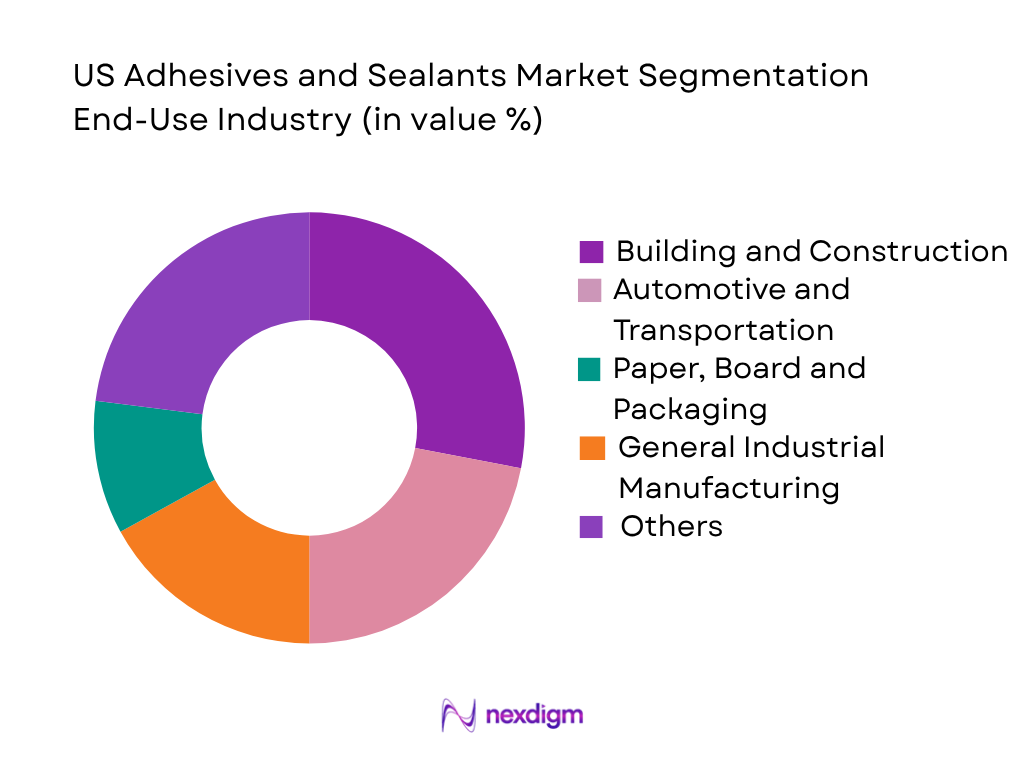
The US Adhesives and Sealants Market is segmented by end-use industry into building and construction, automotive and transportation, paper, board and packaging, woodworking and furniture, electrical and electronics, aerospace and defense, healthcare and medical devices, footwear and leather, and general industrial manufacturing. Building and construction represents the leading application group because adhesives and sealants are incorporated into flooring, roofing, insulation, windows, façades, countertops, panels and numerous structural and finishing applications. Construction activity provides a large recurring consumption base because bonding and sealing are required across both new construction and renovation. The U.S. Census Bureau reported USD 2.154 trillion of total construction spending and USD 917.9 billion of residential construction spending, demonstrating the scale of the downstream environment. Automotive and transportation remain important because adhesives support lightweighting, component assembly and sealing. Packaging, electronics and aerospace further diversify demand through requirements for fast curing, thermal resistance, moisture protection and high-performance bonding.
Competitive Landscape
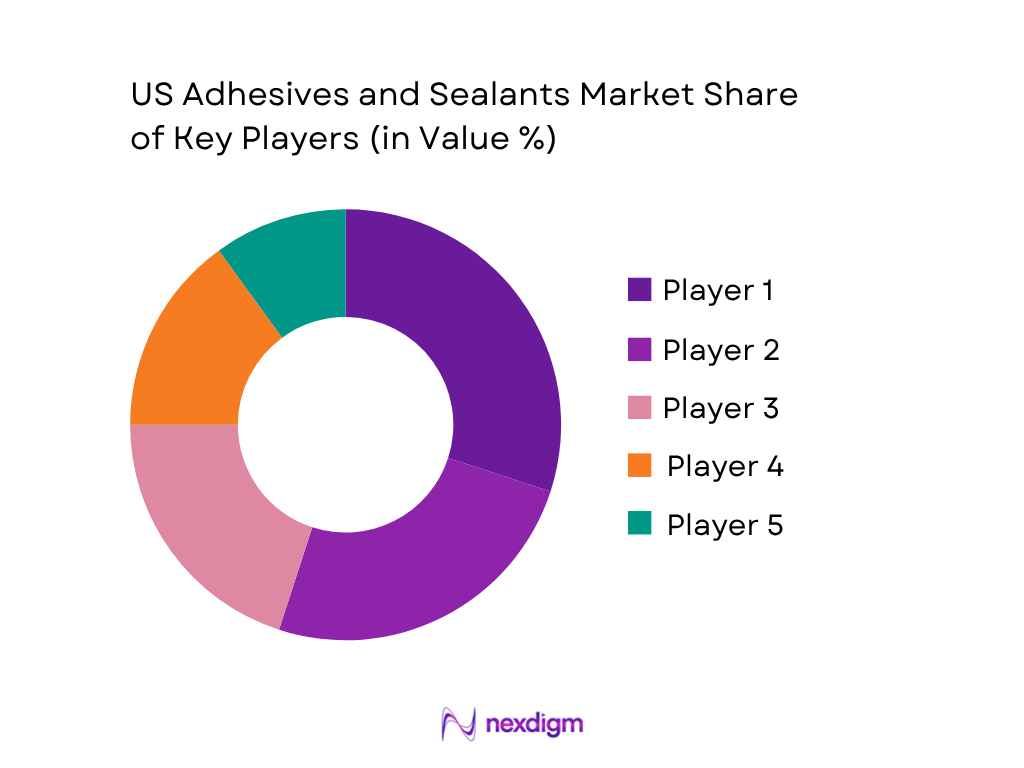
The US Adhesives and Sealants Market comprises large diversified chemical and materials companies alongside specialized adhesive manufacturers. Companies such as 3M, Henkel, H.B. Fuller, Sika and Dow participate across multiple industrial applications and technology categories. Competitive differentiation is based on resin chemistry, formulation expertise, manufacturing footprint, technical support, customer qualification, application engineering and distribution reach. Henkel reported EUR 10.97 billion in Adhesive Technologies sales in 2024, while H.B. Fuller describes itself as a pure-play adhesives company serving more than 30 market segments across more than 140 countries. Sika reported CHF 11.76 billion in 2024 net sales and supplies bonding and sealing solutions to building and automotive customers.
| Company | Establishment Year | Headquarters | Adhesive Technologies | Sealant Capability | Key End-Use Exposure | Global Reach | 2024 Corporate Revenue/Sales | US Market Position |
| 3M Company | 1902 | St. Paul, Minnesota, USA | ~ | ~ | ~ | ~ | ~ | ~ |
| Henkel AG & Co. KGaA | 1876 | Düsseldorf, Germany | ~ | ~ | ~ | ~ | ~ | ~ |
| H.B. Fuller Company | 1887 | St. Paul, Minnesota, USA | ~ | ~ | ~ | ~ | ~ | ~ |
| Sika AG | 1910 | Baar, Switzerland | ~ | ~ | ~ | ~ | ~ | ~ |
| Dow Inc. | 1897 | Midland, Michigan, USA | ~ | ~ | ~ | ~ | ~ | ~ |
US Adhesives and Sealants Market Analysis
Growth Driver
Expansion of Construction and Building Applications
The expansion of US construction activity provides a direct demand base for adhesives and sealants used in flooring, roofing, insulation, windows, façades, panels, concrete joints and interior finishing. The U.S. Census Bureau recorded USD 2.154 trillion in total construction put in place in 2024, compared with USD 2.024 trillion in 2023. Within this total, residential construction reached USD 929.629 billion, while nonresidential construction reached USD 1.225 trillion. Manufacturing construction was particularly significant, reaching USD 233.227 billion, compared with USD 193.630 billion in the preceding year. This manufacturing-construction expansion is relevant to adhesives and sealants because factories, production facilities, clean rooms, warehouses and specialized industrial structures require extensive sealing, bonding and insulation applications. The U.S. Census Bureau data also show transportation construction of USD 68.148 billion and power construction of USD 147.584 billion, creating additional infrastructure-related applications. These figures indicate that adhesives and sealants benefit from activity across both building construction and industrial infrastructure. The breadth of construction applications supports recurring demand for high-performance bonding, waterproofing, joint sealing and protective solutions across residential, commercial and industrial projects. Construction applications also require products with different curing speeds, substrate compatibility and weather resistance, supporting demand for multiple adhesive chemistries rather than a single product category. Increasing use of prefabricated panels, insulation systems, engineered flooring and modular construction further creates opportunities for factory-applied bonding solutions. Renovation and maintenance activities additionally provide recurring requirements for sealants around windows, roofs, façades, bathrooms and building joints. This combination of new construction, industrial facilities and renovation creates a diversified downstream base for US adhesives and sealants suppliers.
Strong Manufacturing and Industrial Production Base
The scale of US manufacturing provides a substantial downstream customer base for adhesives and sealants used in assembly, component bonding, insulation, packaging, electrical systems and equipment manufacturing. The U.S. Census Bureau’s 2024 Annual Integrated Economic Survey reported USD 6.981 trillion in manufacturing sales, value of shipments or revenue across US manufacturing establishments, with annual payroll reaching USD 890.775 billion. Chemical manufacturing alone generated approximately USD 918.2 billion in value of shipments, while food manufacturing generated approximately USD 1.054 trillion, demonstrating the scale of industries requiring specialized bonding and sealing technologies. Regional manufacturing activity is particularly concentrated in the South and Midwest, where manufacturing sales reached approximately USD 2.780 trillion and USD 2.211 trillion, respectively. This industrial concentration supports demand for structural adhesives, hot-melt systems, pressure-sensitive adhesives, silicone sealants and polyurethane technologies. The U.S. Census Bureau also reported substantial activity across transportation equipment, machinery, electronics and chemical manufacturing. Adhesive technologies can support lightweighting, automation and material substitution by joining metals, plastics, composites, glass and engineered materials. Consequently, the breadth of manufacturing output creates multiple demand channels rather than dependence on a single downstream industry. Automotive manufacturing requires adhesives for body structures, interiors, glazing, battery components and vibration-control applications, while electronics manufacturing requires highly precise bonding and encapsulation solutions. Packaging manufacturers use pressure-sensitive and hot-melt technologies for labels, cartons, cases and flexible packaging. Industrial machinery and equipment producers similarly use structural adhesives and thread-sealing technologies to improve assembly efficiency and component performance. The scale and diversity of US manufacturing therefore provide a broad application environment in which suppliers can expand through specialized formulations, technical support and customer-specific product development.
Market Challenge
Exposure to Industrial Energy and Production Costs
Adhesive and sealant manufacturing requires mixing, heating, drying, curing, compounding, packaging and other energy-intensive processes, making industrial energy conditions an important operating consideration. The U.S. Energy Information Administration reported that average US industrial electricity prices increased from 8.04 cents per kilowatt-hour in 2023 to 8.13 cents per kilowatt-hour in 2024. Industrial electricity consumption also reached approximately 1.035 trillion kilowatt-hours, compared with 1.009 trillion kilowatt-hours in 2023. Natural gas remains an important industrial energy input, with the EIA reporting a US industrial natural-gas price of USD 4.07 per thousand cubic feet in 2024, compared with USD 4.53 in 2023. Although natural-gas prices declined, manufacturers still operate across regions with materially different energy conditions. California’s industrial natural-gas price, for example, was USD 11.48 per thousand cubic feet, while Texas recorded approximately USD 3.07 in 2024. Such regional differences affect manufacturing economics, especially for facilities using thermal processing and curing equipment. The U.S. Energy Information Administration data therefore indicate that energy exposure remains relevant even when national energy prices stabilize, because production economics differ considerably across manufacturing locations. Adhesive and sealant plants also require controlled temperatures and processing conditions to maintain viscosity, mixing quality and curing consistency. Energy-intensive operations can therefore influence plant utilization decisions, particularly for products requiring elevated-temperature processing or drying. Regional differences in electricity and natural-gas costs can also influence where new production capacity is established. Manufacturers may consequently prioritize process optimization, energy-efficient equipment and production scheduling to limit exposure to operating-cost fluctuations. These factors can become particularly relevant when downstream customers simultaneously seek competitive pricing and tighter performance specifications. Energy-management requirements therefore remain an important operational consideration for manufacturers seeking to preserve production efficiency and maintain reliable supply.
Dependence on Petrochemical and Chemical Feedstock Supply Chains
US adhesives and sealants producers remain exposed to chemical feedstock availability because many commercial formulations rely on polymers, resins, solvents, additives, plasticizers and specialty chemicals. The scale of the US chemical manufacturing ecosystem demonstrates the importance of this supply chain. According to the U.S. Census Bureau, US chemical manufacturing generated approximately USD 918.2 billion in value of shipments in 2024, providing a major domestic upstream base for formulated adhesive technologies. At the same time, international trade remains important for specialty chemicals and intermediate materials that may not be economically available from domestic sources. The US manufacturing sector generated USD 6.981 trillion in sales, shipments or revenue in 2024, meaning disruptions in chemical, polymer and intermediate supply chains can affect a broad network of downstream producers. Adhesive manufacturers must manage inventories across multiple resin chemistries, including polyurethane, epoxy, acrylic, silicone and rubber-based systems. Differences in formulation requirements also limit the ability to substitute one feedstock immediately for another because changes can affect curing, viscosity, adhesion, temperature resistance and regulatory characteristics. Consequently, supply continuity, qualification requirements and feedstock diversification remain important challenges for US adhesive and sealant manufacturers. Specialty formulations can be particularly sensitive because a small number of qualified suppliers may provide specific additives or performance-enhancing materials.
Market Opportunity
Electric Vehicle and Advanced Transportation Manufacturing
The expansion of advanced transportation manufacturing creates opportunities for adhesives and sealants because vehicle architectures increasingly incorporate lightweight materials, composites, electronics and battery systems requiring specialized bonding and sealing. The U.S. Energy Information Administration reported that US electricity generation reached 4.309 billion megawatt-hours in 2024, while industrial electricity consumption reached approximately 1.035 trillion kilowatt-hours. These figures illustrate the scale of the industrial infrastructure supporting electrification-related manufacturing. Automotive and transportation applications can require adhesives for battery-cell and module assembly, thermal-management components, body structures, interior systems, glass bonding and vibration control. Sealants are similarly relevant to battery enclosures, electrical protection and environmental barriers. The opportunity extends beyond passenger vehicles into commercial vehicles, aerospace systems and other transportation equipment. Adhesive bonding can help manufacturers join aluminum, steel, composites, plastics and other dissimilar materials while reducing reliance on conventional mechanical fastening. The combination of vehicle lightweighting and increasing electronic content expands the number of components where bonding and sealing technologies can provide functional benefits. This creates an opportunity for suppliers capable of developing application-specific formulations with controlled curing, electrical insulation, thermal resistance and environmental durability.
Growth of Manufacturing Construction and Industrial Facilities
Continued investment in manufacturing facilities creates opportunities for construction adhesives and sealants as new production buildings require waterproofing, insulation, flooring, roofing, glazing, panel bonding and joint-sealing systems. The U.S. Census Bureau recorded USD 233.227 billion of manufacturing construction spending in 2024, compared with USD 193.630 billion in 2023. This represents an increase of approximately USD 39.597 billion in annual manufacturing construction activity. Nonresidential construction reached USD 1.225 trillion, while power construction reached USD 147.584 billion. These projects require multiple classes of adhesive and sealant products across structural and finishing applications. Manufacturing facilities for semiconductors, batteries, chemicals, food processing and advanced industrial equipment can require specialized environments where moisture control, air sealing, chemical resistance and thermal stability are important. The scale of manufacturing construction also creates opportunities for suppliers that can provide integrated systems rather than individual products, including primers, sealants, bonding compounds and surface-treatment technologies. As industrial facilities become more automated and technically complex, construction materials increasingly need to satisfy performance requirements alongside installation efficiency. The current construction pipeline therefore creates multiple avenues for adhesives and sealants manufacturers to expand application penetration across industrial buildings and infrastructure. New production facilities can require high-performance sealants around building envelopes, expansion joints, roofing systems and utility penetrations, while adhesives can be incorporated into insulation panels, flooring systems and prefabricated construction components. Semiconductor and electronics facilities can have particularly demanding requirements for contamination control, chemical resistance and controlled environments. Battery and advanced-material plants similarly require materials that withstand temperature variations, chemicals and continuous industrial operation. Infrastructure associated with these facilities, including power systems, warehouses and logistics structures, adds further bonding and sealing applications.
Future Outlook
Over the forecast period, the US Adhesives and Sealants Market is expected to benefit from continued construction activity, transportation manufacturing, packaging demand and investment in advanced manufacturing. The technology mix is likely to shift toward water-based, hot-melt, reactive and low-emission formulations as customers seek performance alongside environmental compliance. Automotive electrification, electronics assembly and lightweight materials are also creating applications where adhesive bonding can replace or supplement mechanical fastening. The expanding role of adhesives in battery systems, insulation, thermal management, packaging and composite structures should create additional application opportunities.
Major Players
- 3M Company
- Henkel AG & Co. KGaA
- H.B. Fuller Company
- Sika AG
- Dow Inc.
- Arkema Group (Bostik)
- Huntsman Corporation
- RPM International Inc.
- PPG Industries, Inc.
- Avery Dennison Corporation
- Illinois Tool Works Inc. (ITW)
- Wacker Chemie AG
- BASF SE
- Ashland Inc.
- Momentive Performance Materials Inc.
Key Target Audience
- Adhesive and Sealant Manufacturers
- Automotive and Electric Vehicle Manufacturers
- Building Material and Construction Product Manufacturers
- Packaging Converters and Paperboard Manufacturers
- Electronics and Electrical Equipment Manufacturers
- Investments and Venture Capitalist Firms
- Government and Regulatory Bodies (U.S. Environmental Protection Agency, U.S. Food and Drug Administration, Occupational Safety and Health Administration)
- Chemical and Polymer Raw Material Suppliers
Research Methodology
Step 1: Identification of Key Variables
The initial phase involves mapping the US Adhesives and Sealants Market ecosystem, covering resin producers, formulators, adhesive manufacturers, sealant suppliers, distributors and downstream industries. Product chemistry, formulation technology, application requirements, manufacturing capacity and end-use demand variables are identified. Government industrial statistics and company disclosures are used to establish the market framework.
Step 2: Market Analysis and Construction
Historical market information is compiled through top-down and bottom-up approaches, separating adhesives from sealants and mapping demand across construction, automotive, packaging, electronics and industrial applications. Production, shipment, import, manufacturing and downstream-industry indicators are evaluated to establish market relationships and validate the analytical structure.
Step 3: Hypothesis Validation and Expert Consultation
Market hypotheses are developed around product adoption, end-use demand, technology migration, raw-material availability and customer purchasing patterns. Industry disclosures, regulatory publications and expert inputs are used to challenge assumptions and identify inconsistencies. Particular attention is given to application-specific requirements such as curing speed, substrate compatibility, temperature resistance and VOC performance.
Step 4: Research Synthesis and Final Output
The final stage integrates company-level information, government statistics, industry indicators and application analysis into a consolidated market framework. Findings are triangulated across supply-side production information and demand-side end-use indicators. The resulting analysis provides market segmentation, competitive benchmarking, technology assessment and forward-looking industry conclusions.

- Executive Summary
- Research Methodology (Market Definition and Scope, US Adhesives and Sealants Market Classification, Adhesive and Sealant Product Mapping, Resin Chemistry Assessment, Adhesive Technology Analysis, Sealant Formulation Assessment, End-Use Industry Demand Mapping, Domestic Production and Import Assessment, Raw Material Supply Analysis, Application-Level Consumption Assessment, Demand-Side Assessment, Supply-Side Assessment, Primary Industry Interviews, Data Triangulation, Market Sizing Framework, Forecasting Framework, Assumptions and Limitations)

- Definition and Scope
- US Adhesives and Sealants Industry Evolution and Development of Bonding, Sealing and Formulation Infrastructure
- Adhesives, Sealants, Pressure-Sensitive Adhesives, Structural Adhesives, Construction Adhesives, Industrial Adhesives, Specialty Sealants
- US Adhesives and Sealants Value Chain Analysis
- US Adhesives and Sealants Supply Chain Analysis
- Polymer and Resin Suppliers, Specialty Chemical Producers, Additive Suppliers, Adhesive and Sealant Manufacturers, Formulators, Distributors, Industrial Buyers, OEMs, Construction Companies, Packaging Converters and End-Use Industries
- Adhesive and Sealant Integration Across Building and Construction, Automotive, Aerospace, Packaging, Electronics, Woodworking, Furniture, Healthcare, Appliances, Transportation and Industrial Manufacturing

- Growth Drivers (Expansion of Construction and Infrastructure Activities, Growth of Automotive and Electric Vehicle Manufacturing, Increasing Lightweight Material Adoption, Expansion of Packaging Manufacturing, Rising Electronics Production, Demand for High-Performance Bonding, Growth of E-Commerce Packaging, Increasing Adoption of Low-VOC Formulations)
- Market Challenges (Volatility in Petrochemical Feedstock Prices, Stringent VOC and Environmental Regulations, Supply Chain Disruptions, High R&D Requirements for Advanced Formulations, Competition from Mechanical Fastening Systems, Raw Material Availability Constraints, Complex Qualification Requirements in Aerospace and Automotive Applications, Performance Limitations Under Extreme Operating Conditions)
- Market Opportunities (Bio-Based Adhesives and Sealants, Low-VOC and Water-Based Formulations, Electric Vehicle Battery Assembly Applications, Lightweight Automotive Component Bonding, Recyclable Packaging Adhesives, High-Performance Electronics Bonding, Sustainable Construction Sealants, Medical and Healthcare Adhesive Applications)
- Market Trends (Low-VOC Adhesive Adoption, Bio-Based Formulation Development, Recyclable Packaging Adhesives, Reactive Hot-Melt Technology, Electrification of Automotive Manufacturing, Lightweight Material Bonding, High-Performance Silicone Sealants, UV-Cured Adhesive Adoption, Smart and Functional Adhesive Systems)
- Government Regulations and Standards (Environmental Protection Agency VOC Requirements, Occupational Safety and Health Administration Workplace Requirements, Food and Drug Administration Food-Contact and Medical Applications, Federal Specifications for Adhesive Products, ASTM Adhesive and Sealant Standards, American Society of Mechanical Engineers Application Standards, Building Code Requirements, Automotive Material Compliance Requirements)
- SWOT Analysis
- Porter’s Five Forces Analysis
- PESTLE Analysis
- Stakeholder Ecosystem
- Competition Ecosystem

- By Market Value (2020-2025)
- By Adhesive and Sealant Consumption Volume (2020-2025)
- By Adhesive Production Volume (2020-2025)
- By Sealant Production Volume (2020-2025)
- By Domestic Adhesives and Sealants Consumption Volume (2020-2025)
- By Adhesives and Sealants Import Volume (2020-2025)

- By Product Type (In Value %)
Adhesives
Sealants
Pressure-Sensitive Adhesives
Structural Adhesives
Hot-Melt Adhesives
Construction Adhesives
Industrial Adhesives
Specialty Adhesives and Sealants - By Adhesive Resin Type (In Value %)
Acrylic Adhesives
Polyurethane Adhesives
Epoxy Adhesives
Silicone Adhesives
Cyanoacrylate Adhesives
VAE/EVA Adhesives
Rubber-Based Adhesives
Other Resin-Based Adhesives - By Adhesive Technology (In Value %)
Water-Based Adhesives
Solvent-Based Adhesives
Hot-Melt Adhesives
Reactive Adhesives
UV-Cured Adhesives
Pressure-Sensitive Adhesives
Two-Component Adhesive Systems - By Sealant Resin Type (In Value %)
Silicone Sealants
Polyurethane Sealants
Acrylic Sealants
Epoxy Sealants
Polysulfide Sealants
Hybrid and MS Polymer Sealants
Other Sealant Chemistries - By End-Use Industry (In Value %)
Building and Construction
Automotive and Transportation
Paper, Board and Packaging
Woodworking and Furniture
Electrical and Electronics
Aerospace and Defense
Healthcare and Medical Devices
Footwear and Leather
Appliances and Consumer Durables
General Industrial Manufacturing - By Application (In Value %)
Bonding and Assembly
Sealing and Joint Protection
Lamination
Packaging Closure
Structural Bonding
Insulation and Encapsulation
Automotive Component Assembly
Construction Joint Sealing
Electronics Assembly
Product Labeling and Converting - By Region (In Value %)
Northeast USA
Midwest USA
South USA
West USA

- Market Share of Major Players (By US Revenue, Adhesive Sales Volume, Sealant Sales Volume, Product Category Exposure, Resin Portfolio Breadth, End-Use Industry Exposure, Domestic Manufacturing Capacity, Production Footprint, Distribution Network Coverage, Application Technology Coverage, Customer Industry Coverage, R&D and Innovation Capability)
- Cross Comparison Parameters (Adhesives and Sealants Revenue, Resin Chemistry Portfolio Breadth, Adhesive Technology Coverage, Sealant Formulation Capability, Domestic Production Capacity, Automotive and EV Application Capability, Construction Application Coverage, Packaging and Electronics Application Reach)
- SWOT Analysis of Major Players
- Competitive Positioning Matrix
- Detailed Profiles of Major Companies
3M Company
Henkel AG & Co. KGaA
H.B. Fuller Company
Sika AG
Arkema Group (Bostik)
Dow Inc.
Huntsman Corporation
RPM International Inc.
PPG Industries, Inc.
Avery Dennison Corporation
Illinois Tool Works Inc. (ITW)
Wacker Chemie AG
BASF SE
Ashland Global Holdings Inc.
Momentive Performance Materials Inc.

- Automotive OEM Adhesive Procurement Assessment
- Electric Vehicle and Battery Manufacturer Bonding Requirement Analysis
- Building Contractor and Construction Adhesive Requirement Assessment
- Packaging Converter Adhesive Procurement Analysis
- Electronics Manufacturer Assembly Adhesive Assessment
- Aerospace Manufacturer Structural Bonding Requirement Analysis
- Woodworking and Furniture Manufacturer Adhesive Consumption Analysis
- Healthcare and Medical Device Adhesive Requirement Assessment
- Appliance Manufacturer Adhesive and Sealant Application Analysis
- Industrial Equipment Manufacturer Bonding Requirement Assessment
- Distributor Inventory and Procurement Analysis
- OEM-Supplier Adhesive Qualification Assessment

- By Market Value (2026-2035)
- By Adhesive and Sealant Consumption Volume (2026-2035)
- By Adhesive Production Volume (2026-2035)
- By Sealant Production Volume (2026-2035)
- By Adhesives and Sealants Domestic Consumption Volume (2026-2035)
- By Adhesives and Sealants Import Volume (2026-2035)


 Request a Sample
 Ask for Customization
 Get a Quote
 Enquire Now