
 Download PDF
Market Overview
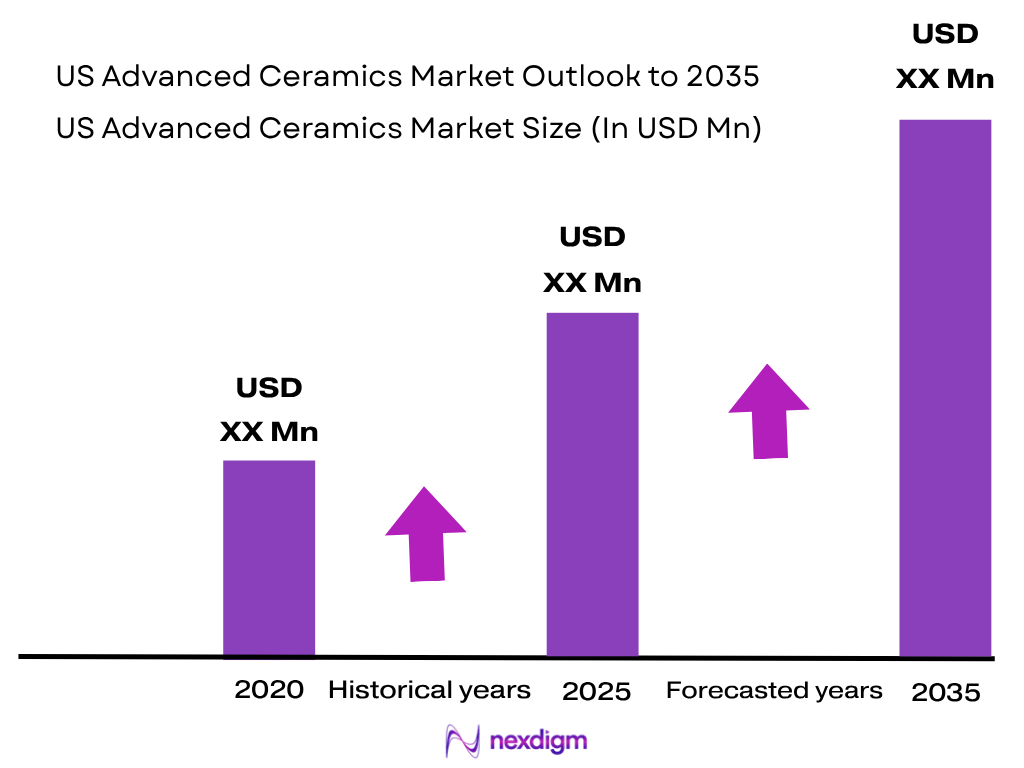
The US Advanced Ceramics Market is valued at approximately USD ~XX billion, based on historical market analysis. Demand is driven by semiconductor fabrication, aerospace and defense systems, medical implants, power electronics, industrial machinery and high-temperature applications. Domestic semiconductor expansion is particularly important: federal CHIPS programs supported nearly USD 450 billion in announced private semiconductor investment and more than 125,000 construction and manufacturing jobs, strengthening demand for high-purity ceramic process components.
Arizona, Texas, California and New York are among the most important US locations shaping advanced ceramics demand because they combine semiconductor fabs, aerospace operations, electronics manufacturing and advanced-material supply chains. Phoenix has attracted more than USD 65 billion in planned TSMC fabrication investment, while Central Texas has attracted more than USD 37 billion through Samsung’s semiconductor expansion. New York is supported by approximately USD 13 billion of GlobalFoundries investment, reinforcing demand for semiconductor-grade ceramic components.
Market Segmentation
By Material Type
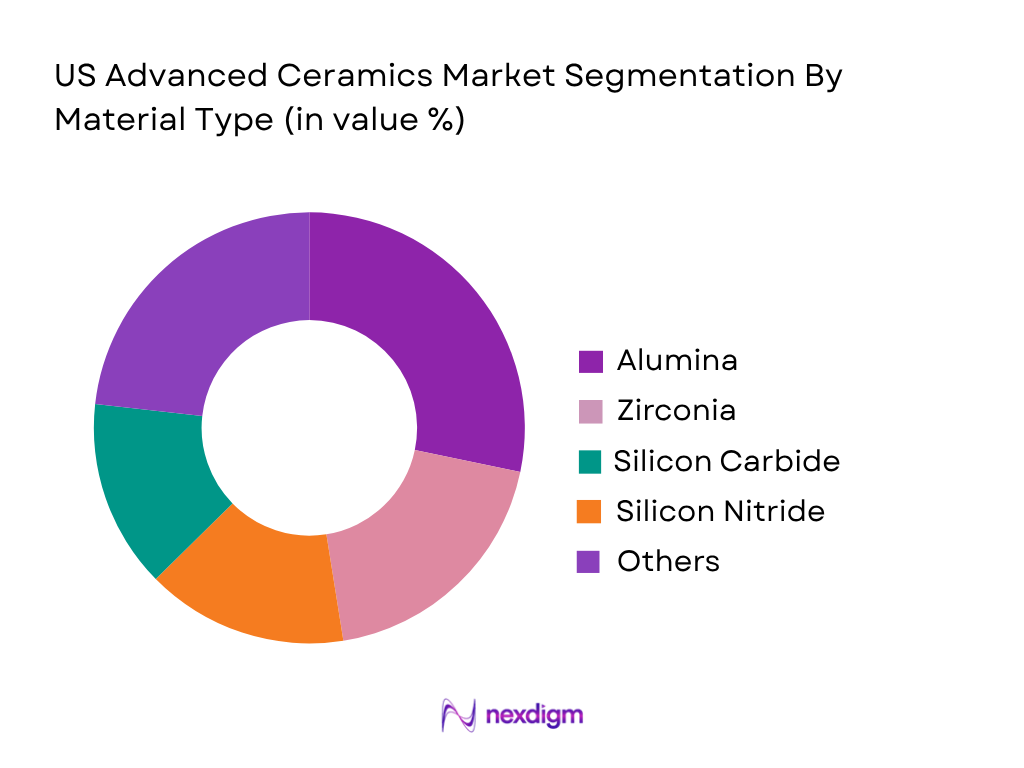
The US Advanced Ceramics Market is segmented by material type into alumina, zirconia, silicon carbide, silicon nitride, aluminum nitride, boron nitride and other specialty ceramics. Alumina holds the dominant market share because it combines electrical insulation, hardness, wear resistance, thermal stability and established manufacturing scalability across semiconductor equipment, electronics, medical products and industrial systems. It is extensively processed into substrates, insulators, feedthroughs, wear parts, tubes and precision structural components. FDA recognition of ISO 6474-1 for high-purity alumina used in orthopedic applications also demonstrates alumina’s relevance beyond electronics and industrial machinery. Silicon carbide is increasingly important in semiconductor processing, aerospace and energy because of its thermal conductivity, chemical stability and high-temperature strength, while zirconia is differentiated by fracture toughness and medical applicability. Aluminum nitride serves thermal-management applications in power electronics and semiconductor packaging.
By End-Use Industry
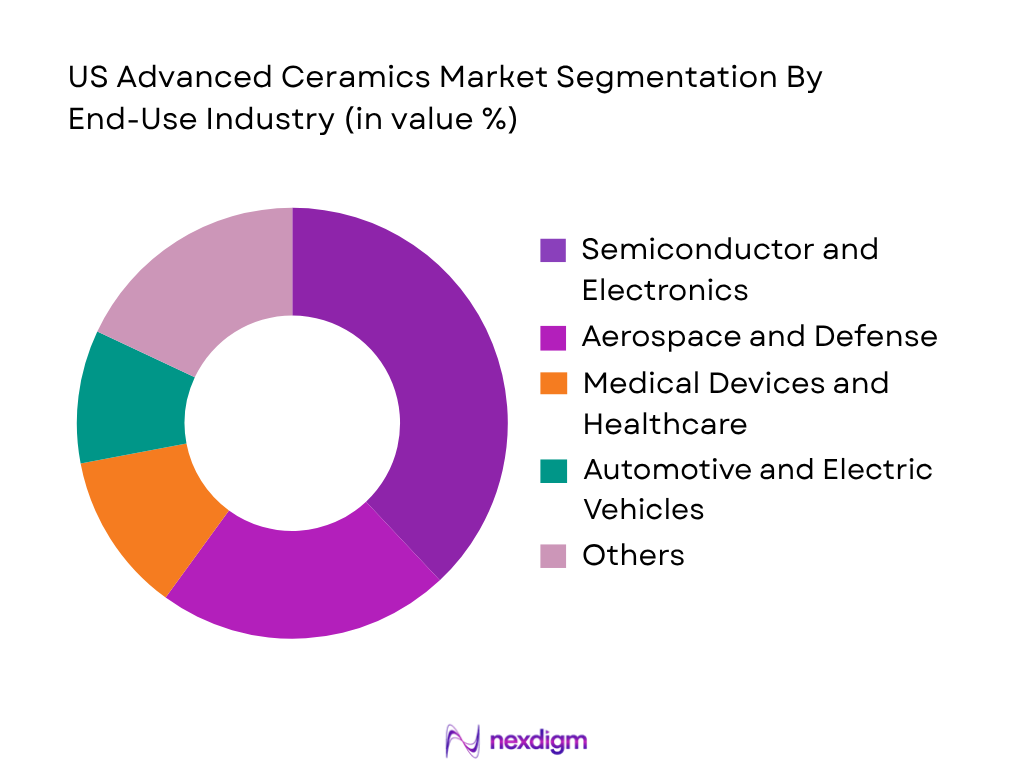
The US Advanced Ceramics Market is segmented into semiconductor and electronics, aerospace and defense, medical devices, automotive and electric vehicles, energy, industrial machinery and other specialized applications. Semiconductor and electronics applications hold the dominant market share because wafer fabrication requires highly engineered ceramic components capable of operating under plasma exposure, corrosive gases, thermal cycling, electrical isolation and stringent contamination limits. The domestic semiconductor manufacturing buildout is expanding this requirement significantly. TSMC’s Arizona program represents more than USD 65 billion across three fabs, Samsung is supporting more than USD 37 billion of semiconductor investment in Central Texas, and Intel’s supported US expansion covers Arizona, New Mexico, Ohio and Oregon. These projects increase potential demand for ceramic heaters, electrostatic chuck components, wafer-handling parts, chamber liners, insulators, substrates and precision silicon carbide and alumina components. Aerospace and defense remains another strategically important segment because advanced ceramics provide low weight, temperature capability, wear resistance and ballistic performance.
Competitive Landscape
The US Advanced Ceramics Market has a combination of large diversified technical-ceramic groups and specialized domestic manufacturers. CoorsTek has a broad US engineering and production footprint, while KYOCERA, CeramTec, Morgan Advanced Materials and Saint-Gobain participate across electronic, semiconductor, industrial, medical and high-temperature applications. Competition is driven less by commodity production and more by material purity, proprietary processing, machining tolerances, application qualification, customer co-development and the ability to manufacture components consistently for highly regulated or technically demanding applications.
| Major Player | Establishment Year | Headquarters | Core Ceramic Materials | Semiconductor Capability | Aerospace & Defense Capability | Medical Ceramic Capability | Manufacturing Expertise | Key Differentiation |
| CoorsTek, Inc. | 1910 | Colorado, USA | ~ | ~ | ~ | ~ | ~ | ~ |
| KYOCERA Corporation | 1959 | Kyoto, Japan | ~ | ~ | ~ | ~ | ~ | ~ |
| CeramTec GmbH | 1903 | Plochingen, Germany | ~ | ~ | ~ | ~ | ~ | ~ |
| Morgan Advanced Materials plc | 1856 | Windsor, UK | ~ | ~ | ~ | ~ | ~ | ~ |
| Saint-Gobain | 1665 | Courbevoie, France | ~ | ~ | ~ | ~ | ~ | ~ |
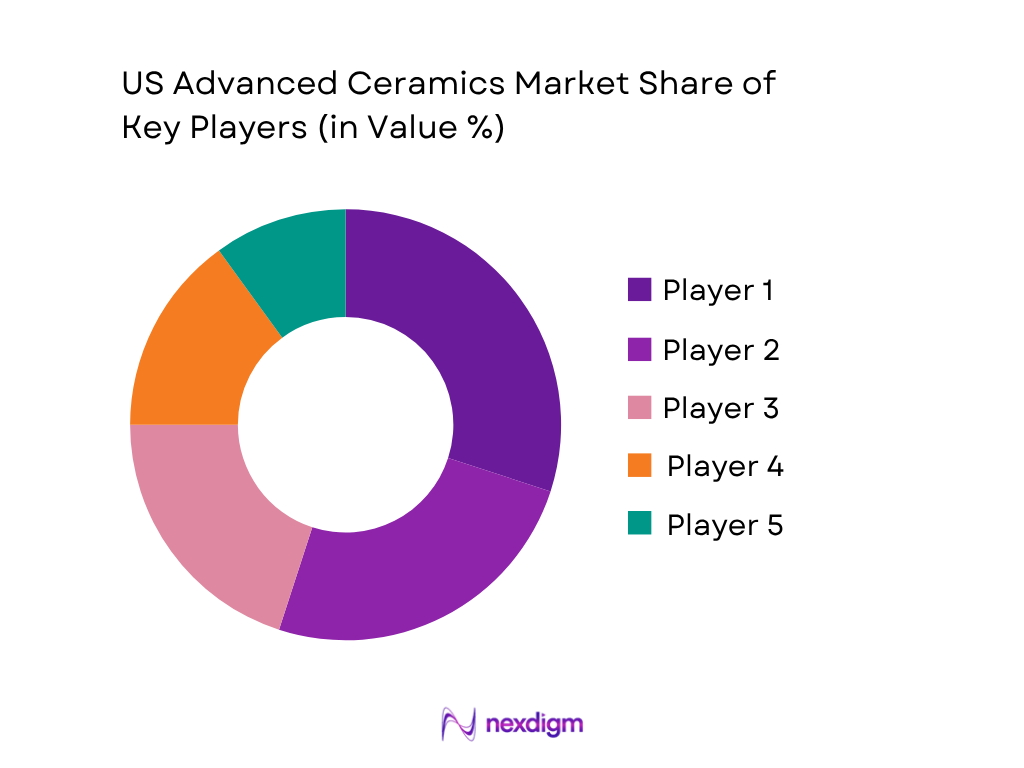
US Advanced Ceramics Market Analysis
Growth Drivers
Expansion of Domestic Semiconductor Manufacturing
Expansion of semiconductor fabrication is strengthening demand for high-purity alumina, silicon carbide, aluminum nitride and other advanced ceramic components used in etching chambers, deposition equipment, wafer handling, electrostatic chucks, heaters and electrical insulation. The U.S. Department of Commerce reported in 2024 that CHIPS-related initiatives had catalyzed nearly USD 450 billion in private semiconductor investment and more than 125,000 construction and manufacturing jobs. TSMC Arizona’s program includes more than USD 65 billion for 3 leading-edge fabs, while Intel’s supported projects cover Arizona, New Mexico, Ohio and Oregon and are associated with nearly USD 90 billion of expected U.S. investment. Micron’s manufacturing program includes approximately USD 100 billion in New York and USD 25 billion in Idaho, creating a larger domestic customer base for ceramic process components exposed to plasma, heat and corrosive gases. This industrial expansion is supported by World Bank macroeconomic data showing U.S. GDP at USD 28.75 trillion, GDP per capita at USD 84,534, and population at 340,110,988 in 2024, providing substantial economic depth for capital-intensive semiconductor manufacturing and its advanced-material supply chain.
Aerospace and Defense Modernization Increasing High-Performance Ceramic Requirements
Aerospace and defense modernization is another major growth driver for the US Advanced Ceramics Market because ceramic matrix composites, silicon carbide, alumina and ultra-high-temperature ceramics are increasingly relevant to propulsion, missile protection, armor, radomes and thermal-management systems. The U.S. Department of Defense’s fiscal 2025 budget requested USD 28.4 billion for missile-defense capabilities, USD 49.2 billion for nuclear-triad modernization, USD 9.9 billion for the Columbia-class submarine and USD 5.3 billion for continued B-21 bomber development and procurement. The Army’s fiscal 2025 submission separately included USD 1.2 billion for continued development and testing of the Long-Range Hypersonic Weapon, where extreme thermal and mechanical environments support demand for advanced ceramic and composite materials. NASA research also continues to address ceramic matrix composites and engineered ceramic insulation for high-temperature aerospace systems. The economic foundation supporting these technology-intensive programs remains substantial: World Bank data place U.S. GDP at USD 28.75 trillion, GDP per capita at USD 84,534, and population at 340,110,988 in 2024. These defense, aerospace and macroeconomic conditions provide a strong platform for continued adoption of performance-critical ceramic components.
Market Challenges
Dependence on Specialized Ceramic Feedstocks and Critical Mineral Supply Chains
The US Advanced Ceramics Market faces material-supply challenges because high-performance ceramics depend on specialized mineral feedstocks, high-purity powders and processing intermediates that are not fully supported by domestic extraction. The U.S. Geological Survey reported that U.S. imports of zirconium ores and concentrates reached 19,000 metric tons of zirconium-oxide content in 2024, alongside 580 metric tons of unwrought zirconium, powder, waste and scrap and 340 metric tons of wrought zirconium. Zirconium materials are directly relevant to zirconia ceramics used in medical, structural, thermal and specialized engineering applications. USGS also reported that domestic mineral-dependent industries, including aerospace and electronics, represented USD 4.08 trillion in economic activity during 2024, illustrating the industrial exposure associated with mineral availability. At the same time, domestic nonfuel mineral production was valued at USD 106 billion, compared with USD 105 billion in 2023, highlighting the difference between mineral production and the much larger downstream industrial base. World Bank data record U.S. GDP of USD 28.75 trillion and a population of 340,110,988 in 2024. Consequently, advanced ceramic producers must manage imported feedstock qualification, inventory continuity and geographically diversified sourcing while maintaining stringent purity requirements.
Complex Processing, Qualification and Skilled Manufacturing Requirements
Advanced ceramics require tightly controlled powder preparation, forming, debinding, sintering, hot isostatic pressing, grinding and precision machining, creating a manufacturing challenge as U.S. semiconductor capacity expands rapidly. The scale of announced fab construction illustrates the corresponding technical workforce requirement. The Department of Commerce reported more than 125,000 semiconductor-related construction and manufacturing jobs associated with nearly USD 450 billion of private investment announced under the domestic semiconductor expansion cycle. Intel’s Arizona expansion is expected to support 3,000 manufacturing jobs and 6,000 construction jobs, while its New Mexico advanced-packaging expansion supports 700 manufacturing jobs and 1,000 construction jobs. Micron’s New York and Idaho plans are associated with approximately 20,000 jobs, creating competition for technicians, process engineers and precision-manufacturing capabilities across supporting material industries. Advanced ceramic suppliers face additional demands because semiconductor, aerospace and medical customers require exact dimensional tolerances, controlled porosity, high purity and repeatable material performance before components can be qualified. World Bank data show U.S. GDP of USD 28.75 trillion, GDP per capita of USD 84,534, and population of 340,110,988 in 2024. The scale of the economy supports investment, but rapid high-technology expansion makes specialized ceramic-processing capability increasingly critical.
Market Opportunities
Semiconductor Ceramic Component Localization and Advanced Packaging
The expansion of domestic semiconductor fabrication creates a substantial future opportunity for U.S. advanced ceramic manufacturers to localize chamber components, wafer-handling systems, ceramic heaters, insulators, substrates and thermal-management components. Current investment provides the industrial base for this future demand. TSMC Arizona’s 3-fab program represents more than USD 65 billion of planned investment, while Intel’s supported manufacturing and advanced-packaging projects correspond to nearly USD 90 billion of expected U.S. investment. GlobalFoundries is undertaking approximately USD 13 billion of investment across New York and Vermont, and Micron’s programs include approximately USD 100 billion in New York and USD 25 billion in Idaho. Advanced packaging also creates opportunities for aluminum nitride and alumina substrates because thermal conductivity, electrical insulation and dimensional stability are critical as semiconductor power density rises. These existing investments create future commercialization opportunities for ceramic suppliers capable of meeting semiconductor-grade contamination, surface-finish and dimensional requirements. World Bank data record U.S. GDP at USD 28.75 trillion, GDP per capita at USD 84,534, and population at 340,110,988 in 2024, providing a large economic base for sustained advanced-manufacturing investment and localization of critical semiconductor supply-chain components.
Silicon Carbide and Ceramic Matrix Composites Across Energy and Nuclear Applications
Silicon carbide ceramics and ceramic matrix composites represent an important future growth avenue because U.S. energy programs are actively developing these materials for power electronics, nuclear fuel systems, hydrogen turbines and high-temperature equipment. The Department of Energy launched a USD 2.25 million Silicon Carbide Packaging Prize in 2024 to advance SiC semiconductor packaging for high-voltage applications such as energy storage. Later in 2024, DOE selected 9 projects for approximately USD 20 million under its transformer technology initiative and awarded 8 first-phase SiC packaging teams USD 50,000 each from a USD 400,000 phase pool. DOE’s Office of Nuclear Energy also reported successful development of woven silicon carbide nuclear fuel-cladding tubes through its Accident Tolerant Fuel Program, demonstrating a direct application pathway for advanced ceramics in extreme environments. Separate DOE-supported research is developing SiC/SiC ceramic matrix composite manufacturing and durable CMC interfaces for nuclear fuel cladding, hydrogen turbines and solar heat exchangers. These current programs support future commercial demand without relying on forecast statistics. World Bank data place U.S. GDP at USD 28.75 trillion, GDP per capita at USD 84,534, and population at 340,110,988 in 2024, reinforcing the financial and industrial capacity available for advanced energy-material commercialization.
Future Outlook
The US Advanced Ceramics Market is projected to expand at approximately ~XX% CAGR during 2026-2035. Growth will be supported by semiconductor manufacturing localization, AI-related computing infrastructure, aerospace engine development, defense modernization, electric-vehicle power electronics and increasing use of ceramic biomaterials. Future industry development is expected to shift toward high-purity, application-engineered ceramics rather than conventional structural materials, with semiconductor-grade components and ceramic matrix composites emerging as particularly important areas.
Semiconductor Fabrication Expansion: Semiconductor manufacturing will remain one of the strongest future demand channels for US advanced ceramics. TSMC’s Arizona program covers three leading-edge fabs supported by more than USD 65 billion in planned private investment. Intel’s US manufacturing program involves nearly USD 90 billion of expected investment across Arizona, New Mexico, Ohio and Oregon, while Micron’s broader manufacturing plans include approximately USD 100 billion in New York and USD 25 billion in Idaho. Such projects require substantial quantities of high-purity alumina, aluminum nitride, silicon carbide and other technical ceramics in deposition, etch, thermal processing, wafer handling and advanced packaging equipment.
Major Players
- CoorsTek, Inc.
- KYOCERA Corporation
- CeramTec GmbH
- Morgan Advanced Materials plc
- Saint-Gobain
- 3M Company
- Corning Incorporated
- Materion Corporation
- NGK Insulators, Ltd.
- Murata Manufacturing Co., Ltd.
- Ferrotec Holdings Corporation
- McDanel Advanced Ceramic Technologies LLC
- Blasch Precision Ceramics, Inc.
- Superior Technical Ceramics
- Elan Technology
Key Target Audience
- Advanced Ceramic Material Manufacturers
- Semiconductor Equipment and Wafer Fabrication Companies
- Aerospace, Defense and Hypersonic System Manufacturers
- Medical Device and Orthopedic Implant Manufacturers
- Automotive and Electric Vehicle Component Manufacturers
- Energy, Nuclear and High-Temperature Equipment Manufacturers
- Investments and Venture Capitalist Firms
- Government and Regulatory Bodies (US Department of Commerce, National Institute of Standards and Technology, US Food and Drug Administration, US Environmental Protection Agency, US Department of Defense)
Research Methodology
Step 1: Identification of Key Variables
The initial phase involves constructing an ecosystem map covering ceramic powder suppliers, component manufacturers, precision machining companies, semiconductor equipment OEMs, aerospace and defense contractors, medical-device manufacturers and industrial customers across the US Advanced Ceramics Market. Secondary research is used to identify critical variables such as material chemistry, purity, processing technology, component configuration, thermal characteristics, electrical properties, end-use qualification requirements and domestic manufacturing presence.
Step 2: Market Analysis and Construction
Historical market data are assessed through top-down and bottom-up models. The top-down approach analyzes semiconductor manufacturing, aerospace and defense production, medical-device activity, electronics manufacturing and high-temperature industrial demand. The bottom-up methodology evaluates ceramic consumption across substrates, semiconductor chamber components, bearings, armor, implants, thermal-management parts and ceramic matrix composites. Supply availability, product mix and application penetration are reconciled to establish the market model.
Step 3: Hypothesis Validation and Expert Consultation
Market hypotheses are validated through computer-assisted telephone interviews with advanced ceramic manufacturers, high-purity powder suppliers, semiconductor equipment companies, aerospace suppliers, medical-device manufacturers and precision machining companies. Discussions cover material specifications, customer qualification cycles, manufacturing yields, purity requirements, component replacement patterns, sintering technologies and supply-chain constraints. Primary insights are subsequently compared against secondary datasets to validate market structure and refine application-level demand assumptions.
Step 4: Research Synthesis and Final Output
The final phase consolidates government databases, regulatory information, company disclosures and primary industry inputs into a unified US Advanced Ceramics Market framework. Bottom-up component demand is cross-checked against top-down manufacturing indicators, while competitive analysis compares material portfolios, semiconductor exposure, ceramic matrix composite capabilities, precision machining strength, medical qualifications and domestic production footprints. This triangulation process is used to generate the final market assessment and long-term outlook.

- Executive Summary
- Research Methodology (Market Definition and Scope, US Advanced Ceramics Classification, Oxide and Non-Oxide Ceramic Mapping, Technical Ceramic Value Chain Assessment, High-Purity Ceramic Powder Supply Analysis, Component-Level Demand Assessment, Semiconductor Equipment Ceramic Consumption Mapping, Aerospace and Defense Application Assessment, Medical Ceramic Qualification Mapping, Ceramic Matrix Composite Assessment, Supply-Side Production Analysis)

- Definition and Scope
- US Advanced Ceramics Industry Evolution and Development of High-Performance Materials Ecosystem
- Advanced Ceramic Material Chemistry, Microstructure and Performance Architecture
- US Advanced Ceramics Value Chain Analysis
- US Advanced Ceramics Supply Chain Analysis
- High-Purity Ceramic Powder, Powder Preparation, Forming, Sintering, Hot Isostatic Pressing, Machining, Coating and Component Integration Ecosystem Analysis
- Advanced Ceramics Integration Assessment Across Semiconductor Equipment, Electronics, Aerospace, Defense, Medical Devices, Automotive, Energy and Industrial Equipment

- Growth Drivers (Expansion of Domestic Semiconductor Manufacturing, Increasing Aerospace and Defense Material Requirements, Growth of Power Electronics and High-Frequency Electronics, Increasing Demand for Wear and Corrosion Resistant Industrial Components, Expansion of Ceramic Medical Implant Applications, Development of High-Temperature Energy Systems)
- Market Challenges (High-Purity Ceramic Powder Processing Requirements, Energy-Intensive Sintering Operations, Brittle Failure Characteristics, Complex Precision Machining Requirements, Dependence on Critical Mineral and Specialty Powder Supply Chains, Long Aerospace and Medical Qualification Cycles, Semiconductor-Grade Contamination Control Requirements)
- Market Opportunities (Semiconductor Fab Ceramic Components, Advanced Packaging and Electronic Substrates, Ceramic Matrix Composites for Aerospace Engines, Hypersonic Thermal Protection Materials, Medical Zirconia and Alumina Implants, Silicon Carbide Components for Nuclear Applications, Additively Manufactured Ceramic Components, Electric Vehicle Power Electronics Substrates)
- Market Trends (High-Purity Alumina Adoption, Aluminum Nitride Thermal Management Expansion, Silicon Carbide Semiconductor Equipment Components, Ceramic Matrix Composite Integration, Additive Manufacturing of Technical Ceramics, Ultra-High-Temperature Ceramic Development, Zirconia-Toughened Alumina Medical Applications, Domestic Critical Material Supply Chain Development)
- Regulatory and Standards Landscape (FDA Recognized Ceramic Implant Standards, ISO 6474 Alumina Implant Requirements, ISO 13356 Zirconia Implant Requirements, ASTM Advanced Ceramic Test Standards, EPA Ceramic Manufacturing Emission Requirements, EPA Greenhouse Gas Reporting Requirements, ITAR Defense Supply Requirements, AS9100 Aerospace Quality Requirements)
- SWOT Analysis
- Porter’s Five Forces Analysis
- PESTLE Analysis
- Stakeholder Ecosystem
- Competition Ecosystem

- By Market Value (2020-2025)
- By Advanced Ceramic Consumption Volume (2020-2025)
- By Oxide Ceramic Consumption Volume (2020-2025)
- By Non-Oxide Ceramic Consumption Volume (2020-2025)
- By Monolithic Ceramic Component Volume (2020-2025)
- By Ceramic Matrix Composite Consumption Volume (2020-2025)
- By Semiconductor and Electronics Ceramic Consumption Volume (2020-2025)

- By Material Type (In Value %)
Alumina
Zirconia
Aluminum Nitride
Silicon Carbide
Silicon Nitride
Boron Nitride
Titanates
Ferrites
Cordierite
Mullite
Ceramic Matrix Composite Materials
Other Specialty Advanced Ceramics - By Ceramic Class (In Value %)
Oxide Ceramics
Non-Oxide Ceramics
Silicate Ceramics
Electroceramics
Bioceramics
Ultra-High-Temperature Ceramics
Ceramic Matrix Composites - By Product Type (In Value %)
Monolithic Ceramic Components
Ceramic Substrates
Ceramic Packages and Feedthroughs
Ceramic Bearings and Mechanical Components
Ceramic Tubes and Rods
Ceramic Crucibles and Wafer-Handling Components
Ceramic Armor Components
Ceramic Filters and Membranes
Ceramic Coatings
Ceramic Matrix Composite Components
Medical Ceramic Components - By Application Type (In Value %)
Electrical Insulation
Electronic Substrates and Packaging
Semiconductor Processing Equipment
Wear and Corrosion Resistant Components
Thermal Management
Ballistic Protection
High-Temperature Structural Components
Cutting and Grinding Tools
Medical Implants and Prosthetics
Sensors and Actuators
Energy Conversion and Storage
Filtration and Environmental Control - By End-Use Industry (In Value %)
Semiconductor and Electronics
Aerospace
Defense and Homeland Security
Medical Devices and Healthcare
Automotive and Electric Vehicles
Industrial Machinery
Energy and Power Generation
Nuclear Energy
Chemical Processing
Telecommunications
Environmental Technologies - By Manufacturing Technology (In Value %)
Dry Pressing
Isostatic Pressing
Injection Molding
Extrusion
Slip Casting
Tape Casting
Hot Pressing
Hot Isostatic Pressing
Pressureless Sintering
Spark Plasma Sintering
Reaction Bonding
Chemical Vapor Infiltration
Additive Manufacturing - By Functional Property (In Value %)
Electrical Insulation Ceramics
Thermally Conductive Ceramics
Wear Resistant Ceramics
Corrosion Resistant Ceramics
High-Temperature Ceramics
Ballistic Resistant Ceramics
Piezoelectric and Dielectric Ceramics
Biocompatible Ceramics
Low Thermal Expansion Ceramics
High-Purity Semiconductor Ceramics - By Sales Channel (In Value %)
Direct OEM Supply
Tier-1 Component Supply
Semiconductor Equipment Manufacturer Procurement
Aerospace and Defense Prime Contractor Procurement
Medical Device OEM Procurement
Specialty Ceramic Distributors
Industrial Equipment Integrators
Contract Manufacturing and Precision Ceramic Suppliers - By Region (In Value %)
West Coast
Southwest
Midwest
Southeast
Northeast
Mountain States
Texas Manufacturing Corridor
California Semiconductor and Aerospace Cluster

- Market Share of Major Players (By Revenue, Ceramic Material Type, Product Architecture, End-Use Industry, Semiconductor Application, Aerospace and Defense Application, Medical Application, US Manufacturing Presence)
- Cross Comparison Parameters (Advanced Ceramic Material Portfolio Breadth, High-Purity Semiconductor Ceramic Capability, Ceramic Matrix Composite Technology Capability, Aerospace and Defense Qualification Strength, Medical-Grade Ceramic Capability, Precision Forming and Machining Capability, US Manufacturing and Supply Chain Footprint, Application Engineering and Customer Co-Development Capability)
- SWOT Analysis of Major Players
- Competitive Positioning Matrix
- Pricing and Ceramic Category Benchmarking
- Detailed Profiles of Major Companies
CoorsTek, Inc. – Alumina, Silicon Carbide, Silicon Nitride, Semiconductor Components and Engineered Technical Ceramics
KYOCERA Corporation – Fine Ceramics, Semiconductor Components, Electronic Ceramics and Industrial Ceramic Solutions
CeramTec GmbH – Advanced Ceramics, Medical Bioceramics, Electronics Components and Industrial Ceramic Solutions
Morgan Advanced Materials plc – Technical Ceramics, Electrical Ceramics, Semiconductor Components and Thermal Management Materials
Saint-Gobain – High-Performance Ceramics, Silicon Carbide, Boron Nitride and Industrial Ceramic Materials
3M Company – Advanced Ceramics, Ceramic Fibers, Ceramic Matrix Technologies and High-Performance Material Solutions
Corning Incorporated – Specialty Glass-Ceramics, Semiconductor Materials, Optical Ceramics and Advanced Material Technologies
Materion Corporation – Electronic Materials, Ceramic-Metal Solutions, Semiconductor Materials and Precision Components
NGK Insulators, Ltd. – Electronic Ceramics, Semiconductor Manufacturing Components, Ceramic Substrates and Energy Ceramics
Murata Manufacturing Co., Ltd. – Multilayer Ceramic Components, Piezoelectric Ceramics and Electronic Ceramic Devices
Ferrotec Holdings Corporation – Fine Ceramics, Semiconductor Fabrication Components, Ceramic Machining and Vacuum Technology Components
McDanel Advanced Ceramic Technologies LLC – Alumina and Mullite Tubes, Rods, Crucibles and High-Temperature Technical Ceramics
Blasch Precision Ceramics, Inc. – Silicon Carbide, Alumina and Precision Ceramic Components for Industrial and Energy Applications
Superior Technical Ceramics – Precision Technical Ceramics, Alumina, Zirconia, Silicon Carbide and Custom Engineered Components
Elan Technology – Technical Ceramic Manufacturing, Steatite, Alumina, Cordierite and Custom Ceramic Components

- Semiconductor Equipment Manufacturer Procurement Assessment
- Aerospace OEM Material Requirement Analysis
- Defense Contractor Ceramic Requirement Assessment
- Medical Device Manufacturer Procurement Assessment
- Electronics Manufacturer Requirement Assessment
- Automotive and EV Manufacturer Assessment
- Energy Equipment Manufacturer Assessment
- Industrial Equipment Manufacturer Assessment
- Advanced Ceramic Supplier Selection Criteria

- By Market Value (2026-2035)
- By Advanced Ceramic Consumption Volume (2026-2035)
- By Oxide Ceramic Consumption Volume (2026-2035)
- By Non-Oxide Ceramic Consumption Volume (2026-2035)
- By Monolithic Ceramic Component Volume (2026-2035)
- By Ceramic Matrix Composite Consumption Volume (2026-2035)
- By Semiconductor and Electronics Ceramic Consumption Volume (2026-2035)


 Request a Sample
 Ask for Customization
 Get a Quote
 Enquire Now